INTRODUCTION
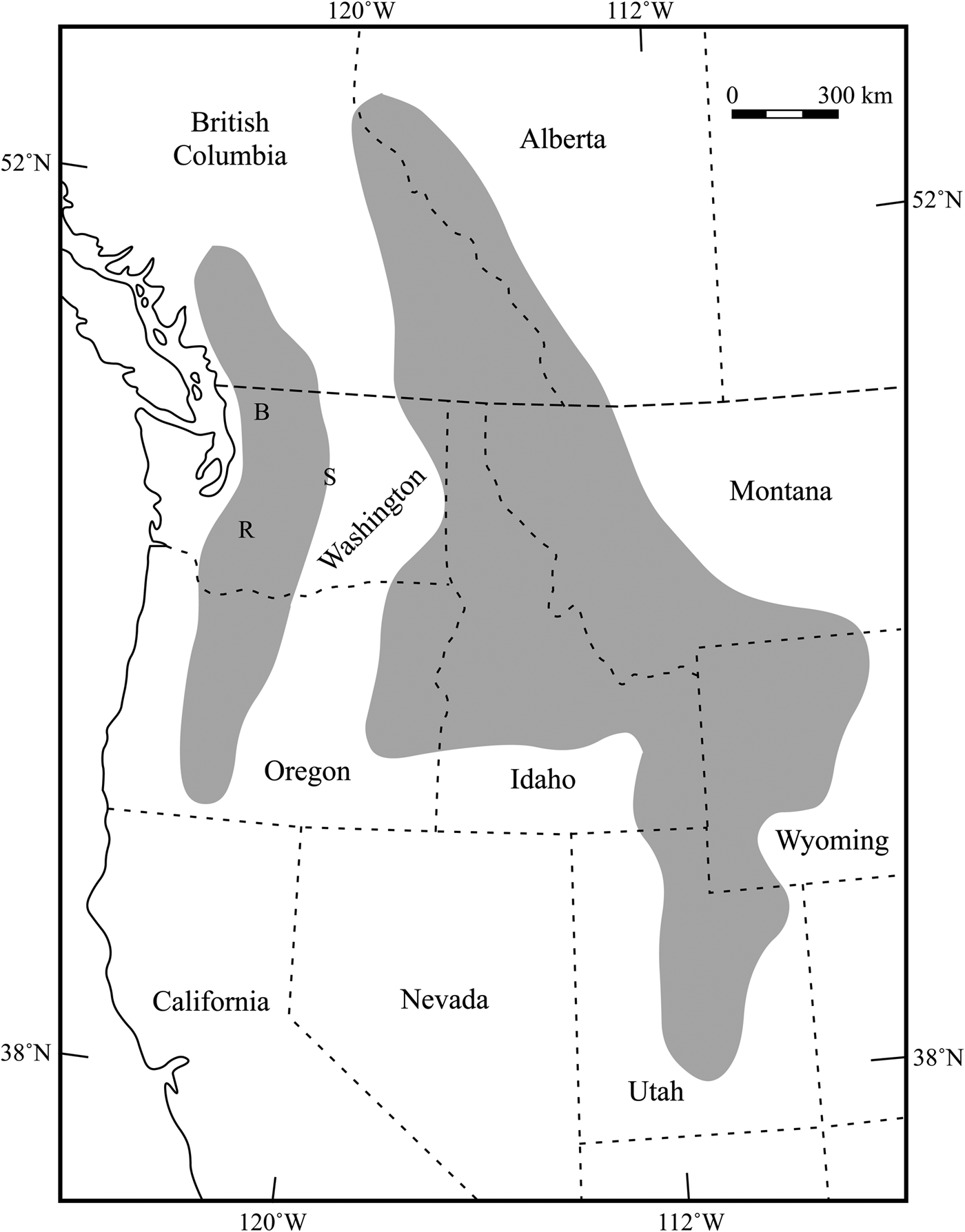
The arvicoline rodent Microtus richardsoni (water vole, or Richardson's vole) is one of the two largest members of the genus in North America, being matched in size only by M. xanthognathus (yellow-cheeked, or taiga, vole; Semken and Wallace, Reference Semken and Wallace2002). The historically documented distribution of the water vole forms two disjunct areas in montane habitats of northwestern North America (Fig. 1; Ludwig, Reference Ludwig1984a). The western area coincides with the Cascade Range from southwestern British Columbia south through Oregon, and the eastern area coincides with the Rocky Mountains from central British Columbia and Alberta south through Idaho, western Montana, western Wyoming, and into central Utah. The Quaternary fossil record for this species is not extensive. Records include late Pleistocene specimens from two localities in southwestern Alberta (Burns, Reference Burns1982), late Pleistocene and Holocene specimens from two localities in western Montana (Rasmussen, Reference Rasmussen1974), and late Pleistocene and early Holocene specimens from three localities in north-central Wyoming (Walker, Reference Walker, Graham, Semken and Graham1987, Reference Walker, Frison and Walker2007). All previously known prehistoric specimens come from within the range of the eastern metapopulation in the Rocky Mountains; none has previously been reported from the western metapopulation occupying the Cascade Range.
Modern biogeographic range of water vole, Microtus richardsoni (shaded, after Hall, Reference Hall1981). B, Mount Baker; R, Mount Rainier; S, Stemilt Creek Village archaeological site.

In this paper, I report specimens recovered from late Holocene archaeological deposits just east of the eastern margin of the western metapopulation in central Washington state. The original report on the identification saw limited distribution and also included what is now interpreted as an incorrect identification of a Microtus specimen (Lyman, Reference Lyman, Boreson and Galm2005). It is for these two reasons, and the fact that the specimens reported here represent the only prehistoric ones known from the western metapopulation, that publication of this paper in an accessible venue is necessary. Further, the likely paleoenvironmental implications of the central Washington specimens are discussed, a topic not explored in the original report.
ARCHAEOLOGICAL DEPOSITS
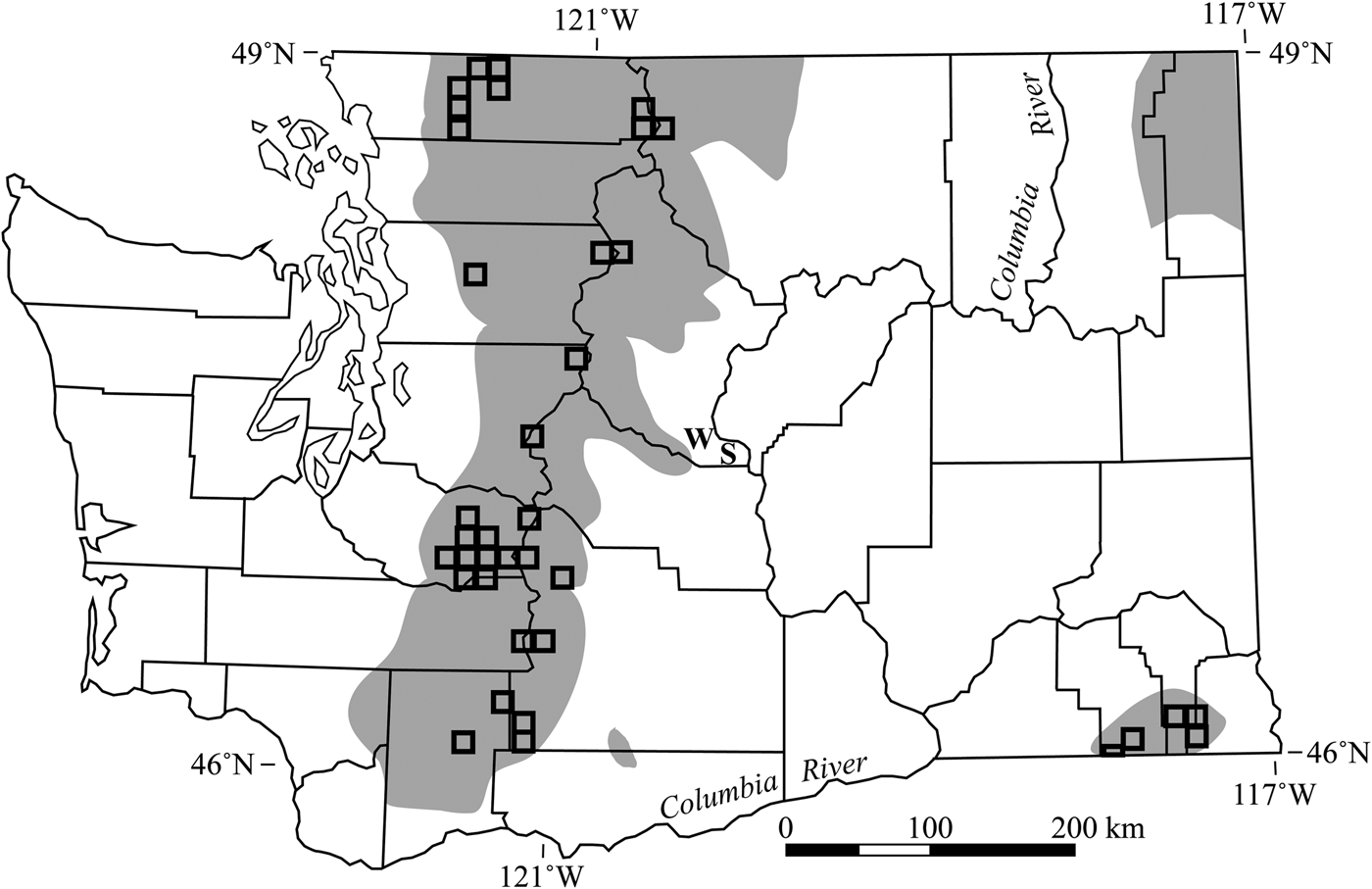
The archaeological deposits that produced the water vole specimens described here make up what is known as the Stemilt Creek Village site (official state site number 45CH302). The site is located on a terrace of very fine sand and coarse silt adjacent to the Columbia River in central Washington state, approximately 10 km east-southeast of the modern city of Wenatchee (Fig. 2). Site deposits produced a wealth of artifacts and faunal remains. Multiple radiocarbon dates indicate the site was occupied by culturally complex foragers (American Indians) intermittently between 1700 cal yr BP and 150 cal yr BP (Boreson and Galm, Reference Boreson and Galm2005). The sample of taxonomically identified faunal remains includes mollusks, fish, birds, amphibians, and reptiles, but by far the most numerous remains represent mammals, with 1071 bones and isolated teeth identified to at least the genus level (Lyman, Reference Lyman, Boreson and Galm2005). Among those mammal remains are 68 bones and isolated teeth identified as members of Microtinae. Given the complex and often mixed stratigraphy of the deposits, it is difficult to assign individual microtine specimens to a precise age. Many of the specimens, including those identified as water vole, display staining and weathering similar to that evident on bones of animals clearly accumulated and deposited by the prehistoric human occupants of the site. On this basis, I believe that the water vole specimens described below date to the last 2000 yr and also that these specimens are not recently intrusive to site sediments during, say, the last 200 yr.
Confirmed records of modern water vole (Microtus richardsoni) in eastern Washington state (bold squares, 9.6 × 9.6 km), and locations of Stemilt Creek Village archaeological site (S) and city of Wenatchee (W). County lines shown for reference. Prime water vole habitat (shaded) approximated after Johnson and Cassidy (Reference Johnson, Cassidy, Cassidy, Grue, Smith and Dvornich1997).

Historic distributions of Microtus indicate at least five species may be represented among the Stemilt Creek Village specimens. Based on early interpolations of modern location records, montane vole (M. montanus) and long-tailed vole (M. longicaudus) occur in the immediate site area, meadow vole (M. pennsylvanicus) is found approximately 40 km east of the town of Wenatchee (Fig. 2), creeping vole (M. oregoni) occurs ~30 km west of Wenatchee, and water vole is found ~5 km west of Stemilt Creek Village (Maser and Storm, Reference Maser and Storm1970). The last is likely the “marginal record” reported by Hall (Reference Hall1981, p. 820) as occurring at the location of the city of Wenatchee. A more recent study aimed in part at confirming the identifications of all historic records of mammals in the state does not mention the marginal record in Wenatchee and places the closest historic record of the water vole 80 km west of Stemilt Creek Village (Johnson and Cassidy, Reference Johnson, Cassidy, Cassidy, Grue, Smith and Dvornich1997). That study also found small habitat patches suitable for water vole 15–20 km southwest of the site and larger patches of prime habitat ~40 km to the west (Fig. 2). Klaus and Beavais (Reference Klaus and Beauvais2004:17) summarized point location data for all known modern specimens of water vole, including what seems to be Hall's (Reference Hall1981) record at Wenatchee. A search on VertNet (vertnet.org, undertaken July 12, 2018) revealed no such record, so I could not confirm that point location.
SYSTEMATIC PALEOZOOLOGY OF MICROTINAE REMAINS
Postcranial remains of microtines were not identified, as they are morphometrically similar to skeletal remains of deer mice (Peromyscus sp.); 29 mandibles and maxillae of the latter were identified in the Stemilt Creek Village collection. Microtine mandibles (N = 45) were identified as Microtus or sage vole (Lemmiscus curtatus) on the basis of the location of the mandibular foramen (Grayson, Reference Grayson and Thomas1983). In sage vole, that foramen is located on the anterocranial wall of the ridge of bone enclosing the base of the incisor and cannot be seen in medial/lingual view. In Microtus, the mandibular foramen is on or adjacent to the medial surface of the ridge of bone encapsulating the incisor base and is clearly visible in medial/lingual view. Skulls (N = 12) were identified as one or the other genus on the basis of the distinctive occlusal morphology of the M3 (Ingles, Reference Ingles1965; Chomko, Reference Chomko and Gilbert1980; Barnosky and Bell, Reference Barnosky and Bell2003). Specimens that lacked these traits (e.g., isolated m2, m3; edentulate mandibular horizontal ramus) were identified merely as Microtinae.
Microtus skulls from Stemilt Creek Village were identified based on the shape of incisive foramina, a morphometric trait believed to be taxonomically diagnostic (Hall and Cockrum, Reference Hall and Cockrum1953; Ingles, Reference Ingles1965; Maser and Storm, Reference Maser and Storm1970; Kurtén and Anderson, Reference Kurtén and Anderson1980). Because the shape of the incisive foramina is known to change with ontogenetic age (Zakrzewski, Reference Zakrzewski and Tamarin1985), this criterion was used only with skulls displaying complete closure of all sutures. Two of 12 total specimens were mature enough to display fused sutures and also anatomically complete enough to have complete incisive foramina display the posterior constricting pattern of the montane vole and are identified as such. Skull and maxillae specimens identified as Microtus sp. may represent this species or the long-tailed vole.
No M2 specimens displayed the occlusal pattern first proposed by Bailey (Reference Bailey1900) as diagnostic of the meadow vole and subsequently endorsed by Guilday (Reference Guilday1962)—an anterior loop, three closed triangles, and a posterior-most button-shaped loop. The M2 of all other Microtus species has either three or five closed triangles. In my initial report (Lyman, Reference Lyman, Boreson and Galm2005), I followed earlier workers who indicated the m1 of the meadow vole has six isolated or closed dentine triangles whereas m1s of other Microtus species have five closed triangles (Ingles, Reference Ingles1965; Hoffmann and Pattie, Reference Hoffman and Pattie1968; Maser and Storm, Reference Maser and Storm1970; Chomko, Reference Chomko and Gilbert1980; Hall, Reference Hall1981). More recent researchers have found that the m1 features supposedly diagnostic of meadow vole occasionally occur in other Microtus species (e.g., Zakrzewski, Reference Zakrzewski and Tamarin1985; Morlan, Reference Morlan, Stewart and Seymour1996; Bell and Mead, Reference Bell and Mead1998; Bell and Barnosky, Reference Bell and Barnosky2000). Thus, I here correct my former identification of a single Stemilt Creek Village m1 specimen as meadow vole and now identify it as Microtus sp.
Although some paleozoologists have cautioned that the occlusal length of m1 may not be as taxonomically diagnostic of Microtus species as once thought (Schubert, Reference Schubert, Schubert, Mead and Graham2003; Bell and Bever, Reference Bell and Bever2006), this criticism was leveled at distinguishing the yellow-cheeked (or taiga) vole from other, smaller-bodied species of the genus based on size. The water vole was not considered. Water voles (mean adult body mass = 85 gm) and yellow-cheeked voles (mean adult body mass = 125 gm) both are on average larger bodied than other species of Microtus (all <70 gm; weight data from Smith et al., Reference Smith, Lyons, Morgan Ernest, Jones, Kauffman, Dayan, Marquet, Brown and Haskell2003), although there is some size overlap. Further, size alone has been found to not discriminate all populations of some Microtus species (Schubert, Reference Schubert, Schubert, Mead and Graham2003; Wallace, Reference Wallace2006). However, the combination of large size and the wide anterior cap of the m1 seems to be diagnostic of the water vole (Burns, Reference Burns1982; Semken and Wallace, Reference Semken and Wallace2002), whereas either trait alone is not diagnostic based on modern specimens I have examined.
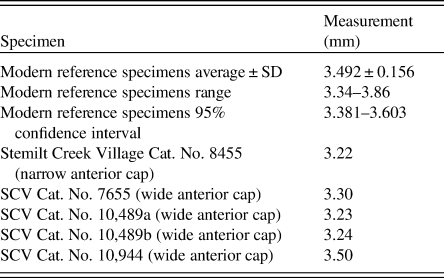
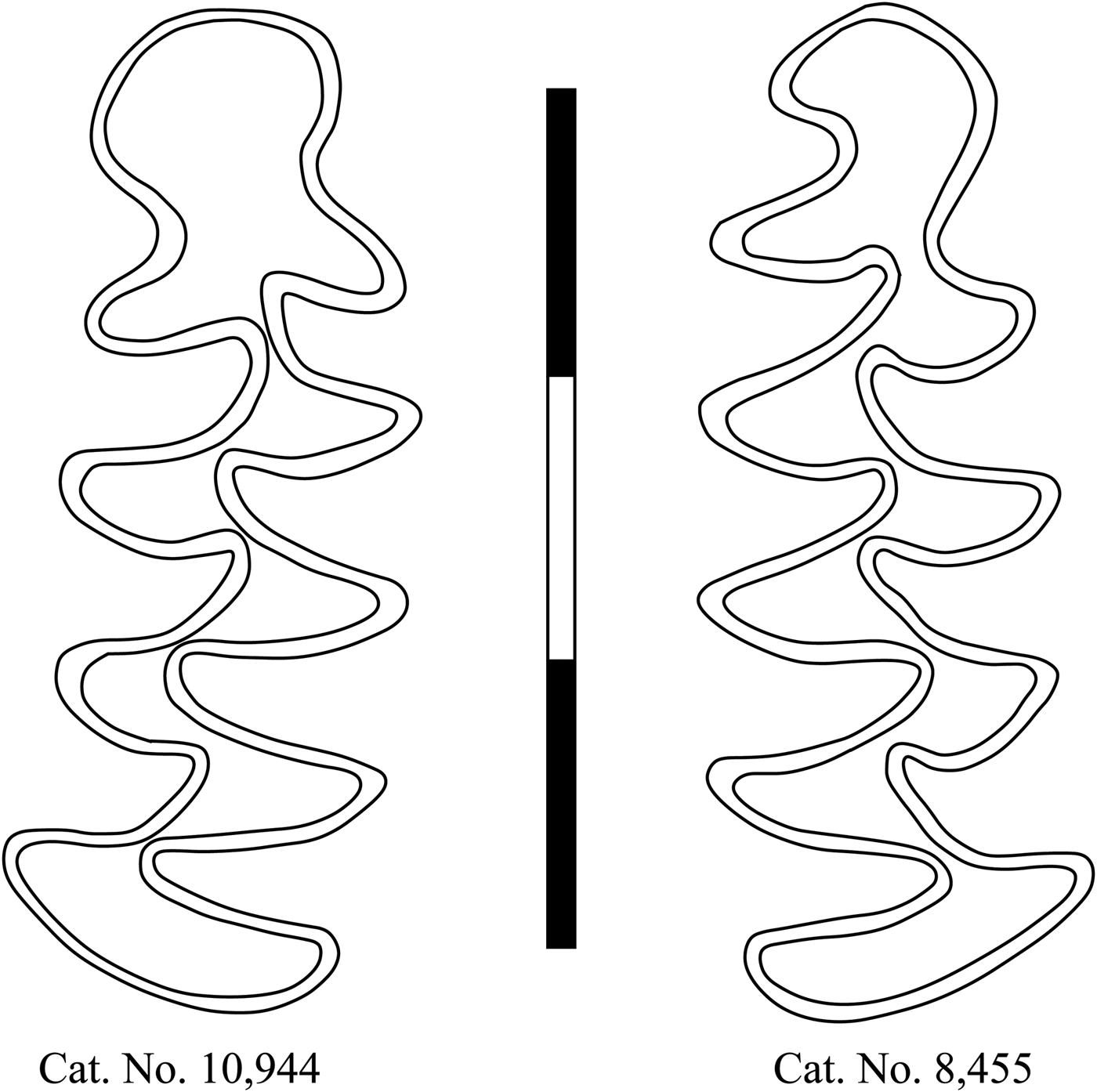
I measured the occlusal lengths of 10 left m1s of modern museum specimens of water vole; two were collected in Montana and eight in Idaho. All represent the Rocky Mountain metapopulation and are housed at the University of Kansas Museum of Natural History (Table 1). Among the 30 m1s recovered from Stemilt Creek Village, all but five have antero-posterior occlusal lengths ≤3.1 mm; the occlusal lengths of those other five all exceed 3.2 mm, and four of them have a relatively broad anterior loop (Fig. 3). The latter four are identified as water vole based on their occlusal lengths and wide anterior caps. The single long specimen with a narrow anterior cap (no. 8455) is here identified as cf. water vole (M. cf. richardsoni), as it exceeds the lengths of all other (seemingly non-water vole) measurable (anatomically complete) Microtus specimens from site deposits (N = 8, range of 2.60–3.06 mm) and falls outside the 95% confidence intervals for modern water vole, but is similar in size to the four Stemilt Creek Village specimens identified as water vole (Table 1). The narrow anterior cap of this Stemilt Creek specimen (no. 8455) is morphologically similar to the m1 of a specimen of M. r. myllodontus from Utah illustrated by Rasmussen and Chamberlain (Reference Rasmussen and Chamberlain1959).
Metric data for m1 length of modern Microtus richardsoni reference specimens (N = 10) and late Holocene specimens from Stemilt Creek Village (SCV). All measurements are in millimeters.

(A) Occlusal surface of a Stemilt Creek Village water vole (Microtus richardsoni) left m1, specimen 10,944; note broad anterior cap. (B) Occlusal surface of Stemilt Creek Village cf. water vole (Microtus cf. richardsoni) right m1, specimen 7655; note narrow anterior cap. Cementum in re-entrant angles not shown. Scale bar is 3 mm.

None of the Stemilt Creek Village m1 water vole specimens has an occlusal length that falls within the 95% confidence intervals for the modern reference specimens (Table 1). This suggests there may be a difference in the mean size of individuals in the two disjunct metapopulations, with the Rocky Mountain metapopulation (M. r. macropus, M. r. myllodontus, and M. r. richardsoni) averaging slightly larger than the Cascade Range metapopulation (M. r. arvicoloides). Verts and Carraway (Reference Verts and Carraway1998), however, present summary statistics for samples from Oregon of both metapopulations, distinguished by sex. In their sample, the Cascade Range subspecies (M. r. arvicoloides) is larger on average than individuals from the Rocky Mountain population (M. r. macropus) in nine skeletal dimensions, body mass, total length, tail length, and hind foot length. Verts and Carraway (Reference Verts and Carraway1998, p. 328) are, however, skeptical that there is a size difference between the two subspecies because “coefficients of variation are extremely large.” The samples for each sex in each subspecies are small (N = 7 to 22) and thus may not be representative. Therefore, the taxonomic and paleoecological significance of the apparent size difference between the Stemilt Creek specimens and the modern specimens I measured is obscure.
DISCUSSION
In light of what is known about modern water voles, the specimens from Stemilt Creek Village require explanation. The water vole is said to be “strictly an alpine animal living around streams, marshes, and damp meadows” (Ingles, Reference Ingles1965, p. 289), “a denizen of the subalpine and alpine areas of the Cascade and Rocky Mountain Ranges” (Maser and Storm, Reference Maser and Storm1970, p. 131), an occupant of the “Canadian and Hudsonian life zones, particularly at higher elevations” (Kritzman, Reference Kritzman1977, p. 76), and “characteristically found within subalpine and alpine meadows in close proximity to water, especially swift, clear, spring-fed or glacial streams with gravel bottoms” (Ludwig, Reference Ludwig1984a, p. 3). Johnson and Cassidy (Reference Johnson, Cassidy, Cassidy, Grue, Smith and Dvornich1997) indicate core habitat for the species in Washington state includes alpine parkland, subalpine fir (Abies lasiocarpa), silver fir (A. alba), and mountain hemlock (Tsuga mertensiana); peripheral habitats include western hemlock (T. heterophylla), grand fir (A. grandis), interior red cedar (Juniperus virginiana), and Douglas fir (Pseudotsuga menziesii) when these areas are close to core habitats. In their view, non-forested habitats were “suitable” if small bogs and lakes were present (Johnson and Cassidy, Reference Johnson, Cassidy, Cassidy, Grue, Smith and Dvornich1997, p. 192).
The modern habitat of the Stemilt Creek Village archaeological site is shrub-steppe and includes bunch grass and big sagebrush (Artemisia tridentata; Franklin and Dyrness, Reference Franklin and Dyrness1973). Low-resolution maps of vegetation types indicate there is a narrow east-southeastward extension of potentially suitable habitat for water voles that originates on the eastern slopes of the Cascade Range and extends to an area 15–20 km southwest of Stemilt Creek Village (Fig. 2; Franklin and Dyrness, Reference Franklin and Dyrness1973; Johnson and Cassidy, Reference Johnson, Cassidy, Cassidy, Grue, Smith and Dvornich1997). It is doubtful, however, that this suitable habitat was the source of the water vole remains at the archaeological site. There is no evidence, such as butchering marks, among all of the microtine remains indicating that humans were responsible for their accumulation and deposition. Similarly, there is no modification to the bones (e.g., digestive corrosion) implying accumulation by a mammalian or avian predator (Falk and Semken, Reference Falk, Semken, Saunders, Styles and Baryshnikov1998; Morlan, Reference Morlan1994). Second, prehistoric human foragers tended to procure resources in optimal ways, minimizing costs and maximizing benefits (Bettinger, Reference Bettinger1991; Kelly, Reference Kelly1995). Small-bodied prey were indeed exploited (likely opportunistically), but their carcasses were seldom transported far. In sum, it is highly unlikely the Stemilt Creek Village water voles were transported from the modern nearby patch of suitable habitat.
Klaus and Beavais (Reference Klaus and Beauvais2004, p. 16) state that in the western United States water voles range between 900 and 3200 m elevation. Johnson and Cassidy (Reference Johnson, Cassidy, Cassidy, Grue, Smith and Dvornich1997, p. 192), however, report that water voles have been found on the lower slopes of Mt. Rainier at an elevation of 760 m above mean sea level (amsl). Hooven (Reference Hooven1973) found water voles at 670 m amsl on the west slope of the Oregon Cascade Range. Finally, Cowan and Guiguet (Reference Cowan and Guiguet1965, p. 217) report that “during years of peak numbers [water voles] sometimes descend to lower elevations.” Stemilt Creek Village sits at an elevation of 189 m amsl (Boreson and Galm, Reference Boreson and Galm2005). Johnson and Cassidy (Reference Johnson, Cassidy, Cassidy, Grue, Smith and Dvornich1997) report several species of small-bodied mammal have been collected near Stemilt Creek Village, including long-tailed vole and montane vole. This suggests the lack of a confirmed historic record of water vole in the area is not a result of modern sampling error, in particular, that local voles were not sampled.
How and why might water voles have come to occupy environs around the mouth of Stemilt Creek sometime during the last 2000 yr, but apparently not be found there today? Evidence of late Holocene alpine glacier advance is available for both Mt. Baker to the northwest and Mt. Rainier to the southwest of Stemilt Creek Village (Fig. 2; Osborn et al., Reference Osborn, Menounos, Ryane, Riedel, Clague, Koch, Clark, Scott and Davis2012; Samolczyk et al., Reference Samolczyk, Osborn, Menounos, Clague, Davis, Riedel and Koch2010, respectively). These advances are more or less contemporaneous between the two mountains, occurring at about 1.6–1.7, 1.0–0.9, and 0.7–0.4 ka. These advances suggest cooler climates and more effective precipitation in the Cascade Range. Even a small climatic shift likely resulted in the development of mesic habitats in the immediate Stemilt Creek Village area that water voles would have found suitable. Such would account for both the seemingly exceptionally low elevation record represented at Stemilt Creek Village, and the implication of the presence of multiple individuals that this is not an idiosyncratic occurrence.
Finally, there is a potentially curious fact about the Stemilt Creek microtine bones and teeth. Remains of both sage vole and water vole occur in the Stemilt Creek Village deposits. Perhaps they were sympatric in the site area some time during the last two millennia. If so, that could have significant paleoenvironmental implications (e.g., Wood and Barnosky, Reference Wood and Barnosky1994; Barnosky, Reference Barnosky, Saunders, Styles and Baryshnikov1998). Today the two species are distributionally disjunct (Johnson and Cassidy, Reference Johnson, Cassidy, Cassidy, Grue, Smith and Dvornich1997). Water voles only occur west of the Columbia River in mesic grassland habitats in this area. Sage voles only occur east of the Columbia River and in xeric sagebrush steppe habitats (Carroll and Genoways, Reference Carroll and Genoways1980; Johnson and Cassidy, Reference Johnson, Cassidy, Cassidy, Grue, Smith and Dvornich1997). Given the coarse chronological resolution for the Stemilt Creek Village specimens, it is difficult to determine if these two species lived side-by-side at some time during the past 2000 yr. To determine if the Stemilt Creek voles were sympatric requires direct AMS dating of specimens of each species (e.g., Semken et al., Reference Semken, Graham and Stafford2010). Given that the Stemilt Creek Village specimens are paleozoologically unique, it seems unwise at this time to sacrifice one or several of them for such age assessments. The recovery and documentation of additional specimens of similar estimated age in extralimital locations may signal that the time is right to directly date a few specimens.
CONCLUSION
The first prehistoric specimens of water vole from eastern Washington state are reported. They also represent the first prehistoric specimens recovered from near the modern range of the western metapopulation. Dating to the last 2000 yr, the specimens seem to represent records several tens of kilometers east and north of the closest historically confirmed specimens. As extralimital records, the specimens from the Stemilt Creek Village archaeological site seem to reflect the cooler environments represented by late Holocene advances of Cascade Range alpine glaciers. The potential temporal association of water vole remains with those of sage vole is not easily explained as the two are today locally allopatric and display quite different habitat preferences. The Stemilt Creek Village remains represent either stratigraphic mixing or evidence of a unique previous environment.
Given the habitat predilections of modern water voles, future identifications of ancient specimens of this species in locations it does not presently occupy could reveal much about prehistoric environments, as have prehistoric records of the yellow-cheeked vole (e.g., Semken et al., Reference Semken, Graham and Stafford2010, and references therein). Additional comparative specimens of water vole need to be examined and measured in order to ensure proper care in identifying prehistoric m1 specimens of Microtus, and to determine if a cline may exist in the occlusal length of this tooth.
ACKNOWLEDGMENTS
Thanks to Jerry R. Galm for his faith in my abilities to study the faunal remains from Stemilt Creek Village some years ago. An early draft received critical reading by H.A. Semken, Jr. and an anonymous reviewer. The final product is better as a result.