Introduction
After the alarming reduction in the fishing resources of the Mediterranean Sea, the states that are members of the General Commission of Fishing of the Mediterranean agreed that more restrictive standards for fishing are required in order to safeguard fish populations and to ensure a sustainable fishery (Garcia et al., Reference Garcia, Tanstad and Caramelo2012).
The round sardinella, Sardinella aurita (Valenciennes, 1847), is a small, pelagic fish with great commercial and economic importance in Tunisia, with reported landings of about 14,000 tons in 2011 (Anonymous, 2011). Catches have undergone several fluctuations during this decade in various areas of Tunisia (Gaamour et al., Reference Gaamour, Ben Abdallah, Khemiri and Mili2004). This fish is widely distributed in Tunisian waters (Kartas, Reference Kartas1981) but with a geographical distribution varying between locality and season (Gaamour, Reference Gaamour1999). Seasonal variability of the distribution of S. aurita is related to the seasonal variation of the activity of the fishing fleets and the availability of resources. This species migrates in search of spawning grounds and optimum conditions for larvae (Binet, Reference Binet, Bard and Koranteg1995; Pauly, Reference Pauly and Moreau1997).
Accurate knowledge of the number of fish stocks is a basic requirement to ensure sustainable fishing. However, there is still no agreement on the number of round sardinella stocks in Tunisian waters. Based on the annual output and the number of vertebrae and branchiospines, Kartas (Reference Kartas1981) concluded that there are two isolated stocks in Tunisia: one in the north, from the Algerian–Tunisian border to the gulf of Tunis, and the other off the eastern coast including the gulf of Hammamet and the gulf of Gabes. Later, based on a study of catches per monthly unit of effort, Gaamour (Reference Gaamour1999) suggested two hypotheses. The first hypothesis suggests the existence of two stocks: one in the north, from the Algerian–Tunisian border to the gulf of Hammamet, and one in the south at the gulf of Gabes. The second hypothesis suggests that a single stock occurs throughout Tunisian waters.
Parasites have been used as biological tags in fish population studies (MacKenzie, Reference MacKenzie2002; MacKenzie & Abaunza, Reference MacKenzie, Abaunza, Cadrin, Friedland and Waldman2005) and can also help to differentiate stocks (Moser, Reference Moser1991) and migratory movements of fish (Oliva, Reference Oliva2001). This natural method has some advantages over other methods, such as artificial tagging, because no re-capture of fish is required. Also, artificially tagged fish can exhibit altered behaviour, and this is less likely in the case of parasites, unless they are highly pathogenic (Williams et al., Reference Williams, MacKenzie and McCarthy1992; Arthur, Reference Arthur, Flegel and MacRae1997). Also, parasitological methods are less expensive than genetic studies and can indicate the existence of ecological stocks (MacKenzie, Reference MacKenzie2002).
In this paper, we assess spatial variability in the composition of helminth parasites of S. aurita, aiming to discriminate potential stocks off the Tunisian coast.
Materials and methods
Study area and examination of samples
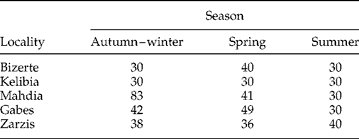
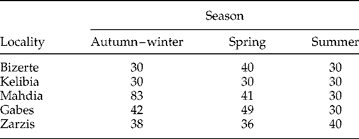
A total of 579 individuals of S. aurita from 27 fish samples were collected between September 2007 and May 2008 at five fishing localities off the Tunisian coast, i.e. Bizerte (37°16′N 9°52′E) and Kelibia (36°50′N 11°10′E) in the north, Mahdia (35°30′N 11°5′E) in the east and Gabes (34°12′N 10°5′E) and Zarzis (33°40′N 10°30′E) in the south. Samples were obtained during three periods: summer, spring and autumn–winter. Specimens from autumn and winter were pooled. Indeed, the Tunisian catch of S. aurita is most important during seasons spring, summer and autumn. In winter, because the cold meteorological conditions are unfavourable for fishing, this species is not available and completely absent from fishing ports (table 1). Samples were kept fresh, or deep frozen in plastic bags at − 10°C, until examination in the laboratory.
The number of samples of Sardinella aurita caught from five localities off the coast of Tunisia from September 2007 to May 2008.
After thawing, each fish was examined for parasites. The body of the fish was observed under a stereomicroscope with incident light to detect ectoparasites. Fins, oral cavity, nasal pits, eyes and gills were examined thoroughly. Internal organs (heart, liver, spleen, gall bladder and gonads) were separated and examined for endoparasites. The stomach, pyloric caeca and intestine were separated, opened longitudinally and their contents rinsed into beakers from which endoparasitic helminths were removed when the contents had settled.
Data analysis
Prevalence and mean abundance were determined for each parasite species (Bush et al., Reference Bush, Lafferty, Lotz and Shostak1997). Non-parametric analyses were performed to evaluate characteristics of the infection at population and community levels. Univariate analysis was performed to evaluate the infection at infrapopulation levels only for parasites with prevalence >5% (Bush et al., Reference Bush, Lafferty, Lotz and Shostak1997). χ2 analyses and a posteriori multiple comparisons for proportions, were used to test for significant differences of prevalence between zones. Analysis of variance (ANOVA) and a posteriori Tukey tests for unequal samples on log10(x+1) transformed data were used to analyse the effect of locality on mean abundance of each parasite species (Zar, Reference Zar1996).
A discriminant analysis based on Mahalanobis distances was used to find differences between localities and to identify which parasite species were responsible for these differences (Highland Statistics Ltd, 2000).
Results
Three digenean species were identified, namely Parahemiurus merus (Linton, 1910), Aphanurus stossichii (Monticelli, 1891) from the stomach of S. aurita in all localities, and Lecithochirium sp. from the swim bladder, which was absent from Gabes and Zarzis. Tetraphyllidean larvae were found in the pyloric caeca, and the monogenean Mazocraes sp. on the gills of fish, in all localities, although the latter species, with a prevalence of only 1.64%, was not included in stock discrimination analysis.
With reference to levels of infection in fish between localities, significant differences were only found in the prevalence and mean abundance of the three digenean species in Mahdia (see table 2).
The prevalence (%) and mean abundance (MA) of infection of Sardinella aurita with four helminth species in five localities off the coast of Tunisia; N= number of fish examined; mean values are given with standard deviation (±).

*, Level of significance with P < 0.05.
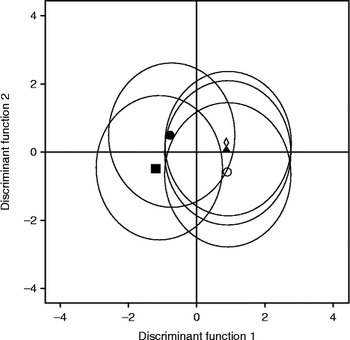
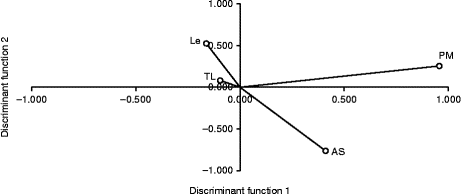
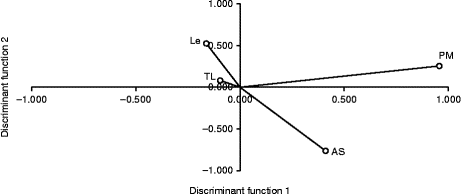
A multivariate analysis used for the separation of S. aurita between localities showed that the first two discriminant functions explained 91.2% of the variance, contributing to 75.3% (eigenvalue = 0.881) and to 15.9% (eigenvalue = 0.185), respectively (fig. 1). There was a significant overall effect of locality: Wilks’ lambda = 0.407, F 37.35, P < 0.01. The use of dimensionality tests showed that the five zones were significantly separated in both dimensions: χ2= 516.004, df = 16, P < 0.01. Fish were classified correctly to the five component communities with an accuracy of 46.8%. Scores of individual fish showed a clear discrimination between two groups, one including fish from Bizerte, Kelibia and Zarzis clumped together and one including fish from Mahdia and Gabes. The Mahalanobis distance does not show any significant difference P > 0.01. The importance of each parasite species with respect to discrimination between groups (fig. 2), evaluated as the contribution of each variable to the total sum Mahalanobis distances, showed that P. merus and A. stossichii were the most important species in determining the position of samples of the first group from Bizerte, Kelibia and Zarzis. Lecithochirium sp. and tetraphyllidean larvae were characteristic of specimens from Mahdia and Gabes.
Sample scores of the first two discriminant functions for specimens of Sardinella aurita from Bizerte (▲), Kelibia (○), Mahdia (●), Gabes (■) and Zarzis (◇). Lettering on the axes represents group averages; circles show 90% tolerances.

Canonical correlations between the first two discriminant functions and four helminth species between localities; tetraphyllidean larvae (TL), Parahemiurus merus (PM), Aphanurus stossichii (AS) and Lecithochirium sp. (Le).
Separation of S. aurita between localities after pooling specimens from Bizerte, Kelibia and Zarzis and pooling those from Mahdia and Gabes were also confirmed using a multivariate analysis. Results showed that the first discriminant function explained 100% of the variance, eigenvalue = 0.842. There was a significant overall effect of locality, Wilks’ lambda = 0.543, F 161.399, p < 0.01. The use of dimensionality tests showed that the two groups were significantly separated in both dimensions, χ2 = 351.471, df = 3, p< 0.01. Fish were classified correctly to the two component communities with an accuracy of 83.1%. Parahemiurus merus and A. stossichii were the most important species in determining the position of samples of the first group from Bizerte, Kelibia and Zarzis. Lecithochirium sp. and tetraphyllidean larvae were characteristic of specimens from the second group from Mahdia and Gabes.
Discussion
Fourteen taxa of parasites have been recorded from S. aurita in different localities in the Atlantic–Mediterranean region (Parukhin, Reference Parukhin1966; Bray, Reference Bray1990; Gaevskaya, Reference Gaevskaya1996; Naidenova & Mordvinova, Reference Naidenova and Mordvinova1997; Bartoli et al., Reference Bartoli, Jousson and Russell-Pinto2000; Derbel et al., Reference Derbel, Chaari and Neifar2012). Among these species, four have been found in Tunisia and we report the monogenean Mazocraes sp. for the first time but with a low prevalence. Differences in the number of parasite taxa from S. aurita in the Atlantic–Mediterranean region are likely to be due to variation in biological and ecological factors, which act individually or together to vary the parasite distribution patterns in their hosts (Oliva et al., Reference Oliva, González and Acuria2004; Sepúlveda et al., Reference Sepúlveda, Marín and Carvajal2004; González et al., Reference González, Barrientos and Moreno2006, Reference González, Vásquez and Acuña2008; Henriquez et al., Reference Henriquez, González, Licandeo and Carvajal2011).
Four of five parasite species showing a prevalence >5% were selected as biological tags. Significant differences of both infection parameters, i.e. prevalence and mean abundance, between areas and results of discriminant analysis demonstrate the potential value of the selected parasites as biological tags. Two stocks can be identified, one in offshore waters and one in inshore waters.
Distribution patterns of parasites showed a high similarity between fish in the north from Bizerte and Kelibia and in the southernmost area from Zarzis, which are characterized by the highest abundances of the digenean hemiurids, P. merus and A. stossichii. These localities are probably endemic areas where conditions are suitable for the transmission of these parasites. Consequently, the second intermediate host, which is generally a copepod for the Hemiuridae (Lefebvre & Poulin, Reference Lefebvre and Poulin2005), is likely to be present in these three localities.
Sampling areas of S. aurita from Bizerte and Kelibia in the north and from Zarzis in the southernmost area were located in offshore waters, between 60 m and 100 m. At this depth range, the current derives essentially from Atlantic waters (Millot, Reference Millot1987). Based on the distribution of minimum horizontal salinity established by Brandhorst (Reference Brandhorst1977), the Atlantic current bypasses Bizerte and Kelibia in the north and moves towards the south, feeding Zarzis in the gulf of Gabes. The introduction of the Atlantic current in offshore waters generates cyclonic and anticyclonic eddies, changing the direction of water circulation and causing vertical movements. This phenomenon influences the distribution of nutrients and zooplankton communities (Millot, Reference Millot1987). Therefore, the highest diversity and abundance of copepods are reported in the north of Tunisia (Daly-Yahia et al., Reference Daly-Yahia, Souissi and Daly-Yahia Kéfi2004) and in the gulf of Gabes beyond 50 m depth (Drira, Reference Drira2009).
Specimens of S. aurita from Mahdia and Gabes were characterized by a higher prevalence of the digenean hemiurid Lecithochirium sp. and Eucestoda tetraphyllidean larvae, respectively. It is likely, therefore, that Lecithochirium sp. uses a different copepod intermediate host from that of P. merus and A. stossichii. Lecithochirium sp. was absent in Gabes, but Derbel et al. (Reference Derbel, Chaari and Neifar2012) reported this digenean in other localities from the gulf of Gabes with a prevalence of 13.89%. The absence of this parasite can be explained by heavy pollution in Gabes due to the coexistence of industrial and urban activities discharging directly in the sea (Rabaoui et al., 2013). This disrupts the stability of the ecosystem which results in a variation of copepod distribution, including the disappearance of some copepods and the appearance of other bio-indicators of water quality (Aleya et al., Reference Aleya, Hartmann and Devaux1992; Foissner & Berger, Reference Foissner and Berger1996; Souissi et al., Reference Souissi, Souissi and Daly-Yahia2008; Rekik et al., Reference Rekik, Drira, Guermazi, Elloumi, Maalej, Aleya and Ayadi2012).
The sampling areas of Mahdia and Gabes were mainly coastal with depths between 15 m and 45 m. Fishing zones from these localities were characterized by shallow waters over large areas. These regions are supplied by local permanent cyclonic circulation and are characterized by a wide continental shelf (Ovchinnikov, Reference Ovchinnikov1966; Lecombe & Tchernia, Reference Lecombe, Tchernia and Stanley1972). The Atlantic current does not reach this area due to the presence of a local counter-current (Brandhorst, Reference Brandhorst1977) and the extended continental shelf (Millot, Reference Millot1987). Consequently, coastal regions are depauperate in nutrients and zooplankton communities relative to offshore waters (Drira, Reference Drira2009). Thus the biomass of intermediate hosts of these species increases in offshore waters at Bizerte, Kelibia and Zarzis and decreases in inshore waters at Mahdia and Gabes. Pérez-del Olmo et al. (Reference Pérez-del Olmo, Raga, Kostadinova and Fernández2007) showed that the predominance of Digenea is linked to the proliferation of intermediate hosts and thus the increase of copepod biomass. Therefore, the depth gradient of fishing localities and its influence on the distribution of copepods and definitive hosts could be the main determining factor of clines shown by the parasites of S. aurita.
The results of discriminant analysis used for the separation of all specimens from S. aurita between localities showed that fish from the five areas represented two units with a mean accuracy of correctly classifying fish to their respective zone of 46.8%. After pooling specimens from Bizerte, Kelibia and Zarzis together, and those from Mahdia and Gabes, the accuracy of classifying fish correctly to their original zone increased to 83.1%. This is the result of distance separation of samples, a common phenomenon that usually emerges as the best predictor of similarity in analyses of parasite communities in relation to characteristics of the habitat (Poulin & Morand, Reference Poulin and Morand1999; Poulin, Reference Poulin2003). Results of discriminant analyses used for the separation of S. aurita between localities after pooling specimens from offshore waters off Bizerte, Kelibia and Zarzis together, and those from inshore waters off Mahdia and Gabes, confirm the result of the first discriminant analysis. In this analysis, P. merus and A. stossichii were characteristic of specimens from Bizerte, Kelibia and Zarzis in offshore waters, and Lecithochirium sp. and tetraphyllidean larvae were characteristic of Mahdia and Gabes from inshore waters, respectively. The accuracy of classifying fish incorrectly in their stock can be explained by the variation in the season of landings of small pelagic fishes such as S. aurita between localities due to the seasonality of the activity of fishing fleets (Gaamour, Reference Gaamour1999). This can also be explained by the variation of ecological and biological factors as S. aurita migrates in search of optimal conditions for living, feeding and breeding (Fréon, Reference Fréon1988; Cury, Reference Cury, Bard and Koranteg1995; Gascuel, Reference Gascuel, Gascuel, Durand and Fonteneau1995; Pauly, Reference Pauly and Moreau1997). Parasites can be used to follow seasonal migrations of fishes from spawning and feeding grounds. Indeed, in the Baltic Sea there are stocks of herring, Clupea harengus, and garfish, Belone belone, that spawn in areas of low salinity and migrate seasonally to feeding grounds further west in areas of higher salinity (Gaevskaya & Shapiro, Reference Gaevskaya and Shapiro1981; Grabda, Reference Grabda1981). Also, Li et al. (Reference Li, Song, Wu, Zou, Nie and Wang2011), using parasites as bio-indicators, proved that Coilia nasus undertook seasonal migrations. Moore et al. (Reference Moore, Buckworth, Moss and Lester2003) studied stock discrimination of Scomberomorus commerson from northern Australia using parasites and proved that this species moved between stocks during their lifetime.
Hemiurid species P. merus, A. stossichii and Lecithochirium sp., in contributing most to the separation of samples from five localities into two stocks, demonstrated that they satisfy the criteria of good biological tags for stock discrimination, as discussed by several authors. Indeed, Timi (Reference Timi2003) proved that adult hemiurid digeneans P. merus and Lecithochirium microstomum are good biological tags for discriminating stock of anchovy from Argentine waters. Similarly, Boje (Reference Boje, Stenmark and Malmberg1987) used the hemiurid digenean Hemiurus levinseni for discriminating stocks of cod from Greenland waters. They proved that the inshore stock was characterized by a high level of infection with H. levinseni, and the offshore stock by a low infection level of H. levinseni. Moreover, Kabata et al. (Reference Kabata, McFarlane and Whitaker1988) used seven species of digeneans from the families Fellodistomatidae, Acanthocolpidae, Hemiuridae, Derogenidae and Opecoelidae to distinguish the offshore seamount stock and the continental slope stock of the sablefish Anoplopoma fimbria from the west coast of Canada.
In conclusion, studies of the spatial variability of helminth parasites in the round sardinella off Tunisia allowed for the identification of two discrete stocks: one in offshore waters from Bizerte, Kelibia and Zarzis characterized by digeneans P. merus and A. stossichii and one in inshore waters from Mahdia and Gabes characterized by Lecithochirium sp. and larvae of the Tetraphyllidea, respectively.
Acknowledgements
We thank Professor Francisco Javier Aznar from the Institute Cavanilles of Biodiversity and Evolutionary Biology Science, University of Valencia, for valuable comments on the manuscript. We are also grateful to Dr R.A. Bray from the Natural History Museum, London for linguistic revision.
Conflict of interest
None.