Introduction
European gorse (Ulex europaeus L.) is a spiny shrub that originates from western Europe and is considered to be a serious pest in many regions of the world, including North America, Chile, South Africa, New Zealand and Australia, where it has invaded a great deal of land (Richardson and Hill, Reference Richardson and Hill1998; Clements et al., Reference Clements, Peterson and Prasad2001). Many basic and applied research programmes have been conducted to eradicate or control the expansion of this species (e.g. Edwards et al., Reference Edwards, Tozer, Maxwell and Marshall2007; Viljoen and Stoltsz, Reference Viljoen and Stoltsz2007).
In native contexts, the species is managed as a weed even if it (and related leguminous species) could be considered to be a beneficial species as, thanks to its symbiosis with rhizobial bacteria, it can fix atmospheric nitrogen (Cavard et al., Reference Cavard, Augusto, Saur and Trichet2007). Indeed, this way of entry of nitrogen into ecosystems where gorse is present, could compensate for nitrogen losses due to export of biomass, particularly in soils with low nutrient contents (Alegre et al., Reference Alegre, Alonso-Blazquez, de Andres, Tenorio and Ayerbe2004; Busse et al., Reference Busse, Jurgensen, Page-Dumroese and Powers2007). Thus understanding the dynamics and abundance of gorse is important for sustainable management of soil fertility. The regeneration process of the species involves a large seed bank in the soil (Ivens, Reference Ivens1978). A seed bank enables dispersal over time (Hodgson and Grime, Reference Hodgson, Grime, Bunce and Howard1990) and is an important part of the regeneration process after disturbance (Moss, Reference Moss1959). Gorse seeds (as in the vast majority of legumes) are produced hard-coated and this property enables them to form very persistent soil seed banks (Sixtus et al., Reference Sixtus, Hill and Scott2003). Gorses are generally considered as pioneer species and their establishment is favoured by disturbance (Clements et al., Reference Clements, Peterson and Prasad2001). In particular, in Mediterranean climates fire is the trigger for seed germination and seedling emergence. In addition, ‘mechanical’ disturbances (felling activities and ploughing) may scarify the topsoil seeds and promote germination and, more importantly perhaps, the exposure of seeds to solar heat in vegetation gaps or clear-cut situations (Ivens, Reference Ivens1982, Reference Ivens1983). Although several studies have been performed on the size and variability of the gorse seed bank as a function of different ecological factors in invasive contexts (Moss, Reference Moss1959; Ivens, Reference Ivens1978; Zabkiewicz and Gaskin, Reference Zabkiewicz and Gaskin1978; Lee et al., Reference Lee, Allen and Johnson1986; Partridge, Reference Partridge1989), few data are available about gorse seed banks in native contexts (Puentes et al., Reference Puentes, Pereiras and Casal1988), and particularly in forest ecosystems (Pywell et al., Reference Pywell, Pakeman, Allchin, Bourn, Warman and Walker2002; Eycott et al., Reference Eycott, Watkinson and Dolman2006).
The aim of this study was to investigate gorse seed banks in the native area of the species and its variability associated with disturbances. The study region was south-western France where gorse is present in pine stands that are intensively managed, and thus periodically disturbed. Gorse, like the other species of the understorey, is at the moment controlled by the managers, to limit competition with the planted pines. Nevertheless, some new experimental management schemes try to integrate gorse as intercropping species in the early phases of the rotation of maritime pine plantations. Information about gorse seed banks is important to estimate the potential of gorse to re-invade pine stands after logging and to understand and predict the dynamics of gorse abundance under pine stands. In this study, the size of the gorse seed banks were quantified in a clear-cut stand, in young pine stands, and in mature pine stands, which taken together represent ‘critical’ stages in the forest management of pine stands. Variations in the seed banks were studied as a function of the stage of development of the pine stand and of soil depth. The influence of the abundance of gorse seeders was also taken into account.
Materials and methods
Study area
The stands studied are located in the ‘Landes de Gascogne’ forest in south-western France. This forest is mainly composed of even-aged stands of maritime pine (Pinus pinaster Ait.) intensively managed for wood production (total area of 0.9 Mha). During the 19th century, the main land use was pastured heathlands in which gorse species were already present (Sargos, Reference Sargos1997). The climate is oceanic with a mean annual temperature of 12.5°C and mean annual rainfall of 930 mm (1951–1990 mm). The parent material of the soils is almost completely composed of coarse sand. Soils are poor, acidic and quite organic (spodosols) (Jolivet et al., Reference Jolivet, Augusto, Trichet and Arrouays2007).
Sampling sites
Five pine stands were selected: one recently clear-cut; two young stands (10–15 years) and two mature stands (30–48 years) all managed in the same way (Maugé, Reference Maugé1989). The stands were sampled from February to April 2008 in order to sample the permanent seed bank, as the maximum flowering period of Ulex europaeus is April (Tarayre et al., Reference Tarayre, Bowman, Schermann-Legionnet, Barat and Atlan2007) even though there is great variability among individuals.
The clear-cut (CC) stand was sampled 1 year after logging (spring 2007) but before ploughing. The former pine stand contained several dense gorse patches and many gorse seedlings were already emerging from the soil at the time of sampling. The two young stands originated from regular stands (trees planted in rows) and the understorey layer contained gorse plants in both stands. One young pine stand was a ‘dry moorland’ site (YPS–D) based on the composition of the understorey and local site classification (Jolivet et al., Reference Jolivet, Augusto, Trichet and Arrouays2007). The other young pine stand was a ‘humid moorland’ site (YPS–H). One of the mature pine stands (MPS–M) had almost no gorse plants and the understorey was completely dominated by purple moor grass [Molinia caerulea L. (Moench)] and bracken [Pteridium aquilinum (L.) Kuhn] at the sampling date. However, according to the stand owner, the stand had been invaded by gorse after planting but the gorse was progressively replaced by purple moor grass. The hypothesis of invasion of MPS–M by gorse during the young stage was consistent with the abundance of the gorse in very young pine stands ( < 5 years) located next to this mature stand. The other mature pine stand (MPS–U) had a few tens of gorse patches of varying density and surface area. The other abundant species of the understorey of the mature pine stand were ericaceous species [mainly common heather (Calluna vulgaris L. Hull)] and, to a lesser extent, purple moor grass.
Sampling design and measurements
Clear-cut (CC)
Twenty 1 m2 sampling plots were randomly selected and the number of emerged gorse seedlings in each plot counted. Three soil samples were then collected at random to a depth of 15 cm using an auger with a diameter of 8 cm. In each core, three soil layers were separated: 0–5, 5–10 and 10–15 cm. For each soil layer, one bulk sample was assembled from the three cores. Thus, there was one bulk sample per soil layer and per sampling plot representing a total soil volume of 2262 cm3 per sampling plot.
Young pine stands (YPS–D and YPS–H)
In contrast to the mature pine stands (even those that were present before the clear-cut), the two young pine stands displayed regular spatial distribution of pine trees (parallel ridges separated by furrows of width 4 m). In the furrows, vegetation was controlled with a bladed roller (pine age at vegetation control: YPS–D = 7 years; YPS–H = 8 years) which created a non-random distribution of gorse plants. For this reason, a regular sampling design was used rather than random sampling. In each pine stand, 15 transects were set up perpendicular to the ridges. Along each transect, eight 1 m2 sampling plots (distance between two consecutive plots: 6 m) were established, including four plots in the furrow and four plots on the ridge. In each young pine stand, there were thus a total of 105 sampling plots. To take into account the non-random spatial distribution of gorse, we increased the number of sampling cores in each sampling plot to 30. In each plot, 30 soil plugs, including the litter layer as it can contain many seeds (Partridge, Reference Partridge1989), were collected at random to a depth of 5 cm, using an auger with a diameter of 2.1 cm. We limited the sampling to the first 5 cm in these stands, contrary to the other stands (CC, MPS-M, MPS-U) because we wanted to focus, for these stands, on the relationship between seed-bank size and the presence of gorse as seeders in the understorey. The 30 soil plugs were aggregated to form one composite soil sample representing a soil volume of 520 cm3. In each sampling plot, the presence of gorse plants was recorded.
Mature pine stands (MPS–M and MPS–U)
Ten to 20 sampling plots were selected in each mature pine stand. The number of sampling plots was chosen according to the visual heterogeneity of the stand. In the stands with no gorse (MPS–M; uniform layer of purple moor grass), ten sampling plots with a surface area of 1 m2 were selected at random. In MPS–U, which contained patches of different types of vegetation, 20 sampling plots (2–4 m2) were selected in areas homogeneously occupied by gorse but with varying densities of gorse plants (0.0–8.5 stems m− 2). In all sampling plots in both mature pine stands, three soil samples per square metre were collected at random to a depth of 15 cm using an auger with a diameter of 8 cm. Bulk samples were made in the same way as in the CC site.
For each MPS-U sampling plot, the gorse vegetation was estimated as a percentage using a visual guide with a calibrated range of percentages of surface cover. In the same way, the gorse stem density (stems m− 2), mean diameter at a height of 10 cm and age of each gorse stem (by counting tree rings) were estimated or measured.
Seed count and viability test
Each composite soil sample was washed and passed through a set of sieves with two mesh sizes: one coarse (4 mm) and one fine (1 mm) sieve. Gorse seeds measure about 3 mm. The two fractions collected were deposited in Petri dishes and then dried at 35°C. Seeds were then hand sorted and the number of seeds in each sample counted. Forty per cent of the soil samples were sorted twice by two operators working independently and no significant error was recorded in seed sorting. A random sub-sample of 40 seeds per site was then tested for viability using a tetrazolium chemical test (Marrero et al., Reference Marrero, Padilla, Valdes and Nogales2007). The seeds were placed in a Petri dish on paper wetted with distilled water for 20 h. Then the teguments of the seeds were scarified to half the length of the seeds to facilitate the penetration of the tetrazolium solution. The embryos now exposed were placed in a Petri dish containing 1% chloride tetrazolium solution and incubated for 24 h, in the dark, at a temperature of 30°C. The seeds were then washed two or three times with distilled water to eliminate the excess of colourant. Following this, the embryos were excised and placed in a dark plate and observed under binocular magnification lenses to analyse their colouration. Viable tissues are stained bright red. The seeds were then classified in three categories depending on their colouration: viable seeds (totally stained); non-viable seeds (not stained at all); and seeds with undetermined viability (seeds partially stained which will produce either normal seedlings or abnormal seedlings, depending on the intensity and the location of the colouration). Particular attention was given to examining whether all the parts of the embryo which are crucial for development were viable. For leguminous species such as gorse, it is known that at least half of the radicle should be stained, as for the coleoptile, and the cotyledons should be stained. For interpreting the results we used known patterns of staining of the embryos (Rao et al., Reference Rao, Hanson, Dulloo, Ghosh, Nowell and Larinde2006).
Data analysis
To study differences in the number of seeds m− 2 at different soil depths and in the different types of stand (mature pine with purple moor grass, mature pine with gorse, clear-cut) we used the Mann–Whitney U-test for two modalities and the Kruskall–Wallis test for more than two modalities. For young pine stands, we also used a Mann–Whitney U-test to check if there were differences in the number of seeds according to the presence or absence of gorse in the understorey. After log transformation of the seed data from the mature pine stand with gorse, we used general linear model (GLM) analysis to investigate the relationship between mean seed number and the abundance, age and density of gorse in the understorey. All analyses were performed using SYSTAT® (R) 9.0 for Windows, 1999 (SPSS Inc., Chicago, Illinois, USA).
Results
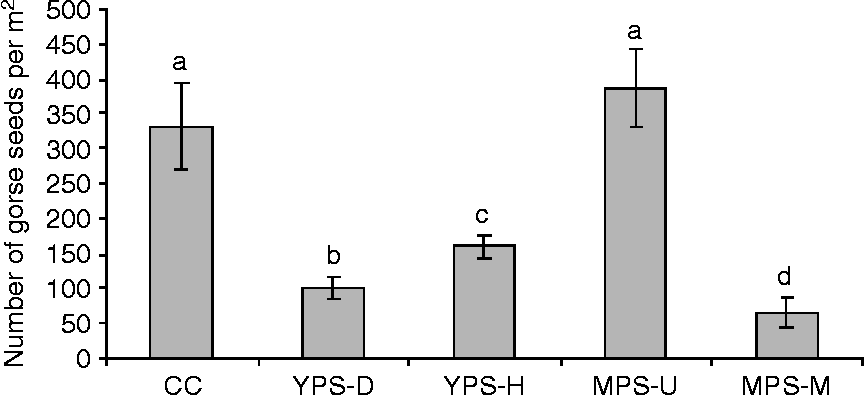
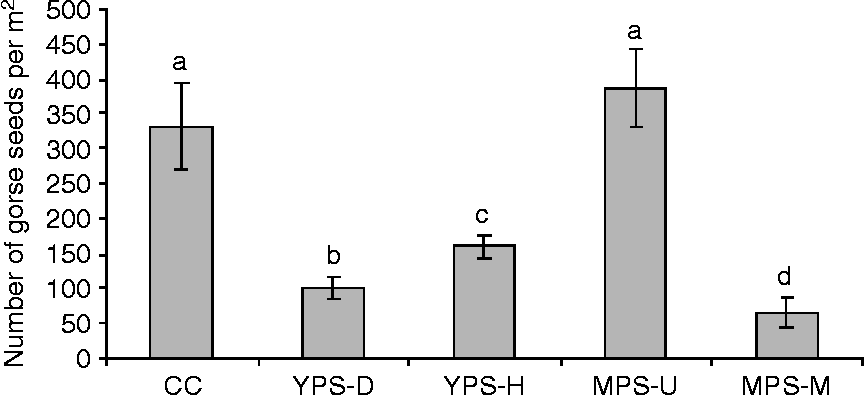
The number of gorse seeds in the soil varied between 0 seeds m− 2 and 1657.5 seeds m− 2 for a given soil layer, with the maximum number of seeds found in the 5–10 cm soil layer in the mature pine stands with gorse in the understorey (MPS-U). Concerning the mean number of gorse seeds in the first 5 cm of the soil only, the maximum mean seed number was found in the clear-cut and in the mature pine stands with gorse in the understorey (MPS-U) (Fig. 1).
Mean seed number per m2 with standard error, in the 0–5 cm soil layer in the different stages of the forest management: the clear-cut (CC), the two young pine stands (YPS–D and YPS–H) and the two mature pine stands, with gorse (MPS-U) or purple moor grass (MPS-M) in the understorey. Different letters indicate significant differences between two bars according to the Mann–Whitney U-test, with P < 0.001.
In the clear-cut, we counted a mean of nine emerged seedlings m− 2 (SE = 13.73), with a maximum of 42 emerged seedlings in 1 m2. The number of seedlings counted in each square metre was not correlated with the total number of seeds found in the soil (r = 0.041; P = 0.864).
Seed viability
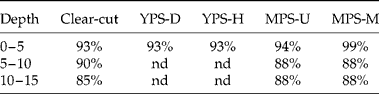
The percentage of seed viability was similar and high in all the stands (Table 1), and a little lower in the deeper soil layers.
Percentage of seed viability as a function soil depth sampled in the following stands: CC, clear–cut; YPS-D, young pine stand in dry moorland; YPS-H, young pine stand in humid moorland; MPS-U, mature pine stand with Ulex in the understorey; MPS-M, mature pine stand with purple moor grass in the understorey
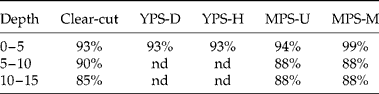
nd, Not determined.
Seed-bank size as a function of the stage of management of pine stand
The mean number of gorse seeds in the first 5 cm of the soil in both the two young pine stands (YPS–D and YPS–H) was significantly higher than the mean number found in the mature pine stand with purple moor grass (MPS-M) (Mann–Whitney U-test: P = 0.0001 and P = 0.001, respectively). However, the mean number of seeds was significantly lower than in both the clear-cut and in the mature pine stand with gorse in the understorey (MPS-U) (compared to clear-cut, P = 0.0001 and P = 0.001; compared to MPS-U, P = 0.0001 and P = 0.0001, for YPS–D and YPS–H respectively). Based on the mean seed number in the first 5 cm of the soil, we were thus able to classify the stands in order of increasing mean seed number (Fig. 1): mature pine with purple moor grass (MPS-M: 66.3 seeds m− 2) ≪young pine stands (YPS–D: 101.8 seeds m− 2 and YPS–H: 161 seeds m− 2) ≪clear-cut (CC: 331 seeds m− 2) < mature pine stand with gorse (MPS-U: 385.9 seeds m− 2).
Concerning the three pooled soil layers (for MPS-U, MPS-M and the CC), the total mean number of seeds m− 2 in the clear-cut (CC) (1312 seeds m− 2) was similar to the total mean seed number in the mature pine stands which contained a lot of gorse in the understorey (MPS-U) (1126 seeds m− 2) (Mann–Whitney U-test: P = 0.401). The lowest mean number of seeds in the stands was in the mature pine stands with M. caerulea in the understorey (MPS-M) and which had been free of gorse for several years (503 seeds m− 2) (Mann–Whitney U-tests with CC and MPS-U, respectively: P = 0.001 and P = 0.002).
Seed-bank distribution as a function of soil depth
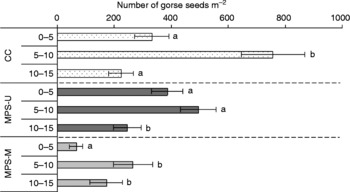
We found a common trend in the three stands in which we studied the distribution of seeds in the different soil layers (clear–cut, mature pines with purple moor grass and mature pines with gorse). The mean seed number was higher in the 5–10 cm soil layer than in the two other layers (0–5 and 10–15 cm) (Fig. 2). However, within this general pattern we identified differences depending on the type of stand.
Differences in seed number per m2 between the different soil layers (0–5, 5–10 and 10–15 cm) for the three types of stands: clear-cut (CC), mature pine stand with gorse (MPS-U) and mature pine stand with purple moor grass (MPS-M) in the understorey. For each type of stand, different letters indicate significant differences between bars according to the Mann–Whitney U-test, with P < 0.001.

In the clear-cut, the mean number of seeds in the soil was significantly higher in the 5–10 cm soil layer than in the 0–5 cm soil layer (Mann–Whitney U-test: P = 0.005) or the 10–15 cm soil layer (Mann–Whitney U-test: P = 0.0001). The mean number of seeds in the topsoil (0–5 cm) did not significantly differ from the mean number in the 10–15 cm soil layer (Mann–Whitney U-test: P = 0.168; Fig. 2).
In the mature pine stand with gorse (MPS-U), as in the mature pine stand with purple moor grass (MPS-M), the mean seed number per m2 was highest in the 5–10 cm soil layer. In the mature pine stand with gorse, this number differed significantly from that in the 10–15 cm soil layer (Mann–Whitney test P = 0.003), whereas in the mature pine stand with purple moor-grass, the number differed significantly from the topsoil layer (Mann–Whitney test P = 0.008).
Relationship with above-ground vegetation cover
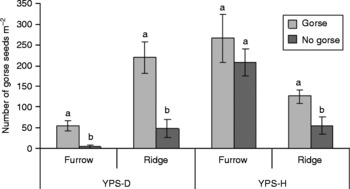
In the young pine stands, the seed bank in ridges and in furrows showed no systematic pattern (Fig. 3). In these stands, we found significantly more seeds in the soil when gorse was present in the understorey (in the sample square metre). This relationship was significant in the dry moorland stand (YPS–D). In the humid moorland stand (YPS–H), there were no significant differences in the number of seeds between the sample squares containing gorse in the understorey and those without gorse (Fig. 3) when furrows and ridges were considered together. However, when furrows and ridges were considered separately, in the ridges, even in the humid moorland, we always found significantly more seeds when gorse was present in the sample square (Fig. 3).
Differences in seed number per m2 between sample squares with or without gorse in the understorey in the young pine stand located in the dry moorland (YPS–D) and in the young pine stand located in the humid moorland (YPS–H), in the furrows and on the ridges. For each type of stand and each location, different letters indicate significant differences between bars according to the Mann–Whitney U-test, with P < 0.001.

When we compared the two mature pine stands, we found more seeds m− 2 in the pine stand with gorse in the understorey than in the stand containing purple moor grass, and this was true for the two upper soil layers (0–5 and 5–10 cm). Moreover, within the mature pine stands with gorse in the understorey, we found a significant positive relationship between both gorse density and age, and the total number of seeds found in the soil (GLM: adjusted r 2 = 0.281; P = 0.05). When we examined the soil layer by layer, we found this significant relationship only for the 5–10 cm soil layer (GLM: adjusted r 2 = 0.281; P = 0.05).
Discussion
In the pine stands we studied, we found a total number of seeds per square metre (all soil depths considered together for the CC, MPS-U and MPS-M) ranging from 503 to 1312 seeds m− 2, which is far lower than the numbers found in the invasive context (3500 seeds m− 2 at a depth of 5 cm, Moss, Reference Moss1959; 10,000 seeds m− 2 at a depth of 15 cm, Ivens, Reference Ivens1978; 5446 seeds m− 2 at a depth of 30 cm, Zabkiewicz and Gaskin, Reference Zabkiewicz and Gaskin1978), but within the range of the values observed in native locations (Puentes et al., Reference Puentes, Pereiras and Casal1988: 1045 seeds m− 2 in a gorse scrubland and 645 seeds m− 2 in the understorey of a 30-year-old maritime pine forest, both at a depth of 15 cm; Warr et al., Reference Warr, Kent and Thompson1994: 53–150 seeds m− 2 at a depth of 15 cm). Indeed, in invasive contexts, gorse has been shown to display higher fecundity than in native contexts where natural enemies such as Exapion ulicis can reduce the seed crop by 35–50% (Rees and Hill, Reference Rees and Hill2001). Gorse seed-bank density varied widely both within and among the pine stands we studied, as observed previously in other contexts by other authors (Zabkiewicz and Gaskin, Reference Zabkiewicz and Gaskin1978; Eycott et al., Reference Eycott, Watkinson and Dolman2006).
Seed-bank size as a function of stand age
No linear decrease in seed-bank density was observed with the age of pine stands, contrary to that found by Hill and Stevens (Reference Hill and Stevens1981) in a study of Ulex gallii. In the same way, Warr et al. (Reference Warr, Kent and Thompson1994) found more seeds in young stands than in mature stands. However, in a study of pine stands in England, Pywell et al. (Reference Pywell, Pakeman, Allchin, Bourn, Warman and Walker2002) also observed great variability of the seed bank of heathland species and no relationship with the age of pine stands. The fact that we found fewer seeds in the young pine stands than in the mature stand with gorse in the understorey could be due to differences in seedling emergence between the two stands, as the soil in young pine stands had been disturbed by recent mechanical operations. Indeed, seed germination favoured by cyclical disturbance can deplete the seed bank (Pywell et al., Reference Pywell, Pakeman, Allchin, Bourn, Warman and Walker2002). Comparing all the stands, it also seems that the number of seeds in the seed bank is more linked to the presence of gorse reproducers in the understorey at the stand scale, as the lowest mean number of seeds found in the stands we studied was in mature pine stands with M. caerulea in the understorey (MPS-M) and which had been free of gorse for several years; and, conversely, the highest number was found in mature pine stands with gorse in the understorey (MPS-U). A tendency for seed-bank depletion has been observed in old forests with increasing stand age, due to senescence of seeds from early successional species, although the seed bank is also replenished by populations of seed-bank-forming species in local disturbances (Bossuyt et al., Reference Bossuyt, Heyn and Hermy2002).
Seed-bank profile as a function of soil depth
The maximum number of gorse seeds we found in the soil was in the 5–10 cm soil layer. This result is consistent with observations by Warr et al. (Reference Warr, Kent and Thompson1994) for U. gallii in conifer stands in south-west England, with more seeds in the 5–10 cm soil layer and fewer seeds in the 0–5 cm layer. These authors interpreted this result as a lack of a replenishment of the top soil layer, as this species was only present in the ground flora in open sites. Godefroid et al. (Reference Godefroid, Phartyal and Koedam2006) also observed a decrease in the number of seeds with soil depth (from 0 to 15 cm) in the different types of stands they studied (with different dominant species), except in pine stands, where the highest number of seeds was in the 5–10 cm soil layer. In contrast, in scrublands many authors found the majority of seeds (from 75 to 90%) in the first 5 cm of the soil (Moss, Reference Moss1959; Ivens, Reference Ivens1978; Zabkiewicz and Gaskin, Reference Zabkiewicz and Gaskin1978). In a study of a gorse seed bank in Spain at two sites, one shrubland and one Pinus pinaster forest with gorse in the understorey, Puentes et al. (Reference Puentes, Pereiras and Casal1998) found most seeds in the top 5 cm in both cases, but found less difference between the 0–5 and 5–10 cm layers in pine forest than in open scrubland. However, it is important to emphasize that, in our study, the differences between the two upper soil layers (0–5 and 5–10 cm) were significant only in the mature stand with no adult gorse in the understorey (MPS-M) and not in the mature stand with gorse (MPS-U). In the stand with gorse, the decrease in the number of seeds in the first 5 cm, either due to germination or seed mortality, which are higher in the top 5 cm (Hill et al., Reference Hill, Gourlay and Barker2001), appears to be partly compensated for by the dispersal of new seeds produced by the gorse in the understorey, which is probably present as a result of past local disturbances. What is less easy to understand is why we found such a difference in the number of seeds between the two upper soil layers in the clear-cut stand, with more seeds in the 5–10 cm soil layer. We could suspect that the decrease in the number of seeds between the two first soil layers was the result of soil disturbances caused by machinery used for the clear-cut. As sampling was made 1 year after clear cutting, we cannot ignore the possible germination of gorse seedlings and subsequent mortality of these seedlings as an explanation for the smaller number of seeds in the 0–5 cm soil layer.
Relationship with above-ground vegetation cover
Seed banks may vary with the standing vegetation cover, even though a recent review found that frequently there is no relationship between standing vegetation and seed-bank composition in forest ecosystems (Hopfensperger, Reference Hopfensperger2007). However, the abundance of reproducers in the current vegetation or in vegetation present a few years previously is responsible for the replenishment of the seed bank (Godefroid et al., Reference Godefroid, Phartyal and Koedam2006). As species found in the seed banks are usually pioneer species such as gorse, similarity between soil seed banks and above-ground vegetation is expected to be greater in post-harvest stands (Hill and Stevens, Reference Hill and Stevens1981; Decocq et al., Reference Decocq, Valentin, Toussaint, Hendoux, Saguez and Bardat2004). As such, in intensively managed pine plantations, with frequent disturbances, there is usually more similarity between the standing vegetation and the seed bank, mainly due to the similarity within the group of the broad-range species (Amezaga and Onaindia, Reference Amezaga and Onaindia1997). This is particularly true for the species with dispersal types such as autochory or barochory, the seeds of which generally fall near the mother plant (Valbuena and Trabaud, Reference Valbuena and Trabaud2001), as is the case of gorse, the seeds of which rarely disperse more than 2 m from the parent plant (Hill et al., Reference Hill, Gourlay, Lee and Wilson1996).
Overall, we found more seeds in the soil when gorse was present in the understorey in both young (YPS–D and YPS–H) and mature (MPS-U) pine stands. The study of the seed bank in the mature pine stand without gorse in the understorey (MPS-M), suggests a decrease in the seed bank over time (lowest value compared with the other stands), if the decrease is not compensated for by the production of new seeds by the understorey. In New Zealand, in an area with no gorse for 26 years, Moss (Reference Moss1959) also found a low number of seeds in the soil (1.9 viable seeds m− 2).
The importance of the presence of gorse plants in the understorey and their age (number of reproductive episodes), crossed with disturbances, probably explains why we did not find a decrease in the seed number as a function of increasing stand age. Indeed, the patches of adult gorse in the understorey of one of the mature pine stands (MPS-U), contained both old gorse (10–11 years old) and young gorse (mean = 3.7 years old, very similar to the mean found in the young pine stands), which can produce a lot of new seeds. Nevertheless, in the mature stand with no gorse in the understorey we did observe a decrease in the number of seeds over time. In this way, after the major disturbance corresponding to the clear-cutting, which favours the germination and establishment of many gorse plants from the seed bank, the number of seeds in the soil of mature stands depends on whether local disturbances occur or not, enabling some new gorse plants to establish and survive. These new adult gorse plants will be responsible for the replenishment of the seed bank in mature pine stands.
Conclusions
Given the high variability in the seed bank, the limited number of sites, and the lack of knowledge about the history of disturbance, vegetation and seedling recruitment at the sites, we cannot draw definitive conclusions with this single study. However, the conclusions we can draw from the present study are that gorse seed banks are variable, both temporally and spatially, for a variety of reasons; that the presence of a seed source can increase that variability; and, particularly, that the seed banks measured are low compared to ranges in the invasive context (but consistent with other measures in the native range).
Acknowledgements
The authors would like to thank Sylvie Niollet for her technical help, Céline Meredieu for providing the sampling sites (young pine stands) through the ‘GIS COOP de données’ and Daphne Goodfellow for revising the English. They are also very grateful to Mr Guillemin, the owner of the mature pine stands and the clear-cut, for allowing them to sample his stands. Finally, they are thankful to Laurent Séverin, Luc Puzos and Thomas Blain from the INRA Experimental Unit, Pierroton, and to Loïc Prudhomme, for their technical help during the inventories, and to Etienne Saur for discussion of methodological aspects.