Substantial work has examined the associations between exposures to extreme stress or potentially traumatic events (PTEs) and subsequent mental health problems. Although rates of exposure to stressful events vary by study and population, epidemiological research suggests that approximately 61% of men and 51% of women in the general population and 65% of military personnel have experienced a PTE.Reference Hourani, Yuan and Bray1Reference Kessler, Sonnega, Bromet, Hughes and Nelson2 Types of exposures differ by sex, with men more likely to experience combat and women more likely to experience sexual violence, such as rape.Reference Kessler, Sonnega, Bromet, Hughes and Nelson2Reference Hirini, Flett, Long and Millar3
The type and number of PTEs often influence the severity of negative postdisaster mental health outcomes. In general, PTEs increase the risk for experiencing depression, anxiety disorders such as posttraumatic stress disorder (PTSD), substance abuse, and anger,Reference Kessler, Sonnega, Bromet, Hughes and Nelson2Reference Magee4Reference McFarlane5Reference Orth and Wieland6 and multiple PTEs compared with a single PTE are associated with worse mental health outcomesReference Green, Goodman and Krupnick7; however, PTEs involving interpersonal violence, the actions of an individual intended to cause injury, death, or other type of harm to another individual,8 in some studies have been associated with poorer mental health outcomes than nonviolent PTEs.Reference Burnam, Stein and Golding9Reference Norris and Kaniasty10
Interpersonal violence may be emotional, verbal, physical, or sexual. Exposure to interpersonal violence and the development of subsequent mental illness is multifaceted and may be potent in determining outcomes. In addition to predicting the development of psychological disorders,Reference Norris and Kaniasty10 being exposed to violence in the context of a nonviolent PTE, such as a natural disaster, may exacerbate stress-related symptoms associated with the disaster.Reference Terranova, Boxer and Morris11 Because some natural disasters increase the risk for experiencing interpersonal violence,Reference Pittaway, Bartolomei and Rees12Reference Schumacher, Coffey, Norris, Tracy, Clenents and Galea13 exposure to interpersonal violence is of particular concern among the survivors of Hurricane Katrina and other natural disasters. This risk may be particularly high for individuals who experienced interpersonal violence before the disaster. For example, Schumacher and colleaguesReference Schumacher, Coffey, Norris, Tracy, Clenents and Galea13 found women with a history of pre-Katrina intimate partner violence were at greatest risk for intimate partner violence after Katrina. The mechanism of the association is not clear, but it is possible that the stress of disasters increases interpersonal conflict and violence. Therefore, experiencing interpersonal violence is a predictor of mental health problems and subsequent violent reexposure (also known as revictimization),Reference Norris and Kaniasty10Reference Schumacher, Coffey, Norris, Tracy, Clenents and Galea13Reference Roodman and Clum14 but the nature of the associations among predisaster violent PTEs, reexposure to violent PTEs during a disaster, nonviolent PTEs, and negative mental health outcomes is less clear.
The breadth of research demonstrating associations between exposure to PTEs and subsequent psychological problems has been translated clinically into the development of mental health triage after disasters. Triage facilitates access to services for those at greatest risk for negative mental health outcomes and enables responders to allocate services to those areas or individuals in the greatest need. Triage instruments, such as the PsySTART Rapid Triage System,Reference Gurwitch, Kees, Becker, Schreiber, Pfefferbaum and Diamond15 identify individuals at risk for negative outcomes based on their exposure to stressors during the disaster. The predictive validity of instruments like PsySTART has been established after natural disasters, such as the 2004 tsunami in Thailand.Reference Thienkrua, Cardozo and Chakkraband16
Because screening instruments are often disaster specific, they do not take into account the cumulative effect of exposure to multiple types of PTEs,Reference Green, Goodman and Krupnick7 such as interpersonal violence, experienced before and during the disaster. This limitation could result in a failure to identify at-risk individuals who experienced less-severe disaster PTEs but severe predisaster PTE. Furthermore, in some disasters for which exposures to disaster-specific traumatic events are ubiquitous across a population, instruments using disaster-specific items may not be able to discriminate those at highest risk for mental health problems. For example, given the catastrophic nature and expanse of the 2010 Haitian earthquake, during which most individuals in and around Port-au-Prince experienced severe trauma (eg, loss of a family member, injury), limiting mental health triage to disaster-specific PTEs would have little utility in prioritizing the allocation of limited mental health resources.
At this point, it is unclear whether and which predisaster stressful events would be important to consider in identifying individuals at risk for negative mental health outcomes. It is also unclear whether PTEs during a disaster follow the pattern mentioned above, with violent experiences having poorer outcomes than nonviolent event experiences. To address this gap, the present study examined the relation between disaster-specific and predisaster PTEs and subsequent mental health problems among male military veterans after Hurricane Katrina. We expected recent exposures (both violent and nonviolent) and violent exposures experienced before Katrina to be associated with symptoms of anger, mood, and anxiety disorders after Katrina. Our analyses adjusted for predisposing risk factors for adverse psychological outcomes, such as preexisting psychological disorders, age, marital status, and history of military service in a combat zone. Although most research on the long-term effects of interpersonal violence has been conducted with adult female subjects, we were also interested in examining, in an all-male sample, the degree to which experiencing interpersonal violence before Katrina contributed to interpersonal violence revictimization during Katrina and negative mental health outcomes after Katrina. Identification of predisaster exposures that predict postdisaster outcomes would support the inclusion of predisaster PTEs in mental health triage instruments.
METHODS
Identification of Population to Be Sampled
We used Department of Veterans Affairs' (VA) administrative files located at the Austin Information Technology Center to identify 2 pools of potential subjects: veterans with prehurricane mental illness (MI) diagnoses (MI positive cohort) and veterans with no prehurricane MI (MI negative cohort). To be eligible for participation, all of the subjects in the database were required to have had at least 1 outpatient clinic visit in the 1-year period before Hurricane Katrina at either the VA Medical Center in New Orleans, Louisiana, or Biloxi, Mississippi, and to have resided in an area greatly affected by Hurricane Katrina. A veteran was considered to have resided in a hurricane-affected area if his ZIP code reflected likely residence within Hancock, Harrison, or Jackson counties in Mississippi or Jefferson, Orleans, Plaquemines, St Bernard, or St Tammany parishes in Louisiana. All of the participants were men between 18 and 60 years at the time Hurricane Katrina made landfall. The study was restricted to male veterans because the proportion of female veterans was relatively small (about 12%) and a proportional sampling of men and women would not have provided adequate power for testing the possible effects of sex.
In addition to the inclusion criteria that were applied to all of the participants, cohort-specific inclusion/exclusion criteria were used. For inclusion in the MI-positive cohort, veterans must have paid 1 or more visits to a VA mental health clinic between August 26, 2004, and August 25, 2005, and the veteran must have been diagnosed as having an affective disorder, anxiety disorder (PTSD and non-PTSD anxiety disorders), or psychotic disorder. Veterans with substance abuse diagnoses in the 5 years preceding Hurricane Katrina were excluded to minimize substance use comorbidity in the sample. For inclusion in the MI-negative cohort, veterans must have paid 1 or more visits to a VA primary care clinic between August 26, 2004, and August 25, 2005, and have received no mental health diagnoses or substance abuse diagnoses in the preceding 5 years. These criteria identified a participant sampling pool of 2098 eligible MI-positive veterans and 2607 MI-negative veterans (N = 4705).
Sampling Strategy and Recruitment Procedures
To ensure that respondents adequately represented their respective cohort with regard to disease severity, the potential participants were stratified according to number of clinic visits (10 strata, ranging from 1 visit to a maximum of ≥10 visits). Although we acknowledge that number of visits does not correspond perfectly to the severity of illnesses, this measure of illness severity was readily available from the administrative database and could serve as a proxy for a direct measure of disease severity. We then randomly sampled from the entire pool of 4705 participants with the restriction that the strata proportions for each cohort sample matched the proportions in the overall cohort population.
Because it is likely that the severity of negative health outcomes decreases over time and that recruitment of the proposed sample would require several months, we selected names from the 2 cohorts simultaneously to minimize “time since the hurricane” as a potential confound. A total of 850 veterans in each cohort (1700 total) were eventually drawn for recruitment attempts. Upon reaching a veteran, the interviewer explained the study in detail, answered questions, and asked for verbal consent. If consent was given, then the interviewer confirmed eligibility by verifying that the respondent was living in the “highly affected area” at the time of Hurricane Katrina on the basis of the ZIP codes described above. If the respondent was eligible, then the interviewer verbally administered the full survey. Interviews were conducted between November 2007 and May 2008, approximately 2.5 years after the hurricane.
Of the 1700 veterans' names that were originally drawn, 70 (about 4%) opted out by postcard. Six hundred ninety-three veterans (about 41%) could not be contacted despite attempts to obtain updated contact information. The survey firm was able to make contact with 937 (55%) veterans' households. It was reported to survey administrators that the prospective participant in 4 of the 937 households was deceased. One hundred forty-three veterans declined to participate once contacted by telephone. An additional 220 individuals were contacted but stated that the time was inconvenient for the survey and ultimately could not be reached to initiate the interview despite repeated callbacks. The consent process was completed on 570 veterans. Sixty-three individuals were determined to be ineligible at the outset of the interview because the respondent denied residing in an eligible parish or county in August 2005. An additional 4 veterans terminated the interview before completion of the survey. Therefore, of the 937 veterans we were able to contact, 503 completed interviews (54%). Of the 503 completed interviews, 250 respondents were in the MI-negative cohort and 253 were in the MI-positive cohort.
Measures
Demographics and Combat Service
During the interview, respondents were asked their age, race/ethnicity, marital status, and whether they had served in a combat zone.
Stress Exposures
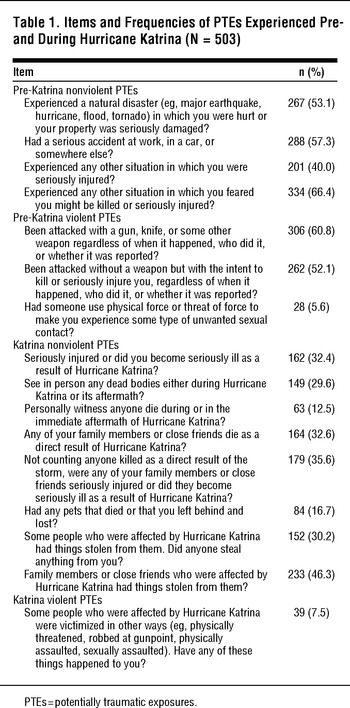
Stressful and potentially traumatic life events experienced before Hurricane Katrina were assessed using a modified version of questions from the Diagnostic Interview Schedule.17 The 8 items (Table 1) of this scale were grouped into 3 categories based on the nature of the exposure: pre-Katrina nonviolent PTE (4 items), pre-Katrina nonsexual violent PTE (2 items), and pre-Katrina sexually violent PTE (1 item). Because some research suggests that sexual violence is a unique form of violence, which may have more numerous negative long-term consequences than nonsexual interpersonal violence,Reference Burnam, Stein and Golding9Reference Norris and Kaniasty10 we examined pre-Katrina sexual and nonsexual PTEs separately. Items in each category were dichotomously scored such that if a veteran reported experiencing any item within a type of exposure, he received a score of 1.
Items and Frequencies of PTEs Experienced Pre- and During Hurricane Katrina (N = 503)

Stressful traumatic events and PTEs that the respondent may have experienced during Hurricane Katrina and its short-term aftermath were measured using 10 items (Table 1), which were modeled after other trauma scales but modified to reflect experiences that were the most relevant to Hurricane Katrina.18 For the purpose of the present study, the 10 items that concerned direct, personal PTEs were grouped into 2 categories based on the nature of the exposure: nonviolent Hurricane Katrina PTEs (8 items) and interpersonally violent PTEs during Hurricane Katrina (1 item). Items in each category were dichotomously scored such that if a veteran reported experiencing any item within a type of exposure, he received a score of 1.
Mental Health Outcomes
When possible, we used continuous measures of mental health constructs to capture symptom severity, frequency, or both. For some constructs, however, only dichotomous diagnostic screening measures were administered because of concerns surrounding participant burden.
PTSD symptom severity was assessed with the Short PTSD Rating Interview (SPRINT).Reference Connor and Davidson19 The SPRINT consisted of 8 items that assessed the presence of intrusion, avoidance, reexperience of trauma, and arousal symptoms of PTSD (eg, How much have you been bothered by poor sleep, poor concentration, jumpiness, irritability, or feeling watchful around you?). Respondents indicated to what extent they have experienced these symptoms during the past month. A 5-point response scale was used, ranging from “not at all” (scored as 0) to “very much” (scored as 4). Scores were summed for an overall scale score, with higher scores representing more PTSD symptoms. In our sample, Cronbach alpha for the scale was 0.94. The SPRINT, as opposed to other PTSD assessments, was selected for this study because of its brief administration and because past work has demonstrated that the SPRINT's validity is comparable to other self- and clinician-administered measures of PTSD.Reference Ljubotina and Muslić20Reference Vaishnavi, Payne, Connor and Davidson21
The Patient Health Questionnaire,Reference Kroenke, Spitzer and Williams22 a 2-item measure, was used to screen for depression. Total scores could range from 0 to 6, and we chose a cutpoint of 4 to indicate a positive screen for major depressive disorder. Kroenke et alReference Kroenke, Spitzer and Williams22 noted that cut scores ranging from 2 to 4 may be used; however, they cautioned that the use of a lower cutpoint to maximize sensitivity, in conjunction with a 5% to 10% prevalence of major depression, means that most patients who screen positive will be false-positive cases. As a result, we chose the higher cutpoint to maximize specificity (93.3%) while maintaining adequate although not ideal sensitivity (73.2%). Cronbach alpha for the scale was 0.84.
We used the 5-question screen from the Brief Patient Health QuestionnaireReference Spitzer, Kroenke and Williams23 to screen for panic disorder. The items question the occurrence of panic attacks and the characteristics of the attacks (eg, Do some of these attacks come suddenly out of the blue?). Respondents answer “yes” or “no” to the items. The screening instrument is scored by summing the number of yes responses. Because the majority of the sample (62%) answered no to all of the questions, a dichotomous variable was created such that a 1 indicated symptoms of panic disorder and a 0 indicated the absence of symptoms.
Generalized anxiety symptom severity was assessed with the Generalized Anxiety Disorder 7-item (GAD-7) scale.Reference Spitzer, Kroenke, Williams and Löwe24 This measure consists of 7 items for which respondents should indicate the frequency with which they have experienced particular anxiety symptoms (eg, Being so restless it is hard to sit still). Responses are made on a 4-point Likert-type scale ranging from 0 (not at all) to 3 (nearly every day). Item responses were summed to obtain a scale total score. Higher scores indicate more frequent symptoms. Cronbach alpha for the scale was 0.93.
The anger subscale of the Buss-Perry Aggression scaleReference Buss and Perry25 was used to assess respondents' experiences of anger in the past month and yields a continuous measure of anger severity. The subscale consists of 7 items describing expressions of anger (eg, When frustrated, I let my irritation show). Participants indicated how characteristic of them each statement was on a 5-point Likert-type scale. To score the subscale as described in the scoring instruction,Reference Buss and Perry25 the sum of the 7 item responses was calculated. Higher scores represent more anger. Cronbach alpha for the scale was 0.85.
Data Analysis
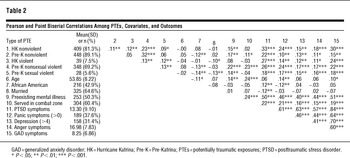
With continuous PTSD, GAD, and anger scales and dichotomous panic, depression, and PTEs measures, descriptive analyses such as frequencies, means, and standard deviations were performed. Next, Pearson and point biserial bivariate correlations were performed to understand the associations among covariates, exposures, and outcome variables. To examine the likelihood of reexposure to interpersonal violence, we performed a χ2 test of independence and calculated the odds ratio for the association between pre-Katrina and Katrina interpersonal violence. A χ2 test was selected because pre-Katrina and Katrina violence were assessed using different item(s) rather than the same item administered at different times. To examine the associations between violent and nonviolent PTEs and negative psychological outcomes after adjusting for covariates, general linear regressions or generalized linear models were performed, depending on the nature of the variable and normality of the distribution of the variable. Specifically, we examined PTSD (continuous and normally distributed) using a general linear regression, depression and panic (dichotomous) using logistic regressions, and GAD and anger (continuous, positively skewed) using loglinear models with negative binomial probability distribution (GAD) and gamma distribution (anger). Although different analyses were used, in each model the variables were entered in an order that would allow examination of the additional contribution of violent PTEs after taking into account covariates and nonviolent PTEs. For example, with the linear regression a forced entry procedure was used. This procedure was used to test our hypothesis that although recent, nonviolent PTEs may predict negative psychological outcomes, violent PTEs also may contribute to the prediction of negative outcomes. Therefore, for each model, covariates—age, African American ethnicity (with all of the others as reference group), marriage, preexisting mental illness, and military service in a combat zone—were entered first, followed by Katrina nonviolent PTEs, pre-Katrina nonviolent PTEs, Katrina violent PTEs, and pre-Katrina violent PTEs. All of the analyses were performed in SPSS version 15.0 (SPSS Inc, Chicago, IL).
RESULTS
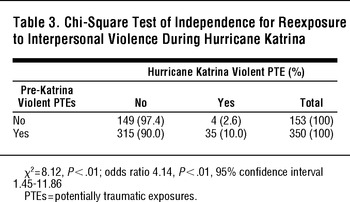
The participants reporting each PTE are described in Table 1. Means, standard deviations, frequencies, and Pearson and point biserial correlations among variables are reported in Table 2. In addition to the 216 (42.9%) African American participants shown in Table 2, 242 participants (48.1%) self-identified as white, 33 (6.6%) identified as other ethnicities, and 10 (2.0%) identified as American Indian/Alaska Native. A χ2 test with odds ratio was used to examine the likelihood of experiencing a violent PTE during Katrina among those who also experienced a violent PTE pre-Katrina. The results are presented in Table 3 and indicate that 10% of the veterans who experienced a violent PTE before Katrina also reported a violent PTE during Katrina compared with 2.6% of those with no prior interpersonal violence exposure, making veterans with a pre-Katrina violent PTE more than 4 times more likely to re-experience interpersonal violence during Katrina.
Pearson and Point Biserial Correlations Among PTEs, Covariates, and Outcomes

Chi-Square Test of Independence for Reexposure to Interpersonal Violence During Hurricane Katrina

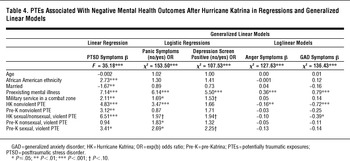
Results of the regressions and generalized linear models that examined the associations of violent and nonviolent PTEs with PTSD, GAD, and anger severity, and screening diagnoses of depression and panic are presented in Table 4. All of the models were significant overall. In terms of PTEs associated with negative outcomes, nonviolent PTEs during Katrina were associated with PTSD, panic, anger, and GAD symptoms. Pre-Katrina nonviolent PTEs were associated only with PTSD symptoms. Violent PTEs during Katrina and pre-Katrina were associated with PTSD and panic symptoms. Hurricane Katrina violent PTEs also were associated with GAD symptoms. In terms of covariates associated with negative outcomes, having a preexisting mental illness was significantly associated with symptoms of PTSD, panic, anger, and GAD and a screening diagnosis of depression. Serving in a combat zone was associated with PTSD and panic symptoms post-Katrina. African American ethnicity was associated with PTSD symptoms, whereas being married was a promotive factor for PTSD, such that married veterans were at lower risk than unmarried veterans for PTSD symptoms.
PTEs Associated With Negative Mental Health Outcomes After Hurricane Katrina in Regressions and Generalized Linear Models

DISCUSSION
In the present study, we examined the degree to which violent and nonviolent PTEs experienced before and during Hurricane Katrina were associated with symptoms of PTSD, anger, GAD, panic, and a screening diagnosis of depression 2.5 years after the storm among male veterans. Because some research, albeit with predominantly female samples, suggests that sexual violence is a unique form of violence, which may have more numerous negative long-term consequences than nonsexual interpersonal violence,Reference Burnam, Stein and Golding9Reference Norris and Kaniasty10 we examined sexual violence as a separate pre-Katrina PTE in the models. In addition, we were interested in examining among male veterans who reported a history of interpersonal violence the likelihood of reexperiencing interpersonal violence during Hurricane Katrina. Our results suggested that recent nonviolent PTEs, recent violent PTEs, and pre-Katrina sexually violent PTEs were associated consistently with symptoms of anxiety. Contrary to our expectations, only Hurricane Katrina nonviolent PTEs were associated with anger. In partial support of our hypotheses, sexually violent pre-Katrina PTEs were more predictive of PTSD than nonsexually violent pre-Katrina PTEs. In line with our reexposure hypothesis, veterans who experienced violent PTEs pre-Katrina were more than 4 times more likely to report a violent PTE during Katrina.
The number of male veterans who reported experiencing forced sex or rape (5.6%) was higher than the national averages for men's lifetime prevalence of rape (3%).Reference Tjaden and Thoennes26 Possible explanations for the higher frequency of rape may be that 50% of the sample had preexisting mental illness and mental illness is more frequent among individuals with a history of sexual violence.Reference Burnam, Stein and Golding9 Indeed, 79% (n = 22) of the men in the sample who reported sexual assault were also in the preexisting mental illness cohort. It is also possible that the frequency of sexual violence for men in the military differs from that among civilian men, but this is an empirical question. Because the present sample was not representative of veterans or specifically of veterans who experienced Katrina, this finding should be interpreted with caution.
The present study was one of the first to examine the effects of predisaster violent experiences on postdisaster mental health outcomes. Moreover, it was the first to examine the long-term effects of men's experience of rape on psychological functioning after a natural disaster. The findings have implications for disaster mental health triage and the identification of individuals at risk for mental health problems after a disaster. Specifically, our results suggest that in addition to assessing an individual's experiences during a disaster, triage procedures and instruments should also take into consideration men's predisaster interpersonal violence; for military veterans, this may also include experiences during service, such as combat trauma and military sexual trauma. Identifying predisaster factors that discriminate men who are at risk for mental health problems may be particularly important in widespread catastrophic events, when mental health resources are limited and substantial portions of the population report similar disaster exposures. Increasing the sensitivity and predictive validity of mental health triage and pairing triage with effective disaster mental health services have the potential to prevent the onset of new psychological disorders after a disaster, and thus may have both individual and public health benefits. Although not ideal, survey instruments that assess past violent exposures in addition to other risk behaviors often use single items (eg, Youth Risk Behavior Survey),27 therefore, adding items similar to the item used in the present study to triage instruments would be an acceptable method of capturing violent exposures.
The likelihood of violent reexposure during Katrina for male veterans who experienced pre-Katrina interpersonal violence was striking and suggests an opportunity for interpersonal violence prevention during disasters. Research has demonstrated that disasters increase the risk for interpersonal violence,Reference Schumacher, Coffey, Norris, Tracy, Clenents and Galea13 particularly among women with a history of interpersonal violence. Our results extend this finding to men. Explanations for revictimization suggest complex associations between the initial victimization, mediating risk factors, and subsequent victimization. Most theories suggest that the context (eg, unstable family environment) or sequelae of experiencing interpersonal violence (eg, alcohol use) create opportunities or increased risk for reexposure.Reference Fargo28Reference Testa, Hoffman and Livingston29 It is important to note that identifying factors associated with reexperiencing interpersonal violence in no way places blame on the survivor but may offer avenues for prevention. Although some work has suggested approaches to interpersonal violence prevention postdisasters,Reference Klein30 much more research is needed in this area. Moreover, owing to the limited infrastructure after a disaster, violence-prevention efforts may benefit from being integrated with other disaster-response activities.
This study was limited in that we used secondary data analyses to examine hypotheses for which the data were not originally designed. This affected our findings in 2 ways. First, little information about the context of the event was included, such that it was not possible to determine whether some of the nonviolent PTEs contained aspects of violence. For example, the context of “seeing dead bodies,” a nonviolent PTE, was unclear. Second, the data were not representative of all of the veterans, did not include female veterans, and overrepresented veterans with a mental illness. These factors enabled us to obtain a sufficient sample of male veterans who had been raped to examine the effects of sexual violence; however, frequencies of exposures should not be considered generalizable to veterans as a whole or, more specifically, to the population of veterans in Louisiana and Mississippi who experienced Hurricane Katrina.
CONCLUSIONS
Natural and human-made disasters have multiple negative effects on individuals, communities, and society, not the least of which is an increased risk for mental illness among survivors. Developing procedures and tools to identify and triage individuals who are at particularly high risk for negative mental health outcomes after a disaster may have preventive effects and may mitigate the long-term effects of the PTE. The present study examined the influence of violent and nonviolent PTEs experienced pre- and during Katrina on subsequent mental health symptoms. For several disorders, violent PTEs, in addition to recent, nonviolent PTEs, were associated with psychological symptoms. Results suggest that in addition to disaster-specific exposures, considering sexually violent PTEs before the disaster may be useful in identifying individuals at risk for post-disaster mental illness.