INTRODUCTION
The phenotypic selection to improve performance traits, e.g. growth or milk yield, causes the co-selection of a generally unknown underlying genetic architecture (Dekkers and Hospital, Reference Dekkers and Hospital2002). As a consequence, selection for desired traits can have detrimental effects on other traits (Williams, Reference Williams2005). For example, long-term selection for growth in mice has produced individuals with seemingly shorter life-spans and reduced fertility (Bünger et al. Reference Bünger, Renne, Buis and Reeve2001). A review by Rauw et al. (Reference Rauw, Kanis, Noordhuizen-Stassen and Grommers1998) concluded that selection for high body weight in poultry decreased fertility and immunocompetence whilst also increasing the occurrence of defective eggs and chromosomal abnormalities. This review also suggested that selection for high milk yield in dairy herds increased the incidence of diseases such as ketosis or mastitis and general leg problems. The observation of these correlations may be due to various mechanisms.
It has been suggested that the genetic mechanism behind changes in correlated traits could be due to pleiotropy and/or genetic linkage and that consequently these would be seen under all environmental conditions (Rauw et al. Reference Rauw, Kanis, Noordhuizen-Stassen and Grommers1998). Alternatively, observed losses in traits could be explained by a change in the prioritization of allocation of scarce resources. In selectively bred hosts, relatively more of the available scarce resources may be allocated towards the selected trait because of its increased nutrient demand, when compared to unselected counterparts. As a consequence, fewer resources would be allocated to other bodily functions, including immunity (Beilharz et al. Reference Beilharz, Luxford and Wilkinson1993; Beilharz, Reference Beilharz1998a, Reference Beilharzb; Glazier, Reference Glazier2002). In support of this view, protein scarcity has been shown to reduce immunity (resistance) to parasites to a greater extent in fast-growing and multiple-rearing hosts compared to their slower growing and single-rearing counterparts (reviewed by Houdijk et al. Reference Houdijk, Jessop and Kyriazakis2001; Houdijk and Athanasiadou, Reference Houdijk and Athanasiadou2003).
During gastrointestinal (GI) parasitic infection, anorexia (or the reduction in voluntary food intake) is a common observation, which may be considered as a functional host response and substantially contributes to observed losses in production (Kyriazakis et al. Reference Kyriazakis, Tolkamp and Hutchings1998). It has been suggested that selected animals may have an altered degree of anorexia due to the observation that intensely selected animals show reduced resistance and the assumption that anorexia diminishes as immunity increases (Sandberg et al. Reference Sandberg, Emmans and Kyriazakis2006; Vagenas et al. Reference Vagenas, Bishop and Kyriazakis2007). Selection for high growth can be expected to increase nutrient demand and thus reduce disease resistance. However results have been inconsistent for the strength and direction of the genetic correlation between growth and resistance (Broughan and Wall, Reference Broughan and Wall2007). Studies in livestock species involving interactions between genetic selection for growth and immunity to GI nematodes are limited by the shortage of truly comparable breeds, as breeds have been selected often from different founder populations and have been selected for different and changing breeding goals in different environments. The use of a unique mouse model involving 2 lines derived from the same base population (implying an identical initial genetic makeup) divergently selected purely on the basis of high and low body weight at 42 days of age may enable the elucidation of further interactions between selecting for growth traits and immunity.
Using this mouse model our objectives were to assess the effects of selection for high body weight on the ability to cope with a pathogen challenge, on the degree of anorexia observed and the response to increasing protein nutrition during infection. We hypothesized that mice selected for high body weight experience a greater penalty to the resilience (performance under infection) and resistance to infection than their low body weight counterparts, that anorexia would be more severe in mice selected for high body weight, and that these penalties would be reduced at higher dietary protein contents.
MATERIALS AND METHODS
Animals and housing
A total of 72 Roslin High (ROH) and 72 Roslin Low (ROL), newly weaned male mice aged 21 to 23 days were housed in a room with an ambient temperature of 21±1°C and a 12 h light cycle (06.00 to 18.00 h). The ‘Roslin lines’ of mice were produced from a cross of 2 inbred lines (C57BL/6J×DBA/2J), which were subsequently divergently selected for high (ROH) or low (ROL) body weight (BW) at 42 days of age and afterwards inbred for over 38 generations (described in detail by Heath et al. Reference Heath, Bulfield, Thompson and Keightley1995; Bünger et al. Reference Bünger, Renne, Buis and Reeve2001). ROH mice reach body weights of 36 g and 41 g (at 42 and 70 days of age respectively) with ROL mice reaching 16 g and 19 g (at 42 and 70 days of age respectively) when offered a standard diet (see below) and kept under standard maintenance conditions. ROH and ROL mice entered the adaptation phase (see below) of the experiment with a mean (±s.e.) body weight of 16·7±0·48 g and 6·66±0·17 g, respectively. Mice were individually housed in solid-bottomed cages with fresh sawdust and bedding material provided weekly. The experimental details described below were approved by the Animal Experiment Committee of Scottish Agricultural College (ED AE 05/2007) and carried out under Home Office regulations (PPL 60/3626).
Diets
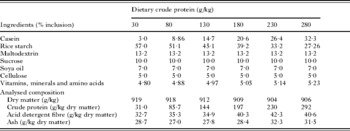
All mice were fed ad libitum a standard pelleted expanded breeding diet (Rat and Mouse No. 3, Special Diet Services, Witham, UK; digestible crude oil: 39 g/kg; digestible crude protein: 209 g/kg, starch: 273 g/kg; sugars: 112 g/kg; digestible energy: 12·1 MJ/kg) for 3 days after arrival. A total of 6 isoenergetic (Digestible Energy, 15 MJ/kg) pelleted experimental diets with a fixed amino acid to crude protein (CP) ratio were used at differing levels of CP; 30, 80, 130, 180, 230 and 280 g/kg (Table 1). These CP levels were chosen to range from scarce to more than adequate in gradually increasing increments (NRC, 1995), where most standard diets contain 180–200 g/kg, and to capture the low dietary protein contents used elsewhere in studies on nutritional sensitivity of parasitism in mice (Slater and Keymer, Reference Slater and Keymer1988; Boulay et al. Reference Boulay, Scott, Conly, Stevenson and Koski1998; Ing et al. Reference Ing, Su, Scott and Koski2000; Tu et al. Reference Tu, Koski, Wykes and Scott2007). As casein was used as the protein source, 15 g cysteine was added to each kg of casein to account for the relative scarcity of this amino acid. The 30 and 280 g/kg CP diets were formulated and the 80, 130, 180 and 230 g/kg CP diets were then produced using an appropriate mixture of the 30 and 280 g/kg CP diets (Table 1).
Chemical and analysed composition of the 6 experimental diets

Infection protocol and experimental design
At day 0 of the experiment mice either received a single infection of 250 Heligmosomoides bakeri infective larvae (L3) suspended in 0·2 ml of water (I) or a sham infection of 0·2 ml of water (C) via oral gavage (Houdijk and Bünger, Reference Houdijk and Bünger2007). The H. bakeri, formerly known as Heligmosomoides polygyrus bakeri and Nematospiroides dubius (Cable et al. Reference Cable, Harris, Lewis and Behnke2006), were donated by Professor Jerzy Behnke, University of Nottingham, UK (see Jenkins and Behnke, Reference Jenkins and Behnke1977 for full origin details). The dose of H. bakeri was chosen to produce a subclinical level of infection that is known to affect the growth of the mice (Houdijk and Bünger, Reference Houdijk and Bünger2006, Reference Houdijk and Bünger2007). Previous studies using higher levels of infection with H. bakeri found that 400 L3 caused a 10% mortality rate in heterozygous mice (Ehrenford, Reference Ehrenford1954a) whereas in NZB mice 100% mortality was achieved at 300 L3 (Mitchell and Prowse, Reference Mitchell and Prowse1979). Although it is known that variation in the genetic background of mice used in infection studies substantially affects the response to larval dose (Liu, Reference Liu1966; Mitchell and Prowse, Reference Mitchell and Prowse1979; Behnke et al. Reference Behnke, Lowe, Clifford and Wakelin2003), it is not known whether this is also the case for the ROH/ROL parent lines.
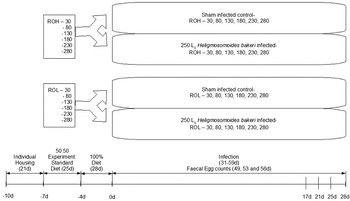
I and C mice of the ROL and ROH line were fed ad libitum on 1 of the 6 experimental diets (referred to as 30, 80, 130, 180, 230 and 280) with 6 replicates in each group, resulting in 24 treatment combinations. Figure 1 shows the experimental design and timetable. Mice entered the adaptation phase at approximately 3 weeks of age (day-10 of experiment). This consisted of a period where a 50:50 mix of experimental and standard diet was offered to acclimatize the mice to the experimental diet (day-7 until day-4) with infection occurring at day 0; between days-3 and 0 mice were only offered the experimental diets. Mice were humanely killed (aged between 49 and 53 days) on day 28 post-primary infection (p.i.), for the assessment of worm burdens, colon egg count and body fat percentage.
Diagram of experimental design. Timeline in experimental days shown along the bottom and mean age of mice between brackets. Allocation of mice to diets occurred when 50:50 experimental:standard diet was offered, mice were then further allocated to infection groups within these diets at day 0 of the experiment.

Sample measurements and collection
Body weight and food intake
Mice and food refusals were weighed twice weekly (Tuesday and Friday) throughout the experiment resulting in 8 experimental periods for food intake and 8 observations on post-infection body weight until day 28. On each of these days food refusals were weighed out and fresh food weighed in, around 30 g was offered to ROH and 15 g to ROL mice, this was sufficient for ad libitum feeding. Food intake was calculated per individual per day within each of the 8 experimental periods. Body weight data were used to calculate body weight gain over the post-infection (p.i.) period.
Nematode egg counts
Mice were placed onto wire-bottomed cages overnight and faecal samples collected on days 17, 21 and 25 p.i. to assess faecal egg counts (eggs per g faeces). This was carried out using a modified flotation technique (Christie and Jackson, Reference Christie and Jackson1982). The total period of faecal collection (finish time – start time) was recorded to estimate faeces volume per 12 h, assuming even production of faeces during the collection period. This faeces volume was used to standardize egg output per 12 h (EO, eggs per 12 h) to eliminate variation between achieved collection times as well as to account for the dilution effect on faecal egg counts expected for ROH mice due to their larger volumes of faeces.
Colon contents and worm burden
Mice were humanely killed on day 28 via CO2 inhalation and dissected to obtain the small intestine and the colon. The small intestine was weighed, opened up and placed in a gauze pouch suspended in Hanks' solution, this was then incubated at 37°C for 3 h to collect the adult worms (Wahid and Behnke, Reference Wahid and Behnke1992). A 5% formalin solution was added to the recovered worms, and the intestine and gauze checked for remaining worms. Male and female worms were separated and counted. The colon contents were weighed and a colon egg count (eggs per g) performed. The colon egg count was then multiplied by colon contents weight to account for dilution effects arising from the expected larger colon content volume of the ROH mice. Resultant data were therefore expressed as number of eggs in colon (EIC, number of eggs). The EIC was divided by the number of females counted to obtain an estimate for the per capita fecundity (PCF, eggs per female).
Fat percentage
The carcasses were then weighed and bagged for subsequent freeze-drying to allow prediction of fat percentage. To prepare the carcass for the freeze-drying process incisions were made in the back, tail and head of the animal to allow maximum water loss. The carcasses were then placed onto individual labelled trays and the freeze-drier turned on. After approximately 7 days (or weight loss ceased) at −70°C the carcasses were removed and re-weighed. To calculate fat percentage the following equation was used (Hastings and Hill, Reference Hastings and Hill1989):

Statistical analysis
Due to the skewed nature of the data, EO, EIC and PCF were log10 (n+1) transformed. These are reported as back-transformed least-square means, accompanied by a lower and upper confidence interval, calculated from back-transforming least-square mean of transformed data (μ), μ – s.e. and μ+s.e. respectively. To adequately account for the relatively large differences in performance data between the mouse lines, arising from the difference in body weights per se between ROL and ROH mice, body weight and food intake data were also log10 (n+1) transformed before analysis (Falconer and MacKay, Reference Falconer and MacKay1996). Repeated measures Restricted Maximum Likelihood (REML) was used to assess interactive effects of genetic growth potential, dietary protein content, infection status and time on body weight, food intake and EO. The full repeated measures model is as follows: parameter of interest=genetic potential (G)+crude protein content (CP)+infection status (I)+time (t)+all possible six 2-way interaction+all possible three 3-way interaction+the 4-way interaction (G.CP.I.t). REML analysis was also used to assess interactive effects between genetic growth potential, dietary protein content and infection status on average daily weight gain, average food intake and body fat percentage. The full REML model is as follows: parameter of interest=G+CP+I+all possible three 2-way interaction+the 3-way interaction (G.CP.I). Where significant, litter was included as a random effect. To account for a possible overestimation of effect size arising from the unbalanced nature of the data (see results), each P-value reported was calculated conservatively through including first all other terms into the final REML model. Interaction terms that did not approach significance at P<0·05 were omitted from the final REML models for each parameter. F-statistics reported are followed by the numerator then the denominator degrees of freedom in subscript. Effects with P-values less than 0·05 are considered significant whilst those with P-values between 0·05 and 0·10 are described as tendencies or trends. All statistical analyses were performed using Genstat 11 for Windows release 11.1, 2008 (VSN international, Hemel Hempstead, UK).
RESULTS
Loss of the infected ROL-30 group
ROL-30-I mice were found to show severe clinical signs of infection at day 7 p.i. such as starry coat, unsteadiness and disorientation. These mice were euthanized and this treatment group discontinued in accordance with previously defined end-points. Thus, the resulting dataset was characterized as an incomplete 2×2×6 factorial design, which consequently was appropriately analysed through REML.
Body weight gain and food intake
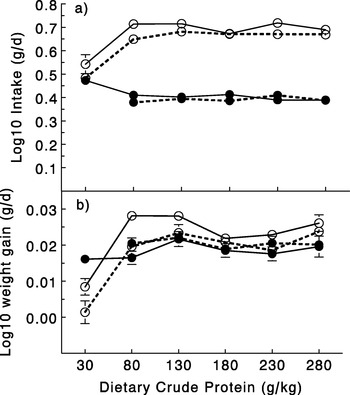
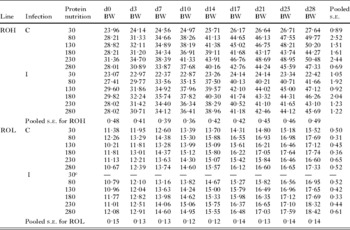
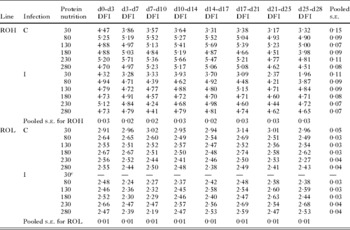
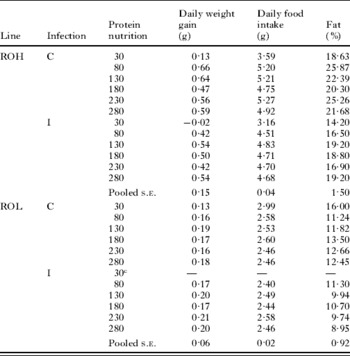
Mean observed body weight and food intake are summarized in Tables 2 and 3, respectively, whilst mean performance data for each line×infection×feeding treatment are summarized in Table 4. Figure 2 shows the log-transformed mean of daily weight gain and food intake over the experiment. ROH mice, with the exception of ROH-30-I mice, gained more weight over the experiment than ROL mice (mean=0·497±0·202 g per day and 0·175±0·005 g per day respectively; F1,114=529·55, P<0·001). However, on average ROH-30-I mice did not gain weight across the experiment (mean=−0·02±0·04 g per day).
(A) Log10 transformed daily food intake and (b) body weight gain of high (ROH – open circle) and low (ROL – closed circle) body weight mice averaged across 28 days of infection with Heligmosomoides bakeri (dashed line) or sham infection with water (solid line) at different levels of dietary CP.

Summary of mean body weights (BW in g) and pooled standard errors (s.e.) over time and at each time-pointFootnote a, Footnote b

a Raw data shown.
b ‘Roslin’ mice divergently selected for high (ROH) and low (ROL) body weight were either sham-infected (C) or infected with 250L3Heligmosomoides bakeri (I). Experimental diets contained 30, 80, 130, 180, 230 or 280 g crude protein per kg.
c ROL-30-I showed clinical signs of infection and were discontinued.
Summary of mean average daily food intakes (DFI in g) and pooled standard errors (s.e.) over time and at each time-periodFootnote a, Footnote b

a Raw data shown.
b ‘Roslin’ mice divergently selected for high (ROH) and low (ROL) body weight were either sham-infected (C) or infected with 250L3Heligmosomoides bakeri (I). Experimental diets contained 30, 80, 130, 180, 230 or 280 g crude protein per kg.
c ROL-30-I showed clinical signs of infection and were discontinued.
Summary showing means and pooled standard errors (s.e.) of performance dataFootnote a, Footnote b

a Data were log transformed for statistical analysis.
b ‘Roslin’ mice divergently selected for high (ROH) and low (ROL) body weight were either sham-infected (C) or infected with 250L3Heligmosomoides bakeri (I). Experimental diets contained 30, 80, 130, 180, 230 or 280 g crude protein per kg.
c ROL-30-I showed clinical signs of infection and were discontinued.
A three-way interaction between genetic growth potential, protein nutrition and infection status was observed for body weight gain (F4,114=3·01, P=0·021). This was due to ROH mice showing a reduction in weight gain on the 30 g CP per kg diet and also in response to infection on 30, 80 and 130 g CP per kg diets whilst ROL mice maintained a relatively stable weight gain regardless of experimental group. ROH mice gained more weight than ROL mice, with the exception of ROL-30-C gaining more than ROH-30-I (F1,114=529·55, P<0·001). The random effect of litter was not significant (P>0·10).
Genetic growth potential interacted with dietary protein content and with infection status for average daily (log-transformed) food intake (Fig. 2). The interaction with dietary protein content resulted from decreased food intake of ROH-30 mice whereas ROL-30 mice increased their intake on this diet when compared to other diets (F5,103=29·44, P<0·001). The interaction with infection status was reflected in a reduced intake following infection in ROH mice but not in ROL mice (F1,99=6·70, P=0·011). Across feeding and infection treatments, ROH mice consumed more food than ROL mice (F1,36=1188·36, P<0·001). The random effect of litter was significant (deviance ratio=6·53, d.f.=1, P=0·01).
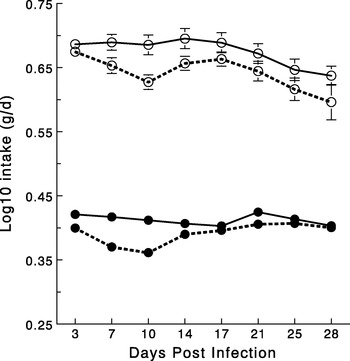
Figure 3 shows the log-transformed mean of daily food intake over time. Time and infection status interacted for average daily food intake (F7,811=3·33, P=0·002); infection caused a temporary decrease in voluntary intake between day 3 and day 14 p.i. This anorexia was not affected by genetic growth potential. However, the analysis of food intake over time showed two 3-way interactions. Firstly, infection status interacted with protein and time as evidenced by the variable presence of anorexia over the 6 levels of dietary CP (F35,860=2·6, P<0·001). Anorexia was not observed for 3 of the remaining 11 mice line – feeding treatment combinations, i.e. ROH-130, ROH-180 and ROL-230. Secondly, genetic growth potential interacted with protein and time as evidenced by a larger decline in intake over time on the 30 g/kg CP in ROH mice compared to ROL mice (F35,860=1·62, P=0·014). In addition and in comparison with the other experimental diets, ROH-30 mice had a lower intake whilst for ROL-30 mice intake on this diet was the highest.
Log10 transformed daily food intake of high (ROH – open circle) and low (ROL – closed circle) body weight mice following infection with Heligmosomoides bakeri (dashed line) or sham infection with water (solid line) over the 28-day experimental period.

Egg output, eggs in colon and worm burden
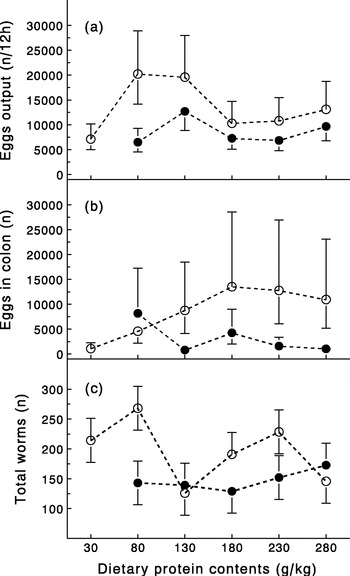
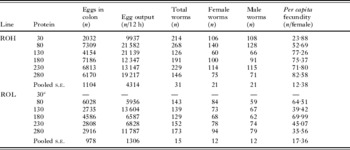
Mean parasitism data for each line×infection×feeding treatment combination are summarized in Table 5. Figure 4 shows the back-transformed mean EO, EIC and mean total worm burden. The 12 h faecal production was higher in ROH mice than in ROL mice (0·55 vs 0·34 g; s.e.d: 0·025 g; F1,54=38·49, P<0·001), which justified the need to account for potential dilution effects on faecal egg counts. Genetic growth potential and feeding treatment did not significantly interact with time for EO. Therefore, the mean EO averaged over days 17, 21 and 25 p.i. was analysed. Back-transformed EO are shown in Fig. 4. Genetic growth potential and dietary protein contents interacted for EO (F4,29=2·95, P=0·036); EO tended to be consistently higher in ROH than in ROL mice (F1,32=2·94, P=0·096) but was significantly higher on 80 g/kg CP diets only. Increasing dietary protein content also increased 12 h faecal production in both lines (F5,27=5·65, P<0·001). The random effect of litter was significant (deviance ratio=19·19, d.f.=1, P<0·001).
(A) Back-transformed 12 h egg output averaged over days 17, 21 and 24 post-infection. (B) Back-transformed number of eggs in the colon on day 28 post-infection. (C) Total worm burden on day 28 post-infection for high (ROH – open circle) and low (ROL – closed circle) body weight mice, infected with Heligmosomoides bakeri and fed different levels of dietary crude protein (CP) for 28 days.

Summary showing means and pooled standard errors (s.e.) of parasitism dataFootnote a, Footnote b

a Egg count and fecundity data were log transformed for statistical analysis.
b ‘Roslin’ mice divergently selected for high (ROH) and low (ROL) body weight were fed either 30, 80, 130, 180, 230 or 280 g crude protein per kg diets.
c ROL-30-I showed clinical signs of infection and were discontinued.
Genetic growth potential and feeding treatment interacted for colon contents weight (F5,54=23·01, P<0·001); increasing dietary protein content increased colon content weight in ROH mice but decreased colon contents weight in ROL mice. Across feeding treatments, weight of colon contents was higher in ROH mice than in ROL mice (0·21 vs 0·16 g; s.e.d. 0·014 g; F1,54=13·00, P=0·001). As with faecal output, these observations justified accounting for effect of colon contents volume on worm egg concentrations. Genetic growth potential and feeding treatment did not interact for EIC. However, EIC was significantly higher in ROH mice than ROL mice (F1,58=5·97, P=0·018; Fig. 4). The random effect of litter was not significant (P>0·10).
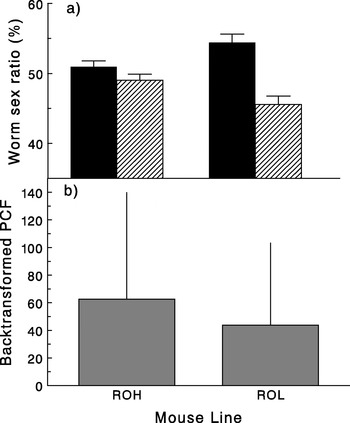
Genetic growth potential and feeding treatment did not interact for total worm counts (Fig. 4). However, genetic growth potential affected male worm numbers, as ROH mice had significantly higher numbers of male worms than ROL mice (96 vs 68; s.e.d. 10·9; F1,54=6·10, P=0·017). Figure 5 shows the sex composition of the worm burdens and per capita fecundity. Genetic growth potential significantly affected worm burden sex composition; ROL mice had a higher percentage of female worms than ROH mice (54·43 vs 49·72%; s.e.d. 1·889%; F1,63=6·21, P=0·021). Per capita fecundity tended to be higher in ROH mice than in ROL mice (F1,62=3·37, P=0·071) but was not affected by dietary CP contents. The random effect of litter was not significant for worm numbers or per capita fecundity (P>0·10).
(A) Sex ratio of worm burdens (% female worms-solid bar and % male worms-patterned bar) and (B) mean back-transformed per capita fecundity (PCF) for high (ROH) and low (ROL) body weight mice taken 28 days after infection with Heligmosomoides bakeri.

Body fat percentage
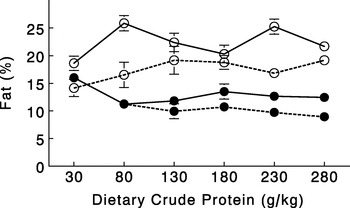
A three-way interaction between genetic growth potential, dietary protein and infection status was significant for body fat percentage (F4,109=2·78, P=0·030; Fig. 6). ROH mice had higher body fat percentage than ROL mice (F1,35=134·95, P<0·001) and infection reduced body fat percentage in both ROH and ROL mice (F1,92=65·88, P<0·001). However, body fat percentage seemed to increase with higher levels of dietary CP contents for infected ROH mice, whilst it decreased for infected ROL mice. ROL mice had their highest body fat percentage at 30 g CP per kg. The random effect of litter was significant (deviance ratio=9·78, d.f.=1, P=0·002).
Average body fat percentage of high (ROH – open circle) and low (ROL – closed circle) body weight mice either infected with Heligmosomoides bakeri (dashed line) or sham infected with water (solid line) at different levels of dietary CP, taken 28 days after infection.

DISCUSSION
The results of this study supported our hypothesis that selection for high body weight in mice imposes a greater penalty on resistance and resilience to parasite infection than selection for low body weight, and that improved protein nutrition could ameliorate the penalty on host resilience. However, in contrast to our other hypotheses, our results also showed that this difference in genetic growth potential did not affect anorexia, and that increased protein nutrition did not affect host resistance.
Body weight and feed intake
It was found that ROH mice had a greater reduction in average daily intake and daily weight gain, but a similar reduction in body fat percentage in response to infection relative to ROL mice. Although this effect has not been addressed in divergently selected mouse lines, infections have been shown to produce reductions in both food intake and body weight gain in mice (Brailsford and Mapes, Reference Brailsford and Mapes1987; Tu et al. Reference Tu, Koski, Wykes and Scott2007). Moreover, Kristan and Hammond (Reference Kristan and Hammond2001, Reference Kristan and Hammond2006) investigated the effect of H. bakeri infection on body fat in Swiss-Webster mice and found a reduction of 20% on average, which corresponds very well to the reduction found in the current study in both the ROH and ROL mice (an average of 21·5% and 21·8% respectively). This reduction of body fat appears to suggest that the two genetic lines utilized energy similarly in response to infection and suggests a possible role for energy nutrition during gastrointestinal nematode infections. Indeed, caloric restriction, via restrictive feeding protocols (causing mainly energy restriction but in addition also some degree of protein restriction), may increase susceptibility to parasite infection and also worm burdens and parasite fecundity (Koski et al. Reference Koski, Su and Scott1999; Kristan, Reference Kristan2008). However, the sham-infected animals showed a difference in their allocation rules, with ROH-80-280 mice having increased body fat compared to ROH-30 whilst ROL-30 mice have the highest body fat compared to ROL-80-280.
Increasing dietary CP contents to 130 g CP per kg and above resulted in increased host resilience in ROH mice, as illustrated by reduced penalty of infection on food intake and body weight gain. A preliminary study using ROH and ROL mice did find that feeding a 250 g CP per kg diet similarly reduced the penalty of infection on body weight gain in ROH mice when compared to ROH mice fed 50 g CP per kg (Houdijk and Bünger, Reference Houdijk and Bünger2007). This is consistent with our findings, and suggests that moderate protein nutrition using highly digestible protein sources (130 g CP per kg diet) may ameliorate losses in production during a primary infection with gastrointestinal nematode parasites.
Anorexia, characterized as a temporary reduction in food intake following infection, is a common outcome of exposure to pathogens, including gastrointestinal parasites (Kyriazakis et al. Reference Kyriazakis, Tolkamp and Hutchings1998; Mercer et al. Reference Mercer, Mitchell, Moar, Bisset, Geissler, Bruce and Chappell2000). Its biological relevance is evident from force-feeding studies. For example, Murray and Murray (Reference Murray and Murray1979) observed increased host mortality following force-feeding mice during a Listeria monocytogenes infection. However, the time-course of anorexia has not been described in detail during H. bakeri infection; to date, studies have only reported a decrease in food intake over the entire experimental period (Brailsford and Mapes, Reference Brailsford and Mapes1987; Shi et al. Reference Shi, Koski, Stevenson and Scott1997; Boulay et al. Reference Boulay, Scott, Conly, Stevenson and Koski1998; Tu et al. Reference Tu, Koski, Wykes and Scott2007). This study, therefore, is the first to describe the time-course of anorexia during a primary infection of H. bakeri. Anorexia in both lines was found to occur between day 3 and day 14 post-primary infection. Although genetic growth potential was not found to affect anorexia overall, whether anorexia differed between lines depended on dietary protein content. ROH mice did not show anorexia at 130 or 180 g CP per kg whilst ROL mice did not show anorexia at 230 g CP per kg only. This apparent lack of systematic effect of dietary CP content on anorexia in both lines may be due to variation in food intake at different levels of dietary CP in the sham-infected mice. Although a lack of systematic research in this area makes it difficult to reach a consensus on the effect of diet composition on anorexia (Kyriazakis, Reference Kyriazakis2009), the data from this study would support the view that the degree of anorexia does not depend on dietary CP contents. The latter is consistent with earlier work done on H. bakeri (Brailsford and Mapes, Reference Brailsford and Mapes1987) but also on sheep infected with T. colubriformis (Kyriazakis et al. Reference Kyriazakis, Anderson, Oldham, Coop and Jackson1996) and Haemonchus contortus (Datta et al. Reference Datta, Nolan, Rowe and Gray1998).
Egg output, eggs in colon and worm burden
Compared to ROL mice, infection in ROH mice produced greater 12 h egg output, total eggs in the colon contents and per capita fecundity. This suggests that ROH mice had an impaired resistance to H. bakeri, which in turn implies that selection for high body weight may produce a loss of immunity towards pathogen challenge. Since this reduced immunocompetence was observed at times of apparently adequate CP nutrition, it may not necessarily have arisen from reduced allocation of scarce protein to host immune functions. Influences of host genetics on H. bakeri infection have long been considered and some commonly used mouse strains have now been categorized as high or low responders based on LD50 experiments and also according to time taken to clear out the infection (Liu, Reference Liu1966; Iraqi et al. Reference Iraqi, Behnke, Menge, Lowe, Teale, Gibson, Baker and Wakelin2003). Given that genetic differences in immunocompetence between the ROH and ROL mice exist they could potentially be the result of a true genetic correlation or drift. As selection for high production in lambs can also impair the ability to cope with pathogens, as lambs with a high growth potential had higher faecal egg counts than their low growth potential counterparts (Zaralis et al. Reference Zaralis, Tolkamp, Houdijk, Wylie and Kyriazakis2008) it is suggested that it is more likely a genetic correlation than drift.
Consistent with our results, Slater and Keymer (Reference Slater and Keymer1988) also did not find an effect of increased protein nutrition on worm burdens or egg counts during a primary infection. However, Boulay et al. (Reference Boulay, Scott, Conly, Stevenson and Koski1998) did report a significant reduction in worm burdens in mice fed 240 g CP per kg when compared to 30 and 70 g CP per kg diets. These mice were older than those in the current study, which may have led to stronger immune response per se (Goff et al. Reference Goff, Johnston, Parish, Barrington, Tuo and Valdez2001; Miller et al. Reference Miller, Dunn, Reid, Ogden and Strachan2005). In addition, it remains to be elucidated whether the differences between Boulay's findings and our own may have arisen from differences in feeding treatment regime, i.e. our study introduced the experimental diets 1 week before infection whilst in the study of Boulay et al. (Reference Boulay, Scott, Conly, Stevenson and Koski1998), mice were fed the experimental diets several weeks before infection. During secondary infections, protein scarcity, arising from feeding 20 or 30 g CP per kg diets, decreased weight gain and increased worm burdens and egg counts when compared with diets with 70 or more g CP per kg (Slater and Keymer, Reference Slater and Keymer1988; Boulay et al. Reference Boulay, Scott, Conly, Stevenson and Koski1998). In addition, it was shown that switching food types from protein deficient (30 g/kg) to protein sufficient (240 g/kg) during primary or secondary infection with H. bakeri was also shown to rapidly restore body weights in mice and resulted in a reduction of worm burdens and faecal egg counts during secondary challenge to levels achieved on the protein sufficient diet for the entire study (Tu et al. Reference Tu, Koski, Wykes and Scott2007). Taken together, these and our findings support the view that protein scarcity affects expression of immunity to a larger extent that acquisition of immunity (Coop and Kyriazakis, Reference Coop and Kyriazakis1999).
The lower level of EO in ROH mice on diet 30 compared to diet 80 was an unexpected result but in agreement with similar findings in sheep, primary infected with the small intestinal nematode Trichostrongylus colubriformis (Athanasiadou et al. Reference Athanasiadou, Kyriazakis, Jackson and Coop2001). These observations may suggest that very low levels of nutrient supply can limit the parasite as well as the responses of the host (Houdijk and Athanasiadou, Reference Houdijk and Athanasiadou2003). In the case of H. bakeri, these limitations may be incurred through villus atrophy that occurs under protein scarce environments (Tu et al. Reference Tu, Koski, Wykes and Scott2007). This in turn may reduce availability of epithelial cells as a food resource to H. bakeri (Bansemir and Sukhdeo, Reference Bansemir and Sukhdeo1994, Reference Bansemir and Sukhdeo1996).
The worm burden results were more subtly altered than egg count parameters in this current study with ROL mice showing a female worm bias. Such a bias is commonly reported in studies involving wild mice (Keymer and Dobson, Reference Keymer and Dobson1987; Gregory et al. Reference Gregory, Montgomery and Montgomery1992). This difference in worm sex ratios between ROH and ROL may also be a product of potential genetic drift or inherent genetic correlation. Alternatively, differences in parasite sex ratios may be influenced by factors such as mating probabilities and disproportional survival between the sexes during larval stages in the host (Stien et al. Reference Stien, Dallimer, Irvine, Halvorsen, Langvatn, Albon and Dallas2005).
Loss of ROL-30-I group
The loss of the ROL-30-I group made comparison of the treatment groups incomplete. Had this group been present, then the effect of protein on scarcity on resilience and resistance to H. bakeri infection may have been better understood. Clinical symptoms of infection were observed in this group from day 7 p.i. which corresponds to the time when larvae migrate from the intestinal mucosa to the lumen for their final moult to adult worms (Ehrenford, Reference Ehrenford1954b). This process is probably associated with mucosal damage, leading to loss of plasma proteins and epithelial cells, which are common features of intestinal parasitism (Coop and Holmes, Reference Coop and Holmes1996; van Houtert and Sykes, Reference van Houtert and Sykes1996). Because such losses would interfere with host maintenance, parasitized hosts would be expected to attempt to replenish them (Coop and Kyriazakis, Reference Coop and Kyriazakis1999). Moreover, replenishment of these losses is the largest contributor to elevated protein requirements during gastrointestinal nematode infections (Houdijk et al. Reference Houdijk, Jessop and Kyriazakis2001). The clinical signs observed in the ROL-30-I mice may have arisen from their inability to respond to this temporary increased protein requirement. ROH-30-I mice did not show any clinical signs but displayed a small, temporal reduction in body weight on day 7 p.i. relative to day 4 and day 10 p.i. at similar levels of intake. This may suggest they were more able than their ROL counterparts to utilize body reserves to cope with the assumed temporal elevation of protein requirements at times of dietary protein scarcity. ROL mice infected with 250 L3H. bakeri and fed ad libitum a 50 g CP per kg food did not have any clinical signs of parasitism as observed in this study (Houdijk and Bünger, Reference Houdijk and Bünger2007). In addition, a single infection with 150 L3 in 3 spare ROL-30-I mice also resulted in no clinical signs but a small temporal drop in body weight and an approximately 20% reduction in body weight gain over 28 days p.i. was observed, relative to ROL-30-C mice (data not shown). Taken together, these observations suggest that the inability of ROL-30-I mice to cope with the experimental treatment was likely a combination of the low dietary CP contents, the relatively high level of infection and their small body size.
The growth performance data obtained in the current experiment support the view that protein scarcity may only have been achieved in the ROH-30 mice; Fig. 2 suggests that growth performance did not differ between 80–280 g CP per kg in both lines whilst 30 g CP per kg causes a significant loss of performance in ROH mice when mice were not infected. This is in agreement with earlier findings, where BALB-c mice fed diets with 70 and 240 g CP per kg had similar growth performance, which was higher than that of mice fed diets with 30 g CP per kg (Boulay et al. Reference Boulay, Scott, Conly, Stevenson and Koski1998). The food intake data suggest ROL attempted to compensate for protein scarcity on the 30 g CP per kg diet through increasing their food intake. Such an increased intake would have been associated with a higher intake of energy, which in our experiment is reflected in the higher body fat percentage observed for ROL-30 mice compared to ROL mice on higher CP diets. In contrast, ROH mice were apparently unable to compensate for protein scarcity through an increased food intake; in fact, their intake on the 30 g CP per kg diet was significantly lower compared to ROH mice on higher CP diets. This result, is in accordance with the findings of Boulay et al. (Reference Boulay, Scott, Conly, Stevenson and Koski1998) where food intake on the 30 g CP per kg diet was greatly reduced and the highest intake was observed on 70 g CP per kg diet. The significantly reduced intake of ROH-30 mice coincided with them having the lowest body fat percentage. It remains unclear why ROL and not ROH were able to overcome protein scarcity through displaying increased food intake but the data support the view that the protein requirement in ROL mice may be considerably lower than that in ROH mice. As such, the conditions for studying the effects of protein scarcity on genetic growth potential have not been met, which consequently confounds effects of protein scarcity with effects of genetic growth potential at the lowest levels of protein used in our study.
In conclusion, this study supports the view that narrow selection for a performance trait, body weight in this instance, may penalise immunocompetence and thus host ability to cope with a primary pathogen challenge and that, at least in terms of resilience, ensuring sufficient protein nutrition could minimize this penalty. Resistance per se may be due to genetic linkage or pleiotropy or alternatively through genetic drift during a primary infection, as this study found a lack of evidence supporting the allocation theory. Whether host protein nutrition affects the consequences of narrow selection for production traits on ability to cope with secondary infections remains to be addressed.
This work was carried out at the Scottish Agricultural College and University of Edinburgh with financial assistance from the Scottish Government Rural and Environmental Research and Analysis Directorate (RERAD). Special Diet Services (Witham, UK) supplied the diets. We would also like to thank Leigh Jones, John Verth, Ray McInnes, Moira Stewart and Lesley Deans for their technical assistance.