1. Introduction
Colombia – Measures Relating to the Importation of Textiles, Apparel and Footwear Footnote 1 is primarily a dispute about measures ostensibly taken to combat trade-based money laundering, and so needs to be viewed in the context of this objective. Trade-based money laundering poses challenges linked to customs administration and the overlap between financial oversight and trade-related treaty obligations. In the Americas, the laundering of money is a multinational operation, where for example Mexican cartels help move Colombian drug and terrorism funds through false invoicing of traded goods. This has grown to involve both use of customs free zones in Panama and mislabeling of goods as originating from FTA partners (such as Chinese goods being re-labeled as originating from Central America). A logical question, therefore, is whether the rules of the multilateral system are relevant in this regard.
As further background, Columbia–Textiles also needs to be considered in the context of an earlier dispute, Colombia – Indicative Prices and Restrictions on Ports of Entry,Footnote 2 where Colombia raised several of the same issues – again involving under-invoicing, money laundering, and smuggling, in its defense of measures taken with reference to GATT Article XX(d).
2. Background to the dispute and the Panel's and Appellate Body's findings
2.1 Background to the dispute
Colombia–Textiles was the third in a line of disputes between Panama and Colombia, centered on measures applicable to textiles, apparel, and footwear that were exported from Panama into Colombia.
The initial dispute related to measures imposed by Colombia in 2005, which included the use of indicative prices in customs procedures and restrictions on the ports of entry through which they could be imported.Footnote 3 Colombia claimed that under-invoicing and smuggling had been longstanding issues with imports from Panama and the Colon Free Zone.Footnote 4 After consultations under the DSU between Panama and Colombia, Colombia repealed the measures and the parties signed the ‘Protocol of Procedure for Cooperation and Exchange of Customs Information between Customs Authorities of the Republic of Panama and the Republic of Colombia’.Footnote 5 Under the Customs Cooperation Protocol, the parties agreed to institute a program of cooperation and mutual assistance for the purpose of investigating and preventing customs law infringements in both countries.Footnote 6
In June 2007, Colombia enacted several customs measures similar to those enacted previously, notwithstanding the Customs Cooperation Protocol.Footnote 7 These measures affected certain textiles, apparel, and footwear exported and re-exported from the Colon Free Zone and Panama to Colombia. As described below, in Colombia–Ports of Entry, the Panel found that Colombia's measures contravened several provisions of the GATT 1994 and that the violations were not justified by the GATT Article XX(d).
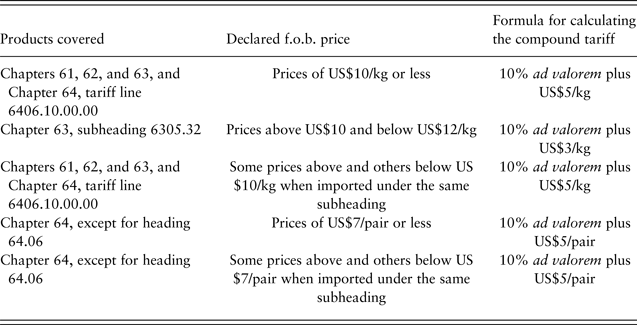
Colombia–Textiles related to the imposition by Colombia of a compound tariff on the importation of certain textiles, apparel, and footwear classified in Chapters 61 through 64 of Colombia's Customs Tariff. The compound tariff was composed of: (1) an ad valorem component of 10% of the customs value of the products; and (2) a specific levy, expressed in units of currency per unit of measurement, the amount of which depended upon the price of the relevant goods.Footnote 8 The compound tariff did not apply to imports from countries with which Colombia has signed trade agreements,Footnote 9 or to goods entering certain regions designated by Colombia as Special Customs Regime Zones or under Special Import-Export Systems.Footnote 10
The compound tariff was initially introduced by a decree of the President of the Republic of Colombia dated 23 January 2013 (Decree No. 074), which was repealed and replaced by a subsequent decree dated 28 February 2014 (Decree No. 456).Footnote 11
The compound tariff is summarized in the Table 1 below. The structure of the tariff meant that, in some cases, lower priced goods were actually more expensive to import than higher priced goods. At the same time, these same goods were subject to effective ad valorem tariffs well above the bound rate for the lowest range of prices. This is shown in Figure 1 for the case of footwear. For shoes below US$7/pair, the tariff is well above the bound rate. In addition, the duty inclusive price for shoes below US$7/pair is also above the duty inclusive price for shoes with a customs value above $7/pair.
AVEs of Colombian compound tariffs on footwear

Structure of the compound tariff

Source: Colombia–Textiles, paras. 7.187.
2.2 Overview of the findings of the Panel and Appellate Body
Findings of the Panel
Application of Articles II:1(a) and II:1(b) of the GATT 1994 to ‘Illicit Trade’. Colombia claimed that the measure was designed to combat money laundering, and Articles II:1(a) and (b) of the GATT 1994 did not extend to ‘illicit trade’ transactions. Specifically, Colombia argued that ‘imports of textiles, apparel and footwear at prices below the thresholds prescribed in Decree No. 456 are imports at prices which are ‘artificially low’ so that there is a ‘high likelihood’, a ‘greater likelihood’ or a ‘high risk’ that such imports are being used to launder money through the under invoicing of imports’.Footnote 12 According to Colombia, in light of the principle of good faith and the object and purpose of the GATT 1994 reflected in its preamble, as well as in the preamble to the WTO Agreement, ‘Article II:1(b) covers licit trade and cannot cover operations where there are indications that they are being concluded at artificially low prices in order to launder money’.Footnote 13 Colombia also maintained that Decree No. 456 was a measure designed to combat money laundering linked with drug trafficking and the financing of criminal groups, as well as tax evasion and unfair competition.Footnote 14 In support of its argument, Colombia claimed that its competent authorities – such as the DIAN (National Customs and Excise Directorate of Colombia) and the UIAF – as well as international organizations that monitor the issue – including the OECD and the Financial Action Task Force – had confirmed the use, by criminal groups, of imports of apparel and footwear at artificially low prices to launder money.Footnote 15
Panama claimed that the compound tariff imposed by Colombia was inconsistent with Articles II:1(a) and II:1(b) of the GATT 1994 and Colombia's Schedule of Concessions. In particular, imports of textiles, apparel, or footwear, legally subject to import procedures and whose prices are below certain thresholds unilaterally established by Colombia does not constitute ‘illicit trade’ – the fact that criminals may sometimes be behind such transactions does not make them illicit. Panama also claimed that the issue of alleged illegality of trade operations should be transposed to the context of Colombia's defense under Article XX of the GATT 1994.Footnote 16
The Panel noted at the outset that the WTO agreements contain no definition of ‘illicit trade’.Footnote 17 However, it acknowledged that certain provisions of those agreements referred to several situations identified by Colombia as ‘illicit trade’ practices regulated by international instruments.Footnote 18 Notwithstanding, the Panel found that the compound tariff was not structured or designed to apply solely to operations classified as ‘illicit trade’, and that, in Colombia's legal system, there was no rule prohibiting or restricting what Colombia considered ‘illicit trade’.Footnote 19 Accordingly, the Panel determined that ‘a finding as to whether or not the obligations in Article II:1(a) and II:1(b) of the GATT 1994 are applicable to “illicit trade” would be merely theoretical and would be neither necessary nor of practical use in achieving a satisfactory settlement of the matter placed before this Panel’.Footnote 20 However, the Panel stated that Colombia's assertion that the compound tariff could be useful in discouraging the under-invoicing of imports and the use of such practices for money laundering was related to Colombia's argument that the compound tariff is a measure necessary to protect public morals or secure compliance with rules against money laundering.Footnote 21
The Panel found that the compound tariff constituted an ordinary customs duty and, in certain cases, exceeded the levels bound in Colombia's Schedule of Concessions according less favorable concessions, in violation of Article II:1(a) and Article II:1(b).Footnote 22
Colombia's defense under Article XX(a) of the GATT 1994. In response to Colombia's assertion that the measure was designed to combat money laundering and, therefore, was justified as necessary to protect public morals under Article XX(a) of the GATT 1994, the Panel found that Colombia had failed to show that the compound tariff was ‘designed’ to protect public morals. The Panel accepted that Colombia had demonstrated that ‘combating money laundering was one of the policies designed to protect public morals in Colombia’.Footnote 23
However, having considered the text of Decree No. 456 and the available evidence, it found that Colombia had not demonstrated that the compound tariff was designed to combat money laundering.Footnote 24 In particular, the design, architecture, and structure of the measure,Footnote 25 including the way in which the price thresholds were set,Footnote 26 the lack of evidence that any undervaluation was for money laundering purposes,Footnote 27 the exemptions,Footnote 28 the period of application of the compound tariff, and the fact that imports of products at prices below the thresholds established were not prohibited under Colombian legislation,Footnote 29 ‘do not make it possible to conclude that there is a relationship between the compound tariff and the declared objective of combating money laundering’.Footnote 30 Consequently, the Panel found Colombia had also failed to show that the compound tariff is a measure designed to protect public morals with Article XX(a).Footnote 31
The Panel, notwithstanding its conclusion that Colombia had failed to demonstrate that the compound tariff was a measure designed to protect public morals, ‘in order to be exhaustive in its analysis’ proceeded to analyze whether the measure was ‘necessary’ to protect public morals. The Panel found that Colombia had shown that combating money laundering was an important policy objective for the Colombian government and that it had submitted evidence concerning the existence of a connection between money laundering and drug trafficking in Colombia, activities connected to the financing of the internal armed conflict in the country.Footnote 32
Colombia had argued that the compound tariff was indispensable to combat money laundering because it reduced the incentives causing criminal groups to use textile, apparel, and footwear imports to launder money through ‘artificially low’ or undervalued prices.Footnote 33 However, the Panel found that the evidence submitted by Colombia did not support its claim that the compound tariff ‘resulted in a decrease in the undervaluation index of imports of the relevant products’.Footnote 34 Similarly, the Panel found that there was no evidence that the compound tariff had affected imports of lower-priced products to a greater extent than imports of higher-priced tariffs.Footnote 35 Accordingly, the Panel concluded that on the basis of the totality of the evidence and the text of Decree No. 456, Colombia had not ‘demonstrated the existence of an authentic relationship of means and ends between the compound tariff and the alleged objective of combating money laundering’,Footnote 36 and, therefore, the contribution of the measure to the objective of combating money laundering.
Having also reviewed the trade-restrictiveness of the compound tariff and the three alternative measures identified by Panama, the Panel found that the measure was not necessary to combat laundering and, consequently, was not necessary to protect public morals within the meaning of Article XX(a) of the GATT 1994.Footnote 37
Colombia's defense under Article XX(d) of the GATT 1994. Colombia claimed that the compound tariff was a measure necessary to secure compliance with laws and regulations which are not inconsistent with the provisions of the GATT 1994 within the meaning of Article XX(d) of the GATT. The Panel identified the laws and regulations with which Colombia was seeking to secure compliance as Article 323 of the Colombian Criminal Code (Article 323), which is an anti-money laundering provision.Footnote 38
In considering whether Decree No. 456 was designed to secure compliance with Article 323, the Panel found that ‘the same elements that led the Panel to conclude that Colombia has failed to demonstrate that the compound tariff is designed to combat money laundering, lead it to conclude that Colombia has also failed to demonstrate that the measure is designed to secure compliance with the Colombian anti-money laundering legislation and, more specifically, with Article 323 of the Criminal Code’.Footnote 39
Notwithstanding this finding, the Panel also continued to consider whether the measure was necessary to secure compliance with the Colombian anti-money laundering legislation. The Panel determined that the objective of securing compliance with the anti-money laundering legislation reflected social interests that could be characterized as ‘vital and important in the highest degree’.Footnote 40 However, taking account of the totality of the evidence and the text of Decree No. 456, the Panel considered that Colombia had failed to demonstrate a genuine relationship of ends and means between the tariff and the alleged objective of securing compliance with the Colombian anti-money laundering legislation.Footnote 41 Accordingly, in this light and given the trade restrictiveness of the measure and the possible alternatives reasonably available to Colombia identified by Panama, the Panel concluded that Colombia had failed to show that the compound tariff was a measure necessary to secure compliance with laws or regulations within the meaning of Article XX(d) of the GATT 1994.
Findings of the Appellate Body
Application of Articles II:1(a) and II:1(b) of the GATT 1994 to ‘Illicit Trade’. Colombia appealed the Panel's assessment under Article 11 of the DSU on grounds that the Panel had deemed it unnecessary to rule on Colombia's claim that the Article II obligations were not applicable to illicit trade. The Appellate Body found that the Panel acted inconsistently with its duty under Article 11 of the DSU to make an objective assessment of the matter, and reversed the Panel's finding that it was unnecessary for the Panel to issue a finding as to whether Articles II:1(a) and (b) of the GATT 1994 apply to illicit trade.Footnote 42
The Appellate Body proceeded to complete the legal analysis, but determined that both the text of Articles II:1(a) and (b) of the GATT 1994 and the context provided in Articles II:2 and VII:2 of the GATT 1994 and the Customs Valuation Agreement supported the view that Article II:1(a) and (b) did not exclude what Colombia classified as illicit trade.Footnote 43 The Appellate Body stated that its analysis ‘should not be understood to suggest that Members cannot adopt measures seeking to combat money laundering. This aim, however, cannot be achieved through interpreting Article II:1 of the GATT 1994 in a manner that excludes from the scope of that provision what a Member considers to be illicit trade. A Member's right to adopt and pursue measures seeking to address concerns relating to money laundering can be appropriate preserved when justified, for example, in accordance with the general exceptions contained in Article XX of the GATT 1994.’Footnote 44
Colombia's defense under Article XX(a) of the GATT 1994. The Appellate Body also reversed the Panel's finding under Article XX(a) that Colombia had failed to show that the compound tariff was a measure ‘designed’ to protect public morals within the meaning of Article XX(a) of the GATT.
The Appellate Body recalled that analysis of a measure under Article XX is two-tiered.Footnote 45 The first phase determines whether the relevant measure falls within the exception invoked – in this case, Article XX(d). If the measure is found to fall within that exception, the second phase assesses whether the measure is applied in a manner that compiles with the requirements of the chapeau to Article XX. For purposes of assessing whether a measure is justified under Article XX(a), the measure first must be ‘designed’ to protect public morals, and second must be ‘necessary’ to protect such public morals.Footnote 46
Colombia claimed that the Panel applied an ‘overly demanding’ legal standard in assessing whether the compound tariff is a measure ‘designed’ to protect public morals.Footnote 47 The Appellate Body noted the Panel's findings that: ‘it could not be ruled out’ that goods imported at prices below the thresholds reflect ‘artificially low’ prices;Footnote 48 ‘the information available suggests that the undervaluation of imports is, in fact, one of the methods used for money laundering detected by the Colombian authorities’;Footnote 49 and the Panel's acknowledgment that ‘the compound tariff could reduce the incentives for importing textile products, apparel and footwear at prices below the thresholds laid down in Decree No. 456’.Footnote 50 Taking these findings together, the Appellate Body considered that the Panel ‘itself recognized that the compound tariff is not incapable of combating money laundering, such that there is a relationship between that measure and the protection of public morals’.Footnote 51 Accordingly, it reversed the Panel's finding that Colombia had failed to demonstrate that the measure was ‘designed’ to combat money laundering and concluded that the Panel should have considered the ‘necessity’ of the measure.
The Appellate Body also reversed the Panel's findings regarding the ‘necessity’ of the measure. It proceeded to complete the ‘necessity’ analysis, but found that Colombia had not demonstrated the extent to which the compound tariff contributed to the objective of countering money laundering and that there was a lack of clarity about the trade-restrictiveness of the measure. Consequently, the Appellate Body found that Colombia had failed to demonstrate that the compound tariff was a measure ‘necessary to protect public morals’ within Article XX(a).Footnote 52
Colombia's defense under Article XX(d) of the GATT 1994. Similarly, the Appellate Body also reversed the Panel's finding that Colombia had not shown that the compound tariff was ‘designed’ to achieve compliance with laws or regulations within Article XX(d), on the basis that the Panel's recognition that the compound tariff was not incapable of securing compliance with Article 323 of Colombia's criminal code, such that there was a relationship between that measure and securing such compliance.Footnote 53 However, the Appellate Body, relying on the Panel's findings, found that there was a lack of sufficient clarity with respect to key elements of the ‘necessity’ analysis and that, consequently, ‘a proper weighing and balancing that could yield a conclusion that the measure is “necessary” could not be conducted’.Footnote 54 Accordingly, the Appellate Body found that Colombia failed to demonstrate the necessity of the measure.
The Appellate Body recommended that the Dispute Settlement Body request Colombia to bring its measure into conformity with its GATT 1994 obligations. At a meeting of the Dispute Settlement Body (DSB) on 22 June 2016, the DSB adopted the Appellate Body Report and the Panel Report (as modified by the Appellate Body Report). Colombia confirmed its intention to implement the DSB's recommendations and rulings within a reasonable period of time.
3. The prior dispute: Colombia – Indicative Prices and Restrictions on Ports of Entry
3.1 Background to Colombia–Ports of Entry
In Colombia–Ports of Entry, Colombia adopted a series of measures purportedly aimed at combating under-invoicing, money laundering, and smuggling of goods exported from Panama or the Colon Free Zone to Colombia.
First, Colombia imposed measures establishing indicative prices in customs procedures for textiles, footwear, and apparel arriving from countries, except those with which Colombia had signed free trade agreements (in particular, Decree No. 2685 of 1999 (Decree 2685/1999) and Resolution No. 4240 of 2000 (Resolution 4240/2000).Footnote 55 The indicative prices were reference prices for use as a control mechanism on the declared freight on board (f.o.b.) value of imported goods; the indicative prices were calculated based on the average production costs of the goods or by reference to the lowest price actually negotiated or offered for importation of the goods into Colombia.Footnote 56 Indicative prices are used at the time of presentation of the customs declaration. If, upon presentation of the import declaration for goods subject to indicative prices, the f.o.b. value was lower than the indicative price, the good would not be released until the importer corrected the value on the declaration based on the indicative prices and paid customs duties and sales tax on this basis.Footnote 57
The measures also imposed port restrictions on textiles, apparel, and footwear originating in or arriving from Panama and the Colon Free Zone, which could – subject to certain exceptions – only enter Colombia through Bogota Airport or Barranquilla seaport (in particular, Resolution No. 7373 of 22 June 2007 (Resolution 7373/2007),Footnote 58 as modified by Resolution No. 7637 of 28 June 2007 (Resolution 7637/2007)). The reason given for the limitation on the ports of entry was to strengthen and improve customs controls related to the importation of textile, apparel, and footwear goods. Failure to comply with the port restrictions subjected the goods to seizure and forfeiture.Footnote 59
Additionally, importers of these products coming from Panama were required to present advance import declarations and pay customs duties and sales tax in advance of the goods' arrival, a requirement not generally imposed on importers.Footnote 60 Importers of textiles arriving from Panama were also required to pay a fee to correct certain errors appearing in the advance import declaration.Footnote 61
3.2 The Panel's findings of violation of the GATT 1994
On 20 May 2009, the DSB adopted the Panel Report, Colombia–Ports of Entry.Footnote 62 The Panel Report found that: (1) Decree 2685/1999, Resolution 4240/2000, and the various resolutions establishing indicative prices were inconsistent with the methods of valuation set out in Articles 1, 2, 3, 5, 6, 7.2(b) and 7.2(f) of the Agreement on the Implementation of Article VII of the General Agreement on Tariffs and Trade 1994 (Agreement on Customs Valuation); and (2) Resolution 7373/2007 (as amended by Resolution 7637/2007), restricting the Colombian ports of entry for certain goods, was inconsistent with Article I:1, Article V:2, Article V:6, and Article XI:1 of the GATT 1994.
3.3 Application of the Article XX(d) defense
Colombia claimed that – even if the measures were found to violate its WTO obligations – this violation was justified under GATT Article XX(d) according to which:
Subject to the requirement that such measures are not applied in a manner which would constitute a means of arbitrary or unjustifiable discrimination between countries where the same conditions prevail, or a disguised restriction on international trade, nothing in this Agreement shall be construed to prevent the adoption or enforcement by any contracting party of measures …
(d) necessary to secure compliance with laws or regulations which are not inconsistent with the provisions of this Agreement, including those relating to customs enforcement, the enforcement of monopolies operated under paragraph 4 of Article II and Article XVII, the protection of patents, trademarks and copyrights and the prevention of deceptive practices.
The Panel in Colombia–Ports of Entry, referring to the Appellate Body's findings in Korea–Various Measures on Beef,Footnote 63 confirmed that two elements must be satisfied in order for a measure to be provisionally justified under Article XX(d):
For a measure … to be justified provisionally under paragraph (d) of Article XX, two elements must be shown. First, the measure must be one designed to ‘secure compliance’ with laws or regulations that are not themselves inconsistent with some provision of the GATT 1994. Second, the measure must be ‘necessary’ to secure such compliance. A Member who invokes Article XX(d) as a justification has the burden of demonstrating that these two requirements are met.Footnote 64
In its submissions to the Panel in Colombia–Ports of Entry, Colombia argued that its ‘port of entry measure on certain products from Panama were [sic] implemented … in order to ensure compliance with Colombian customs law and combat contraband and money-laundering’.Footnote 65 The Colombian provisions identified by the Panel for which the ports of entry measure sought to ensure compliance included Decree No. 2685 and Resolution No. 4240 – both of which had the objective of ensuring customs control and enforcement.Footnote 66 The Panel found that, in light of the circumstances surrounding the implementation of the ports of entry measure – suggesting a problem with customs fraud – and ‘the fact that the measure was imposed with a view to addressing the need to strengthen and improve customs controls related to the importation of textiles, apparel, and footwear arriving from Panama’,Footnote 67 Colombia had demonstrated that the ports of entry measure was designed to secure compliance with Decree No. 2685 and Resolution No. 4240.
Turning to whether the ports of entry restrictions were necessary to secure compliance with these laws and regulations in accordance with Article XX(d), the Panel referenced the criteria to be considered as established by the Appellate Body,Footnote 68 and confirmed that in evaluating whether a measure is necessary it would consider: ‘(i) the relative importance of the common interests or values that the law or regulation to be enforced is intended to protect; (ii) the extent to which the measures contribute to the realization of the end pursued; and (iii) the restrictive impact of the measure on imported goods’.Footnote 69
The Panel noted that Colombia had asked the Panel to examine the measures in light of the important interests involved in securing compliance with its customs laws, ‘both in terms of revenue lost, and in terms of illegal and criminal activities linked to contraband and smuggling in general’.Footnote 70 Colombia also claimed that that contraband trade and customs plays a role in other criminal activities, such as money-laundering and terrorism.Footnote 71 The Panel acknowledged that ‘combating under-invoicing and money laundering associated with drug trafficking is a relatively more important reality for Colombia than for many other countries’.Footnote 72
The Panel determined that the ports of entry measure was designed to secure compliance with Decree 2685/1999 and Resolution 4240/2000.Footnote 73 Turning to the question of whether the measure was necessary, the Panel assessed ‘the extent to which the ports of entry measure contributes to the realization of the end pursued in light of the quantitative and qualitative assessment advanced by Colombia. The Panel noted that ‘Colombia [had] not presented any evidence whether the measure contributes to combating problems allegedly related to contraband, such as money-laundering or drug trafficking’.Footnote 74 Therefore, the Panel limited its analysis to whether the measure was ‘apt to contribute to tackling under-invoicing and smuggling, which Colombia considers to be linked to illicit activities, including problems with money-laundering and drug trafficking’.Footnote 75
The Panel analyzed a number of quantitative indicators presented by Colombia to confirm the effectiveness of the ports of entry measure, including: (1) the alleged increase in the implicit prices; (2) the purported increase in contraband related seizures; and (3) the claimed decrease in the ‘level of distortion’ since the measure was introduced.Footnote 76 The Panel found, however, that Colombia had failed to provide evidence to demonstrate increased compliance arising from the measure but rather speculated that this was the case. In particular, ‘evidence on price data, seizures and trade distortions has not demonstrated the measure was effective’.Footnote 77 The Panel also identified structural shortcomings with the ports of entry measure that limited its potential to tackle under-invoicing and smuggling, as evidenced by Colombia's greater trade distortions with other trading partners and that distortions with Panama were related to open smuggling, rather than technical smuggling, which the ports of entry measure was designed to address.Footnote 78 Similarly, the Tribunal was unable to gauge the restrictive impact on trade of the ports of entry measure and found that Colombia had failed to substantiate that under-invoicing had diminished during the periods of implementation of the ports of entry measure.Footnote 79 Accordingly, the Panel was unable to conclude that the ports of entry measure contributed to combating customs fraud and contraband in Colombia.Footnote 80 In view of these findings, the Panel did not address the chapeau of Article XX.Footnote 81
4. Award in the arbitration
The WTO dispute settlement rules permit a Member a ‘reasonable period of time’ to implement any findings that measures are in breach of WTO obligations. Under Article 21.3(c) of the Dispute Settlement Understanding, where parties cannot reach agreement on what constitutes a reasonable period of time, this issue can be addressed through arbitration.
In the absence of the parties' agreement on a reasonable period of time for implementation under Article 21.3(b) of the DSU in Colombia–Textiles, the matter was referred to arbitration under Article 21.3(c). The issue of Colombia's policy objective underlying the original measure – namely, combating money laundering – arose in the context of the parties' disagreement about the necessary measures for achieving compliance.
4.1 The parties submissions regarding the necessary measures for achieving compliance
Colombia and Panama disagreed not only on the time required by Colombia for implementation of the DSB's recommendations and rulings, but also on the type of measures that Colombia could adopt in order to achieve compliance. Colombia claimed that the particular circumstances relevant to determining the reasonable period of time include the Appellate Body's acknowledgment that the compound tariff is a measure designed to combat money laundering within the scope of Article XX(a) and (d) of the GATT 1994. Accordingly, Colombia asserted that it was entitled to devise a measure that both complies with Article II.1(a) and (b) of the GATT 1994, and addresses the legitimate policy objective that the original measure sought to address – i.e., combating money laundering.
Specifically, Colombia asserted that it was not sufficient simply to allow the compound tariff measure to lapse, but instead two ‘mutually supportive decrees’ were necessary to: (1) adjust the compound tariff to make it compliant with Colombia's tariff bindings, while addressing the continuing risks of money laundering posed by imports at artificially low prices; and (2) improve Colombia's customs control and supervision procedures so as to address the risks of money laundering associated with imports of apparel and footwear.
Panama, on the other hand, submitted that Colombia's implementation obligation was limited to eliminating the inconsistency of the compound tariff measure with Article II.1(a) and (b) of the GATT 1994 – i.e., to ensuring that its tariffs do not exceed the bound levels in its Schedule of Concessions. Accordingly, any measure going beyond removal of this inconsistency would be ‘extraneous’ to the DSB's recommendations and rulings and should not be taken into account in determining the reasonable period of time. Colombia's proposed customs measure was not aimed at bringing the compound tariff measure into compliance with Article II.1(a) and (b) of the GATT 1994, but rather at improving Colombia's criminal policy to combat money laundering.
4.2 The arbitrator's determination of the relevant measures
At the outset of his analysis, the Arbitrator, Professor Giorgio Sacerdoti, identified a number of principles derived from prior Article 21.3(c) awards that guided his mandate. These principles included that: (1) the Panel's and the Appellate Body's findings offer relevant guidance for determining whether the proposed implementing measures are suitable for achieving compliance and, accordingly, for the determination of the time frame required for implementation; (2) the means of implementation chosen must be apt in form, nature, and content to bring the Member into compliance with its WTO obligations within a reasonable period of time, in accordance with the guideline contained in Article 21.3(c); and (3) objectives or measures extraneous to the Panel's and the Appellate Body's findings cannot justify prolonging the reasonable period of time.
The Arbitrator addressed the Parties' dispute about the type of measure that Colombia could adopt to achieve compliance and looked to the Appellate Body's determination that there is a relationship between the compound tariff and the objective of combating money laundering in Colombia. In this light and taking account of the discretion accorded to implementing Members in choosing the means of implementation, the Arbitrator disagreed with Panama and stated that:
Colombia has a range of implementation options, which include the adoption of a measure that continues to pursue the policy objective of combating money laundering in a WTO-consistent manner. Therefore, in determining the reasonable period of time, it is relevant, in my view, that the DSB's recommendations and rulings imply that Colombia may decide to adopt measures pursuing the policy objective of combating money laundering, as long as they are apt in form, nature, and content to bring Colombia into compliance with its obligations under the GATT 1994.Footnote 82
Accordingly, the Arbitrator determined that the reasonable period of time should include the time needed both to enact a tariff and a customs measure.
4.3 Analysis of the arbitrator's reasonable period of time for implementation
Taking account of the factors raised by the Parties, the Arbitrator determined that the reasonable period of time in this case was seven months from the date on which the DSB adopted the Panel and Appellate Body reports.
An examination of the Award shows that the factors raised by the parties and/or considered by the Arbitrator in determining the reasonable period of time were consistent with the criteria typically employed in Article 21.3(c) proceedings, including: (1) Colombia's steps taken towards implementation between the date of adoption of the Panel's and the Appellate Body's reports and initiation of the arbitration; (2) the complexity of the implementing measures and the administrative and legislative procedures required; and (3) the developing country status of Colombia and Panama.
With respect to the reasonable period of time determined in the Award – 7 months – in line with the findings in a recent paper, the Arbitrator took ‘the path of compromise, opting for a [reasonable period of time] that approximately lies half-way between the time proposed by the complaining Member(s) and that proposed by the defending Member’.Footnote 83 Notably, this is consistent with previous Article 21.3(c) awards in which legislative action was required to implement rulings. Specifically, the seven-month period awarded reflects the rough mid-point between the 66-day period initially indicated as reasonable by complaining Member, Panama, and the 12-month period requested by Colombia. The seven-month period awarded by the Arbitrator reflects less than half of the difference between the time period ultimately proposed by Panama and the 12-month period requested by Colombia.Footnote 84
5. Themes and policy implications
The Colombia disputes, specifically Columbia–Textiles but also the earlier dispute Columbia–Ports of Entry and its history, raise important questions about the effectiveness of trade-related measures to combat trade-related money laundering. The problem is well known, and in the case of Panama, the administration of its Customs Free Zones is repeatedly flagged as a concern.Footnote 85 However, it is not clear that the solution pursued actually targeted this concern effectively. From a ‘business model’ perspective, for example, one can underprice medium and high-priced goods as well as low-priced goods. In addition, the trade based money laundering industry is innovative, meaning that tariff instruments like those in the present case may not be very effective in their stated purpose. For example, we have recent evidence of deliberate mislabeling of the country of origin from third countries products to free trade agreement partner destinations to circumvent duty calculations entirely.Footnote 86
Notwithstanding the legitimacy of stated policy objectives with respect to measures taken by Colombia, analytically it is not clear that the measures taken really could sustainably address the stated problem. The measures are blunt, targeting both suspect imports and non-suspect imports alike, while violating GATT commitments. In a sense, the policy steps taken violate the concept of second best. They do not directly target the basic problem (movement of illicit funds), but take a blunter approach. Concurrent with the trade dispute, direct action against some major players underpinning the money laundering activities targeted were caught through the application of laws directly targeting money laundering.Footnote 87 The solution would seem to be cooperation of customs authorities and financial regulators, rather than application of broad-based trade policy measures.
While the WTO system has adapted to deal with concerns – such as environmental protection – that are not pivotal to the trade regime per se (e.g., United States – Import Prohibition of Certain Shrimp and Shrimp Products Footnote 88), even as a second-best option, can and should the system adapt to deal with questions of corruption, money-laundering, and smuggling? In Colombia–Ports of Entry, the European Communities acknowledged the ‘fundamental importance of tackling such illegal activities’, but ‘expresse[d] doubts on the phenomenon of money-laundering necessarily falling within the scope of the enforcement of customs laws and regulations. It would appear to the European Communities that in relation to the phenomenon of money-laundering, the relevant laws and regulations the measures might be designed to secure compliance with are those relating to general law enforcement rather than customs enforcement, unless money laundering is an illegal activity criminalized or otherwise addressed in the customs laws of Colombia’.Footnote 89
Where the WTO may be more relevant is in providing leverage to gain cooperation in direct targeting of illegal financial activities. Consider Argentina–Financial Services,Footnote 90 in which Panama challenged measures taken by Argentina against services and service suppliers from jurisdictions, such as Panama, that did not exchange information for purposes of tax transparency and the prevention of money laundering and terrorist financing. Argentina asserted that its measures were guided by and necessary to secure compliance with international standards on the prevention of money laundering adopted within Financial Action Task Force Framework.
In this case, for purposes of paragraph 2(a) of the GATS Annex on Financial Services (prudential exception), the Appellate Body indicated that WTO Members are entitled to deference in relation to the prudential goals that they pursue, provided that there is a rational relationship between the prudential objective of the measure and the measure itself. In this case, the Panel accepted the recommendations of international bodies such as the FATF and the OECD's Global Forum as representing a global agreement on, among other things, approaches to tax transparency. The Panel noted that the Financial Action Task Force is an intergovernmental body whose ‘mandate is to set standards and promote effective implementation of legal, regulatory and operational measures for combating money laundering, financing of terrorism and the proliferation of weapons of mass destruction, among other threats to the integrity of the financial system. The FATF Recommendations are recognized as the international standard against money laundering and the financing of terrorism.’Footnote 91 If the solution to the problem is better (and where necessary enforced) cooperation of customs authorities and financial regulators, the WTO may indeed have relevance.