English language learners (ELLs) appear to be more vulnerable than native speakers of English as a first language (EL1) when it comes to vocabulary learning. For example, research involving ELLs with Spanish as their L1 shows that they typically enter school with smaller vocabularies in English than their peers, and even though they acquire new vocabulary at school and elsewhere, they perform more poorly than their monolingual peers on vocabulary and reading comprehension tasks (e.g., Carlo et al., Reference Carlo, August, McLaughlin, Snow, Dressler and Lippman2004). Not enough is known about trajectories of vocabulary development in ELL school-age students, or about the cognitive underpinnings of second language (L2) vocabulary development. This paper compares the developmental trajectories of receptive vocabulary in ELL and EL1 students, and examines the cognitive predictors of receptive vocabulary development in English.
In general, research on vocabulary development in English-speaking monolingual children has focused on young children either before or at the onset of formal schooling (e.g., Gathercole, Service, Hitch, Adams, & Martin, Reference Gathercole, Service, Hitch, Adams and Martin1999; Gathercole, Willis, & Baddeley, Reference Gathercole, Willis and Baddeley1991; Gray, Reference Gray2006; Majerus, Poncelet, Greffe, & Van der Linden, Reference Majerus, Poncelet, Greffe and Van Der Linden2006; Metsala, Reference Metsala1999) and on vocabulary development in children with language impairment (e.g., Archibald & Gathercole, Reference Archibald and Gathercole2006b; Beck & McKeown, Reference Beck and McKeown2007; Gathercole, Willis, Emslie, & Baddeley, Reference Gathercole, Willis, Emslie and Baddeley1992). Some studies also examined vocabulary development in ELLs (e.g., Hutchinson, Whitley, Smith, & Conners, Reference Hutchinson, Whitley, Smith and Conners2003) or English as a foreign language learners (e.g., Masoura & Gathercole, Reference Masoura and Gathercole1999, Reference Masoura and Gathercole2005). On the whole, this cluster of studies has demonstrated the role of phonological short-term memory in vocabulary development of monolingual and L2 learners, but has been less concerned with developmental trajectories.
Three longitudinal studies modeled trajectories of vocabulary development in English-speaking children and adolescents with or without language impairment (Beitchman et al. Reference Beitchman, Jiang, Koyama, Johnson, Escobar and Atkinson2008; Law, Tomblin, & Zhang, Reference Law, Tomblin and Zhang2008; Rice Reference Rice, Rice and Waren2004). The language-impaired participants had serious deficits in their vocabulary right from the outset, and received intervention that targeted their language skills. Beitchman et al. (Reference Beitchman, Jiang, Koyama, Johnson, Escobar and Atkinson2008) studied children from kindergarten into adulthood. Law et al. (Reference Law, Tomblin and Zhang2008) assessed receptive vocabulary of children at ages 7, 8, and 11, and Rice (Reference Rice, Rice and Waren2004) followed participants from kindergarten to Grade 4. In each of these studies vocabulary growth was nonlinear. In general, in the first few assessment waves vocabulary developed rapidly and leveled off thereafter. However, vocabulary growth rate in the language-impaired groups was significantly faster than in that of their counterparts with no language impairment.
In a similar vein, Farkas and Beron (Reference Farkas and Beron2004) studied the effects of socioeconomic status (SES) and race on vocabulary development of children from kindergarten to age 13. Right from the onset the vocabulary of African American, low SES children was lower than that of their higher SES African American or non-African American (and non-Latino) counterparts. There was a somewhat steeper vocabulary growth in the low SES African American sample from age 3 to 5, but from that point onward the vocabulary trajectories continued to develop in parallel and the vocabulary gap between low and higher SES children did not close by age 13.
The only study that examined vocabulary growth in ELLs (Uchikoshi, Reference Uchikoshi2006) modeled English vocabulary development of kindergarten children whose home language is Spanish from October to June. Within this short time frame vocabulary development was linear. This study does not provide insight into the processes of vocabulary growth in ELLs over a longer period. On the whole, little is known about the extent to which L1-based studies of vocabulary growth apply to vocabulary growth in ELLs. In addition, the role of intraindividual, cognitive, and phonological processes in vocabulary growth over an extended period is also less well understood.
COGNITIVE AND PHONOLOGICAL UNDERPINNINGS OF VOCABULARY DEVELOPMENT
There is a wealth of research evidence on the association between phonological short-term memory and vocabulary learning (e.g., Baddeley, Gathercole, & Papagno, Reference Baddeley, Gathercole and Papagno1998; Gathercole, Reference Gathercole2006; Gathercole, Service, Hitch, Adams, & Martin, Reference Gathercole, Service, Hitch, Adams and Martin1999; Metsala, Reference Metsala1999; Swanson, Howard, & Sáez, Reference Swanson, Howard and Saez2006). Research pointing to the role of phonological short-term memory in L2 vocabulary learning is growing as well. It has been suggested that phonological short-term memory tends to be more strongly associated with early stages of vocabulary learning, when learners have fewer linguistic resources such as the ability to draw upon a broad existing lexicon (Masoura & Gathercole, Reference Masoura and Gathercole2005; Swanson, Sáez, & Gerber, Reference Swanson, Sáez and Gerber2006). Studies involving school children with limited knowledge of the L2 have shown a positive relationship between phonological short-term memory and L2 vocabulary acquisition, whether vocabulary and phonological short-term memory were examined concurrently (e.g., Masoura & Gathercole, Reference Masoura and Gathercole1999, Reference Masoura and Gathercole2005) or longitudinally, over two measurement points (e.g., Ellis & Sinclair, Reference Ellis and Sinclaire1996; Gathercole, Tiffany, Briscoe, Thorn, & The ALSPAC Team, Reference Gathercole, Tiffany, Briscoe and Thorn2005; Service, Reference Service1992; Service & Kohonen, Reference Service and Kohonen1995; Thorn & Gathercole, Reference Thorn and Gathercole1999).
Most of these studies employed Baddeley's multicomponent model (Baddeley, Reference Baddeley1986, Reference Baddeley2000; Baddeley & Hitch, Reference Baddeley, Hitch and Bower1974) to understand the contribution of the phonological loop (i.e., phonological short-term memory) to the acquisition of vocabulary in L1 and L2 learners. Baddeley et al. (Reference Baddeley, Gathercole and Papagno1998) suggested that because phonological short-term memory fosters the long-term learning of the phonological structure of language, it plays a significant role in L1 and L2 vocabulary learning. Baddeley (Reference Baddeley2003) also showed that the causal, unidirectional relationship found between phonological short-term memory and vocabulary of 4- and 5-year-old monolingual children (e.g., Gathercole & Baddeley, Reference Gathercole and Baddeley1989) was not replicated for older monolingual children. In the context of studying monolingual children, Baddeley hypothesized that, over time, the relationship between phonological short-term memory and vocabulary might become reciprocal. However, the validity of this hypothesis has not been tested in L1 or L2 contexts.
Phonological short-term memory is typically measured with tasks requiring participants to repeat nonwords. The theoretical underpinnings of tasks such as nonword repetition and their association with vocabulary acquisition have been questioned. Raising the problem of “wordlikeness,” researchers have argued that the quality of performance on nonword repetition tasks may be determined by previously established vocabulary knowledge and familiarity with phonological structures embedded in the nonword items (e.g., Gathercole, Reference Gathercole1995; Snowling, Chiat, & Hulme, Reference Snowling, Chiat and Hulme1991). Accordingly, participants might be using their knowledge of familiar English word segments to accurately repeat English-like nonwords, and previously established knowledge of phonological segmentation and assembly in English vocabulary might contribute to a better performance on nonword repetition tasks. In a study designed to address these arguments, Gathercole (Reference Gathercole1995) reports that whereas repetition of more wordlike nonwords correlated with vocabulary of monolingual 4- and 5-year-old children, repetition of less wordlike nonwords correlated with digit span. Using cross-lagged correlations she has demonstrated that there was a causal relationship between breadth of vocabulary knowledge and subsequent performance on a more wordlike nonword repetition task, but that there was no such relationship between less wordlike nonwords and vocabulary. According to Baddeley (Reference Baddeley2003) these results can be explained by thinking of phonological short-term memory in terms of storage and articulatory components. The storage component is responsible for passive immediate store of phonological input. The articulatory system is responsible for actively rehearsing the phonological input and preventing it from decay. Both components may be required to learn unfamiliar words. The articulatory output system may depend on morphological knowledge of a given language, whereas the phonological storage component is not influenced by preexisting linguistic knowledge.
One way of testing this hypothesis is to have participants repeat nonwords that are remote from English in terms of word patterns, syllable structure, and morphology. This might show whether the articulatory system can function as rehearsal system even when it cannot rely on familiar linguistic structures to prevent memory decay. More importantly, it may also highlight the challenges of initial stages of learning a new unfamiliar language. In the case of ELLs, it is possible that performance on phonological short-term memory tasks is related to proficiency in English. That is, unlike beginning, less proficient ELLs, ELLs who are relatively more fluent in English may already have better established lexical and morphological representations of the newly acquired language. Therefore, a positive relationship between phonological short-term memory and vocabulary may be confounded with language proficiency and amplify the effect of “wordlikeness.”
Phonological awareness (PA) is another cognitive skill associated with various memory components and with vocabulary acquisition (e.g., Alloway, Gathercole, Willis, & Adams, Reference Alloway, Gathercole, Willis and Adams2004; Gibbs, Reference Gibbs2004, Reference Gibbs2005; Metsala, Reference Metsala1999). Although researchers agree that vocabulary learning is related to memory and PA, the nature of this relationship has been the subject of some debate (Gibbs, Reference Gibbs2004, Reference Gibbs2005). Some argue that PA and phonological short-term memory tap a common phonological element that is primarily responsible for phonological learning (e.g., Bowey, Reference Bowey2001; Griffiths & Snowling, Reference Griffiths and Snowling2002; Metsala, Reference Metsala1999). Others argue that phonological short-term memory is responsible for the quality of phonological storage and representation in memory, whereas PA taps awareness of the representation of phonological forms of a given language (e.g., Windfuhr & Snowling, Reference Windfuhr and Snowling2001). A third view is that even though phonological short-term memory and PA are highly associated with underlying phonological processing ability, each shares variance with a distinct memory mechanism: phonological short-term memory taps basic storage capacity (i.e., the phonological loop), whereas PA shares variance with higher order aspects of memory that enable linguistic analysis (e.g., Gathercole, Reference Gathercole2006; Hecht, Torgesen, Wagner, & Rashotte, Reference Hecht, Torgesen, Wagner and Rashotte2001).
Gathercole et al. (Reference Gathercole, Willis and Baddeley1991) attempted to tease apart the contributions of PA and phonological short-term memory skills to vocabulary knowledge of 4- and 5-year-old monolingual children. They found that even though the two constructs shared a common phonological processing component, the two were differentially associated with outcomes; phonological short-term memory was significantly associated with vocabulary performance and PA with word reading performance. At this point, not much is known about the relative role of phonological short-term memory and PA with respect to vocabulary growth. Neither the Gathercole et al. (Reference Gathercole, Willis and Baddeley1991) nor the Metsala (Reference Metsala1999) studies shed light on this question. In addition, it is not known whether conclusions based on studies involving English speaking monolinguals are adequate for understanding vocabulary growth in L1 or L2 students.
There is a paucity of research, longitudinal or otherwise, that has examined the relative role of PA and phonological short-term memory in vocabulary development of L2 learners. One exception is a recent study by San Francisco, Mo, Carlo, August, and Snow (Reference San Francisco, Mo, Carlo, August and Snow2006), which showed that young bilingual children who were familiar with many lexical items in either English or Spanish were better able to use phonological knowledge to analyze the sounds of the respective languages. The question of unidirectional versus reciprocal relations between PA and vocabulary in monolingual and ELLs has not been raised to date.
RATIONALE FOR THE PRESENT STUDY
Examining developmental trajectories of vocabulary and its cognitive correlates
When one studies developmental trajectories and the factors associated with growth over time a number of theoretically interesting perspectives can be undertaken. One perspective concerns the general shape of the developmental trajectories that characterize growth. Recent developmental research (e.g., Singer & Willett, Reference Singer and Willett2003) suggests that over an extended period of time rate of growth is not constant. As children develop their cognitive abilities or linguistic knowledge, growth begins to slow down; that is, the trajectories are nonlinear. It is not known whether the vocabulary trajectories of ELLs and EL1 school children are linear or nonlinear, nor is it known how similar the ELL and EL1 trajectories are.
Next, to conceptualize the relationship between cognitive variables such as phonological short-term memory and PA, and vocabulary skills, it is possible to focuses on the entry point (i.e., initial intercept). In the present study this involves understanding the concurrent, potentially reciprocal, relations between cognitive processes and vocabulary knowledge at the entry point. Based on the literature, the assumption here is that there may be mutually facilitative relationships between cognitive processes and vocabulary at the outset. These relationships exist regardless of the effect of exposure to language (Gathercole, Reference Gathercole2006), and opportunities to develop vocabulary.Footnote 1
Another related perspective entails a longitudinal, unidirectional or reciprocal, conceptualization. The focus here is on the extent to which phonological short-term memory and PA at entry point (e.g., onset of formal schooling in Grade 1) predict vocabulary knowledge several years later (e.g., in Grade 6, the final intercept), or conversely, the contribution of vocabulary knowledge at the entry point to performance on phonological short-term memory and PA several years later (e.g., in Grade 6, the final intercept). In the present study, of interest is also the extent to which the relationship between vocabulary and these cognitive processing skills is similar in ELLs and monolinguals at initial and final intercepts.
The last perspective focuses on rate of growth. In this study the focus is on the contribution of cognitive processes at entry point to vocabulary rate of growth (i.e., slopes) in ELL and monolingual students. Here, the possibility that rate of growth on the predictor variables contributes to vocabulary growth parameters (intercepts and slope) is also important to explore.
Measuring phonological short-term memory
To measure phonological short-term memory in a manner that does not favor English-speaking monolingual children, and that does not favor ELLs who are more proficient in English, we decided to develop a nonword repetition task in a language that is typologically and etymologically different and distant from the languages spoken by any of the participants. Reflecting demographic and immigration trends the ELL participants in this study spoke Indo-European languages (Punjabi or Tamil) or a Latin-based language (Portuguese). These considerations led us to develop a nonword repetition task in Hebrew, a Semitic language. The objective was to minimize the ability to rely on morphological representations of sound sequences in lexical and sublexical units (Archibald & Gathercole, Reference Archibald and Gathercole2006a). It was assumed that performance on such a task would not advantage EL1 or more proficient ELLs, and it was hypothesized that it would be a purer measure of phonological short-term memory and explain unique variance in vocabulary growth of ELL and EL1 students.
Based on the theoretical and methodological considerations discussed above, the study aimed to answer the following questions:
1. How does vocabulary develop over time in ELLs and EL1s?
a. Are vocabulary growth trajectories linear or nonlinear?
b. Are there ELL–EL1 differences in vocabulary in Grade 1 (initial intercept) and Grade 6 (final intercept)?
2. What are the relations between phonological short-term memory, PA, and vocabulary in EL1s and ELLs?
a. How are they related concurrently and longitudinally?
b. Are growth rates of phonological short-term memory and PA associated with Grade 6 vocabulary in ELL and EL1?
c. Are there longitudinal reciprocal relationships between vocabulary and phonological short-term memory and PA in ELL and EL1?
3. Can the wordlikeness issue be overcome with a nonword repetition task based on a typologically remote foreign language? Would such an approach yield a more reliable measure of short-term memory?
METHOD
Participants
In Canada, children who have recently emigrated from non-English-speaking countries or have limited English proficiency upon school entry are placed in regular classrooms. They are withdrawn from these classrooms daily for 30 to 40 min of English language instruction, provided by teachers with English as a second language (ESL) specialist training. The ESL classes typically comprise students of various ages and home languages, grouped by level of English language proficiency. English language learners receive instruction in ESL classes for up to 2 years. For the remainder of the day, in the regular classroom, instruction takes place in English with their EL1 peers. These teachers make appropriate adaptations and accommodations to the programming and curriculum for their ELL students. At the beginning of the study, some of the participants in the ELL group were enrolled in these classes and others had been recently involved in such classes.
The data analyzed for this paper are part of a longitudinal study conducted with 442 participants in a broad range of 13 schools across four boards of education in a large multiethnic Canadian metropolis. The schools were located in areas with relatively low SES. It is important to note that the ELL and EL1 students came from the same schools and were drawn from the same classes. Four successive cohorts were recruited over 4 years; each cohort was followed from Grades 1 to 6. Data collection lasted 10 years. The successive cohorts came from the same schools, and during the data collection period there were no major instructional/curriculum/policy changes that might have affected differences between cohorts.
Attrition is inevitable in longitudinal research, and the most common reason for attrition in this dataset was mobility. The final sample comprised 141 participants who were tested on at least four of the six waves of data collection. Numbers of students tested on four, five, or six waves from each language group are presented in Appendix A.
The sample consisted of 91 ELLs (52 boys, 39 girls) and 50 EL1s (14 boys, 36 girls). ELLs spoke Punjabi (n = 44), Tamil (n = 17), or Portuguese (n = 30) at home. English was the only language spoken at home by the EL1 students. At initial testing (Grade 1), the mean ages were 6 years, 4 months (SD = 3.77 months) for the ELLs, and 6 years, 6 months (SD = 3.41 months) for the EL1 group. Prior to the initial wave of testing (in Grade 1), of the ELL participants, 37 had a minimum of 1 year (kindergarten or preschool), and 54 had 2 years of schooling in which English was the language of instruction. Seventy-five percent of the ELLs were born in Canada but spoke a language other than English at home.
Measures
Nonverbal ability. The Matrix Analogy Test (Naglieri, 1985), considered to be relatively culture free, was administered to assess students’ nonverbal ability. In each item students are shown an incomplete matrix and asked to choose the component that would complete it. This test was administered at the end of Grade 2. The data of two ELLs and one EL1 student, whose standard scores on this task were lower than 80, were excluded prior to subsequent analyses.
Phonological short-term memory. Two measures of phonological short-term memory were used in this study: English-like nonword repetition task adapted from Gathercole, Willis, Baddeley, and Emslie (Reference Gathercole, Willis, Baddeley and Emslie1994) and Hebrew-like nonword repetition task.
ENGLISH-LIKE NONWORD REPETITION TASK. The adapted version of the Students’ Test of Nonword Repetition (see Appendix B; Wade-Woolley, Reference Wade-Woolley1999) consists of 25 of the 50 items on the original task, modified to avoid unfamiliar phonemes or syllable structure. The number of syllables increases gradually, with 10 two-syllable, 5 three-syllable, 5 four-syllable, and 5 five-syllable English-like nonwords. The task was professionally recorded, using a female voice. Participants listened to the tape-recorded “English-like nonwords” presented one at a time, and were instructed to repeat each nonword as accurately as possible. Each item was preceded by a bell. There was no stop-rule procedure for this task. Children's responses were recorded and scored later. Each correctly repeated item received a score of 1. Raw scores were used in the analyses. The internal consistency (Cronbach α) was 0.73 for ELLs and 0.70 for EL1s.
HEBREW-LIKE NONWORD REPETITION TASK. To minimize the effect of wordlikeness of nonwords derived from English words, and the potential advantage that this might have for EL1 or more proficient ELL participants, a nonword repetition task, based on Hebrew morphology was developed. Hebrew word patterns are very different from English word patterns (e.g., Berman, Reference Berman1985, Reference Berman2004; Ravid & Schiff, Reference Ravid and Schiff2009). The Hebrew-like nonword repetition task consists of 27 Hebrew-like nonwords (see Appendix C). The items do not include novel phonemes or unfamiliar stress patterns. The number of syllables increases gradually with 8 two- syllable, 8 three-syllable, 6 four-syllable, and 5 five-syllable Hebrew-like nonwords. The task was professionally recorded, using a female voice. Participants listened to the tape-recorded “Hebrew-like nonwords” presented one at a time and were instructed to repeat each nonword as accurately as possible. Each item was preceded by a bell. There was no stop-rule procedure for this task. Children's responses were recorded and scored later. Each correctly repeated item received a score of 1. Raw scores were used in the analyses (ELL Cronbach α = 0.73, EL1 Cronbach α = 0.73).
PA. An adapted version of the Auditory Analysis Test (Rosner & Simon, Reference Rosner and Simon1971) was used to measure students’ PA.Footnote 2 An examination of the items on the original Auditory Analysis Test indicated that there was variability in terms of word frequency of the stimuli and target responses. To minimize the potential effect of language familiarity and a possible EL1 advantage on the ability to perform this task, only high-frequency words were used for the stimuli and target responses (e.g., leg–egg, train–rain). As a further precaution, classroom teachers were asked to judge whether the words would be familiar to ELLs in their classroom. There were 16 one-syllable items in this task. The first 6 items required participants to delete the initial or final phoneme in one syllable consonant–vowel–consonant words (e.g., “Say leg”; “Say it again but don't say the /l/”). The remaining 10 items involved deletion of single phonemes in an initial or final consonant blend (e.g., “Say ‘train’”; “Say it again without the /t/”; “Say ‘left’”; “Say it again without the/f/”). The test was discontinued after five consecutive errors. Each correct response received a score of 1. Raw scores were used in the analyses (ELL Cronbach α = 0.92, EL1 Cronbach α = 0.89).
Receptive vocabulary. The Peabody Picture Vocabulary Test—Revised (Dunn & Dunn, Reference Dunn and Dunn1981) measures receptive vocabulary in English. In this task, participants see four pictures, and are asked to point to the picture that matches a word said by the tester. Because the Peabody Picture Vocabulary Test—Revised task was not normed on ELL students, raw scores rather than standard scores were used.
Procedure
Test batteries were administered in the winter/spring of each successive year. Participants were tested individually by fully trained graduate students and research assistants. ELLs had sufficient language skills to understand the instructions, which were given in English.
RESULTS
In this study we used growth curve analysis (hierarchical linear modeling; Raudenbush & Bryk, Reference Raudenbush and Bryk2002) to model growth in vocabulary from Grades 1 to 6. Hierarchical linear modeling allows an examination of the fundamental nature of individual growth, or change, over time. It also permits a description of both the intraindividual and interindividual processes of change (Francis, Fletcher, Stuebing, Davidson, & Thompson, Reference Francis, Fletcher, Stuebing, Davidson and Thompson1991). In addition, in growth curve analysis, performance of the students across all measurement points is accounted for in the estimation of growth parameters.
Methodological considerations
Length of English instruction prior to Grade 1 and ELLs vocabulary. Accounting for the length of prior formal English instruction, we examined the contribution of phonological short-term memory and PA to Grades 1 and 6 vocabulary in ELLs. Results indicated that the length of English instruction prior to Grade 1 did not contribute to differences in Grade 1, β = 0.15, t (85) = 1.55, p = .125; or Grade 6, β = 0.07, t (85) = 0.67, p = .51, vocabulary performance in ELLs.
Controlling for cohort differences. We modeled vocabulary growth and entered cohort as a predictor of change over time in vocabulary. The results indicated no significant interaction effect between cohort and the rates or patterns of vocabulary growth: intercept, t (139) = −0.086, p = .932; slope, t (840) = −0.273, p = .785.
Autoregression. In growth curve analysis the effect of the autoregressor is partialled out. Therefore, there are no concerns about influence of earlier measurements on subsequent measurements of the same task (Huttenlocher, Haight, Bryk, Seltzer, & Lyons, Reference Huttenlocher, Haight, Bryk, Seltzer and Lyons1991).
Attrition. Attrition and missing data may make the sample different from the population it is taken from; it can downgrade the precision and validity of inferences regarding that population. Moreover, listwise or pairwise deletions are associated with various biases such as loss of power and problems of generalizability and inferences (Peugh & Enders, Reference Peugh and Enders2004). Therefore, we decided to multiply impute the data (Rubin, Reference Rubin1987). However, to justify the use of this method, the data must be “missing completely at random” or “missing at random” (Peugh & Enders, Reference Peugh and Enders2004). To establish the randomness of missing data two conditions should apply. First, the participants who dropped out should not differ in a systematic manner from the participants who remained in the study on the outcome variable (i.e., vocabulary). Second, the rates or patterns of attrition should not be different for the two groups of participants (i.e., ELL and EL1). To establish this we examined the effects of attrition on the final vocabulary intercept and vocabulary slope, after the effects of nonverbal ability and language status were accounted for (i.e., ELL vs. EL1). These sensitivity analyses indicated that the data were missing at random (Peugh & Enders, Reference Peugh and Enders2004). Subsequently, we multiply imputed the data, using Schafer's (Reference Schafer2000) NORM program.
Two modeling approaches were taken: analysis of the entire sample (442 students) with raw observed and unobserved values, and a comparison analysis with multiply imputed data sets (Schafer, Reference Schafer2000). In general, there were no significant differences in growth parameters in vocabulary of students who had dropped out and those who remained in the study: intercept, t (353) = −0.860, p = 0.391; slope, t (353) = −0.426, p = .670. Nor were there any significant difference in the rates or patterns of attrition between ELL and EL1 language groups: intercept, t (352) = −0.516, p = .606; slope, t (352) = −0.223, p = .824. In addition, the results revealed no significant interaction among attrition, nonverbal ability, and language status, intercept, t (351) = −0.682, p = .496, slope, t (351) = −0.392, p = .695, with vocabulary knowledge over time.
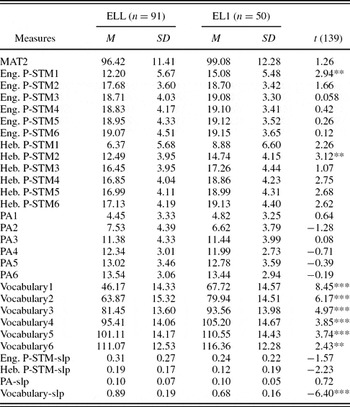
Adjustment for multiple comparisons. We used a minimal alpha level of 0.01 to control for the large number of group comparisons and in simple conditional models. Means and standard deviations of nonverbal ability (assessed in Grade 2), vocabulary, the two phonological short-term memory measures, and PA from Grades 1 to 6 for the ELL and EL1 groups and the corresponding t values are presented in Table 1. The descriptive statistics reveal substantial gains over time in vocabulary in both language groups. A t test comparing ELL and EL1 students’ performance on nonverbal ability indicated that the two groups were not significantly different on this measure, t (139) = −1.290, p = .199.
Descriptive statistics for Grades 1 to 6 cognitive measures, vocabulary, and respective rates of growth (slopes)

Note: Numbers 1 to 6 refer to the respective grade levels; ELL, English language learners; EL1, English monolinguals; MAT, Matrix Analogy Test (nonverbal ability task); Eng. P-STM, English phonological short-term memory (English-like nonword repetition task); Heb. P-STM, Hebrew phonological short-term memory (Hebrew-like nonword repetition task); PA, phonological awareness; Vocabulary, Peabody Picture Vocabulary Test; slp, slope parameter.
**p < .01. ***p < .001.
Trajectories of vocabulary, phonological short-term memory, and PA in ELL and EL1
As noted earlier, developmental data are often collected over a prolonged period with multiple testing waves. In such cases, it is not likely that the rate of growth (i.e., slope) will remain constant. Therefore, we assumed that individual development on various skills can be modeled as nonlinear. To test whether growth on variables of interest is fundamentally of a nonlinear (i.e., quadratic) nature, we first fitted Level 1, unconditional linear growth (i.e., intraindividual achievement model) and unconditional nonlinear models to the data. Next, as it was assumed that the growth parameters would vary across individuals, Level 2 models (i.e., interindividual factors that may affect individual achievement, such as ELL/EL1 status or Grade 1 predictors) were formulated to represent the contribution of potential predictors to this variation (Raudenbush & Bryk, Reference Raudenbush and Bryk2002).
To model the mean growth of vocabulary and the predictor variables the intercept was centered around the midpoint (i.e., around the mean age in Grade 4: 115 months). This defines the slope as the average slope during the data collection period. Centering around the midpoint also reduces the correlation between the linear and nonlinear growth as the “estimation procedure” is stabilized (Raudenbush & Bryk, Reference Raudenbush and Bryk2002, p. 182). We fitted unconditional growth models with nonlinear terms, to examine the patterns of growth in vocabulary, phonological short-term memory, and PA. In general, all participants developed these skills at a faster rate in lower elementary grades than in upper grades. The growth began to level off gradually from Grade 3 onward.
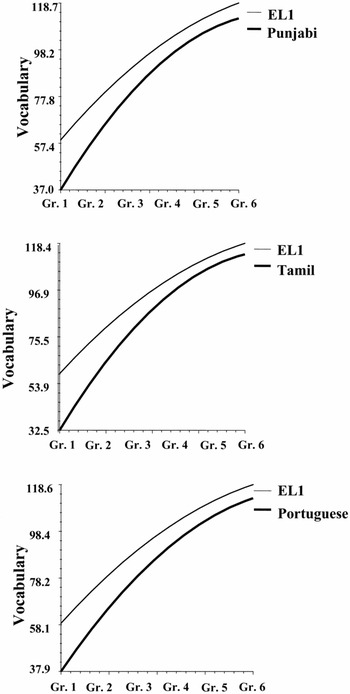
Vocabulary. Separate growth trajectories of vocabulary development in Punjabi, t (92) = −2.781, p = .007, Tamil, t (65) = −2.003, p = .025, and Portuguese, t (78) = −2.782, p = .007, participants were modeled first. The results indicated that there were no significant differences in patterns of vocabulary growth, a result that justified grouping the three language groups into one ELL group in subsequent analyses (Figure 1).
Estimated mean growth curves of vocabulary for Punjabi, Tamil, and Portuguese language backgrounds.

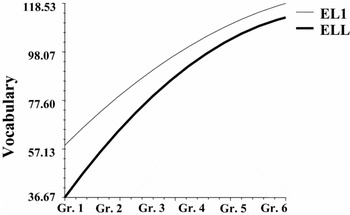
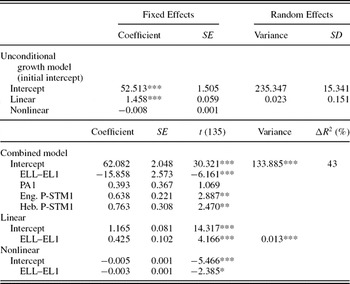
The conditional growth models for ELL and EL1showed significant variations in individual vocabulary growth rates. A significant nonlinear effect is present (EL1 = −0.005, p = .000; ELL = −0.003, p = .01), indicating deceleration in vocabulary growth with time. That is, in the first 3 years of schooling vocabulary develops faster in ELLs than in EL1s, t (139) = 3.825, p = .000. However, in both groups trajectories associated with vocabulary begin to level off in subsequent years.
An example may help clarify the differential growth patterns in ELL and EL1 vocabulary. The mean and standard deviation of vocabulary for EL1 students in Grade 4 were 105 and 14.70, respectively. The coefficient of −0.005 associated with vocabulary slope indicates that an EL1 student whose score is 1 SD above the mean on vocabulary is expected to achieve a slower growth rate of −0.09 on vocabulary (i.e., −0.005×14.70) than a child at the mean of vocabulary. In contrast, for ELL students the mean and standard deviation of vocabulary in Grade 4 were 95 and 14.06, respectively. The coefficient of −0.008 (i.e., −0.005 + [−0.003]) associated with the vocabulary slope indicates that an ELL student whose score is 1 SD above the mean on vocabulary is expected to achieve a slower deceleration rate of −0.112 (i.e., −0.008×14.06) on vocabulary than an ELL student at the mean of vocabulary (see Figure 2 for slopes). These examples illustrate that deceleration on the vocabulary task is observable in both groups but that it occurs significantly more slowly in the ELL than in the EL1 group.
Estimated mean growth curves of vocabulary as a function of language status.

Phonological short-term memory measures. The ELL and EL1 groups did not differ from each other in growth patterns on English- and Hebrew-like nonword tasks. A nonlinear trend was observed in the development of both the English-like, t (843) = −6.333, p = .000, and Hebrew-like, t (843) = −7.766, p = .000, nonword repetition tasks. This indicated that ELL and EL1 students developed their phonological short-term memory skills rapidly in the early years, with a deceleration from Grade 4 onward.
PA. The ELL and EL1 groups did not differ from each other in growth patterns on PA. As was the case with phonological short-term memory measures, a significant nonlinear trend was noted in the development of PA, t (843) = −19.131, p = .000. ELL and EL1 students developed their PA skills rapidly in the early years, with a deceleration from Grade 4 onward.
ELL–EL1 differences on vocabulary, phonological short-term memory, and PA
To model Grade 1 (initial intercept) and Grade 6 (final intercept) vocabulary, phonological short-term memory measures, and PA we centered the intercepts around the students’ mean age in Grade 1 and in Grade 6, respectively. Results showed considerable variability in students’ scores on these measures. We entered into the model the language status variable “ELL–EL1” as a potential predictor of the individual differences on these variables in Grade 1 and Grade 6. Detailed results for each construct are presented below.
Vocabulary. English language learners performed consistently more poorly than EL1s on the vocabulary measure in Grade 1, t (139) = −7.507, p = .000, and in Grade 6, t (139) = −2.739, p = .007. ELLs did not catch up with their EL1 peers on vocabulary knowledge even after 6 years of schooling in English.
Phonological short-term memory measures. In Grade 1, ELLs scored lower than EL1s on the English-like nonword repetition measure, t (139) = 2.921, p = .004. There were no differences between ELL and EL1 students’ performance on this task from Grade 2 onward. There were no group differences on the Hebrew-like nonword repetition task in Grades 1 and 6.
PA. English language learners and EL1 students were not significantly different in their performance on PA in Grade 1 or Grade 6.
Correlations among vocabulary, phonological short-term memory, and PA
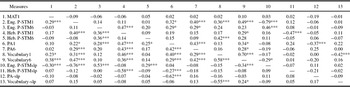
The results of bivariate concurrent and longitudinal correlations between Grade 1 and 6 vocabulary, the two phonological short-term memory measures and PA, and their slopes are presented in Table 2. Correlations above the diagonal pertain to the EL1s and correlations below the diagonal pertain to the ELLs. Inspection of the patterns of concurrent associations indicates that in the case of the ELLs in Grade 1, both phonological short-term memory measures and PA correlated positively and significantly with vocabulary. In the case of the EL1s in Grade 1, only English-like nonword repetition task correlated positively and significantly with vocabulary, whereas Hebrew-like nonword repetition task and PA did not. Inspection of the patterns of bivariate longitudinal correlations indicates that Grade 1 phonological short-term memory measures and PA correlated with Grade 6 vocabulary in the ELL and EL1 groups alike.
Concurrent and longitudinal correlations among ELL (lower diagonal) and EL1 (upper diagonal) cognitive measures and vocabulary and their rate of growth from Grade 1 to 6

Note: Numbers 1 and 6 refer to Grades 1 and 6; ELL, English language learners; EL1, English monolinguals; MAT, Matrix Analogy Test (nonverbal ability task); Eng. P-STM, English phonological short-term memory (English-like nonword repetition task); Heb. P-STM, Hebrew phonological short-term memory (Hebrew-like nonword repetition task); PA, phonological awareness; Vocabulary, Peabody Picture Vocabulary Test; slp, slope parameter.
*p < .05. ***p < .001.
Concurrent and longitudinal predictors of growth parameters in vocabulary
We fitted simple conditional models into the data. Using person-level (Level 2) hierarchical linear models (Raudenbush & Bryk, Reference Raudenbush and Bryk2002), we examined the contribution of Grade 1 phonological short-term memory measures and PA to Grade 1 and Grade 6 vocabulary, and to the rate of vocabulary growth. To examine Grade 1 predictors of change in vocabulary, we centered the data around mean age in Grade 1 (i.e., 75 months). To examine Grade 1 predictors of Grade 6 vocabulary, we centered the data around mean age in Grade 6 (i.e., 140 months). Results of these analyses revealed that when each of the two phonological short-term memory measures or PA was entered separately into the model, each predicted significantly vocabulary concurrently (Grade 1) and longitudinally (Grade 6). However, neither Grade 1 phonological short-term memory measures nor Grade 1 PA predicted rate of growth in vocabulary. Given these results we proceeded to fit combined models for predicting Grade 1 and Grade 6 vocabulary, using ELL–EL1 and Grade 1 cognitive measures as predictors.
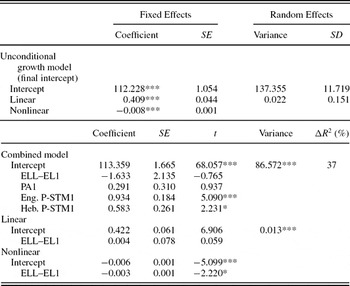
To examine whether English- and Hebrew-like nonword repetition task and PA make unique contributions to vocabulary development, three approaches were taken in fitting the combined conditional models for Grades 1 and 6 vocabulary and for the rate of growth in vocabulary. First, we entered language status, English-like nonword task, and PA as combined predictors of Grades 1 and 6 vocabulary. In the second model, we replaced the English task with the Hebrew-like nonword task. Finally, we fitted a model with all significant predictors (i.e., language status, English- and Hebrew-like nonword task, and PA). The results of the analyses for the final combined models are summarized in Table 3 and Table 4 for initial and final intercepts, respectively.
Final model fitted for Grade 1 vocabulary using Grade 1 predictors (concurrent)

Note: Number 1 refers to Grade 1; ELL–EL1, English language learners–English monolinguals; PA, phonological awareness; Eng. P-STM, English phonological short-term memory (English-like nonword repetition task); Heb. P-STM, Hebrew phonological shortterm memory (Hebrew-like nonword repetition task.
*p < .05. **p < .01. ***p < .001.
Final model fitted for Grade 6 vocabulary using Grade 1 predictors (longitudinal)

Note: Number 1 refers to Grade 1; ELL–EL1, English language learners–English monolinguals; PA, phonological awareness; Eng. P-STM, English phonological short-term memory (English-like nonword repetition task); Heb. P-STM, Hebrew phonological short-term memory (Hebrew-like nonword repetition task.
*p < .05. ***p < .001.
Results for the Grade 1 vocabulary (presented in Table 3) indicated that in all three models, language status and the two phonological short-term memory measures contributed significantly to the variance in Grade 1 vocabulary. When either English- or Hebrew-like nonword repetition tasks are added to the models, PA did not make any unique contribution to Grade 1 models. Language status was also highly significant, that is, ELL students performed significantly lower than EL1s on Grade 1vocabulary. Jointly, the phonological short-term memory measures and language status explained 43% of the variance on the initial vocabulary intercept. However, language status was the only factor that contributed variance to the rate of growth in vocabulary from Grade 1 through Grade 6 (i.e., vocabulary slope).
As for Grade 6 vocabulary, results of the first and second models indicated that with either English- or Hebrew-like nonword task present in the models, none of the other predictors contributed uniquely to the variations in Grade 6 vocabulary. English, t (136) = 5.307, p = .000, and Hebrew, t (136) = 2.885, p = .005, phonological short-term memory tasks were the only significant independent predictors of Grade 6 vocabulary in the first and second models. Moreover, as shown in Table 4, when the two measures of phonological short-term memory were entered simultaneously into the model, they contributed to vocabulary differences in Grade 6 significantly and independently, whereas PA and language status lost their significance. The results indicated that English- and Hebrew-like nonword task were independent measures of phonological short-term memory that make unique concurrent and longitudinal contributions to vocabulary when they were entered into the models simultaneously. The combined model explained 37% of the variance in Grade 6 vocabulary.
Growth on cognitive variables as predictor of vocabulary development
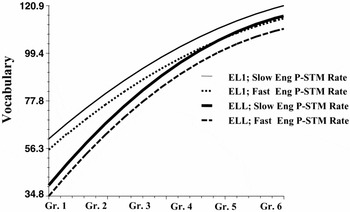
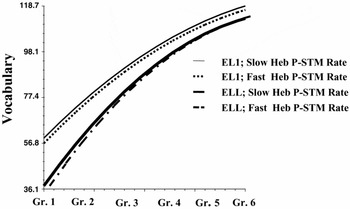
The next step in the analysis was to examine the extent to which the rate of growth in cognitive predictor variables might be related to growth parameters in vocabulary. As noted above, no statistically significant group (ELL–EL1) differences were found in the rates of growth on the two measures of phonological short-term memory and on PA. Results of simple conditional models indicated that growth (slope) in English-like nonword task contributed significantly to Grade 6 vocabulary, t (139) = −4.400, p = .000. The negative association indicated that vocabulary knowledge in Grade 6 and the rate of growth in English-like nonword task were inversely related (Figure 3). That is, the higher the vocabulary scores in Grade 6, the slower the growth rate in English-like nonword task. The rate of growth in English-like nonwords repetition explained 16% of the variance in Grade 6 vocabulary outcome. Rate of growth in Hebrew-like nonwords repetition and PA was not related to Grade 6 vocabulary or to the rate of growth in vocabulary (Figure 4).
Rate of growth on the English-like phonological short-term memory as a predictor of Grade 6 vocabulary.

Rate of growth on the Hebrew-like phonological short-term memory as a predictor of Grade 6 vocabulary.

Vocabulary as a concurrent and longitudinal predictor of cognitive variables
Finally, to explore the notion of reciprocal relationship we fitted parallel simple conditional models into the data to examine the contribution of Grade 1 vocabulary to Grade 1 and Grade 6 English- and Hebrew-like nonword repetition measures, and to PA, and to examine the contribution of Grade 1 vocabulary to the rate of growth on these cognitive variables. Results indicated that Grade 1 vocabulary did not contribute significantly to Grade 1 or Grade 6 Hebrew-like nonword repetition. However, Grade 1 vocabulary explained 10% of the concurrent, t (139) = 3.544, p = .001, and 16% of the longitudinal, t (139) = 2.590, p = .01, variance in English-like nonword repetition. Grade 1 vocabulary did not contribute to the rate of growth on English-like nonword task. Finally, Grade 1 vocabulary explained 4% and 5% of the variance in Grade 1, t (139) = 2.576, p = .01, and Grade 6, t (139) = 2.643, p = .01, PA, respectively. Rate of growth in vocabulary did not contribute variance to the growth parameters of the cognitive and phonological processing variables.
DISCUSSION
This study examined the extent to which vocabulary trajectories are similar in ELL and EL1 students, and whether the same cognitive processes drive vocabulary development in these two groups. The longitudinal examination of vocabulary growth revealed similarities and differences between EL1 and ELL students in growth patterns, and in the cognitive processes that underlie this growth. We found that at the onset ELLs had lower English vocabulary knowledge than EL1 students and that this gap did not close over 6 years of elementary schooling. We also found that in both ELLs and EL1s phonological short-term memory and PA predicted vocabulary concurrently and longitudinally, but that in the presence of phonological short-term memory PA did not account for unique variance in vocabulary.
A number of observations can be made with regard to the development of receptive vocabulary over time. It appears that vocabulary improves gradually during the elementary school years, regardless of students’ home language, and this improvement is nonlinear. As hypothesized, growth in the vocabulary knowledge of ELLs in the primary years is steeper than that of EL1 students, who come to school already speaking English fluently. However, it appears that this momentum decelerates in the upper elementary years. In comparison with EL1s, the vocabulary skills of ELL novices have “more room to grow” in the early years of formal schooling. At this time ELLs encounter constantly new lexical and morphosyntactic structures in formal settings such as when they receive ESL support and learn to read, and in less structured contexts involving play and communication. In contrast, monolingual learners come to school with a more extended vocabulary in the societal language thanks to a longer and more distributed exposure to their first language. In addition, as has been suggested (e.g., Chall, Reference Chall1996), they are typically familiar with the language of print.
Many ELLs come from homes where English is not spoken or is not spoken fluently and extensively. These students are first introduced to English in a systematic manner with the onset of formal schooling and consistent exposure to language and literacy instruction. It is therefore not surprising that in the early years the average ELL vocabulary trajectory may be steeper than it is in monolinguals. However, ELLs continue to have significantly poorer vocabulary knowledge than their EL1 counterparts even though the gap begins to narrow in the upper elementary years. That the vocabulary gap does not close is problematic, because vocabulary has been shown to be related to reading comprehension and academic achievement (e.g., August, Carlo, Dressler, & Snow, Reference August, Carlo, Dressler and Snow2005; Chall, Reference Chall1983; Nation & Snowling, Reference Nation and Snowling2004; Proctor, Carlo, August, & Snow, Reference Proctor, Carlo, August and Snow2005; Verhoeven & van Leeuwe, Reference Verhoeven and van Leeuwe2008). The persistent lag in vocabulary knowledge raises two issues that require further study. From a theoretical perspective one can ask whether there may be some unspecified upper limit to the amount of vocabulary that can be acquired within a given time frame, and that ELLs might be at capacity in terms of the number of new vocabulary items they can acquire in a given time (e.g., Biemiller, Reference Biemiller1999; Biemiller & Boote, Reference Biemiller and Boote2006). From an instructional perspective the question is whether the rate of new vocabulary learning in ELLs can be accelerated with more effective, long-term, instruction.
Concurrent and longitudinal predictors of vocabulary in ELL and EL1
The finding that PA lost its significance in the presence of phonological short-term memory measures can be considered from two theoretical perspectives. One perspective concerns the finding in the literature that phonological short-term memory and PA represent separable components in young children (Alloway et al., Reference Alloway, Gathercole, Willis and Adams2004), but may merge to tap similar underlying cognitive systems as a result of their shared contribution to literacy development in the early school years. Gathercole, Alloway, Willis, and Adams's (Reference Gathercole2006) results do not support this hypothesis. Gathercole et al. (Reference Gathercole, Alloway, Willis and Adams2006) reported that reading (dis)ability was associated with language and PA skills of school age children and not with phonological short-term memory performance. They maintain that although related, complex working memory and phonological short-term memory have “dissociable links” (p. 265) with reading (dis)ability. That is, they do not have similar association with reading disabilities. The current research does not support either Alloway et al.'s (Reference Alloway, Gathercole, Willis and Adams2004) hypothesis or Gathercole et al.'s (Reference Gathercole, Alloway, Willis and Adams2006) findings. Instead, we found that PA and phonological short-term memory do not have dissociable links when vocabulary development is considered. It appears that phonological short-term memory mediates the relationship between PA and vocabulary, and that it is a standalone concurrent and developmental predictor of vocabulary through which PA is associated with vocabulary development.
The second perspective concerns the neurological underpinnings of PA and phonological short-term memory. There is neurological evidence suggesting that distinct areas of the cortex are responsible for phonological short-term memory store and the rehearsal/articulatory components of the phonological loop (e.g., Henson, Burgess, & Frith, Reference Henson, Burgess and Frith2000). It has been argued that in individuals with unimpaired neurological systems, problems in the articulatory component of phonological short-term memory are related to component skills of PA such as segmentation, deletion, and rhyming (Burani, Vallar, & Bottini, Reference Burani, Vallar and Bottini1991; Vallar, Reference Vallar2005; Vallar & Papagno, Reference Vallar, Papagno, Baddeley, Kopelman and Wilson2002). It is possible that the rehearsal/articulatory component and PA tap the same underlying system and that the relationship between PA and vocabulary is mediated through the rehearsal/articulatory component of phonological short-term memory. The independent contribution of phonological short-term memory to vocabulary knowledge suggests that the phonological short-term memory store reflects an underlying system that is somewhat related to the rehearsal/articulation component, but is distinct from PA. Students who have a larger vocabulary store can draw on morphological (Anglin, Reference Anglin1993; Nagy, Berninger, & Abbott, Reference Nagy, Berninger and Abbott2006) and phonotactic information (Zamuner, Reference Zamuner2009) associated with the rehearsal/articulatory component of English-like nonwords, thus allowing them to acquire additional new words. This process is applicable to both monolingual and L2 learners. Further elaboration of the neurological underpinnings of phonological short-term memory and PA is beyond the scope of this paper.
It is interesting that the English-like and Hebrew-like measures of phonological short-term memory had similar patterns of relationship with English vocabulary. Phonological short-term memory measured either with English-like nonwords or with typologically remote, novel, and foreign linguistic stimuli (in this case, Hebrew) predicted vocabulary at the outset and 6 years later. Yet, despite these similarities the English-like and Hebrew-like nonwords tasks were not interchangeable and each made distinct contributions to the prediction of vocabulary, suggesting that, as hypothesized, they tap different cognitive systems that underlie vocabulary development. When the nonword repetition task involves minimal or no familiar linguistic information, the measurement of the rehearsal/articulatory component of phonological short-term memory is not confounded with existing linguistic knowledge (e.g., Baddeley, Reference Baddeley2003). This is not the case when more familiar nonwords are used to measure phonological short-term memory (e.g., Gathercole, Reference Gathercole1995; Masoura & Gathercole, Reference Masoura and Gathercole2005). That is, a nonword repetition task that involves minimal or no familiar linguistic information affords a “purer” assessment of the phonological store component of phonological short-term memory (phonological loop), and this phonological store is related to vocabulary development over time. In contrast, the English-like nonword repetition task and English vocabulary draw on linguistic knowledge and familiarity with word patterns. The ability to recall English-like nonwords enhances vocabulary development, and in turn, better vocabulary enhances the ability to recall English-like nonwords (Chiat, Reference Chiat2006; Gathercole, Reference Gathercole2006). In sum, the current results replicate and extend findings from previous research (e.g., Gathercole, Reference Gathercole1995; Masoura & Gathercole, Reference Masoura and Gathercole2005).
Not only are the English-like and Hebrew-like nonword tasks distinct in terms of predicting vocabulary, but they are also different from each other with respect to the association between rate of growth on these measures and vocabulary skills in Grade 6. Rate of growth on the English-like phonological short-term memory varied as a function of students’ vocabulary proficiency. This interaction is illustrated in Figure 3. Notice that steeper growth rate on the English-like nonword task was associated with lower vocabulary scores in Grade 6, whereas less steep growth rate on the English-like nonword task was associated with higher vocabulary in Grade 6. It is important to note that there is similar negative relationship between vocabulary intercept and slope and between English phonological short-term memory intercept and slope. This points to the possibility of a ceiling effect such that children who start at a relatively higher level on these two skills do not show as much growth. Relatedly, recall that there is a positive relationship between English phonological short-term memory and English vocabulary. That is, children who start at a higher level on phonological short-term memory or on English vocabulary perform at a higher level on the other skill. The inverse relationship between the rate of growth in English phonological short-term memory and vocabulary mirrors the negative relationship between the rate of growth in vocabulary and its intercept. These relationships reflect that vocabulary and English phonological short-term memory rely on a similar underlying language component. As discussed earlier, this similarity underscores problems associated with wordlikeness.
No such interaction exists in the case of Hebrew-like nonwords. Instead, growth rate on the Hebrew-like nonwords mirrors vocabulary growth rate. This relationship is illustrated in Figure 4. It appears that, unlike the English-like nonword repetition measure, this measure is less susceptible to the effects of wordlikeness, language proficiency, and familiarity with the language of home, community, or school. Performance on a typologically remote nonword repetition measure is therefore less prone to chunking of words on the basis of proficiency and familiarity with morphology and word patterns (e.g., Edwards, Beckman, & Munson, Reference Edwards, Beckman and Munson2004), and a more reliable measure of phonological short-term memory.
Mutually facilitative relations
Baddeley (Reference Baddeley2003) hypothesized that over time the relationship between phonological short-term memory, PA, and vocabulary might become reciprocal. Findings of the present study support this hypothesis and extend it by showing that this reciprocity, or mutual facilitation, exists not only longitudinally but also concurrently and that it applies to both ELLs and EL1s. Vocabulary knowledge at the outset facilitated the improvement of underlying cognitive mechanisms that target coordination of multiple familiar stimuli (Alloway, Gathercole, & Pickering, Reference Alloway, Gathercole and Pickering2006; Baddeley, Reference Baddeley2000, Reference Baddeley2003). For example, the reciprocal relationships between vocabulary and PA might stem to some extent from the ability of EL1s and some ELLs with relatively better vocabulary to simultaneously store the incoming familiar lexical information in their memory, use their existing phonological knowledge, and carry out mental activities necessary for blending and segmenting fine-grained phonological units. Likewise, individual differences in performance on the English-like nonword repetition task and vocabulary reflect familiarity with similar, lexically based, linguistic structures.
At the same time, in ELLs and EL1s alike, there was no evidence of a reciprocal association between phonological short-term memory based on a foreign and typologically distant language (Hebrew) and English vocabulary, nor did we find evidence for the contribution of vocabulary at the outset of the study to the rate of growth in Hebrew-like nonwords. Instead, unidirectional concurrent and longitudinal relationships were noted between the ability to repeat foreign nonwords and English vocabulary. That is, compared to the ability to repeat English-like nonowords, to repeat truly foreign words one cannot rely on previously acquired linguistic skills. In this regard, measuring phonological short-term memory with a truly distant and foreign set of items can be considered a “purer” or “less-contaminated” cognitive measure of phonological short-term memory. Such a measure predicts vocabulary development in ELLs and EL1s regardless of language proficiency. Clearly, these results need to be replicated in other studies involving different groups of learners and measures of phonological short-term memory based on other, typologically distant, languages. This promises to be an important question for future studies of the cognitive underpinning of monolingual and L2 vocabulary learning over time.
CONCLUSIONS AND IMPLICATIONS
This study has shown that the same underlying cognitive processes are implicated in vocabulary growth of ELLs and English monolingual students. Some might argue that measuring cognitive skills in young ELLs is not reliable (e.g., Hamayan & Damico, Reference Hamayan and Damico1990; Holtzman & Wilkinson, 1991). Findings of the present study suggest that, as is the case with monolingual school children and notwithstanding the effects of schooling, instruction, and exposure to language, individual differences in phonological short-term memory predict individual differences in subsequent receptive vocabulary skills. It is important for educators and researchers to be mindful that even though the vocabulary skills of normally developing L2 students in mainstream classrooms improve over time, they do not catch up with those of their EL1 counterparts. Having more restricted vocabulary impacts their reading comprehension and writing achievement. It is therefore important to be attuned to subtle differences in students’ command of more advanced vocabulary skills, even when these learners are technically not considered to be ELL anymore.
APPENDIX A
Frequency (percentage) of children who were tested in Waves 4, 5, or 6 in each language group

APPENDIX B
English-like nonword, phonological short-term memory task

APPENDIX C
Hebrew-like, nonword, phonological short-term memory task

ACKNOWLEDGMENTS
This research was supported by grant 410-96-0851 from the Social Sciences Research Council of Canada and a grant from the Ontario Ministry of Education (to E.G.). We thank the staff and children at the Peel Board of Education, the Toronto District School Board, the Toronto Separate School Board, and the York Region Separate School Board of Education for their patience and cooperation.