

The Aurignacian sensu lato (ie, including the Proto-Aurignacian; c. 36,500–29,500 uncal bp) is central to our understanding of the Eurasian Middle–Upper Palaeolithic transition and the coeval replacement of Neanderthals by anatomically modern humans (AMHs). Whereas there is disagreement over who made other archaeological assemblages at the transition (eg, Bohunician, Chatelperronian, Uluzzian, Streletskian), the Aurignacian is generally accepted as having been left by early AMHs (Henry-Gambier et al. Reference Henry-Gambier, Maureille and White2004; Conard & Bolus Reference Conard, Bolus, Bar-Yosef and Zilhão2006; Anikovich et al. Reference Anikovich, Sinitsyn, Hoffecker, Holliday, Popov, Lisitsyn, Forman, Levkovskaya, Pospelova, Kuz’mina, Burova, Goldberg, MacPhail, Giaccio and Praslov2007; Henry-Gambier & Sacchi Reference Henry-Gambier and Sacchi2008; Hoffecker Reference Hoffecker2009; Bar-Yosef & Bordes Reference Bar-Yosef and Bordes2010; Benazzi et al. Reference Benazzi, Douka, Fornai, Bauer, Kullmer, Svoboda, Pap, Mallegni, Bayle, Coquerelle, Condemi, Ronchitelli, Harvati and Weber2011; Reference Benazzi, Slon, Talamo, Negrino, Peresani, Bailey, Sawyer, Panetta, Vicino, Starnini, Mannino, Salvadori, Meyer, Pääbo and Hublin2015; Müller et al. Reference Müller, Pross, Tzedakis, Gamble, Kotthoff, Schmiedl, Wulf and Christanis2011; Zilhão Reference Zilhão, Condemi and Weniger2011, Reference Zilhão, Akazawa, Nishiaki and Aoki2013; Higham et al. Reference Higham, Douka, Wood, Ramsey, Brock, Basell, Camps, Arrizabalaga, Baena, Barroso-Ruíz, Bergman, Boitard, Boscato, Caparrós, Conard, Draily, Froment, Galván, Gambassini, Garcia-Moreno, Grimaldi, Haesaerts, Holt, Iriarte-Chiapusso, Jelinek, Jordá Pardo, Maíllo-Fernández, Marom, Maroto, Menéndez, Metz, Morin, Moroni, Negrino, Panagopoulou, Peresani, Pirson, de la Rasilla, Riel-Salvatore, Ronchitelli, Santamaria, Semal, Slimak, Soler, Soler, Villaluenga, Pinhasi and Jacobi2014; Nigst et al. Reference Nigst, Haesaerts, Damblon, Frank-Fellner, Mallol, Viola, Götzinger, Niven, Trnka and Hublin2014; Hublin Reference Hublin2015; Kadowaki et al. Reference Kadowaki, Omori and Nishiaki2015; Fu et al. Reference Fu, Posth, Hajdinjak, Petr, Mallick, Fernandes, Furtwängler, Haak, Meyer, Mittnik, Nickel, Peltzer, Rohland, Slon, Talamo, Lazaridis, Lipson, Mathieson, Schiffels, Skoglund, Derevianko, Drozdov, Slavinsky, Tsybankov, Grifoni Cremonesi, Mallegni, Gély, Vacca, González Morales, Straus, Neugebauer-Maresch, Teschler-Nicola, Constantin, Teodora Moldovan, Benazzi, Peresani, Coppola, Lari, Ricci, Ronchitelli, Valentin, Thevenet, Wehrberger, Grigorescu, Rougier, Crevecoeur, Flas, Semal, Mannino, Cupillard, Bocherens, Conard, Harvati, Moiseyev, Drucker, Svoboda, Richards, Caramelli, Pinhasi, Kelso, Patterson, Krause, Pääbo and Reich2016; Hoffecker et al. Reference Hoffecker, Holliday, Anikovich, Dudin, Platonova, Popov, Levkovskaya, Kuz’mina, Syromyatnikova, Burova, Goldberg, Macphail, Forman, Carter and Crawford2016; Roussel et al. Reference Roussel, Soressi and Hublin2016; Vishnyatsky Reference Vishnyatsky2016; Bataille Reference Bataille2017; Gravina et al. Reference Gravina, Bachellerie, Caux, Discamps, Faivre, Galland, Michel, Teyssandier and Bordes2018; Teyssandier & Zilhão Reference Teyssandier and Zilhão2018). With the Aurignacian we see the appearance or increased preponderance of behaviours commonly considered ‘modern’ or characteristically ‘Upper Palaeolithic’, including art, music, personal adornment, long-distance circulation of objects/materials, and prismatic blade/bladelet and osseous technologies. Aurignacian life was founded on hunting and gathering and apparently included a particularly high level of residential (and probably also logistical) mobility, with personal gear in some cases transported hundreds of kilometres (Bon et al. Reference Bon, Simonnet, Vézian, Jaubert and Barbaza2005; Bordes et al. Reference Bordes, Bon, Le Brun-Ricalens, Jaubert and Barbaza2005; Discamps et al. Reference Discamps, Soulier, Bachellerie, Bordes, Castel, Morin, Thiébault, Costamagno and Claud2014; Anderson et al. 2015; Reference Anderson, Lejay, Brugal, Costamagno, Heckel, de Araujo Igreja, Pradeau, Salomon, Sellami, Théry-Parisot, Barshay-Szmidt, Mensan and Bon2018).
Material that is reasonably called ‘Aurignacian’ covers a remarkably wide geographical area. In Europe, Aurignacian assemblages are found from the East European Plain to the Atlantic and from Britain to the Mediterranean coast, and comparable material is found beyond Europe in the Levant and further east in the Zagros region of Iran. The best Aurignacian record anywhere is in Western Europe, and particularly south-western France.
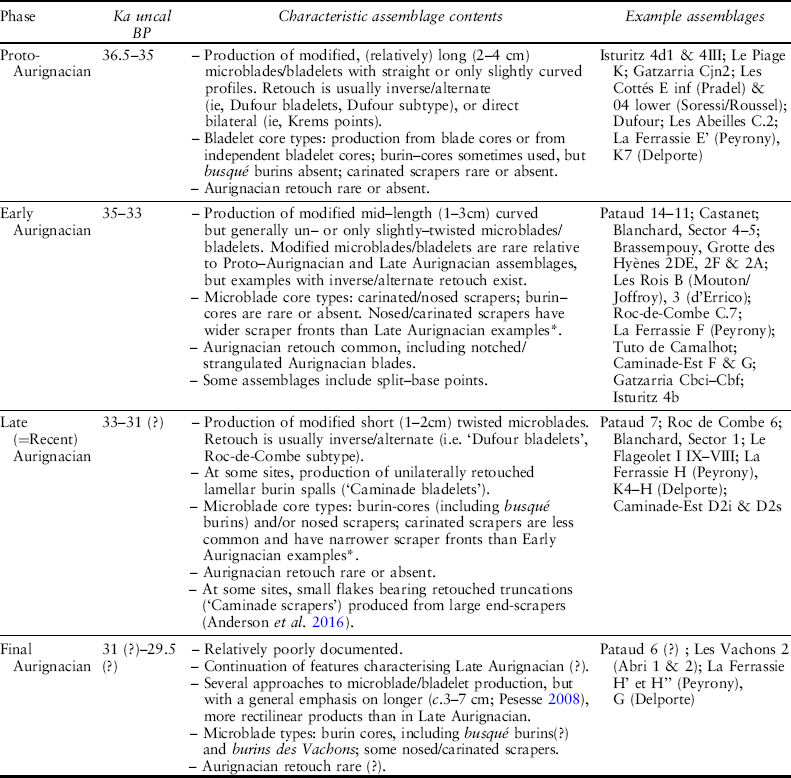
South-western France has an abundance of often rich Aurignacian sites, including around 50 with two or more Aurignacian layers. Some of these multi-layered sites have especially well-stratified and high-resolution sequences and have been recently excavated using modern methods. The result is a large corpus of good-quality data from which to reconstruct change through Aurignacian time (Table 1).
CHRONOCULTURAL SCHEME DESCRIBING MAJOR CHANGES WITHIN THE SOUTH-WESTERN FRENCH AURIGNACIAN
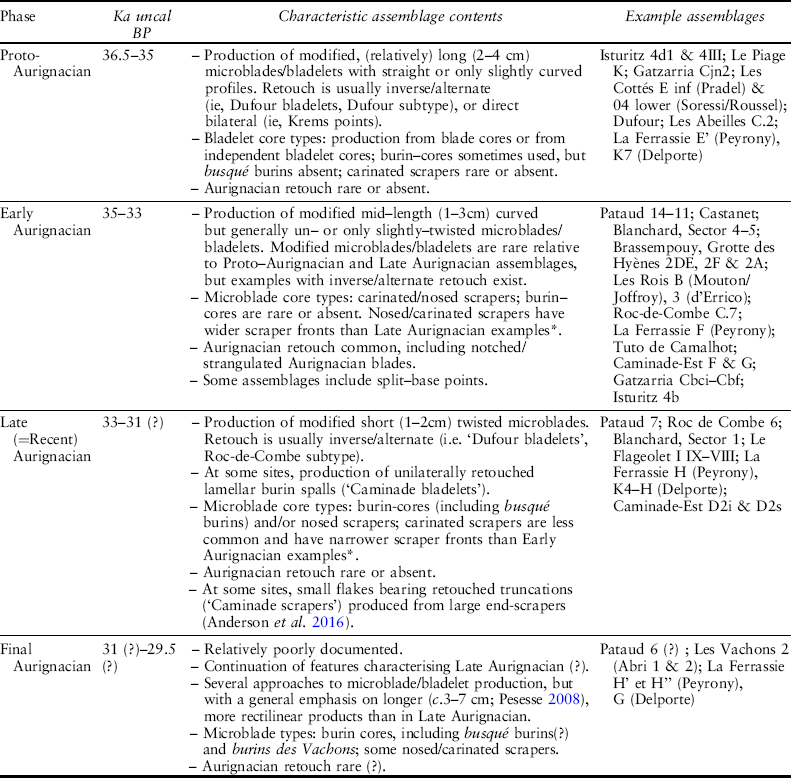
Note only chronologically sensitive aspects of the assemblages are included. *For the sample detailed here (see below & Table 6), median Early Aurignacian scraper front width is 25 mm compared to 17 mm for Late Aurignacian scraper fronts. Radiocarbon chronology following Higham et al. (Reference Higham2011), Banks et al. (Reference Banks, d’Errico and Zilhão2013a; Reference Banks, d’Errico and Zilhão2013b), and Bourrillon et al. (Reference Bourrillon, White, Tartar, Chiotti, Mensan, Clark, Castel, Cretin, Higham, Morala, Ranlett, Sisk, Devièse and Comeskey2018) plus two unpublished radiocarbon dates of c. 29,000 uncal bp for the Early Gravettian of Pataud 5 (K. Douka, pers. comm.).
Although the chronocultural scheme in Table 1 has been formulated over many decades, research over the past 20 years has permitted a better understanding of what this diachronic assemblage variation is documenting (eg, Lucas Reference Lucas1997; Bon Reference Bon2002; Bordes & Lenoble Reference Bordes and Lenoble2002; Chiotti Reference Chiotti2003; Bordes Reference Bordes and Le Brun-Ricalens2005, Reference Bordes, Bar-Yosef and Zilhão2006; Le Brun-Ricalens et al. Reference Le Brun-Ricalens, Bordes and Bon2005; Michel Reference Michel2010). All Aurignacian phases saw production of lamellar tools and it is now clear that their production also shaped other aspects of the assemblages. Several typically Aurignacian artefacts historically regarded as ‘burins’ or ‘scrapers’ – notably busqué/carinated burins and thick nosed/carinated scrapers – are now known to be microblade cores. As Aurignacian retouched lamellar pieces served as constituent parts of composite tools (Bon Reference Bon, Le Brun-Ricalens, Bordes and Bon2005; O’Farrell Reference O’Farrell and Le Brun-Ricalens2005; Pelegrin & O’Farrell Reference Pelegrin, O’Farrell and Le Brun-Ricalens2005; Normand et al. Reference Normand, O’Farrel, Rios Garaizar, Pétillon, Dias-Meirinho, Cattelain, Honegger, Normand and Valdeyron2009; Teyssandier et al. Reference Teyssandier, Bon and Bordes2010; Anderson et al. Reference Anderson, Chesnaux, Rué, Picavet, Fernandes, Morala, Caux, Tallet, Caverne and Kawalek2016; Caux Reference Caux2017) their changing form, along with the changing form of their parent cores, constitutes a tangible aspect of material culture that changes through time. As a result of this there is now consensus that Aurignacian bladelet and microblade technologies are key chronocultural markers (eg, Bon et al. Reference Bon, Teyssandier, Bordes and Otte2010; Michel Reference Michel2010; Teyssandier et al. Reference Teyssandier, Bon and Bordes2010; Anderson et al. Reference Anderson, Bon, Bordes, Pasquini, Slimak, Teyssandier, Naudinot, Meignen, Binder and Querré2015; Chiotti et al. Reference Chiotti, Cretin, Morala, White and Bourrillon2015; Dinnis & Flas Reference Dinnis and Flas2016; Falcucci et al. 2017; Reference Falcucci, Peresani, Roussel, Normand and Soressi2018; Bataille & Conard Reference Bataille and Conard2018).
Because of its quality, the south-western French record is frequently used as a reference sequence for understanding sparser and poorer quality archaeological records elsewhere. As a result, the extent to which the south-western French scheme applies to other regions is often discussed and debated (eg, Michel Reference Michel2010; Demidenko & Noiret Reference Demidenko, Noiret and Demidenko2012a; Flas et al. Reference Flas, Tartar, Bordes, Le Brun-Ricalens, Zwyns, Rougier and Semal2013; Banks et al. Reference Banks, d’Errico and Zilhão2013a; Reference Banks, d’Errico and Zilhão2013b; Davies et al. Reference Davies, White, Lewis and Stringer2015; Dinnis Reference Dinnis, Ashton and Harris2015; Dinnis & Flas Reference Dinnis and Flas2016; Tafelmaier Reference Tafelmaier2017; Bataille & Conard Reference Bataille and Conard2018; Bataille et al. Reference Bataille, Tafelmaier and Weniger2018; Teyssandier & Zilhão Reference Teyssandier and Zilhão2018) – some see it as a good explanatory framework for the archaeological record beyond the region, whereas others see important chronological and/or cultural differences elsewhere.
Over the past two decades, Conard and colleagues (Conard & Bolus Reference Conard and Bolus2003; Reference Conard, Bolus, Bar-Yosef and Zilhão2006; Reference Conard and Bolus2008; Conard et al. Reference Conard, Dippon, Goldberg, Zilhão and d‘Errico2003) have argued that the Aurignacian of the Swabian Jura in southern Germany is distinct from that further west and represents a unique and localised diachronic development. Early radiocarbon dates for the lowest layers from Geißenklösterle (Conard & Bolus Reference Conard and Bolus2003; Higham et al. Reference Higham, Basell, Jacobi, Wood, Ramsey and Conard2012) have been used to argue greater antiquity for the region’s Early Aurignacian than elsewhere and, by extension, a precocious penetration of Early Aurignacian AMHs into central Europe via the Danube corridor. In addition, rich osseous assemblages and early radiocarbon dates for some Early/Mid-Upper Palaeolithic layers have been used to argue that Swabia was the source area of cultural innovations such as Aurignacian and Gravettian technical systems, art, and music, which are only later more widely distributed across Europe – the Kulturpumpe hypothesis (Conard & Bolus Reference Conard and Bolus2003; Reference Conard and Bolus2008; Conard et al. Reference Conard, Dippon, Goldberg, Zilhão and d‘Errico2003; Higham et al. Reference Higham, Basell, Jacobi, Wood, Ramsey and Conard2012). These intepretations therefore fundamentally reject the notion that an Aurignacian chronocultural framework built on south-western French evidence is applicable to the Swabian Jura.
Testing hypotheses such as those of Conard and colleagues is not straightforward, largely due to two well-documented complicating factors. First is the ongoing challenge of consistently producing correct radiocarbon dates for the period. Despite progress, numerous recent publications leave no doubt that dates still cannot be presumed correct, even when there is no indicator of problems based on ancillary technical information (eg, Alex et al. Reference Alex, Barzilai, Hershkovitz, Marder, Berna, Caracuta, Abulafia, Davis, Goder-Goldberger, Lavi, Mintz, Regev, Mayer, Tejero, Yeshurun, Ayalon, Bar-Matthews, Yasur, Frumkin, Latimer, Hans and Boaretto2017; Reynolds et al. Reference Reynolds, Dinnis, Bessudnov, Devièse and Higham2017; Barshay-Szmidt et al. Reference Barshay-Szmidt, Anderson, Lejay, Théry-Parisot, Burr, Mensan and Bon2018a; Reference Barshay-Szmidt, Normand, Flas and Soulier2018b; Bourrillon et al. Reference Bourrillon, White, Tartar, Chiotti, Mensan, Clark, Castel, Cretin, Higham, Morala, Ranlett, Sisk, Devièse and Comeskey2018; Dinnis et al. Reference Dinnis, Bessudnov, Reynolds, Devièse, Pate, Sablin, Sinitsyn and Higham2019). However, despite this being widely understood, radiocarbon dates are often employed as the main or even sole evidence for regional or site-specific origins or late persistence of specific artefact assemblages. We discuss this issue further below.
The second obstacle is the challenge of isolating unmixed archaeological assemblages. Most of Central and Western Europe’s key sites are caves or rockshelters, which are universally subject to post-depositional disturbance of their sedimentary deposits (see, for instance, d’Errico et al. Reference d’Errico, Zilhão, Julien, Baffler and Pelegrin1998; Zilhão & d’Errico Reference Zilhão and d‘Errico1999; Conard & Bolus Reference Conard, Bolus, Bar-Yosef and Zilhão2006, 219; Bertran et al. Reference Bertran, Caner, Langohr, Lemée and d’Errico2008; Conard Reference Conard2009; Discamps et al. Reference Discamps, Gravina and Teyssandier2015). The question is therefore not whether these sites’ archaeological assemblages have undergone post-depositional movement, but rather how extensive this was and how it affects their interpretation. This problem is especially pressing at sites with multiple Aurignacian occupations; taphonomic investigation is prerequisite before the assemblage from an archaeological layer can justifiably be treated as representative of a short amount of Aurignacian time. When characterising diachronic change in the Aurignacian both issues must be kept in mind, in order to maintain, as far as is practicable, an appropriate quality of data.
HOHLE FELS IV AND WESTERN eUROPEAN LATE AURIGNACIAN ASSEMBLAGES
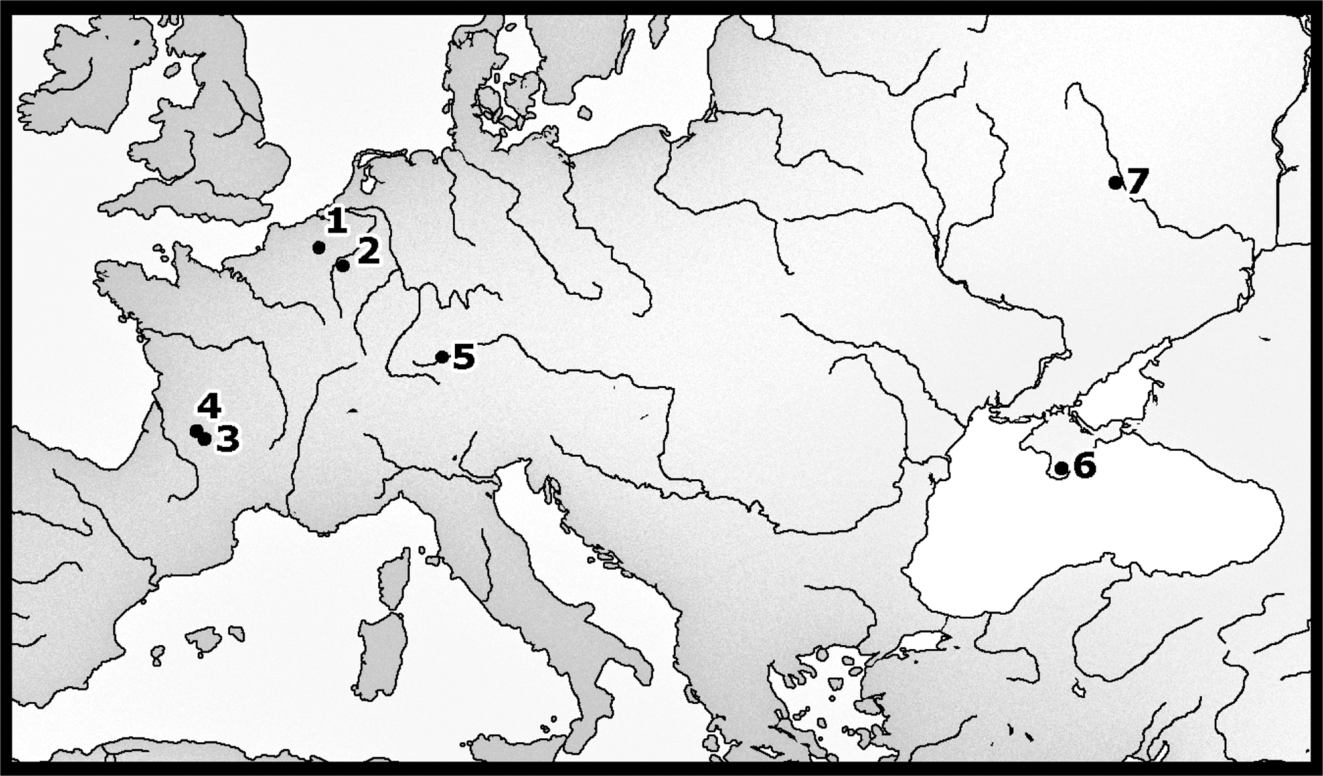
The Swabian Aurignacian’s relationship with the Western European record was recently revisited by Bataille and Conard (Reference Bataille and Conard2018) in their analysis of Layer IV of Hohle Fels (Fig. 1). Their study details important similarities with the Western European Late Aurignacian.Footnote 1 However, they also stress that it displays differences from Western European Late Aurignacian assemblages and argue that it is older. Therefore, they conclude, Hohle Fels IV represents a regional facies that ‘challenge[s] the claim that the typo-chronological system from Southwestern Europe can be applied to the Central European Aurignacian’ (Bataille & Conard Reference Bataille and Conard2018, 1).
Location of key Aurignacian sites discussed: 1. Maisières Canal; 2. Trou du Renard; 3. Roc de Combe; 4. Abri Pataud; 5. Hohle Fels; 6. Siuren I; 7. Kostënki
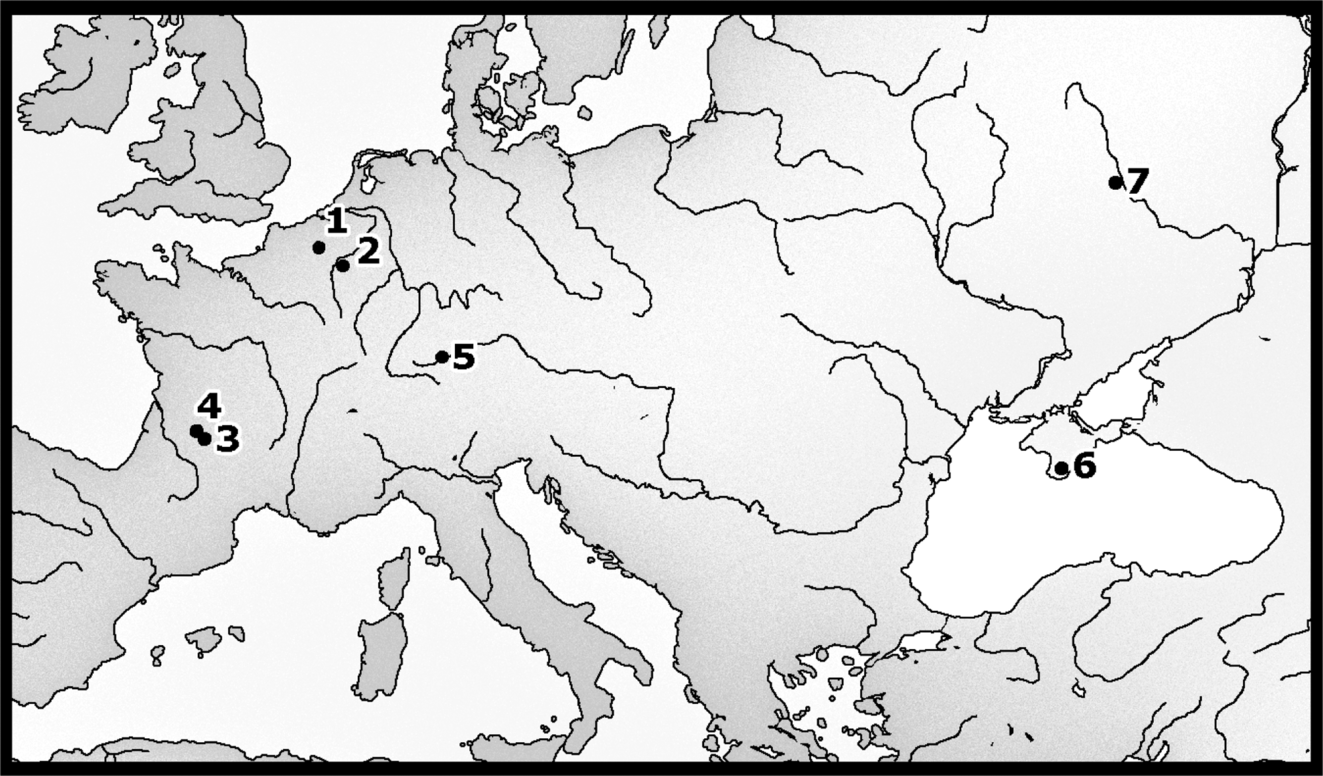
We here examine this assertion. Given the presence of busqué burins in Hohle Fels IV, appropriate Western European assemblages for comparison include those suggested by Bataille and Conard (Reference Bataille and Conard2018): Trou du Renard and Maisières Canal in Belgium, and Abri Pataud and Roc de Combe in south-west France (Fig. 1). Although we refer to other assemblages, our primary focus is therefore Late Aurignacian material from these four sites.
Hohle Fels, Baden-Württemberg, Germany
Hohle Fels has yielded an archaeological sequence of Middle Palaeolithic, Aurignacian, Gravettian, and Magdalenian, with the Aurignacian spanning seven horizons or sub-horizons over a depth of 1 m (Bataille & Conard Reference Bataille and Conard2018). With multiple levels, sizeable lithic and osseous artefact assemblages, recent excavation with modern techniques, and intensive programs of radiocarbon dating, Hohle Fels is, alongside Geißenklösterle, the most important Swabian Aurignacian sequence.
For Bataille and Conard (Reference Bataille and Conard2018) to conclude that Hohle Fels IV ‘challenge[s] the claim that the typo-chronological system from Southwestern Europe can be applied to the Central European Aurignacian’ they implicitly show that they consider the assemblage to be unmixed and reflective of a relatively short period of activity. As a basis for the present discussion we therefore do the same. It must be noted, however, that the Hohle Fels IV assemblage cannot per se be treated this way. The assemblage is bracketed by Aurignacian layers above and below and, judged by the distribution of finds given by Conard (Reference Conard2009, 249), there are no intermediate sterile deposits. Stratigraphic problems in parts of the Hohle Fels sequence have already been documented (Conard Reference Conard2009; Taller & Conard Reference Taller and Conard2016) and others are surely present. As Bataille and Conard (Reference Bataille and Conard2018, 2) point out, their study is part of ongoing work that will, we assume, include comprehensive taphonomic investigation of the sequence. This work will help to determine whether straightforward comparison of Hohle Fels’ individual layers with those from demonstrably well-stratified sites like Abri Pataud and Maisières Canal (see below) is appropriate.
Maisières Canal, Hainaut Province, Belgium
Better known for its later Maisièrian assemblage (Pesesse & Flas Reference Pesesse and Flas2012; Touzé Reference Touzé2018), the open-air site of Maisières Canal has also yielded a small but well-stratified Late Aurignacian lithic assemblage, excavated between 2000 and 2002. The total of 2872 lithics includes small pieces. Stratigraphic, technological, and refitting analyses indicate that the assemblage represents a single/short period of activity (Miller et al. Reference Miller, Haesaerts and Otte2004).
Trou du Renard, Namur Province, Belgium
Excavation of the cave site of Trou du Renard in 1900 led to the discovery of a Late Aurignacian lithic assemblage of c. 500 pieces. The Aurignacian Layer B was bracketed above and below by archaeologically sterile deposits. Despite the antiquity of the excavations the lithic assemblage includes very small pieces (Van den Broeck Reference Van den Broeck1901; Rahir Reference Rahir1914; Dinnis & Flas Reference Dinnis and Flas2016). Correct radiocarbon dating of the assemblage has not proved possible (explained below), but available dates and the composition of the layer’s faunal assemblage are consistent with its position in Marine Isotope Stage 3 (Dinnis & Flas Reference Dinnis and Flas2016). Based on descriptions of the assemblage’s discovery and its notably restricted technotypological profile it probably results from a single occupation or a few occupations over a brief period (ibid.).
Abri Pataud, Dordogne, France
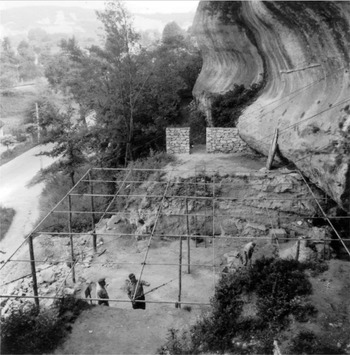
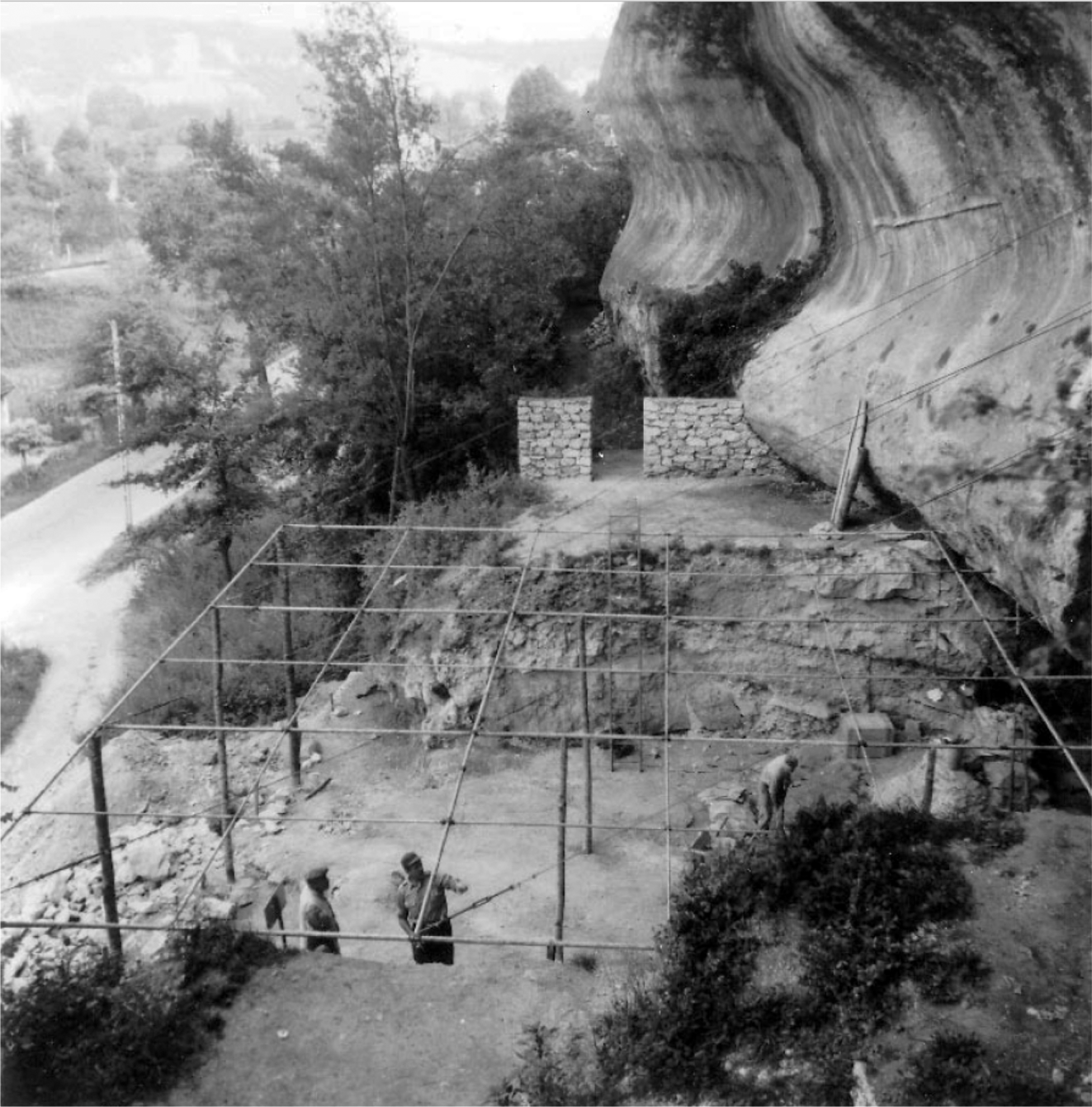
Chiefly excavated by Hallam Movius in 1953–64 (Fig. 2), Abri Pataud’s 14 archaeological layers span the Early and Mid-Upper Palaeolithic. The basal nine layers cover the Early and Late Aurignacian, with a probable Final Aurignacian component to the uppermost Layer 6. Abri Pataud stands as the best-stratified Aurignacian sequence in south-western France and among the very best Early Upper Palaeolithic sequences anywhere. Movius’s methodical recording of his excavations means that spatial analyses are possible and although the retention of smaller pieces varied between layers it was generally good. Importantly, Pataud’s archaeological layers were separated by éboulis layers of, sometimes large, limestone clasts but only few archaeological objects. These layers of éboulis helped to limit post-depositional mixing between the main archaeological accumulations. Although the validity of some of Movius’s sub-layer delineations can be questioned, taphonomic work and radiocarbon dating have confirmed the overall quality of the sequence (Chiotti Reference Chiotti2005; Michel Reference Michel2010; Higham et al. Reference Higham, Jacobi, Basell, Ramsey, Chiotti and Nespoulet2011). The assemblages from most of Pataud’s Aurignacian layers are sufficient for good technotypological characterisation (Chiotti Reference Chiotti2005) and, setting aside the fine detail, chronocultural change through the sequence is mirrored at other south-western French sites that have fewer and/or less well-stratified layers.
Excavation of Abri Pataud under the direction of Hallam Movius, 1958. Movius’s installation of a permanent grid system was one of the innovative methods he employed to ensure a detailed record of material recovered (©MNHN archives)
Bataille and Conard (Reference Bataille and Conard2018) explicitly compare Hohle Fels IV to Pataud 8 and 7. Here we also compare it to the overlying Layer 6, due to the presence of busqué burins and the potential chronological convergence with Hohle Fels IV. For the sake of simplicity, Layer 7 is here treated as one unit (ie, Layer 7 Lower and Upper are grouped together).
Roc de Combe, Lot, France
The cave site of Roc de Combe has yielded an important Middle Palaeolithic and Early/Mid-Upper Palaeolithic sequence. Carefully controlled and systematic work was undertaken by J. Labrot and F. Bordes in 1966, demonstrating a well-stratified sequence within the cave mouth (Bordes & Labrot Reference Bordes and Labrot1966; Bordes Reference Bordes and Le Brun-Ricalens2005; Michel Reference Michel2010). The Aurignacian of Roc de Combe comprises an Early Aurignacian assemblage from Layer 7 and Late Aurignacian assemblages from the overlying Layers 6 and 5 (Bordes & Labrot Reference Bordes and Labrot1966; Bordes Reference Bordes and Le Brun-Ricalens2005; Michel Reference Michel2010). A small sterile layer separated Layers 7 and 6. Although there was no sterile layer separating Layers 6 and 5 taphonomic investigation revealed no significant indication of mixing between them (Michel Reference Michel2010, 243–8), thereby supporting the stratigraphic separation of the layers’ assemblages.
In their comparison, Bataille and Conard (Reference Bataille and Conard2018) explicitly refer to the assemblage from Roc de Combe 6. Due to the presence of busqué burins, we also consider the overlying Layer 5.
CHRONOLOGY
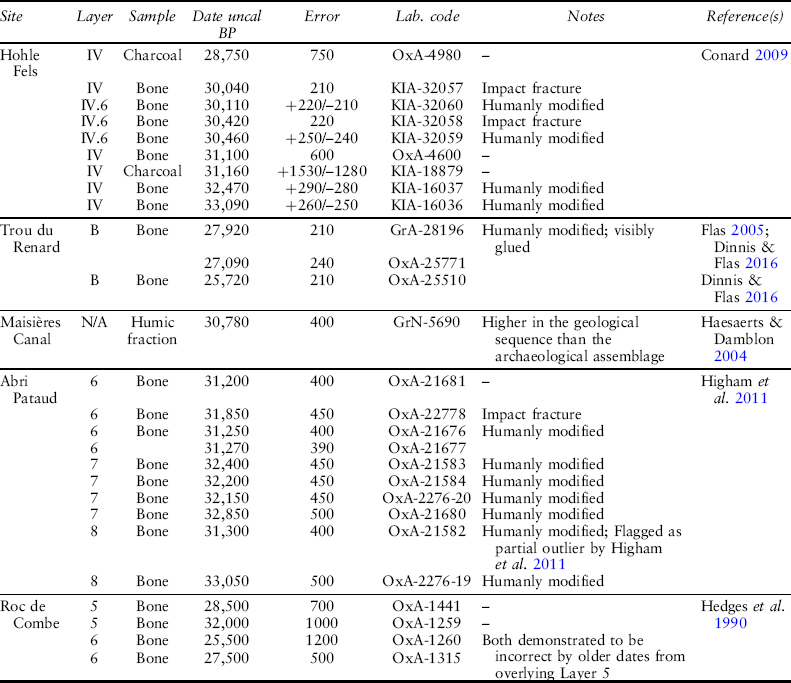
Bataille and Conard (Reference Bataille and Conard2018, 38) claim that Hohle Fels IV is ‘older than most of the western European Roc-de-Combe [ie, Late] Aurignacian sites’, citing Maisières Canal as a possible exception. Without reference to specific assemblages this statement cannot easily be assessed but we can compare radiocarbon dates from Hohle Fels IV with dates from sites with which Bataille and Conard (Reference Bataille and Conard2018) explicitly compare it: Abri Pataud, Roc de Combe, Trou du Renard, and Maisières Canal. Radiocarbon dates relevant to Late Aurignacian assemblages from these sites are given in Table 2.
RADIOCARBON DATES FOR HOHLE FELS IV AND FOR WESTERN EUROPEAN LATE AURIGNACIAN SITES WITH WHICH BATAILLE & CONARD (Reference Bataille and Conard2018) MAKE THEIR COMPARISON
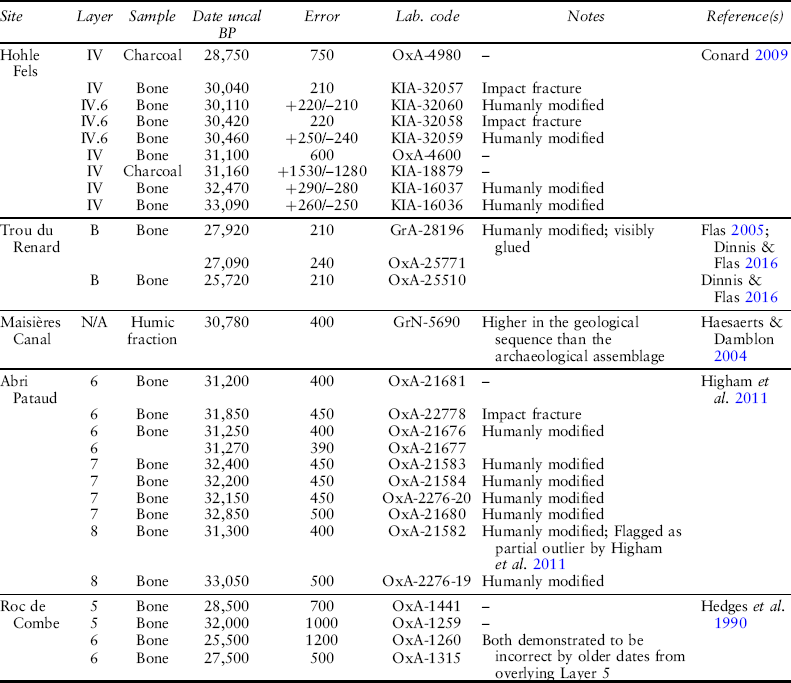
Note only the more recently produced dates of Higham et al. (Reference Higham2011) for Abri Pataud are given. Thier dates are internally consistent through the sequence, and agree with the generally well-stratified nature of the Aurignacian layers and the haitus between them and the overlying Mid Upper Palaeolithic Layer 5
The most widespread problem for successfully radiocarbon dating the Early Upper Palaeolithic is the incomplete removal of exogenous carbon which commonly leads to radiocarbon dates being erroneously young (Higham Reference Higham2011). With this in mind, there is good reason to reject dates for two of the assemblages in Table 2.
First, the dates for Roc de Combe Layer 6 of 25,500± 1200 bp (OxA-1260) and 27,500 ± 500 bp (OxA-1315) are contradicted by two older dates for the overlying Layer 5. In the absence of evidence for stratigraphic problems with these two layers it can be concluded that the Layer 6 dates are incorrect (as per a comment by P. Mellars noted in Hedges et al. Reference Hedges, Housley, Law and Bronk1990, 102). The dates from Trou du Renard can also be rejected. Two cutmarked bones associated with an apparently single- or short-occupation Late Aurignacian assemblage produced three dates of c. 28–26,000 uncal bp. The dated bones have visibly been treated with conservation materials and, as recent work has confirmed (Reynolds et al. Reference Reynolds, Dinnis, Bessudnov, Devièse and Higham2017; Dinnis et al. Reference Dinnis, Bessudnov, Reynolds, Devièse, Pate, Sablin, Sinitsyn and Higham2019), this alone is enough to treat them as minimum ages only. They are also younger than the appearance of Mid-Upper Palaeolithic assemblages across Europe (Jöris et al. Reference Jöris, Neugebauer-Maresch, Weninger, Street, Neugebauer-Maresch and Owen2010; Higham et al. Reference Higham2011; Table 1). Like those from Roc de Combe 6, the Trou du Renard dates should therefore be rejected.
Comparison can instead be made between Hohle Fels IV and the Late Aurignacian of Maisières Canal, Abri Pataud 8, 7, and 6 and Roc de Combe 5 (see Tables 2 & 3; Fig. 3).
CALIBRATED AGE RANGES (68.2%) FOR THE CALIBRATED RADIOCARBON DATES SHOWN IN FIG. 3

Produced using OxCal (Bronk Ramsey Reference Bronk Ramsey2009; Reimer et al. Reference Reimer, Bard, Bayliss, Beck, Blackwell, Ramsey, Buck, Cheng, Edwards, Friedrich, Grootes, Guilderson, Haflidason, Hajdas, Hatté, Heaton, Hoffmann, Hogg, Hughen, Kaiser, Kromer, Manning, Niu, Reimer, Richards, Scott, Southon, Staff, Turney and van der Plicht2013) and Calpal (Weninger et al. Reference Weninger, Jöris and Danzeglocke2016). The radiocarbon dates and sample information can be found in Table 2
Calibrated ages for radiocarbon dates listed in Table 2 from Hohle Fels IV and selected Western European Late Aurignacian assemblages. Maisières Canal is excluded as the radiocarbon date does not date the archaeological horizon (see text). Figure produced using OxCal 4.3.2 and IntCal13 (Bronk Ramsey Reference Bronk Ramsey2009; Reimer et al. Reference Reimer, Bard, Bayliss, Beck, Blackwell, Ramsey, Buck, Cheng, Edwards, Friedrich, Grootes, Guilderson, Haflidason, Hajdas, Hatté, Heaton, Hoffmann, Hogg, Hughen, Kaiser, Kromer, Manning, Niu, Reimer, Richards, Scott, Southon, Staff, Turney and van der Plicht2013). Table 3 contains calibrated age ranges for these dates produced using Calpal and OxCal

Following Haesaerts (Reference Haesaerts and Miller2004; Haesaerts & Damblon Reference Haesaerts, Damblon and Miller2004), the single radiocarbon date from Maisières Canal (Table 2) comes from a position in the sequence higher than the Late Aurignacian assemblage, and therefore provides a terminus ante quem for the occupation. Based on extrapolation from a dated sequence in the Netherlands, Haesaerts (Reference Haesaerts and Miller2004; Haesaerts & Damblon Reference Haesaerts, Damblon and Miller2004) conclude that the palaeosol containing the Maisières Canal Late Aurignacian material dates to c. 33–32,000 uncal bp.
The radiocarbon dates from Abri Pataud and Roc de Combe 5 instead come from material within their archaeological layers. Higham et al. (Reference Higham2011) report four dates of 32–31,000 uncal bp for Pataud 6, four dates of 33–32,000 uncal bp for Pataud 7, and two dates of 33,050 ± 500 bp (OxA-2276-19) and 31,300 ± 400 bp (OxA-21582) for Layer 8. The latter date was one of two partial outliers detected by Higham et al. (Reference Higham2011) from their suite of 32 dates from Pataud’s basal ten layers. The weight of evidence supporting the coherence of the Pataud sequence and the four older dates from the overlying Layer 7 indicate that this single date is an underestimate. Roc de Combe 5 has produced two dates on bone of 28,500 ± 700 bp (OxA-1441) and 32,000 ± 1000 bp (OxA-1259). These dates should be treated cautiously, due to their large errors and the fact that they were produced at the Oxford Radiocarbon Accelerator Unit prior to the implementation of current pre-treatment techniques. That said, they are unlikely to overestimate the age of the dated samples (Higham Reference Higham2011) and they can therefore be viewed as providing a minimum age for the layer as well as for the underlying Layer 6.
Radiocarbon dates for Late Aurignacian assemblages from Pataud 8–6, Roc de Combe 5, and Maisières Canal therefore indicate an age of c. 33–30,000 uncal bp (≈38–34,000 cal bp), with the most reliable data suggesting an age of c. 33–31,000 uncal bp (≈38–35,000 cal bp) (Tables 2 & 3; Fig. 3).
Radiocarbon dates for Hohle Fels IV are in good agreement with this (Table 2 & 3; Fig. 3). Excluding the layer’s single youngest date, all dates lie in the range 33–30,000 uncal bp (≈38–34,000 cal bp). Six of these eight dates cluster between 30,040 ± 210 bp (KIA-32057) and 31,160+530/–1280 bp (KIA-18879), potentially suggesting that a large part of the Layer IV assemblage has a chronological position towards the end of the 33–30,000 uncal bp range. Bataille and Conard’s claims that Hohle Fels IV is older than most Western European Late Aurignacian assemblages and that ‘the early dates of the [Hohle Fels IV] assemblage … speak against a chronological interpretation as late Aurignacian’ (Bataille & Conard Reference Bataille and Conard2018, 38) are therefore not supported by the data.
COMPARISON OF ARCHAEOLOGICAL ASSEMBLAGES
As well as claiming an older age for Hohle Fels IV, Bataille and Conard (Reference Bataille and Conard2018) also argue that it is significantly different from the Western European Late Aurignacian. We were able to isolate six features of Hohle Fels IV that in their view mark it as different, each of which we address in the following sections:
1. The use of soft stone hammers in blade production.
2. The presence of ‘Aurignacian’ retouch.
3. The presence of carinated/nosed scrapers alongside busqué burins.
4. The presence of Mladeč points.
5. A prevalence of lamellar burin spalls and prevalence of on-axis rather than off-axis lamellar products.
6. An absence of microblades bearing inverse/alternate edge retouch (ie, Dufour bladelets).
An additional argument put forward by Bataille and Conard (Reference Bataille and Conard2018) was omitted from our analysis. For them, ‘pointed blades’ have been claimed as a feature of the Western European Early Aurignacian. Based on this premise, Bataille and Conard (Reference Bataille and Conard2018) argue that their presence in Hohle Fels IV contradicts the Western European record. However, none of the sources they refer to (ibid., 42) in support of their premise actually mentions Western European Early Aurignacian pointed blades. We therefore consider it unnecessary to address this argument. Finally, Bataille and Conard (ibid., 35) also highlight similarity of blade thickness and profile in Hohle Fels IV and at Geißenklösterle. It is unclear whether this observation is evoked as evidence for Hohle Fels IV’s incompatibility with the Western European scheme. We therefore do not consider it in detail but for the sake of thoroughness we can point out that, based on Bataille and Conard’s (Reference Bataille and Conard2018) blade thickness and profile data, the blades from Hohle Fels IV fit well with those in Western European Late Aurignacian assemblages (Flas Reference Flas and Miller2004; Michel Reference Michel2010; RD, LC, DF & AM unpublished data).
The comparison of Hohle Fels IV and the Western European Late Aurignacian presented below relies on data for Hohle Fels IV from Bataille and Conard (Reference Bataille and Conard2018). Where possible, we have therefore used their preferred units of analysis, notably categories of different lamellar products:
Bladelets: width 7–12mm
Microblades: width <7mm
Lamellar burin spalls: width <12mm, two ventral faces, triangular/trapezoidal cross-section
Soft stone percussion
Noting esquillements de bulbe (sensu Pelegrin Reference Pelegrin, Valentin, Bodu and Christensen2000, 79) on some blades in Hohle Fels IV, Bataille and Conard (Reference Bataille and Conard2018, 30) conclude that soft stone hammers were used. They suggest that this differs from the Western European Late Aurignacian, where organic hammers were used (Bataille & Conard Reference Bataille and Conard2018, 35). In support they cite Dinnis and Flas’s (Reference Dinnis and Flas2016) study of Trou du Renard, which identified only evidence suggestive of organic hammers. In this regard Trou du Renard is like Late Aurignacian assemblages from Maisières Canal and Pataud 7 (Flas Reference Flas and Miller2004; Chiotti Reference Chiotti2005; Michel Reference Michel2010). Evidence for soft stone percussion has, however, been described at other sites, including for blade production in Roc de Combe 5 and Le Flageolet 1 Layer G, and small blade/large bladelet production in Pataud 6 (Pesesse Reference Pesesse2008; Michel Reference Michel2010; Dinnis & Flas Reference Dinnis and Flas2016). Soft stone percussion therefore cannot be viewed as distinguishing Hohle Fels IV from the Western European Late Aurignacian.
‘Aurignacian’ retouch
A prevalence of ‘Aurignacian’ retouch is regarded as typical of the Western European Early Aurignacian (eg, Djindjian et al. Reference Djindjian, Otte and Kozlowski1999; Teyssandier & Zilhão Reference Teyssandier and Zilhão2018). Particularly typical are large blades bearing Aurignacian retouch (=Aurignacian blade), sometimes with lateral constrictions produced by this modification (=strangulated/notched Aurignacian blade). Aurignacian retouch is generally understood as scaled, profound, and well-marked (Demars & Laurent Reference Demars and Laurent1992, 78), with the most characteristic pieces having undergone multiple phases of edge modification and bearing additional stepped retouch post-dating the invasive scaled retouch. Aurignacian retouch is nonetheless notoriously difficult to satisfactorily define. There is no clear boundary between ‘Aurignacian blades’ and more generic retouched blades (ibid.), and blades bearing ‘Aurignacian’ retouch occur in low levels throughout most of the Upper Palaeolithic (ibid., 161).
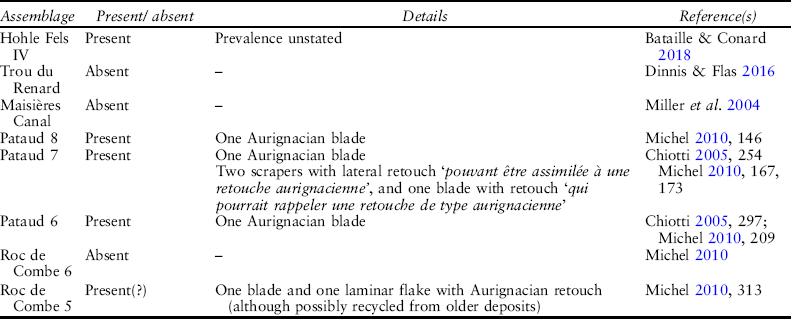
Because Aurignacian retouch is prevalent in the Early Aurignacian, Bataille and Conard (Reference Bataille and Conard2018) argue that its presence in Hohle Fels IV alongside Late Aurignacian-type microblade cores contradicts the Western European model. They do not provide counts for pieces with Aurignacian retouch and figure only one flake with stepped retouch (ibid., fig 15, no. 1) that may or may not be Aurignacian retouch. Neither Conard and Bolus (Reference Conard, Bolus, Bar-Yosef and Zilhão2006) nor Bataille and Conard (Reference Bataille and Conard2018) refer to, or illustrate, typically Early Aurignacian strangulated/notched examples. Overall, given the (albeit low-level) presence of Aurignacian retouch in some Western European Late Aurignacian assemblages (Table 4), its presence alone in Hohle Fels IV does not contradict the Western European model.
PRESENCE/ABSENCE & RELATIVE PREVALENCE OF AURIGNACIAN RETOUCH IN HOHLE FELS IV & WESTERN EUROPEAN LATE AURIGNACIAN ASSEMBLAGES
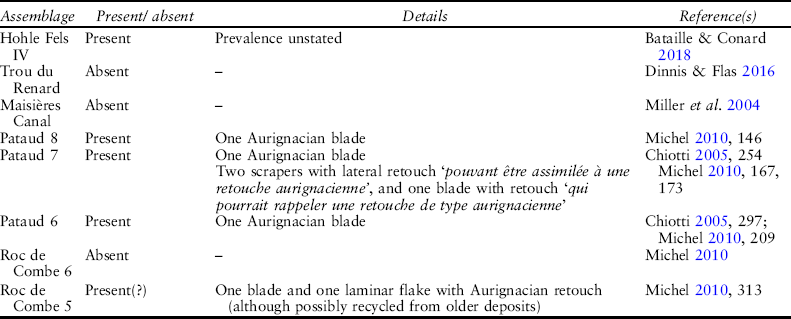
The presence of nosed/carinated scrapers and carinated/busqué burins
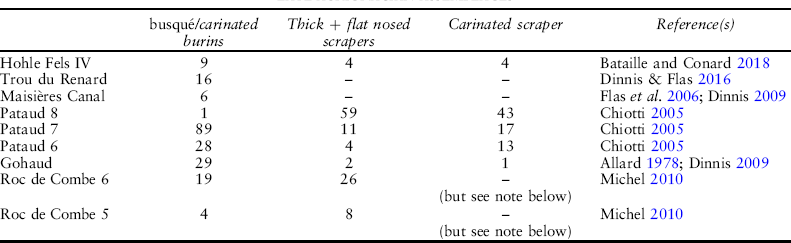
Bataille and Conard (Reference Bataille and Conard2018) argue that the co-existence of carinated/nosed scrapers and carinated/busqué burins in Hohle Fels IV differentiates it from Western Europe, where, they suggest, the former artefact types belong to earlier phases of the Aurignacian than the latter. Although chronoculturally sensitive (see Table 1, above), these core types are in fact frequently found together in well-stratified Western European Late Aurignacian assemblages (Table 5).
COUNTS OF CHRONOCULTURALLY SENSITIVE ARTEFACT TYPES IN HOHLE FELS IV & IN WESTERN EUROPEAN LATE AURIGNACIAN ASSEMBLAGES

Note that some differences will exist between the different typological definitions used by each author. Despite our comments regarding the most appropriate taxon for Bataille & Conard’s (Reference Bataille and Conard2018) carinated scrapers (see text), we use their typological categories. To enable comparison with Bataille & Conard’s counts we have pooled flat and thick nosed scraper counts for each assemblage. Michel’s (Reference Michel2010) nosed scraper counts for Roc de Combe 5 & 6 exclude pieces not showing clear core morphology. They also include pieces without any notch(es), and therefore examples that would be classified by others as carinated scrapers (see Michel Reference Michel2010, 276). Material from Pataud éboulis 6/7 is included in counts for Layer 6. Artefacts from Pataud and Roc de Combe classified respectively as atypical for their class by Chiotti (Reference Chiotti2005) and as uncertain examples by Michel (Reference Michel2010) are excluded. One carinated piece of uncertain form has been excluded from the counts for Trou du Renard
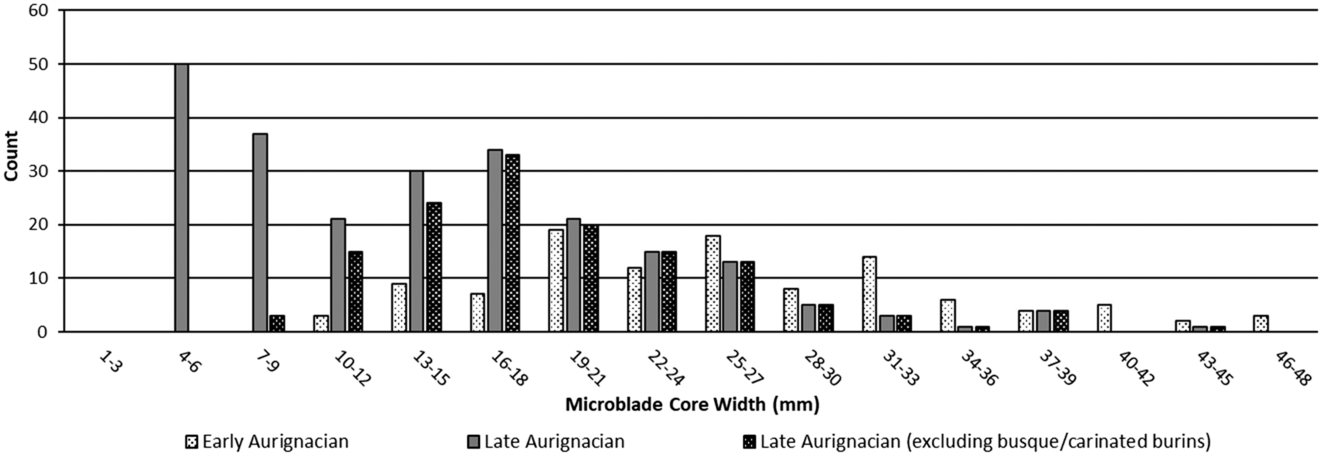
Instead of their presence/absence, a distinction between Early and Late Aurignacian assemblages can be made on the technomorphology of these cores. Early Aurignacian carinated cores have, overall, larger and wider debitage faces than Late Aurignacian ones (Bordes & Lenoble Reference Bordes and Lenoble2002; Bordes Reference Bon, Simonnet, Vézian, Jaubert and Barbaza2005; Reference Bordes, Bar-Yosef and Zilhão2006; Chiotti Reference Chiotti2005; Chiotti et al. Reference Chiotti, Cretin, Morala, White and Bourrillon2015; Table 6; Fig. 4). The constriction in debitage face width in the Late Aurignacian means that microblades are more systematically twisted than their Early Aurignacian counterparts. It is this shift towards smaller, twisted microblades that underpins changes in the microblade core assemblages: ‘carinated scraper’ cores become less prevalent as debitage faces are more frequently made narrower through notching, thereby creating ‘nosed scrapers’; and the desire for (or tolerance of?) narrower microblade cores allows the use of busqué/carinated burin cores that exploit the width (rather than the thickness) of blanks.
DESCRIPTIVE STATISTICS FOR METRICS (TO NEAREST WHOLE MM) OF MICROBLADE CORE WIDTHS (SCRAPER FRONT WIDTHS OF NOSED/CARINATED SCRAPER-CORES & BURIN BIT WIDTHS FOR BUSQUÉ/CARINATED BURIN-CORES) FOR EARLY & LATE AURIGNACIAN ASSEMBLAGES

See also Fig. 4. The Late Aurignacian sample is composed of artefacts from Maisières Canal (n=6), Abri Pataud 7 & 8 (n=216), and Abri Blanchard (Sector 1) (n=13). The Early Aurignacian sample is composed of artefacts from Pataud 11–14 (n=65), Abri Blanchard (Sector 4–5) (n=6) and Abri Castanet (n=39). Artefacts classed as atypical/not probable bladelet cores and those from which a valid measurement could not be taken are excluded. To enable comparison of Early and Late Aurignacian nosed/carinated scrapers only, statistics are also given for the Late Aurignacian with all burin-cores excluded. The elevated Coefficient of Variation for the Late Aurignacian sample is the result of its bimodal distribution (see Fig. 4). The scraper fronts of Early Aurignacian nosed/carinated scraper-cores are wider than those from the Late Aurignacian (P=0.00)
Microblade core widths (scraper front widths (mm) of nosed/carinated scraper-cores and burin bit widths (mm) for busqué/carinated burin-cores) for the Early and Late Aurignacian assemblages detailed in Table 6. Note the bimodal distribution of the Late Aurignacian sample. This is the result of different values for nosed/carinated scrapers (which tend to have larger values) and busqué/carinated burins (whose values tend to be smaller, as they are largely determined by blank thickness, and often are made on blades <10 mm thick). Summary statistics for these data are given in Table 6

To return to Hohle Fels, the carinated/nosed scraper microblade cores illustrated by Bataille and Conard (Reference Bataille and Conard2018, 23; fig. 17C) show a lateral constriction of their debitage faces. They are close to those from Spy Cave referred to by Flas et al. (Reference Flas, Tartar, Bordes, Le Brun-Ricalens, Zwyns, Rougier and Semal2013) as ‘narrow-fronted carinated scrapers’, which, for those authors, are particularly characteristic of the south-western French Late Aurignacian. There is certainly nothing in the illustrated examples from Hohle Fels that would preclude them from a Western European Late Aurignacian assemblage.
As well as suggesting that the presence of these different artefact forms invalidates Hohle Fels IV’s inclusion in the Western European chronocultural framework, Bataille and Conard (Reference Bataille and Conard2018, 38) also question the validity of the framework as applied to Western Europe. The only evidence offered to support this is busqué burins that were wrongly attributed to the Early Aurignacian Layer 13 of Abri Pataud by Chiotti (Reference Chiotti2003), a mistake rectified soon after (Chiotti Reference Chiotti2004). These artefacts in fact belong to the busqué burin-dominated Layer 7 (Lower) assemblage. Overall, the sudden appearance in Layer 7 (Lower) of the Abri Pataud sequence of busqué burins is entirely in accordance with the Western European chronocultural scheme.
Osseous point types
Bataille and Conard (Reference Bataille and Conard2018) highlight two ivory massive-base Mladeč points in Hohle Fels IV, suggesting that this point type (along with the split-base point) is typically Early Aurignacian and therefore inconsistent with a Late Aurignacian attribution for the layer.
Unlike the split-base point, however, (ivory) massive-base Mladeč points, along with their equivalent (antler) lozangic points, are usually regarded as markers of the Late Aurignacian (eg, Djindjian et al. Reference Djindjian, Otte and Kozlowski1999: 163, 166; Cattelain Reference Cattelain and Otte2010; Doyon Reference Doyon2017). Where artefacts described as Mladeč (or lozangic) points and split-base points have been found in different strata at the same site, the former always overlies the latter (Laplace Reference Laplace1966; Brooks Reference Brooks and Bricker1995; Djindjian et al. Reference Djindjian, Otte and Kozlowski1999; de Sonneville-Bordes Reference de Sonneville-Bordes2002; Vercoutère Reference Vercoutère2004; Oliva Reference Oliva and Teschler-Nicola2006, 57; Chiotti et al. Reference Chiotti, Cretin, Morala, White and Bourrillon2015; Doyon Reference Doyon2017; Bourrillon et al. Reference Bourrillon, White, Tartar, Chiotti, Mensan, Clark, Castel, Cretin, Higham, Morala, Ranlett, Sisk, Devièse and Comeskey2018). Long and narrow massive-base ivory points from the basal Aurignacian layers of Geißenklösterle and Hohle Fels are morphologically (and functionally?) different from Mladeč points (Bolus & Conard Reference Bolus and Conard2006; Doyon Reference Doyon2017), which underscores the point that ‘massive-base points’ per se are potentially poor chronocultural markers due to their generalised form (Cattelain Reference Cattelain and Otte2010; Flas et al. Reference Flas, Tartar, Bordes, Le Brun-Ricalens, Zwyns, Rougier and Semal2013, 248). That said, the presence of Mladeč points in Hohle Fels IV certainly cannot be argued as contradictory of the Western European model.
Prevalence of lamellar burin spalls and on-axis lamellar products
Bataille and Conard (Reference Bataille and Conard2018, 41) describe a prevalence of lamellar burin spalls with straight or on-axis twisted profiles as ‘a specific characteristic of the Hohle Fels IV facies’. In the overall assemblage of 37 retouched/use-modified lamellar products, 81% (n=30) of pieces are of this blank type (ibid., 11). Eighty per cent of these bear unilateral modification (n=24 of 30) (ibid., 11). Similar lamellar burin spalls, including those that have been retouched, have been recognised in many Western European Late Aurignacian assemblages.
Numerous unretouched pieces fitting Bataille and Conard’s (Reference Bataille and Conard2018) definition (ie, Chiotti’s [Reference Chiotti2003] ‘type C’ bladelet) are well documented for the Late Aurignacian of Pataud (Chiotti Reference Chiotti2003; Reference Chiotti2004) and are common in assemblages containing burin-cores. As they were left unmodified, though, it is difficult to argue for these assemblages that they were intended products rather than simply by-products of microblade production.
Retouched examples fitting Bataille and Conard’s (Reference Bataille and Conard2018) description of those in Hohle Fels IV are, however, present in other assemblages. Bordes and Lenoble (Reference Bordes and Lenoble2002) describe 37 unilaterally modified ‘Caminade bladelets’ in the Late Aurignacian of Caminade (Dordogne) and a single Caminade bladelet has been identified in the small Maisières Canal assemblage (Flas et al. Reference Flas, Miller, Jacobs, de Araujo Igreja Bracco, Bracco and Le Brun-Ricalens2006). Although unpublished, Caminade bladelets have also been recognised in French Late Aurignacian assemblages from Route de Marsaneix (Dordogne), Maldidier (Dordogne) and Les Fieux (Lot).
Some comparison between retouched examples from Caminade and Hohle Fels IV is possible based on the respective descriptions of Bordes and Lenoble (Reference Bordes and Lenoble2002) and Bataille and Conard (Reference Bataille and Conard2018). At Caminade, as in Hohle Fels IV, lamellar burin spall blanks chosen for modification are narrower and thicker than microblade blanks selected for use/retouch (Bordes & Lenoble Reference Bordes and Lenoble2002, 743; Bataille & Conard Reference Bataille and Conard2018, 31). At both sites, twisting of lamellar burin spall blanks is less prevalent than for microblade blanks (Bordes & Lenoble Reference Bordes and Lenoble2002, 742; Bataille & Conard Reference Bataille and Conard2018, 35), although as these observations are based respectively on modified and unmodified pieces (for Hohle Fels IV) and modified pieces only (for Caminade) it is difficult to know if this reflects a similarity of targeted product. For the same reason, the relatively greater prevalence of twisting of lamellar burin spalls reported for Hohle Fels IV (compare Bordes & Lenoble Reference Bordes and Lenoble2002, 742 with Bataille & Conard Reference Bataille and Conard2018, 35) may or may not represent a true difference between the two assemblages.
Although not contradictory of the Western European record, we agree with Bataille and Conard (Reference Bataille and Conard2018) that the relative prevalence of unilaterally retouched/use-modified lamellar burins spalls in Hohle Fels IV is of interest, especially against the apparent paucity of modified microblades (see below). As they suggest, this could be the result of activity specialism at the site. We await results of the planned use-wear analysis with interest. Future work could also usefully include a formal comparison of the Caminade and Hohle Fels IV assemblages, to assess the level of similarity of this artefact type.
Bataille and Conard (Reference Bataille and Conard2018, 41) note two lamellar productions in Hohle Fels IV: curved and off-axis twisted products from carinated/nosed scrapers and burin-cores; and a more prevalent production of on-axis twisted products, and especially lamellar burin spalls, from burin-cores. This is argued (ibid., 33) to differentiate it from Western European assemblages, which are characterised instead by off-axis twisted microblade production. Again, formal comparison with Western European Late Aurignacian assemblages (including those with retouched lamellar burin spalls) would be needed to ascertain whether this is the case, and, if so, whether it is simply an artefact of the prevalence of lamellar burin spall production in Hohle Fels IV. Certainly, the presence of different lamellar productions in the same layer would not in itself contradict the Western European record (Bordes & Lenoble Reference Bordes and Lenoble2002; Chiotti Reference Chiotti2005; Dinnis & Flas Reference Dinnis and Flas2016).
Absence of Dufour bladelets
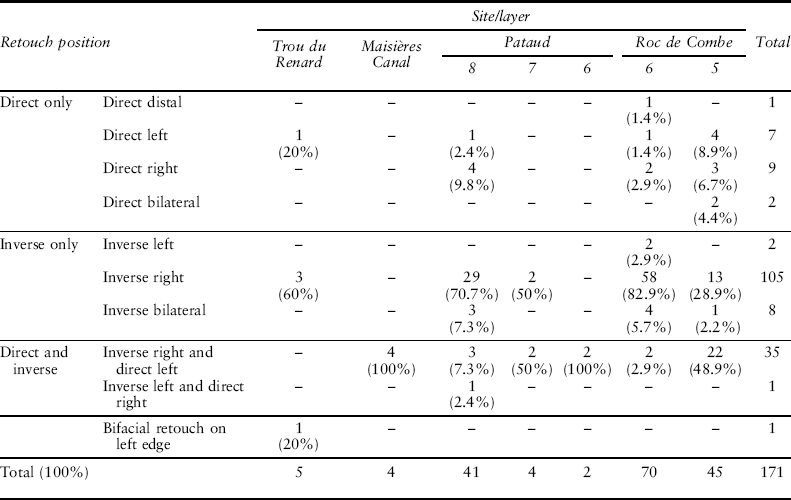
The most diagnostic feature of the Western European Late Aurignacian is the, sometimes numerous, assemblages of microblades bearing alternate/inverse edge retouch, commonly referred to as Dufour bladelets (Table 7). In line with the technological changes seen in microblade production between the Early and Late Aurignacian (see above), in the Late Aurignacian these are made from small (1–2 cm long), anticlockwise twisted blanks, usually struck from busqué/carinated burin cores. Despite production of this blank type in Hohle Fels IV Bataille and Conard (Reference Bataille and Conard2018) identified no microblades bearing inverse/alternate retouch. They refer to this on several occasions as marking a clear point of difference between Hohle Fels IV and the Western European Late Aurignacian (Bataille & Conard Reference Bataille and Conard2018, 34, 37, 38, 39).
RETOUCH POSITION FOR MICROBLADES (& BLADELETS FROM THE SAME PRODUCTION TECHNIQUES) FROM MAISIÈRES CANAL (FLAS ET AL. Reference Flas, Miller, Jacobs, de Araujo Igreja Bracco, Bracco and Le Brun-Ricalens2006); TROU DU RENARD (DINNIS & FLAS Reference Dinnis and Flas2016), ROC DE COMBE 5 & 6, AND PATAUD 8, 7, & 6 (MICHEL Reference Michel2010)

Note the eight dorsally retouched Font Yves points/bladelets from Pataud 6 are too large for the definition of microblade and are therefore excluded. The low number of examples from Pataud 6 & 7 reflect inadequate screening/collection during excavation in comparison to Layer 8 and the other sites. Percentages are for differently retouched microblades within each assemblage
According to Bataille and Conard (Reference Bataille and Conard2018, 11), there is only one laterally retouched microblade in Hohle Fels IV. The absence of Dufour bladelets is therefore actually a more general dearth of retouched microblades. This is intriguing. Although their study (ibid., 7) sample includes ‘all formal tools’,Footnote 2 it would be useful in any future publication if they could explicity confirm whether this includes retouched pieces from the fine fraction, as this is the most likely place that the (usually fragmentary) edge-retouched microblades would be found.
Even if Hohle Fels IV is indeed characterised by a sparsity of retouched microblades, there are numerous ways through which they could become poorly represented, ranging from site function and raw material economy to taphonomic processes and excavation/sampling method (Bordes & Lenoble Reference Bordes and Lenoble2002; Lenoble Reference Lenoble2005; Pelegrin & O’Farrell Reference Pelegrin, O’Farrell and Le Brun-Ricalens2005; Bertran et al. Reference Bertran, Claud, Detrain, Lenoble, Masson and Vallin2006; Reference Bertran, Lenoble, Todisco, Desrosiers and Sørensen2012). Even when smaller pieces are present, collected, and searched for in the fine fraction, not all assemblages contain numerous Dufour bladelets. A good example is the open-air site of Gohaud (Loire Atlantique, France), where the collection of 1235 pieces includes small fragments (Allard Reference Allard1978). Twenty-nine busqué/carinated burin cores (Dinnis Reference Dinnis2009) show that microblade production was one of the site’s key activities. Despite this, of a total of eight complete/fragmentary microblades bearing retouch or use-modification, only two fragmentary examples could warrant classification as Dufour bladelets (Allard Reference Allard1978, 33, fig. 25).
We await clarification over whether the absence of laterally retouched microblades is real. If it is, potential taphonomic reasons for their absence should be considered before it can be claimed as a meaningful difference between Hohle Fels IV and the Western European Late Aurignacian.
SUMMARY
Radiocarbon dates of 33–30,000 uncal bp for Maisières Canal, Abri Pataud 8–6, and Roc de Combe 5 are consistent with dates from Hohle Fels IV. Bataille and Conard’s (Reference Bataille and Conard2018) claim that early dates for Hohle Fels IV mark it as incompatible with Western European Late Aurignacian sites therefore finds no support in the data. Furthermore, most of the features of Hohle Fels IV flagged by those authors as being different from the Western European Late Aurignacian are, in fact, documented in French and/or Belgian assemblages. The occurrence of Aurignacian retouch in Hohle Fels IV does not contradict the French record, and the co-occurrence of carinated/nosed scrapers and carinated/busqué burins is common in Western European assemblages. Like Hohle Fels IV, soft stone hammer percussion has been reported for Late Aurignacian assemblages from Abri Pataud, Roc de Combe, and Le Flageolet 1. Laterally modified lamellar burin spalls, considered by Bataille and Conard (Reference Bataille and Conard2018) to be particularly characteristic of Hohle Fels IV, have been identified at Western European sites and are particularly abundant in the Late Aurignacian of Caminade. Bataille and Conard’s (Reference Bataille and Conard2018) claim that Mladeč points are markers of the Early Aurignacian is unconvincing, and their presence in Hohle Fels IV does not contradict the Western European Late Aurignacian. Although the almost total absence of retouched microblades in Hohle Fels IV is intriguing it requires corroboration, first by confirmation that the layer’s fine fraction has been searched and then by consideration of potential taphonomic reasons for their absence. Overall, contrary to Bataille and Conard’s (Reference Bataille and Conard2018) claims, Hohle Fels IV accords well chronologically and in terms of assemblage contents with the Western European Late Aurignacian.
DISCUSSION
Does the Western European scheme apply to Eastern Europe?
Seeing a region-specific signature in the Hohle Fels Aurignacian, Bataille and Conard (Reference Bataille and Conard2018, 42) in their discussion cast doubt on Zilhão’s (Reference Zilhão, Condemi and Weniger2011) suggestion that the Western European succession of ‘Transitional Industry’–Proto-Aurignacian–Early Aurignacian–Late Aurignacian is valid across Europe. In another recent publication, Bataille et al. (Reference Bataille, Tafelmaier and Weniger2018) interpret the wider European Aurignacian record from a similar perspective, seeing evidence for regional cultural continuity and viewing Eastern Europe in particular as inconsistent with the Western European scheme. In our view, however, in its key features Eastern Europe shows a good level of chronocultural agreement with the west.
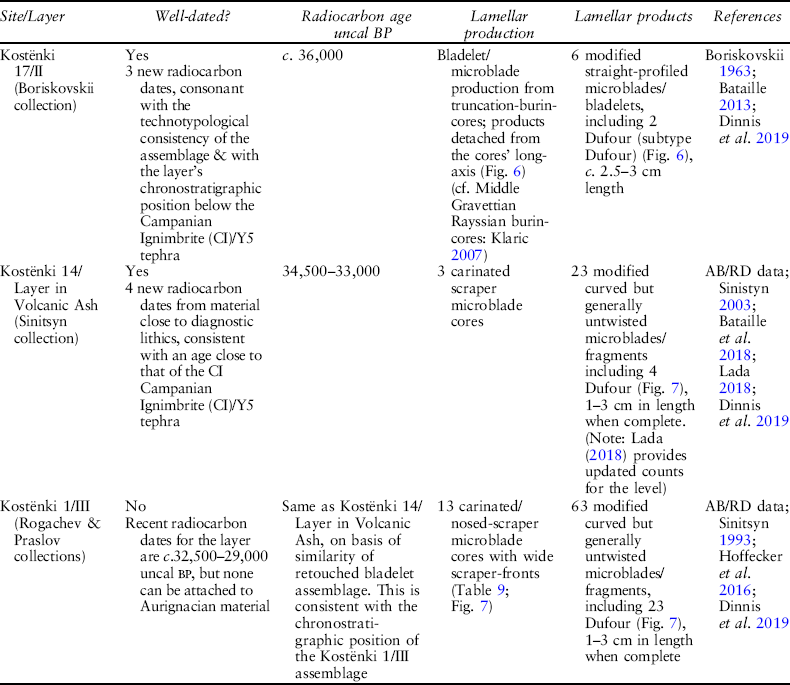
Because of a paucity of quality sites, any characterisation of the Eastern European Aurignacian relies on the famous complex of open-air sites at Kostënki (Voronezh Oblast, Russia) and the rockshelter site of Siuren I (Crimea; Figs 1 & 5). Several of Kostënki’s Early Upper Palaeolithic assemblages have featured in considerations of the European Aurignacian (eg, Sinitsyn Reference Sinitsyn, Bánesz and Kozłowski1993; Reference Sinitsyn2003; Hoffecker Reference Hoffecker2009; Davies et al. Reference Davies, White, Lewis and Stringer2015; Bataille et al. Reference Bataille, Tafelmaier and Weniger2018; Dinnis et al. Reference Dinnis, Bessudnov, Reynolds, Devièse, Pate, Sablin, Sinitsyn and Higham2019). For Bataille et al. (Reference Bataille, Tafelmaier and Weniger2018), Layer IVb of Kostënki 14 is notable because it shows an Aurignacian-like assemblage dating to >42,000 cal BP (≈ >36,500 uncal BP) (ibid., 22), and also because it demonstrates this early age for typically Late Aurignacian busqué burins, thereby contradicting the Western European record (ibid., 20). We reject this interpretation, for two reasons. First, unlike other layers from Kostënki it is not clear whether the Layer IVb assemblage is homogeneous. The layer’s archaeological material was found redeposited on the sloping side of a palaeo-gully and in the gully’s base. Indeed, Bataille et al. (Reference Bataille, Tafelmaier and Weniger2018, 18) see bifacially worked pieces in the assemblage as possible evidence for mixing of artefacts from different periods. We have no strong opinion about whether this is the case but given its depositional circumstances nor are we confident about the layer’s homogeneity. Furthermore, the given age for the layer (ibid., 22) is based on the oldest of the 11 dates listed by Sinitsyn and Hoffecker (Reference Sinitsyn and Hoffecker2006), which actually range from 32,600 ± 280 BP (OxA-9568) to 37,240 ± 430/400 BP (GrA-10948). We can here note that more recently published dates for Layer IVb fall in the range 36,500–34,000 uncal BP (Douka & Higham Reference Douka and Higham2017). Given that neither we, nor Bataille et al. (Reference Bataille, Tafelmaier and Weniger2018), have confidence in the layer’s homogeneity, and given the range of dates for the layer, individual radiocarbon dates clearly cannot be assumed to mark the age of specific artefacts. Secondly, the reported convergence of microblade core-type between Layer IVb and the Western European Late Aurignacian is unconvincing. Bataille et al. (Reference Bataille, Tafelmaier and Weniger2018, 13) classify six artefacts in the collection as busqué burins, but in our view only one artefact warrants this classification (Sinitsyn Reference Sinitsyn and Otte2014a: 204, fig. 9, artefact no. 22). Furthermore, the six modified microblades/fragments from the layer are not consistent with Late Aurignacian examples. Unlike twisted Late Aurignacian microblades they are straight-profiled (Sinitsyn Reference Sinitsyn and Otte2014a) and they are significantly larger than those from Late Aurignacian contexts.Footnote 3
2014 excavations at Kostënki 14 (top; photo: R. Dinnis) and 2018 excavations at Kostënki 17 (bottom; photo: A. Bessudnov). At both sites CI/Y5 tephra deposits serve as an important chronological marker independent of radiocarbon dating

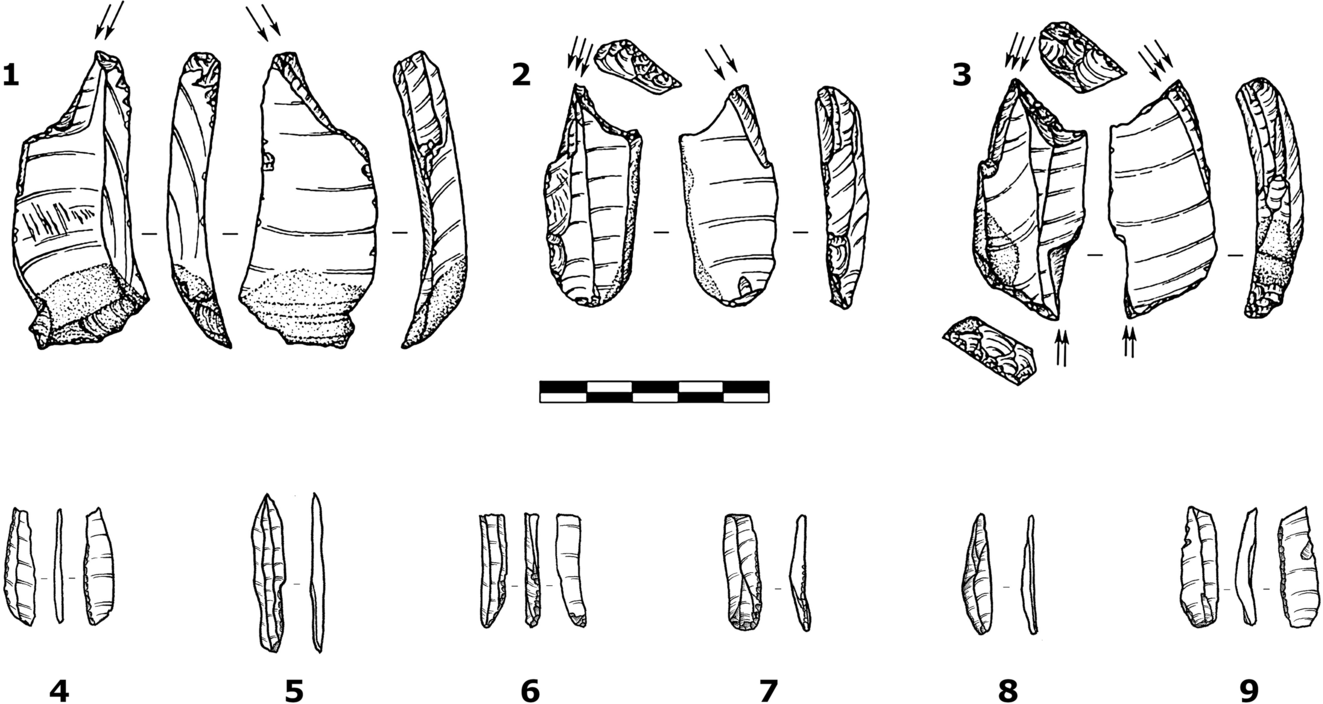
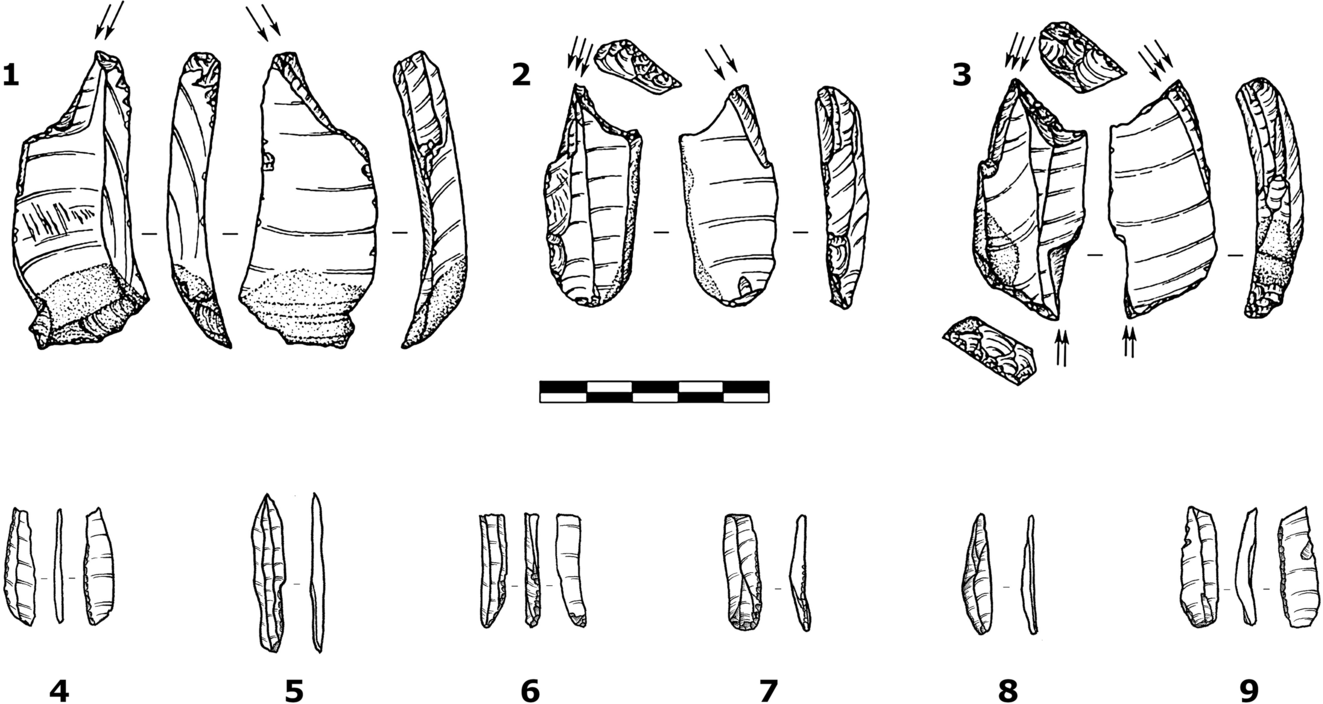
Better evidence comes instead from other layers at Kostënki (Table 8). The oldest of these is the ‘Spitsynian’ of Kostënki 17, now apparently well dated to c. 36,000 uncal BP and therefore within the timeframe of the Proto-Aurignacian (Banks et al. Reference Banks, d’Errico and Zilhão2013a; Reference Banks, d’Errico and Zilhão2013b; Table 1). Like the Proto-Aurignacian it shows a primary focus on the production of similarly sized straight-profiled bladelets/microblades, despite a difference in the method through which they were produced (Table 8; Fig. 6; Dinnis et al. Reference Dinnis, Bessudnov, Reynolds, Devièse, Pate, Sablin, Sinitsyn and Higham2019). With different methods employed to produce the same products, the Spitsynian can be interpreted as a local variant of the Proto-Aurignacian.
EARLY UPPER PALAEOLITHIC ASSEMBLAGES FROM KOSTËNKI THAT CONTRIBUTE TO AN UNDERSTANDING OF THE EASTERN EUROPEAN AURIGNACIAN, OUTLINING DATING & BLADELET/MICROBLADE PRODUCTION
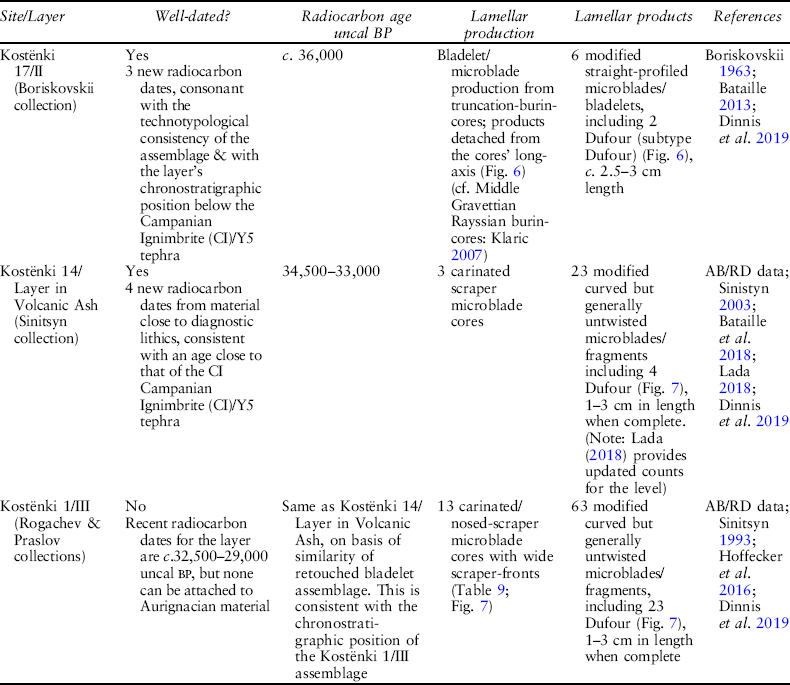
Note that except for the method of bladelet/microblade production in Kostënki 17/II there is good agreement with the south-western French record (Table 1).
Truncation-burin-cores (1–3) and retouched bladelets (4–9) from Kostënki 17/II. 3D models of artefact nos 2 & 9 can be Viewed and downloaded from http://www.earlymodernhumaneurope.com
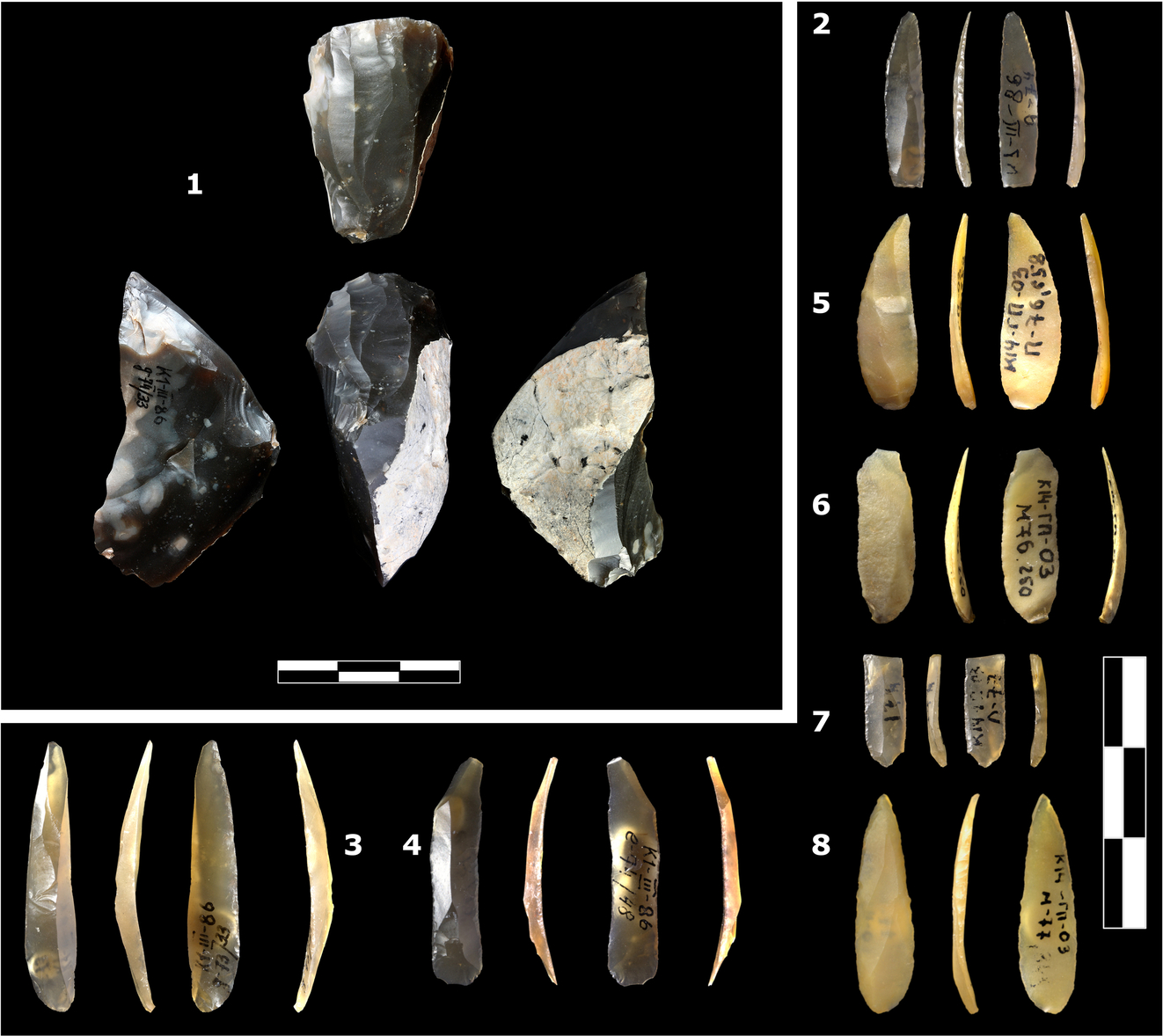
Material that is more typically Aurignacian comes from Kostënki 1 (Layer III) and Kostënki 14 (Layer in Volcanic Ash; Praslov & Rogachev Reference Praslov and Rogachev1982; Sinitsyn 1993; Reference Sinitsyn2003). In these layers microblade production mirrors that in the Western European Early Aurignacian (Tables 8 & 9; Fig. 7), with modified microblades distinct from larger and straighter Proto-Aurignacian examples and smaller and systematically twisted Late Aurignacian ones. Furthermore, in the larger Kostënki 1 assemblage there are artefacts with Aurignacian retouch including a typically Early Aurignacian strangulated Aurignacian blade (Sinitsyn Reference Sinitsyn, Bánesz and Kozłowski1993: 253, fig. 10, artefact no. 6).
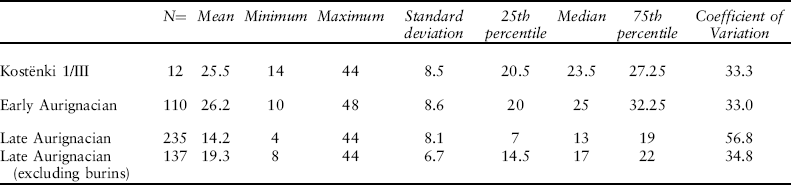
DESCRIPTIVE STATISTICS FOR METRICS (TO NEAREST WHOLE MM) OF SCRAPER FRONT WIDTHS OF NOSED/CARINATED SCRAPER MICROBLADE CORES FROM KOSTËNKI 1/III

One artefact from which a valid measurement could not be taken is excluded. These values are compared against the equivalent values for Western European Early and Late Aurignacian assemblages from Table 6. See note to Table 6 for details of these other samples. Note the similarity of mean, median, and range values for Kostënki 1/III with Western European Early (rather than Late) Aurignacian samples. The relatively wide debitage faces of the Kostënki 1 cores is consistent with the generally untwisted retouched microblades from the layer
1. Microblade core from Kostënki 1/III; 2–4. modified bladelets from Kostënki 1/III. 5–8. modified bladelets from Kostënki 14/Layer in Volcanic Ash. A 3D model of artefact no. 1 can be viewed and downloaded from http://www.earlymodernhumaneurope.com.

Due to the similarity of their modified microblade assemblages the Aurignacian occupations at Kostënki 1 and Kostënki 14 can be viewed as (at least broadly) contemporary. Of the two, only Kostënki 14 is well dated (Table 8). The assemblage was associated with the Campanian Ignimbrite (CI)/Y5 tephra, recently dated to 34,290 ± 90 bp (Giaccio et al. Reference Giaccio, Hajdas, Isaia, Deino and Nomade2017), and four new dates for bones found close to the layer’s microblades range from 34,400 ± 600 bp (OxA-35311) to 33,150 ± 500 bp (OxA-35314) (Dinnis et al. Reference Dinnis, Bessudnov, Reynolds, Devièse, Pate, Sablin, Sinitsyn and Higham2019). Together this indicates an age close to or perhaps slightly younger than the CI tephra, and consistent with the Western European Early Aurignacian (Table 1). The chronostratigraphic position of the Kostënki 1 Aurignacian assemblage above but close to the CI tephra is consistent with this age.
Overall, rather than contradicting the Western European record, evidence from Kostënki is therefore rather consistent with it. The Spitsynian – related to the Proto-Aurignacian – apparently dates to 36,000 uncal bp, with an Early Aurignacian occupation at or shortly after 34,000.
Several open-air assemblages attributed to the Aurignacian are known elsewhere in Russia, but these are generally small and are not multi-layered or adequately dated (Shchelinskiy Reference Shchelinskiy2007; Demidenko Reference Demidenko2009). Other than Kostënki only the Crimean site of Siuren I can contribute to a regional chronocultural model. Material from the site’s numerous Aurignacian occupations is stratigraphically separated into two units, each with ample evidence of bladelet/microblade production from which to adequately characterise the assemblages.
In their detailed study of the site’s lithic material, Demidenko and colleagues (Demidenko & Chabai Reference Demidenko, Chabai and Demidenko2012a; Reference Demidenko, Chabai and Demidenko2012b; Reference Demidenko, Chabai and Demidenko2012c; Demidenko & Noiret Reference Demidenko, Noiret and Demidenko2012a) give convincing reason why the stratigraphically lower Unit H/G and higher Unit F are best described respectively as Proto-Aurignacian and Late Aurignacian. Their attributions were based, in particular, on their modified bladelet/microblade assemblages: Unit H/G contained larger and generally straight-profiled bladelets, including Dufour bladelets/microblades (Dufour subtype); whereas Unit F yielded smaller and twisted examples, including Dufour microblades (Roc de Combe subtype). Suiren I is therefore in agreement with the Western European record (Table 1). Although Bataille and colleagues acknowledge the stratigraphic succession of these key artefacts, they see sub-prismatic/sub-cylindric bladelet cores in both units as evidence for regional continuity (Bataille Reference Bataille2016; Bataille et al. Reference Bataille, Tafelmaier and Weniger2018). We do not view this as convincing evidence for cultural continuity, but, regardless, the site does not contradict the Western European record. Despite numerous dates Siuren I’s radiocarbon record is unfortunately too poor to date the Aurignacian occupations (Demidenko & Noiret Reference Demidenko, Noiret and Demidenko2012b).
Other than difference in the method of bladelet production at Kostënki 17, Eastern European evidence is therefore consistent with the Western European record. Chronostratigraphic relationships between the (older) Proto-Aurignacian-related Spitsynian and (younger) Early Aurignacian are demonstrated at Kostënki. Chronometric data for Kostënki 17 and Kostënki 14 indicates chronological agreement with the Western European record. At Siuren I the chronostratigraphic relationship between the (older) Proto-Aurignacian and (younger) Late Aurignacian is demonstrated. The Spitsynian is an interesting case in that it differs from its closest Western European analogue (the Proto-Aurignacian), and it may transpire that it is as similar to contemporary material to the south of Kostënki as it is to that to the west (Bataille Reference Bataille2013; Dinnis et al. Reference Dinnis, Bessudnov, Reynolds, Devièse, Pate, Sablin, Sinitsyn and Higham2019). However, as is the case for Hohle Fels IV, nothing from these Eastern European sites calls into question the overall validity of a chronocultural framework built on Western European evidence.
Radiocarbon dating and chronological overlap of Aurignacian chronocultural phases
As well as Bataille (Reference Bataille2016; Bataille & Conard Reference Bataille and Conard2018; Bataille et al. Reference Bataille, Tafelmaier and Weniger2018), others have recently questioned the Western European Aurignacian chronocultural scheme and the extent to which it is applicable elsewhere. Doubt has been cast on the scheme primarily in two ways. First, some have questioned the validity of technological features argued previously to characterise the Proto-Aurignacian and to distinguish it from other Aurignacian phases, notably the Early Aurignacian (eg, Bataille Reference Bataille2016; Falcucci et al. Reference Falcucci, Conard and Peresani2017; Tafelmaier Reference Tafelmaier2017). We are sure this issue will see much future discussion, but here it suffices to note that none of these critiques contradicts the chronostratigraphic change in bladelet/microblade products as outlined in Table 1. Instead, these studies conclude that the distinction between the Proto- and Early Aurignacian is not entirely clear and stress that the two facies share some technotypological features.
More problematic are claims that phases within the Aurignacian overlap chronologically between sites or between regions, by, in some cases, several thousand years (see Higham et al. Reference Higham, Jacobi, Basell, Ramsey, Chiotti and Nespoulet2011; Reference Higham, Basell, Jacobi, Wood, Ramsey and Conard2012; White et al. Reference White, Mensan, Bourrillon, Cretin, Higham, Clark, Sisk, Tartar, Gardère, Goldberg, Pelegrin, Valladas, Tisnérat-Laborde, de Sanoit, Chambellan and Chiotti2012; Nigst et al. Reference Nigst, Haesaerts, Damblon, Frank-Fellner, Mallol, Viola, Götzinger, Niven, Trnka and Hublin2014; Moreau et al. Reference Moreau, Odar, Higham, Horvat, Pirkmajer and Turk2015; Tafelmaier Reference Tafelmaier2017; Falcucci et al. Reference Falcucci, Conard and Peresani2017). No stratigraphy anywhere in Europe indicates inversion of the Proto-Aurignacian–Early Aurignacian–Late Aurignacian succession and where the CI tephra is found, its stratigraphic position is entirely consistent with it (d’Errico & Banks Reference d’Errico and Banks2015; Davies et al. Reference Davies, White, Lewis and Stringer2015; Dinnis et al. Reference Dinnis, Bessudnov, Reynolds, Devièse, Pate, Sablin, Sinitsyn and Higham2019; contrary to the claim of Davies et al. (Reference Davies, White, Lewis and Stringer2015, 236), who confusingly conclude that it evidences cultural heterogeneity at the time of the eruption). Claimed chronological overlap of these facies is therefore made with no support from the chronostratigraphic data.
These arguments are instead grounded in radiocarbon dating, which remains beset by several significant problems. The most widely discussed is whether dated samples can be securely attached to the archaeological phenomena they are purportedly dating. Teyssandier and Zilhão’s (Reference Teyssandier and Zilhão2018) critical assessment of the claimed age of 39,000 uncal BP (Nigst et al. Reference Nigst, Haesaerts, Damblon, Frank-Fellner, Mallol, Viola, Götzinger, Niven, Trnka and Hublin2014) for an Early Aurignacian occupation at Willendorf (Austria) provides a recent example of this: dated charcoal from recent excavations cannot be tied to any of the diagnostic artefacts from the old collections, and therefore, contrary to the claims by Nigst et al., these dates do not demonstrate a precociously early Early Aurignacian.
In our view, though, equally problematic is the frequent historical and continued a priori assumption that radiocarbon dates are correct. As Higham et al. (Reference Higham, Wood, Moreau, Conard and Ramsey2013, 806) warned explicitly, radiocarbon dating the period 50–30,000 years ago, at the far end of the method’s useable range, is in a ‘state of flux’. Numerous publications over the years since have more than justified this statement (Alex et al. Reference Alex, Barzilai, Hershkovitz, Marder, Berna, Caracuta, Abulafia, Davis, Goder-Goldberger, Lavi, Mintz, Regev, Mayer, Tejero, Yeshurun, Ayalon, Bar-Matthews, Yasur, Frumkin, Latimer, Hans and Boaretto2017; Devièse et al. Reference Devièse, Karavanić, Comeskey, Kubiak, Korlević, Hajdinjak, Radović, Procopio, Buckley, Pääbo and Higham2017; Reynolds et al. Reference Reynolds, Dinnis, Bessudnov, Devièse and Higham2017; Barshay-Szmidt et al. Reference Barshay-Szmidt, Anderson, Lejay, Théry-Parisot, Burr, Mensan and Bon2018a; Bourrillon et al. Reference Bourrillon, White, Tartar, Chiotti, Mensan, Clark, Castel, Cretin, Higham, Morala, Ranlett, Sisk, Devièse and Comeskey2018; Kosintsev et al. Reference Kosintsev, Mitchell, Devièse, van der Plicht, Kuitems, Petrova, Tikhonov, Higham, Comeskey, Turney, Cooper, van Kolfschoten, Stuart and Lister2018; Dinnis et al. Reference Dinnis, Bessudnov, Reynolds, Devièse, Pate, Sablin, Sinitsyn and Higham2019). Widely used modern methods continue to produce sometimes-incorrect dates from charcoal (Wood et al. Reference Wood, Douka, Boscato, Haesaerts, Sinitsyn and Higham2012; Haesaerts et al. Reference Haesaerts, Damblon, van der Plicht, Otte, Nigst, Vasilyev, Sinitsyn and Otte2017; Barshay-Szmidt et al. Reference Barshay-Szmidt, Anderson, Lejay, Théry-Parisot, Burr, Mensan and Bon2018a) and bone (whether treated with conservation materials or not; Bourrillon et al. Reference Bourrillon, White, Tartar, Chiotti, Mensan, Clark, Castel, Cretin, Higham, Morala, Ranlett, Sisk, Devièse and Comeskey2018; Dinnis et al. Reference Dinnis, Bessudnov, Reynolds, Devièse, Pate, Sablin, Sinitsyn and Higham2019). Shell dates are generally considered less reliable than charcoal/bone dates and examples of dates produced using up-to-date methods that are incompatible with their sample’s chronostratigraphic position are easily found (Douka et al. Reference Douka, Higham and Hedges2010; Douka Reference Douka2011; Sinitsyn Reference Sinitsyn2014b; Wood Reference Wood2015). Sometimes radiocarbon dates are consistently incorrect across multiple laboratories and/or multiple samples from a specific site (Wood et al. Reference Wood, Douka, Boscato, Haesaerts, Sinitsyn and Higham2012; Dinnis et al. Reference Dinnis, Bessudnov, Reynolds, Devièse, Pate, Sablin, Sinitsyn and Higham2019). In a recent case, multiple dates indicated different ages for two hearths that can be considered contemporary on archaeological grounds. The reason appears to be that samples from the two hearths were dated at different laboratories (Barshay-Szmidt et al. Reference Barshay-Szmidt, Anderson, Lejay, Théry-Parisot, Burr, Mensan and Bon2018a). Haesaerts et al. (Reference Haesaerts, Damblon, Drozdov, Checha and van der Plicht2014), however, have shown that even the same sample, same method, and same laboratory can produce different results. It is certainly true that methodological advances mean that fewer dates are now wrong by many thousands or tens of thousands of years than in decades past (for a good example relating to bone dating, see Jacobi and Higham (Reference Jacobi and Higham2008) and the changing radiocarbon age of the Red Lady of Paviland). However, it is still the case that when dates are inaccurate the extent of this inaccuracy is inconsistent, and in certain cases even up-to-date methods can produce dates that are wrong by many thousands of years (Higham et al. Reference Higham, Jacobi, Julien, David, Basell, Wood, Davies and Bronk Ramsey2010; Caron et al. Reference Caron, d’Errico, Del Moral, Santos and Zilhão2011; Hublin et al. Reference Hublin, Talamo, Julien, David, Connect, Bodu, Vandermeersch and Richards2012; Marom et al. 2012; Reference Marom, McCullagh, Higham and Hedges2013; Alex et al. Reference Alex, Barzilai, Hershkovitz, Marder, Berna, Caracuta, Abulafia, Davis, Goder-Goldberger, Lavi, Mintz, Regev, Mayer, Tejero, Yeshurun, Ayalon, Bar-Matthews, Yasur, Frumkin, Latimer, Hans and Boaretto2017; Devièse et al. Reference Devièse, Karavanić, Comeskey, Kubiak, Korlević, Hajdinjak, Radović, Procopio, Buckley, Pääbo and Higham2017; Dinnis et al. Reference Dinnis, Bessudnov, Reynolds, Devièse, Pate, Sablin, Sinitsyn and Higham2019). Crucially, in many cases the incorrect dates’ ancillary information gives no hint that there is any problem, and as well as being unresolved these problems remain unquantified.
Despite this, however, radiocarbon dates are still frequently presented in a way that either implicitly or explicitly assumes their accuracy, even when accepting them requires contradicting diachronic patterning evident in all chronostratigraphic data. Although by no means the worst example, direct dating of an osseous point from the cave site of Divje babe I (Slovenia) by Moreau et al. (Reference Moreau, Odar, Higham, Horvat, Pirkmajer and Turk2015) illustrates these problems well. The Early Upper Palaeolithic Layer 2 from Divje babe I has yielded a small and undiagnostic lithic assemblage and four osseous points. Moreau et al. (Reference Moreau, Odar, Higham, Horvat, Pirkmajer and Turk2015) radiocarbon dated one of these points, regarding it as a split-base point, which is commonly considered an index fossil of the Early Aurignacian. Their date of 29,760 ± 340 bp (OxA-28219) – substantially younger than the Early Aurignacian of Western Europe (Table 1) – therefore has significance beyond both Divje babe I and Central Europe. Because of the undiagnostic nature of the layer’s lithic assemblage, Moreau et al. (Reference Moreau, Odar, Higham, Horvat, Pirkmajer and Turk2015, 175) are careful not to interpret their radiocarbon date as evidence that split-base points exist in non-Early Aurignacian assemblages. They do, however, question the ‘time specificity’ of split-base points, and interpret their and the small corpus of other direct dates on Early Upper Palaeolithic osseous points as evidence that the south-western French chronocultural record is not applicable to Central Europe.
As Teyssandier and Zilhão (Reference Teyssandier and Zilhão2018, 112) have since pointed out, the artefact’s classification as a split-base point is at very least questionable. (In their view it is a massive-base point with a proximal en languette break.) Of equal note, though, is how Moreau et al. (Reference Moreau, Odar, Higham, Horvat, Pirkmajer and Turk2015) present their date. In addition to it being several thousand years younger than the chronostratigraphic position of split-base points further west, their result is also younger than a previous date of 35,300 ± 700 bp (RIDDL-734) from palaeontological material in Divje babe I’s Early Upper Palaeolithic layer (Moreau et al. Reference Moreau, Odar, Higham, Horvat, Pirkmajer and Turk2015). For Moreau et al. (ibid., 170) their new date ‘shows once more the importance of assessing the chronological setting of the human occupation by sampling diagnostic material instead of associated palaeontological material’.
It is hard to disagree that a date from a bone with human modification can more confidently be related to human presence than a date from one without. However, also implicit within their sentence is an unstated but firm assumption that the date produced is correct and, thus, that it demonstrates that the layer’s previous radiocarbon date does not date its archaeological contents. This is despite the fact that the same dating methods Moreau et al. (Reference Moreau, Odar, Higham, Horvat, Pirkmajer and Turk2015) used had already produced incorrect ages for material from Grotte du Renne (Arcy-sur-Cure; Yonne, France; Higham et al. Reference Higham, Jacobi, Julien, David, Basell, Wood, Davies and Bronk Ramsey2010; Caron et al. Reference Caron, d’Errico, Del Moral, Santos and Zilhão2011; Zilhão et al. Reference Zilhão, d’Errico, Julien and David2011; Hublin et al. Reference Hublin, Talamo, Julien, David, Connect, Bodu, Vandermeersch and Richards2012), Abri Castanet (Dordogne, France; compare Higham et al. Reference Higham2011 & White et al. Reference White, Mensan, Bourrillon, Cretin, Higham, Clark, Sisk, Tartar, Gardère, Goldberg, Pelegrin, Valladas, Tisnérat-Laborde, de Sanoit, Chambellan and Chiotti2012), Sungir’ (Vladimir Oblast, Russia; Marom et al. Reference Marom, McCullagh, Higham, Sinitsyn and Hedges2012), and La Ferrassie (Dordogne, France; Marom et al. Reference Marom, McCullagh, Higham and Hedges2013) and have since produced (systematically) incorrect ages for Abri Blanchard (Dordogne, France; Bourrillon et al. Reference Bourrillon, White, Tartar, Chiotti, Mensan, Clark, Castel, Cretin, Higham, Morala, Ranlett, Sisk, Devièse and Comeskey2018) and Kostënki 17 (Dinnis et al. Reference Dinnis, Bessudnov, Reynolds, Devièse, Pate, Sablin, Sinitsyn and Higham2019). Considering this, the implicit assumption by Moreau et al. that the date is correct is both unwarranted and unhelpful.
To be clear, we are not saying that the radiocarbon date obtained by Moreau et al. (Reference Moreau, Odar, Higham, Horvat, Pirkmajer and Turk2015) is incorrect but, rather, that, as things stand it is impossible to know whether it is or not. As this is the case, the way it was presented should have been tempered accordingly, in order to mitigate against the (very real) possibility that it was incorrect. Furthermore, as the date produced by Moreau et al. was – at least to their minds – from an artefact type integral to understanding the Europe-wide chronocultural structure of the Early Upper Palaeolithic, the level of confidence they employ seems particularly inappropriate.
Other cases of (usually inadvertent) undue confidence in radiocarbon dating are easily found. Based on radiocarbon dates Falcucci et al. (Reference Falcucci, Conard and Peresani2017, 34) conclude that it is ‘very likely’ that the Proto-Aurignacian and the Early Aurignacian coexisted over several millennia, despite the absence of any chronostratigraphic evidence that suggests this. Similarly, Tafelmaier (Reference Tafelmaier2017, 195–6) accepts the chronostratigraphic succession of Proto- and Early Aurignacian, but on the basis of radiocarbon dates from a few sites concludes that they cannot be viewed as successive phases. Davies et al. (Reference Davies, White, Lewis and Stringer2015, 234–5) state that ‘direct dating of osseous points reveals chronological overlap between split-based and other point forms’ (our emphasis), and thus that the model of diachronic succession of specific forms established through chronostratigraphic data requires replacement. Use of the word ‘reveal’ by Davies et al. shows an unmerited acceptance that these dates are necessarily correct.
This problem of course extends beyond archaeological artefacts and layers to key human fossils. Chu (Reference Chu2018, 161) sees no rapid expansion of AMHs across the Carpathian Basin, as ‘evidenced by the relatively late hybridization of the Peştera cu Oase fossil’ (our emphasis). The two radiocarbon dates for the fossil of 34,290+970/-870 bp (GrA-22810) and >35,200 bp (OxA-11711) (Trinkaus et al. Reference Trinkaus, Moldovan, Milota, Bîlgăr, Sarcina, Athreya, Bailey, Rodrigo, Mircea, Higham, Bronk Ramsey and van der Plicht2003) were produced from the same laboratories and using the same methods as two dates from a cutmarked bone from Trou du Renard which, based on the analysis of the assemblage’s content, are both likely to be 4–5000 radiocarbon years too young (Dinnis & Flas Reference Dinnis and Flas2016). Chu’s implicit acceptance that the Oase remains’ single finite radiocarbon date is correct is therefore unwarranted, particularly as the fossil comes from a context with no independent evidence for assessing its age. Lastly, it would be remiss not to cite one of us similarly affording too much confidence in radiocarbon dating Aurignacian-age material (Dinnis Reference Dinnis2012, 78).
As Banks et al. (Reference Banks, d’Errico and Zilhão2013b, 816) correctly point out, radiocarbon dating may be in a ‘state of flux’ but the archaeological record is not. The basis of our diachronic investigations is, and must remain, stratigraphy: the stratigraphic association of different assemblage types and their relationship with chronostratigraphic markers such as tephra. If less reliable evidence, such as radiocarbon dates, contradict a consistent chronostratigraphic picture, then the burden of proof clearly falls to those arguing that such evidence should be accepted. Presentation of such data should make clear its potentially problematic nature (as was done, for example, in recent publications by Barshay-Szmidt and colleagues (Reference Barshay-Szmidt, Anderson, Lejay, Théry-Parisot, Burr, Mensan and Bon2018a; Reference Barshay-Szmidt, Normand, Flas and Soulier2018b), and if necessary should explicitly address the theoretical implications of this data for our understanding of Upper Palaeolithic foragers (see Teyssandier & Zilhão Reference Teyssandier and Zilhão2018).
CONCLUSIONS
Contrary to the arguments put forward by Bataille and Conard (Reference Bataille and Conard2018) the assemblage from Hohle Fels IV fits well with the Western European Late Aurignacian. The only potentially meaningful difference is the near-total absence of edge-retouched microblades which are common on most Western European sites. Before accepted as a real difference, however, it should be clarified whether the layer’s fine fraction has been searched and confirmed that potential taphonomic reasons for their absence have been considered. Despite Bataille and Conard’s (Reference Bataille and Conard2018) claim, radiocarbon dates for Hohle Fels IV are not evidence for its chronological incompatibility with the Late Aurignacian. They instead align well with dates for Late Aurignacian assemblages in south-western France and Belgium. Overall, Hohle Fels IV therefore shows a good level of consistency with Western Europe.
The notion that Eastern Europe shows discordance with the Western European framework (Bataille et al. Reference Bataille, Tafelmaier and Weniger2018) is equally problematic. The few well-dated and well-stratified assemblages that exist are instead reasonably consistent with it. Spitsynian material from Kostënki 17 is apparently well dated to 36,000 uncal bp and is related to the Proto-Aurignacian. Typically Early Aurignacian material is known from Kostënki 14 and Kostënki 1, with the former well dated to 34,500–33,000 uncal bp. Although without reliable radiocarbon dates, the Crimean rockshelter site of Siuren I shows the chronostratigraphic relationship between an (older) Proto-Aurignacian and (younger) Late Aurignacian. Overall this Eastern European data is therefore consistent with the Western European record. New work on assemblages across Europe will no doubt illuminate further similarities and differences in the coming years but, at present, the Western European model explains the European data reasonably well.
That said, even though stratigraphies across Europe show a consistent picture, Bataille et al. (Reference Bataille, Tafelmaier and Weniger2018, 21) are correct that when radiocarbon data is considered ‘a quite heterogeneous picture emerges’. In our view, however, this tells us more about radiocarbon dating than it does about the Aurignacian. Widely used modern sample pre-treatment methods still sometimes produce dates that are incorrect, for reasons that remain incompletely understood and to an unquantified extent. Because of this it is crucial that we employ appropriate language when dates are presented, so as not to attribute to them an unwarranted level of confidence. As a result of methodological improvements, fewer dates produced today are wrong by many thousands of years than was the case in the method’s early years. This, however, makes caution all the more necessary: radiocarbon dates that are incorrect by 1000, 2000, or 3000 years are more likely to be accepted at face value – and are therefore much more pernicious – than those that are 8000 or 10,000 years wrong. We must also remain mindful of these issues when deciding which data and methods are appropriate for our archaeological investigations, lest we opt for those that increase confusion rather than clarity. For example, while the desire of Davies et al. (Reference Davies, White, Lewis and Stringer2015) to test high-resolution, dynamic hypotheses of Early Upper Palaeolithic cultural change is understandable, their proposal that this can be done via radiocarbon dating osseous points is, as things stand, methodologically unsustainable.
In conclusion we should return to Hohle Fels and emphasise that the comparison undertaken here was only possible thanks to the data and analysis presented by Bataille and Conard (Reference Bataille and Conard2018), and that we in fact agree with several of the sentiments they express. Although we disagree with some of their conclusions, their observations help highlight technotypological variation within the Late Aurignacian. Further documenting and attempting to interpret this variation are surely worthwhile areas of future work. We also agree that functional and other site-specific factors have tended to be overlooked (Bataille Reference Bataille2016; Bataille & Conard Reference Bataille and Conard2018), with focus instead disproportionately placed on the age of some Aurignacian assemblages. Nor do we disagree that some variation within the Aurignacian is regional. What we do disagree with, though, is the notion that Hohle Fels IV is significantly different from or older than the Western European Late Aurignacian. As far as we can see, it is neither.
Acknowledgements:
We are grateful to numerous colleagues for discussion about these issues, most notably Lars Anderson who also offered insightful comments on a previous draft and pointed us towards pertinent literature. Jesse Davies is thanked for help with preparation of figures. We also acknowledge Andrei Sinistyn for facilitating our study of his and others’ Early Upper Palaeolithic collections from Kostënki, and for always being willing to generously share his unparalleled knowledge of the Kostënki sites. RD acknowledges Leverhulme Trust (RPG-2012-800) for the time spent working on some of the collections discussed. AB’s work is supported by Russian Science Foundation, grant number RSF 18-78-00136. DF is supported by the Agence Wallone du Patrimoine (AWaP), grant n°17/21317.