Introduction
Glyphosate-resistant (group 9) and acetolactate synthase (ALS)-resistant (group 2) horseweed populations are widespread in no-till production systems throughout the United States (Davis et al. Reference Davis, Gibson and Johnson2008; Heap Reference Heap2017; Kruger et al. Reference Kruger, Davis, Weller, Stachler, Loux and Johnson2009). In no-till glyphosate-resistant soybean, best management practices include the use of effective preplant herbicides to control emerged horseweed plants before planting plus residual herbicides to provide residual control (Loux et al. Reference Loux, Stachler, Johnson, Nice, Davis and Nordby2006).
Synthetic-auxin herbicides (group 4) such as 2,4-D and dicamba are used for horseweed control before planting in no-till glyphosate-resistant soybean (Bruce and Kells Reference Bruce and Kells1990; Loux et al. Reference Loux, Stachler, Johnson, Nice, Davis and Nordby2006, Reference Loux, Doohan, Dobbles, Johnson, Young, Legleiter and Hager2017; Wilson and Worsham Reference Wilson and Worsham1988). However, these herbicides have inconvenient preplant restrictions that vary according to rate and formulation used, and can delay soybean planting under unfavorable weather conditions (Anonymous 2010a, 2010b, 2013; Thompson et al. Reference Thompson, Steckel, Ellis and Mueller2007). Labels for 2,4-D products generally indicate a preplant interval of 7 to 15 d for ester formulations and 15 to 30 d for amine formulations for rates of 0.56 to 1.12 kg ae ha−1 (Anonymous 2010b, 2013). Dicamba labels mandate a preplant interval of 14 to 28 d after a minimum accumulation of 2.5 cm of rainfall or overhead irrigation, at rates of 0.28 to 0.56 kg ae ha−1 for all soybean varieties (Anonymous 2010a), except for approved dicamba formulations applied to dicamba-resistant soybean (Anonymous 2017a).
Overlooking preplant restrictions of synthetic-auxin herbicides in soybean can result in delayed seedling emergence, crop phytotoxicity, and yield reduction (Krausz et al. Reference Krausz, Kapusta and Matthews1993; Thompson et al. Reference Thompson, Steckel, Ellis and Mueller2007). Soybean phytotoxicity up to 40% and delayed soybean emergence up to 58% was reported by Krausz et al. (Reference Krausz, Kapusta and Matthews1993) for 2,4-D applications at soybean planting at 1.12 kg ae ha−1. In addition, Thompson et al. (Reference Thompson, Steckel, Ellis and Mueller2007) reported that dicamba and 2,4-D applications at rates of 0.28 and 0.56 kg ae ha−1, respectively, at soybean planting caused soybean phytotoxicity up to 73% for dicamba and 18% for 2,4-D at 35 d after planting (DAP).
Soybean seedling phytotoxicity due to herbicide residue in the soil has been documented in extension articles and research papers. The general paradigm is that phytotoxicity to preplant herbicide applications will increase under cool and wet soil conditions during soybean emergence, because of slower plant metabolism. This occurs for ALS- and protoporphyrinogen oxidase–inhibiting herbicides, as well as seedling root-growth–inhibiting herbicides (Hartzler Reference Hartzler2017; Jhala Reference Jhala2017; Legleiter et al. Reference Legleiter, Johnson and Ruhl2014; Swantek et al. Reference Swantek, Sneller and Oliver1998; Taylor-Lovell et al. Reference Taylor-Lovell, Wax and Nelson2001). However, literature on the effects of soil moisture and temperature on soybean phytotoxicity to preplant applications of synthetic auxins is very limited, although some herbicide labels indicate that cold and wet weather may enhance the possibility of phytotoxicity (Anonymous 2010a) or reduce herbicide efficacy (Anonymous 2010b). Therefore, understanding the effect of temperature and soil moisture on soybean phytotoxicity to preplant applications of synthetic auxins requires additional research.
Halauxifen-methyl is a new synthetic-auxin active ingredient for control of horseweed and other broadleaf weeds in preplant applications for corn (Zea mays L.), cotton (Gossypium hirsutum L.), and soybean (Anonymous 2017b). In 2017, halauxifen-methyl received federal registration from the U.S. Environmental Protection Agency (Switalski et al. Reference Switalski, Rutter and Hecht2017). Product label indicates a preplant interval of 14 d in soybean at 5 g ae ha−1 without environmental restrictions (Anonymous 2017c). Our objectives for this research were to evaluate the potential of halauxifen-methyl (5 g ae ha−1) to cause soybean phytotoxicity under field conditions when applied at five different preplant intervals and investigate the relative importance of herbicide rate, temperature, and soil moisture on soybean phytotoxicity in a controlled environment.
Materials and Methods
Field Experiments
Research experiments were conducted during the 2015 and 2016 growing seasons at three locations in Indiana: Pinney Purdue Agricultural Center (PPAC; Wanatah: 41.44°N, 86.92°W), Southeast Purdue Agricultural Center (SEPAC; Butlerville: 39.03°N, 85.53°W), and Throckmorton Purdue Agricultural Center (TPAC; Lafayette: 40.29°N, 86.90°W). Each location provided diverse soil properties and environmental conditions (Table 1).
Description of soil properties for all sites.

a Abbreviations: CEC, cation exchange capacity; OM, organic matter; PPAC, Pinney Purdue Agricultural Center (Wanatah, IN); SEPAC, Southeast Purdue Agricultural Center (Butlerville, IN); TPAC, Throckmorton Purdue Agricultural Center (Lafayette, IN).
A stale seedbed system was used at the SEPAC site, whereas at TPAC and PPAC, soil preparation consisted of tillage approximately 30 d before soybean planting, with no soil disturbance after initial tillage. Tillage buries plant residue and promotes a less aggregated soil, which may increase herbicide degradation rates (Cheng and Lehmann Reference Cheng and Lehmann1985) and increase crop phytotoxicity after heavy rain events (via splashing).
Halauxifen-methyl (Elevore®; Dow AgroSciences LLC, Indianapolis, IN) was applied at five different preplant intervals (4, 3, 2, 1, and 0 WBP) at a rate of 5 g ae ha−1; the study included a nontreated control. Methylated seed oil (MSO UltraTM; Precision Laboratories LLC, Waukegan, IL) was added at a rate of 1% vol/vol according to label recommendations (Anonymous 2017c). Halauxifen-methyl was applied using a handheld CO2-pressurized sprayer equipped with eight TeeJet XR 11002 nozzles (TeeJet Technologies, Glendale Heights, IL) spaced 38 cm apart, travelling at speed of 4.8 km h−1 and calibrated to deliver 140 L ha−1 spray solution at 131 kPa operating pressure.
Experimental areas were maintained weed-free throughout the growing season with multiple herbicide applications. Glyphosate (1,120 g ae ha−1) plus ammonium sulfate (N-Pak® AMS; Winfield Solutions LLC, St. Paul, MN) at 2.5% vol/vol was applied at 1 WBP of soybean and in two POST applications. Paraquat (1,120 g ai ha−1) plus crop oil concentrate (Prime Oil®; Winfield Solutions LLC, St. Paul, MN) at 1% vol/vol was applied at planting. Hand weeding of escapes occurred as needed.
Treatments were arranged in a randomized complete block design with four replications. Individual plots measured 3 m wide by 9 m long. Glyphosate-resistant soybean varieties were planted in 76-cm rows at seeding rates that ranged from 259,000 to 420,000 seeds ha−1, according to local practices at each site (Table 2).
Field preparation, soybean variety, and planting parameters for all site years.

a Abbreviations: PPAC, Pinney Purdue Agricultural Center (Wanatah, IN); SEPAC, Southeast Purdue Agricultural Center (Butlerville, IN); TPAC, Throckmorton Purdue Agricultural Center (Lafayette, IN).
b Tillage occurred before first halauxifen-methyl application.
Evaluations consisted of visual ratings (percentage) of soybean phytotoxicity and two soybean stand counts per plot (plants m−1 of row) at 14, 21, and 35 DAP. Plots were harvested at the end of the growing season to evaluate the effect of halauxifen-methyl on soybean grain yield. Differences in soybean phytotoxicity, stand counts, and grain yield were determined with one-way ANOVA using PROC GLIMMIX in SAS, version 9.4 (SAS Institute Inc., Cary, NC) with mean separation using Tukey’s honestly significant difference (P ≤ 0.05).
Growth-Chamber Experiments
Soil residual bioassays were conducted in 2018 in a growth chamber (Conviron® PGR15; Controlled Environments Ltd., Winnipeg, Manitoba, Canada) using pregerminated soybeans as bioindicator plants to investigate the influence of herbicide rate, temperature, and soil moisture on crop phytotoxicity. Soybean seeds (Asgrow® 2933; Monsanto Co., St Louis, MO) were placed in a tray with moist cloth for 48 h at 25 C to allow imbibition and initiate germination before the experiment setup.
The experimental design consisted of a full factorial design with three factors (temperature, soil moisture, and herbicide rate), 12 repetitions per combination of factors, and two runs (n = 24). Three temperatures (15, 20, and 30 C) were tested separately with constant light intensity (900 μmol m−2 s−1) and air relative humidity (70% ± 5%), and a photoperiod of 14 h. In addition, three levels of soil moisture were tested (40%, 58%, and 75% of water-holding capacity by weight) and the rates of halauxifen-methyl were 0, 10, 20, and 40 g ae ha−1. Halauxifen-methyl rates, soil moisture levels, and temperature levels tested in this experiment were selected on the basis of observations from a preliminary run (data not shown) to provide a range of environmental conditions while also allowing plant survival.
The field soil used in this experiment consisted of a loamy sand texture (83% sand, 10% silt, and 7% clay) with 2.2% organic matter, pH of 7.0, and cation exchange capacity of 9.6 meq/100 g, according to the soil analysis. The soil was air dried to constant weight and sieved using a ±2-mm mesh sieve and then mixed with different herbicide solutions or water. Herbicide solutions were adjusted to provide the desired herbicide rate (in g ae ha−1) once mixed with air-dried soil (calculations were based on an acre furrow slice weighing 2 million pounds). Next, 144 g of treated soil was used to fill each 164-cm3 cone (Ray Leach SC-10 Super Cell Cone-tainers; Stuewe & Sons, Tanget, OR). One pregerminated soybean seed was placed in each cone and covered with 30 g of sand to prevent soil-surface crusting. Soil moisture was adjusted for each cone on the basis of weight. The weight of the herbicide solution added was considered when adjusting soil moisture. Cone water-holding capacity was determined by saturating air-dried soil and measuring the change in weight 24 h later to allow water drainage by gravity.
Soil moisture levels were maintained by weighing the cones daily and adding water to achieve desired weight. Each run of the experiment was maintained in the growth chamber until the nontreated plants reached a fully expanded unifoliate, which corresponded to a total of 7, 9, and 11 d for 30, 20, and 15 C, respectively.
Evaluations consisted of total plant length (roots plus shoots), plant biomass, and soybean emergence at harvest. A factorial ANOVA using PROC GLIMMIX in SAS for a type I test of fixed effects (P ≤ 0.05) was conducted on plant length and biomass data. Outliers were removed for soybean biomass data on the basis of Cook’s distance test for influential data points. Soybean emergence data, which were categorical (i.e., 0 or 1), were analyzed using PROC FREQ in SAS for a χ2 test of interactions among herbicide rate, temperature, and soil moisture.
Results and Discussion
Field Experiments
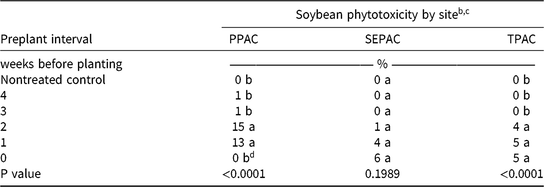
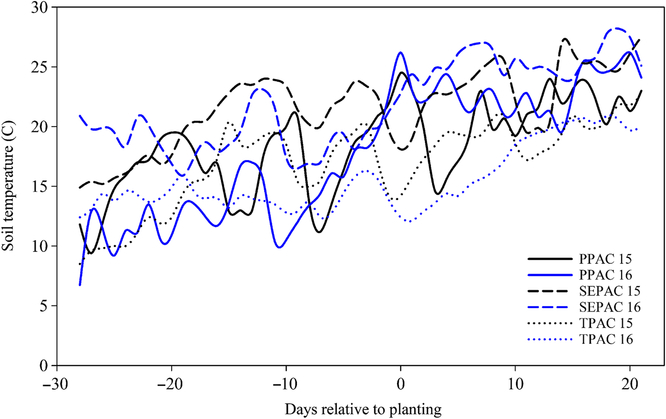
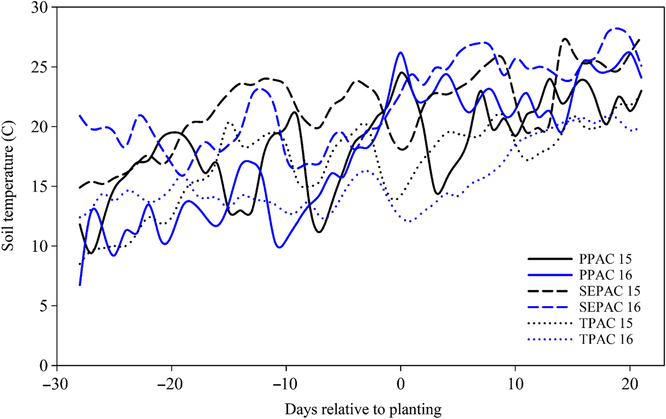
Soybean phytotoxicity did not occur in 2015 for any of the halauxifen-methyl treatments at any site. In 2016, phytotoxicity was observed at all sites at 14 DAP (Table 3). However, differences in environmental conditions between 2015 and 2016 (Figures 1 and 2) did not explain the cause of increased soybean phytotoxicity in 2016. The PPAC site had the highest levels of soybean phytotoxicity in 2016; however, this site was not the coldest, nor did it receive the highest amounts of rainfall compared with the other site-years Therefore, growth-chamber experiments were conducted in 2018 to further investigate the influence of environmental conditions on the level of soybean phytotoxicity in response to halauxifen-methyl. Epinasty occurred in the field in the unifoliate leaves, resembling symptoms caused by 2,4-D in preplant applications. Halauxifen-methyl applied at 3 and 4 WBP caused 1% soybean injury at PPAC in 2016. The preplant interval of 2 WBP resulted in phytotoxicity of 15%, 1%, and 4% at PPAC, SEPAC, and TPAC, respectively. Applications at 1 WBP resulted in 13%, 4%, and 5% phytotoxicity for PPAC, SEPAC, and TPAC, respectively. Finally, applications at planting resulted in 0%, 6%, and 5% phytotoxicity for PPAC, SEPAC, and TPAC, respectively. Because of unfavorable weather conditions, the 0 WBP treatment at PPAC was delayed and applied three DAP, before soybean emergence. However, no soybean phytotoxicity was observed for this treatment.
Influence of halauxifen-methyla application timing on soybean phytotoxicity for all sites at 14 d after planting in 2016.

a Halauxifen-methyl was applied at 5 g ae ha−1.
b Abbreviations: PPAC, Pinney Purdue Agricultural Center (Wanatah, IN); SEPAC, Southeast Purdue Agricultural Center (Butlerville, IN); TPAC, Throckmorton Purdue Agricultural Center (Lafayette, IN).
c Means followed by same letter within a column are not statistically different according to Tukey’s honestly significant difference (P ≤ 0.05).
d The 0 weeks before planting treatment was applied 3 days after planting at PPAC in 2016.
Daily accumulated precipitation (mm) from 28 d before planting to 21 d after planting for all sites in 2015 and 2016. Abbreviations: PPAC, Pinney Purdue Agricultural Center (Wanatah, IN); SEPAC, Southeast Purdue Agricultural Center (Butlerville, IN); TPAC, Throckmorton Purdue Agricultural Center (Lafayette, IN).

Daily soil temperature averages (C) from 28 d before planting to 21 d after planting for all sites in 2015 and 2016. Abbreviations: PPAC, Pinney Purdue Agricultural Center (Wanatah, IN); SEPAC, Southeast Purdue Agricultural Center (Butlerville, IN); TPAC, Throckmorton Purdue Agricultural Center (Lafayette, IN).
Halauxifen-methyl half-life under field conditions is approximately 15 d, and soil mobility of halauxifen-methyl is limited (soil adsorption coefficient, Koc = 1,418 mL g−1) (Shaner Reference Shaner2014). Therefore, positioning and/or solubilization of halauxifen-methyl molecules in the soil at the time of soybean emergence may influence the occurrence of phytotoxicity.
Soybean plants recovered from halauxifen-methyl phytotoxicity rapidly, and at 21 DAP, previously injured plants displayed no observable injury in the first trifoliate. Therefore, soybean phytotoxicity symptoms were deemed negligible at 21 DAP (data not shown). Thompson et al. (Reference Thompson, Steckel, Ellis and Mueller2007) observed soybean phytotoxicity at 14 DAP up to 16%, 18%, and 31% for 2,4-D ester, 2,4-D amine, and dicamba applications at planting, respectively. In addition, soybean phytotoxicity increased or persisted for ratings at 35 DAP, up to 14%, 12%, and 73% for 2,4-D ester, 2,4-D amine, and dicamba, respectively. Studies performed by Krausz et al. (Reference Krausz, Kapusta and Matthews1993) showed soybean phytotoxicity up to 35% at 30 DAP for 2,4-D applications at 0.56 kg ae ha−1 at planting and up to 18% at 45 DAP. Experiments including these three herbicides simultaneously under the same environmental conditions are necessary to make better comparisons.
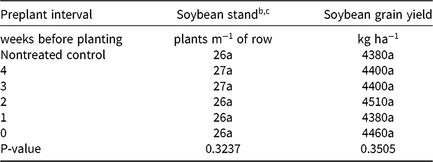
Preplant application timings of halauxifen-methyl did not affect soybean stand counts or soybean grain yield for any of the sites and years evaluated (Table 4). Research has shown that 2,4-D applied at planting can delay soybean emergence up to 50% at 0.56 kg ae ha−1, and dicamba applied at 0.28 kg ae ha−1 at planting can reduce yield up to approximately 55% (Krausz et al. Reference Krausz, Kapusta and Matthews1993; Thompson et al. Reference Thompson, Steckel, Ellis and Mueller2007).
Influence of halauxifen-methyla application timing on soybean stand counts at 35 d after planting and soybean grain yield for all site years.

a Halauxifen-methyl was applied at 5 g ae ha−1.
b Data pooled over six site years (n =24).
c Means followed by same letter within a column are not statistically different according to Tukey’s honestly significant difference (P ≤ 0.05).
Factors such as herbicide application rates, soil moisture and texture, temperature, precipitation, tillage, and planting depth can influence herbicide degradation rates and persistence in the soil (Cheng and Lehmann Reference Cheng and Lehmann1985). Experiments conducted over a wider range of soil and climatic conditions are necessary to determine the influence of environmental factors on the level of phytotoxicity that halauxifen-methyl may cause in the field. The growth chamber experiment discussed in the following section was conducted to additionally investigate the influence of these factors on herbicide phytotoxicity levels.
Growth-Chamber Experiments
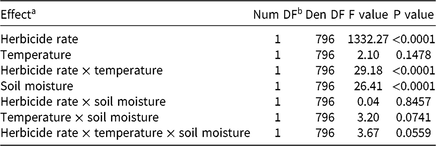
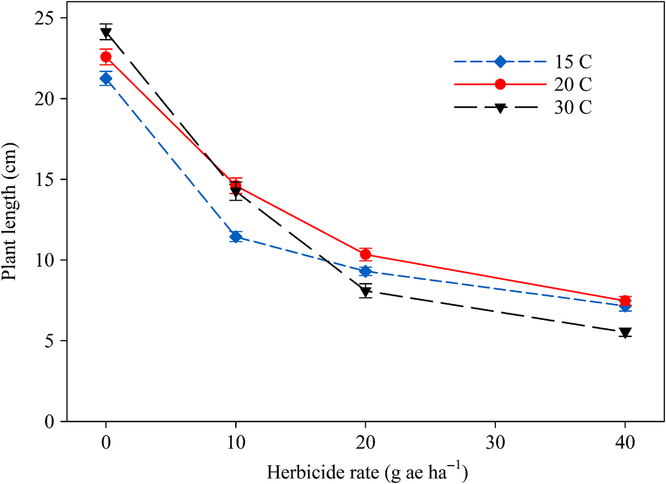
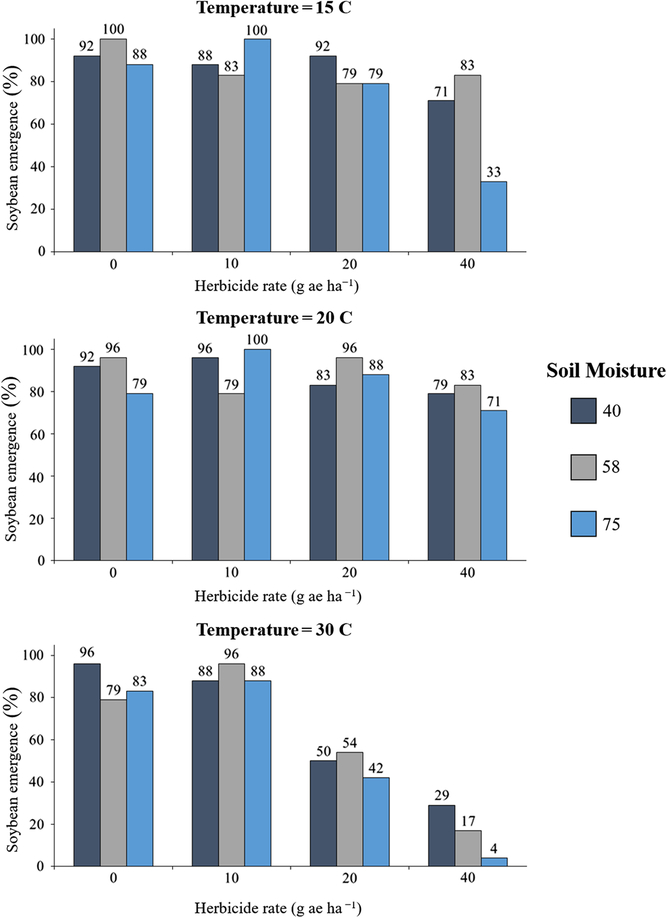
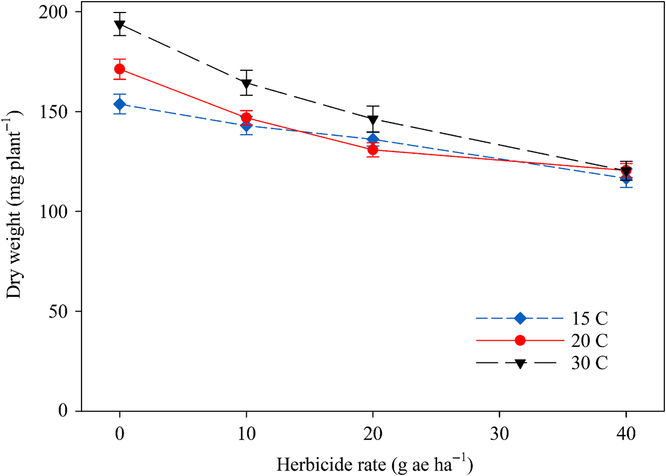
Statistical analysis of the growth-chamber experiment showed an interaction between halauxifen-methyl rate and temperature (P ≤ 0.0001) for soybean plant length (Table 5) and biomass (Table 6). Interaction plots (Figures 3 and 4) showed that greater plant length and biomass reduction occurred for soybean plants growing at 30 C than at 15 or 20 C as halauxifen-methyl rate increased. Furthermore, soybean emergence at 30 C was less than 55% for all moisture levels when halauxifen-methyl was applied at 20 and/or 40 g ae ha−1, which did not occur at 15 or 20 C (Figure 5). The interaction between herbicide rate and temperature for soybean emergence data was also significant according to the χ2 test (P = 0.0003; data not shown).
Type I test of fixed effects for total soybean plant length in controlled environment experiment.

a Data for two runs combined (n = 24).
b Abbreviations: DF, degrees of freedom; Den, denominator; Num, numerator.
Type I test of fixed effects for total soybean biomass in controlled environment experiment.

a Data for two runs combined (n = 24).
b Abbreviations: DF, degrees of freedom; Den, denominator; Num.numerator.
Influence of herbicide rate and temperature on soybean plant length in growth chamber experiment harvested at VC growth stage.

Influence of herbicide rate and temperature on soybean biomass in growth chamber experiment harvested at VC growth stage.
Influence of herbicide rate, temperature, and soil moisture on soybean emergence in growth chamber experiment harvested at VC growth stage.

Although the statistical analysis also indicated an interaction between halauxifen-methyl rate and soil moisture for soybean biomass (Table 6), this interaction was not significant for plant length (Table 5) or soybean emergence (Figure 5). The main effects are not discussed, because of the occurrence of interactions.
Although the general paradigm is that soybean phytotoxicity to preplant herbicide applications will increase when plants emerge under cool, wet conditions (Hartzler Reference Hartzler2017; Jhala Reference Jhala2017; Legleiter et al. Reference Legleiter, Johnson and Ruhl2014; Swantek et al. Reference Swantek, Sneller and Oliver1998; Taylor-Lovell et al. Reference Taylor-Lovell, Wax and Nelson2001), data supporting this paradigm for synthetic-auxin herbicides are lacking. Literature on other species does exist, although it is not conclusive. Experiments conducted by Gauvrit and Gaillardon (Reference Gauvrit and Gaillardon1991) on corn (Zea mays L.) showed that cold stress reduced 2,4-D metabolism and increased phytotoxicity. In contrast, Shibasaki et al. (Reference Shibasaki, Uemura, Tsurumi and Rahman2009), in Arabidopsis thaliana(L.) Heynh., showed that cold temperatures inhibited root basipetal auxin transport, thus reducing auxin activity. Friesen and Dew (Reference Friesen and Dew1966) investigated the influence of soil moisture and temperature on activity of 2,4-D, dicamba, and picloram in Tartary buckwheat [Fagopyrum tataricum (L.) Gaertn.] and showed that higher moisture increased phytotoxicity compared with low soil moisture, whereas temperature had little effect on phytotoxicity.
In conclusion, the results of this research contradict the currently held paradigm in which lower temperatures result in increased soybean phytotoxicity to preplant herbicide applications of synthetic auxins. High temperatures (30 C) resulted in greater reductions in plant length, biomass, and emergence in comparison with the nontreated control. Increased transpiration rates and herbicide uptake from the soil solution during emergence may explain reduced biomass and plant length as well as lower rates of soybean emergence at higher temperature levels. Additional research investigating the mechanisms of auxin uptake by soybean plants and the routes of metabolic degradation, as well as the environmental fate of halauxifen-methyl after application, are necessary to further explain these results.
Author ORCIDs
Marcelo Zimmer https://orcid.org/0000-0003-4451-0849
Acknowledgments
The authors would like to thank Dow AgroSciences for funding this research. No conflicts of interest have been declared.