Introduction
Piezoelectric materials enable the transformation between electrical and mechanical signals and can thus be used in actuators, sensors, and resonators. Individual applications require specific piezoelectric properties. For example, the most important parameter for an actuator is the piezoelectric coefficient (d), while the performance of a resonator will depend on the coupling coefficient (k) and the mechanical quality factor (Q m).
Since the pioneering work by the Toyota Central R&D Lab., Inc. in 2004,Reference Saito, Takao, Tani, Nonoyama, Takatori, Homma, Nagaya and Nakamura1 piezoelectric properties of lead-free piezoceramics have rapidly improved. In parallel to academic research, intensive industrial development has been carried out worldwide, especially in Europe and Asia. In particular, ferroelectric ceramics based on (K,Na)NbO3 (KNN), (Bi1/2Na1/2)TiO3 (BNT), (Sr,Ca)2NaNb5O15 (SCNN), and (Ba,Ca)(Zr,Ti)O3 (BCZT) compositions have shown performance for individual applications comparable to those of state-of-the-art Pb(Zr,Ti)O3 (PZT) and thus are of considerable commercial interest.Reference Rödel, Webber, Dittmer, Jo, Kimura and Damjanovic2
Despite the promising properties of the newly emerging lead-free compositions, a majority of the industrial players are still hesitant about implementation of these materials. This is mostly because the motivation to replace the well-established PZT with lead-free materials is, in most areas, still low. However, this motivation may change in the near future due to the increasing amount of available lead-free products, emergence of new players on the market, increased environmental and health awareness of consumers, and expected changes in governmental regulations.3 In addition, further improvements of piezoelectric properties and other application-relevant aspectsReference Koruza, Bell, Frömling, Webber, Wang and Rödel4 are expected to promote this development. In this article, we introduce the most prominent current applications and prototypes using lead-free piezoelectrics based on ferroelectric materials.
Lead-free products and prototype devices
Actuator applications
Actuators require piezoceramics with large electric-field-induced strain, a large blocking force (force produced in the fully clamped state), and, for many applications, a high Curie temperature (T C). These parameters predominantly define the actuator’s operational range and are adjusted according to individual device requirements.
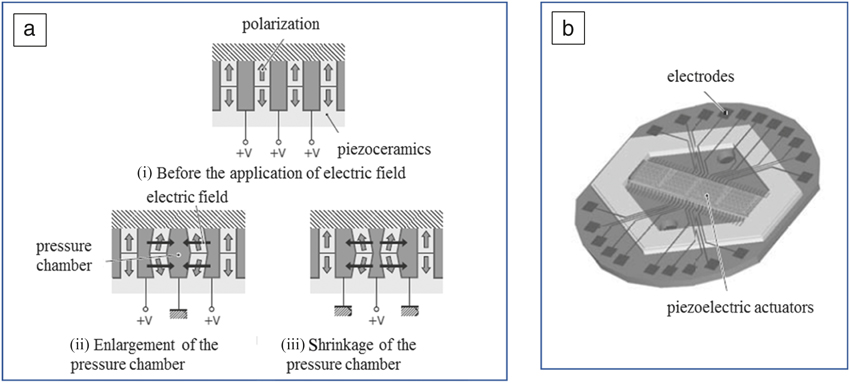
In 2012, Toshiba Tec Corporation (Japan), in cooperation with Hosei University (Japan), developed an inkjet printhead using the shear mode of KNN-based piezoceramics.Reference Shimosato and Tanuma5 Two poled piezoceramic plates with fine-patterned ink channels are glued in a tail-to-tail configuration to form multiple pressure chambers, as shown in Figure 1a. The piezoceramic acts both as the wall of the pressure chamber and as the actuator. Electrodes are deposited on the inside of the pressure chambers. An electric field, applied perpendicular to the polarization direction, causes shear motion of the piezoceramics and generates pressure on the ink in the channels, resulting in ejection of a droplet of ink through the nozzles. Computer simulations found that the ejection is mostly dependent on the properties of the ink. Note that for the same type of ink, the printhead design/size used for the KNN-based devices was the same as the one for the PZT-based devices. The shear-mode type inkjet printhead is shown in Figure 1b. The KNN-based lead-free actuator consists of 60 nozzles and the density of nozzles is 150 dots/in. The minimum ink droplet that the printhead could eject is as small as 6 pL, and the printhead has almost the same characteristics as the PZT-based one. The remaining issue for the KNN-based printhead is its high driving voltage, which is about 2× that of the PZT-based printhead, and could be reduced by further improvements in the material’s piezoelectric properties.
Shear-mode inkjet printhead. (a) Principle of the shear-mode inkjet printhead. (i) Before application of the electric field, (ii) enlargement of the pressure chamber, and (iii) shrinkage of the pressure chamber. (b) Image of the shear-mode inkjet printhead.Reference Shimosato and Tanuma5

Konica Minolta, Inc. (Japan), in cooperation with the Tokyo Institute of Technology (Japan), also made a prototype of an inkjet printhead that uses the shear mode of BiFeO3-doped (K,Na,Li)(Nb,Ta,Sb)O3.Reference Maruyama6 They confirmed that the inkjet printhead could continuously eject ink. Like Toshiba TEC’s printhead, the driving voltage was approximately 2× that of the PZT-based one.
Murata Manufacturing Co., Ltd. (Japan) is a pioneer in developing lead-free multilayer piezoceramic actuators with base-metal inner electrodes.Reference Kawada, Kimura, Higuchi and Takagi7,Reference Kawada, Hayashi, Ishii, Kimura, Ando, Omiya and Kubodera8 They found that KNN-based lead-free piezoceramics with Ni electrodes can be densely sintered under low oxygen partial pressure. A multilayer piezoelectric actuator with 12 piezoceramic layers was fabricated using the composition 0.96(K0.5Na0.5)NbO3−0.04CaZrO3+0.03ZrO2+0.05MnCO3. The maximum reported electric-field induced normalized strain, S max/E max, was 360 pm/V at 2 kV/mm. Although the value is only about one-half of the value for the PZT-based actuators, it is claimed that by stacking more piezoceramic layers and reducing the piezoceramic-layer thickness, the KNN-based multilayer ceramic can achieve a similar displacement as the PZT-based ones. Moreover, using Ni instead of Ag/Pd as the electrode material, the cost of the multilayer KNN-based actuator is almost reduced to that of the PZT-based ones, despite higher material costs for KNN-based materials.Reference Koruza, Bell, Frömling, Webber, Wang and Rödel4 The development of multilayer actuators with KNN-based compositions and base-metal electrodes was also reported by Taiyo Yuden Co., Ltd. (Japan) (Ni electrodes)Reference Liu, Liu, Kobayashi and Randall9 and PI Ceramic GmbH (Germany) (Cu electrodes).Reference Gao, Ko, Guo, Hennig and Randall10
Noliac A/S (Denmark) reported lead-free multilayer actuators made of BNT-based piezoceramics, which belong to the group of relaxor ferroelectrics.Reference Sapper, Gassmann, Gjødvad, Jo, Granzow and Rödel11 Although the strain response was lower than that of PZT, some compositions revealed excellent cycling stability.
Sensor applications
Piezoelectric sensors transform external mechanical signals into electrical signals, which enable detection of different acoustic impulses or pressure, for example. The operation in nonresonant conditions requires high piezoelectric coefficients (piezoelectric charge coefficient, d, and voltage coefficient, g), while the sensors operating near resonance necessitate a material with high coupling coefficients (k) and mechanical quality factor (Q m).
NGK Spark Plug Co., Ltd. (Japan) succeeded in developing a composite system containing KNN-based piezoceramics and KTiNbO5 (KNN-KTN).Reference Matsuoka, Kozuka, Kitamura, Yamada, Kurahashi, Yamazaki and Ohbayashi12 The material is available in 100-kg batches, which are manufactured using a spray-drying technique. The KNN-KTN compositions exhibit a high planar coupling coefficient (k p; coupling coefficient for the electric field in the polarization direction and planar vibrations perpendicular to the polarization direction) of 0.52 and are stable against aging. The company has used this composition to fabricate a knocking sensor, which is used to monitor the combustion process and adjust ignition timing in automotive engines. The lead-free sensor exhibits the same level of output voltage and superior durability to that fabricated with PZTReference Ohbayashi13 and is currently available on the market.
Lead-free piezoceramics for knocking sensors and combustion pressure sensors have also been developed by Kyungwon Industry Co., Ltd. (Korea),14 a ceramic producer that supplies several European and Asian device manufacturers.
Resonator applications
Resonators operate in the vicinity of a device’s piezoelectric resonant frequency in order to amplify the displacement. Resonator applications require piezoceramics with high k and high Q m to avoid mechanical loss.
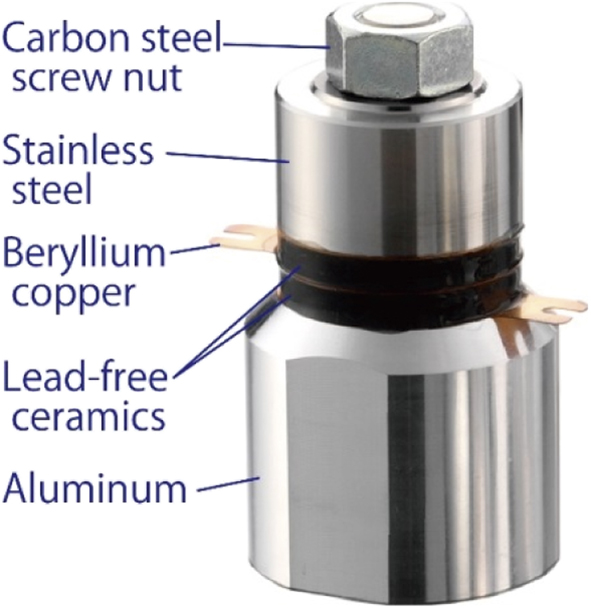
Honda Electronics Co., Ltd. (Japan) has developed a new lead-free piezoceramic with the composition (Bi1/2Na1/2)TiO3-BaTiO3-(Bi1/2Na1/2)(Mn1/3Nb2/3)O3,Reference Tou, Hamaguti, Maida, Yamamori, Takahashi and Terashima15 using commercially available raw materials. Raw metal oxides were mixed by ball milling, calcined at 850°C for 2 h, and sintered at 1100–1200°C for 2 h. The optimal composition was 0.82(Bi1/2Na1/2)TiO3−0.15BaTiO3−0.03(Bi1/2Na1/2)(Mn1/3Nb2/3)O3, which showed excellent piezoelectric properties with thickness coupling coefficient k t = 0.41, mechanical quality factor Q m = 500, piezoelectric coefficient d 33 = 110 pC/N, relative permittivity ε33T/ε0 = 520 (ε33T is the dielectric permittivity in the polarization direction when an electric field is applied in the same direction, under constant stress; ε0 is the dielectric permittivity of free space), dielectric dissipation factor tanδ = 0.66% (δ is the dielectric loss angle), T C = 260°C, density ρ = 5.5 g/cm3, high mechanical strength, and good high-power behavior.Reference Tou, Hamaguti, Maida, Yamamori, Takahashi and Terashima15 The poled samples were used to fabricate a bolt-clamped Langevin type transducer (BLT), and 15 BLTs were applied to fabricate an ultrasonic cleaner. Figure 2 shows the picture of a BLT, which is a common vibration source in high-power ultrasonic applications. Two pieces of 5.0-mm-thick lead-free piezoceramics were bolt clamped by two metal (stainless steel and aluminum) blocks. The dimensions of the metal blocks were adjusted to tune the resonant frequency of the BLT to 28 kHz. The vibration velocity of the BLT using lead-free piezoceramics was larger than that of PZT at the same input power. The result suggests that the power loss in lead-free BLT is smaller than that in hard PZT. Moreover, the ultrasonic cleaner using lead-free piezoceramics showed higher ultrasound intensity than PZT-based cleaners. This result corresponded to the fact that higher vibration velocity results in higher ultrasonic intensity. In addition, the physical effect induced by acoustic cavitation was investigated to explain the ultrasound intensity. A square piece of aluminum foil was placed into the water cleaning tank. The erosion area of the aluminum foil originating from cavitation was relatively large, which confirmed a high cleaning effect suitable for commercial application.
A photograph of a bolt-clamped Langevin type transducer. Courtesy: Honda Electronics Co., Ltd., Japan.

Taiyo Yuden Co., Ltd. (Japan) focused their research on tetragonal-tungsten-bronze-structured lead-free piezoceramic SCNN, which exhibits a high mechanical quality factor (Q m ∼ 800) and is suitable for high-power usage. A miniature cantilever-type ultrasonic motor using a multilayer piezoelectric actuator with 37 layers of SCNN piezoceramics and Ag-Pd inner electrodes showed similar characteristics as a PZT ultrasonic motor.Reference Doshida, Kishimoto, Ishii, Kishi, Tamura, Tomikawa and Hirose16 However, an approximately 10× higher driving electric field was needed for the SCNN-based device. By using 2 × 2 matrix array-type multilayer SCNN piezoceramics, the properties could be improved, and the driving electric field was markedly lowered to about 3× that of the PZT ultrasonic motor.Reference Doshida, Kishimoto, Irieda, Tamura, Tomikawa and Hirose17 HanaUtech Co., Ltd. (Korea), in cooperation with Ulsan National Institute of Science and Technology (Korea), University of Ulsan (Korea), and Tsinghua University (China) also constructed a prototype of an ultrasonic motor using KNN-based ceramics.Reference Hong, Han, Lee, Wang, Yao, Li, Gwon, Quyet, Jung and Jo18
Lead-free piezoceramic materials
The development of lead-free powders and sintered ceramic components was driven by ceramic producers and, especially in Asia, also by manufacturers of the final devices. The achievements of the latter were presented in previous sections, while the developments of the companies focusing on piezoceramic production are summarized next.
PI Ceramic GmbH (Germany) is one of the European pioneers of industrial development of new lead-free piezoceramics.19 Research of these compositions started in the early 2000s, and was partially supported by national and European governmental funding. In 2014, the efforts resulted in the piezoceramic product PIC700, which was one of the first new lead-free piezoceramics available on the market. This BNT-based composition is characterized by a relatively high thickness coupling coefficient (k t = 0.40), low density (ρ = 5.6 g/cm3), and an operational temperature up to 200°C, making this material a good candidate for ultrasonic transducers in the MHz range and sonar/hydrophone applications.
CeramTec GmbH (Germany) developed the BaTiO3-based piezoelectric material SONOX P1 LF, exhibiting a piezoelectric coefficient (d 33) of 135 pC/N, a thickness coupling coefficient (k t) of 0.45, and T C of 115°C.20
Meggitt A/S (Denmark) commercialized a KNN-based lead-free composition referred to as Ferroperm Piezoelectric Pz61.21 This piezoceramic has a low density and thus a low acoustic impedance of 24.6 MRayl, which is important for improved impedance matching in medical imaging and nondestructive testing. The piezoelectric coefficient (d 33) is 80 pC/N, thickness coupling coefficient (k t) is 0.4, and the maximal operational temperature is 180°C. The material is also available as a thick film (InSensor TF6100) for medical applications, such as in vivo skin imaging.Reference Levassort, Grégoire, Lethiecq, Astafiev, Nielsen, Lou-Moeller and Wolny22 An even higher image resolution was obtained by linear-array transducers using composites of domain-engineered lead-free KNbO3 single crystals and a polymer.Reference Bantignies, Filoux, Mauchamp, Dufait, Thi, Rouffaud, Grégoire and Levassort23 For high-temperature applications, Meggitt A/S developed a nonperovskite material based on Bi-titanate (Pz46). This piezoceramic is characterized by an extremely high T C of 650°C, while the drawback is the relatively low d 33 of about 15–20 pC/N.
Ceramic Powder Technology AS (CerPoTech; Norway) offers a wide variety of lead-free piezoceramic powders with different compositions. The company utilizes the environmentally friendly spray-pyrolysis technique and can provide batches of 100 kg.24
Lead-free piezoelectric films
PZT piezoelectric thin films, with thickness less than 5 μm, have recently been widely used in a variety of microelectromechanical system (MEMS) devices, such as angular rate sensors, inkjet printer heads, and varifocal liquid lenses.Reference Fujii, Takayama, Nomura, Murata, Hirasawa, Tomozawa, Fujii, Kamada and Torii25–Reference Nicolas, Allain, Bridoux, Fanget, Lesecq, Zarudniev, Bolis, Pouydebasque and Jacquet27 Driven by the promising piezoelectric properties of bulk lead-free ceramics, researchers have developed techniques for growing lead-free piezoelectric films for MEMS devices.
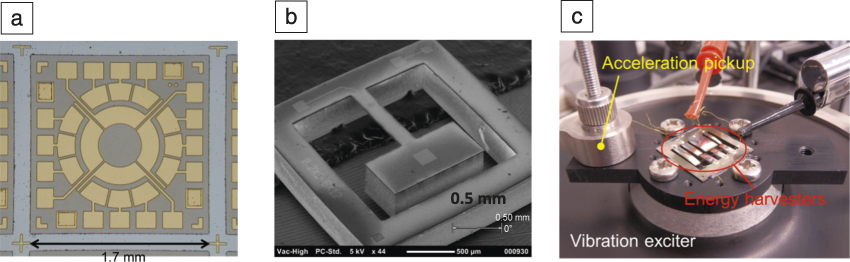
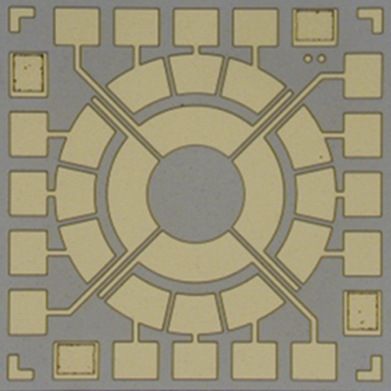
SCIOCS Co., Ltd. (Japan) focused their attention on KNN films, motivated by the well-known report on high piezoelectric properties of oriented KNN-based ceramics, reported by the Toyota R&D Laboratories in 2004.Reference Saito, Takao, Tani, Nonoyama, Takatori, Homma, Nagaya and Nakamura1 SCIOCS’ goal is to realize oriented KNN films on Si substrates using film-growth techniques, which were reported to be difficult by previous studies.Reference Saito, Wada, Adachi and Kanno28,Reference Nakashima, Sakamoto, Maiwa, Shimura and Yogo29 In 2008, the company succeeded in growing highly oriented KNN films on Pt/Ti/SiO2/Si substrates using the radio frequency magnetron sputtering technique for the first time in this community.Reference Shibata, Oka, Ohishi, Mishima and Kanno30 The KNN films had a polycrystalline c-axis-oriented perovskite structure and reasonable piezoelectric properties. By optimizing the film’s composition and stress, they realized micrometer-thick KNN films with a high transverse piezoelectric coefficient (e 31,f) of 14.4 C/m2, a value comparable to commercialized PZT films.Reference Shibata, Suenaga, Watanabe, Horikiri, Nomoto and Mishima31 They also developed techniques to grow KNN films with good uniformity across 6-in. wafers and to etch KNN films to make device patterns, and established the optimal electrodes for KNN films. Based on these techniques and knowledge, they manufactured three-axis angular rate sensors,32 energy harvesters with Si mass,Reference Le Van, Motoaki, Fumimasa, Kenji, Tomoyoshi and Hiroki33 and energy harvesters with stainless-steel mass.Reference Tsujiura, Suwa, Kurokawa, Hida, Suenaga, Shibata and Kanno34 The pictures of these manufactured devices are shown in Figure 3. Today, this sputtered KNN film is considered to be the most promising lead-free candidate to replace PZT films.
Manufactured devices that use (K,Na)NbO3 (KNN) films. (a) Three-axis angular rate sensor,32 (b) energy harvester with Si mass,Reference Le Van, Motoaki, Fumimasa, Kenji, Tomoyoshi and Hiroki33 and (c) energy harvester with stainless-steel mass.Reference Tsujiura, Suwa, Kurokawa, Hida, Suenaga, Shibata and Kanno34

Panasonic Corp. (Japan), on the other hand, has been developing technologies for growing BNT-BT films on Pt/MgO(100), (111), and (110) single-crystal substrates. Transverse piezoelectric coefficients (e 31,f) for 3-μm-thick (100)-, (111)-, and (110)-oriented BNT-BT films were reported to be 18.1, 15.0, and 20.6 C/m2, respectively.Reference Tanaka, Harigai, Ueda, Adachi and Fujii35 Although these values are higher than those of commercial PZT films, these substrates are too expensive for use in consumer devices.
Summary
In this article, we summarized the most prominent examples of applications using lead-free piezoelectric materials. These remarkable works demonstrate a comparable or even higher level of performance as devices based on PZT. Moreover, the pioneering results indicate the possibility for further practical application of lead-free piezoelectrics in the near future. One of the remaining issues is the need for higher driving electric fields as compared to PZT. Further improvements in the piezoelectric properties, the optimization of device design, and a better understanding of other application-relevant properties will be helpful in this regard.

Kenji Shibata is a project leader for SCIOCS Co. Ltd., Japan, working with the R&D of (K,Na)NbO3 lead-free piezoelectric films. He received his PhD degree from Kyushu University, Japan, in 2013. His recent research has produced 11 papers. He received the Richard M. Fulrath Award from the American Ceramic Society in 2015. Shibata can be reached by email at shibatak3@sc.sumitomo-chem.co.jp.

Ruiping Wang is a senior researcher at the National Institute of Advanced Industrial Science and Technology, Japan. She obtained her diploma in physics from the University of Science and Technology, China, and a PhD degree in materials science from the Tokyo Institute of Technology, Japan. Her main research interests include dielectric/ferroelectric/piezoelectric materials, their properties, and their applications in actuators and sensors. By forming morphotropic phase boundaries, she has succeeded in developing lead-free piezoceramics with properties comparable to that of Pb(Zr,Ti)O3. Wang can be reached by email at rp-wang@aist.go.jp.

Tonshaku Tou is an ultrasonics engineer at Honda Electronics Co., Ltd., Japan. He received his PhD degree from Shizuoka University, Japan, in 1995. His research interests focus on piezoelectric materials and the design of ultrasonic sensors and transducers. Tou can be reached by email at ttou@honda-el.co.jp.

Jurij Koruza has held a junior group leader position within the group for nonmetallic–inorganic materials at Technische Universität Darmstadt (TU Darmstadt), Germany, since 2015. He received his PhD degree from the Jožef Stefan International Postgraduate School, Slovenia, in 2013. He was then a postdoctoral researcher at TU Darmstadt, Germany. His research focuses on the development of new ferroelectrics, ceramics processing, and electromechanical properties of electroceramics. In 2017, he received the Athene Young Investigator Award. He has co-authored more than 50 publications and three book chapters. Koruza can be reached by email at koruza@ceramics.tu-darmstadt.de.