Introduction
Community Assessment for Public Health Emergency Response (CASPER) is a set of tools and methods designed by the US Centers for Disease Control and Prevention (CDC) to rapidly collect reliable and accurate population-based public health information.1 The CASPER methods and tools can be used to quickly measure the health status and basic needs of a community affected by a disaster by providing objective information required to direct resources and assets.Reference Zane, Bayleyegn and Haywood2 The methods originally were developed by the World Health Organization's (WHO's) Expanded Program on Immunization (EPI) for assessing vaccine coverage, and have been adapted for use in disaster-related rapid assessments by the CDC.Reference Henderson and Sundaresan3, Reference Malilay, Flanders and Brogan4 CASPER methods consist of a two-stage cluster sampling strategy with probability proportionate to population sampling of 30 clusters in the first stage, and a random selection of seven subjects per cluster in the second stage (30 × 7). CASPER tools include site selection tools, questionnaires, data analysis templates, and paper-based or electronic devices for data collection.
Community-based surveys have long been viewed as an important way to collect public health data from residents.Reference Frerichs and Shaheen5 Two-stage cluster surveys, such as CASPERs, may be preferable to one-stage, simple random samples because they do not require an enumeration of all the eligible persons in the population prior to selection. They also require relatively little formal epidemiologic or statistical training and may be performed by the staff with funds available to local health departments (LHDs).Reference Ewert, Thomas, Chun, Enguidanos and Waterman6 Community-based surveys have been used regularly by LHDs to assess vaccination coverage, particularly among hard-to-reach populations,Reference Ewert, Thomas, Chun, Enguidanos and Waterman6-Reference Shaheen, Frerichs, Alexopolous and Rainey8 and to determine disaster-related needs.Reference Berg, Grievink, Gutschmidt, Lang and Palmer9 However, to date, there has been no systematic evaluation of the use of CASPERs at the state or local public health level in the United States.
Evaluations of CASPERs have been conducted in developing countriesReference Bennett, Radalowicz, Vella and Tompkins10 and computer simulation evaluation studies of the 30 × 7 method have been undertaken by the WHO and the CDC.Reference Lemeshow and Robinson11, Reference Henderson and Sundaresan12 These studies validated the method, with samples meeting the stated goal of estimating proportions within 10% of the true population proportion. Another computer simulation study found that while the 30 × 7 method was adequate for rapid assessment of morbidity prevalence or nutritional status, it may not be appropriate for measuring factors such as education or socio-economic status.Reference Bennett, Radalowicz, Vella and Tomkins13 When electronic data collection instruments are used for the CASPERs, the methods have been found to save time and eliminate errors from double data entry, and are preferred by public health personnel, despite limited experience in using them.Reference Fletcher, Erickson, Toomey and Wagenaar14-Reference Pace and Staton16 Importantly, survey respondents and patients are comfortable with the use of the technology for data collection.Reference Buck, Rochon and Turley17, Reference Greene18
North Carolina public health professionals have used CASPERs since 2003 to collect information to facilitate public health emergency responses, including the response to Hurricane Isabel in 2003.19 CASPERs also have been used in North Carolina to collect community-based information for routine public health practices including Community Health Assessments. Since 2003, 17 of 85 local health departments in North Carolina received resources such as handheld computers, software, software licenses, and training to allow them to conduct CASPERs.Reference Horney, Ramsey, Smith, Johnson and MacDonald20 While no additional funds for CASPER tools have been provided since 2004, training and technical assistance has continued.
The purpose of this evaluation is to identify the reasons for and the barriers to the use of the CASPER in North Carolina, the value it provides, and recommendations for the use of this method in public health practice and during disasters.
Methods
Study Population
Preparedness Coordinators (or their designees) from all 85 LHDs in North Carolina were invited to participate in the study survey. Preparedness Coordinators are employed by LHDs to plan for public health disasters, train local health department staff on key preparedness topics, test preparedness plans through regular exercises, and serve as liaisons between the LHD and other agencies and partners. Because of their professional responsibilities, Preparedness Coordinators are more likely than other LHD staff to use CASPER tools and methods, and could, therefore, provide information on the use of CASPERs in LHDs in North Carolina.
Study Design and Questionnaire
A quantitative survey instrument was developed by the University of North Carolina Center for Public Health Preparedness (UNC CPHP) and piloted internally and with state partners from the North Carolina Division of Public Health (NC DPH). The revised survey was administered online via SurveyMonkey to LHD Preparedness Coordinators. Participants received an email invitation from the research team, and non-respondents received a reminder email three and six weeks after the initial invitation. Survey responses were collected from mid-April to mid-June 2010.
The questionnaire included a series of questions to determine when and how CASPERs were used during 2003-2010. First, respondents were asked whether their LHD had used CASPER methods (eg, two-stage cluster sampling by census tract), and whether their LHD had participated in an event where CASPER methods were used by another agency. Second, respondents were asked whether their LHD had used CASPER tools (eg, handheld electronic data collection units), and whether their LHD had participated in an event in which CASPER tools were used by another agency. Respondents who answered “yes” to any of these questions were asked to provide additional information about each instance, including the year, type of organization using the CASPER (eg, single county health department, multi-county health district, regional, other), and the reason for implementing the CASPER (eg, disaster-related rapid needs assessment, routine community health assessment, routine environmental health inspection, exercise, special topic survey, other routine surveillance, or other).
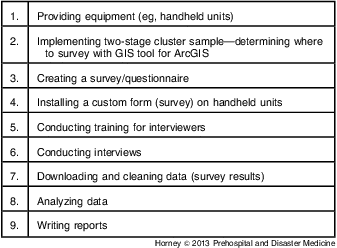
To assess the organizational capacity for CASPER use, respondents were provided with a scenario in which their agency would need to conduct a disaster-related rapid needs assessment in one month, and asked whether they would need assistance with nine CASPER-related tasks (Table 1). Next, respondents were asked which agency they would contact for technical assistance, whether they had received CASPER training and ArcGIS software training, and the total number of trained staff who were currently employed at the agency. The survey also inventoried equipment owned by the agency or available to the agency (eg, handheld global positioning system (GPS) units, tablet computers), and whether the agency maintained a software license for ArcGIS.
Community Assessment for Public Health Emergency Response (CASPER)—Related Tasks
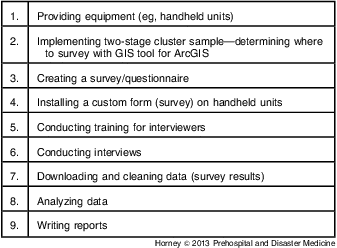
Abbreviation: GIS, geographic information system
To assess potential barriers to CASPER use, all respondents were asked to choose from a list of reasons why their agency would not use a CASPER. A separate question asked whether the respondent believed a random sample could represent their jurisdiction. Finally, the survey examined key factors that may facilitate the use of CASPERs for public health preparedness and routine public health practice. To determine the potential need for CASPERs, respondents were asked whether their agency collected data from the public on a variety of topics such as environmental health inspections, vaccination status, and infectious disease outbreaks. Respondents were asked to rate the likelihood that their agency would use CASPERs in the future on a four-point scale from “very likely” to “very unlikely.” Those who answered “likely” or “very likely” were asked to specify the situation in which their agency would use a CASPER. Those who answered “unlikely” or “very unlikely” were asked to provide an open-ended comment about reasons for not using a CASPER.
Data Analysis
Data were downloaded from SurveyMonkey and imported into Excel (2007, Redmond, Washington USA) and SAS (9.1.2, Cary, North Carolina USA) for calculation of frequencies. A Student's t-test was conducted to determine if there was a significant difference in the mean likelihood of conducting a CASPER in the future depending on experience in conducting a CASPER in the past.
Results
Fifty-two of North Carolina's 85 LHDs (61%) responded to the survey. Of the LHDs that responded, 47 were from single-county health departments; the remainder were from multi-county health departments. Overall, 65 of North Carolina's 100 counties (65%) were represented in the study.
Use of CASPERs in North Carolina
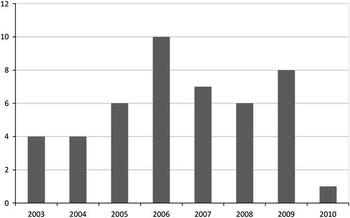
Twenty-eight LHDs (54%) reported a total of 46 instances of CASPER use during the period 2003 to 2010 (Figure 1). The survey only allowed the LHD to report up to 7 separate instances of CASPER use. Twenty-four LHDs (46%) reported no instances of CASPER use during the specified time period.
Number of Community Assessment for Public Health Emergency Response (CASPER) Uses Reported by North Carolina Local Health Departments (n = 28), 2003-2010

The majority of 46 CASPERs conducted by the LHDs were for community health assessments (n = 20, 43%) or exercises (n = 11, 24%). Other reported reasons for the use of CASPERs were: hurricane response (n = 3, 7%); sampling private drinking water wells (n = 2, 4%); outbreak management (n = 2, 4%); an obesity study (n = 1, 2%); a Healthy Homes Survey (n = 1, 2%); a food product recall (n = 1, 2%); a survey about LHD services (n = 1, 2%); environmental shelter assessments (n = 2, 4%); a Legionnaire's Disease outbreak investigation (n = 1, 2%); and training (n = 1, 2%).
Twenty-three of the 46 instances (50%) of CASPER use were conducted by the LHDs alone, 14 (30%) were conducted by more than one agency acting together (such as an LHD and a regional public health support team), and three (seven percent) were conducted by some other agency (either the North Carolina Department of Public Health DPH or the CDC).
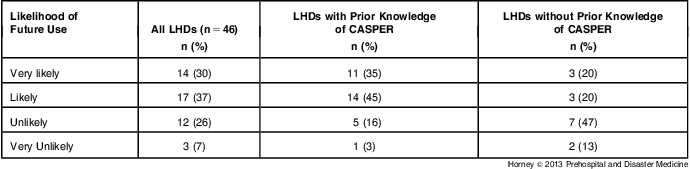
Thirty-one of the LHDs (67%) indicated they were “likely” or “very likely” to use CASPERs in the future, whereas 15 (33%) were “unlikely” or “very unlikely” (Table 2). Twenty-five of the 31 LHDs (81 with prior knowledge of CASPERs were ‘very likely’ or ‘likely’ to use CASPERs in the future, while only 6 of 15 (40%) of the LHDs without prior knowledge were “very likely” or “likely” to use CASPERs in the future (P = .02).
Likelihood of Future Use of Community Assessment for Public Health Emergency Response (CASPER) by North Carolina Local Health Departments
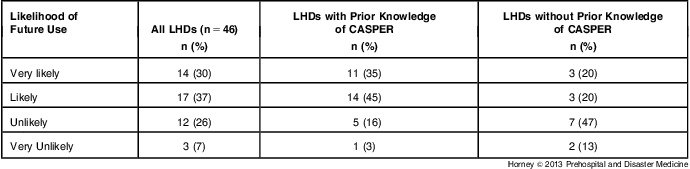
Abbreviation: LHDs, local health departments
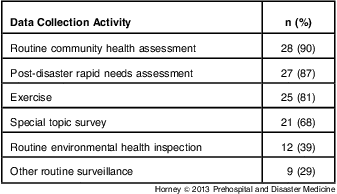
Situations in which a CASPER was reported “likely” to be used by LHDs are listed in Table 3. Among the 31 LHDs that reported that they were likely or very likely to use CASPERs in the future, the most commonly reported reasons were for routine community health assessments (n = 28, 90%), post-disaster rapid needs assessments (n = 27, 87%), and exercises (n = 25, 81%).
Likelihood of Community Assessment for Public Health Emergency Response (CASPER) Use for Data Collection Activities by North Carolina Local Health Departments (n = 31)
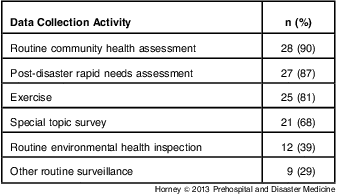
Capacity and Barriers
Concern regarding the representative quality of a 30 × 7 random sampling method was not perceived to be a barrier to CASPER use; 31 of 46 LHDs (67%) felt that 210 households could represent their jurisdiction. However, all LHDs indicated they would need help with at least one of the nine CASPER tasks, including installing a survey on handheld units (n = 44, 96%), downloading and cleaning data (n = 43, 93%), conducting random cluster sampling (n = 41, 89%), providing equipment (n = 39, 85%), and analyzing data (n = 39, 85%). Forty-five of 46 LHDs (98%) would contact a regional public health preparedness support team for help with CASPER tasks; 11 (24%) would ask UNC CPHP for help; seven (15%) would ask NC DPH; and five (11%) would ask another LHD for help.
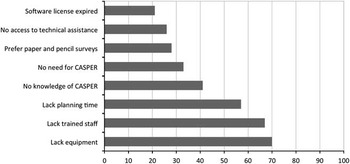
The three most common barriers to using CASPERs by LHDs were lack of equipment (n = 32, 70%); lack of trained staff (n = 31, 67%); and lack of planning time (n = 26, 57%) (Figure 2). Twenty-three of the LHDs (50%) reported having access to equipment owned by others to conduct a CASPER, and 34 (74%) own such equipment themselves. Overall, 37 LHDs (80%) have access to some CASPER equipment, whether owned or borrowed. However, only 15 (33%) reported possessing a current ArcGIS software license.
Barriers to using Community Assessment for Public Health Emergency Response (CASPER), North Carolina Local Health Departments

Twenty-six LHDs (56%) reported having no staff trained in the use of CASPER tools or methodology; 13 LHDs reported having 1-3 trained staff members; six reported having 4-10 trained staff members; and one LHD reported having 11 trained staff members. Similar results were reported for the number of LHD staff trained in the use of GIS: 24 LHDs (52%) reported having no staff trained in GIS; 10 (22%) had 2-3 trained staff members; and one LHD had 7-10 trained staff members.
Discussion
Although CASPERs have been used widely by public health agencies in the US for assessment of immunization coverage, disaster-related assessments, and other public health research questions, there has been no prior evaluation of the use of CASPERs at the state or local level.Reference Horney, Snider, Gammons and Ramsey21-Reference Rosselli, Bevc, Simon, Casani, Horney and MacDonald23 In North Carolina, CASPERs have been used nearly 50 times during 2003-2010 for a wide variety of activities including emergencies, outbreaks, public health exercises, and routine public health functions such as regular community health assessments. More than half of the respondents who reported using CASPERs in the past indicated that they intended to use CASPERs again in the future.
The main barriers to conducting CASPERs were lack of trained staff and lack of equipment. Most LHDs indicated that they did not have enough staff sufficiently trained in CASPER tools and methodology. The lack of training is also apparent in the high percentage of LHDs that reported requiring assistance with essential CASPER tasks. Lack of equipment may also hamper the LHDs’ ability to perform some CASPER tasks such as navigation and data collection.
Recommendations to address the identified barriers include: 1) the development of CASPER-specific training for LHD staff; 2) the enlistment of individuals at NC DPH or experts at other agencies to provide technical support to LHDs on specific topics such as how to download and clean data, and how to conduct random cluster sampling; and 3) the incorporation of CASPER methods and tools into regular training exercises conducted by LHDs or other recurrent events, such as community health assessments or special topic surveys. It is important to note however, that training is not a prerequisite for implementing CASPERs. Just-in-time training can be effective preparation, particularly for the interviewing and data collection components of the CASPER.
Lack of equipment need not be a deterrent for using CASPERs in the future. Using new technologies already in place in LHDs (eg, smart phones or personal digital assistants) to collect data can offset some of the costs and learning barriers associated with CASPER-specific data collection equipment. Simple paper-based data collection methods can be an effective means of collecting CASPER data. Moreover, in addition to paper maps, auto- or phone-based GPS units are inexpensive and widely available for navigating to interview locations.
The reported need for both training and equipment may be addressed by maintaining training among state public health staff or other outside agencies and increasing awareness among local public health agencies of the many uses of CASPERs, and the availability of other agencies for technical assistance. For example, UNC CPHP, in collaboration with NC DPH, is well-positioned to serve as a resource to provide direct technical assistance to LHDs, as well as to assist outside agencies in providing technical assistance to LHDs, particularly given that this activity is currently funded through the CDC's Preparedness and Emergency Response Learning Center.
Several key factors can facilitate the future use of CASPERs, not only as a part of preparedness, but for routine public health practice in North Carolina. For example, every four years, LHDs in North Carolina are required, as part of accreditation, to conduct a community health assessment to identify priorities that affect the health of the local population and to determine what resources are available within the community to address these identified priorities. Each assessment requires primary data collection from the community. CASPER methods and tools are ideal for this purpose.
This study has several limitations. Firstly, the overall local health department response rate was relatively low, and selection bias could have been introduced if a greater proportion of survey non-respondents were from counties unfamiliar with the CASPER. Secondly, given that many of the LHDs partnered with other LHDs to conduct the CASPER, there may be overlap in reporting a particular CASPER, which could have led to an overestimation of the overall use of CASPERs. However, the reported number of CASPER uses per agency may actually be an underestimate, since it is unlikely that survey respondents have been in their position since 2003, and they may not have knowledge of, or may not recall, each use of the CASPER. Lastly, respondents also may have had limited knowledge about available equipment and analytic and mapping software available in the health department given that they are public health staff rather than information technology staff.
Looking forward, the two most commonly identified barriers to the use of CASPERs for LHDs (ie, the lack of equipment and trained staff) can be overcome by resources and training, but the third most common barrier, lack of planning time, cannot. Forty-one percent of LHD staff reported lack of knowledge about the purpose of CASPERs as a barrier. This was not limited to LHDs who reported no prior knowledge of the existence of CASPERs. Not surprisingly, LHDs reporting no prior knowledge tended to report a lower likelihood of using CASPERs in the future than did LHDs with prior knowledge. However, more LHDs indicated that it was likely or very likely that they would use CASPERs in the future compared to those who had reported using CASPER in the past. This indicates that the LHD staff are aware of CASPER, and despite the barriers, plan to use it in the future.
Conclusion
CASPERs are perceived to be most beneficial in situations in which there are clear objectives and goals, and the specific survey questions have been validated in advance. These situations are more common in routine public health practice, such as in community health assessments and special topic surveys or research than during a disaster. Disaster-related rapid needs assessments commonly were listed as the reasons to use CASPERs in the future; however, the impact of CASPERs in these settings were not well described in this study and require further analysis. Future use of CASPERs in North Carolina should focus on applications for routine public health practice and research. CASPER use in the disaster setting must have clear objectives, goals, pre-identified stakeholders, and actionable data to justify its use.
North Carolina LHDs have used CASPER tools and methods, and intend to use them again, regardless of barriers due to training or lack of equipment. Local Health Departments are aware of the value of CASPERs, and with additional support from the state public health department and others, they can utilize CASPERs to collect community information to improve public health programs for all North Carolinians.
Acknowledgement
The authors would like to thank Shabbar Ranapurwala, MPH for assistance with data analysis.