The Fukushima Daiichi nuclear disaster that occurred after the devastating earthquake and tsunami on March 11, 2011, triggered a health care crisis in Tohoku, the northeast area of Japan.Reference Thielen 1 , Reference Brumfiel and Cyranoski 2 The Japanese government first set an evacuation zone within a 20-km radius of the plant, and then expanded it to 30 km.Reference Makinen 3
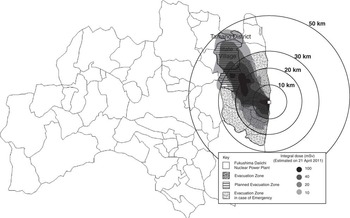
After it was revealed that radiation levels of Iitate Village (located about 40 km northwest of the plant) were above those believed to be safe for habitation, the Japanese government officially imposed an evacuation order on April 22, 2011Reference Bell 4 (Figure 1). However, the residents of Iitate Village were forced to stay inside their houses or shelters for a period of 2 months owing to the delay of the evacuations.Reference Tabuchi 5 Because our medical team entered the zone on April 11, 2011, to provide medical supports,Reference Tsubokura, Gilmour, Takahashi, Oikawa and Kanazawa 6 , Reference Hayano, Tsubokura and Miyazaki 7 we performed health checkups in collaboration with the local governments for the residents in Hiso, Nagadoro, and Warabidaira districts of Iitate Village on May 21 and 22, 2011, and in Tamano district of Soma City on May 28 and 29, 2011.Reference Sugimoto, Krull, Nomura, Morita and Tsubokura 8
The 10- to 50- km radius of the Fukushima Daiichi Nuclear Power Plant in Fukushima, Japan, and gamma dose rates (mSv) reported by the Japanese Ministry of Education, Culture, Sports, Science and Technology.

Subsequent to the potential primary health threats of a natural disaster such as a disease epidemic associated with poor hygiene and sanitation due to the destruction of infrastructure,Reference Tsubokura, Mori, Tanimoto and Oikawa 9 , Reference Mori, Tsubokura and Sugimoto 10 the attention of local communities usually shifts toward development and progression of mental and chronic diseases such as hypertension and diabetes among the residents.Reference Harasawa, Tanimoto, Kami, Oikawa, Kanazawa and Komatsu 11 - Reference Tsubokura, Takita and Matsumura 14 However in the case of Fukushima, such health care data are not yet adequately available.
Therefore, the aim of the study was to compare the results of the clinical parameters and the extent of mental distress from the medical checkups after the disaster with the results of annual health evaluations from the previous year.
Methods
Subjects
The health-screening programs were conducted on May 21 and 22, 2011, in Hiso, Nagadoro, and Warabidaira districts of Iitate Village, and on May 28 and 29, 2011, in Tamano district of Soma City. Residents were informed about the programs by each municipal government approximately 1 week before they were conducted. All of the residents from those districts of Iitate Village and Soma City were eligible for the programs.
A total of 564 residents from Iitate Village and Soma City voluntarily participated in the programs, accounting for 33% and 65% of the registered population of these districts of Iitate Village and Soma City, respectively, before the disaster. Among the 564 residents, we selected 155 individuals who underwent annual health evaluations in the previous year and after the disaster to evaluate changes in the clinical parameters. No interventions were performed in this study. The institutional review board of the Institute of Medical Science, the University of Tokyo, approved the study.
Measurement
Using the health care database from the local governments of Iitate Village and Soma City, we reviewed the results of the medical checkups using the following: post-disaster variables such as body weight, body mass index (BMI), systolic blood pressure (SBP), diastolic blood pressure (DBP), hemoglobin, aspartate aminotransferase (AST), alanine aminotransferase (ALT), gamma guanosine triphosphate (GTP), glucose levels, hemoglobin A1c, (HbA1c), low-density lipoprotein cholesterol (LDL-C) and high-density lipoprotein cholesterol (HDL-C) levels, and triglyceride levels.
These measurements were taken by conventional procedures and compared with the predisaster health records to identify observable changes. Trained nurses using an appropriately-sized blood pressure cuff measured the participants’ post-disaster blood pressures in millimeters of mercury. The value for HbA1c (%) was estimated as a National Glycohemoglobin Standardization Program (NGSP) equivalent value (%) calculated by the formula HbA1c (%)=HbA1c [Japan Diabetes Society %]) + 0.4%.Reference Kuzuya, Nakagawa and Satoh 15
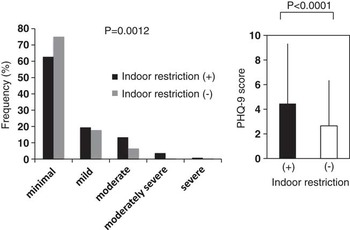
The participants of the 2011 evaluation also completed a patient health questionnaire 9 (PHQ-9) to assess the levels of mental distress; scores ranged from 0 to 27. The distribution of scores between the 2 populations were compared with use of a χ2 test, categorized by degree of depression: minimal (0-4), mild (5-9), moderate (10-14), moderately severe (15-19), and severe (20-27). As previously reported, PHQ-9 scores of 10 or greater have 88% sensitivity and specificity for major depression.Reference Kroenke, Spitzer and Williams 16 Thus, the participants with scores of 10 or greater were further evaluated.
Self-reported physical activity was estimated by asking the participants to recall the duration of any moderate to vigorous outdoor activities conducted in the past week. Daily duration of physical activity was categorized as 1 (less than 10 minutes), 2 (10 to less than 30 minutes), 3 (30 to less than 60 minutes), 4 (1 to less than 3 hours), 5 (3 to less than 5 hours), and 6 (5 hours or longer). The difference in pre- and post-disaster duration of physical activity was assessed as a continuous variable.
Statistical analysis
Student t tests or Pearson χ2 tests were performed to compare differences in values of each variable between the Iitate Village and Soma City populations. We assessed the differences in pre- and post-disaster clinical parameters in the residents using a paired t test. Qualitative categorical variables were compared with χ2 analyses. We compared changes in clinical parameters between the 2 populations using ANOVA for normally distributed variables with adjustment for possible confounders including age, gender, and BMI.
We used JMP 10.0.2 (SAS Institute) software in this study; P values less than .05 were considered statistically significant for type I (alpha) errors in the rejection of the null hypothesis.
Results
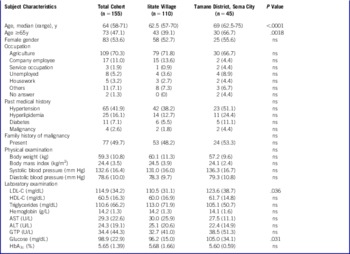
Among the total cohort of 155 participants, 72 were men (46.4%) and 83 were women (53.6%); the median age was 64 years (interquartile interval: 58-71 years). Demographic characteristics and the predisaster variables of the participants who underwent the health evaluations in the previous year and again after the earthquake have been described in Table 1. The study took place in a rural region with an aging population, as indicated by the median age of the participants (64 years). Farming was the major occupation of the region (70%). The median age of the participants of Iitate Village and Soma City were 62.5 (interquartile interval, 57-70) and 69 (interquartile interval, 62.5-75), respectively. The difference in age between the two groups was statistically significant (P < .0001). The predisaster levels of blood glucose (P = .036) and LDL-C (P = .031) were significantly lower among the participants of Iitate Village compared to those of Soma City.
Subject Characteristics at Baseline and Predisaster VariablesFootnote a

Abbreviations: ALT, alanine aminotransferase; AST, aspartate aminotransferase; GTP, gamma glutamyl transpeptidase; HbA1c, hemoglobin A1c; HDL-C, high-density lipoprotein cholesterol; LDL-C, low-density lipoprotein cholesterol.
b Mean and SD or number and percentage are shown for numerical or categorical data. Student t tests or Pearson χ2 tests were used to compare numerical data or proportions between Iitate Village and Soma City, respectively.
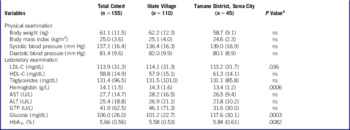
Post-disaster variables are shown in Table 2. While the levels of blood glucose (P = .0003) and HbA1c (P = .0082) observed among the participants of Iitate Village were significantly lower than those of Soma City, the levels of hemoglobin (P = .0006) and LDL-C (P = 0.036) were significantly higher in residents of Iitate Village compared to those of Soma City.
Screening Results After the EarthquakeFootnote a

Abbreviations: ALT, alanine aminotransferase; AST, aspartate aminotransferase; GTP, gamma glutamyl transpeptidase; HbA1c, hemoglobin A1c; HDL-C, high-density lipoprotein cholesterol; LDL-C, low-density lipoprotein cholesterol.
a Mean and SD or number are shown for numerical data. Student t tests were used to compare numerical data between Iitate Village and Soma City, respectively.
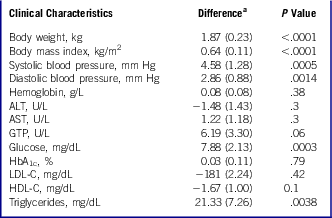
A significant post-disaster increase in body weight (P < .0001), BMI (P < .0001), SBP (P = .0005), DBP (P = .0014), blood glucose levels (P = .0003), and triglyceride levels (P = .0038) were observed. No post-disaster differences were found in hemoglobin count, AST, ALT, GTP, HbA1c, LDL-C levels, or HDL-C levels (Table 3).
Pre- and post- disaster differences in clinical characteristics of residents proximal to the Fukushima Daiichi nuclear power plant

Abbreviations: ALT, alanine aminotransferase; AST, aspartate aminotransferase; GTP, gamma glutamyl transpeptidase; HbA1c, hemoglobin A1c; HDL-C, high-density lipoprotein cholesterol; LDL-C, low-density lipoprotein cholesterol.
aMean of post-disaster minus predisaster value and SE.
We found that 12% of the 564 participants had a PHQ-9 score of 10 or greater, indicating that a substantial number of the residents had major depression. We observed a significantly higher risk of possible major depression in residents from Iitate Village than in those living in Soma City (17.8% vs 7.2%, P = .0012; odds ratio, 2.82; 95% CI: 1.62–4.89) (Figure 2). It was also clear that the level of physical activity among the residents of Iitate Village appeared to have decreased greatly, as compared to those of Soma City (mean, 1.66; SE, 0.14 vs mean, −0.20; SE, 0.23; P < .0001).
Mental Distress of Residents Inside and Outside the Indoor Restriction Zone.

We compared the clinical parameters and the changes between the 2 populations. The Iitate residents tended to have a greater increase in DBP (mean, 3.95 mm Hg; SE, 1.06 vs mean, −0.09 mm Hg; SE, 1.70; P = .051) than those in Soma City.
Discussion
The findings in this study disclosed a substantial deterioration of the clinical parameters related to lifestyle diseases after the Fukushima Daiichi nuclear disaster. Although the social media and press focused predominantly on the potential health threat of the radiation leaking from the damaged nuclear plant,Reference Sugimoto, Nomura and Tsubokura 17 we found no evidence of acute radiation syndrome among the residents living in high radiation-contaminated areas. Our findings were consistent with previous studies that have suggested the relationship of the evacuees’ physical and mental health problems with those of natural disasters, such as the great Hanshin-Awaji earthquakeReference Kario and Ohashi 18 - Reference Saito, Kim, Maekawa, Ikeda and Yokoyama 20 and Hurricane Katrina.Reference Fonseca, Smith and Kuhadiya 21 An approximately 5-mm Hg increase in the SBP observed among the residents living near the crippled nuclear plant was a significant health concern.
Almost all of the younger residents living just outside the evacuation zone began leaving after a relatively short period preceding the administrative recommendation for evacuation. This exodus could be justified based on data collected from the Chernobyl disaster in 1986, which showed a steep increase in the incidence of pediatric thyroid cancer.Reference Fuzik, Prysyazhnyuk and Shibata 22 - Reference Hatch, Ron, Bouville, Zablotska and Howe 24
Because airborne radioactive particles can drift unpredictably, depending on the weather and wind direction, the US Nuclear Regulatory Commission has recommended an evacuation zone in a 80-km (50-mile) radius from the nuclear plant, 25 far beyond the 30-km evacuation zone recommended by the Japanese authorities. Considering a worst-case scenario, this decision may have been appropriate; as evacuating all residents within an 80-km zone was not practical; hundreds and thousands of residents were living in those areas. Moreover, to impose an evacuation on elderly people living outside the immediate disaster area may not be justified, because in Fukushima the mortality of affiliated nursing homes during and after the evacuation was 2.4 times higher in 2011 than in 2010.Reference Yasumura, Goto, Yamazaki and Reich 26 , Reference Nomura, Gilmour and Tsubokura 27 As compared to those affected by the 1986 Chernobyl disaster, where the average age of the residents in the Kiev grid of the Ukraine was mid-30s, the median age of the participants in this study was 64 years. Although it is unlikely that a radiation-associated increase in the incidence of cancer in these elderly people would occur, the deterioration of the clinical parameters related to lifestyle diseases, which could lead to an increase in cardiovascular events, was observed for those who did not evacuate and stayed indoors. Thus, health interventions after a major nuclear disaster should not be entirely focused on the risk management of radiation exposure, especially in older people. Attention should also be given to the control of lifestyle diseases. Similar consequences to the Japan's nuclear accident might occur in other nations whose aging populations would be rapidly increasing in the future.
Our findings showed that general psychological distress was common among residents living near the nuclear plant. As no baseline PHQ-9 scores from the previous year were available, it was difficult to conclude from the present study whether the regional condition of mental distress had worsened. However, a possible reason for the high level of distress among the residents in Iitate Village and Soma City may have been attributed to the lack of timely and accurate information. Messages from the Japanese government stated that the Fukushima Daiichi nuclear plant was in a stable and safe state, although the situation was the opposite. This poor communication caused serious social distrust and fear among the general public, which also may have added increased psychological distress.Reference Onishi and Fackler 28 , Reference Fackler 29
The DBP levels worsened among the participants from Iitate Village, who were younger and had lower blood glucose levels in predisaster measurements compared to those of Soma City. Also, the risk for possible major depression was significantly higher in the residents of Iitate Village than in of Soma City. In addition, the risk for physical and mental health was greater and more negative among the Iitate residents compared to those in Soma city.
While these findings may be associated with direct and indirect consequences of the Iitate Village residents having a greater degree of exposure to this disaster, an indoor restriction order may have been responsible for the negative physical and mental effects, because they were forced to stay indoors for a period of 2 months. Further investigations are needed.
Limitations
The present study has several limitations. First, the study population was small and individuals younger than age 18 years from Iitate Village were excluded. However, under the chaotic situation caused by the consecutive disasters of earthquakes, tsunami, and nuclear plant accident, it was not possible to conduct a systematic cohort study with a larger population. Second, as the population of interest was a clinical sample of those who voluntarily joined the health checkups, selection bias was a possibility and may have limited the generalizability of the results. One reason was that the participants may have been more concerned about their own health, and thus the deterioration of the general health status may have been underestimated. On the other hand, healthy and younger individuals might have moved from the affected areas, which could account for worse health outcomes among the remaining residents.
Conclusions
This study was conducted as a preliminary pilot study. The Japanese government has subsequently begun prospective research in larger areas, with greater populations, to examine the influences of the nuclear disaster in more detail, including the long-term effect of exposure to low levels of radiation. However, our findings suggest important implications about the management of nuclear accidents. In addition to controlling the levels of radiation exposure, aggressive management for immediate health crisis of physical and mental status may be necessary in future nuclear accidents.
Acknowledgments
The officers and nurses of Iitate Village and Soma City, and the Seto Health Checkup Clinic (Takamatsu, Japan) assisted in organizing these programs. Yasuo Miyazawa and volunteers at Seisa Group assisted in operating the checkups.
We are grateful to many staff and physicians from throughout Japan who offered assistance after the disaster.