Carbapenem-resistant Acinetobacter baumannii (CRAB) has emerged as a major cause of healthcare-associated infections worldwide, and its management and treatment have become significant challenges for physicians.Reference Higgins, Dammhayn, Hackel and Seifert 1 – Reference Young, Sabel and Price 3 CRAB pneumonia has been associated with a high mortality rate (14.3%–46.6%),Reference Betrosian, Frantzeskaki, Xanthaki and Douzinas 4 – Reference Gurjar, Saigal and Baronia 6 especially among patients receiving inadequate initial empiric antimicrobial therapy or with higher disease severity scores.Reference Chang, Chen and Lin 7 The most common type of CRAB infection is ventilator-associated pneumonia (VAP).Reference Vahdani, Yaghoubi and Aminzadeh 8 – Reference Werarak, Kiratisin and Thamlikitkul 14 Since 2000 in Thailand, the National Antimicrobial Resistance Surveillance Center (NARST) has reported that CRAB incidence has been increasing; the carbapenem-resistant rate of CRAP was >64.7% in 2013. 15 This increase in the number of CRAB cases greatly limits the therapeutic options for management of patients who are infected with this organism.
Various antimicrobial agents such as imipenem, sulbactam, colistin, rifampicin, and tigecycline have been used to treat CRAB.Reference Bassetti, Righi, Esposito, Petrosillo and Nicolini 16 In vitro studies have demonstrated that a combination of antimicrobial agents including colistin and rifampicin, colistin and imipenem, imipenem and rifampicin, and cefoperazone/sulbactam combination with imipenem, are synergistic for the treatment of CRAB.Reference Tripodi, Durante-Mangoni, Fortunato, Utili and Zarrilli 17 – Reference Tan, Lim, Lee, Sasikala, Hsu and Kwa 19 Currently, colistin with or without other antibiotics comprises the main regimen for treatment CRAB VAP.Reference Tripodi, Durante-Mangoni, Fortunato, Utili and Zarrilli 17 – Reference Falagas and Kasiakou 20 Notably, colistin has poor concentration in lung parenchymal tissue and is associated with nephrotoxicity.Reference Lu, Girardi and Zhang 21 , Reference Imberti, Cusato and Villani 22 Therefore, treatment of CRAB pneumonia has become difficult, with clinical response rates ranging from 60% to 83.8%.Reference Betrosian, Frantzeskaki, Xanthaki and Douzinas 4 – Reference Gurjar, Saigal and Baronia 6 , Reference Kalin, Alp, Akin, Coskun and Doganay 23 Available data are limited concerning the expected and clinical success rates for treatment of CRAB VAP by infectious disease physicians (IDPs). To help identify the gaps in the management of treatment and outcomes of CRAB VAP, we conducted this study to evaluate the expected and clinical success rates for treatment of CRAB VAP by Thai IDPs.
METHODS
Study Design and Participants
We surveyed all Thai IDPs for the expected and treatment success rates of CRAB VAP. According to data obtained from the Medical Council of Thailand, as of December 31, 2013, 153 board-certified IDPs and 30 in-training ID fellows were practicing in Thailand. Between June 1, 2014, and March 1, 2015, one of authors (A.B.) conducted a structured interview using a standardized questionnaire to survey all board-certified and in-training IDPs in Thailand. All IDPs were invited to participate in this study. If consent was obtained, they were interviewed face to face, by telephone, or by E-mail interview. IDPs were excluded from the study if they declined to be interviewed or had limited experience treating CRAB infection (ie, <4 cases per month). For IDPs who were enrolled via an E-mail interview, a researcher presented the case scenarios and all definitions listed in the data collection tool prior to participation (Online Supplementary Appendix). All data were collected from participants by a single investigator (A.B.) using a standardized data collection tool created by 4 IPDs (A.B., A.A., T.K., and S.R.).
Case Scenario
In this study, we used a case scenario for CRAB VAP in a patient with severe community-acquired pneumonia with respiratory failure who was treated with broad-spectrum antibiotics. The patient subsequently developed VAP due to CRAB and required treatment (Online Supplementary Appendix). Prior to the study, the case scenario was validated for internal reliability and consistency by 3 IDPs (A.A., T.K., and S.R.). As part of the questionnaire development phase, the interviewer (A.B.) met with 3 IDPs (A.A., T.K. and S.R.) to discuss the ways in which the case scenario represented typical clinical presentation of CRAB VAP and the appropriateness of questions concerning the expected and clinical success rates for the treatment of CRAB VAP. The case scenario was modified according to the 3 IDPs’ comments. Subsequently, 2 interviewers independently tested the survey instrument with the same 10 volunteer IDPs and achieved 100% concordance among the survey responses. Content validation (conducted in face-to-face interviews) included the individualized post-survey feedback from each of the 10 volunteer IDPs for the case scenario and the questions specific to the expected and clinical success rates. Revisions to the survey items were made based on the feedback from the 10 volunteer IDPs. A second test was then performed, and content validation of the survey instrument was conducted with a different set of 10 volunteer IDPs, and 100% concordance among the survey responses was achieved. A secondary review of the survey items was undertaken by the 3 IDPs (A.A., T.K., and S.R.) after the second test.
Data Collection and Study Definitions
We abstracted the expected success rate and the clinical success rate for the case scenario after IDP participants reviewed it. The IDP expected success rate was defined as the expectation of clinical response after treatment of CRAB VAP for the given case scenario. The IDP clinical success rate was defined as the overall reported success rate of treatment CRAB VAP based on each IDP’s clinical practice database. The expected and clinical success rates were divided into low (<60%), standard (60%–80%), and high (>80%) categories. The clinical response rates for CRAB nosocomial pneumonia are 60%–83.6% according to the existing literature.Reference Betrosian, Frantzeskaki, Xanthaki and Douzinas 4 – Reference Gurjar, Saigal and Baronia 6 , Reference Kalin, Alp, Akin, Coskun and Doganay 23 The following data were collected: (1) IDP participant baseline characteristics (eg, gender, age, position and duration of working, frequency of attending infectious disease (ID) conference, number of ID in-patient consultation cases, and number of CRAB consultation cases/month), (2) IDP participant hospital characteristics (eg, type and level of the hospital, medical school affiliation, and prevalent of multidrug-resistant organisms [MDROs] in their hospitals), and (3) infection control (IC) protocol for CRAB in their hospitals, defined as the implementation of standard IC and/or intensified IC interventions to control CRAB, based on the Healthcare Infection Control Practices Advisory Committee (HICPAC) recommendation. 24
Definitions
The study definition of clinical response was demonstrated improvement and resolution of signs and symptoms of VAP after the completion of therapy. Multidrug-resistant (MDR) A. baumannii was defined as resistance to at least 1 antibiotic in >3 classes of antibiotics including 2 β-lactams (ie, ampicillin-sulbactam, ceftazidime, cefotaxime, and piperacillin/tazobactam), gentamicin or amikacin, ciprofloxacin, and trimethoprim-sulfamethoxazole.Reference Magiorakos, Srinivasan and Carey 25 Extremely drug-resistant (XDR) A. baumannii was defined as resistance to carbapenems, to second- and third-generation cephalosporins, to anti-pseudomonal penicillins, fluoroquinolones, and aminoglycosides, but susceptibility to tigecycline and colistin. Pandrug-resistant (PDR) A. baumannii was defined as nonsusceptibility to all antimicrobial agents.Reference Magiorakos, Srinivasan and Carey 25 Standard IC intervention was defined as IDP participant responses to any of the following interventions: hand hygiene, contact isolation, cohort isolation, or environmental cleansing. Intensified IC intervention was defined as the use of active surveillance culture, intensified environmental cleansing (eg, use of hydrogen peroxide vaporization), or source control strategies (eg, chlorhexidine bath). 24
Statistical Analyses
Analyses were performed using IBM SPSS Statistics version 20 (SPSS, Armonk, NY). A χ2 or Fisher’s exact test was used to compare categorical data, as appropriate. Continuous variables were compared using the Mann-Whitney U test. All P values were 2-tailed; P<.05 was considered statistically significant. To determine factors associated with standard and high expected success rates as well as clinical success rates, variables that were present at a significance level of P<.20 in univariate analysis or had a priori clinical significance were entered into multivariate logistic regression models. Pearson’s correlation test was used to evaluate the correlation between expected rates and clinical success rates.
RESULTS
Participant Characteristics
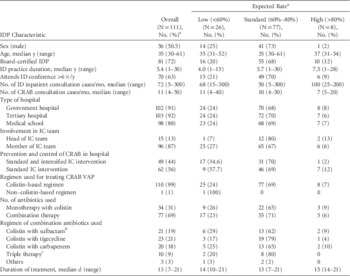
A total of 183 participants (153 Thai IDPs and 30 in-training ID fellows) from the list of the Medical Council of Thailand completed the survey administered during the study period. Of these 183 participants, 153 IDPs (153 of 183; 83%) participated in the interview. Of these 153 participants, 42 participants (42 of 153; 27%) were excluded for the following reasons: (1) declined to be interviewed (34 of 153; 22%) or (2) a low rate of CRAB consultation cases per month (8 of 153; 5%). Of 111 total participants, 80 (80 of 111; 73%) were interviewed face to face, 25 (25 of 111; 22%) were interviewed by E-mail, and 6 (6 of 111; 5%) were interviewed by telephone. Overall, the median duration of work was 5.4 years (range, 1–30 years), the number of inpatient consultation cases was 72 (range, 5–300 cases), and the number of CRAB consultation cases per month was 11 (range, 4–50 cases). Most participants worked in a tertiary care hospital (103 of 111; 92%) and were affiliated with medical schools (98 of 111; 88%). A total of 32 participants (32 of 111; 28%) reported MDR A. baumannii as the most prevalent MDR organism in their hospital. All participants joined the IC team in their hospital; 15 participants (15 of 111; 13%) served as the head of their IC committee. All participants reported having implemented a standard IC intervention for CRAB, while 62 participants (62 of 111; 56%) worked in hospitals that implemented standard IC with an intensified IC intervention for CRAB (Table 1).
Demographics, Hospital Characteristics, Treatment Regimens, and Expected Treatment Success Rates among Infections Disease Physicians (IDPs) in Thailand

NOTE. ID, infectious disease; CRAB, carbapenem-resistance Acinetobacter baumannii; IC, infection control; VAP, ventilator-associated pneumonia.
a Unless otherwise noted.
b In combination with ampicillin (ampicillin/sulbactam) and cefoperazone (cefoperazone/sulbactam).
c Colistin/tigecycline/carbapenem (N=3), colistin/sulbactam/carbapenem (N=5), colistin/tigecycline/sulbactam (N=1), colistin/carbapenem/fosfomycin (N=1).
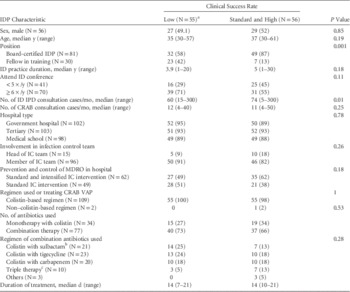
Most IDP participants said they would prescribe colistin-based regimens (110 of 111; 99%) and combination therapy (77 of 111; 69%) to treat CRAB VAP in the case scenario. The 3 most common combination regimens included (1) colistin with tigecycline (23 of 111; 21%), (2) colistin with sulbactam (21 of 111; 19%), and (3) colistin with carbapenem (20 of 111; 18%). Only 10 IDPs (10 of 111; 9%) reported using triple combination therapy (Table 1). The median duration of the treatment regimens was 13 days (range, 7–21 days). The IDP demographics, hospital characteristics, and treatment regimens are shown in Table 1.
Expected Rate and Clinical Success Rate
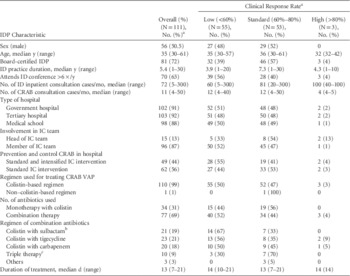
The median expected rate for the case scenario presented to the Thai IDPs was 68% (range, 40%–95%). The overall responses for expected treatment success were categorized into three groups: low (26 of 111; 24%), standard (77 of 111; 69%), and high (8 of 111; 7%). The median clinical success rate for CRAB VAP treatment was 58% (range, 30%–90%). Clinical success rates were measured as categorized into 3 groups: low (55 of 111; 49%), standard (53 of 111; 48%), and high (3 of 111; 3%). Characteristics among participants across all groups of expected and clinical success rates are compared in Tables 1 and 2.
Demographic, Hospital Characteristics, Treatment Regimens, and Clinical Success Rates among Infections Disease Physicians (IDPs) in Thailand

NOTE. ID, infectious disease; CRAB, carbapenem-resistant Acinetobacter baumannii; IC, infection control; VAP, ventilator-associated pneumonia.
a Unless otherwise noted.
b In combination with ampicillin (ampicillin/sulbactam) and cefoperazone (cefoperazone/sulbactam).
c Colistin/tigecycline/carbapenem (N=3), colistin/sulbactam/carbapenem (N=5), colistin/tigecycline/sulbactam (N=1), colistin/carbapenem/fosfomycin (N=1).
Factors Associated with Standard and High Expected and Clinical Success Rates
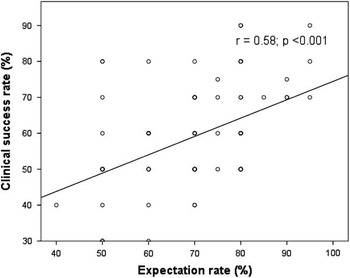
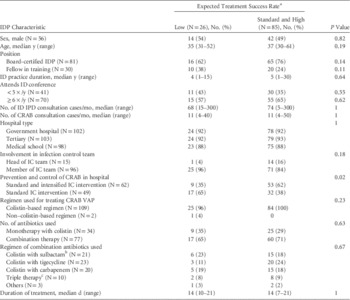
Compared with IDPs who had low expected rate, IDPs who had standard and high expected rate were more likely to practice in a hospital that implemented standard IC with intensified IC intervention to control CRAB [35 of 56 (63%) vs 27 of 49 (49%); P=.02] (Table 3). By multivariate analysis, working in a hospital that implemented standard IC with intensified IC intervention was the only factor associated with standard and high expected success rates (aOR, 3.01; 95% CI, 1.17–7.73; P=.02) (Table 5). Notably, IDPs who reported having implemented standard IC with intensified IC intervention were more likely to use combination therapy compared with those whose institution did not implement intensified IC intervention [49 of 62 (79%) vs 29 of 49 (59%); P=.02]. Compared with IDPs who had low clinical success rates, IDPs who had standard and high clinical success rates were more likely to be board-certified IDPs [49 of 56 (87.5%) vs 32 of 55 (58.2%); P=.001] and were more likely to have a higher number of ID inpatient consultation cases per month (median, 74 vs 60 cases per month; P=.01) (Table 4). As shown by our multivariate analysis, being board certified (aOR, 5.76; 95% CI, 2.16–15.37; P<.01) and having high number of ID inpatient consultation cases per month (aOR, 4.84; 95% CI, 1.98–11.80; P<.01) were associated with reported standard and high clinical success rates (Table 5). We identified a significant correlation between the expected rate and the reported clinical success rate among the IDPs (r=0.58; P<.001) (Figure 1).
Scatter plot diagram and correlation coefficients between expected treatment success rate and clinical success rate.

Demographics and Characteristics of Infections Disease Physicians (IDPs) in Thailand with Low vs Standard and High Expected Treatment Success Rates for CRAB VAP

NOTE. ID, infectious disease; IPD, inpatient department; CRAB, carbapenem-resistant Acinetobacter baumannii; IC, infection control; VAP, ventilator-associated pneumonia.
a Unless otherwise noted.
b In combination with ampicillin (ampicillin/sulbactam) and cefoperazone (cefoperazone/sulbactam).
c Colistin/tigecycline/carbapenem (N=3), colistin/sulbactam/carbapenem (N=5), colistin/tigecycline/sulbactam (N=1), colistin/carbapenem/fosfomycin (N=1).
Demographics and Characteristics of Infections Disease Physicians (IDPs) in Thailand with Low vs Standard and High Clinical Success Rates for CRAB VAP

NOTE. ID, infectious disease, IPD, inpatient department; CRAB, carbapenem-resistant Acinetobacter baumannii; IC, infection control; VAP, ventilator-associated pneumonia.
a Unless otherwise noted.
b In combination with ampicillin (ampicillin/sulbactam) and cefoperazone (cefoperazone/sulbactam).
c Colistin/tigecycline/carbapenem (N=3), colistin/sulbactam/carbapenem (N=5), colistin/tigecycline/sulbactam (N=1), colistin/carbapenem/fosfomycin (N=1).
Adjusted Odds Ratios of Factor Associated with Standard and High Expected and Clinical Success Rates

NOTE. CI, confidence interval; IDP, infectious disease physician; IC, infection control; ID, infectious disease, IPD, inpatient department.
DISCUSSION
Herein, we have reported the median clinical success rate for CRAB VAP treatment of was 58% (range, 30%–90%), and the results of our study have some important implications. First, we found that IDP expectations of treatment success influence clinical treatment success. Notably, awareness of the IC program via the implementation of an intensified IC program to control MDROs is the essential factor driving positive attitudes toward favorable treatment outcomes. Second, being an ID board-certified specialist and clinical treatment experience do impact the overall treatment success rate of CRAB VAP. Third, there is a clear positive correlation between expected and clinical success rates. To our knowledge, this is the first national survey study to evaluate expected and clinical success rates for the treatment of CRAB VAP.
In previous studies of cases treated by American IDPs, the median acceptable failure rate for treatment of uncomplicated community-acquired pneumonia was 13.5%;Reference Kaye, Harris, McDonald, Strausbaugh and Perencevich 26 for central venous catheter-associated bacteremia caused by coagulase-negative staphylococci, this rate was 6.8%;Reference Perencevich, Harris and Kaye 27 and for diabetic osteomyelitis, the median acceptable failure rate was 8.1%.Reference Perencevich, Kaye, Strausbaugh, Fisman and Harris 28 In contrast, the median expectation of clinical response for CRAB VAP treatment in this study was only 68%. This finding is not surprising because an effective antibiotic treatment for CRAB-associated infections is currently lacking.Reference Betrosian, Frantzeskaki, Xanthaki and Douzinas 4 – Reference Gurjar, Saigal and Baronia 6 , Reference Falagas and Kasiakou 20 , Reference Kalin, Alp, Akin, Coskun and Doganay 23 Notably, attempts to identify significant factors associated with a particular acceptable failure rate in previous studies failed.Reference Kaye, Harris, McDonald, Strausbaugh and Perencevich 26 – Reference Perencevich, Kaye, Strausbaugh, Fisman and Harris 28 In this study, we found that a higher proportion of IDPs worked in a hospital that had implemented standard IC combined with intensified IC intervention. This was a significant factor associated with standard and high expected rates, in addition to the use of combination therapy for treatment of CRAB VAP. This finding, albeit controversial, implies that these IDPs believe that using combination therapy helps reduce selection for MDR–Gram-negative bacteria in their institutions and improves patient outcomes. This finding has been supported by previous studies involving other pathogens (eg, MDR-P. aeruginosa, carbapenemase-producing Klebsiella spp., MDR-A. baumannii).Reference Lister and Wolter 29 – Reference Daikos, Tsaousi and Tzouvelekis 35
Existing evidence in both developed and developing countries suggests the favorable role of IDPs in improving the diagnosis accuracy of infectious diseases and their management,Reference Raineri, Pan, Mondello, Acquarlo, Candiani and Crema 36 in reducing mortality in patients with Staphylococcus aureus bacteremia,Reference Jenkins, Price, Sabel, Mehler and Burman 37 , Reference Rieg, Peyerl-Hoffmann and de With 38 in reducing morbidity and mortality associated with sepsis,Reference Doern, Vautour, Gaudet and Levy 39 – Reference Byl, Clevenbergh and Jacobs 42 in reducing inappropriate antibiotic use and improving antibiotic de-escalation practices,Reference Apisarnthanarak, Danchaivijitr, Bailey and Fraser 43 , Reference Apisarnthanarak, Bhooanusas, Yaprasert and Mundy 44 and in enhancing IC practices to prevent MDR A. baumannii.Reference Apisarnthanarak, Khawcharoenporn and Mundy 45 Our finding complements existing evidence and supports the role of board-certified IDPs in improved CRAB VAP treatment outcomes. One of the most valuable and often underappreciated qualities of IDPs is their ability to enhance care of difficult-to-treat or perplexing cases.Reference Petrak, Sexton and Butera 46 Experienced IDPs are skilled in treating complex cases and managing patients with clinical disease who deteriorate despite aggressive treatment strategies.Reference Petrak, Sexton and Butera 46 Our study results support the role of experienced IDPs in improving clinical treatment outcomes for complex infectious diseases such as CRAB VAP.
We are aware of some limitations pertaining to this study. The survey response rate in our study was only 65%, which may not be generalizable to all IDPs in Thailand, despite the fact that this response rate is higher than that reported in previous studies (52%–54%).Reference Kaye, Harris, McDonald, Strausbaugh and Perencevich 26 – Reference Perencevich, Kaye, Strausbaugh, Fisman and Harris 28 We did not include the data regarding IDP knowledge and attitude toward colistin use and its related adverse reactions, which may impact the selection of antibiotic regimen and the expected clinical success rates. The small sample size in our study limited our capacity to identify potential factors associated with both expected and clinical successful rates. However, this is the first study to evaluate the expected and clinical success rates at a national scale with regard to the treatment of CRAB VAP. Given that the questionnaires were distributed using different methods (eg, face-to-face, E-mail, and telephone interviews), there may have been a potential misunderstanding of questions and definitions in the survey. Nonetheless, we believe that this bias is minimal because we performed validity and reliability tests on our data collection tool and because we modified the study collection tool and methods accordingly prior to the initiation of the study. We included only 1 scenario for CRAB VAP treatment; our results may not be applicable to treatment of other CRAB-associated infections at sites other than lungs or treatment of VAP caused by other MDROs. We did not measure the case-mix overall severity of illness in the hospitals, and this may have created a bias toward worse treatment outcomes among hospitals that had more sick patients. Finally, because this was an observational study, the result is not definitive.
In conclusion, the results of this study indicate that IDP attitudes toward infection control do impact an IDP’s expectation of successful treatment of CRAB VAP. This attitude also has a positive impact on clinical response rates. Our results also highlight the role of ID training in developing countries; this training improves outcomes of complex infectious diseases cases involving MDROs. Further studies are needed to evaluate factors associated with physician treatment knowledge, physician attitudes, and physician perceptions toward other MDROs and their correlation with clinical success. These studies will help fill the gaps in our understanding and improve treatment outcomes in era of emerging MDROs with limited therapeutic options.
ACKNOWLEDGMENTS
Financial support: A.A. and T.K. are supported by the National Research University Project of the Thailand Office of Higher Education Commission.
Potential conflicts of interest: All authors report no conflicts of interest relevant to this article.
SUPPLEMENTARY MATERIAL
To view supplementary material for this article, please visit http://dx.doi.org/10.1017/ice.2015.240