What's Wrong with Economics?
It Ignores the Pogo Principle: “We have met the enemy and he is us.”Footnote 1
Or … more classically, as it was put by Cassius:
“The fault (dear Brutus) is not in our stars, But in ourselves….” Julius Caesar (Shakespeare 2006, p. 16)
I. LAYING OUT THE PROBLEM
Let me begin by giving credit where credit is due. Modern economic analysis is beautifully elegant and impressively powerful. I agree with George Stigler that “the systematic analysis of behavior of individuals pursuing their self-interest under conditions of competition … is Newtonian in its universality” (Stigler Reference Stigler1976, p. 1201).
But what is really unique about humankind is not the fact that we pursue our self-interest under conditions of competition. This applies to all species. Those that fail vanish.
What makes us unique is our capacity to reflect upon, understand, act upon, and significantly reshape the universe that surrounds us. That capacity has made possible the progress of humankind from the rude state of hunting and gathering to a level of material well-being amongst the privileged classes of the world today that the greatest kings and emperors of the past would envy.
This prospect of, as Adam Smith referred to it, “bettering their condition” (Wealth of Nations [hereafter WN] p. 341) has unleashed the energy and creativity of individuals wherever individuals are free to choose their own path in life. That energy and creativity have been directed most efficiently and effectively where market signals, prices, are free to adjust … constantly signaling to each and all where the best opportunities lie in the next moment. And even as existing opportunities are seized by the energetic and the agile, the creative players among us lead the markets to new paths of opportunity that had heretofore been unimagined. The only limit to the fruitfulness of the market system seems to be our capacity for energy and imagination. Or so it seems if one is working in a world of Stigler’s economic man, homo economicus: one driven solely and powerfully by a desire to better his condition.
But Stigler, and modern economics analysis more generally, miss one very essential point. “[T]he systematic analysis of behavior of individuals pursuing their self-interest under conditions of competition … [may be] Newtonian in its universality,” but we are not physicists studying stars or quarks, we are social scientists studying the human condition, and, as noted above, humans are unique in nature. Stigler focuses on the beauty of unfettered freedom to bring out the best of human capacities. When energy and imagination are unleashed in pursuit of self-interest, each individual is “led by an invisible hand to promote an end which was no part of his intention” (WN, p. 456). This is the engine of the progress of opulence for society, this is the cause in The Nature and Causes of the Wealth of Nations. But, freedom can also unleash the worst in human behavior. The energy and imagination that can be so constructive can also be employed in very destructive ways that freedom makes possible.
The slave trade that provided cheap labor to the sugar plantations of the West Indies and to the tobacco plantations of the American South was a complex free market in which many exercised energy and imagination in providing a valuable commodity to the market: humans as chattel. One man’s free to choose was another man or woman’s slavery.
The system of apartheid in the Old South Africa was of great service to the market for commodities such as diamonds, providing cheap labor to energetic and imaginative men who certainly considered themselves entrepreneurs. In this case, one man’s freedom to choose was another man or woman’s quasi-slavery.
If there is a problem with economics today, it is that it models based on homo economicus, an abstract being that does not reflect the complexity of human nature. Adam Smith writes in his Theory of Moral Sentiments:
Human society, when we contemplate it in a certain abstract and philosophical light, appears like a great, an immense machine, whose regular and harmonious movements produce a thousand agreeable effects. As in any other beautiful and noble machine that was the production of human art, whatever tended to render its movements more smooth and easy, would derive a beauty from this effect, and, on the contrary, whatever tended to obstruct them would displease upon that account: so virtue, which is, as it were, the fine polish to the wheels of society, necessarily pleases; while vice, like the vile rust, which makes them jar and grate upon one another, is as necessarily offensive (Theory of Moral Sentiments [hereafter TMS], p. 316).
Smith’s analysis of the human condition and of our collective prospect begins with a theory of virtue and vice in his first book, The Theory of Moral Sentiments, because it is the balance of these that determines the efficacy of the invisible hand in his second book, An Enquiry into The Nature and Causes of the Wealth of Nations.
Where is there room for the issues of virtue and vice in a world populated by homo economicus? What does it mean to be an ethical homo economicus? … an unethical homo economicus? Wherein lay the norms for approbation or disapprobation of behavior if we are all simply maximizing utility? For homo economicus there are no norms—there is only self-referential motive.
In my introductory economics class, I explain that markets are amoral—not moral, not immoral—amoral. In that sense they are like computers … incredibly powerful at processing immense amounts of information in useful ways, but totally agnostic as to the use. Computers can be used to educate, to elucidate, to heal … or to develop weapons of mass destruction. They don’t give a damn, nor do markets … nor does homo economicus.
Well, there’s a Catch-22 here. If no one gives a damn, then the market system doesn’t work very well. As Hobbes appreciated in the seventeenth century, unfettered freedom is a dangerous and destructive environment. Somewhere, somehow, someone must give a damn about norms.Footnote 2
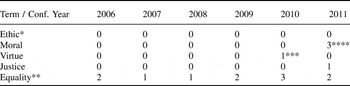
If morals or ethics or virtue or justice or equality are terms that one would associate with a concern about, and a conversation regarding, norms, we would expect to see these terms reflected in that discourse. The published Papers and Proceedings Footnote 3 of the annual meeting of the American Economic Association is arguably the best source for examining the content of the discourse among modern mainstream economists, for this publication presumably reflects what the most significant association of economists considers representative of, and exemplary in, its annual community discourse. An examination of the titles of sessions listed and papers published in Papers and Proceedings for the period covering the six annual meetings from 2006 to 2011 suggests that if the terms cited at the opening of this paragraph—morals … ethics … virtue … justice … equality—are indeed good proxies for norms as a subject of conversation, then norms are not a significant part of the conversation among those in the mainstream modern economics discourse.Footnote 4
Number of times each term appeared in the Papers and Proceedings of a given yearFootnote 5

* Captured possible cases: Ethics or Ethical
** Captured possible cases: Equality or Inequality
*** Title: “Institutions, Factor Prices, and Taxation: Virtues of Strong States”
**** All in a session titled “Economics as a Moral Science”
II. THE ROLE OF “NORMS” IN ECONOMICS ANALYSIS?
The term “norms” seems to make some economists nervous, so let me be clear. The issue here is not whether analysis should be normative or positive. The issue here is that norms matter in society, so any positive analysis of how human society works must factor in the role of norms.
Adam Smith writes, again in the Theory of Moral Sentiments:
Society … cannot subsist among those who are at all times ready to hurt and injure one another.… If there is any society among robbers and murderers, they must at least, according to the trite observation, abstain from robbing and murdering one another. Beneficence, therefore, is less essential to the existence of society than justice. Society may subsist, though not in the most comfortable state, without beneficence; but the prevalence of injustice must utterly destroy it (TMS, p. 86).
Liberal society, and here I mean small-l liberal—liberal as in a society in which citizens enjoy freedom—is for obvious reasons especially vulnerable to the Hobbesian quandary of freedom: the potential of a war of all against all. Liberty for all is constructive only to the degree that there is justice for all. Above, I cited American slavery and South African apartheid as examples of “free market” societies in which there were distortions of justice. In each case the injustice is clear and present to anyone who believes that individuals should “not be judged by the color of their skin but by the content of their character” (King Reference King, Carson and Shepard2001, p. 85).
Structures of societal control such as slavery, apartheid, or segregation create a system of market power. The destructive consequences of power lie in the perverse alignment of incentives created by power. Power pays—in the vernacular, it generates a “rent,” a return not to productive activity but to the advantage that power provides. Those who enjoy the power advantage are not challenged by the competition of the powerless. The powerful win the “race for wealth” because they control the race. They need not overly exert themselves, they need not call upon all their creativity and imagination to win in the race … because the race is fixed. Fat and happy, the only efforts that they must carefully and consistently attend to are those that preserve their power.Footnote 6
And what of those on the down side of the power structure? They are competing too, but their competition is only with one another, for a diminished set of prospects. They too desire to better their condition, but the best they can hope for is a “better” relative to the rest of the oppressed. There is little or no opportunity to nurture their gifts of creativity and imagination, and thus there is little incentive to do so because there is little prospect of being rewarded for those gifts. This untapped human potential is a significant loss to society.
Power is a “blessing” for the powerful because they enjoy a large slice of the social “pie,” of the social product, but it is a large slice of a very diminished pie because power distortions are inefficient for society.
Not only is much of the productive capacity that could spring from the imagination and creative energies of free individuals in fair, unfettered competition lost due to the perverse incentives created by power, but power requires resources to be spent for its maintenance. Police, paddy wagons, guns, whips, jails, bullets, batons … significant resources had to be expended to maintain the system of slavery or apartheid or segregation. These resources didn’t educate a child or cure a sick individual, they simply kept people “in their place”—to use an expression I grew up with.
I grew up in the 1950s in New Orleans. In those days the first-level headings of the job-listing section of the daily newspaper were not, as they are today, work categories like professional, medical, food service, and so on. Back then, the first-level headings of job listings were divided into two categories: “Help Wanted—Male” and “Help Wanted—Female.” So immediately we see the power structure of that society … in that time … in that place … reflected in the gender demarcation under “Help Wanted.”
If you were a woman, you might read a listing that said: “Apprentice plumber wanted, starting pay $5.00/hour. Will train. For information call TW1-0708.” But there was no point in picking up the phone. That listing was under the male column and you were not eligible. You might like the thought of $5.00/hour but your options read like this: “Waitress wanted. Must be able to work flexible hours. $1.00/hour + tips. Call UN6-5782.”
And imbedded in the structure of those job listings was yet another power structure: race-based demarcations. An actual ad from the June 21, 1948, New Orleans Times-Picayune reads (all four of the following advertisements from that issue [Nicholson Reference Nicholson1948, p. 33]).

In those days all the available jobs were listed in the paper. Abstracting from the market power created by “separate but equal” schools, and assuming all could read, everyone had equal access to information. Anyone who bought a newspaper could see the available job options. But knowing the options is not enough to ensure a fair race. For the race to be fair, you have to have equal access to participate. But, access was not equal.
In those days in New Orleans and in many other places before and since (Antebellum South, Old South Africa, …) this was not seen by those in power as a distortion. It was simply the norm, the natural order of things.Footnote 7 It was not seen as a violation of free market economics, it was simply the context of the “free market.” Blacks were inferior—after all, they were “colored”—and women were frail—unless, of course, they were black and/or poor—and both had their “place.”Footnote 8
Power can be generated by political institutions backed by police and armies (e.g., slavery or apartheid or segregation), or by socially constructed norms that, inculcated through socialization, become tacit knowledge for all in that society (Berger and Luckmann Reference Berger and Luckmann1966). In New Orleans of the 1940s and 1950s, gender-based power was primarily established by socialization of norms with minimal need for political institutional reinforcement (there were restrictions on working hours and conditions for women that limited their options). Race-based power also began with socialization, but it required significant political institutional reinforcement to sustain itself. Clearly, the political foundations of these power structures have been significantly eroded, but the social foundations … the tacit understandings, the shared norms … still have strength. Societal norms exert a very significant influence on economic processes. They are not as visible as political institutions,Footnote 9 they adapt much more slowly than political institutions, and they don’t exist in the normless world populated by homo economicus. This is a problem for economics if it aspires to represent the world as it is, as opposed to the world as it is assumed.
But for a moment, let’s assume away this problem of norms that demarcate opportunities based on gender or race or some other observable difference.Footnote 10 Let’s focus on process norms, the norms of the competition in the race for wealth. As noted at the outset, absent such norms, homo economicus does not play well with others. And that can be very destructive.
III. NORMS, THE “RACE FOR WEALTH,” AND “GOVERNMENT”
Consider some of the roots of the economic crisis that unfolded in 2008.
Thanks to the Fed, in 2002, 2003, 2004, money was cheap, and the more you could move the more you could make. The government was focused on expanding homeownership. Mortgage finance companies acted like any red-blooded entrepreneur would: they seized the day, offering loans to any and all comers, and then they sold those mortgages bundled as securities. This location in the middle of the mortgage transaction was a wonderful place to play in this game.
You could dupe the mortgage recipient into believing she wasn’t over-leveraging with lines like “Hey, I wouldn’t offer you a mortgage you can’t afford … come on, I want to be paid back. How stupid do you think I am? I’ve been in this business for years (Note: In many cases it was actually months), I don’t make losing bets. It’s a no-lose situation for both of us. If you find you can’t pay, we sell the house for a profit. I get paid back, you walk away with some extra cash. It’s a no-brainer.”Footnote 11
What the mortgage recipient often didn’t understand was that you weren’t really going to share the risk because you weren’t in this for the long haul. Soon after she signed the mortgage paper, you were out of the transaction. You bundled this mortgage along with other mortgages into a security that you then sold.Footnote 12
But alas, you’re selling a security larded with risky mortgages, and risk is clearly an issue for the potential security buyer, so you “launder”Footnote 13 the risk: you, in effect, digitized the mortgages, dividing them into micro pieces that were then recombined into bundles that homogenize lots of degrees of risk, so the risk seemed a mile wide (broadly spread) and an inch deep (not a problem).Footnote 14 But it was a problem, albeit not a transparent one. The security buyer was buying blind.
Imagine taking a family album, digitizing the pictures into pixels, then shuffling the pixels so that every new print has just a few pixels from each of the original pictures. These new prints would have no recognizable information. You’d have no idea what the underlying pictures looked like. And so it was with these mortgage-backed securities. But, fortunately for the securities buyers, they had the good work of the security rating agencies as a warrant for the quality of the securities. Unfortunately for the security buyers, these rating agencies were working for the security sellers.Footnote 15 The rest, as they say, is history.
There’s a lot of imagination, energy, creativity … a lot of good ’ol free market entrepreneurial activity going on here. And the consequence was a disaster that was almost catastrophic.
Most economists didn’t see this coming because it all seemed to make sense. The free market was “doing its thing.” Creative entrepreneurs were bettering their condition by using their imagination to create opportunities for homeownership, while others did the same by creating financial instruments that spread risk so broadly that no one had to worry. And hardly anyone did … until it was too late.
What was missing? Norms, ethical norms. Norms that would have constrained mortgage sellers from using asymmetric information to exploit the hopes and dreams of aspiring homeowners or the consumption addiction of folks who thought they could use their house as a piggy bank.Footnote 16 Norms that would have required security sellers to make the risk content of the securities clear so the transaction was transparent. Norms that would have made it incumbent upon ratings agencies to carefully assess and report the risk built into those securities … their word being their bond. At every step of this transaction sequence, the actors seemed to be playing the part that economists assumed they would: acting as homo economicus, as amoral beings who were simply doing what needed to be done to maximize their utility, to better their condition. In fact, however, they were not homo economicus. These individuals were human beings who, more often than not, understood society’s ethical norms and chose to ignore them, and to act unethically in pursuit of their self-interest.
IV. WOULD ADAM SMITH HAVE PREDICTED THE GREAT RECESSIONS?Footnote 17 PROBABLY NOT, BUT …
As I tell my students in my introductory economics textbook:Footnote 18 the answer key as to how the world works is not in the back of the book. The value of a good analytical tool kit is not the answers it gives, but rather the questions it encourages us to ask and the tools it offers us to address those questions in a thoughtful, systematic way. So, too, Adam Smith’s work.Footnote 19
Smith envisioned all of us as being made of the same “coarse clay” (TMS, p. 162). The properties of that clay include the capacity for self-love, or, as we refer to it: self-interest … the desire to better our condition. There is also beneficence … the warmth of human kindness; and justice … the capacity to bridle our self-love so that we don’t trample upon others in our pursuit of a better condition. It is the balance of these “sentiments”—self-love, beneficence, and justice—that determines the content of our character.
That clay, and thus our character, is initially shaped by the social context into which we are born, for we have a desire for approbation. We desire to be accepted by our social reference group. This gives that reference group the power to mold us. For children, that reference group is generally a small and cohesive and enveloping family, and the norms of that group are taken to be the natural order of things and are inculcated as our “duty.” To the degree we buy into and are committed to these norms, we develop the self-command to do our duty.
As we get older, the range of our references grows and competing norms are experienced. We develop a degree of autonomy, for we each have the free will to make choices among these competing normative models. Indeed, given our imagination, we even have the capacity to contribute our own adaptations to the norms of our society, and to advocate for these adaptations. Each of us has a unique biography … each of our journeys through life is different, so we each emerge as an autonomous individual initially shaped by, but ultimately shaping, to different degrees, the institutions of our world.
This dynamic, the socially constructed being developing autonomy and reconstructing society, lies at the heart of Adam Smith’s vision of the dynamic of humankind’s progress, for he does believe that the course of humankind’s history is a story of progress. Not an inexorable, uninterrupted story of progress—Smith is keenly aware of the horrors of human history and the failures of once grand societies—rather, a progress strewn with failures but nonetheless … progress. For Smith, any given society is a natural experiment. It emerges through the intended and unintended consequences of human action, and sustains itself to the degree that it solves the challenges of progress more effectively than those challengers that surround it.
Smith envisions humankind’s progress as proceeding through four stages, each one more fruitful than the last: hunting and gathering, followed by pasturage, then agriculture, and finally commercial society. Growing complexity is an inevitable part of this progress, for the increased material well-being that each successive stage offers is based on an expanding market nexus. It is, after all, an increasingly extensive market that makes possible the ever-finer division of labor that gives rise to increasing productivity. This growing complexity is characterized by more autonomy of individual action and extended forms of property. This combination is fertile ground for destructive behavior of unbridled self-interest, for property is “the grand fund of all dispute … “ (LJA, p. 208).Footnote 20 Here again we face the Hobbesian challenge: how does a liberal society capture the fruits of freedom? For Smith, the key to a society’s progress lay in its capacity to address the challenge of social cohesion, and, for Smith, that key to social cohesion is civic ethics.
In Smith’s story of humankind’s progress, institutional big-G Government emerges and grows as a guarantor of individuals’ security. But in Smith’s analysis, the real blossoming of humankind’s potential, the stage of free individuals and free markets—a commercial society—requires that much of the policing role of government be taken on not by institutional Government, but by individual citizens in the form of shared civic ethics, shared norms of self-government. In his analysis of humankind’s progress, institutional Government plays an essential instrumental role. It facilitates progress to the degree it develops rules of justice that are fair and effective constraints on self-love. Smith’s Lectures on Jurisprudence reflect a deep admiration for the British Common Law as a product of intended as well as unintended consequences of human action that, he believed, had made Great Britain the most mature example of human society to his day.
To the degree that these institutional standards of behavior become accepted as civic duty—as shared norms—by individual citizens of society, the policing role of institutional Government can be reduced because ethical citizens are self-governed.Footnote 21 In a mature free-market society, the many are good citizens guided by their shared standards of civic ethics, and institutional Government is a community instrument for enforcing those rules on the few who do not willingly choose to play fair, to play by the rules.
Smith’s hope for free-market society’s growing ever more mature lay in the dynamics of commerce itself. Growing commerce would, he believed, progressively improve the lot of the least among the working class, giving those citizens a stake in the society, and thereby building an ever-broader base of citizen commitment to society’s shared civic values.Footnote 22 Indeed, Smith’s standard of a good commercial society is the condition of the working class. In The Wealth of Nations he writes:
Servants, labourers, and workmen of different kinds, make up the far greater part of every great political society. But what improves the circumstances of the greater part can never be regarded as an inconveniency to the whole. No society can surely be flourishing and happy, of which the far greater part of the members are poor and miserable. It is but equity, besides, that they who feed, clothe, and lodge the whole body of the people, should have such a share of the produce of their own labour as to be themselves tolerably well fed, clothed, and lodged (WN, p. 96).
Smith believed that in a maturing free-market economy, the well-being of the working class would be constantly enhanced, and the distance between that class and the elite would be constantly diminished. He believed the very dynamic of market system drives this.
In his analysis, the stock of capital grows in the course of a continuous circular flow that expands that stock with each circuit.Footnote 23 This growth of capital stock happens faster than labor force growth—so the competition among capitals becomes progressively more intense and the return to capital diminishes … even as the competition for labor from an ever-deepening capital stock drives up wages.Footnote 24
Thus, for Smith, two leading indicators of progress in a free-market society are the broadening acceptance and adherence to a shared system of civic ethics, and a diminishing distance between the top and the bottom of society’s income distribution. It follows that a growing gap in income distribution is a prima facie case for a distortion somewhere in the system; e.g., a distortion caused by market power enjoyed by those who, not concerned with shared norms, exploit their control over access to capital to their advantage.
This perverse case was not a hypothetical for Smith. Even as he published The Wealth of Nations in 1776, he was concerned with, and subsequently became consumed with, the distortions caused by what he referred to as the mercantile interests. “Like an overgrown standing army” (WN, p. 471),Footnote 25 these energetic and imaginative entrepreneurs had used their political influence to manage the flow of trade to their advantage, routing much of it though the one favored artery of trade that served their interests; the colonial trade. As a consequence, this favored artery, “artificially swelled beyond its natural dimensions” (WN, p. 604), was a crisis waiting to happen—which indeed it did.
While not every economic contraction can be accounted for as a crisis brought on by a rupture of an artery that has been engorged by excessive flows of capital,Footnote 26 such distortions may help us understand some such crises.
Consider, for example, the Great Depression or the Great Recession. There is evidence that these crises were preceded by a widening of the income distribution consistent with power advantages. In tables 195 and 197 of “Income Payments – Annual Changes in Percentage Shares of Total Income Payments in Current Prices (Kuznets) 1919–1938,” we see that the “[u]pper 1 percent[‘s]” share of total income payments went from 12.3% in 1920 to 14.5% in 1929, while the “Lower 95 Percent[‘s]” share went from 77.9% to 73.9% during the same period (United States Department of Commerce 1949, p. 15). Similarly, Diaz-Giménez, et al. write in “Facts on the Distribution of Earnings, Income and Wealth in the United States: 2007 Update”: “Overall, … there has been a substantial increase in most measures of inequality since 1998 …” (Diaz-Giménez, et. al. Reference Diaz-Giménez, Glover and Riios-Rull2011, p. 3). If Smith had been around in the years leading up to the Great Depression or the Great Recession, he might not have forecast these events, but the skewing of income distribution in the 1920s and in the 2000s would have given him a sense of foreboding, and his analysis would have encouraged us to ask some very instructive questions about market distortions.Footnote 27
I study Adam Smith because his work can inform our modern discourse. I was introduced to Adam Smith in a History of Economic Thought class I took as a PhD student. My teacher in that course was an excellent scholar and a wonderful human being named Jesse Burkhead. When Jesse retired, I had the privilege of succeeding him as the teacher of that course.
V. ON HISTORY OF ECONOMIC THOUGHT AND THE VALUE OF SKEPTICAL REFLECTION …
At the opening class of my history of economic thought course for the economics PhD students, I explain to them that my goal is to introduce them to some alternative perspectives on the subject of economics. I tell them that I want to offer them these alternative perspectives as tools for skepticism about what they are learning in their other economics courses.
I then go on … You are learning economics at a specific point in time. You are learning the economics of “now.” The field has not always been as it is and, if the past is any indication of the future, it will not always be as it is. The history we are about to study is the economic thought of the past, but this past is more than prologue.
The subjects that we struggle to understand today: human behavior, the dynamics of interpersonal behavior, the origin and impact of institutions as they relate to this interpersonal dynamic—how humans in an interdependent world make their way as they seek to “better their condition” (WN, p. 341) through their day-to-day activities in “ordinary business of life” (Marshall Reference Marshall1936, p. 1)—these subjects have been the focus of, to name a few of our great predecessors: Adam Smith, David Ricardo, John Stuart Mill, Alfred Marshall, John Maynard Keynes, Milton Friedman.
These subjects have not changed because the basic subject-matter has not changed. Adam Smith lived from 1723 to 1790. He died just over 200 years ago. Two hundred years is a micro-moment relative to the course of human evolution. We are the same in our nature as we were 200 years ago.
Certainly our technical context is worlds apart. Thanks to human imagination, invention has changed our context dramatically, but imagination itself is timeless. That imagination that brought us to the technological wonders of the twenty-first century is the same imagination that was central to Smith’s analysis of humans and humankind. It is the same today as it was then, and so too the entire nature of human nature. We are as we were 200 years ago and will be 200 years hence … made of the same “coarse clay” as Smith described us to be in 1759. We are the same and so too our subject-matter is the same.
But, I’m often asked by my PhD students: don’t we know more because we have built on the understandings of our predecessors? And, isn’t our analysis much better because it is much more sophisticated?
I respond to the first of these points as follows: the assertion that “we know more because we have built on the understandings of our predecessors” is an empirically testable hypothesis.
We can examine the history of economic thought with a comparative eye on the present, constantly asking ourselves: have we separated the wheat from the chaff and moved beyond the understandings of the past, or have there been gains and losses in the discourse as it has evolved?
We could assume that we know more and ignore the past, but why be so arrogant when the past is available for exploration? If we find nothing new, we can at least examine how analytical progress proceeded. This alone would be worth the price of admission, for understanding the dynamic of analytical progress might help us to accelerate it. But, I note, there is always the possibility that there are lost insights to be found in the past.
Good scientists are skeptical; they want to challenge their own ideas. The venue for such challenges, the marketplace of ideas, is greatly diminished if that marketplace is limited to the participants of the “now” discourse. That limitation privileges the “now” norms. We’ve all learned from the same texts and we all read the same journals, all of which are written based on the norms of “now.” Certainly there are debates about issues in the “now” model, but there is little in the way of fundamental challenges to the premises, the norms, of the extant system of thought.Footnote 28
The articles accepted this year in the leading journals, those “hits” most likely to advance or secure one’s academic standing and position, privilege the “now” assumptions; for example, homo economicus. From where will the challenges to such assumptions come? Think “Adam Smith.”
Good science requires thoughtful skepticism. One ready source of divergent thinking that can nurture such skepticism is the work of our predecessors who studied and wrote about the same subject-matter. When, in 1936, Keynes wrote that the “now” economic thinking of his day needed to escape from “habitual modes of thought and expression,” he believed that the problem of his 1936 “now” discourse derived from a lack of “generality of premises” (Keynes Reference Keynes1964, p. xiii). Keynes had seen this show before.
In his “Essay” on Malthus, Keynes quotes an exchange of letters between Ricardo and Malthus. In one quotation we hear Malthus criticizing Ricardo’s premises as follows: “‘A writer may, to be sure, make any hypothesis he pleases; but if he supposes what is not at all true practically, he precludes himself from drawing any practical inferences from his hypothesis’” (Keynes Reference Keynes1956, p. 33). As Keynes sees it, through Malthus’ eyes, Ricardo’s assumptions abstract from the complexity of the real world, and yet Ricardo prevailed.Footnote 29 Keynes continues: “One cannot rise from a perusal of this correspondence without a feeling that the almost total obliteration of Malthus’s line of approach and the complete domination of Ricardo’s for a period of a hundred years has been a disaster to the progress of economics” (Keynes, Reference Keynes1956, p. 33). Keynes looks to the past, to Malthus, for divergent thinking and to see his way into the future.
We should invite those from the past to join the discourse by exposing graduate students to this rich source of divergent perspectives … of constructive skepticism. We should invite such challenges from our predecessors, not neglect them based on the assumption that we know all they did about these human issues and more. If Shakespeare still speaks to us about our humanity and the human condition, it is because our nature and our condition are the same as when he explored those subjects in his plays and poems over 400 years ago. So, too, Adam Smith can still speak to us about our humanity and the human condition, because our nature and our condition are the same as when he explored these subjects in his works over 200 years ago.
As for the second question my PhD students ask—Isn’t our analysis better because it is more sophisticated?—I point out that growing technical complexity is often treated as a proxy for increased sophistication. Part of our sense of methodological advance derives from the mathematization of the field. In the “best” journals, the discourse looks like physics, complex equations laid out with crisp precision.Footnote 30 Math is the medium of the economics conversation; it is the language of “now.” If you don’t speak the language, you’re not going to be a part of the conversation.
Precision is good. But is that language up to the fullness of subject? Is math sufficient to capture all that we wish to understand and represent about the human condition and the human prospect? The strength of math is its rigor. Does it have any drawbacks?Footnote 31
Every language, by its nature, casts light and shadows on the subject to which it is applied. Is math a perfect language for all expression? Clearly not. If it was, we would have long since started to translate Shakespeare into its mathematical equivalent, eliminating all those superfluous flourishes as “full of sound and fury, Signifying nothing” (Shakespeare, Macbeth, Reference Shakespeare2005, p. 156).
Adam Smith does not use math. Does that mean that his analysis of the human condition and the human prospect is less insightful, less valuable, less sophisticated? There’s a simple way to find out: read him.
At this point one of my PhD students would invariably ask, having just arrived from econometrics: But clearly our method is better when it comes to empirical testing of the models … right? We use incredibly sophisticated techniques, huge data sets, and high-powered computers to determine from the numeric data whether the evidence supports or rejects a hypothesis. This is obviously ‘better.’ … Right?
Is it? Is the analysis of numeric data sufficient to capture and represent the “invisible chains” (Smith Reference Smith, Wightman and Bryce1980, p. 45), the invisible connecting principles, that underlie the visible human actions and human interactions that we seek to understand?Footnote 32 Certainly the modern empirical methods have borne much fruit, but are they sufficiently fruitful to understand the complexities of humankind in an historical, multicultural, multi-institutional world? Maybe. But why assume it’s so? Why not compare the fruitfulness of our modern methods to the empirical methods used by our predecessors? Why assume computers can capture all complexities of the human condition more richly than the observant human mind?
Adam Smith did not have access to econometric techniques or a computer. Would he have abandoned his own method if he had? Would he have rejected the modern tools if they had been available? Or, would he have found usefulness in both? If we examine Smith’s empirical method, we might find it has strengths that complement the modern methods. His database was rich, woven narrative history. His method was to cull from the narratives of history, from stories of contemporaneous societies (nascent anthropology), from participant observation (nascent sociology), the invisible connecting principles that guide human action and humankind’s evolution. His method was very persuasive in his day. Shall we assume that his approach is antiquated, lacking sophistication, and thus ignore it? Why not examine how he made his case?Footnote 33 We might learn something that improves our own work. At worst, we can establish that our modern methods are at least as comprehensive and are more powerful, not by assumption, but by comparison.
If modern economic theory has one potential weakness that an exploration of the past can easily address, that is the character of the assumptions upon which it is constructed. In my introductory textbook, as I develop the role of assumptions in model building, having explained the distinction between strong and weak assumptions and the process of relaxing assumptions, I note that in an odd twist of language it is true that models are only as strong as their assumptions are weak. I constantly remind my students to keep their eye on the assumptions for they set the foundation on which we are building.
Given the assumptions, the construction begins. In the modern discourse, the assumptions are indeed “given”; the construction of the superstructure of a model is where the action is. Identifying any weakness in the superstructure is an opportunity for personal distinction, for there is notoriety in such a “victory.” It is this competition for distinction that leads to constant improvement in the superstructure. There is no such a competition regarding the assumptions.
The assumptions on which my PhD students build as they reconstruct the superstructure of modern economic theory in order to master its intricacies are not examined or challenged at all. They reflect the shared belief system, a shared norm, the “natural order” thinking of the “now”: humans maximize utility … assume homo economicus … now on to model building.
Keynes writes in his “Preface” to the General Theory:
[I]f orthodox economics is at fault, the error is to be found not in the superstructure, which has been erected with great care for logical consistency, but in the lack of clearness and of generality of the premisses. (Keynes Reference Keynes1964, p. v).
Whether or not one agrees with the argument Keynes makes in his General Theory, isn’t he right to suggest that we should examine our assumptions? Keynes learned the importance of doing so from Malthus. Keynes appreciated that there are lessons to be learned from the past.
I’ve gone on and on about my opening conversation with my PhD students in the History of Economic Thought course, but, fact is, I don’t get to teach that History of Thought course anymore. I don’t get to encourage skepticism in those who seek to be economists. I don’t get to tell them about a time when human nature was not defined by homo economicus so they can decide for themselves if this is a weak or a strong assumption.
When I joined the faculty at Syracuse over twenty-five years ago, the History of Economic Thought course was a core requirement of the PhD program, but my department—as have almost all economics departments in the United States—deemed the opportunity cost of a History of Thought class, that cost being a real, relevant, and up-to-date “now” economics course like an additional econometrics class, to be too dear a price to pay, so the History of Economic Thought requirement, and with it the course, died in the spring of 2002.
I don’t get to teach History of Economic Thought to PhD students anymore. I think that’s a shame, not just for me, not just for my students, but for the future of the field. PhD students today spend five or so years in courses and dissertation work that reflect the “now” system of thought, followed by six years of publication in pursuit of tenure that is successful only if one participates on the “now” terms. Eleven or so years of systematic “now” thinking in a “Life Among the Econ” (Leijonhufvud Reference Leijonhufvud1973) will almost surely socialize one to think of “now” norms of analysis as the natural order of things. How do we escape this “now” normative constraint? How do we empower our students to consider alternative assumptions, assumptions such as: norms matter?Footnote 34
Keynes’ opening words in the “Preface” to his General Theory are:
This book is chiefly addressed to my fellow economists. I hope that it will be intelligible to others. But its main purpose is to deal with difficult questions of theory, and only in the second place with the applications of this theory to practice. For if orthodox economics is at fault, the error is to be found not in the superstructure, which has been erected with great care for logical consistency, but in a lack of clearness and of generality in the premisses (Keynes Reference Keynes1964, p. v).
It is in this spirit that I write to my fellow economists: open up a window of constructive skepticism in the minds of your students. Introduce them to ideas of the brilliant predecessors in their field who have struggled with the same questions your students have come to school to explore. Teach them the history of economic thought.