Introduction
There is increasing evidence that the environmental conditions experienced by parents can influence the phenotype and life-history traits of their progeny by affecting their physiological conditions (Mousseau & Dingle, Reference Mousseau and Dingle1991; Mousseau & Fox, Reference Mousseau and Fox1998; Badyaev & Uller, Reference Badyaev and Uller2009; Bonduriansky & Day, Reference Bonduriansky and Day2009; Valtonen et al., Reference Valtonen, Kangassalo, Pälkki and Rantala2012; Burgess & Marshall, Reference Burgess and Marshall2014; Attisano & Kilner, Reference Attisano and Kilner2015; Kilner et al., Reference Kilner, Boncoraglio, Henshaw, Benjamin, Jarrett, Gasperin, Attisano and Kokko2015). These transgenerational effects can be viewed as plastic phenotypic responses of the progeny to parental environmental conditions, i.e., non-genetic parental effects.
Parental effects on reaction norms for morphological, behavioural and physiological traits have been investigated in a number of insects, such as the tobacco budworm (Heliothis virescens) in terms of the effect of parental diet on progeny development time (Gould, Reference Gould1988), the seed beetle Stator limbatus in terms of the effect of parental feeding on progeny body mass (Fox et al., Reference Fox, Thakar and Mousseau1997), the desert locust (Schistocerca gregaria) in regard to the effect of parental rearing density on progeny morphology and behaviour (Simpson & Miller, Reference Simpson and Miller2007), the fly Drosophila melanogaster in terms of the effect of parental food quality on progeny development time (Valtonen et al., Reference Valtonen, Kangassalo, Pälkki and Rantala2012), the tobacco hornworm (Manduca sexta) in regard to the effect of immunochallenged parents on progeny larval development time and body mass (Trauer & Hilker, Reference Trauer and Hilker2013) and the burying beetle Nicrophorus vespilloides in terms of the effect of the parental developmental environment on progeny reproduction and wing morphology (Kilner et al., Reference Kilner, Boncoraglio, Henshaw, Benjamin, Jarrett, Gasperin, Attisano and Kokko2015; Attisano & Kilner, Reference Attisano and Kilner2015).
Environmentally modulated transgenerational plasticity in progeny diapause has been examined in some insects that undergo facultative summer or winter diapause (Danks, Reference Danks1987; Yang et al., Reference Yang, Lai, Sun and Xue2007; Lai et al., Reference Lai, Yang, Wu, Zhu and Xue2008; Scharf et al., Reference Scharf, Bauerfeind, Wolf U. Blanckenhorn and Schäfer2010). In general, the photoperiod, temperature, host availability or density experienced by the parental generation will determine the probability of diapause in their offspring (Vinogradova, Reference Vinogradova1974; Mousseau & Dingle, Reference Mousseau and Dingle1991; Fox & Mousseau, Reference Fox, Mousseau, Mousseau and Fox1998; Oku et al., Reference Oku, Yano and Takafuji2003; Tachibana & Numata, Reference Tachibana and Numata2004; Huestis & Marshall, Reference Huestis and Marshall2006; Yang et al., Reference Yang, Lai, Sun and Xue2007; Lai et al., Reference Lai, Yang, Wu, Zhu and Xue2008; Scharf et al., Reference Scharf, Bauerfeind, Wolf U. Blanckenhorn and Schäfer2010).
Parental effects have been regarded as an important source of evolutionary diversification. Parental effects can alter the nature and pace of ecological and evolutionary change, potentially permitting organisms to adapt quickly in a rapidly changing environment (e.g., Räsänen & Kruuk, Reference Räsänen and Kruuk2007; Badyaev & Uller, Reference Badyaev and Uller2009; Kilner et al., Reference Kilner, Boncoraglio, Henshaw, Benjamin, Jarrett, Gasperin, Attisano and Kokko2015).
The cabbage beetle, Colaphellus bowringi Baly (Coleoptera: Chrysomelidae), is a serious pest of crucifers in the mountainous areas of Jiangxi Province. In the field, there are two distinct infestation peaks: the single spring generation between March and April and the three autumn generations between September and November, which undergo aestivating and hibernating imaginal diapause in the soil, respectively (Xue et al., Reference Xue, Li, Zhu, Gui, Jiang and Liu2002a). This cabbage beetle shows a short-day response (develops in response to short day length and enters diapause in response to long day length) when the mean daily temperature is ≥20°C. All individuals enter diapause when the mean daily temperature is ≤20°C regardless of the photoperiod. High temperatures strongly weaken the diapause-inducing effects of long day lengths (Xue et al., Reference Xue, Spieth, Li and Hua2002b). The female parent exhibits a greater effect on diapause initiation than the male parent (Chen et al., Reference Chen, Xiao, He, Xu and Xue2014). Previous studies of C. bowringi have revealed that parental physiological age, mating pattern, diapause duration, geographical origin and host plant had a significant influence on the incidence of diapause in their progeny (Yang et al., Reference Yang, Lai, Sun and Xue2007; Lai et al., Reference Lai, Yang, Wu, Zhu and Xue2008). The present study aimed to detect how the photoperiod and temperature experienced by parents of C. bowringi influence the incidence of diapause in their progeny.
Materials and methods
Experimental animal
Diapausing adults of C. bowringi were collected from the field in autumn in Xiu-Shui County, Jiangxi Province, PR China (29°1′N, 114°4′E) and then transferred to large glass bottles (diameter: 50 cm; height: 180 cm) containing soil to burrow for dormancy. The bottles were placed outdoors at Jiangxi Agricultural University, Nanchang, Jiangxi Province (28°46′N, 115°59′E). When post-diapause adults emerged from the soil, they were transferred in pairs to Petri dishes for mating and oviposition. The eggs were collected every day at approximately 5:00 pm, and newly hatched larvae were transferred to plastic rearing boxes (17.5 × 12.5 × 6.5 cm3). Each box contained at least 60 individuals. In all experiments, each treatment was replicated three to five times. Larvae were fed with mature leaves of radish (Raphanus sativus var. longipinnatus) until the adults entered diapause. The diapausing adults were transferred to large glass bottles containing soil to burrow for dormancy.
Experimental designs
To examine the effects of the photoperiod and temperature experienced by parents on the incidence of diapause in their progeny, three experiments were conducted. The first experiment spanned 2 years. The parental larval generation produced by post-diapause adults was reared under different photoperiods (LD 10:14, LD 11:13, LD 12:12, LD 13:11, LD 14:10, LD 15:9 and LD 16:8 h) at 25°C (a diapause-preventing temperature) and produced non-diapausing and diapausing parents. The incidence of diapause in the progeny from non-diapausing and diapausing parents was evaluated under LD 12:12 at 25°C both in the current spring and in the next spring (fig. 1a).
Experimental design used to test the effects of photoperiod and temperature experienced by Colaphellus bowringi parents on the incidence of diapause among their progeny. (a) Effect of photoperiod experienced by parents on diapause incidence in their progeny; (b) effect of temperature experienced by parents on diapause incidence in their progeny; (c) effect of temperature experienced by diapausing parents during diapause period on diapause incidence among their progeny.

The second experiment also spanned 2 years. The parental larval generation produced by post-diapause adults was reared under LD 12:12 at 22, 25, 28 and 30°C and produced non-diapausing and diapausing parents. Similar to the first experiment, the incidence of diapause in the progeny from non-diapausing and diapausing parents was evaluated under LD 12:12 at 25°C both in the current spring and in the following spring (fig. 1b).
In the third experiment, naturally diapausing adults (parental generation) were maintained at a constant temperature of 9°C (an overwintering temperature), 28°C (an aestivating temperature) or the mean daily summer temperature of 27.84°C for 90 days under continuous darkness conditions. Then, the incidence of diapause in the progeny from these post-diapause parents was evaluated under different photoperiods (LD 10:14, LD 11:13, LD 12:12, LD 13:11, LD 14:10 and LD 15:9 h) at 25°C (fig. 1c).
It should be mentioned that diapausing parents that experienced different photoperiods and temperatures emerged from the soil the following spring (early March) at the same time.
Diapause identification
All diapausing adults show a digging behaviour and burrow into the soil after 4–6 days at 25 or 30°C and after 7–9 days at 20°C (Xue et al., Reference Xue, Spieth, Li and Hua2002b).
Statistical analyses
Data on parental diapause incidence under different photoperiods and temperatures and diapause incidence data for progeny from non-diapausing and diapausing parents were analysed using analysis of variance (ANOVA) followed by a Bonferroni multiple comparisons test (STATA 9.0 software). The percentage data for diapause incidence were arcsine square root transformed before analysis. Data on the incidence of diapause in progeny were compared by two-way ANOVA with the photoperiod or temperature experienced by parents, parent status (diapausing or non-diapausing) and their interaction as explanatory variables. Different treatment effects were compared using a Bonferroni test after ANOVA with a significance level of P = 0.05 for all comparisons.
Results
Effect of photoperiod experienced by parents on diapause incidence among progeny
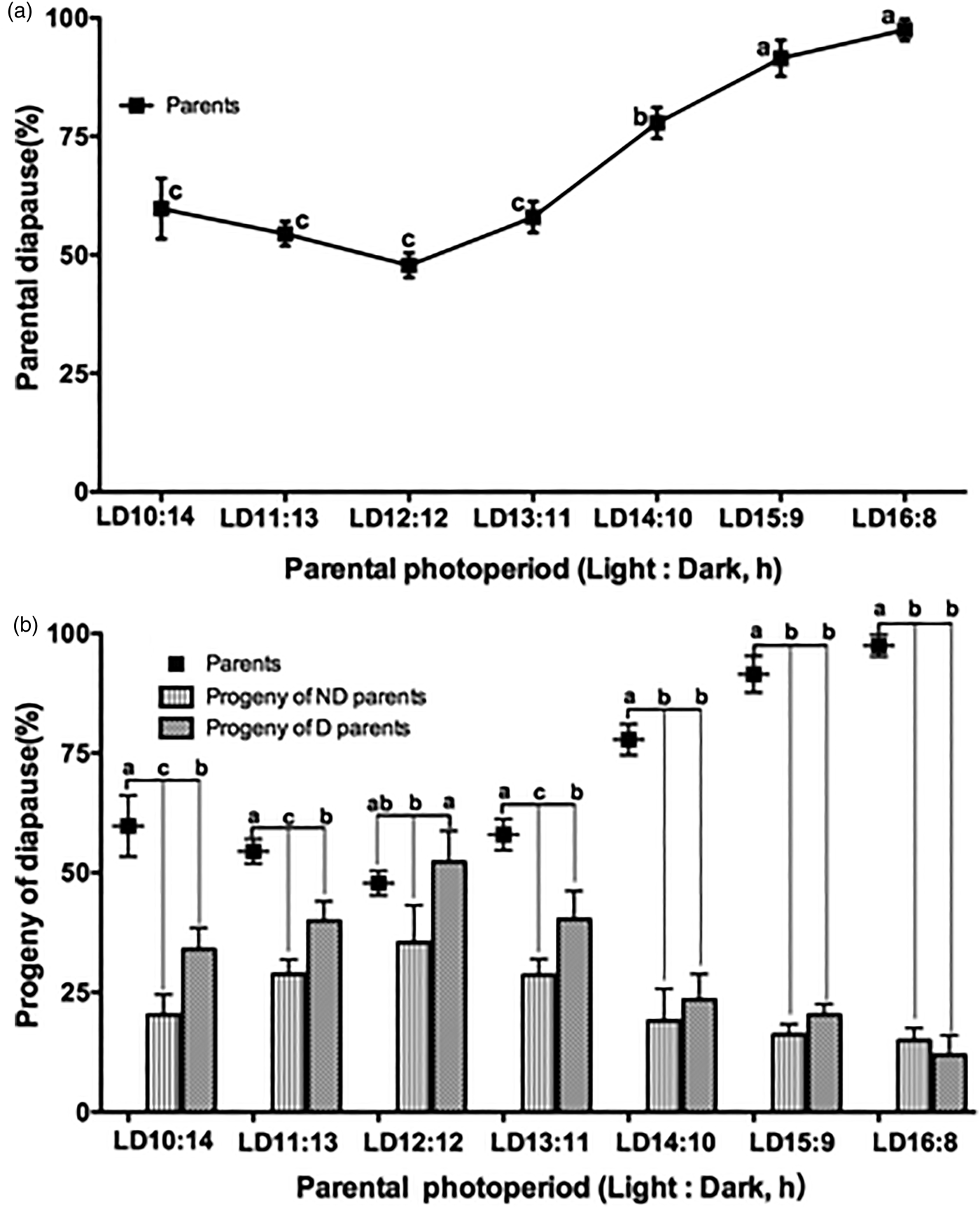
The incidence of diapause among progeny was significantly affected by the photoperiod experienced by parents (F = 29.71, df = 6, P = 0.0000), parental status (diapausing or non-diapausing) (F = 28.12, df = 1, P = 0.0000) and their interaction (F = 2.85, df = 6, P = 0.0272) (fig. 2, Table S1).
Parental diapause incidence in Colaphellus bowringi when parental larvae were reared under different photoperiods at 25°C (a). Diapause incidence in progeny under LD 12:12 at 25°C (b) when their non-diapausing (ND) and diapausing (D) parents experienced different photoperiods. Error bars indicate SD. Values with different lowercase letters are significantly different for different photoperiods and types at the 0.05 level (n = 205–235 for each treatment).

When parents were exposed to different photoperiods, the parental diapause incidence gradually decreased from LD 10:14 to LD 12:12 (from 50.7 to 43.8%) and gradually increased from LD 12:12 to LD 16:8 (from 49.6 to 82.6%) (fig. 2a). There were significant differences among photoperiods in parental diapause incidence (F = 53.03, df = 6,14, P < 0.001). However, the incidence of diapause among the progeny from both non-diapausing and diapausing parents showed a gradual increase when the parental rearing photoperiod changed from LD 10:14 to LD 12:12 (from 26.7 to 36.4% when produced by non-diapausing parents and from 35.6 to 46.3% when produced by diapausing parents) and a gradual decrease when the parental rearing photoperiod changed from LD 12:12 to LD 16:8 (from 32.3 to 22.7% when produced by non-diapausing parents and from 29.3.3 to 20.0% when produced by diapausing parents) (fig. 2b). This result shows that the incidence of diapause among progeny was exactly opposite to that of their parents, i.e., the higher the parental diapause incidence, the lower the diapause incidence among their progeny. There were significant differences in diapause incidence among progeny (for non-diapausing progeny: F = 8.04, df = 6,14, P < 0.001; for diapausing progeny: F = 24.69, df = 6,14, P < 0.001) (fig. 2b). The incidence of diapause among progeny from diapausing parents was generally higher than that among progeny from non-diapausing parents, with significant differences when their parents experienced the shorter photoperiods from LD 10:14 to LD 13:11 (P < 0.05).
Effect of temperature experienced by parents on the incidence of diapause among progeny
The diapause incidence among progeny was significantly affected by the temperature experienced by parents (F = 54.36, df = 5, P = 0.0000) and by the interaction between the temperature experienced by parents and parental status (diapausing or non-diapausing) (F = 10.50, df = 3, P = 0.0005) (fig. 3, Table S2).
Parental diapause incidence of Colaphellus bowringi when parental larvae were reared under LD 12:12 at 22, 25, 28, and 30°C (a). Diapause incidence among under LD 12:12 at 25°C when their non-diapausing (ND) and diapausing (D) parents experienced different temperatures (b). Error bars indicate SD. Values with different lowercase letters are significantly different at the 0.05 level (n = 198–225 for each treatment).

The rearing temperature had a significant influence on parental diapause incidence (F = 74.35, df = 3,8, P < 0.001), which decreased gradually (from 62.7 to 9.5%) with increasing rearing temperature from 22 to 30°C (fig. 3a). However, the diapause incidence in progeny from both non-diapausing and diapausing parents showed a significant increase (from 11.6 to 48.6% when produced by non-diapause parents and from 27.3 to 41.7% when produced by diapause parents) with increasing parental rearing temperature (for non-diapausing progeny: F = 74.02, df = 3,8, P < 0.001; for diapausing progeny: F = 7.01, df = 3,8, P < 0.001) (fig. 3b). This indicates that the incidence of diapause among progeny was exactly opposite to that of their parents (fig. 3b). The incidence of diapause in progeny from diapausing parents was significantly higher than that in progeny from non-diapausing parents when their parents were reared at 22°C (P < 0.05) but lower when their parents were reared at the higher temperatures of 28 and 30°C without showing significant differences (P > 0.05).
Effect of temperature experienced by diapausing parents on diapause incidence among progeny
The incidence of diapause among progeny was significantly affected by photoperiod (F = 21.10, df = 5, P = 0.0000), temperature experienced by parents (F = 22.53, df = 2, P = 0.0000) and their interaction (F = 2.24, df = 10, P = 0.0353) (fig. 4, Table S3).
Diapause incidence of Colaphellus bowringi progeny under different photoperiods at 25°C when their diapausing parents were maintained at the constant temperatures of 9 and 28°C and under natural conditions, with a daily mean temperature of 27.84°C, under continuous darkness for 90 days. Error bars indicate SD. Values with different lowercase letters are significantly different for the same photoperiod at the 0.05 level (n = 178–347 for each point).

By maintaining the diapausing adults at different temperatures and then exposing their progeny to different photoperiods, the incidence of diapause among their progeny significantly changed with increasing photoperiod under all temperatures experienced by the parents (for the constant temperature of 9°C: F = 14.98, df = 5,12, P < 0.001; for the constant temperature of 28°C: F = 5.72, df = 5,12, P < 0.05; for the daily mean temperature of 27.84°C: F = 4.76, df = 5,12, P < 0.05) (fig. 4). The incidence of diapause among progeny was higher when their parents experienced high temperatures (28 and 27.84°C) than when they experienced low temperatures (9°C), with significant differences for the short day lengths of 10 and 11 h (P < 0.05). However, the diapause incidence among progeny did not significantly differ between 28 and 27.84°C (P > 0.05).
Discussion
To our knowledge, few studies have tested parental effects on diapause under a wide range of photoperiodic and temperature conditions, likely because of the difficulty and time required to collect the data. The results we present here reveal how the photoperiod and temperature experienced by parents affect the incidence of diapause in their progeny.
In the parental photoperiodic experiment, the parental generation of C. bowringi exhibited a short-day response (fig. 2a), in support of previous research findings (Xue et al., Reference Xue, Spieth, Li and Hua2002b). In the parental temperature experiment, we observed that parental diapause incidence significantly decreased with increasing rearing temperature (fig. 3a), which is consistent with previous research findings showing that the higher the temperature, the stronger the influence of short days (Xue et al., Reference Xue, Spieth, Li and Hua2002b). Interestingly, in both experiments, the incidence of diapause among progeny was exactly opposite to that of their parents, i.e., the higher the parental diapause incidence, the lower the progeny diapause incidence (figs 2b and 3b). We believe this to be the first report on the negative relationship of diapause incidence between the parental generation and the progeny generation. This phenomenon may be explained as follows. When exposed to a diapause-preventing photoperiod or temperature, only a small proportion of individuals in the parental generation that have a genetically strong tendency to enter diapause become diapausing adults. Therefore, the incidence of diapause among their progeny should be accordingly high when they are reared under the same conditions. When exposed to a diapause-inducing photoperiod or temperature, most individuals in the parental generation that have a genetically weak tendency to enter diapause become diapausing adults. Therefore, the incidence of diapause among their progeny should be accordingly low when they are reared under the same conditions. This case may demonstrate frequency-dependent selection. This negative relationship in diapause incidence between the parental generation and the progeny generation in C. bowringi may provide useful information for analysing field population dynamics.
In the two experiments, the post-diapause adults produced both non-diapausing and diapausing parents under different photoperiods and different temperatures. We found that the diapause incidence among progeny produced by non-diapausing parents was significantly lower than that among progeny produced by diapausing parents when the parents were reared under the day lengths of 10, 11, 12 and 13 h (diapause-preventing day lengths), whereas the incidence of diapause among progeny produced by non-diapausing parents was higher than that among progeny produced by diapausing parents when the parents were reared at the higher temperatures of 28 and 30°C (diapause-preventing temperatures). This suggests that the photoperiodic and temperature controls of diapause inductions in C. bowringi may have different genetic bases (Xue et al., Reference Xue, Spieth, Li and Hua2002b).
In the third experiment, it is notable that the diapause-maintaining temperatures that diapausing parents experienced had a significant effect on the incidence of diapause in progeny, with the incidence of diapause in progeny being higher when their parents experienced high temperatures than when their parents experienced the lower temperature. Therefore, exposure to diapause-maintaining temperatures in the parental generation is the principal factor that may induce distinct physiological preparations (Danks, Reference Danks, Lee and Denlinger1991; Denlinger, Reference Denlinger, Lee and Denlinger1991) and result in differences in diapause incidence in the parental generation and progeny generation. Further study of the physiology of this beetle may aid in the understanding of these phenomena.
Previous studies have demonstrated that C. bowringi is a species composed of several types of individuals with different diapause potentials, showing distinct variation in diapause induction and diapause duration among individuals (Xue & Kallenborn, Reference Xue and Kallenborn1993; Xue et al., Reference Xue, Li, Zhu, Gui, Jiang and Liu2002a; Wei et al., Reference Wei, Zhou, Xiao, Wang and Xue2010). In the three present experiments related to diapause induction, total emergence was never achieved (figs 2a and 3a and 4), and some individuals always entered diapause regardless of the rearing photoperiod and temperature, further suggesting that the onset of diapause in these individuals is independent of the environment. The adaptive advantage of such a reproductive strategy is that it prevents the situation in which individuals have ‘placed all their eggs into one basket’ and subjects them all simultaneously to the possibility of meeting unfavourable environmental conditions (Waldbauer, Reference Waldbauer and Dingle1978; Wise, Reference Wise1980; Xue & Kallenborn, Reference Xue and Kallenborn1993). Thus, their chances of survival are increased.
Supplementary material
The supplementary material for this article can be found at https://doi.org/10.1017/S0007485318000019
Acknowledgements
The authors thank Dr Shaohui Wu from the Department of Entomology at Rutgers University (New Brunswick, NJ) for providing critical comments and polishing the language of the manuscript. The research was supported by a grant from the National Natural Science Foundation of the People's Republic of China (31560608).