I. INTRODUCTION
Metal-based, binary, and mechanically alloyed materials offer advantageous performance as fuel additives in energetic formulations for propellants, explosives, and pyrotechnics. Reference Palaszewski and Powell1–Reference Dreizin5 Recent research has focused on aluminum-based materials where the reactivity enhanced compared to pure Al powders. These materials have high combustion enthalpies, with tailored density, high energy density, and reduced ignition delays. Reference Schoenitz and Dreizin6–Reference Zhu, Schoenitz and Dreizin11 Typically, Al–Mg alloys have been explored for applications in energetic materials for a long time. Reference Lea and Molinari12–Reference Rodrigues, de Lourdes Noronha Motta Melo and Dos Santos15 Several reports in the combustion literature indicated performance advantages of Al–Mg alloys compared to pure Al. Reference Schoenitz and Dreizin6–Reference Schoenitz and Dreizin8 The results showed that the ignition temperature of Al–Mg alloys was found to be much lower than that of pure Al. A shorter ignition delay and more complete combustion were also observed. According to Tenório and Espinosa, Reference Tenório and Espinosa13 the oxidation of Al–Mg alloys depends directly on the concentration of Mg in the temperature range of 440–540 °C. Oxygen diffusion through the amorphous Al2O3 layer is favored by doping with Mg, which favors fast MgO-crystal nucleation and growth at the metal-oxide interface by direct reaction between oxygen and Mg. Increasing Mg content in the alloy caused an increase in the oxidation rate. On the other hand, Yi et al. studied the thermal reactivity of nanostructure Al0.8Mg0.2 alloy powder used in thermites under highly pure argon atmosphere. Reference Yi, Wei, Lixin, Hongying, Yaqing and Fengsheng16 The results showed that Al0.8Mg0.2–Fe2O3 system presented a considerable solid–solid state reaction before the melting of alloy, which was different from the traditional Al–Fe2O3 thermite system. It was indicated that the addition of Mg could promote the low-temperature thermite reaction. Al–Mg/KMnO4 thermite system was investigated by Baoming et al. Reference Baoming, Wei, Wei and Fengsheng17 It was concluded that the increase of Mg content results in a significant decrease in ignition temperature and a substantial improvement in reactivity. All of these showed the advantage of Mg in improving the performance of Al–Mg alloys.
Earlier oxidation experiments using Al–Li alloys were reported in literature. Reference Moore, Turns and Yetter18–Reference Beloni, Hoffmann and Dreizin20 The results showed that lithium increased the oxidation rate of aluminum alloys in the solid and liquid states. It was found that lithium confers a greater reactivity to aluminum melts than any other alloying element. As was reported, at elevated temperatures lithium diffuses rapidly through the aluminum alloy, and through the oxidized surface to become oxidized preferentially at the oxide/air interface where it forms a nonprotective oxidation product. Reference Partridge19 Moreover, aluminum oxide is known to form a protective layer on metallic surfaces, Reference Rufino, Boulc, Coulet, Lacroix and Denoyel21 retarding oxidation, whereas magnesium oxide forms a porous layer which has no influence on oxidation rates for Al–Mg alloys with Mg concentrations above 15 at.% (13.6 wt%). Reference Schoenitz and Dreizin8 Magnesium and lithium in aluminum alloys have greater affinity for oxygen than aluminum and can be used to boost the reactivity of Al-based fuels. Reference Samoshina and Bryantsev22 This suggests that Mg and Li could be oxidized prior to Al and the oxidation would not hinder the oxidation of Al. Therefore, Al–Mg–Li alloys are very promising for obtaining the materials with advantageous performance.
In recent research, an overwhelming majority of the metal based alloys were prepared by mechanical alloying. Reference Shoshin and Dreizin9,Reference Hadjiafxenti, Gunduz, Kyratsi, Doumanidis and Rebholz23–Reference Kalisvaart and Notten27 The prepared alloys were usually in metastable states, and the degree of metastability, which is necessary for modeling processes of combustion of metallic fuel particles, was difficult to identify. The specific properties of the prepared mechanical alloys generally depend on bulk composition, as well as, on process parameters. Reference Schoenitz and Dreizin6 As a result, some experiments are of poor reproducibility. In this research, Al–Mg–Li alloys were prepared successfully by close-coupled gas atomization (CCGA). This preparation method ensures the alloy particles possessing stable phase composition.
The aim of this research is to study the thermal behavior of the Al–Mg–Li alloy powders. To further understand the oxidation progress, the effect of magnesium content on thermal behavior of the alloys and the correlation between the phase and observed oxidation events are investigated as well. The approach of this investigation is to use differential thermal analysis/thermogravimetry (DTA/TG) to monitor the oxidation reactions of the alloys. Meanwhile, scanning electron microscope/energy dispersive x-ray spectroscopy (SEM/EDX) and x-ray diffraction (XRD) are used to analyze the alloy powders and oxidation products.
II. EXPERIMENTAL PROCEDURE
A. Sample preparation
Aluminum (Al), and Mg and Al–20 wt% Li ingots bought from China Rare Metal Research Institute were used as the raw materials for the production of atomized alloys. Alloy powders with the compositions Al0.85Mg0.1Li0.05, Al0.75Mg0.2Li0.05, Al0.65Mg0.3Li0.05, and Al0.55Mg0.4Li0.05 were prepared using a CCGA instrument (PSI Company, British). With the rapid movement of fluid (atomizing medium), the alloy liquid will be break up into small droplets and then condenses into solid powder. The preparation process includes two steps. The first step was aimed to achieve compositional homogeneity among the components. Raw materials with desired formulation ratio were placed in the crucible to melt. The instrument was then evacuated to 10−2 Pa and filled with argon. The second step was to prepare alloy powders. After the prepared materials were completely melted, the formed liquid alloy was atomized. The atomizing pressure was 3.5 MPa. Al–Mg–Li powder was obtained after about 90 s. Argon was adopted as the protective atmosphere during the preparation process. Only the atomized alloy powders that sifted through a 325 mesh sieve were used for the investigation.
The thermites were prepared by mixing the prepared alloy powders and oxidizer at stoichiometric ratio. The mixture of the alloy powder (Al0.55Mg0.4Li0.05) and Fe2O3 powder was blended in n-hexane by ultrasonic dispersion technology then heated at a low temperature in vacuum to evaporate n-hexane to obtain the thermites used for the research. The Al–Fe2O3 thermite was prepared by the same method.
B. Characterization of samples
Experiments of higher temperatures in oxygen were conducted using DTA/TG in a NETZSCH simultaneous thermal analyzer STA409 PC (Germany). Approximately 2 mg alloy samples were placed in an alumina crucible and heated from room temperature to a final temperature of 1300 °C at 20 °C min−1 rate. Oxygen was chosen as the oxidizer with a flow rate of 100 mL min−1. DTA measurements of the thermites were carried out from room temperature to 1300 °C in argon. The gas flow rate was 100 mL min−1 and a heating rate of 20 °C min−1 was adopted.
To obtain the oxidation products, the samples were placed in alumina crucibles and heated in an OFS-XL1200 vacuum sintering furnace in O2 atmosphere. A heating rate of 20 °C min−1 was chosen for the experiments. The furnace power was turned off at 600 and 1100 °C, respectively. The atmosphere was replaced by argon. The samples were collected after cooling down to room temperature. The morphologies of the alloys and oxidation products were investigated using x-ray diffractometer (Empyrean, PROPANalytical B.V.) and Environment Scanning Electron Microscope (ESEM, Quanta 200, FEI, Netherlands) with an EDX analyzer. Cross-sectional observation of powder was implemented using resin solidification. The final slice sample was obtained by mechanical grinding and polishing.
III. RESULTS
A. Phase composition and morphology
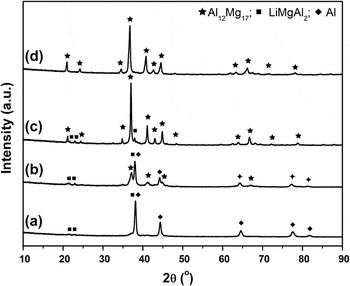
The XRD patterns of all the prepared alloys are shown in Fig. 1. The α-Al phase is observed for the alloys with 10–20% magnesium, and the intensity of the diffraction peaks decreases gradually as the Mg content increases. The main peaks of the γ phase (Al12Mg17) are observed when the concentration of Mg is higher than 10%. The peaks shifted toward the lower angle and become pronounced with increasing Mg. The LiMgAl2 phase existed in alloys with 30% Mg and less, that is, the main peaks of the LiMgAl2 phase could no longer be observed in Al0.55Mg0.4Li0.05 alloy. Moreover, no lithium contained phase could be observed in the Al0.55Mg0.4Li0.05 alloy. According to the Al–Mg–Li ternary phase diagram, Reference Gautam, Effenberg and Ilyenko28 Al12Mg17 could dissolve up to 20 at.% Li(≈6 wt%) and the lattice parameter of Al12Mg17 decreases with the addition of Li. Therefore, only Al12Mg17 is observed in Al0.55Mg0.4Li0.05 alloy.
XRD patterns of atomized Al–Mg–Li alloys with varying composition: (a) Al0.85Mg0.1Li0.05, (b) Al0.75Mg0.2Li0.05, (c) Al0.65Mg0.3Li0.05, and (d) Al0.55Mg0.4Li0.05.

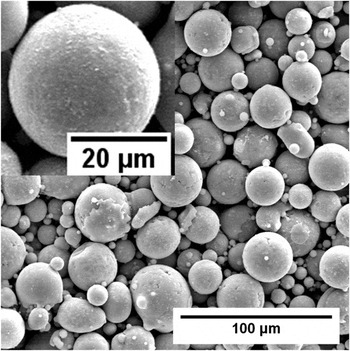
Morphology of the atomized alloy particles is shown in Fig. 2. The results indicate that smooth-faced microsphere particles with high sphericity were produced successfully by gas atomization.
Morphology of atomized alloy particles.

B. Thermal analysis
1. Oxidation in oxygen
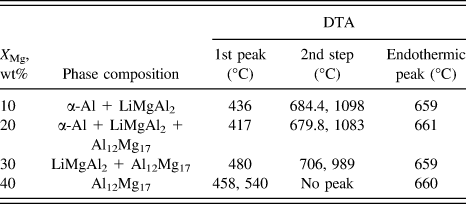
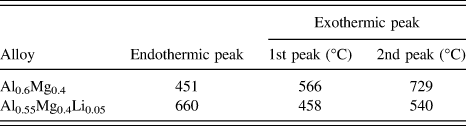
The thermal behavior of the alloys in oxygen was studied by TG/DTA. A summary of phase composition and the temperatures at which the DTA characteristics were observed for different samples is listed in Table I. The melting temperature of Al (660 °C) is used as the reference temperature. Presented for each alloy are the observed endothermic peak temperature, exothermic peak temperatures, and phase composition.
Summary of results from the XRD and DTA experiments.

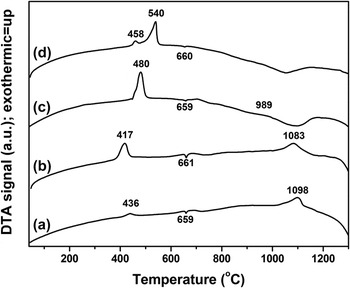
DTA traces of the alloys performed in O2 are shown in Fig. 3. The results indicate that the first exothermic peak on each DTA curve occurs at 417–480 °C. The endothermic effect at about 660 °C is due to the melting of the aluminum in the alloys and the intensity decreases as the magnesium content increases from 10 to 40%. The alloy with 40% Mg concentration shows no further exothermic peaks above 660 °C. While for the alloys with 30% Mg and less, a weak exothermic peak can be observed on the DTA curves right after 660 °C. As the temperature was increased, another exothermic peak occurs over a wide range of temperature (989–1098 °C). For Al0.55Mg0.4Li0.05 alloy, the second observed exothermic occurs at 540 °C.
DTA traces of Al–Mg–Li alloys with varying composition: (a) Al0.85Mg0.1Li0.05, (b) Al0.75Mg0.2Li0.05, (c) Al0.65Mg0.3Li0.05, and (d) Al0.55Mg0.4Li0.05.

Listed in Table II are the observed DTA characteristics of Al0.6Mg0.4 and Al0.55Mg0.4Li0.05 alloys. The results show that Al0.6Mg0.4 alloy begins to oxidize at 566 °C, while the first oxidation peak of Al0.55Mg0.4Li0.05 appears at 458 °C.
Summary of the DTA results of the atomized Al0.6Mg0.4 and Al0.6Mg0.4 Li0.05 alloys.

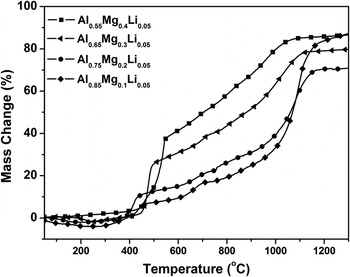
According to the TG traces shown in Fig. 4, the observed weight changes are consistent with the exothermic effects shown on the DTA curves shown in Fig. 3. The weight gains occur with an onset temperature of about 400 °C. For the alloys with Mg concentration ranging from 10 to 30%, a weak weight gain is observed at around 700 °C, consistent with the weak exothermic effects on the DTA curves. The weight of the alloys shows no further increase in the range of 1100–1300 °C.
TG curves of Al–Mg–Li alloys.

Al0.85Mg0.1Li0.05 alloy shows an exothermic peak at 436 °C. The phase composition of Al0.85Mg0.1Li0.05 alloy includes LiMgAl2 and α-Al, which implies that the exothermic effect is related to the oxidation of LiMgAl2. Similar peaks are also observed for the other samples, as shown in Fig. 3. For the alloys with magnesium concentration ranging from 10 to 30%, the intensity of the exothermic effects increases gradually with increasing Mg concentration. This might be caused by the oxidation of Al12Mg17 in alloys because Al12Mg17 was detected when Mg content is 20% and higher. To further validate this hypothesis, the intermediate oxidation products of Al0.85Mg0.1Li0.05 and Al0.75Mg0.2Li0.05 were investigated.
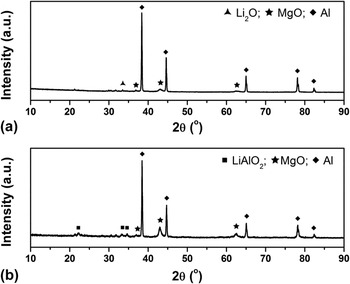
The XRD patterns of the intermediate oxidation products of Al0.85Mg0.1Li0.05 alloy and Al0.75Mg0.2Li0.05 alloy heated to 600 °C in oxygen are shown in Fig. 5. The results show that the intermediate product of Al0.85Mg0.1Li0.05 includes Li2O, MgO, and Al. Since the formed aluminum oxide is likely amorphous and forms a thin film, the diffraction peaks of Al2O3 and the small decrease in intensity of the peak of metallic Al are thus hard to detect. It is indicated that Li and Mg in LiMgAl2 have been oxidized selectively into Li2O and MgO, respectively, and Al is the main residual metallic phase. LiAlO2 is observed in the intermediate oxidation products of Al0.75Mg0.2Li0.05 besides MgO and Al. Neither Al12Mg17 nor any other Al–Mg intermediate phase is found in the oxidation products. This suggests that the Al12Mg17 contained in the Al0.75Mg0.2Li0.05 alloy is oxidized during the oxidation at 417 °C. The formed Li2O (because of the oxidation of LiMgAl2) and Al2O3 react further into LiAlO2 and release heat. This validates the increase of the intensity of the oxidation peak at 417–480 °C with increasing magnesium content from 10 to 30%.
XRD pattern of the intermediate oxidation products of the alloys at 600 °C: (a) Al0.85Mg0.1Li0.05 and (b) Al0.75Mg0.2Li0.05.

As shown in Fig. 4, Al0.55Mg0.4Li0.05 alloy exhibited no further weight gain at 1100 °C, whereas alloys with 30% Mg and less continued to oxidize at 1150 °C. It is concluded that the increase of Mg concentration is beneficial to the complete oxidation of the alloys. Thereby the oxidation products of Al0.55Mg0.4Li0.05 were studied.
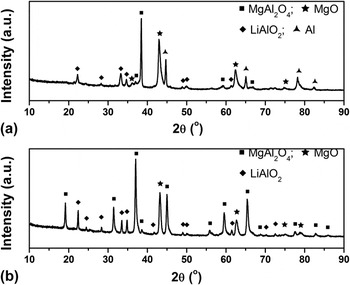
The XRD pattern of the intermediate product of Al0.55Mg0.4Li0.05 alloy shown in Fig. 6 indicates that the oxide phases include MgAl2O4, LiAlO2, and MgO, and Al is the main residual metallic phase at 600 °C. The observed Al is formed due to the selective oxidation of Li and Mg in Al12Mg17. Details are discussed below. The XRD pattern of the product of Al0.55Mg0.4Li0.05 alloy at 1100 °C shows that the product consists of MgAl2O4, MgO, and LiAlO2, and no intermediate phase is observed.
XRD patterns of the oxidation products of Al0.55Mg0.4Li0.05 at (a) 600 °C and (b) 1100 °C.

According to the above results, the low-temperature oxidation of Al0.55Mg0.4Li0.05 alloy is the most intense among all the researched alloys (Fig. 3). Al0.55Mg0.4Li0.05 alloy can be oxidized completely at 1100 °C (Fig. 6). A more centralized heat release and complete oxidation at lower temperature can be achieved by Al0.55Mg0.4Li0.05 as compared to the other alloys. To further study the oxidation process, morphology analysis and element constitution of the oxidation products of Al0.55Mg0.4Li0.05 were investigated.
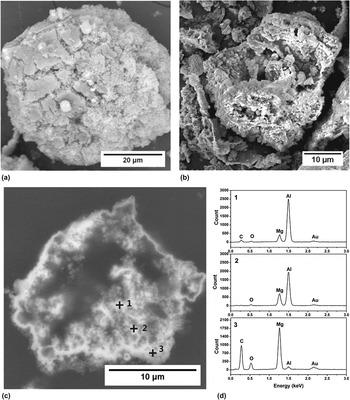
The porous structure can be observed on the particle surface at 600 °C [Fig. 7(a)] in favor of the diffusion of oxygen and could promote the oxidation of residual phase. The EDX analysis [Fig. 7(d)] suggests that Al is the major element inside the particle while Mg is the dominated element on the particle surface. The proportion of Mg increases with the decrease of the distance from the particle surface. The Li element, however, is not observed when performing EDX analysis, for lithium is too light to be detected. Carbon element is detected, resulting from the presence of resin as matrix during solidification. A cracked particle with hollow structure can be observed in the final oxidation product at 1100 °C [Fig. 7(b)].
SEM images of (a) the oxidation product of Al0.55Mg0.4Li0.05 at 600 °C, (b) the oxidation product of Al0.55Mg0.4Li0.05 at 1100 °C, (c) the cross section of oxidation product of Al0.55Mg0.4Li0.05 at 600 °C, and (d) EDXs obtained from the region labeled 1, 2, and 3 in (c), respectively.

2. Thermite reaction
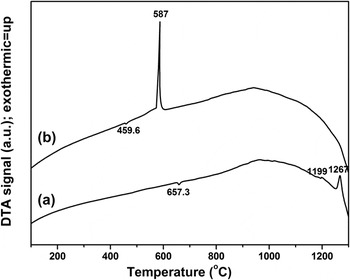
The DTA curves of the thermites were obtained by heating the Al–Fe2O3 and Al0.55Mg0.4Li0.05–Fe2O3 thermites in highly pure Ar atmosphere at 20 °C min−1 (Fig. 8). One endothermic peak at 657.3 °C and two exothermic reaction peaks at 1199 and 1267 °C are shown on the DTA curve of Al–Fe2O3 thermite. The endothermic reaction is due to the melting of the aluminum powder, and the two exothermic reaction peaks indicate the reactions between the aluminum and iron oxide. The result is consistent with the research reported previously. Reference Mei, Halldear, Sn and Xiao29 For Al0.55Mg0.4Li0.05–Fe2O3 thermite, however, only one endothermic peak and one exothermic reaction peak are observed on the DTA curve. The endothermic reaction peak at 459.6 °C is due to the melting of Al12Mg17 in the alloy. The violent exothermic reaction peak occurs at 587 °C, significantly lower than the reaction temperature of Al–Fe2O3 thermite. It is obvious that Li and Mg in the alloy promote the thermite reaction significantly and improved the intensity of thermite reaction.
DTA traces of samples obtained at a heating rate of 20 °C min−1: (a) Al–Fe2O3 and (b) Al0.55Mg0.4Li0.05–Fe2O3.

IV. DISCUSSION
The observed phase compositions of all the prepared alloys are consistent with what described in the Al–Mg–Li phase diagram. Reference Gautam, Effenberg and Ilyenko28 All the phases containing Mg and Li in the alloys exist in the form of stable intermediate compounds. According to the SEM image showed in Fig. 2, the atomized particles are spherical in shape and smooth-faced. Al–Mg–Li alloy powders were prepared successfully by gas atomizing process.
In all alloys, the temperature of the first oxidation peak is 417–480 °C. As is reported in literature, Reference Schoenitz and Dreizin8 two separated exothermic peaks occurred during the oxidation of Al0.7Mg0.3 at 561.8 and 971.3 °C, respectively. For Al0.65Mg0.3Li0.05 alloy in present research, the first oxidation peak appears at 480, 81.6 °C lower than the temperature of Al0.7Mg0.3, which indicates that the addition of Li is helpful in promoting the oxidation of Al–Mg–Li alloy.
For the alloys with less than 40% Mg, Al12Mg17 begins to appear in Al0.75Mg0.2Li0.05 and its content increases with increasing magnesium content. As shown in Fig. 5, the first exothermic peak on the DTA curves of Al0.75Mg0.2Li0.05 and Al0.65Mg0.3Li0.05 is due to the oxidation of LiMgAl2 and Al12Mg17 in the alloys, while the oxidation of LiMgAl2 leads to the first exothermic effect on the DTA curve of Al0.85Mg0.1Li0.05. Therefore, the intensity of the first exothermic peak increases with increasing magnesium content. Magnesium in the alloys is present in parts as dissolved in α-Al and as part of the Al12Mg17 alloy phase. Oxidation of the dissolved Mg is more thermodynamically favorable, and thus can occur at a lower temperature. However, a greater fraction of Mg becomes part of the alloy phase, as the total Mg concentration increases. Consequently, the temperature of the first exothermic peak rises as the magnesium content increases.
The selective oxidation of Mg and Li in Al-based and other Mg-containing or Li-containing alloys has been reported previously. Reference Partridge19,Reference Surla, Valdivieso, Pijolat, Soustelle and Prin30 Similar selective oxidation of Li and Mg is observed in the present experiments with all the samples tested. For Al0.55Mg0.4Li0.05 alloy, two consecutive exothermic peaks occur before 540 °C and no endothermic peak at about 450 °C (caused by the melting of Al12Mg17) exists on the DTA curve. Since Li diffuses faster than Mg and could react with oxygen in solid state, Reference Partridge19 the Li dissolved in the alloy diffuses to the surface of the alloy and starts to oxidize before the melting point of Al12Mg17. The heat that the Li–O2 reaction released was much more than the heat that the melting of Al12Mg17 needs. So, the endothermic effect which is supposed to be at about 450 °C was not observed and only the exothermic peak at 458 °C exists on the DTA curve.
An endothermic peak at about 660 °C occurs on the DTA curve of Al0.55Mg0.4Li0.05 alloy. It is indicated that Al was formed during the first oxidation step of the alloy, consistent with the result shown in Fig. 6(a). Magnesium could diffuse in Al–Mg alloys before 600 °C, Reference Lea and Molinari12 resulting in the segregation of magnesium on the surface of the alloy. According to the EDX analysis [Fig. 7(d)], little Mg can be observed inside the particle and there is a gradual increase of Mg concentration as the distance from the particle surface becomes shorter. The result shows that Mg diffused to the particle surface and the particle becomes Mg-depleted inside. Above 500 °C, Li and Mg can diffuse through surface oxide films on Al–Li alloys and Li could be oxidized before Mg, although the Li concentration is much lower than that of Mg. Reference Partridge19 It is reasonable to conclude that Li and Mg in the alloy diffuse to the surface and are oxidized preferentially before 600 °C, whereas Al remains as the residual metallic phase in the particle. According to the results in Table II and Fig. 6(a), the addition of Li promotes the low-temperature oxidation of the Al0.55Mg0.4Li0.05 alloy. The selective oxidation of the lithium dissolved in the alloy leads to the appearance of the first exothermic peak at 458 °C and the second peak at 540 °C is due to the oxidation of Al12Mg17 in Al0.55Mg0.4Li0.05.
The previous research relating to the aluminum–oxygen reaction showed that the oxidation occurs at the outer surface of the growing rigid oxide layer and thus is controlled by the outward diffusion of aluminum ions. Reference Zhang and Dreizin31 As shown in Fig. 7(a), the oxidation of Li and Mg leads to the formation of porous structure on the particle surface. Continuous removal of the residual Al in the oxidation process is, therefore, strongly favored. The XRD pattern of the oxidation product of Al0.55Mg0.4Li0.05 suggests that the alloy has been oxidized completely by 1100 °C [Fig. 6(b)], much lower than the temperatures of other Al–Mg–Li alloys and the reported 1400 °C for traditional Al powder. Reference Schoenitz, Patel, Agboh and Dreizin32 The same conclusion can be drawn from the TG curve (Fig. 4). This suggests that Li and Mg promote the complete oxidation of the particles.
For the samples with a magnesium concentration lower than 40%, there may be some Mg that is not oxidized at the temperature where the remainder of the metallic phase melts (the endothermic effect shown in Table I). When the remainder of the metallic phase melts, the Mg is therefore exposed to the oxygen and oxidized, resulting in the observed weak exothermic peak. The unoxidized Mg is not observed in the XRD patterns of the intermediate products due to the low concentration which failed to reach the measuring accuracy of the x-ray diffractor. With the increase of temperature, an exothermic peak is observed in the range of 989–1098 °C, consistent with the previously reported oxidation temperature of Al. Reference Zhang and Dreizin31 The endothermic peak at around 660 °C indicates the existence of residual Al. So, it is obvious that the oxidation of residual Al in the alloys results in the exothermic effect.
The thermite reactions between the aluminum and iron oxide in the present research were at 1199 and 1267 °C, respectively, higher than the reported values of Al–Fe2O3 thermite with a mean particle size of 20 μm. Reference Mei, Halldear, Sn and Xiao29 This is because the powders in this research are with larger particle size. One endothermic peak and one exothermic reaction peak are shown on the DTA curve of Al0.55Mg0.4Li0.05–Fe2O3 thermite. It is indicated that Al12Mg17 melts at 459.6 °C, resulting in the endothermic peak on the curve. The melting Al12Mg17 reacts with Fe2O3 at 587 °C, accompanied by intense heat release. No endothermic peak is observed at about 660 °C, indicating the Al0.55Mg0.4Li0.05 alloy has reacted with Fe2O3 completely during the oxidation. In conclusion, the addition of Li and Mg could make the reaction of thermite shift to lower temperature and heat release more intense.
According to the thermal behavior of the alloys in oxygen and used in thermite, it is concluded that magnesium and lithium improve the reactivity of the alloys. Particularly, the Al0.55Mg0.4Li0.05 alloy is with the advantages including low-temperature reaction and complete oxidation at lower temperature.
V. CONCLUSIONS
-
(1) Preparation of Al–Mg–Li alloyed powders is feasible by close-coupled inert gas atomization. Electron microscopy and XRD patterns showed that the spherical particles of Al–Mg–Li with a homogeneous and stable phase composition were consistent with the previously published phase diagram.
-
(2) Lithium and magnesium promote the initial oxidation of the alloys and accelerate the complete oxidation of the alloy. The selective oxidation of Li and Mg results in their depletion in the alloy. The porous structure formed during the selective oxidation process is favored to the diffusion of oxygen and residual aluminum; therefore, the oxidation of the alloy was accelerated. A complete oxidation at lower temperature was achieved by Al0.55Mg0.4Li0.05 as compared to the other alloys.
-
(3) The thermite reaction experiment of the Al0.55Mg0.4Li0.05–Fe2O3 system conducted in Ar showed a reaction temperature of 587 °C, which is significantly lower than the reaction temperature observed for Al–Fe2O3 system which reacts at 1199 °C.
ACKNOWLEDGMENTS
The authors gratefully acknowledge the financial support by the Self-determined and Innovative Research Funds of HUST (2013QN058) and the Open Project of the State Key Laboratory of Digital Manufacturing and Equipment Technology (DMETKF2013009).