


1. Introduction
At least since van Heijenoort’s seminal paper (Van Heijenoort Reference Van Heijenoort1967), it has become standard amongst interpreters to argue that Frege’s conception of logic is completely at odds with the contemporary one. According to the contemporary (schematic) conception, so the story goes, the subject-matter of logic is the (logical) forms of sentences and arguments; according to Frege’s conception, on the other hand, the subject matter of logic is reality’s most general features. In section 2 I briefly present the contemporary conception of logic, and in section 3 I present ‘the standard interpretation’, according to which Frege rejects the view that logic is formal: while on the schematic conception logic is formal because it is devoid of content, and only attends to the form of sentences and arguments, on Frege’s view logic has a maximally general content.
In section 4 I argue that the early Frege endorsed, rather than rejected, the view that logic is formal. On Frege’s view, the task of logic (and thus of Frege's own BegriffsschriftFootnote 1) is to provide the logical or formal scaffolding that interrelates the propositions used in particular sciences, and to provide a reliable method for testing the validity of inferences within each of the particular sciences. If I am right, then the standard interpretation of Frege’s (early) conception of logic is mistaken, and Frege’s view of logic – at and around the time of publication of Begriffsschrift – is far less distant from the schematic conception of logic, and hence from the idea that logic is formal, than scholars have traditionally assumed.
In section 5 I argue that my reading of the early Frege makes good sense (unlike the standard interpretation) of Frege’s idea that logic can be applied to particular sciences. Logic provides the formal scaffolding that combines with the contentful propositions of different sciences, namely concepts and inferential modes of expression allowing to express the truths of particular sciences perspicuously; secondly, I address Frege’s claim that Begriffsschrift is a lingua, and not a mere calculus – a claim that my reading of Begriffsschrift as formal seems, prima facie, unable to accommodate. By paying close attention to the context in which Frege describes Begriffsschrift as a language, I argue that this is not the case. Finally, in the concluding section 6, I quickly discuss the relations between the formal understanding of logic I attribute to Frege in his Begriffsschrift and his later logical views.
2. The schematic conception of logic
In this section, following Warren Goldfarb’s influential paper (Goldfarb Reference Goldfarb, Floyd and Shieh2001), I offer a brief overview of the contemporary (schematic) conception of logic, and highlight three tenets about the nature of logic that are embedded in it.
As Goldfarb says, according to the schematic conception
the subject matter of logic consists of logical properties of sentences and logical relations among sentences. Sentences have such properties and bear such relations to each other by dint of their having the logical forms they do. Hence, logical properties and relations are defined by way of the logical forms; logic deals with what is common to and can be abstracted from different sentences. (Goldfarb Reference Goldfarb, Floyd and Shieh2001, 26)
Logical forms are schemata, namely representations of the structures of sentences, obtained by the use of logical signs (quantifiers and sentential connectives) and schematic letters (sentence and predicate letters). The propositional schema ‘p ∧ ¬q’ expresses what is common to – and what can be abstracted from – sentences like ‘Edinburgh is in Scotland but Liverpool is not’, ‘Toronto is in Canada and not in the US, ‘wolves, but not crocodiles, are mammals’, and so forth. The schema can thus be interpreted, by replacing its schematic letters with actual sentences; a quantificational schema like (∀x)(∀y) [(Px → Qx) ∧ (Fy → ¬Qy)], on the other hand, becomes a statement once it is interpreted by substituting actual (one-place) predicates for schematic predicate letters ‘P’, ‘Q’, ‘F’. When schemata are interpreted they become statements with a truth value. Conversely, actual sentences can be schematized, by replacing their sentential components by sentence-letters or their sub-sentential predicate components by schematic predicate letters.
The above is important for how the schematic conception characterizes central logical notions such as those of ‘entailment’, ‘validity’, and ‘logical truth’. The notion of entailment (or logical consequence) is understood on the schematic conception of logic as follows: a schema entails another (or the second is a logical consequence of the first) ‘if and only if every interpretation that makes the first true also makes the second true’ (Goldfarb Reference Goldfarb, Floyd and Shieh2001, 26). Likewise, the notion of validity applies directly to schemata: ‘a schema is valid if and only if it is true under every interpretation’ (26). Moreover, the schematic conception sharply distinguishes logical laws from logical truths, the former being schemata, that can be interpreted, whereas the latter are sentences, that can be schematized by valid schemata (see Goldfarb Reference Goldfarb, Floyd and Shieh2001, 27).
Three (related) tenets are part and parcel of the schematic conception of logic. Firstly, the schematic conception takes the subject matter of logic to be the logical properties of sentences (and arguments), thus its laws are not statements but schemata, representing the form of sentences (and arguments). Secondly, the schematic conception distinguishes between two kinds of vocabulary. As Dutilh Novaes has observed:
The backbone of the schematic […] [conception] is […] the partition of the vocabulary into two kinds: those that are to be held fixed and those that are to be regarded as replaceable. A schema is precisely a construction with ‘gaps’ along with specifications of how these gaps can be filled in by various different objects […]. Once this partition is undertaken, it becomes quite natural to view the terms that remain fixed as constitutive of the form of a sentence/argument, while those that are to be replaced would correspond to its matter. (Dutilh Novaes Reference Dutilh Novaes2011; 310; See also Textor Reference Textor2011; 45)
The logical (or formal) vocabulary is constituted by expressions that contribute to represent the logical forms of sentences (such as sentential connectives) while the non-logical (or material) vocabulary expresses the contentful part of statements (what they are ‘about’). Schemata only contain the former (and schematic letters as dummies or gaps for the latter) and as such they do not say anything, while actual sentences contain both (and thus convey factual information about a particular subject-matter). As Goldfarb writes, ‘[l]ogic deals with logical forms, which schematize away the particular subject matter of sentences. Thus logic is tied to no particular subject matter because it deals with these “empty” forms rather than with particular contents’ (Reference Goldfarb, Floyd and Shieh2001, 27). The second tenet of the schematic conception of logic is thus the idea that logic is only concerned with the form – and not with the content – of sentences and arguments.
The two tenets above relate to the view that logic is – under the schematic conception – not a science alongside others. Particular sciences (like physics or chemistry) all have specialized subject matters and thus employ specific concepts and are about specific objects; they are thus contentful and, as it were, ‘about the world’. Logic, on the other hand, is not about features of reality, but about logical forms, and thus only attends to the form of sentences and their logical relations and is devoid of a content of its own.
To sum up: the three tenets of the schematic conception of logic I have identified are:
(1) Logical laws are (empty) schemata, not substantive truths.
(2) Logic only attends to the form, and not the content, of sentences and arguments.
(3) Logic is not a science alongside others.
3. The standard interpretation and Frege’s universalism
What I have called ‘the standard interpretation’ is the (widespread) view that the ‘schematic conception is foreign to Frege’ (Goldfarb Reference Goldfarb, Floyd and Shieh2001, 27), because he held logic to be a substantive (contentful) science, indeed the most general science, thus rejecting the view that logic is essentially formal. I take as exponents of the standard interpretation authors who attribute to Frege the rejection of the three tenets that we saw are part of the schematic conception of logic.
The following are attributions to Frege of a rejection of tenet 1 of the schematic conception of logic, namely the view that logical laws are schemata:
For Frege […] the propositions of logic […] are no schematic placeholders which may be assigned one value or another. Every logical formula has a fixed meaning; there is no question of reinterpreting any sign. (Goldfarb Reference Goldfarb1979, 352)
For Frege […] the generality of logic is substantive, not schematic. (Ricketts Reference Ricketts, Haaparanta and Hintikka1986, 76)
[Frege] held logic to be […] a science. Its principles are thus not schemata, but fully interpreted, genuine truths. His logical symbolism, the concept-script in which those principles are formulated, is therefore a genuine language. (Sullivan Reference Sullivan, Gabbay and Woods2004, 680)
Sentential expressions of the Begriffsschrift are not empty schemas […] for there are no schematic letters in the Begriffsschrift. [They] are not empty formulas but full-blown sentences […] capable of expressing content […]. (Korte Reference Korte2010, 288–290)
The following are claims that Frege rejected tenet 2, with its distinction between a logical (formal) vocabulary and a non-logical (contentful) one, and thus with its characterization of logic as having to do with the form and not the subject-matter of sentences and arguments:
[T]he laws of logic [are not] distinguished from other laws by containing some specialized or proprietary vocabulary that segregates its subject matter from that of other sciences […]. Rather, what distinguishes logic from other sciences is the fact that its laws are in no significant way restricted with respect to subject matter. (Taschek Reference Taschek2008, 380–381)
[Frege has] no reason to distinguish logical from non-logical vocabulary. (Blanchette Reference Blanchette and Link2014, 109)
Where Frege differed from some neo-Kantians, Kant himself, and many others since, was in rejecting the understanding of logic as comprising purely formal principles, devoid of content and subject-matter. (Klement Reference Klement and Moyar2010, 870)
[L]ogic, according to Frege, is not ‘formal’ in any sense that would oppose form to content: The sentences of Begriffsschrift are not mere forms. (Heck and May Reference Heck and May2011, 126)
Finally, the following are attributions to Frege of the view (which involves a rejection of tenet 3) that logic is a science alongside others, simply more general than any other:
For Frege “logic is a branch of positive science. Logic differs most significantly from the other sciences […] in this respect: it is the maximally general science. (Conant Reference Conant1991, 139)
On Frege’s view “logical laws are maximally general truths, substantive generalizations that are ‘about reality’ in the same fashion that the laws of geometry, physics, chemistry are”. (Ricketts Reference Ricketts1996a, 123)
Frege characterizes the theorems of logic […] simply as the ‘most general laws’: whereas the special sciences represent the facts concerning some particular domain of reality […] logic represents the most general and abstract facts, ones which hold for all objects and concepts whatsoever. (Kemp Reference Kemp1998, 221–222)
Frege’s rejection of the three tenets of the schematic conception of logic amounts to his ‘universalism’ about logic; according to the standard interpretation, Frege denies that the laws of logic are empty schemata and thinks of them as substantive truths, in the same sort of relation to the world as the laws of the special sciences. Logic is thus not intrinsically different from particular sciences, according to the standard interpretation of Frege, it is simply more general than any of them, so general that it can be said to encompass everything. Logical laws are therefore laws which hold for anything whatsoever.Footnote 2
In the next section I present extensive evidence from Frege’s texts that undermines the standard interpretation of Frege’s early conception of logic. If I am right, then Frege’s conception of logic – at and around the time of publication of his Begriffsschrift – is far less distant from the schematic conception than scholars belonging to the standard interpretation have traditionally assumed.Footnote 3
4. Formality of logic and Frege’s Begriffsschrift
As is well known, the critical reception of Frege’s Begriffsschrift (Frege Reference Frege and Bynum1879) was largely negative. Frege was particularly disappointed by Ernst Schröder’s review, which – in the words of Frege himself – ‘in comparing my “conceptual notation” with the Boolean formula language, […] reaches the conclusion that the latter is preferable in every respect’ (Frege Reference Frege and Bynum1882–3, 90). In order to correct that misguided conclusion about his concept-script, Frege wrote in the years 1880–1883 several papers which discuss in depth (and great clarity) the differences between his concept-script and Boole’s, thus providing valuable insights into the nature of his Begriffsschrift and its aims.Footnote 4 In this section of my paper I argue that what Frege says in these texts (and in Begriffsschrift itself) contradicts the standard interpretation.
Frege highlights the differences between Boole’s concept-script and his own Begriffsschrift thus:
In contrast [with Boole] we might now set out the aim of my concept-script. Right from the start I had in mind the expression of a content. What I am striving after is a lingua characterica in the first instance for mathematics not a calculus restricted to pure logic. But the content is to be rendered more exactly than is done by verbal language. (Frege Reference Frege, Hermes, Kambartel, Kaulbach, Long and White1979a, 12)
I did not wish to present an abstract logic in formulas, but to express a content through written symbols in a more precise and perspicuous way than is possible with words. In fact, I wished to produce, not a mere calculus ratiocinator, but a lingua characteristica in the Leibizian sense. (Frege Reference Frege and Bynum1882–3, 91)
Frege’s Begriffsschrift is meant to be ‘a system of symbols from which every ambiguity is banned, which has a strict logical form from which the content cannot escape’ (Frege Reference Frege and Bynum1882, 86), Footnote 5 namely a lingua characteristica; Boole’s concept-script, on the other hand, in its being merely ‘a technique for resolving logical problems systematically […] [in which] there is no concern for content whatsoever’ (Frege Reference Frege, Hermes, Kambartel, Kaulbach, Long and White1979a, 12), is simply a calculus ratiocinator.
Frege’s preoccupation in Begriffsschrift with the expression of content has been thought by many interpreters subscribing to the standard interpretation to be evidence for his universalism.Footnote 6 If Frege’s Begriffsschrift is a proper (logically regimented) language that aims at expressing content unambiguously, then its formulae must be contentful.Footnote 7 Thus, Frege must oppose tenets 1 and 2 of the schematic conception of logic, according to which logical laws (schemata) are only concerned with the form (and not the content) of statements and arguments.
In my view this conclusion is mistaken. What Frege means by saying that his Begriffsschrift is a tool for expressing content is not that it comprises contentful (maximally general) formulae, but that those formulae are suited to be combined with a content (unlike Boole’s formulae). Øystein Linnebo has expressed this point clearly:
Some interpreters have taken Frege’s distinction between a calculus and a language as evidence that Frege regarded logical truths as contentful. But […] what Frege had in mind wasn’t this strong claim that the purely logical part of the Begriffsschrift has content all by itself, but the weaker claim that this language allows content to be expressed when contentful signs […] are added to it. (Linnebo Reference Linnebo2003, 240)Footnote 8
There is significant evidence in Frege’s texts for this interpretation of his remarks about Begriffsschrift’s concern with expressing content. For instance, Frege says that a ‘true conceptual notation’ (and, no doubt, he thinks that his Begriffsschrift is one) must meet the following requirement:
It must have simple modes of expression for the logical relations which, limited to the necessary, can be easily and surely mastered. These forms must be suitable for combining most intimately with a content. (Frege Reference Frege and Bynum1882, 88, my emphasis)
Frege also says that his aim in Begriffsschrift is ‘devising signs for logical relations that are suitable for incorporation into the formula-language of mathematics’ (Reference Frege, Hermes, Kambartel, Kaulbach, Long and White1979a, 14, my emphasis). And also,
My concept-script […] strives to make it possible to present a content when combined with arithmetical and geometrical signs. (Frege Reference Frege, Hermes, Kambartel, Kaulbach, Long and White1979a; 46, my emphasis; see also, Reference Frege, Hermes, Kambartel, Kaulbach, Long and White1979b; 47)
This suggests that Frege’s Begriffsschrift provides symbols for the ‘logical relations’, or ‘logical forms’, which are to be combined with – but do not on their own express – a content. Presumably, then, the content is to be supplied by other symbols. In § 1 of Begriffsschrift Frege says:
I adopt this fundamental idea of distinguishing two kinds of symbols […]. I […] divide all the symbols I employ into those which one can take to signify various things and those which have a completely fixed sense. (Frege Reference Frege and Bynum1879, 110)
The ‘symbols that have a completely fixed sense’ are the logical signs – the core of the vocabulary of Begriffsschrift – whereas the ‘symbols that signify various things’ are letters (of which Frege uses a variety, e.g. capital Greek letters, italic letters, German letters, etc.); these, says Frege, give “the content of the judgement (Reference Frege and Bynum1879, 111, my emphasis), and ‘serve mainly for the expression of generality’ (Reference Frege and Bynum1879, 110). Among the former symbols we find the judgement stroke (Reference Frege and Bynum1879, 111).Footnote 9

which is placed to the left of the symbols ‘signifying various things’. Other logical symbols include symbols for the material conditional – the conditional stroke (Reference Frege and Bynum1879, 114–115):

and for negation, the negation stroke (Reference Frege and Bynum1879, 120):

Symbols are also introduced for generality (Reference Frege and Bynum1879, 130–131), namely for the universal quantifier,

while the symbol for the existential quantifier is obtained by combining the symbol for the universal quantifier and that for negation (Reference Frege and Bynum1879, 134):

As Frege says, the logical symbols ‘must be suitable for combining with a content’. Given his claim that content is indicated by letters, logical symbols must be combined with letter symbols. And this is exactly what we find in Begriffsschrift: the form of a logically simple judgement is as follows:

The form of a conditional judgement (equivalent to ‘B → A’ in modern notation) is as follows:

The following is the form of a judgement that combines the conditional and the negation strokes (see Frege Reference Frege and Bynum1879, 120) (equivalent to  , in modern notation):

Through the combination of logical symbols and letter symbols, more complex forms of judgement are obtained, as well as forms of judgement representing other sentential connectives. Frege explains the difference (and interaction) between logical symbols and letter symbols by saying that ‘every highly developed language must consist [of two components]. That is, we may distinguish the formal part which in verbal language comprises endings, prefixes, suffixes and auxiliary words, from the material part proper’ (Reference Frege, Hermes, Kambartel, Kaulbach, Long and White1979a, 13, my emphasis), implying that what corresponds to the former is ‘the logical cement that will bind these building stones firmly together’ (ibid.).
Interestingly, Frege discusses his symbols by resorting to the formal/material dichotomy: the letters are indication of content while the logical symbols bind the content (or contents) together according to a specific logical relation (logical form). We saw in section 2 that the distinction between formal and material vocabulary is central to the schematic conception of logic: for a schema is precisely a formula which employs symbols for logical relations (the formal part of the vocabulary) and with gaps – represented by schematic letters – which indeterminately indicate content. Once schematic letters are replaced by syntactic items of the appropriate kind (which belong to the material part of a language), it becomes a statement. If this is correct, then, contra the standard interpretation, in Begriffsschrift Frege does not at all reject tenet 2 of the schematic conception, with its distinction between a logical/formal and material vocabulary – and its view that logic deals with form and not content – but rather endorses it.
Consistently with the above, Frege provides a schematic explanation of his letter symbols; the standard interpretation denies this, claiming that Frege does not conceive of his formulae as containing gaps for which sentences can be substituted (formulae that allow for interpretation) but rather that he understands them as universally quantified statements. Now, this reading is contradicted by Frege’s statement that one ‘must think of whole formulas in the places of A and B’ (Reference Frege and Bynum1882–3, 97), or ‘imagine[…] replacing the single letters with whole formulas’ (Frege Reference Frege and Bynum1882–3, 98). And this is exactly how Frege explains his formulae: for instance, when explaining the relation between the judgement and the content strokes he says: “For example, let  mean the judgement: ‘Opposite magnetic poles attract each other’ (Reference Frege and Bynum1879, 111–112), commenting in a footnote at just this point: ‘I use capital Greek letters [in this case capital alpha] as abbreviations to which the reader may attribute an appropriate sense if I do not specifically define them’ (Reference Frege and Bynum1879, 112, my emphasis). This is exactly why letters might be taken ‘to signify various things’, for they do not express a determinate content but are placeholders for which content might be replaced at will (Frege’s ‘opposite magnetic poles attract each other’ is simply one of the infinitely many ‘appropriate senses’ that can be attributed to the letter A).Footnote 10 The same happens later in Begriffsschrift (§ 5), when Frege explains ‘conditionality’ as follows: ‘If A and B stand for assertible contents’ (Reference Frege and Bynum1879, 114) then the symbol
 means that the possibility that ‘A is denied and B is affirmed’ does not occur (see Frege Reference Frege and Bynum1879, 114–115). Frege explicitly reinterprets his letter symbols, by saying things like: ‘let A stand for [the circumstance] that 3 × 7 = 21’ (Reference Frege and Bynum1879, 115), ‘let B stand for the circumstance that the sun is shining’, ‘let A stand for the circumstance that perpetual motion is possible’, ‘let B stand for the circumstance that the universe is infinite’, ‘let B stand for the circumstance that the moon is in quadrature [with the sun] and A the circumstance that it appears as a semicircle’ (Reference Frege and Bynum1879, 115) and so forth. It is thus clear that in the first part of Begriffsschrift letters are used schematically.
In the second part of Begriffsschrift Frege deals with more complex formulae, particularly with ‘a small number of laws’, which ‘potentially imply all the others’ (CN: 136). These are the axioms of Frege’s system, from which all other logical laws can be derived. The first axiom (see Frege Reference Frege and Bynum1879, 137, § 14) reads as follows:

Here (and in axioms 2–6)Footnote 11 Frege no longer uses capital Greek letters as indeterminate symbols of assertible contents, but italic letters. According to Terrell Bynum, followed in this by many commentators, Frege ‘employs italic letters to express a generality when the scope of generality (universal quantifier) is the whole of an asserted formula’ (Frege Reference Frege and Bynum1879, 69); so, formulae with italic letters are quantified formulae. Similarly, according to Goldfarb, ‘the letters that may figure in logical formulas, for example, in “(p&q → p)” are not schematic: they are not sentence letters […] and hence […] the formula is to be understood […] as the universally quantified statement “(∀p)(∀q)(p&q → p)” […] [which] states a law, we might say, about all objects’.Footnote 12 Frege’s explanation of his own axiom, however, contradicts the reading that italic letters are bound variables, and thus that his formulae are quantified statements. Here is how Frege reads his first axiom:
We can also express the judgement in words this way: ‘If a proposition a holds, it holds also in case an arbitrary proposition b holds’. For example, let a stand for the proposition that the sum of the angles of the triangle ABC is two right angles and b stand for the proposition the angle ABC is a right angle. Then we obtain the judgement: ‘If the sum of the angles of the triangle ABC is two right angles, this holds also for the case in which the angle ABC is a right angle’. (Frege Reference Frege and Bynum1879, 137)
Again, not dissimilarly from the case of capital Greek letters, italic letters seem to represent indeterminate assertible contents, and as such seem to be liable to be interpreted at will, by substituting them with suitable sentences in order to obtain particular judgements. Similar (and plentiful) examples occur later in Begriffsschrift, where Frege interprets his italic letters (a, b, c, d) by actual sentences, always beginning by saying ‘let a mean…, let b mean…, let c mean…’.Footnote 13 Thus, even italic letters are symbols that ‘one can take to signify various things’, (propositions or sentences), and are as such understood essentially schematically.Footnote 14 If so, then, Frege’s understanding of the difference between his letter-symbols has been overestimated by proponents of the standard interpretation.Footnote 15
In §§ 9–10 of Begriffsschrift Frege provides a syntactic characterization of function and argument: He says: ‘If, in an expression […], a […] symbol occurs in one or more places and we imagine it as replaceable by another […] at all or some of the places then we call the part of the expression that shows itself invariant [under such replacement] a function and the replaceable part its argument’ (Reference Frege and Bynum1879, 127). He then defines the following function-argument expression  as ‘A has the property Φ’, and
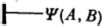 as ‘B stands in the Ψ-relation to A’. Here, again, the predicate letter symbols are understood essentially schematically, not unlike how the schematic conception characterizes predicate letters, namely as being liable to be interpreted by substituting them with actual predicates of the appropriate kind, which is what Frege does when, in § 22 for example, he provides an instance of one of his quantified formulae (formula 59) by interpreting the function-argument schematic expressions ‘g(A)’ and ‘f(A)’ as, respectively, ‘A is a bird’ and ‘A can fly’.Footnote 16
Now, does the above imply that the formulae of Frege’s Begriffsschrift are schemata, insofar as they contain symbols with fixed meanings (for logical relations) and symbols for the expression of indeterminate content (schematic letters), contrary to the standard interpretation? It should be noted that Ernst Schröder, in his hostile review of Frege’s Begriffsschrift, interprets them in just this way.Footnote 17 Given Frege’s efforts to defend his conceptual-notation from what he regarded as deep misunderstandings of it on Schröder’s part (efforts resulted in the papers mentioned in footnote 13 above), if he did not conceive of them that way, he would have certainly pointed it out. But he did not. Quite the contrary, he explicitly says that ‘[t]hese formulas [of my “conceptual notation”] are actually only empty schemata’ (Frege Reference Frege and Bynum1882–3, 97), in which one should ‘imagine[…] replacing the single letters with whole formulas’ (ibid., 98). If this claim of Frege’s is to be taken at face value, and I do not see why it shouldn’t, Footnote 18 then tenets 1 and 2 of the schematic conception of logic are actually endorsed by Frege in Begriffsschrift, and not – as the standard interpretation claims – rejected.
Frege’s universalism about logic is by the standard interpretation often directly linked to his alleged rejection of tenet 3 of the schematic conception; Frege allegedly thinks that logic is not in principle different from other sciences – like the latter it is ‘directed at the real world’ – but is simply the most general science.
On the universalist conception […] logic is […] a science in its own right, one that is directed at reality in the same way that physics is, but at reality’s most general features. (Ricketts Reference Ricketts, Sluga and Stern1996b, 60).Footnote 19
So, given that ‘all sciences have truth as their goal’ (Frege Reference Frege, McGuinness and Black1918–9, 351), logic would have the goal of establishing maximally general laws, namely maximally general truths. As such, however, logic would be distinguished from other sciences simply by its maximum generality. While specific sciences express truths about objects and relations pertaining to particular domains, logic expresses truths about all objects and all relations, its domain is by no means restricted, it simply is the universe, and thus contains whatever there is.
Besides relying on the mistaken interpretation that Begriffsschrift’s formulae are contentful, universally quantified statements generalizing over everything, the attribution to Frege of the view that logic comprises maximally general truths relies on Frege’s statement that ‘[l]ogic is the science of the most general laws of truth’ (Reference Frege, Hermes, Kambartel, Kaulbach, Long and White1979c, 128; see also, Reference Frege, Ebert, Rossberg and Wright1893–1903, xv). Notice the identification here between ‘the most general laws of truth’ and ‘maximally general truths’, which amounts to a non-sequitur.Footnote 20 Indeed, Frege seems more often than not concerned with distinguishing logic from other sciences rather than doing the opposite; for instance, he says that ‘there is a sharp divide’ (Reference Frege, Hermes, Kambartel, Kaulbach, Long and White1979c, 3) between logic and the natural sciences; while the latter are concerned with truth simply because they aim to ‘extend the domain of truths’, logic aims to ‘study the property “true”’, so that its laws ‘are nothing other than an unfolding of the content of the word “true”’ (ibid.). There is a clear denial, here, of the idea that logic and other sciences are on a par, simply distinguished by different degrees of generality.
In the Foundations of Arithmetic Frege is even more explicit; there he says that the laws of logic ‘are not really applicable to external things; they are not laws of nature. They are applicable to judgements holding good of things in the external world: they are laws of laws of nature. They assert not connexions between phenomena, but connexions between judgements, and among judgements are included the laws of nature’ (Reference Frege and Austin1884, 99).Footnote 21 This suggests that Frege understands the generality of logic differently from how the standard interpretation interprets him as doing; rather than seeing logic as the most general science, directed at the most abstract and general features of reality, he sees it as having essentially to do with judging and inferring.Footnote 22 And this in turn coheres with his view of logic as a normative science, providing prescriptions for thinking regardless of its particular subject-matter:
[W]e do not demand of […][logic] that it should go into what is peculiar to each branch of knowledge and its subject-matter. On the contrary, the task we assign to logic is only that of saying what holds with the utmost generality for all thinking, whatever its subject-matter. (Frege Reference Frege, Hermes, Kambartel, Kaulbach, Long and White1979c, 128)
If the reading developed here is correct, then Frege’s Begriffsschrift’s understanding of the nature and role of logic is far less distant from the schematic conception of logic than the standard interpretation claims. Rather than seeing logic as fundamentally on a par with other sciences, Frege characterizes it as providing the ‘formal element’ (Reference Frege, Hermes, Kambartel, Kaulbach, Long and White1979a, 13), the ‘logical cement’ (ibid.) or the ‘framework’ (Reference Frege and Bynum1882, 89) – through symbols for logical relations – that ties together the contents of possible judgements, regardless of their subject-matter, and thus also as providing norms for judging and inferring in all areas of thinking; after all, the ‘logical relations occur everywhere’ (ibid.).Footnote 23
In the next section of this paper I argue that my interpretation of the early Frege’s conception of logic makes good sense of what he says about the application of his Begriffsschrift, and it provides a reading of Frege’s claims that Begriffsschrift is not simply a calculus but a lingua that is free from the problems affecting the standard interpretation.
5. The application of Begriffsschrift and its status as a ‘lingua characteristica’
In the Preface to Begriffsschrift Frege says that the chief purpose of his concept-script is ‘to test in the most reliable manner the validity of a chain of inference’ (Reference Frege and Bynum1879, 104); hence Begriffsschrift is concerned with proof, particularly with the proof of judgements of arithmetic (see Frege Reference Frege and Bynum1879, 103), and arithmetic is therefore the primary domain to which Begriffsschrift can be applied. How Begriffsschrift applies to arithmetic is explained by Frege as follows: ‘I wish to blend together the few symbols which I introduce and the symbols already available in mathematics to form a single formula language. In it the existing symbols [of mathematics] correspond to the word-stems of [ordinary] language; while the symbols I add are comparable to the suffixes and [deductive] formwords that logically interrelate the contents embedded in the stems’ (Frege Reference Frege and Bynum1882–3, 93). This implies that the ‘single formula language’ results from the amalgamation of the symbols of arithmetic that express (arithmetical) content, and the symbols for logical relations, which ‘supplement the signs of mathematics with a formal element’ (Frege Reference Frege, Hermes, Kambartel, Kaulbach, Long and White1979a, 13). His task in Begriffsschrift is thus that ‘of devising signs for logical relations that are suitable for incorporation into the formula-language of mathematics’ (14). As Frege also puts it:
Arithmetic […] was the starting point of the train of thought which led me to my ‘conceptual notation’. I intend, therefore, to apply it to this science first, trying to analyse its concepts further and provide a deeper foundation for its theorems. (Frege Reference Frege and Bynum1879, 107)
I have attempted to supplement the formula language of arithmetic with symbols for the logical relations in order to produce – at first just for arithmetic – a conceptual notation […]. (Frege Reference Frege and Bynum1882, 89)
[The] formulas [of my ‘conceptual notation’] are actually only empty schemata; and in their application, one must think of whole formulas in the places of A and B, – perhaps extended equations, congruences, projections. (Frege Reference Frege and Bynum1882–3, 97)Footnote 24
Frege is very clear, however, that his Begriffsschrift is not only limited to the field of arithmetic but can have wider applications: ‘I am sure that my “conceptual notation” can be successfully applied wherever a special value must be placed upon the validity of proofs’ (Reference Frege and Bynum1879, 106). What we said above about the formal nature of Begriffsschrift makes it clear how further applications of it to other domains can be carried out; Begriffsschrift represents a logical – formal – skeleton or framework that can be applied to what is peculiar to different domains, their content proper (namely particular concepts, objects and relations). Although specifically designed to be applied to arithmetic, says Frege:
This does not rule out the application of my symbols to other fields. The logical relations occur everywhere, and the symbols for particular contents can be so chosen that they fit the framework of the conceptual notation. Be that as it may, a perspicuous representation of the forms of thought has, in any case, significance extending beyond mathematics. (Frege Reference Frege and Bynum1882, 89)
And this, in my view, makes good sense of what Frege says about Begriffsschrift’s providing a ‘new domain’ to the particular sciences, ‘indeed, the one situated in the middle adjoining all the others’ (Reference Frege and Bynum1879, 105). Here is the passage:
We can view the symbols of arithmetic, geometry, and chemistry as realizations of the Leibnizian idea in particular areas. The ‘conceptual notation’ offered here adds a new domain to these; indeed, the one situated in the middle adjoining all the others. Thus, from this starting point […] we can begin to fill in the gaps in the existing formula languages, connect their hitherto separate domains to the province of a single formula language and extend it to fields which up to now have lacked such a language. (Frege Reference Frege and Bynum1879, 105–106)
Thus, Begriffsschrift should be seen as providing the formal element that gives expression to logical relations, and thus that can be relied upon in testing the validity of inferences; as such, it is applicable to all sciences, insofar as the logical relations are part of the logical framework which is shared by all of them.Footnote 25
The view of Begriffsschrift as a contentful – maximally general – language, and thus of logic as a science on a par with others, simply more general (integral to the standard interpretation) is hard to reconcile with Frege’s idea that logic provides a domain that is situated ‘in the middle adjoining all other sciences’, and thus that it has a maximally general scope of application. Edward Kanterian has highlighted this problem for the standard interpretation (though he endorses it):
Insofar as the propositions of logic express truths, they are well-formed and complete, with no gaps or free variables in them. But how can they then be applied to particular, non-logical propositions? (Kanterian Reference Kanterian2012, 12)
Indeed. But if we understand logical formulae as schemata that represent logical forms and relations, then their application to other sciences (to ‘non-logical propositions’) is easier to understand: other sciences provide the non-logical, specialized, vocabulary that imbues with content the logical framework, so as to create logically regimented languages for particular scientific purposes.
We saw that, once read correctly, Frege’s claim that the aim of Begriffsschrift is ‘the expression of a content’ (Reference Frege, Hermes, Kambartel, Kaulbach, Long and White1979a, 12; Reference Frege and Bynum1882–3, 91) does not support the standard interpretation’s view that Begriffsschrift formulae are contentful. They do not express a content directly, but only once combined with the material part of a language, namely when Begriffsschrift is applied to a particular domain.Footnote 26 It may seem, however, that my reading is not able to vindicate Frege’s claim that Begriffsschrift is not only a calculus (for testing the validity of inferences) but also a language, a lingua characteristica; after all, a language is a system of signs (some of) which express content, not a set of merely formal symbols for logical relations.
My suggestion as to how to read Frege’s claims that Begriffsschrift is a language is the following: Frege uses the term ‘Begriffsschrift’ (variably translated as ‘concept-script’ or ‘conceptual notation’) for two different things. Sometimes he uses the term ‘Begriffsschrift’ to indicate the formal (logical) part of a language, devoid of content, thus what we might call the logical skeleton (or ‘cement’ or ‘framework’) of a language (the one actually presented in Begriffsschrift); on other occasions, he uses the term to indicate the result of the application of such formal structure to the contentful – material – part of a language, thus to indicate the combination of the formal and the material parts. When he speaks of the formulae of his conceptual notation’s being only empty schemata he is using the term in the first sense. Likewise, in the following passage, he suggests that a ‘true conceptual notation’ has signs for logical relations, but not (necessarily) contentful signs, which belong to the material part:
[A] true conceptual notation […] must have simple modes of expression for the logical relations which […] must be suitable for combining most intimately with a content. […] The symbols for denoting content are less essential. They can be easily created as required, once the general [logical] forms are available. (Frege Reference Frege and Bynum1882, 88)
This connects to an important qualification that Frege puts forth when he speaks of his Begriffsschrift as being a language, which has been significantly overlooked in the literature on Frege. The qualification is contained in the very subtitle of Begriffsschrift, which reads as follows: ‘A Formula Language of Pure Thought Modelled upon the Formula Language of Arithmetic’. Begriffsschrift is therefore a language of pure thought. Frege explains this expression in the Preface of Begriffsschrift:
Since I limited myself, for the present, to the expression of relations which are independent of the particular state of things, I was also able to use the expression “formula language of pure thought” [Formelsprache des reinen Denkens]. (Frege Reference Frege and Bynum1879, 104)
Frege uses the expression ‘language of pure thought’, because he limits himself – in it – to ‘the expressions of relations which are independent of the particular state of things’. These are of course the logical relations, which, as Frege says, ‘occur everywhere’, and are thus not tied up to a particular subject-matter. But this again means that Begriffsschrift contains only symbols for logical relations, or ‘logical forms’. Begriffsschrift is a language, as Frege also puts it, that lies ‘within the domain of pure logic’ and therefore, that ‘disregard[s] content’ (Reference Frege, Hermes, Kambartel, Kaulbach, Long and White1979a, 46). Thus, Begriffsschrift is a language of pure thought insofar as it represents only the ‘forms of thought’ (Frege Reference Frege and Bynum1882, 89), disregarding the content peculiar to particular domains.Footnote 27
But Frege also says that the incorporation of logical signs with signs expressing content ‘form[s] – at least for a certain domain – a complete concept-script.’ (Reference Frege, Hermes, Kambartel, Kaulbach, Long and White1979a, 14, my emphasis). And he also says: ‘I wanted to supplement the formula-language of mathematics with signs for logical relations so as to create a concept-script which would make it possible to dispense with words in the course of a proof’ (Reference Frege, Hermes, Kambartel, Kaulbach, Long and White1979b, 47, my emphasis). In these passages, the term ‘concept-script’ is used in the second sense mentioned above. Frege uses it for a fully regimented language that incorporates both parts, a formal and a material one, where the material part – in this particular case – is provided by the symbols of mathematics; such a language results from supplementing mathematical symbols with symbols for logical relations, and is therefore a lingua characteristica for mathematics, or a complete mathematical Begriffsschrift.
6. Conclusion
If the reading of Frege’s conception of logic in Begriffsschrift developed above is correct, and we’ve considered ample evidence from Frege’s texts that supports it, then the standard interpretation, as far as Frege’s Begriffsschrift is concerned, is not. It can only be speculated as to why the standard interpretation has become so ‘standard’. A possible answer, and one that I think is fundamentally correct, is that scholars subscribing to it tend to read Frege’s later views on logic – and Frege’s own understanding of his logical system in Grundgesetze – back into his earlier work, Begriffsschrift. An example of such conflation is the following passage by Gary Kemp:
In the years immediately subsequent to the publication of Begriffsschrift, Frege repeatedly explained that unlike Boole’s or Schröder’s, his logic is represented in a fully interpreted language, not as a mere formalism adaptable for the purposes of the moment. Thus in the footnote to §17 of Grundgesetze, Frege says that in a concept-script, ‘we always proceed directly from one asserted proposition to another’: likewise the heading of §32 is that ‘Every Sentence of Begriffsschrift Expresses a Thought’. (Kemp Reference Kemp1998, 221)
The idea that Frege took logic to have content in Begriffsschrift is here justified by textual evidence from the later Grundgesetze. The latter work, as is well known, is the mature expression of Frege’s logicism, namely the thesis that there are mathematical objects (numbers) and that these are ultimately logical ones. However, the view present in Begriffsschrift – according to which logic is formal in its being indifferent to, and in its abstracting from, the contents of judgements, while only attending to their (logical) form – is ‘evidently incompatible with Frege’s view that logic can supply us with substantive knowledge about objects – for example, the natural numbers’.Footnote 28
The late (Reference Frege, McGuinness and Black1906) Frege is very explicit on the contentful nature of logic. He writes:
[If logic were unrestrictedly formal] then it would be without content. Just as the concept point belongs to geometry, so logic, too, has its own concepts and relations; and it is only in virtue of this that it can have a content. Toward what is thus proper to it, its relation is not at all formal. No science is completely formal; but even gravitational mechanics is formal to a certain degree, in so far as optical and chemical properties are all the same to it. […] To logic, for example, there belong the following: negation, identity, subsumption, subordination of concepts […]. (Frege Reference Frege, McGuinness and Black1906, 338)
What is interesting about this passage, however, is that Frege does not deny that logic is formal, but that it is ‘unrestrictedly’ so. Logic is not unrestrictedly or completely formal insofar as it has a proper domain – of concepts and objects – that forms its content, and towards which ‘its relation is not at all formal’Footnote 29; it is, however, formal to some extent, because it is indifferent to (some of) the characteristics of objects and concepts. If so then, the later Frege would hold that logic is ‘both formal and contentual’ (Dutilh Novaes Reference Dutilh Novaes2011, 315).
This impacts on how Frege came to understand the notion of logical generality differently after Begriffsschrift. While at the time of Begriffsschrift Frege had thought that logic’s generality and universal applicability to different domains is secured by its being concerned only with logical forms and relations and by no means with content – his logicist project’s taking a more definite shape in the years following the publication of Begriffsschrift implied that Frege came to think that ‘[n]o sharp boundary can be drawn between logic and arithmetic. Considered from a scientific point of view, both together constitute a unified science’ (Reference Frege, McGuinness and Black1885, 112).Footnote 30 It is precisely the content (numbers, essentially) of such ‘unified science’ that according to the post-Begriffsschrift Frege justifies logic’s and arithmetic’s universal applicability, and hence also their absolute generality: ‘[W]e can count just about everything that can be an object of thought: the ideal as well the real, concepts as well as objects, temporal as well as spatial entities, events as well as bodies, methods as well as theorems; even numbers can themselves again be counted’ (ibid.). And: ‘The truths of arithmetic govern all that is numerable. This is the widest domain of all; for to it belongs not only the actual, not only the intuitable, but everything thinkable’ (Reference Frege and Austin1884, 21).
Frege’s later views on the nature of logic cannot be reconciled with his early conception of logic as formal. What I hope to have shown in this essay, however, is that that latter view, pace the standard interpretation, is very much part of – and embedded in – Frege’s conception of logic at the time of Begriffsschrift, and constitutes the lens through which Frege’s early logical system should be read.Footnote 31
Funding
This work was supported by a grant from the College of Humanities and Social Sciences, United Arab Emirates University [Grant no. 3099/31H083].
Acknowledgments
Earlier versions of this paper were presented at the sixth annual conference of the Society for the Study of the History of Analytical Philosophy, University of Calgary, Canada (May 2017), at the Triennial International Conference of the Italian Society for Logic and Philosophy of Science, University of Bologna, Italy (June 2017), and at the 9th European Congress of Analytic Philosophy (ECAP 9), Ludwig-Maximilians-Universität München, Germany (August 2017). I would like to thank my audiences on all those occasions, particularly Gregory Landini, Sandra Lapointe, Robert May, and Sanford Shieh. For critical feedback on an earlier version of this paper I am very grateful to Philip Ebert and Marcus Rossberg.


