1. INTRODUCTION
The broad domain of spatial relations subsumes the categories of dynamic motion and static location. Key to the lexical encoding of both types of events in French is the category of spatial prepositions, which has consequently been the object of a sustained program of academic research for many years now (e.g. Vandeloise, Reference Vandeloise1986; Cummins, Reference Cummins1996; Franckel and Paillard, Reference Franckel and Paillard2007; Huyghe, Reference Huyghe2012; Stosic, Reference Stosic2007; inter alia). French has a small number of prepositions that are inherently dynamic in nature and thus used to encode motion events as opposed to static location: for example, depuis, vers, pour and via (Borillo, Reference Borillo1998, p.85). However, the majority of French prepositions are categorized as static in nature because they can be used to encode the location of an entity at an unchanging point in space (cf. Vandeloise, Reference Vandeloise1987, p.88). This is shown by the use of à in the following sentence.

Sentences like this are expressions of actual localization (Vandeloise, Reference Vandeloise2017): that is, they express the static location of one entity (the ‘Figure’, following Talmy, Reference Talmy1991) in relation to a reference entity (the ‘Ground’, ibid.) at a particular point in time. However, static prepositions can also be used in clauses that encode a shift in the Figure’s location.

No longer immobile, the Figure (Jean) is now moving from one location to another, this latter location (Paris) encoded in the semantic role of Ground. This Ground also represents the locative ‘Goal’ (Evans and Tyler, Reference Evans and Tyler2004) of the Figure in motion. This fusion between dynamic motion, as encoded by verb form va, and static location, as represented by the preposition à, is referred to as prospective localization (Vandeloise, Reference Vandeloise1987). Prospective localization represents a type of ‘translocative’ motion (Naidu et al., Reference Naidu, Zlatev, Duggirala, Van De Weijer, Devylder and Blomberg2018) since the Figure’s location changes in relation to the Ground. As far as example 2 is concerned, Jean’s trajectory begins outside of Paris but will finish within the space occupied by the city: the preposition and Ground therefore encode the anticipated end point of the displacement. The key feature of prospective localization is the recruitment of a static locative preposition like à to the expression of the motion event. This raises the question of whether or not all French static prepositions can be used to express prospective localization and what conditions, if any, regulate their use in this context. The principle of anticipation (Vandeloise, Reference Vandeloise1987, Reference Vandeloise2017) proposes an answer.
Principle of anticipation: The basic spatial prepositions describing the actual position of a static target describe similarly the prospective position of a mobile target behind displacement (sic: should read ‘displacement verbs’) compatible with the prospective localization of the target. If the verbal reference place is prospective, this is true for all the static spatial prepositions.
(Vandeloise, Reference Vandeloise2017, p.5)
A certain amount of explanation is required here. Firstly, Vandeloise considers à, sur and dans to be the basic spatial prepositions. As such, the claim is that à, sur and dans can express the prospective location of any verb compatible with prospective localization. But which verbs are compatible with prospective localization? The response is somewhat circular in its reasoning: a verb of motion is compatible with prospective localization if the Ground is interpreted as a Goal when à, dans or sur is used.


In example 3, la colline is not a Goal, and hence marcher, like other French manner of motion verbs, is claimed to be incompatible with prospective localization (Vandeloise, Reference Vandeloise2017, p.4.) However, there is clear evidence to the contrary, as an example like ‘l’armée marche sur RomeFootnote 2 ’ attests (see also Aurnague, Reference Aurnague2011a; Kopecka, Reference Kopecka2009; and Sarda, Reference Sarda, Aurnague and Stosic2019). Manner of motion verbs like marcher often encode events that are atelic (although this is not always the case: see Kopecka, Reference Kopecka2009) and non-linear in terms of the motion trajectory they encode (Morita, Reference Morita2011): this perhaps makes them resistant to the idea of Goal location that is inherent to prospective localization. They can also describe instances of on-the-spot motion (i.e. movement without change of location) (Vandeloise, Reference Vandeloise1987), which further weakens the salience of a Goal locationFootnote 3 . In contrast, in example 4 la colline is a Goal, thus revealing that aller is compatible with prospective localization. It therefore follows that the verb, in addition to the preposition, plays a crucial role in determining the final location of a Figure (Laur, Reference Laur1993). Yet even when a verb is compatible with the idea of prospective localization, it does not automatically follow that it will trigger the principle of anticipation with all static locative prepositions.


Vandeloise notes that the Ground of sentence 6 (“la colline”) provides the actual (as opposed to prospective) location of the Figure. As such, even though partir can be used to achieve a reading of prospective localization with sur (example 5), this does not extend to the preposition devant (example 6). Hence, partir selectively activates the principle of anticipation. Vandeloise attributes this selective behaviour to the concept of the ‘lieu de référence verbal’ (‘verbal reference place’) (Laur, Reference Laur1993). Specifically, all verbs of motion encode reference to an implicit location. As far as partir is concerned, the verbal reference place (hereafter also referred to as the VRP) ‘is the actual origin of the displacement’ (Vandeloise, Reference Vandeloise2017, p.5). In contrast, the VRP of aller is prospective in nature (ibid.), and it is this factor that explains its compatibility with all static locative prepositions.


As such, the verbal reference place must be prospective if the verb is to enable prospective interpretations of all static locative prepositions (Vandeloise, Reference Vandeloise2017).
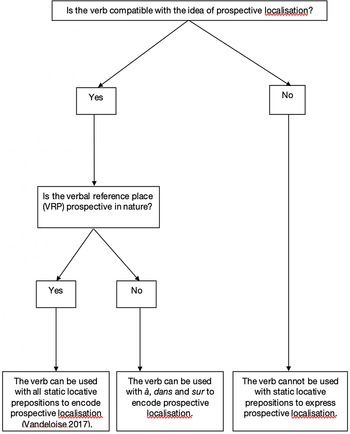
To summarize so far, prospective localization involves the use of a static spatial preposition to express the future location of a Figure in motion. This process is explained by the principle of anticipation. The principle holds that the motion verb must be compatible with prospective localization: this means that the Ground will be interpreted as a Goal when à, dans or sur is used (e.g. examples 5 and 7). This excludes, according to Vandeloise (Reference Vandeloise2017), French verbs that express manner of motion (e.g. example 3). Also excluded are verbs like arriver (‘arrive’), which highlight the Figure’s actual location at the time of speaking, thus entailing that its location can’t be ‘anticipated’. MoreFootnote specifically, in the case of arriver, the Figure’s location is highlighted as already being at the endpoint of its trajectory and therefore at the Ground’s location or in the vicinity immediately preceding it (Vandeloise, Reference Vandeloise1987). If the verb is compatible, then its verbal reference place needs to be determined. If the VRP is not prospective in nature (e.g. partir), it will trigger prospective readings of à, dans and sur but not of all static locative prepositions; any other prepositions for which prospective readings may be triggered need to be investigated on a case-by-case basis. This information is summarized diagrammatically as shown above in Figure 1.
The principle of anticipation, as applied to French, following Vandeloise (Reference Vandeloise1987, Reference Vandeloise2017)Footnote 4 .

The aim of this paper is to investigate how the principle of anticipation applies to verbs that are compatible with the idea of prospective localization but which do not have a prospective verbal reference place: for example, partir and s’enfuir. Vandeloise states that such verbs may trigger prospective readings of the prepositions à Footnote 5 , dans and sur but says little about their ability to do so for other prepositions, although some interesting insights into the verb partir are provided in Vandeloise (Reference Vandeloise1987). This naturally leads to the following question: with which static locative prepositions can these verbs be used in order to trigger the principle of anticipation, and why? Do different verbs show similar patterns of behaviour or are the results verb-specific? On the basis of this, is the concept of the VRP sufficient to explain how the principle of anticipation works with this subset of verbs, or are other explanations required? Research into spatial semantics has shown that locative meaning is distributed over a wide range of elements in a locative clause (cf. Sinha and Kuteva, Reference Sinha and Kuteva1995; Zlatev, Reference Zlatev, Casad and Palmer2003) and that meaning can be prompted for by the linguistic context beyond the target locative clause (Evans and Tyler, Reference Evans and Tyler2004; Zlatev, Reference Zlatev, Casad and Palmer2003). As such, it is conceivable that a unilateral focus on the verb, such as we see in the current definition of the principle of anticipation, is inadequate to explain how prospective readings of static prepositions emerge. That being said, Vandeloise’s focus on the verbal reference place has the merit of highlighting the crucial role of verbal semantics in the activation of the principle of anticipation. Vandeloise takes the concept of the VRP from Laur (Reference Laur1993), a study of French motion verbs developed around the idea of aspectual polarity (‘polarité aspectuelle’, Boons, Reference Boons1987). This concept of polarity will be adopted in the analysis that follows and will lead, quite naturally, to a consideration of the role of the preposition and the Ground as far as the principle of anticipation is concerned. This will prove crucial to the ensuing discussion.
2. RESEARCH QUESTIONS AND METHOD OF INVESTIGATION
2.1. Research questions
In his writings on the principle of anticipation, Vandeloise uses the concept of a ‘prospective’ verbal reference place but unfortunately never defines what he understands by the term ‘prospective’. Despite this lack of clarity, it is clear that reference is being made to a location that is distinct from the one occupied by the Figure at the onset of the motion event. The idea of aspectual polarity (Boons, Reference Boons1987), a concept applied in much other work on the topic (Aurnague, Reference Aurnague2011a, Reference Aurnague, Aurnague and Stosic2019; Borillo, Reference Borillo1998; Zlatev, Reference Zlatev and Brown2006), is relevant here. Three types of polarity are posited: initial, medial and final. Initial polarity involves the assertion, followed by the negation, of a basic locative relationship (Aurnague, Reference Aurnague2011a). For example, partir references the existence of an initial basic locative configuration (e.g. ‘il est à la maison’) which is subsequently negated (i.e. ‘il n’est plus à la maison’, so ‘il est parti de la maison’). Final polarity entails the opposite process: there is initial negation followed by assertion of the locative relationship (ibid.). Only a small amount of motion verbs are of medial polarity (Aurnague, Reference Aurnague2011a): as such, this category will not be of interest in what follows. Clearly, motion verbs that have final polarity (aside from those that reference the actual location of the Figure like arriver) have prospective verbal reference places. This contrasts to motion verbs with initial polarity, which do not because they focus on the initial phase of the motion event. As mentioned earlier, the current study will focus on verbs that do not have a prospective VRP. This naturally leads us to verbs of initial polarity. With this in mind, the following research questions arise:
1) With which static locative prepositions (apart from à, sur and dans) can verbs of initial polarity (e.g. sortir, partir, s’enfuir) collocate to trigger the principle of anticipation? What factors enable this to occur?
2) Are there differences between verbs of initial polarity in terms of the prepositions with which they can collocate in order to trigger the principle of anticipation? If so, why do these differences exist?
2.2. Choice of verbs
It is beyond the scope of a single paper to investigate all verbs of initial polarity and their collocational possibilities with all static locative prepositions: this is particularly true when one aims to provide a qualitative analysis of the phenomena observed. As is the case in Vandeloise (Reference Vandeloise1987), the target verbs in the present study require deeper analysis in order to arrive at a better understanding of their compatibility with the principle of anticipation; it is not possible to undertake this type of longer qualitative analysis on a large set of verbs. Yet how should the verbs be chosen? Aurnague (Reference Aurnague2011a) identifies four types of verbs of initial polarity, which are given below. These distinctions have been made on the basis of semantic and syntactic observations: for example, verbs of extended change of initial relation (e.g. s’enfuir) encode speed and the Figure’s desire to resist the location encoded as the Ground: this contrasts to verbs of independent initial change of relation like partir (ibid.). The justifications leading to this four-fold division, based on semantic and syntactic criteria, will not be reproduced or discussed in depth here. Relevant ideas will be discussed in the later analysis. Please see Aurnague (Reference Aurnague2011a) for detailed information about these categories, which are listed below.

I have selected three verbs of initial polarity as reported in work by Laur (Reference Laur1993), Borillo (Reference Borillo1998) and Aurnague (Reference Aurnague2011a). I have added a fourth, disparaître, as it seems to encode a more punctual event than that encoded by partir, which provides a potentially interesting point of comparison. The category ‘double change of relation with initial saliency’ will not be investigated in what follows as these verbs also encode reference to a Goal location: it therefore follows that they have a prospective VRP. According to the principle of anticipation, this makes it highly likely that they will be compatible with prospective readings of all static locative prepositions (as a quick analysis of déménager seems to confirm).
Table of motion verbs by aspectual polarity

Before discussing my choice of prepositions for this study, it is relevant to show that each of these verbs is compatible with prospective localization, as evidenced by their ability to trigger prospective readings of à, sur and dans. Vandeloise (Reference Vandeloise1987) has already demonstrated this for partir, so this will not be replicated here. The following sentences show that disparaître can also trigger such readings:


These readings of the verb suggest a clear motion event. However, this is not always the case for disparaître. Hence, one could say ‘il a disparu à/dans Paris’ or ‘il a disparu sur la plage de Manly’: this transition from a place of visibility to one of invisibility does not necessarily require a Figure in motion and the reading is non-prospective in nature. This possibility of a dual reading (i.e. prospective/non-prospective) has also been noted for partir à (Vandeloise, Reference Vandeloise1987). As far as sortir is concerned, prospective readings of these prepositions are also evident:


Again, however, there is the possibility of non-prospective readings of à, as attested by a clause like ‘nous sommes sortis à la station Réaumur’. S’enfuir, however, seems to present a more clear-cut case.

2.3. Choice of prepositions
As far as static locative prepositions are concerned, different sub-categories exist and need to be accounted for in the analysis. Vandeloise notes that all verbs that are compatible with the idea of prospective localization can trigger prospective readings of à, sur and dans, all three of which are topological prepositions. This type of preposition encodes a locative configuration in which the Figure is usually in contact with or contained in the Ground (Borillo, Reference Borillo1998), although each individual preposition is also associated with particular functional relationships (Vandeloise, Reference Vandeloise1986). The second broad category of static locative prepositions is projective prepositions. As less is known about how these types of prepositions work with the principle of anticipation, I will focus on these in the current study. Projective prepositions encode spatial relationships in which the Figure and Ground are at clearly separate locations. This encompasses a wide range of prepositions, and one way of subdividing this category is to consider whether or not the preposition encodes directionally-specific information (Tutton, Reference Tutton2016). ‘Directionally-specific information’ involves the encoding of a direction, understood in terms of the end points of the three spatial axes: ‘up’ and ‘down’ for the vertical axis; ‘front’ and ‘back’ for the frontal axis; and ‘left’ and ‘right’ for the lateral axis. Hence, devant and derrière are directionally-specific prepositions because they reference the directional concepts of front and back; the prepositional expressions à gauche de and à droite de are two other examples. In contrast, près de and à côté de do not encode reference to any one particular direction: they are therefore directionally non-specific prepositions. The question then becomes which prepositions to target in the study. Devant and derrière are natural choices for the directionally-specific sub-category: this is because animate entities prioritize motion along a frontal axis extending out from their intrinsic front and back. As far as directionally non-specific prepositions are concerned, I will focus on près de and à côté de. Although both these prepositional expressions encode proximity, près de can be used to reference location along any spatial axis, while à côté de is often used for relationships along the lateral (left-right) axis (ibid.).
Typology of selected French projective locative prepositions

2.4. Clarification of core concepts
In my analysis I draw on concepts from the Cognitive Linguistics literature on Motion events. These are explained in relation to example 14 below.

Figure: the entity that is being localized or which is in motion. This is encoded by le cortège des cheminots.
Ground: the reference entity or entities in relation to which the Figure’s motion takes place. This is encoded by la gare and la Préfecture.
Path: this is a difficult concept to define and is understood in many ways by different linguists (Aurnague and Stosic, Reference Aurnague, Stosic, Aurnague and Stosic2019). For the purposes of the current study I will understand Path in a spatial sense, as the connection between two points in a motion event (Evans and Tyler, Reference Evans and Tyler2004). These two points may not be lexicalized, although both appear in example 14 (i.e. la gare and la Préfecture.) Paths have ‘extension and shape’ (Zlatev, Reference Zlatev and Brown2006), the exact nature of which may not be lexically encoded. In example 14, our extralinguistic knowledge of human beings and processions leads us to assume that the Figure’s Path from the station may not be rectilinear: for example, the group might have to weave their way around numerous streets before ending up at the préfecture. This highlights the importance of extralinguistic knowledge to the interpretation of spatial information (Tyler and Evans, Reference Tyler and Evans2003; Evans and Tyler, Reference Evans and Tyler2004; Naidu et al., Reference Naidu, Zlatev, Duggirala, Van De Weijer, Devylder and Blomberg2018).
Source: the “starting point or locational source” (Evans and Tyler, Reference Evans and Tyler2004, p.251) of a motion event. This is encoded by la gare.
Goal: this is ‘a highlighted end point’ (Evans and Tyler, Reference Evans and Tyler2004, p.258). As far as clauses involving prospective localization are concerned, the Goal is often the same entity as the Ground. It is la Préfecture in example 14.
As far as motion event type is concerned, I will focus on ‘“autonomous”’ as opposed to ‘“caused”’ motion events (Aurnague and Stosic, Reference Aurnague, Stosic, Aurnague and Stosic2019: 6). My analysis concerns events of physical, as opposed to metaphorical, motion. Some examples, like the following, straddle the limit between these two types. Such cases, in which there is nevertheless the idea of a physical movement from one location to another, are included in the analysis.


In contrast, examples which referred to two-dimensional entities, such as icons on screens, were not included in the analysis.

Disparaître raised further questions, since the idea of motion it references is often very subtle. Examples in which the idea of gradual occlusion was encoded, with little reference to any clear movement, were excluded from the analysis.

2.5. Corpus
In order to identify as many uses as possible of the verb and prepositional combinations identified above, I decided to undertake a corpus-based study. Following Laur (Reference Laur1993), I chose to focus on each verb in the passé composé, a perfective tense, in the third person singular form: for example, est sorti devant. A search in Frantext revealed very few examples of the target structures: for example, the combination est parti devant returned 7 results, and est parti derrière returned one. I therefore decided to construct my own corpus using Google. Each combination was searched for using inverted commas to make sure the syntactic sequence was respected: for example, “est parti devant”. The total number of examples returned across all verb/preposition combinations was 1,385. For each combination I went to the final page of results and worked back to page 1, going through each example and analysing whether or not it constituted an example of prospective localization. Examples that were repeated were counted only once. Those that were ambiguous between prospective or non-prospective interpretations, as well as those that were non-sensical, were discarded. An example of the latter type of example is given below.

Also excluded were examples that lacked context: these included examples from grammar worksheets, decontextualized examples on websites like ReversoContext, or the following single-sentence translation (from an oriental language into French) that appeared in an academic journal.

I also excluded examples that appeared to be produced by automatic translators.

Needless to say, there were many irrelevant examples but this process enabled me to create a corpus of relevant data. Obviously, Google searches draw data from a range of sources and the different types of text from which examples are drawn need to be acknowledged. I therefore devised a list of 5 categories to account for the source of each example. These categories are presented below.
-
1. Media outlets
This category contains examples from the websites of newspapers, magazines, and media organizations: for example, the newspaper Le Parisien.
-
2. Organizations (including educational institutions)
Included in this category are examples from business websites and organizations representing collectives. For example, the motorbike website motorsport.com or the website of the Church of Jesus Christ (churchofjesuschrist.org).
-
3. Literature (including legal documents)
This category includes examples from books and legal documents, such as court transcripts.
-
4. Blogs and messages on websites
These examples are essentially personal commentaries and are drawn from personal blogs and user comments on websites.
-
5. Other
This category groups together the minority of examples whose source cannot be ascertained or which do not fit into one of the four categories above.
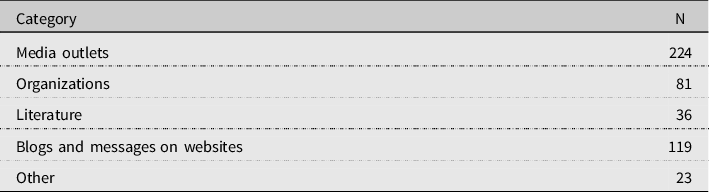
This coding system allowed me to differentiate between examples that were likely to have undergone an editing process and those that hadn’t. For example, examples from categories 1 and 3 have almost certainly undergone some sort of review process for linguistic acceptability (except for direct-speech quotations); this is probably the case for most examples in category 2 as well. However, examples drawn from category 4 are unlikely to have been scrutinized in this manner and the register of the texts in which they appear tends to be more informal. The breakdown of examples across these categories is given above in Table 3.
Source of corpus examples

3. ANALYSIS OF VERBS OF INITIAL POLARITY
3.1. partir and disparaître
In section 1 it was shown that the principle of anticipation was not activated by partir devant (see example 6). In fact, ‘for this verb, the principle of anticipation applies only to à, sur and dans’ (Vandeloise, Reference Vandeloise2017, p.5), and Vandeloise (Reference Vandeloise1987, p.104) mentions specific static prepositions that don’t readily acquire a prospective reading with partir: namely, derrière, à gauche, à droite and près de. This, he claims, is because partir requires a more distant point of view from which to view the Ground, whereas the use of these prepositions is more feasible when the Figure and the Ground are in the viewer’s visual field (1987, pp.104-105). However, this reasoning overlooks the fact that derrière can also be used to describe spatial configurations in which the Figure is visually inaccessible to an observer (Vandeloise, Reference Vandeloise1986), and thus outside of their visual field. Hence, if I described someone as being derrière la porte, the understanding would be that this person is closer to the side of the door that is currently not in view. Such visual inaccessibility complements the idea of a distal point of view associated with partir, because if an object is far away from a viewer it may well be harder to see. With this in mind, we can hypothesize that derrière may, in fact, trigger the principle of anticipation when used with partir.

The implication in this example is that the coffin leaves from an (unspecified) Source and follows a Path that ends in a Goal location beyond the location associated with the curtain. No single lexical item encodes this Path: rather, it is pragmatically inferred thanks to the collocation of partir and derrière, which are complementary in terms of the notion of visual accessibility to an observer. The frame of reference (understood in the sense of Levinson, Reference Levinson2003), is also an important variable to consider. When speakers encode location using devant or derrière, they appeal to either the intrinsic front/back properties of the Ground (in which case an ‘intrinsic’ frame of reference is applied), or they attribute the Ground such properties via the mirror-like rotation of their own (or another entity’s) front and back onto the entity (in which case a ‘relative’ frame of reference is applied). It is the latter strategy that is at work in example 22 – as is arguably the case in all prospective uses of the combination partir derrière. I will return to this point later.
Partir also collocates with derrière to express motion events in which the Ground does not appear to function as the Goal of the Motion event. In such cases I considered that the principle of anticipation had not been activated. These examples are noteworthy as in almost all cases they encode a sequence in which an animate Figure follows an animate Ground. This reading lends itself well to descriptions of pursuit in different contexts, from criminal justice to car racing.


A comparison of the Ground entities in example 22 on the one hand, and in examples 23 and 24 on the other, reveals a key difference in function. Le rideau triggers the conceptualization of an object that serves as a physical boundary between two separate spaces. This was the type of Ground found in all examples of prospective uses of the preposition. In contrast, le conducteur and moi do not function as boundaries but rather as reference points for the Figure’s ongoing Path; crucially, both Figure and Ground are understood to operate within a single, undivided spatial regionFootnote 7 . The majority of Grounds (29 out of 33) that occurred with non-prospective uses of partir derrière were entities in motion such as this one. A pattern therefore emerges: immobile inanimate entities that have clear boundaries tend to occur with prospective uses of partir derrière, whereas entities in motion tend to function as the Ground in non-prospective uses. This suggests that the variable of motion is key to separating prospective and non-prospective uses of partir derrière. In addition, all non-prospective examples of partir derrière conveyed the idea of a Figure starting a motion event (Aurnague, Reference Aurnague2011b), a phenomenon also noted in all non-prospective examples of partir devant.

The use of devant in such examples can also be interpreted as a metaphorical reference to the temporal domain. Hence, as far as the current example is concerned, everyone else departed before the speaker did, meaning that he got off to a slower start. While acknowledging this possible reading, I nevertheless included such examples in the analysis if they also held true in a spatial sense: for instance, in example 25, we understand that tout le monde advanced relative to the front of the speaker.
Devant, as predicted by Vandeloise, is almost exclusively used in examples of non-prospective localization: just one example of prospective localization was found. As far as près de is concerned, almost all examples encoded instances of prospective localization: this contradicts Vandeloise (Reference Vandeloise1987, p.104). In the majority of cases the Ground was a noun referencing a city, a town or a border: that is, an entity that could be considered geographical in nature. This was the case in 21 of the 32 examples of prospective uses.

Six of the examples encoded movement into a spiritual realm, referencing God as the Ground entity.

Vandeloise’s (Reference Vandeloise2017) distinction between material entities and spatial entities is useful at this juncture. Spatial entities are concepts like countries, the world and the universe (ibid.). They possess boundaries that are harder to define than those of material entities (ibid.), perhaps owing to their more abstract nature. While a Ground like son Maître, in reference to God, ostensibly refers to a being, it is also a metonymic reference to another dimension, the boundaries of which are unknown. This is arguably a type of spatial entity itself, perhaps one of the most abstract to be conceptualized by the human mind. It is logical that references to spatial entities, both celestial and otherwise, are introduced by près de but not derrière, because the former does not require the entity to possess (or be attributed) any particular spatial property. As far as à côté (de) is concerned, this prepositional expression “indique la proximité dans l’espace” (Larousse); notably, it is this concept of proximity, as opposed to any reference to a side attribute, that is foregrounded when a spatial entity occupies the role of Ground. Hence, in the following example we understand that the Figure has moved to an area close to Grenoble.

Only six non-prospective examples with à côté de were noted. However, in contrast to the prospective uses, material entities (e.g. chez moi, moi), as opposed to spatial entities, were encoded as the Ground. This is shown by the use of votre table in the following example.

prospective/non-prospective reading of selected prepositions with partir

Disparaître
Disparaître encodes an action in which an entity ceases to be perceptible, either visually, audibly, or in terms of smell (Larousse). The pivotal role of the speaker/observer in this process is clear, thus creating a parallel with partir (see above). However, compared to the latter verb, the results for disparaître are far starker: that is, the corpus suggests that collocation with each of the four prepositions leads to a necessarily prospective or non-prospective interpretation, but not both. As such, all examples with devant triggered non-prospective readings of the preposition.

In contrast, interpretations of derrière were uniformly prospective.

The difference between the two prepositions in terms of access to perception may explain these results. Specifically, derrière encodes a viewer’s lack of perceptual access to the Figure (Vandeloise, Reference Vandeloise1986) whereas devant does not. Given that disparaître encodes a process in which the Figure ceases to be perceptually accessible to the viewer, the Ground NP introduced by derrière is logically interpreted as a Goal given the reading of perceptual inaccessibility associated with the preposition. In contrast, the idea of access to perception associated with devant aligns with the initial phase of the motion event encoded by disparaître in which the Figure can be perceived by the viewer: this entails that the Ground introduced by the preposition is interpreted as a Source. Yet these corpus results and accompanying explanations are challenged in the face of the following example, found in a novel outside the corpus.

Leaving aside the fact that disparaître is in the passé simple, the key factor here is the prospective interpretation of devant. The reading of movement beyond the viewer’s visual field is facilitated by the immediately preceding context, in which the Figure’s Path is clearly established in a direction away from the viewer. The use of an intrinsic frame of reference to interpret devant means that the idea of visual inaccessibility is not hampered: that is, it is the intrinsic front of the calandre which is referred to, and this is understood to be oriented away from the viewer. This shows that a prospective use of devant is, in fact, possible with disparaître provided that the context helps to shape a reading in which devant no longer expresses the idea of perceptual accessibility to the viewer.
As far as non-directionally-specific prepositions are concerned, all examples with près de and à côté de had non-prospective readings.


This is unsurprising if the two prepositions are understood to be more felicitously used when the viewer has perceptual access to the Figure and Ground, as has been suggested previously for près de (Vandeloise, Reference Vandeloise1987, pp.104–105). Spatial entities accounted for almost all Grounds introduced by près de, which suggests that the preposition might be used most frequently in descriptions of larger scale space. This stands to reason as when describing location in small scale space it is more communicatively helpful to localize a Figure in relation to specific properties of the Ground (as mediated by prepositions such as devant, derrière, etc), as opposed to using a coarser-grained expression of proximity which fails to narrow the search domain to a specific directional axis.
prospective/non-prospective reading of selected prepositions with disparaître

3.2. sortir
Like partir, sortir expresses the departure of a Figure from a point of origin but the verbs differ as far as the concept of interiority is concerned. Specifically, partir encodes no reference to the idea, thus suggesting that the underlying locative relationship encoded by the verb is, in most cases, the localising use of the preposition à (Aurnague, Reference Aurnague2011b). In contrast, sortir encodes the Figure in a relationship of containment (Aurnague, Reference Aurnague2011a), thus suggesting that the underlying relationship is aligned with the preposition dans. The movement of the Figure out of a container-like space is expressed by the use of sortir, derrière, and a Ground-encoding NP that references a material entity or a boundary marker (e.g. la ligne de but).


Interestingly, nearly half of these examples came from sport-related writing. These texts represent a variety of sources, including media outlets, professional organizations, blog posts and messages on websites. Just as it was the case for partir, non-prospective uses of sortir and derrière were also attested.


This suggests a similarity between sortir and partir to the extent that both verbs can enable prospective or non-prospective readings of derrière. In addition, the Grounds used with non-prospective uses of sortir derrière were all entities in motion (most of which were human, as in examples 37 and 38); the use of entities in motion as the Ground was also noted for non-prospective uses of partir derrière. However, there is also a fundamental difference between these two verbs. It was mentioned earlier that partir suggests that an observer has a distant viewpoint of the Figure. In contrast, sortir can be used to express movement into the speaker’s field of perception – usually the visual field – thus enabling a closer viewpoint of the Figure. Imagine a scene in which the police have arrived in front of a house to arrest a burglar.


The use of sortir in example 39 does not necessarily mean that the Figure will move closer to the speaker’s location in terms of absolute distance: after all, the robber may walk out a side door and end up further away from the speaker’s location than they are currently. Rather, it calls for the Figure to appear in the speaker’s field of vision. In contrast, partir conveys the idea of movement away from the speaker, thus accounting for the incongruity of the second sentence above within the specified contextFootnote 8 . The idea that sortir is compatible with the idea of entry into the speaker’s perceptual field is shown by several examples in which the use of de is elided before derrière. The Ground functions as the Source, rather than the Goal, of the motion event, and the understanding is that the Figure moves into the visual field of the speaker, who constitutes the implicit Goal. These examples were counted in the analysis as examples of prospective localization.


This result provides a contrast to the common use of sortir to encode a movement of the Figure out of a container-like space: instead, the Figure moves out of a non-container-like location and into the perceptual field of a human observer, itself perhaps conceived as a container-like space. The effect may be one of surprise for the observer, who had not anticipated the appearance of the Figure (example 42). This idea of movement into the perceptual field of the observer is also attested in examples with devant. However, the Ground in such examples now encodes the (human) Goal, as opposed to the Source of the motion event.


In all cases apart from two, est sorti devant involved a prospective use of the preposition.

As far as the prepositional expression à côté de is concerned, nine of the ten examples in the corpus were prospective uses. Each of the entities encoded as the Ground in these examples was an immobile material entity.


An analysis of uses of près de did not return any clear results of prospective localization. There were two reasons for this. Firstly, the majority of the examples included uses of près de as a synonym for presque: they were therefore irrelevant to the study. Secondly, the semantic combination of sortir and près de leads to ambiguous interpretations. That is, sortir is quite punctual in terms of the event it encodes: the Figure leaves one space to arrive in an adjacent one, meaning that the non-directional relationships of proximity encoded by à côté de and près de may be valid both before and after the ‘going out’ event has been completed.

In contrast, a spatial relationship encoded by devant or derrière may only be true once the Figure has moved in or out of a container-like Ground (e.g. examples 41–45), thus enabling a stronger association with prospective localization.
prospective/non-prospective reading of selected prepositions with sortir

3.3. s’enfuir
S’enfuir (‘flee’) encodes the motion of an entity away from a Source along with the concomitant desire of this entity to evade control. The Figure thus attempts to move out of a zone that equates to the search domain (“domaine de recherche”; Vandeloise, Reference Vandeloise1986) of the pursuing entity that seeks to assert control over the Figure. The speaker adopts the perspective of an observer within this search domain, with the understanding that the Figure moves away from the observer’s location in its bid to avoid detection.

In this example the observer is not necessarily facing the front of the shops such that the Figure escapes around to the intrinsic ‘back’ of these buildings. In fact, the observer could be looking at a small row of shops side-on, thus deictically attributing a front and back, the latter of which would be the furthest side away from the observer’s location. This suggests that there may be a deictic component in the activation of the prospective interpretation of the sequence s’enfuir derrière: specifically, the front/back properties of the Ground are attributed via a relative frame of reference in which the oriented observer’s front and back properties are rotated onto the Ground. However, examples like the following challenge this hypothesis.

From a shopper’s point of view, the ‘front’ of a counter is the side we face when we go to make a purchase. While this ‘front’ may initially have been attributed via a relative frame of reference, it has since become a standard property that is easily identified thanks to multiple indicators: the location of the counter on the shop floor which allows less space behind than in front of it, the register facing away from the customer, the products for sale facing towards them, etc. Example 50 might describe a perspective in which the observer faces this conventional, customer-focused front. However, it could also plausibly describe a situation in which an observer, standing in a room immediately beyond the counter, looks through a doorway onto the ‘back’ of the counter, this ‘back’ being understood within the context of the conventional customer-focused interaction just mentioned. The pharmacist might be chased by their assailant through this back room and out into the pharmacy, where they end up behind the counter. In this case, derrière would not refer to a back property attributed by an oriented observer through a relative frame of reference: rather, it would appeal to the conventional front/back distinction discussed above. In addition, the Figure and the Ground might still be visible to the observer even once the Figure has reached the location associated with the Ground. This suggests that the prospective reading of s’enfuir derrière expresses a motion event in which the Figure moves beyond a search domain that is associated with the observer, and thus out of their control. The reading of a lack of visibility, which is complementary to the notion of an absence of control, may also entail. In such cases it will be prompted for by extralinguistic knowledge relating to the objects functioning as the Figure and the Ground.


Our knowledge of cliffs as large, static opaque entities and bandits as animate, mobile beings prompts for the reading of a lack of visibility in example 51. The layperson’s understanding of physics which views the sun as a mobile entity that rises in the East and sets in the West informs our understanding of the sun’s path behind the hills in example 52. Again, our knowledge of the latter as opaque entities capable of occluding the sun contributes to the reading of visual inaccessibility. In all prospective uses of s’est enfui derrière with the exception of one, the Ground is a material entity that is understood as a boundary separating the Figure from a Goal location, the latter of which is inaccessible to the viewer. The use of this type of entity as the Ground is logical as it lends itself well to the role of a stable shield that protects the Figure – often by hiding it. However, prospective readings are not noted with devant: the idea of accessibility to perception encoded by the preposition means that the Ground is more logically considered the Source, as opposed to the Goal, of the motion event.

As far as directionally non-specific prepositions are concerned, uses of s’enfuir are harder to find. Just one prospective reading of the collocation s’est enfui près de was found (example 54), while eight non-prospective uses were recorded, one of which is presented as example 55.


The action of fleeing implies a desire to be out of reach of a pursuer. As such, it makes more sense to take refuge behind an entity – as opposed to near or next to it – due to the additional layer of protection provided by the entity in its separation of the pursuer and the pursued. In addition to this, there is the additional benefit of possible invisibility. It is therefore logical that far more uses of s’est enfui derrière were found than s’est enfui à côté de or près de.
prospective/non-prospective reading of selected prepositions with s’enfuir

4. DISCUSSION
This study began by presenting Vandeloise’s principle of anticipation such as it applies to French. This principle makes two main claims. The first of these is that a verb of motion must be compatible with the idea of prospective localization if it is to trigger the principle of anticipation for the three basic prepositions à, dans and sur. Secondly, the verbal reference place (VRP) of a verb must be prospective in nature if it is to trigger prospective interpretations of all other static locative prepositions. The concept of the VRP was introduced in Laur (Reference Laur1993), a study of verbs of motion in terms of three categories: initial polarity, median polarity, and final polarity. While Vandeloise never explicitly states what he understands a ‘prospective’ VRP to be, it is reasonable to assume that this does not apply to verbs of initial polarity. As such, the present study has focused on testing the principle of anticipation with this type of verb.
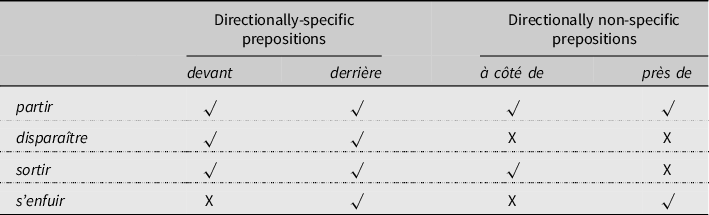
The results show that each of the verbs of initial polarity analysed was able to combine with several, if not all, of the four prepositions (devant, derrière, à côté de, près de) to express prospective localization. The table below summarizes the results. Note that a tick indicates that at least one example was found.
French motion verbs of initial polarity: compatibility with prospective readings of projective locative prepositions
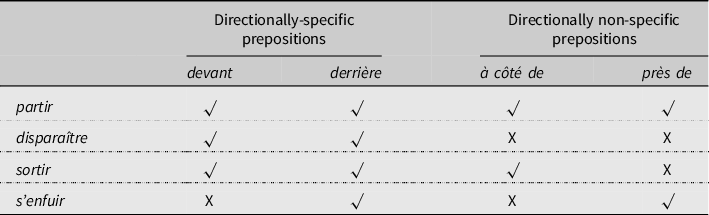
The analysis showed that partir can be used to encode prospective localization with all prepositions, although only one example with devant was noted. The combination partir derrière triggers the principle of anticipation when the Ground is a material entity functioning as a boundary dividing two spaces. In contrast, non-prospective uses of partir derrière also occur: in all such examples the Ground is a material entity (usually a human being) in motion, meaning that the Ground functions as a reference point for the Path of the Figure. It is harder to conceptualize a moving Ground as an achievable Goal because the distance between the Figure and the Ground can be maintained or even increased due to the movement of the latter entity: as such, it is logical that the principle of anticipation fails to hold in such a context. The same result was found for sortir: that is, a non-prospective interpretation resulted when sortir occurred with derrière and a Ground entity in motion. Conversely, material Ground entities functioning as a boundary separating two spaces occurred in examples of prospective localization. The results for sortir differed interestingly to those for partir in that the use of devant almost always triggered a reading of prospective localization. There are two explanations for this. Firstly, sortir can encode the movement of a Figure out of a container-like space (e.g. example 45), and it is this boundary-crossing Path that may facilitate the conceptualization of the Ground as a prospective location. Secondly, sortir is also compatible with a reading in which the Figure moves into the container-like space of a viewer’s perceptual field. It is arguably this explanation that underlies two different types of example: one in which the viewer is implicit (example 56), the other in which the viewer’s perspective aligns with that of the animate Ground (example 57).


In example 56 the reader is an implicit viewer of the scene who attributes a front to the door through a relative frame of reference. In example 57, the Figure moves into the visual field of the Ground, a perspective shared by the viewer (i.e. the reader). As far as directionally non-specific prepositions are concerned, the major difference between the two verbs is the more frequent use of près de with partir to express prospective localization. This may be due to the different implications of distance associated with each verb. That is, the relationship of proximity encoded by près de may be seen as true both before and after the completion of the boundary-crossing trajectory encoded by sortir since the verb encodes a reasonably punctual transition between these two spaces.
The importance of verb semantics in the activation of the principle of anticipation was made clear with disparaître. The encoded motion out of the visual field means that Ground entities introduced by devant, à côté de and près de – all of which encode greater access to perception than derrière (cf. Vandeloise, Reference Vandeloise1986, Reference Vandeloise1987) – are more readily conceptualized as Sources than Goals. However, this finding is not absolute, as contextual information relating to Path direction and the use of an intrinsic frame of reference can trigger a prospective reading of devant (example 32).
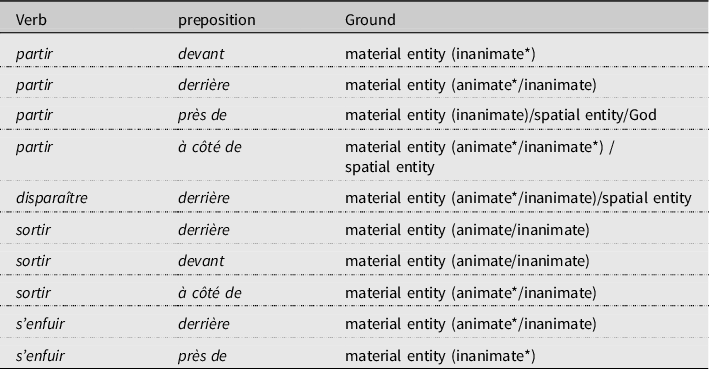
All but one of the prospective readings of prepositions used with s’enfuir occurred with derrière, arguably because both s’enfuir and derrière encourage readings in which the Figure avoids interaction with the viewer: control as far as the verb is concerned, and perceptual detection for derrière. The importance of semantic complementarity between the verb and preposition has been noted on several occasions throughout the study in relation to access to perception; it is particularly salient for combinations involving derrière. The reading of prospective localization, as far as verbs of initial polarity are concerned, hinges on the semantic contributions of both verb and preposition, enabling what Cummins (Reference Cummins1996, p.31) has eloquently called a “synergistic compositional interpretation”: that is, certain aspects of meaning result from combinations of lexemes and cannot be gleaned from a strictly compositional approach: “The whole appears to be greater than the sum of its parts” (ibid., p.50). For example, the idea of movement away from a viewer, as encoded by partir, is strengthened by the idea of perceptual inaccessibility encoded by the preposition derrière. This combination, when partnered with a material Ground entity which has clearly defined boundaries, allows us to pragmatically infer the movement of the Figure to a location behind the Ground, thus activating the principle of anticipation. A similar synergistic approach is seen with this same verb and près de. Specifically, the principle of anticipation is triggered when a spatial entity is encoded as the Ground in this context, as the selection of this more abstract type of Ground suggests a location beyond the viewer’s immediate material surroundings. It is also worthwhile noting that such entities often have boundaries that are harder to define or less stable than those of material entities: this fuzziness complements the idea of a more distant viewpoint of the Ground encoded by partir (Vandeloise, Reference Vandeloise1987, p.104). The recognition of the Ground’s importance in this sort of context is not controversial, nor is it new: as stated by Miller and Johnson-Laird (Reference Miller and Johnson-Laird1976, p.380) many years ago, ‘it is not possible to analyse spatial locatives without taking into account the kinds of landmarks that can serve as their relata’. This repudiation of an individual lexeme-based approach to lexical semantics, along with the assumption of semantic compositionality that accompanies it, forms the core of the distributed spatial semantic approach, as proposed by Sinha and Kuteva (Reference Sinha and Kuteva1995). However, whereas Cummins’ argument is based on the verb as an additional element in the creation of locative meaning, Sinha and Kuteva extend this wider to the whole locative clause. Such broader approaches to spatial semantics have been developed further since then, as shown, for example, by the theory of Holistic Spatial Semantics (Zlatev, Reference Zlatev1997, Reference Zlatev, Casad and Palmer2003, and Reference Zlatev and Cuyckens2007). This latter theory rejects an analysis of locative clauses that is based on individual lexical units in favour of one that takes into account the wider discursive and situational context. Moreover, situations in which a semantic element is encoded over multiple linguistic units (for example, the boundary-crossing reading that is key to the principle of anticipation) “are expected to be the rule rather than the exception” (Zlatev, Reference Zlatev, Casad and Palmer2003: 307). The results presented in the current study support this position by showing how particular verb/preposition/Ground combinations trigger the principle of anticipation. The table below summarizes these results.
Activating the principle of anticipation with verbs of initial polarity

*indicates that there were no more than three examples of this type of entity.
In the vast majority of cases material, as opposed to spatial, entities were used as the Ground, and these were mostly inanimate (i.e. non-human or animal) in nature. This is logical given that spatial entities do not intrinsically possess front or back properties, nor are such properties readily conferred on them: this clearly limits their use with the prepositions devant and derrière. In addition, material entities also possess clearer boundaries than spatial entities (Vandeloise, Reference Vandeloise2017), thus making them better candidates for Goal locations. Material entities were usually inanimate in nature: this stands to reason because an ideal Goal location, as mentioned earlier, is one that is immobile, and immobility is obviously a feature more strongly associated with inanimacy. Spatial entities only occurred as the Ground with partir when the non-directionally specific prepositions près de and à côté de were used: this is logical, given the difficulty of attributing front and back properties (which are typically associated with the prepositions devant and derrière) to spatial entities. It is also worthwhile mentioning the preference of partir près de for a Ground that is either a spatial entity or a reference to divinity: there were only four material entities noted, and two of these were references to bodies of water.
What, then, do these results suggest regarding the compatibility of verbs of initial polarity and the principle of anticipation? Firstly, they indicate that the lack of a prospective VRP can be overcome by particular verb/preposition combinations. Such combinations, however, are typically able to give rise to both prospective and non-prospective readings of prepositions. It is here that the selection of a particular type of entity as the Ground can trigger a preference for a prospective reading in which the Ground is understood as the Goal: for example, sortir+derrière+material entity (inanimate). Secondly, the selection of a preposition that complements the perspective of the (usually) unlexicalized viewer (or speaker) can be a trigger for prospective localization. Hence, the idea of movement away from the viewer as encoded by partir partners well with the idea of perceptual inaccessibility suggested by derrière. This favours the use of an interpretation in which the Figure moves out of the viewer’s sight and behind the Ground, which is therefore understood as a Goal location. This ‘back’ property is consistent with the use of a relative frame of reference, suggesting the importance of deictic factors in the use of this particular verb/preposition combination.
Taking into account context beyond the target clause is also pivotal to understanding certain combinations, particularly ones involving sortir and derrière. In some instances the Ground will be understood as a Goal (examples 35 and 36), while in others it will be understood as the Source (examples 41 and 42). The choice between the two readings requires application of extralinguistic knowledge: for example, the surprise emergence of unexpected aggressors from behind their targets (example 42). As such, in contrast to verbs with a prospective VRP, for which compatibility with all static locative prepositions is posited (Vandeloise, Reference Vandeloise2017), verbs without such a VRP need to be studied on a case-by-case basis: this means an investigation that attends carefully to different verb/preposition/Ground combinations. A logical next step is to investigate the use of these same verbs with other projective prepositions. An ideal one is sous, because it carries the same idea of inaccessibility to perception that was discussed previously for derrière.


Example 58 encodes an event in which the Figure moves from a location external to the water and passes beneath its surface, thus potentially removing himself from the view of a real or imagined observer. Example 59 expresses the movement of the Figure into the enclosed space of the shower – and probably out of the visual field of the speaker. Example 60 encodes the movement of the scorpion out of the physical reach – and presumably sight – of the observer. In all three cases, the Ground is a material entity and the principle of anticipation has been activated. Specifically, the surface of a body of water constitutes a clear boundary through which a Figure must pass to be underwater; a shower is a typically confined space that has container-like properties; and a chair can occupy a space in a manner that confines an object underneath it. This suggests that the analysis presented in this paper should be extended further to enable a more complete understanding of how verbs of initial polarity can participate in the principle of anticipation.