Introduction
Rice in Mississippi is cultivated in a direct-seeded, delayed-flood production system between April 1 and May 20 when the average air and/or soil temperatures are ≥15 C (Buehring et al. Reference Buehring, Walker, Bond, Miller, Street, Buehring, Kanter, Walker, Bond, Silva, Pringle, Thomas, Damicone, Moore, Fox, Sciumbato and Martin2008; Street and Bollich Reference Street, Bollich, Smith and Dilday2003). In 2019, rice producers harvested 45,748 ha, with production in Bolivar, Sunflower, Tunica, Quitman, and Washington counties accounting for roughly 85% of Mississippi rice hectarage (USDA-NASS 2019). In these primary rice-producing counties, land area devoted to rice production makes up 6.25% of row crop hectarage (USDA-NASS 2019). Rice produced in the direct-seeded system is drill-seeded and managed as an upland crop until flood establishment 21 to 28 d after emergence (DAE) (Harrell and Saichuk Reference Harrell, Saichuk and Saichuk2014a; Street and Bollich Reference Street, Bollich, Smith and Dilday2003).
To optimize rice yield, nitrogen (N) fertilizer, is applied to rice in greater quantity and frequency than all other nutrients to optimize yield (Norman et al. Reference Norman, Wilson, Slaton, Smith and Dilday2003). Following N fertilizer application, immediate flooding is recommended to incorporate fertilizer into the soil and minimize losses due to ammonia volatilization (Griggs et al. Reference Griggs, Norman, Wilson and Slaton2007; Norman et al. Reference Norman, Wilson, Slaton, Griggs, Bushong and Gbur2009, Reference Norman, Slaton, Roberts and Hardke2013). The most common source of N fertilizer utilized in direct-seeded rice production is urea (Norman et al. Reference Norman, Wilson, Slaton, Griggs, Bushong and Gbur2009). A single N fertilizer application just prior to flooding is optimum for maximum N use efficiency by rice (Norman et al. Reference Norman, Wilson, Slaton, Griggs, Bushong and Gbur2009, Reference Norman, Slaton, Roberts and Hardke2013). Rice utilizes up to 75% of the total N fertilizer applied if incorporated properly prior to flooding (Dillon et al. Reference Dillon, Walker, Harrell, Krutz, Varco and Cox2012; Norman et al. Reference Norman, Wilson, Slaton, Smith and Dilday2003; Wilson Jr., et al. Reference Wilson, Bollich and Norman1998). Depending on rice cultivar, between 123 and 168 kg N ha–1 are applied during the growing season (Norman et al. Reference Norman, Slaton, Roberts and Hardke2013). Maintenance of flood water for at least 3 wk following N fertilizer application is required for maximum N uptake from preflood N fertilizer applications (Norman et al. Reference Norman, Guindo, Wells and Wilson1992, Reference Norman, Slaton, Roberts and Hardke2013; Wilson Jr. et al. Reference Wilson, Norman and Wells1989). Therefore, in fields with limited irrigation availability and lengthy flood establishment period, a two-way split N fertilizer application is recommended to minimize N losses (Norman et al. Reference Norman, Slaton, Roberts and Hardke2013). The two-way split N fertilizer application involves applying 70% of total N fertilizer prior to flooding, and applying the remaining 30% during early reproductive development (Bollich et al. Reference Bollich, Lindau and Norman1994; Norman et al. Reference Norman, Slaton, Roberts and Hardke2013; Wilson Jr., et al. Reference Wilson, Bollich and Norman1998).
Rice can undergo numerous early-season environmental stresses, including animal and insect feeding, sub-optimal temperatures, and herbicide drift (Walker et al. Reference Walker, Bond, Ottis and Harrell2008a). A common N fertilizer management practice is to apply starter N fertilizer as ammonium sulfate (AMS) at 24 kg N ha–1 to support stressed rice. Starter N fertilizer applied during early vegetative growth stages has been reported to increase yield in corn (Zea mays L.), cotton (Gossypium hirsutum L.), grain sorghum [Sorghum bicolor (L.) Moench], rice, and soybean [Glycine max (L.) Merr.] (Bednarz et al. Reference Bednarz, Harris and Shurley2000; Gordon et al. Reference Gordon, Whitney and Fijell1998; Osborne and Riedell Reference Osborne and Riedell2006; Walker et al. Reference Walker, Bond, Ottis and Harrell2008a). Walker et al. (Reference Walker, Bond, Ottis and Harrell2008a) reported that starter N fertilizer applied to two-leaf rice increased not only grain yield but also early-season plant height.
Glyphosate-resistant (GR) corn, cotton, and soybean cropping systems have revolutionized weed control (Edwards Reference Edwards2013; Owen Reference Owen2000). However, since the commercialization of GR cropping technologies, GR weed biotypes have evolved rapidly (Heap Reference Heap2019). Palmer amaranth [Amaranthus palmeri (S.) Wats] is the most troublesome weed in corn, cotton, and soybean because of its evolution of resistance to multiple herbicide modes of action, prolific seed production, and genetic diversity (Ward et al. Reference Ward, Webster and Steckel2013; Webster Reference Webster2013). The most effective control methods for GR Palmer amaranth utilize preventative strategies (Culpepper et al. Reference Culpepper, Webster, Sosnoskie, York and Nandula2010), and residual herbicides are commonly recommended PRE/prior to planting for Palmer amaranth suppression prior to crop emergence (Anonymous 2018). These PRE/prior to planting herbicide applications for GR weed control in corn, cotton, and soybean often include paraquat at 840 g ha–1 to control emerged weeds in a GR cropping system (Anonymous 2018).
Paraquat applications are labeled preplant, PRE, or post-directed in corn, cotton, grain sorghum, peanut (Arachis hypogaea L.), soybean, and numerous vegetable and fruit crops for nonselective weed control (Anonymous 2019; Shaner Reference Shaner2014). However, paraquat is only labeled preplant or PRE in rice (Anonymous 2018, 2019).
Rice is sensitive to off-target herbicide movement; however, severity of injury can vary with active ingredient, rate, formulation, and carrier volume (Bond et al. Reference Bond, Griffin, Ellis, Linscombe and Williams2006; Davis et al. Reference Davis, Scott, Norsworthy and Gbur2011; Hensley et al. Reference Hensley, Webster, Blouin, Harrell and Bond2012; Webster et al. Reference Webster, Hensley, Blouin, Harrell and Bond2015). In Mississippi, rice seeding dates often coincide with preplant and/or PRE herbicide applications to corn, cotton, and soybean (Buehring Reference Buehring, Miller, Street, Buehring, Kanter, Walker, Bond, Silva, Pringle, Thomas, Damicone, Moore, Fox, Sciumbato and Martin2008). As a result of Mississippi’s diverse cropping systems, incidents of off-target movement of paraquat from fields adjacent to rice are common. Injury symptoms from off-target herbicide movement may vary based on herbicide modes of action and may not always be indicative of total damage to rice growth and development (Davis et al. Reference Davis, Scott, Norsworthy and Gbur2011; Ellis et al. Reference Ellis, Griffin, Linscombe and Webster2003; Kurtz and Street Reference Kurtz and Street2003).
Extensive research has documented the effects on rice growth and development of glyphosate, glufosinate, and acetolactate synthase–inhibiting herbicides applied at reduced rates (Bond et al. Reference Bond, Griffin, Ellis, Linscombe and Williams2006; Davis et al. Reference Davis, Scott, Norsworthy and Gbur2011; Ellis et al. Reference Ellis, Griffin, Linscombe and Webster2003; Hensley et al. Reference Hensley, Webster, Blouin, Harrell and Bond2012; Webster et al. Reference Webster, Hensley, Blouin, Harrell and Bond2015, Reference Webster, Hensley, Blouin, Harrell and Bond2016). However, no data have been published on rice response following exposure to a sub-lethal concentration of paraquat and if altering N fertilizer strategies might reduce problems associated with paraquat injury. Therefore, research was conducted to evaluate (1) whether starter N fertilizer can aid in rice recovery from exposure to a sub-lethal concentration of paraquat and (2) rice response to different N fertilizer management strategies following exposure to a sub-lethal concentration of paraquat.
Materials and Methods
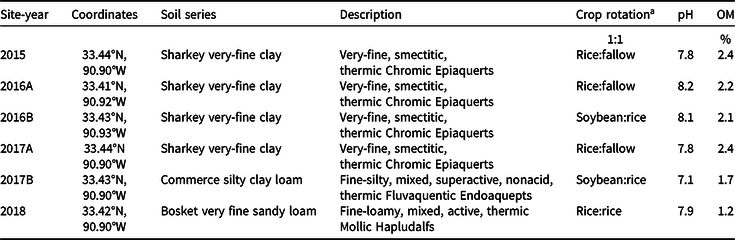
Two studies were conducted from 2015 to 2018 at the Mississippi State University Delta Research and Extension Center in Stoneville, MS, to evaluate the effect of starter N fertilizer applications or altering N fertilizer strategies on rice performance following exposure to a sub-lethal concentration of paraquat. Global positioning system coordinates, soil series, soil description, previous crop rotation, soil pH, and soil organic matter (OM) for all studies are listed in Table 1.
Coordinates, soil series, soil description, previous crop rotation, soil pH, and soil organic matter (OM) in the starter fertilizer study and the nitrogen fertilizer timing study conducted from 2015 to 2018 at the Mississippi State University Delta Research and Extension Center in Stoneville, MS.

a Cropping rotation is annual rotation rice to fallow, soybean to rice, or continuous rice based on geographical location.
Glyphosate (Roundup PowerMax 4.5 L, 1,120 g ae ha–1; Monsanto Co., St. Louis, MO 63167), paraquat (Gramoxone 2.0 SL, 560 g ai ha–1; Syngenta Crop Protection, Greensboro, NC 27409), and/or 2,4-D (2,4-D Amine 3.8 SL, 560 g ae ha–1; Agri Star, Ankeny, IA 50021) were applied in late March to early April each site-year to control emerged vegetation. Clomazone (Command 3 ME, 498 g ha–1; FMC Corp., Philadelphia, PA 19103) plus saflufenacil (Sharpen 2.85 SC, 4.5 g ha–1; BASF Crop Protection, Research Triangle Park, NC 27709) were applied PRE each site-year for residual weed control. Fenoxaprop-p-ethyl (Ricestar HT 0.58 EC, 1,949 g ha–1; Bayer CropScience, Research Triangle Park, NC 27709) and quinclorac (Facet 1.50 SL, 375 g ha–1; BASF Crop Protection, Research Triangle Park, NC 27709) plus halosulfuron (Permit 75 DF, 12 g ha–1; Gowan Co., Yuma, AZ 85364) plus petroleum oil surfactant (Herbimax, 83% petroleum oil; Loveland Products, Greeley, CO 80632) at 1% (v/v) were applied at three- to four-leaf (MPOST) rice to maintain weed-free experimental sites.
Rice was drill-seeded on June 9, 2015, May 11 and May 17, 2016, May 9 and 18, 2017, and May 7, 2018, to a depth of 2 cm using a small-plot grain drill (Great Plains 1520; Great Plains Manufacturing, Inc., Salina, KS 67401). Rice cultivar ‘CL151’ (HorizonAg, Memphis, TN 38125) was seeded at 83 kg ha–1 (356 seeds m–2) all site-years. Treated plots contained eight rows of rice spaced 20 cm apart and were 4.6 m in length. Treated plots were bordered on either end by a 1.5-m fallow alley that contained no rice and on each side by identically sized buffer plots included to minimize treatment contamination. Plots were flooded to an approximate depth of 6 to 10 cm when rice reached the one- to two-tiller stage. Paraquat was applied using a CO2-pressurized backpack sprayer equipped with flat-fan nozzles (AM11002 nozzle; Greenleaf Technologies, Covington, LA 70433) set to deliver 140 L ha–1 at 206 kPa using water as a carrier. Paraquat treatments were applied at a sub-lethal concentration of 10% of their suggested use rate in Mississippi (Al-Khatib and Peterson Reference Al-Khatib and Peterson1999; Anonymous 2018; Lawrence et al. Reference Lawrence, Bond, Golden, Allen, Reynolds and Bararpour2020). All herbicide treatments included NIS (Activator 90, 90% non-ionic surfactant; Loveland Products, Greeley, CO 80632) at 0.5% v/v and AMS water-conditioning agent (Class Act NG, 50% nitrogen fertilizer; WinField Solutions, St. Paul, MN 55164) at 2.5% v/v. Rice in all studies was managed throughout the growing season to optimize yield (Buehring Reference Buehring, Miller, Street, Buehring, Kanter, Walker, Bond, Silva, Pringle, Thomas, Damicone, Moore, Fox, Sciumbato and Martin2008).
All studies were harvested with a small-plot combine (Wintersteiger Delta; Wintersteiger, Inc., Salt Lake City, UT 84116) at a moisture content of approximately 20%. Grain weights and moisture contents were recorded, and rough rice grain yield was adjusted to a uniform moisture content of 12% for statistical analysis (Harvest Master H2 Classic GrainGage; Juniper Systems and Harvest Master, UT 84321). Whole and total milled rice yield was determined from cleaned 120-g subsamples of rough rice using the procedure outlined by Adair et al. (Reference Adair, Bollich, Bowman, Jordon, Johnson, Webb and Atkins1972). Rice was mechanically hulled and milled in a Grainman (Grain Machinery Manufacturing Corp., Miami, FL 33169) No. 2 miller for 30 s and size-separated with a 4.76-mm screen.
Starter N Fertilizer Study
A study was conducted in 2015 to 2018 at Mississippi State University Delta Research and Extension Center in Stoneville, MS, for a total of six site-years to assess whether starter N fertilizer as AMS promoted rice recovery from exposure to a sub-lethal concentration of paraquat. Treatments were arranged as a two-factor factorial within a randomized complete block design with four replications. Factor A was paraquat treatment and consisted of paraquat at 0 and 84 g ha–1 applied EPOST. Factor B was starter N fertilizer timing and consisted of no starter N fertilizer and starter N fertilizer at 24 kg ha–1 as AMS [AGRI-AFC LLC, ammonium sulfate (AMS 21-00-00-24S), Magnolia, MS 39652] applied to rice in the spiking to one-leaf (VEPOST), EPOST, and MPOST stages. Nitrogen fertilizer was applied at 168 kg N ha–1 as urea (46-0-0) to all plots in the study immediately prior to flooding (Norman et al. Reference Norman, Slaton, Roberts and Hardke2013).
Visible estimates of aboveground rice injury were recorded 3, 14, and 21 d after paraquat treatment (DA-PT) on a scale of 0 to 100%, where 0 indicated no visual effect from herbicide and 100% indicated complete plant death. Plant heights were determined 14 DA-PT by measuring from the soil surface to the uppermost extended leaf and calculating the mean height of five randomly selected plants in each plot. Rice dry weight was determined prior to flooding by hand-harvesting a randomly selected area measuring 1 m in length from rows 2 or 7 in each plot to determine starter N fertilizer effect prior to preflood N fertilizer application. The number of days to 50% heading was recorded as an indication of rice maturity by calculating the time from seedling emergence until 50% of rice plants in an individual plot had visible panicles. Additionally, at maturity, a randomly selected area measuring 1 m in length was hand-harvested from rows 2 or 7 in each plot to determine rice dry weight. The remaining area in each plot was harvested with a small-plot combine to determine yield (rough, whole, and total milled rice) after all subsamples had been collected. Hand-harvested samples were greenhouse-dried at 32 to 49 (± 5) C for 2 wk to constant mass and then weighed to determine rice dry weight (weights were then converted to g m–2).
Arcsine transformations of the square roots of visible injury estimates were performed to improve homogeneity of variances. Transformed data were subjected to ANOVA using the PROC MIXED procedure in SAS v. 9.4 (Statistical Software Release 9.4; SAS Institute, SAS Institute Inc., Cary, NC 27513-2414) with site-year and replication (nested within site-year) as random-effect parameters (Blouin et al. Reference Blouin, Webster and Bond2011). Type III statistics were used to test the fixed effects of paraquat and starter N fertilizer timing on rice injury, plant height 14 DA-PT, days to 50% heading, rice dry weight prior to flooding and at maturity, and yield (rough, whole, and total milled rice). Least-square means were calculated and mean separation (P ≤ 0.05) was produced using PDMIX800 in SAS, which is a macro for converting mean separation output letter groupings (Saxton Reference Saxton1998). Nontransformed data are presented for clarity.
Nitrogen Fertilizer Timing Study
A study was conducted in 2015 to 2018 at Mississippi State University Delta Research and Extension Center in Stoneville, MS, for a total of six site-years to evaluate rice response to different N fertilizer application timings following exposure to a sub-lethal concentration of paraquat. Treatments were arranged as a two-factor factorial within a randomized complete block design and four replications. Factor A was paraquat treatment and consisted of paraquat at 0 and 84 g ha–1 applied EPOST. Factor B was N fertilizer application timings and consisted of N fertilizer at 168 kg N ha–1 as urea (46-00-00; SouthernGRO Fertilizer; J&J Bagging, Yazoo City, MS 39194) applied in a single application at four-leaf to one-tiller rice (LPOST); in two sequential applications of 112 and 56 kg N ha–1 applied LPOST followed by (fb) panicle differentiation (PD); in three sequential applications of 84, 42, and 42 kg N ha–1 applied LPOST fb 14 d postflood (14 DPF) fb PD; in four sequential applications of 42, 42, 42, and 42 kg N ha–1 applied MPOST fb LPOST fb 14 DPF fb PD; and in four sequential applications of 42, 42, 42, and 42 kg N ha–1 applied LPOST fb 14 DPF fb PD fb 5% heading (5% HD). All N fertilizer was treated with a urease inhibitor (AGROTAIN Ultra, St. Louis, MO 63147) at 3.1 ml kg–1 N fertilizer. Visible estimations of rice injury 3, 7, 14, 21, and 28 DA-PT, number of days to 50% heading, plant height at 50% heading, rice dry weight at maturity, and yield (rough, whole, and total milled rice) were collected and analyzed as previously described for the starter N fertilizer study.
Results and Discussion
Starter N Fertilizer Study
All of the following results were averaged across starter N fertilizer application timings. A main effect of paraquat treatment was significant for all parameters (Tables 2 and 3). Visible estimations of rice injury following exposure to a sub-lethal concentration of paraquat ranged from 41% to 55% at all evaluations (Table 2). Rice dry weight prior to flooding was reduced from 106 to 24 g m–2 following exposure to paraquat (Table 3). Rice height was 16 cm following exposure to paraquat compared with 28 cm with no exposure to paraquat (Table 3). Averaged across five site-years and four starter N fertilizer application timings, rice dry weight at maturity was reduced from 1,731 to 1,157 g m–2, and rough rice yield was reduced from 8,400 to 5,490 kg ha–1 following exposure to paraquat EPOST (Table 3). Walker et al. (Reference Walker, Bond, Ottis and Harrell2008a) reported that N fertilizer applied prior to tillering (i.e., preflood application) influenced rice grain yield more than applications at any other time; however, when starter N fertilizer was applied to two-leaf rice, grain yield increased ≥200 kg ha–1 compared to where no starter N fertilizer was applied. In the current research, starter N fertilizer had no influence on rice growth, development, or yield following exposure to paraquat. In contrast to Walker et al. (Reference Walker, Bond, Ottis and Harrell2008a), applying starter N fertilizer had no effect on rice performance in plots receiving no paraquat.
Main effect of paraquat treatment on visible estimations of rice injury 3, 14, and 21 d after paraquat treatment (DA-PT) in the starter N fertilizer study conducted from 2015 to 2018 at Stoneville, MS. a

a Data were pooled over six site-years and four starter N fertilizer application timings. Means followed by the same letter for each parameter are not different at P ≤ 0.05.
b Paraquat treatments were paraquat at 0 and 84 g ai ha–1 applied to rice in the two- to three-leaf (EPOST) stage.
Main effect of paraquat treatment on rice dry weight prior to flood, height 14 d after paraquat treatment (DA-PT), number of days to 50% heading expressed as days after emergence (DAE), dry weight at maturity, and rough rice yield, and in the starter N fertilizer study conducted from 2015 to 2018 at Stoneville, MS. a

a Data were pooled over four starter N fertilizer applications and five site-years for dry weight at maturity, and rough rice yields or six site-years for dry weight prior to flooding, height, and days to 50% heading. Means followed by the same letter for each parameter are not different at P ≤ 0.05.
b Paraquat treatments were paraquat at 0 and 84 g ai ha–1 applied to rice in the two- to three-leaf (EPOST) stage.
Regardless of starter N fertilizer application timings, paraquat injured rice ≥41%, reduced rice height 57%, reduced dry weight prior to flooding 77%, delayed rice maturity 10 d, reduced dry weight at maturity 33%, and reduced rough rice yield 35% (Tables 2 and 3). However, there were no differences detected for whole and total milled rice yields. In the absence of a starter N fertilizer application, Lawrence et al. (Reference Lawrence, Bond, Golden, Allen, Reynolds and Bararpour2020) reported ≥9 d delay in rice maturity and ≥23% reduction in rough rice yield from exposure to a sub-lethal concentration of paraquat at EPOST growth stage. Results from the starter N fertilizer study indicate that AMS applied before, at the same time as, or after exposure to a sub-lethal concentration of paraquat did not aid in rice recovery from injury.
Nitrogen Fertilizer Timing Study
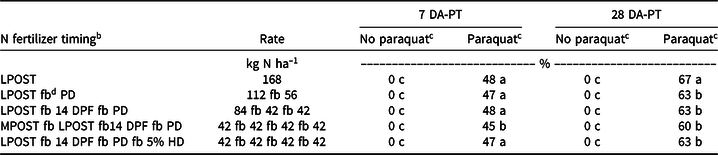
A main effect of paraquat treatment was detected for visible estimations of rice injury 3, 14, and 21 DA-PT (Table 4). An interaction of paraquat treatment and N fertilizer timing was detected for visible estimations of rice injury 7 and 28 DA-PT (Table 5). A main effect of paraquat treatment was also detected for rice height at 50% maturity, number of days to 50% heading, dry weight at maturity, and rough rice yield (Table 6). Additionally, a main effect of N fertilizer timing was detected for number of days to 50% heading and rough rice yield (Table 7).
Main effect of paraquat treatment on visible estimations of rice injury 3, 14, and 21 d after paraquat treatment (DA-PT) in the nitrogen fertilizer timing study conducted from 2015 to 2018 at Stoneville, MS. a

a Data were pooled over six site-years and five N fertilizer management strategies. Means followed by the same letter for each parameter are not different at P ≤ 0.05.
b Paraquat treatments were paraquat at 0 and 84 g ai ha–1 applied to rice in the two- to three-leaf (EPOST) stage.
Interaction of paraquat treatment and N fertilizer timing on visible estimations of rice injury 7 and 28 d after paraquat treatment (DA-PT) in the nitrogen fertilizer timing study conducted from 2015 to 2018 at Stoneville, MS. a

a Data were pooled over six site-years. Means followed by the same letter for each evaluation timing are not different at P ≤ 0.05.
b Nitrogen fertilizer timings included applications to rice at three- to four-leaf (MPOST), four-leaf to one-tiller (LPOST), panicle differentiation (PD), 14 d postflood (14 DPF), and 5% heading (5% HD) growth stages.
c Paraquat treatments were paraquat at 0 and 84 g ai ha–1 applied to rice in the two- to three-leaf (EPOST) stage.
d Abbreviation: fb, followed by.
Main effect of paraquat treatment on rice height at 50% heading, number of days to 50% heading expressed as days after emergence (DAE), dry weight at maturity, and rough rice yields in the nitrogen fertilizer timing study conducted from 2015 to 2018 at Stoneville, MS. a

a Data were pooled over five N fertilizer timings and six site-years for dry weight, rough and total milled rice yield or six site-years for rice height and days to 50% heading. Means followed by the same letter for each parameter are not different at P ≤ 0.05.
b Paraquat treatments were paraquat at 0 and 84 g ai ha–1 applied to rice in the two- to three-leaf (EPOST) stage.
Main effect of N fertilizer timing on number of days to 50% heading expressed as days after emergence (DAE) and rough rice yield in the nitrogen fertilizer timing study conducted from 2015 to 2018 at Stoneville, MS. a

a Data were pooled over six site-years and five N fertilizer applications. Means followed by the same letter for each parameter are not different at P ≤ 0.05.
b Nitrogen fertilizer management strategies included applications to rice at the three- to four-leaf (MPOST), four-leaf to one-tiller (LPOST), panicle differentiation (PD), 14 d postflood (14 DPF), and 5% heading (5% HD) growth stages.
c Abbreviation: fb, followed by.
Visible estimations of rice injury ranged from 45% to 62% 3, 14, and 21 DA-PT (Table 4). Although differences among N fertilizer timings were detected for visible estimations of rice injury 7 DA-PT, none of the N fertilizer treatments had been applied at this evaluation, and the injury ranged from 45% to 48%. Regardless of N fertilizer timing following rice exposure to paraquat, visible estimation of rice injury 28 DA-PT was ≥60%; however, the greatest visible estimate of rice injury (67%) was recorded in plots exposed to paraquat when 100% of N fertilizer was applied in a single LPOST application. Similar levels of rice injury were previously reported following rice exposure to a sub-lethal concentration of paraquat applied to rice EPOST (Lawrence et al. Reference Lawrence, Bond, Golden, Allen, Reynolds and Bararpour2020). Lawrence et al. (Reference Lawrence, Bond, Golden, Edwards, Peeples and McCoy2018) reported that injury to rice with paraquat was ≥41% 14 and 28 DA-PT regardless of growth stage at time of paraquat exposure.
Paraquat reduced rice height from 108 to 93 cm, increased number of days to 50% heading 10 d, reduced dry weight at maturity from 1,804 to 1,004 g m–2, and reduced rough rice yield from 7,930 to 4,430 kg ha−1 (Table 6). Rice maturity was 86 to 88 d regardless of N fertilizer timing; however, a timing with 100% of N fertilizer applied LPOST increased number of days to 50% heading more than when split applications were utilized (Table 7). Nitrogen fertilizer management strategies with applications of 42 kg N ha–1 in four equal dosages at MPOST fb LPOST fb 14 DPF fb PD and LPOST fb14 DPF fb PD fb 5% HD timings reduced number of days to 50% heading to 86 d compared with 88 d following 100% of N fertilizer LPOST (Table 7). Rough rice yield was 6,300 kg ha–1 when N fertilizer was applied at 42 kg N ha–1 in four equal doses at MPOST fb LPOST fb 14 DPF fb PD; however, this N fertilizer management strategy produced rough rice yield comparable to the single LPOST application, and two- or three-way split applications (Table 7). Similarly, Bufogle Jr. (Reference Bufogle, Bollich, Kovar, Lindau and Macchivelli1997) concluded that total N uptake was no different with split midseason N applications compared with single preflood N fertilizer applications. Rogers et al. (Reference Rogers, Norman, Brye, Smartt, Hardke, Roberts, Slaton, Dempsey Fulford and Frizzell2013) reported the greatest rice yield following 134 kg N ha−1 applied the day prior to flooding. Additionally, N uptake by rice was decreased as N fertilizer application timing was delayed greater than 1 d prior to flooding (Rogers et al. Reference Rogers, Norman, Brye, Smartt, Hardke, Roberts, Slaton, Dempsey Fulford and Frizzell2013). When pooled across rice cultivars, Bond and Bollich (Reference Bond and Bollich2007) concluded that the greatest rice yields occurred following 168 kg N ha−1 fertilizer applied immediately prior to flooding.
Rough rice yield was least (5,520 kg ha–1) following N fertilizer applied at 42 kg N ha–1 in four equal doses at LPOST fb 14 DPF fb PD fb 5% HD timings (Table 7). Bond and Bollich (Reference Bond and Bollich2007) reported no interaction or main effect on rough rice yield of N fertilizer applied during rice panicle exertion (booting). Similarly, Walker et al. (Reference Walker, Bond, Ottis, Gerard and Harrell2008b) reported no yield advantage from applying additional N fertilizer at panicle emergence compared with a single preflood N application containing season-long N requirement. In Mississippi, a four-way split N fertilizer strategy is commonly utilized for rice fertilization. However, current and previous research demonstrate that all N fertilizer should be applied prior to rice panicle exertion (booting) regardless of N fertilizer timing (Bond and Bollich Reference Bond and Bollich2007; Walker et al. Reference Walker, Bond, Ottis, Gerard and Harrell2008b). Unfortunately, up to 10 d are often required for flood establishment in commercial rice fields as a result of N fertilizer application difficulty, water management complications, producer familiarity with N fertilizer management, field history of rice physiological disorders, and field moisture content (Harrell and Saichuk Reference Harrell, Saichuk and Saichuk2014b). In these instances, an N fertilizer management strategy that utilizes split N fertilizer applications is recommended to minimize N loss due to volatilization.
Regardless of N fertilizer timing, paraquat injured rice ≥45%, reduced rice plant height 14%, increased days to 50% heading 10 d, reduced dry weight at maturity 44%, and reduced rough rice yield 50% regardless of N fertilizer management strategies (Tables 5 and 6). Lawrence et al. (Reference Lawrence, Bond, Golden, Edwards, Peeples and McCoy2018) reported rice yield as 20% of the nontreated control following exposure to paraquat during PD. Visible estimation of rice injury 7 and 28 DA-PT was influenced by N fertilizer timing following exposure to a sub-lethal concentration of paraquat; however, visible estimation of rice injury was still ≥60% 28 DA-PT. Although an interaction between paraquat treatment and N fertilizer timing was detected for rice injury 7 and 28 DA-PT, N fertilizer timing following rice exposure to a sub-lethal concentration of paraquat had no effect on rice height, days to 50% heading, dry weight, rough and total milled rice yield. Differences in rice yield were not observed due to N fertilizer timing following exposure to a sub-lethal concentration of paraquat. Yield loss due to paraquat was 50% regardless of N fertilizer timing. However, when data were averaged over paraquat treatments, N fertilizer management strategies utilizing all N prior to heading produced rough rice yields comparable to the other strategies, and rough rice yield was ≥6,120 kg ha–1 (Table 7). Nitrogen fertilizer timing utilizing 25% of N fertilizer applied at 5% HD produced lower rough rice yield than all strategies except an N fertilizer timing utilizing 50% of N applied LPOST and 25% applied at both 14 DPF and PD. Both studies indicate that severe rice growth and development issues can occur from rice exposure to a sub-lethal concentration of paraquat. Additionally, rice was unable to overcome early-season exposure to paraquat. Adding starter N fertilizer or manipulating N fertilizer management timings did not aid rice recovery from early-season exposure to paraquat.
Acknowledgments
This publication is a contribution of the Mississippi Agricultural and Forestry Experiment Station. Material is based on work supported by the National Institute of Food and Agriculture, U.S. Department of Agriculture, Hatch project under accession number 199080. The authors would like to thank the Mississippi Rice Promotion Board for partially funding this research. We thank personnel at the Mississippi State University Delta Research and Extension Center for their assistance. No conflicts of interest have been declared.