During the past few years, new technologies are emerging in the field of orthopedic surgery. These technologies are usually more expensive than the ones they replace, and their effectiveness is not evidence-based. One such case is the application of prosthetic arthroplasty, used lately on elderly patients suffering unstable trochanteric hip fracture, or serious osteoporosis, for which classic osteosynthesis would not stabilize the fracture.
Intertrochanteric fractures of the femur are traditionally internally fixed with a sliding hip screw device. So far, prosthetic replacement for treatment of intertrochanteric fractures generally has not been accepted. Impediments to the widespread use of prostheses for extracapsular fractures are attributable to the limited availability of the prostheses, the greater overall costs, the surgeons' limited familiarity with the prosthetic components, and the more challenging surgery involved (Reference Chan and Gill2).
The purpose of this study is to evaluate the hospital cost and the effectiveness of ilosis versus hemiarthroplasty in the management of patients with unstable trochanteric hip fracture. The evaluation of hospital cost was carried out on a microeconomic basis to best evaluate the true cost.
PATIENTS AND METHODS
The subjects of this prospective study were 173 patients with the diagnosis of acute trochanteric hip fracture of nonpathologic origin, 65 years of age and older. The patients were admitted to two different hospitals between March 1, 2001, and February 28, 2002. Ninety-one of the patients were admitted in hospital A and underwent noncemented bipolar hemiarthroplasty (NCBH), whereas 82 were admitted in hospital B and were treated with internal fixation (Richards Ilosis). Patients who were treated conservatively or died before surgery, those who had another type of surgery (e.g., total arthroplasty), as well as moribund patients, were excluded from the study population. On the contrary, patients with dementia or psychiatric disorders were not excluded from the study.
The severity of health problems at the time of admission was assessed with the use of the American Society of Anesthesiology classification system. For purposes of statistical analysis, American Society of Anesthesiologists ratings were collapsed into two categories: 1 or 2 and 3 or 4.
We collected patient demographic data as well as data on the hospital management and their health condition 3, 6, and 12 months after surgery. Health condition was evaluated on the basis of the appearance of complications, survival during the study period, and the achievement of prefracture ambulatory and functional ability. Ambulation levels were classified based on standard definitions of community and home ambulators (Reference Hoffer, Feiwell and Perry6). Community ambulators were able to walk indoors and outdoors, with or without an assistive device. Household ambulators were limited to walking indoors, with or without an assistive device. Nonfunctional ambulators were limited to transfers with human assistance, and finally, nonambulators were confined to their bed or chair.
Patients' functional level both before and after hip fracture was estimated according their ability to perform basic and instrumental activities of daily living. Basic activities of daily living (Reference Katz and Akbom10) included feeding, dressing, toileting, and bathing. Instrumental activities of daily living (Reference Lawton and Broody15) included food shopping, food preparation, performing housework, handling finances, and using public transportation. Each of these basic and instrumental activities was rated on a scale from 0 to 4, with 0 being completely dependent and 4 being completely independent in that activity. A patient was considered independent in an activity if he or she scored a 3 or 4. A score of 0, 1 or 2 indicated that a patient was dependent on that activity. A score was calculated separately for basic and instrumental activities, indicating the number of basic and instrumental activities in which the patient was dependent both before fracture as well as 3, 6, and 12 months after surgery (Reference Shah, Aharonoff and Wolinsky21). Recovery of ambulatory ability and independence in activities of daily living were dichotomized: patients who were dependent on more activities at follow-up than before sustaining hip fracture were categorized as failed to recover, whereas patients no more dependent at follow-up than before sustaining a fracture were categorized as recovered (Reference Koval, Skovron, Aharonoff and Zuckerman13).
The study also provides a comprehensive estimate of the cost of the two alternative operative techniques for the treatment of hip fracture. The cost valuation includes a microlevel estimate of direct hospital cost per patient treated with ilosis and hemiarthroplasty. The economic evaluation includes both costs associated with the surgical treatment and are expressed per hour and the hospitalization costs, which are expressed per patient day. Because fixed charges set by the Ministry of Health for reimbursement purposes do not depict accurately real resource consumption, we calculated total cost associated with the two alternative treatments per episode in the orthopedic ward through direct cost analysis. All direct health sector costs such as medical supplies, drugs, laboratory and radiology tests, salaries and wages, and overhead expenses, including equipment and plant depreciation, were calculated. All data are expressed in 2001 euro prices. For the evaluation of staff costs, the mean time needed for the treatment of patients with hip fracture was estimated for all professionals separately (physicians, nurses, assistant nurses, and physiotherapists; time and motion study). Salaries and wages are estimated according the 2001 mean gross income. Information on health status for the year after hospital surgery was collected by telephone interviews conducted 3, 6, and 12 months after the surgery date.
Because various hospital departments (administration, laundry, housekeeping, and so on) provide services directly or indirectly to hip fracture patients a microcosting model based on the method of direct allocation of overheads, was developed to allocate such costs (Reference Drummond, O' Brien, Stoddart and Torrance4). The cost for surgical biomedical equipment was estimated according to depreciation expenses and maintenance cost (according to the annual contractual obligations of the suppliers). Depreciation expenses for surgical biomedical equipment were estimated according to the utilization levels during the surgery using the fixed balance method.
Comparisons between two groups for continuous variables were performed with Student's t-test or using nonparametric techniques (Mann-Whitney), where needed. The nonparametric Fisher's exact test was used for comparing proportions. The significance level for all two-sided tests was .05. Total number of deaths, incurred both during hospital stay and during the follow-up period, was used to produce survival curves, based on the Kaplan-Meier method. The log rank test was used to compare survival times between patients treated with the two alternative techniques. The nonparametric Friedman test was used to evaluate changes in patients' ambulatory and functional status before and after surgery at 3, 6, and 12 months. The data were analyzed using SPSS software, release 11.
RESULTS
Health Consequences
Patients treated with ilosis and patients who underwent hemiarthroplasty were matched for sex, age, presence of dementia, severity of comorbidities (according to the American Society of Anesthesiology classification system), prefracture ambulatory ability, as well as prefracture ability to perform basic and instrumental activities of daily living. For all of the above characteristics, there was no significant difference between those treated with ilosis and those with hemiarthroplasty (Supplementary Table 1, which can be viewed online at http://www.journals.cambridge.org/jid_thc).
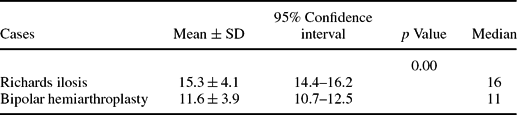
Patients treated with ilosis had statistically significantly higher length of stay compared to patients treated with hemiarthroplasty (Table 1). The health condition of patients with trochanteric hip fracture during their hospital stay was evaluated on the basis of mortality and the appearance of complications. In all, 4 percent of the patients died in hospital. Mortality was 3.3 percent for patients treated with ilosis and 4.9 percent for patients treated with hemiarthroplasty. Mortality was not statistically significantly different between the two groups (p value .709).
Length of Stay for Patients with Trochanteric Hip Fracture by Type of Intervention

Of the total of patients with trochanteric hip fracture, 12.1 percent developed some in-hospital complication. The frequency of such complications for patients treated with ilosis was 11 percent and 13.4 percent for those treated with hemiarthroplasty. The proportion of in-hospital complications was not statistically significantly different between the two groups (p value .694).
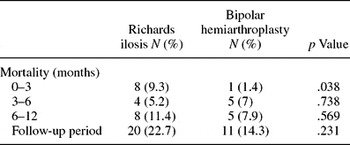
The mortality of patients treated with ilosis during the study period is shown in Table 2. Although mortality during 1 year of follow-up did not differ statistically significantly between the two patients' groups, it was significantly higher during the first trimester after the surgical procedure for those treated with ilosis.
Postdischarge Mortality for Patients with Trochan-teric Hip Fracture by Type of Intervention

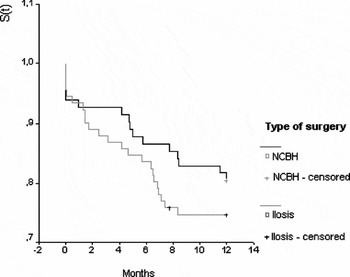
Using the overall number of deaths for patients with trochanteric fracture both during hospitalization as well as during the follow-up period, Kaplan-Meier survival curves were produced (Figure 1). The log rank test showed no statistically significant difference in survival time between patients with trochanteric fractures treated with the two alternative techniques (p value .342).
Survival curves in trochanteric hip fractured patients per type of surgery. NCBH, noncemented bipolar hemiarthroplasty.

During the 1-year follow-up period, the frequency of complications in patients treated with ilosis was 27.9 percent and for those treated with hemiarthroplasty was 23.6 percent. The proportion of complications both during 1 year of follow-up as well as during each of the study's interim time periods of follow-up (0–3 months, 3–6 months, and 6–12 months after surgery) was not statistically significantly different between the two patient groups. We should note that the incidence of complications during the year is not the sum of events during the three interim intervals, as a patient may have had more than one incident in different periods.
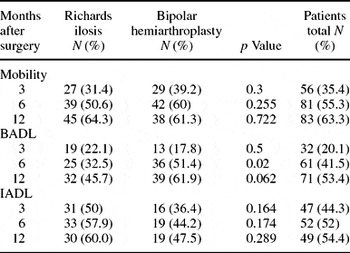
Regarding recovery of mobility and functional ability, there were no statistically significant differences in recovery of both ambulatory ability and ability of performing instrumental activities of daily living between the two patient groups, at 3, 6, and 12 months after surgery (Table 3). However, it was found that patients who underwent hemiarthroplasty were more likely to regain their prefracture ability of performing basic activities of daily living at 6 months after surgery (p value 0.02). There were no differences in recovery of basic activities at 3 or 12 months after surgery between the two patient groups. It is interesting that, for all three outcomes studied, the greatest functional recovery for both patient groups was during the first 6 months after the fracture compared with that of the following 6 months.
Recovery of Ambulatory and Functional Ability during the Follow-up Period

BADL, basic activities of daily living; IADL, instrumental activities of daily living.
Hospital Costs
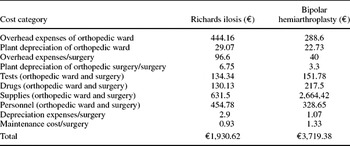
The mean cost of pharmaceuticals per patient treated with ilosis was estimated at €130.13 (SD 25.32; 95 percent confidence interval [CI], 121.92 to 138.34), whereas for those who underwent hemiarthroplasty it was €217.50 (SD, 40.07; 95 percent CI, 200.57 to 234.42). The mean cost for medical examinations per patient with ilosis was estimated at €134.34 (SD, 34.02; 95 percent CI, 123.46 to 145.22) and for those treated with hemiarthroplasty reached the amount of €151.78 (SD, 44.31; 95 percent CI, 133.07 to 170.49).
The total cost of supplies and consumables, used during anesthesia, surgery, and ward stay, was estimated at €631.5 by case treated with ilosis and €2,664.42 per patient underwent hemiarthroplasty. The cost of supplies for anesthesia and ward stay was quite similar between the two patient groups, whereas the cost of surgery was remarkably higher for patients treated with hemiarthroplasty (€2,608.91 per case) compared with those treated with ilosis (€566 per case).
The total personnel cost, including physicians, nurses, and physiotherapists, for the treatment and care per patient was estimated at €454.78 for ilosis and €328.65 for hemiarthroplasty.
The cost for ancillary services and fixed costs for ilosis patients were €29.03 per patient day, and the cost per case was €444.16. The cost per hour of surgery was estimated at €64.4. Because the mean duration of surgery for these patients 90 minutes, the cost for ancillary services and fixed costs was €96.6. For patients underwent hemiarthroplasty, the corresponding cost per day was €24.88, and the total cost per case was €288.6. The hourly cost for ancillary services and fixed costs was estimated at €32, and because the mean duration of this type of surgery was 75 minutes, the cost for ancillaries and overheads was €40. Table 4 shows the analysis by cost item, including depreciation allowances for the cost of medical equipment used for the two types of patients.
Hospital Cost of Treating Trochanteric Hip Fracture, per Cost Category and Operative Technique

Extrapolation to the total number of hip fracture operations in the year 2001 gives an estimate of €15.6 million spent in the treatment of patients with trochanteric hip fracture (6.398 iloses and 765 hemiarthroplasties). This amount accounts for 0.11 percent of total health expenditure. To carry cost calculations based on 2001 costs to 2005, we used the standard discounting technique (Reference Drummond, O' Brien, Stoddart and Torrance4), and at a 3 percent discount rate, we estimated the cost per patient at €2,173 for ilosis and €4,186 for hemiarthroplasty.
DISCUSSION
There are several methodological concerns regarding previous studies that have examined the use of prosthetic replacement for the treatment of comminuted intertrochanteric fractures in the elderly patient. Many have been small case series without a control group. There are few comparative studies and even fewer prospective, randomized controlled trials that have compared prosthetic replacement surgery with standard internal fixation techniques in the long run. Except for three reports of studies conducted at two Belgian university hospitals (Reference Broos, Rommens, Deleyn, Geens and Stappaerts1;Reference Haentjens, Casteleyn, De Boeck, Handelberg and Opdecam5;Reference Stappaerts, Deldycke, Broos, Staes, Rommens and Claes22), all other reports on using endoprostheses for intertrochanteric fractures did not entail a control group for comparative purposes. Despite these methodological concerns, several authors have reported successful prosthetic replacement for treating intertrochanteric fractures and their complications in elderly patients.
In the present study, a nonrandomized convenience sample was used, which does not preclude potential sampling bias. However, this methodological design is—as stated above—in accordance with the one used in the majority of the relevant literature. We should nevertheless note an attempt that was made to match the two patient groups compared, according to several selected characteristics. Of course, there is the possibility that the two groups compared were dis-similar due to other factors, not accounted for in this process.
Another limitation of the study is that specific cost dimensions such as lost productivity of patients' relatives during hospitalization and patients' intangible cost due to disease suffering, pain, and decline of the quality of their life, were not estimated. Finally, a possible source of bias could be that the retrospective data collection regarding patients' health and functional status during the follow-up period was based on their recalling ability.
In-hospital mortality rate for trochanteric hip fracture patients was estimated at 4 percent, which is quite similar to rates found in other studies (Reference Koval, Skovron, Aharonoff, Meadows and Zuckerman12;Reference Koval, Skovron, Aharonoff and Zuckerman13;Reference Magaziner, Simonsick, Kashner, Hebel and Kenzora19;Reference Myers, Robinson and Natta20). Mortality rates 1 year after surgery have been reported to range from 15 percent to 40 percent (Reference Dolk3;Reference Kenzora, McCarthy, Lowell and Sledge11;Reference White, Fisher and Laurin23), which is comparable to present study's results (18.9 percent). However, comparison with historical mortality rates is hampered not only by the inability to match patient characteristics but also by uncertainty as to how those mortality rates were calculated.
The examination of the use of arthroplasty for the treatment of comminuted intertrochanteric fractures in the elderly patients, results in several methodological concerns regarding previous studies. Other reports have varied widely in their period for patient inclusion, time of publication, prosthetic components and outcome measures used, and length of follow-up. The chief outcome measure used has been the incidence of complications after operation.
Comparing the effectiveness of ilosis and hemiarthroplasty resulted in no statistically significant difference in mortality rate between the two patient groups. Three months after surgery, patients treated with ilosis were more likely to have died (p value .038). There was no difference, however, between the two patient groups with regard to mortality rate both during 3–6 months and 6–12 months after surgery, as well as 1 year of follow-up. The last result is similar to that found by Haentjens et al. (Reference Haentjens, Casteleyn, De Boeck, Handelberg and Opdecam5) and Broos et al. (Reference Broos, Rommens, Deleyn, Geens and Stappaerts1), reporting that mortality 1 year after fracture did not differ between patients treated with ilosis and others treated with arthroplasty. Likewise, in the randomized trial described by Stappaerts et al. (Reference Stappaerts, Deldycke, Broos, Staes, Rommens and Claes22), mortality rates were comparable between the two groups. However, the duration of the follow-up period was impressively short (i.e., limited to only 3 months).
In the earliest comparison of prosthetic replacement with internal fixation (Reference Haentjens, Casteleyn, De Boeck, Handelberg and Opdecam5), the frequency of complications during the year of follow-up was found to be significantly lower for the patients who had arthroplasty. This finding was thought to be due mainly to rapid mobilization of the prosthetic group as compared with those fixed internally. In our study, we did not observe a statistically significant difference in the frequency of out-of-hospital (after discharge) complications in favor of hemiarthroplasty during the year, something that could be attributed to the relatively small sample size.
Almost all previous reports were confined to patients who were cognitively intact, were able to walk independently, and were living at home before the fracture. Whether a similarly low postoperative complication rate can be replicated, even among demented and unreliable patients, remains to be clarified.
Studies on the ability to resume basic or complicated daily activity functions are limited either to all patients with hip fracture, or to patients with different types of fractures. We cannot, therefore, compare patients with trochanteric fracture who were subjected to different types of operations. The study results indicate that patients treated with hemiarthroplasty were likely to regain their prefracture ability of performing basic activities of daily living sooner than those who underwent ilosis, although there were no differences in regaining ambulatory ability and instrumental activities of daily living ability between the two patient groups.
Overall, there is insufficient evidence whether arthroplasty has any advantage over osteosynthesis for extracapsular hip fractures. Although hemiarthroplasties for extracapsular fractures have the theoretical advantage because the patient can bear full weight immediately after surgery, an argument against primary arthroplasty has been the possibility of increased postoperative mortality. This argument cannot be supported by the empirical data provided both in the three comparative studies (Reference Broos, Rommens, Deleyn, Geens and Stappaerts1;Reference Haentjens, Casteleyn, De Boeck, Handelberg and Opdecam5;Reference Stappaerts, Deldycke, Broos, Staes, Rommens and Claes22) as well as the present study. Further well-designed randomized trials for the treatment of these fractures for this comparison are required. The more-detailed functional evaluation may help identify a subgroup of patients who may benefit more from one form of surgical technique than another.
Concerning the hospital cost for the care of patients with hip fractures, the literature survey shows that the majority of studies use disease-specific per diem cost, without distinguishing between different types of fractures or types of surgery performed. The frequent use of mean per diem cost with data that are easy and inexpensive to collect, does not, however, reflect the true cost of resources used. For example, the studies of Wiktorowicz et al. (Reference Wiktorowicz, Goeree and Papaioannou24), Lippuner et al. (Reference Lippuner, von Overbeck, Perrelet and Jaeger16), and Lyritis (Reference Lyritis18), use the mean daily cost without reference to the management of patients (conservative or interventional, and the type of operation) and the cost differences due to the different approach used. The few studies that have attempted a microeconomic approach (Reference Hollingworth, Todd and Parker7;Reference Jacobs and Markel8), ignore significant determinants of hospital cost, such as personnel cost and ancillary services, and they do not accurately report the methodological framework of the cost calculations used.
An attempt to compare the cost findings in our study with those in comparable studies has to deal with problems of differences in the study time frame, and the types of interventions used. The overall cost of hospital treatment of patients with hip fractures varies from $1,872 (Reference Lopes Vaz17) to $8,575 (Reference Lawrence, White, Wenn and Moran14). The usual cost estimates range between $6,000 and $9,000, generally much higher than our estimates. The difference is attributed to a large extent to salary differences and to the very low administered prices for diagnostic tests. Hospital charges in Greece do not reflect the true value or cost of resources used (Reference Kaitelidou, Ziroyanis, Maniadakis and Liaropoulos9).
Comparison of the hospital cost for the two types of intervention shows that treating patients with trochanteric fractures with noncemented bipolar hemiarthroplasty is 92.5 percent higher than ilosis. The main cost determinants for patients with ilosis is the cost of supplies, which account for 32 percent of total cost; overheads and ancillary costs accounting for 24 percent; and personnel costs, which contribute 23 percent. Hospital supplies are, by far, the main cost factors for hemiarthroplasty, accounting for 71 percent of the cost, with personnel and overheads contributing only 9 percent and 8 percent, respectively.
That the two interventions have been studied in two different hospitals makes comparisons of their hospital cost component subject to bias due to differences in the respective organizational environments. For this reason, we compare the various cost components in an attempt to account for this “hospital effect.” Concerning the cost of lab tests, there is no significant difference between the patient groups. The opposite happens when we look at pharmaceutical costs, with hemiarthroplasty patients incurring higher costs than ilosis patients (p < 5 percent). The difference in the cost of supplies is much more marked, due to the cost of arthroplasty prostheses. According to Chan and Gill (Reference Chan and Gill2), this is one of the reasons for the limited use of arthroplasty. There is also a significant difference in the fixed costs and the supportive services cost component in orthopedic departments (24 percent compared with 8 percent) as well as in personnel costs (23 percent compared with 9 percent). The difference is due to the statistically significant difference in length of stay (p < 5 percent), with hemiarthroplasty patients hospitalized for a shorter period compared with ilosis patients.
A final finding is the inadequate reimbursement by social security funds for both types of intervention. Patients with ilosis are reimbursed at €1,640, or 75 percent of total cost, almost the same percent (77 percent) reimbursed for hemiarthroplasty patients.
Our findings show that arthroplasty costs are almost twice as much as ilosis, with no commensurate effectiveness advantage. It is, of course, true that effectiveness comparisons must extend beyond the 1-year horizon used in our study, and use larger study samples. It is for this reason that national data bases where patient follow-up results are recorded for a sufficient time period after hospital discharge are necessary. Creation of such a data pool will permit the assessment of medium and long-term health outcomes and cost-effectiveness of arthroplasty and the comparison of treatment modalities.
POLICY IMPLICATIONS
Further development of Health Technology Assessment in orthopedic surgery combined with economic evaluation principles will allow the comparison among competing technologies and interventions aiming at those with highest effectiveness at the least cost. This will be a significant contribution toward rationalizing public and private healthcare expenditure and cost-effective management of patients with hip fractures.
CONTACT INFORMATION
Vassiliki V. Papakonstantinou, RN, PhD (bpapakost@nurs.uoa.gr, bpapakost@yahoo.gr), Researcher, Daphne Kaitelidou, RN, PhD (dkaitelid@nurs.uoa.gr), Lecturer, Researcher, Center for Health Services, Management and Evaluation, Faculty of Nursing, University of Athens, 123, Papadiamantopoulou Street, Athens, Greece 11527
Kassiani D. Gkolfinopoulou, RN, PhD (golfinopoulou@keelpno.gr), Invited Lecturer, Faculty of Nursing, University Of Peloponnese, General Hospital of Sparta, Sparta, Greece, 23 100; RN, Department of Epidemiological Surveillance & Intervention, Hellenic Center for Disease Control & Prevention, 56, 3rd September Street, Athens, Greece, 104 33
Olga Ch. Siskou, RN, PhD (olsiskou@nurs.uoa.gr), Researcher, Center for Health Services Management and Evaluation, Faculty of Nursing, University of Athens, 123 Papadiamantopoulou Street, Athens, Greece, 11527
Theodoros Papapolychroniou, MD, Assistant Medical Director, Department of Orthopedics, NIMTS Hospital, 10, Monis Petraki Street, Athens, Greece, 11521
Panagiotis Baltopoulos, MD, PhD (panbalt@phed.uoa.gr), Assistant Professor, Faculty of Physical Education & Sport Science, University of Athens, 41, Ethnikis Antistaseos Street, Athens, Greece, 172 37; Assistant Medical Director, Department of Orthopedics, KAT Hospital, 2, Nikis Street, Athens, Greece, 145 61
Lycourgos Liaropoulos, PhD (lliaropo@nurs.uoa.gr), Professor; Director, Center for Health Services, Management and Evaluation, Faculty of Nursing, University of Athens, 123, Papadiamantopoulou Street, Athens, Greece, 11527