Introduction
The genus Lichenothelia D. Hawksw. was introduced by Hawksworth (Reference Hawksworth1981) for the Microthelia aterrima group, and included two species: Lichenothelia metzleri (Lahm) D. Hawksw. and L. scopularia (Nyl.) D. Hawksw. Henssen (Reference Henssen1987) provided the first thorough inventory of the genus Lichenothelia and treated 20 species, 18 of them newly described: L. calcarea Henssen, L. convexa Henssen, L. dendritica Henssen, L. echinulata Henssen, L. gigantea Henssen, L. globulifera Henssen, L. intermedia Henssen, L. intermixata Henssen, L. macrocarpa Henssen, L. minor Henssen, L. paradoxa Henssen, L. patagonica Henssen, L. prolifera Henssen, L. radiata Henssen, L. schindleri Henssen, L. solitaria Henssen, L. solitarioides Henssen, and L. tenuissima Henssen. After this pioneering work, several more species were added: L. antarctica Øvstedal from quartz-mica-schist in Antarctica (Øvstedal & Lewis Smith Reference Øvstedal and Lewis Smith2001), L. renobalesiana D. Hawksw. & V. Atienza from limestone and on endolithic thalli of different calcicolous Verrucariaceae in Spain and England (Atienza & Hawksworth Reference Atienza and Hawksworth2008), L. uralensis Zhurb. from siliceous rock in the Ural Mountains in the north-eastern part of European Russia (Zhurbenko Reference Zhurbenko2008), and L. spiralispora (“spiratispora”) Etayo, lichenicolous on Acarospora in Spain (Etayo Reference Etayo2010). Finally, Muggia et al. (Reference Muggia, Kocourková and Knudsen2015 a) added L. arida Muggia et al., L. umbrophila Muggia et al. and L. umbrophila var. pullata Muggia et al., all growing on siliceous rocks, from Europe and the USA. Ertz et al. (Reference Ertz, Lawrey, Common and Diederich2013) combined Lichenostigma rugosum G. Thor as Lichenothelia rugosa (G. Thor) Ertz & Diederich due to the division of stromatic cells by septa (vs. budding in Lichenostigma) and the results of phylogenetic studies.
According to Hawksworth (Reference Hawksworth1981), Henssen (Reference Henssen1987), Hyde et al. (Reference Hyde, Jones, Liu, Ariyawansa, Boehm, Boonmee, Braun, Chomnunti, Crous and Dai2013), and Muggia et al. (Reference Muggia, Kocourková and Knudsen2015 a), Lichenothelia is circumscribed by the following set of characters: thallus not lichenized, forming a black crust, composed of scattered stromata or of scattered to continuous areoles, pseudoparenchymatous, often with stolons bearing microthalli developing into new areoles, thus the single stromata are frequently connected by black superficial hyphae; either with perithecioid and ostiolate ascomata with interascal filaments or non-ostiolate stromata with pseudoparenchymatous locules, releasing ascospores through decay of the stroma wall (some species show intermediate characters); asci bitunicate, globose to clavate, outer layers or apex of ascus K/I+ blue or not, containing (2–)4–8 ascospores; ascospores first hyaline, becoming pale, golden, dark or reddish brown, usually ornamented and halonate, ellipsoid to soleiform, 1-septate to muriform; macroconidia, if present, black, globose, multicellular, often stipitate, originating from the thallus surface; conidiomata, if present, immersed in stromata, with globose to elongated conidiogenous cells and simple, hyaline, rod-shaped conidia.
Most of the described species of this globally distributed genus are either epi- or endolithic, either endocapylic or episubstratic on lichens or are saprophytic. Commonly they live in close contact with colonies of different algae or cyanobacteria (Henssen Reference Henssen1987). Hawksworth (Reference Hawksworth1981) suggests that this mixture of algae and cyanobacteria is a source of carbohydrate for Lichenothelia.
The genus belongs to the polyphyletic ecological group of rock-inhabiting fungi (RIF) or black meristematic fungi (in a strict sense RIF are invariably asexual). These organisms are specialists in extremotolerance, living in different stressful environments such as deserts, exposed rocks, or even saltpans or acidic sites (Selbmann et al. Reference Selbmann, Zucconi, Isola and Onofri2015). On exposed rocks these fungi have to face extreme conditions such as exposure to drought, strong winds, substantial changes in temperature (including repeated freeze-thaw cycles), high evaporation (also causing osmotic stress), and strong solar radiation delivering both visible and ultraviolet light. Their stress-resistance is thought to result from the high melanin content and thick cell walls. Melanin is believed to protect the RIF from extreme cold or heat, extreme pH or osmotic conditions, toxicity of metals, and ultraviolet or even ionizing radiation (Dadachova et al. Reference Dadachova, Bryan, Huang, Moadel, Schweizer, Aisen, Nosanchuk and Casadevall2007; Selbmann et al. Reference Selbmann, Egidi, Isola, Onofri, Zucconi, de Hoog, Chinaglia, Testa, Tosi and Balestrazzi2013a , Reference Selbmann, Grube, Onofri, Isola and Zucconi b , 2015). Another adverse condition of exposed rocks, especially in deserts, is the low availability of energy-rich carbon sources. RIF are thought to gain these from neighbouring algae and cyanobacteria. This putative mode of nutrition is coupled with extremely slow metabolism and growth rates (Selbmann et al. Reference Selbmann, Zucconi, Isola and Onofri2015).
Recently, several attempts have been made to clarify the phylogeny of Lichenothelia species. Whereas Henssen & Jahns (Reference Henssen and Jahns1974) and Hawksworth (Reference Hawksworth1981) placed the Lichenotheliaceae in the order Dothideales, Hyde et al. (Reference Hyde, Jones, Liu, Ariyawansa, Boehm, Boonmee, Braun, Chomnunti, Crous and Dai2013) erected the new order Lichenotheliales K. Knudsen et al. within Dothideomyceta. Ertz et al. (Reference Ertz, Lawrey, Common and Diederich2013) realized that Lichenostigma s. str. does not belong to the Lichenotheliaceae but to the new order Lichenostigmatales within the Arthoniomycetes, whereas species of Lichenostigma with vegetative cells separating by septation (vs. budding in the Lichenostigmatales), which represent most species of the subgenus Lichenogramma, belong to the Lichenotheliaceae. However, a recombination was made only for Lichenostigma rugosum to Lichenothelia rugosa.
Ertz et al. (Reference Ertz, Lawrey, Common and Diederich2013) and Muggia et al. (Reference Muggia, Gueidan, Knudsen, Perlmutter and Grube2013, Reference Muggia, Kocourková and Knudsen2015 a, Reference Muggia, Fleischhacker, Kopun and Grube b ) provided cladograms of the phylogenetic relationships within Dothideomyceta including Lichenothelia species and showed that most of the species or samples cluster within the Lichenotheliales. In Muggia et al. (Reference Muggia, Gueidan, Knudsen, Perlmutter and Grube2013) single specimens were placed outside of this group, into Teratosphaeriaceae or unnamed groups, in one type of analysis and in another analysis within the Lichenotheliales. Lichenothelia tenuissima clustered twice outside the Lichenotheliales, once near the Myriangiales and once in a group with Saxomyces. The authors stated that these placements might be due to the amplification of contaminating fungi but this was not mentioned in Muggia et al. (Reference Muggia, Fleischhacker, Kopun and Grube2015b ). Nevertheless, it appears that the risk of contamination in the analysis was high, consequently the placement of single samples of Lichenothelia outside the Lichenotheliales group is not sufficient to doubt the monophyly of Lichenothelia as described above. We therefore place our two new species, in Lichenothelia since they fit the features of the genus perfectly.
Materials and Methods
This study is based on specimens collected by the first author in 2004 and 2009. Morphological and anatomical observations were made using standard microscopic techniques. Microscopic measurements were made on hand-cut sections mounted in water with an accuracy of up to 0·5 µm. Measurements of ascospores are recorded as (minimum–) x̅–1SD–x̅+1SD (–maximum) followed by the number of measurements.
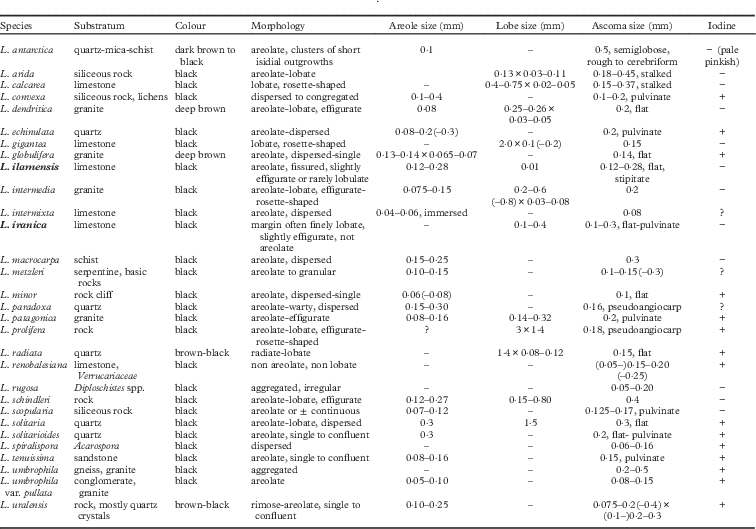
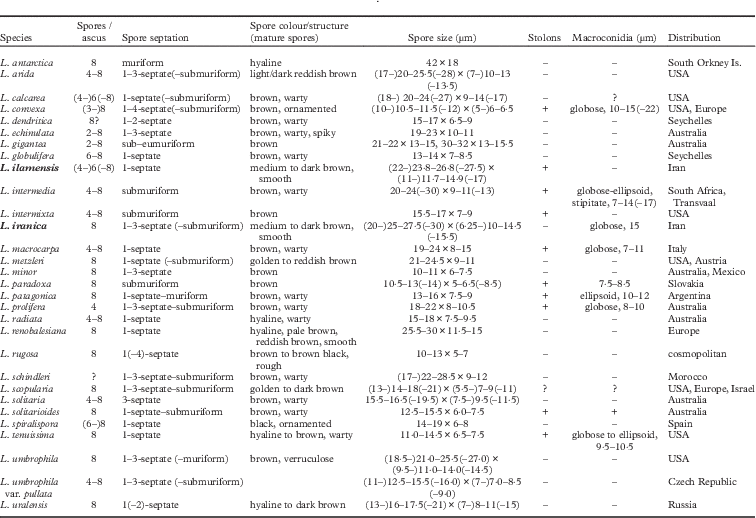
A list of the main distinguishing characters of Lichenothelia species (Tables 1 and 2) was compiled from our own observations, the original descriptions and other literature (Hawksworth Reference Hawksworth1981; Thor Reference Thor1985; Henssen Reference Henssen1987; Øvstedal & Lewis Smith Reference Øvstedal and Lewis Smith2001; Atienza & Hawksworth Reference Atienza and Hawksworth2008; Zhurbenko Reference Zhurbenko2008; Etayo Reference Etayo2010; Knudsen & Kocourková Reference Knudsen and Kocourková2010; Kocourková & Knudsen Reference Kocourková and Knudsen2011; Muggia et al. Reference Muggia, Kocourková and Knudsen2015a ). As noted by Muggia et al. (Reference Muggia, Kocourková and Knudsen2015a ), several species described by Henssen are almost impossible to determine due to the scarce information provided. Tables 1 and 2 are therefore no more than a guide to identification and it is hoped will be helpful in some cases.
Descriptions of the main distinguishing characters of Lichenothelia species
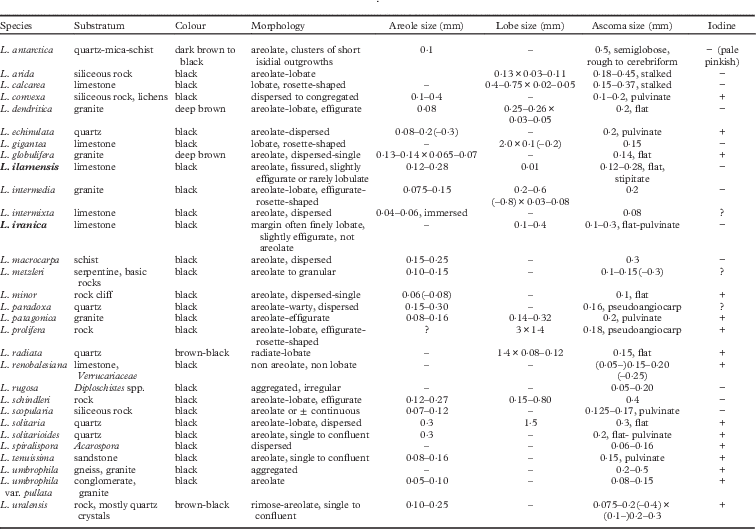
– = either no or not applicable except the Iodine test where it = no reaction; ? = data not available. New species in bold.
Further descriptions of the distinguishing characters of Lichenothelia species and their distribution
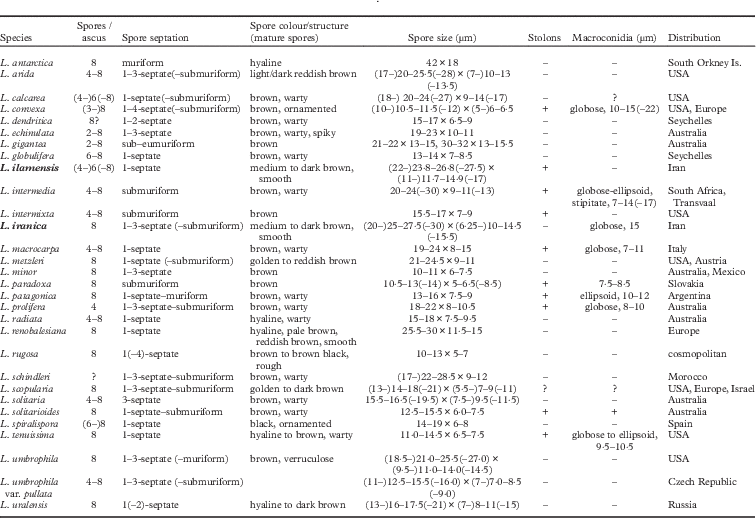
– = either no or not applicable except the Iodine test where it = no reaction; ? = data not available. New species in bold.
The Species
Lichenothelia iranica Valadbeigi, M. Schultz & Brackel sp. nov.
MycoBank No.: MB 801475
Thallus saxicola, niger, lobulatus, ascomata frequentia, rotunda vel subglobosa, ad c. 0·2–0·3 mm lata. Ascosporae 1–3-septatae vel submuriformes, (20·0–)25·0–27·5(–30·0)×(6·25–)9·75–14·50(–15·50)µm. Conidia c. 12·5–14·5 µm longa, macroconidia c. 15 µm longa.
Typus: Iran, Ilam, Tonele reno, 33°42'N, 46°24'E, on calcareous rock, alt. 2038m, 12 July 2009, T. Valadbeigi 101015 (HBG—holotypus; TARI, hb. Valadbeigi—isotypi).
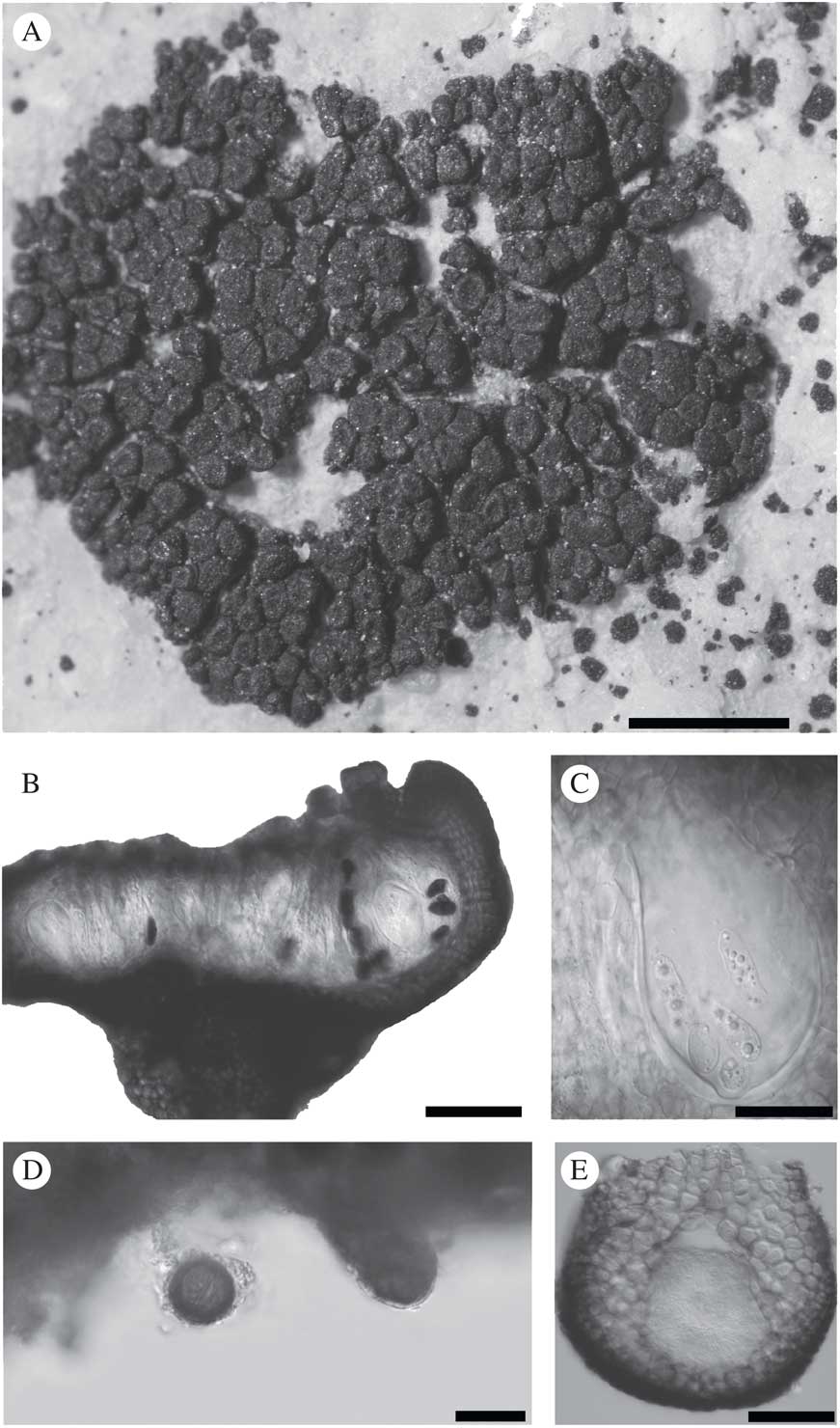
Lichenothelia iranica, holotype. A, thallus; B, section through an ascoma; C, ascus; D, external conidium (macroconidium); E, section through a pycnidium. Scales: A=0·9 mm; B=60 µm; C=20 µm; D=15 µm; E=50 µm.
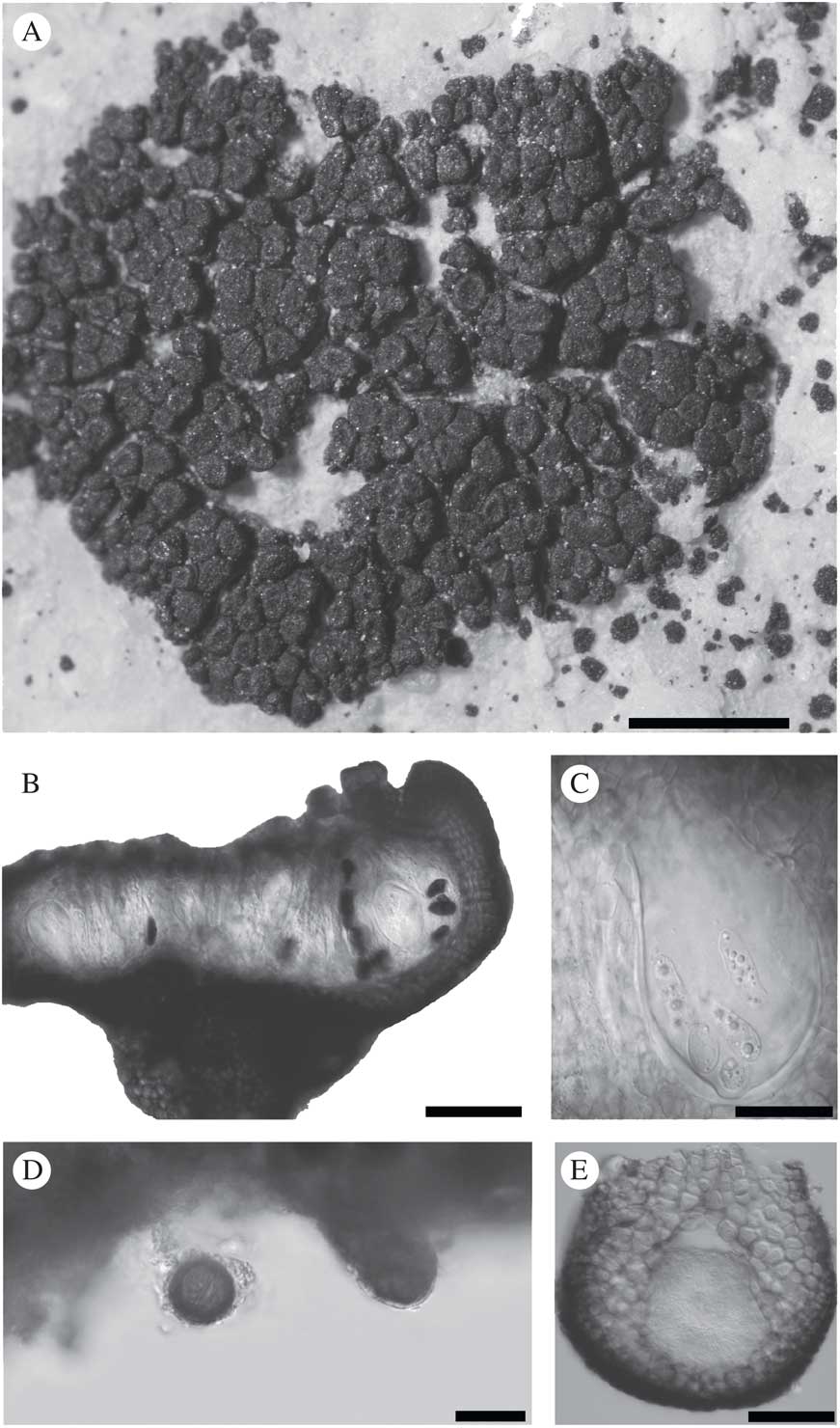
Thallus saxicolous, black, 2–6 mm diam., rounded, cracked, margin often finely lobate (marginal areoles slightly effigurate); lobes 0·1–0·4 mm, without stolons.
Ascomata unilocular stromata, frequent, crowded, rounded, shiny black, ostiolate, c. 0·1–0·3 mm wide; disc flat, sometimes umbonate. Ascomatal wall pseudoparenchymatous, up to 45 µm wide, of 3–4 rows of suborbicular cells, outside dark brown with a granular pigment, inside pale brown to hyaline. Centre with branching interascal filaments, 2·0–3·5 µm wide, some slightly swollen apically (up to 5 µm) and here pale brownish or with a brownish cap. Section I−, K/I− in all parts, partly dextrinoid. Asci ellipsoid to pyriform, c. 66×32 µm, 8-spored. Ascospores hyaline at first, soon brown to dark brown, smooth but seemingly ornamented due to the granular pigmentation, 1–3-septate, sometimes with 1–2 longitudinal or oblique septa, (20·0–)25·0–27·5(–30·0)×(6·25–)9·75–14·50(–15·50)µm (n=20).
Pycnidia resembling apothecia, smaller (c. 150 µm diam.) and less flattened, with a thick pseudoparenchymatous wall (up to 45 µm wide) of ±isodiametric cells, 6–13 µm wide; conidiophores short, branched, c. 5–7×2–3 µm, lining the inner wall of the cavity, conidiogenous cells c. 10×2–3 µm; conidia bacilliform, hyaline, non-septate, c. 1·5–2·0×6–8 µm. External conidia (macroconidia) brown, c. 15um.
Chemistry. Not investigated.
Etymology. The species epithet refers to its occurrence in Iran.
Habitat and distribution. So far recorded on limestone from a mountainous region in the west of Iran (south-western Asia).
Remarks. Lichenothelia iranica should be compared with other species on limestone and with those growing on unspecified ‘rock’. Lichenothelia intermixta, L. minor, and L. prolifera have much smaller ascospores (Table 2). Lichenothelia calcarea differs in the variable number of ascospores per ascus ((4–)6(–8)), whereas in L. iranica there are always 8 (Table 2). Moreover, L. calcarea has warty ascospores (smooth in L. iranica) and the net-forming lobes are much longer. Lichenothelia gigantea also differs in the variable number of spores per ascus (2–8) and the rosette-shaped thallus with long radiating lobes (Table 1). Lichenothelia renobalesiana differs in the thallus lacking radiating lobes and the almost consistently 1-septate ascospores. As we cannot exclude the possibility that L. metzleri and L. schindleri might also occur on calcareous rocks, we must compare the new species with these. The former differs in the I+ reaction of the asci and the golden to reddish brown colour of the ascospores, and the latter in the warty ornamentation of the ascospores.
Among the species on siliceous rocks with similar ascospore dimensions, L. echinulata, L. intermedia, L. macrocarpa, and L. umbrophila differ in the ornamented ascospores, while L. arida differs in the reddish brown colour of the ascospores, the varying number of spores per ascus and the areolate-lobate thallus. All other species on siliceous rocks have either much smaller or much larger ascospores.
Additional specimen examined. Iran: Ilam: Tonele reno, 33°42'N, 46°24'E, c. 2500 m, on calcareous rock, 2004, T. Valadbeigi 101000 (hb. Valadbeigi).
Lichenothelia ilamensis Valadbeigi, M. Schultz & Brackel sp. nov.
MycoBank No.: MB 801476
Thallus saxicola, crustaceus, areolatus, nigricans, ascosporae 1-septatae, (22·0–)23·8–26·8(–27·5)×(11·0–)11·7–14·9(–17·0) µm.
Typus: Iran, Ilam, Tonele reno, 33°42'N, 46°24'E, alt. 3038 m, on calcareous rock, 12 July 2009, T. Valadbeigi 101022 (HBG —holotypus; TARI, hb. Valadbeigi—isotypi).
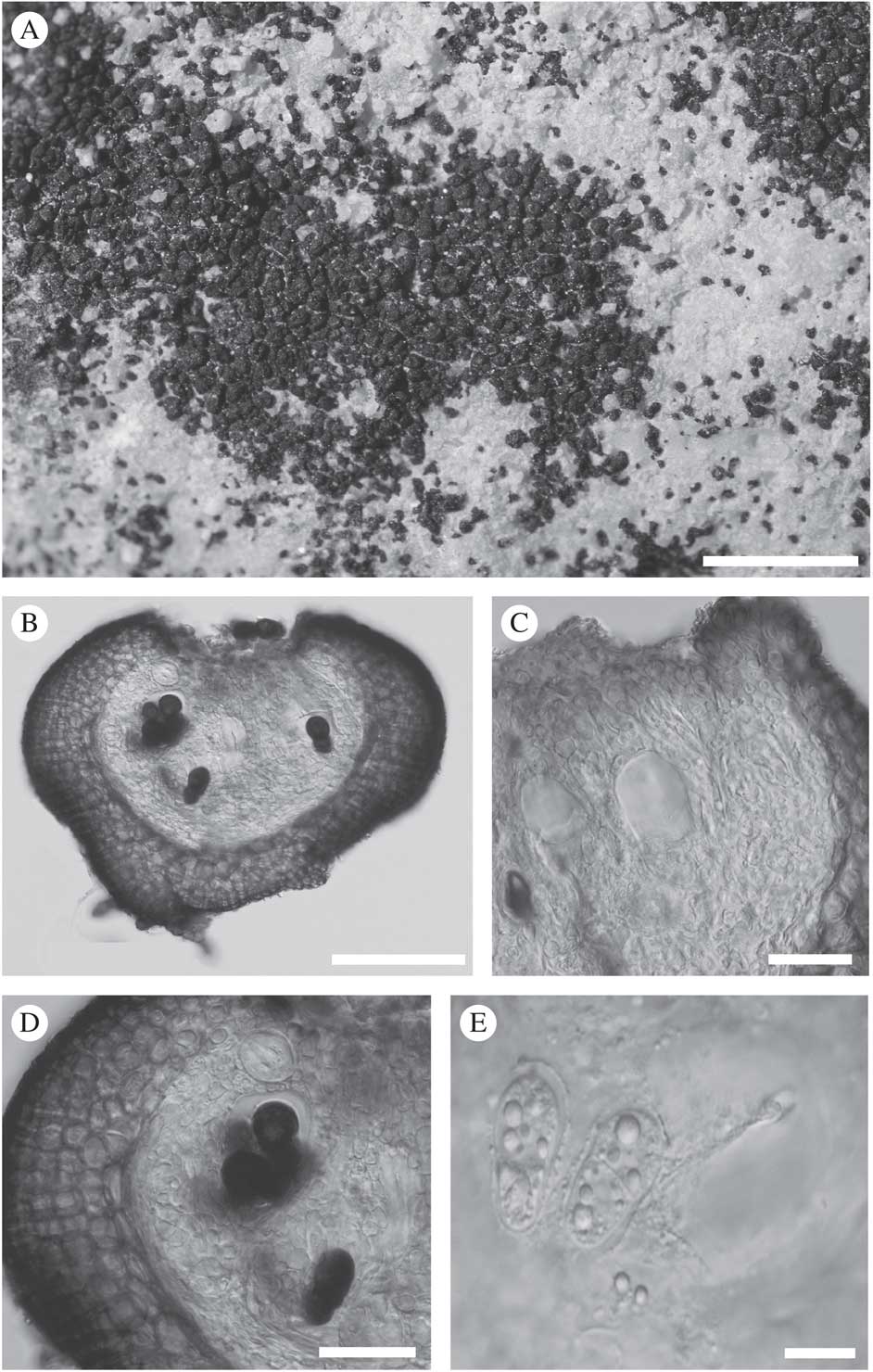
Lichenothelia ilamensis, holotype. A, thallus; B, section through an ascoma; C, asci; D, asci with dark brown ascospores; E, hyaline ascospores with perispores. Scales: A=4 mm; B & C=30 µm; D=35 µm; E=10 µm.
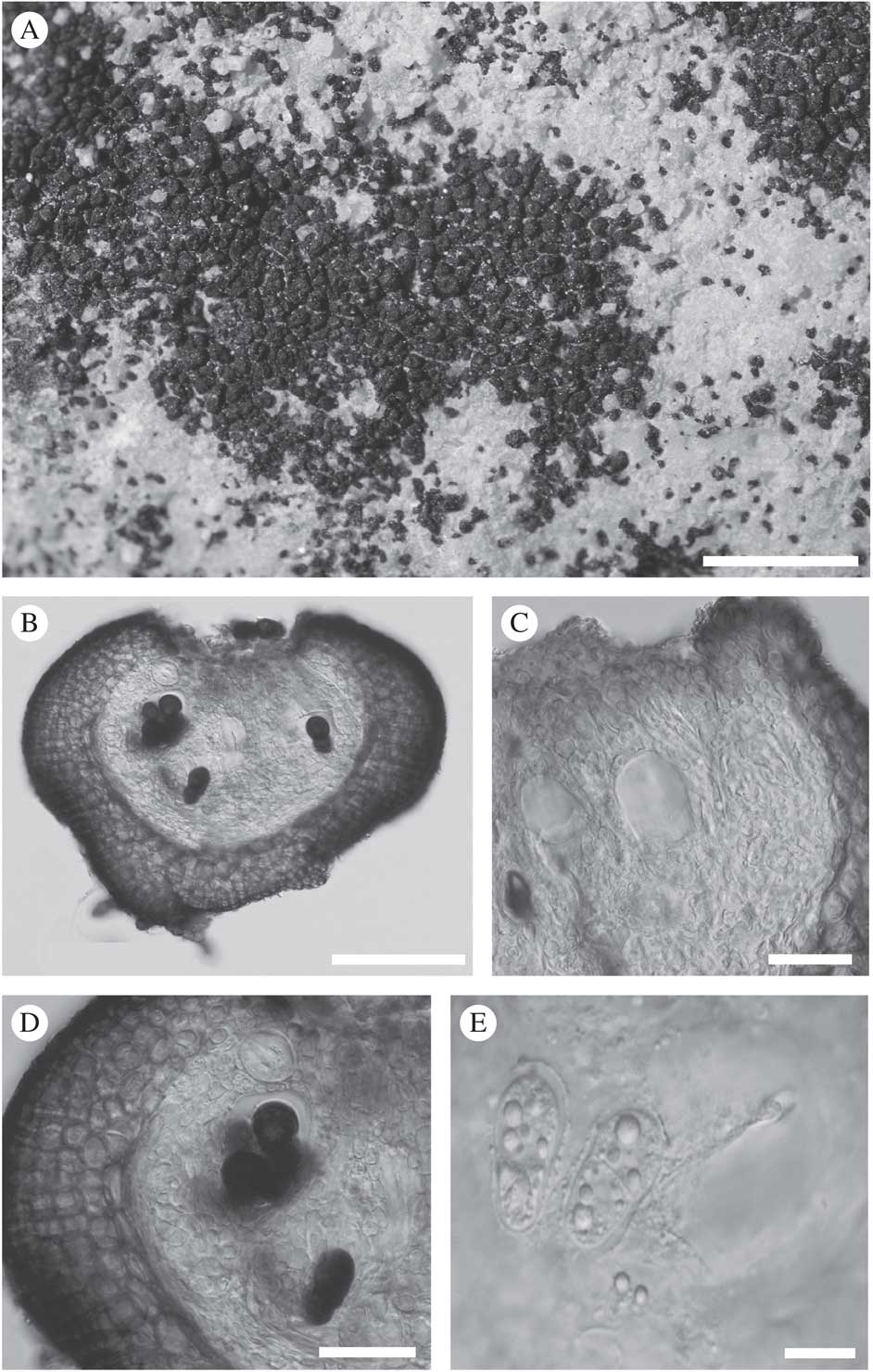
Thallus saxicolous, black, areolate, dispersed at margins, confluent and aggregated in the centre, up to 20 mm diam., not or slightly effigurate or rarely lobulate, with stolons, fissured; areoles c. 0·12–0·28 mm wide.
Ascomata unilocular stromata, frequent, rounded, shiny black, ostiolate, 0·12–0·28 mm, stipitate; disc flat, sometimes concave. Ascomatal wall pseudoparenchymatous, up to 70 µm wide, of 6–10 rows of suborbicular cells, outside dark brown with a granular pigment, inside pale brown to hyaline. Centre with branching interascal filaments, 1·0–2·5 µm wide, not easy to see except in KOH where they swell up to 4 µm. Section I−, K/I− in all parts, partly dextrinoid. Asci ellipsoid to pyriform 40–65×25–35 µm, (4–)6(–8)-spored. Ascospores hyaline at first, soon dark brown, smooth but seemingly ornamented owing to the granular pigmentation, 2-celled, (22·0–)23·8–26·8(–27·5)×(11·0–)11·7–14·9(–17·0) µm, l/b=(1·6–)1·7–2·1(–2·3) (n=20), hyaline spores with perispore.
Pycnidia not observed.
Chemistry. Not investigated.
Etymology. The species epithet refers to the occurrence in Ilam, western Iran.
Habitat and distribution. Known on limestone in mountainous regions, from one locality only in Western Iran.
Remarks. Lichenothelia ilamensis differs from L. iranica in the consistently 1-septate ascospores and in the varying number of spores per ascus. It also has to be compared with the other calcicolous species of the genus and with others growing on unspecified ‘rock’. Of these, L. intermixta, L. minor, and L. prolifera have smaller ascospores; L. metzleri and L. schindleri have narrower ascospores. Lichenothelia calcarea and L. gigantea differ in the 1-septate to submuriform ascospores, whereas the ascospores in L. ilamensis are always 1-septate. Lichenothelia renobalesiana differs in the consistently 8-spored asci (Table 2).
Most of the other species of the genus have at least some pluriseptate or submuriform spores. Among the species with 1-septate ascospores, L. spiralispora, L. tenuissima, L. radiata and L. globulifera have smaller ascospores, and L. macrocarpa has warty ascospores.
The authors are most grateful to Kerry Knudsen (Riverside, California), Lucia Muggia (Graz, Austria), Laura Selbmann (Viterbo, Italy), and Mikhail Zhurbenko (St. Petersburg, Russia) for sending us their papers. Harrie Sipman (Berlin, Germany) supported our work greatly with his hospitality and extensive discussions. The study was financially supported by a grant from Ilam University, awarded to the first author.