Introduction
Immigration, and especially being part of an ethnic minority, is associated both with heightened risk of psychosis (Cantor-Graae & Selten, Reference Cantor-Graae and Selten2005; Bresnahan et al. Reference Bresnahan, Begg, Brown, Schaefer, Sohler, Insel, Vella and Susser2007; Bourque et al. Reference Bourque, van der Ven and Malla2011), and high rates of social adversity. Environmental factors such as lower socioeconomic status, disadvantage, discrimination, parental separation and urban environment contribute to this heightened risk (Karlsen et al. Reference Karlsen, Nazroo, McKenzie, Bhui and Weich2005; Veling et al. Reference Veling, Selten, Susser, Laan, Mackenbach and Hoek2007; Morgan et al. Reference Morgan, Kirkbride, Hutchinson, Craig, Morgan, Dazzan, Boydell, Doody, Jones, Murray, Leff and Fearon2008). Ethnic minority groups also have an increased risk of adverse childhood experiences (Morgan et al. Reference Morgan, Kirkbride, Leff, Craig, Hutchinson, McKenzie, Morgan, Dazzan, Doody, Jones, Murray and Fearon2007; Morgan & Fearon, Reference Morgan and Fearon2007).
There is growing interest in the effects of adverse childhood experiences on psychosis development in general, because of the higher prevalence of childhood trauma in psychotic disorders (Read et al. Reference Read, van Os, Morrison and Ross2005; Fisher et al. Reference Fisher, Craig, Fearon, Morgan, Dazzan, Lappin, Hutchinson, Doody, Jones, McGuffin, Murray, Leff and Morgan2011). A comprehensive review revealed rates of childhood sexual abuse in patients with psychosis to be 42% for women and 28% for men, and childhood physical abuse 35% for women and 38% for men (Morgan & Fisher, Reference Morgan and Fisher2007). Meta-analysis of 41 studies found trauma to increase the risk of psychosis with an odds ratio (OR) of 2.8 (Varese et al. Reference Varese, Smeets, Drukker, Lieverse, Lataster, Viechtbauer, Read, van Os and Bentall2012), and population studies suggest childhood maltreatment to be a significant predictor of psychotic symptoms later in life even among people who do not require treatment for a mental disorder (Read et al. Reference Read, Agar, Argyle and Aderhold2003).
Traumatic stress is also associated with symptomatology in psychosis. Childhood abuse is associated with positive symptoms in patients with psychosis (Ramsay et al. Reference Ramsay, Flanagan, Gantt, Broussard and Compton2011; Perona-Garcelan et al. Reference Perona-Garcelan, Carrascoso-Lopez, Garcia-Montes, Ductor-Recuerda, Lopez Jimenez, Vallina-Fernandez, Perez-Alvarez and Gomez-Gomez2012) and particularly sexual and emotional trauma are linked to auditory verbal hallucinations in patients and non-patients alike (Bentall et al. Reference Bentall, Wickham, Shevlin and Varese2012; Daalman et al. Reference Daalman, Diederen, Derks, van Lutterveld, Kahn and Sommer2012). Hallucination proneness in patients with schizophrenia is associated with childhood trauma, especially childhood sexual abuse (Wigman et al. Reference Wigman, van Nierop, Vollebergh, Lieb, Beesdo-Baum, Wittchen and van Os2012), which also correlates with auditory hallucinations in bipolar disorder (Hammersley et al. Reference Hammersley, Dias, Todd, Bowen-Jones, Reilly and Bentall2003). Hallucinations are more frequent within some minority groups with psychosis such as African Caribbeans in the UK and African-Americans and Latinos in the USA (Harvey et al. Reference Harvey, Williams, McGuffin and Toone1990; Strakowski et al. Reference Strakowski, McElroy, Keck and West1996; Barrio et al. Reference Barrio, Yamada, Atuel, Hough, Yee, Berthot and Russo2003) as well as non-clinical samples of ethnic minorities with non-Western or African Caribbean background (Johns et al. Reference Johns, Nazroo, Bebbington and Kuipers2002; Vanheusden et al. Reference Vanheusden, Mulder, van der Ende, Selten, van Lenthe, Verhulst and Mackenbach2008).
The prevalence of childhood trauma in ethnic minority groups in general is not well documented. As a group they are found to be overrepresented in child services and more often placed outside the home by child services compared to children from the majority population both in Norway and the USA (Dzamarija & Kalve, Reference Dzamarija and Kalve2004; Hill, Reference Hill2007). There are reports of more childhood sexual and physical abuse in women from ethnic minorities residing in urban areas (Hien & Bukszpan, Reference Hien and Bukszpan1999), while others find no significant variation across ethnic groups (Thombs et al. Reference Thombs, Bennett, Ziegelstein, Bernstein, Scher and Forde2007). Among persons with prodromal symptoms of psychosis ethnic minorities reported more childhood trauma (Wigman et al. Reference Wigman, van Winkel, Raaijmakers, Ormel, Verhulst, Reijneveld, van Os and Vollebergh2011). The same is found in persons at high risk for psychosis in which ethnic minorities reported significantly more childhood trauma and parental separation than the majority, and that this is associated with positive symptoms (Thompson et al. Reference Thompson, Kelly, Kimhy, Harkavy-Friedman, Khan, Messinger, Schobel, Goetz, Malaspina and Corcoran2009).
Ethnic minorities are thus found to have heightened risk of psychosis and some studies support more hallucinations in these groups. Further, this group seems to have an increased risk of childhood trauma. Childhood trauma has also been linked to positive psychosis symptoms, specifically auditory hallucinations. However, whether more childhood trauma in ethnic minorities partially explains more hallucinations in this group has not yet been investigated. The main aim with the current study was to explore the prevalence and possible effect on symptomatology of childhood trauma in ethnic minorities with psychosis. We hypothesized that in a sample of persons with psychotic disorder, broadly defined, we would find that:
-
(1) psychosis patients from ethnic minorities would report more childhood trauma than patients from the ethnic majority population, and that
-
(2) psychosis patients from ethnic minorities would have more severe current levels of hallucinations and higher lifetime presence of auditory hallucinations compared to ethnic majority patients, and that
-
(3) childhood trauma would mediate the association between ethnic minorities and hallucinations.
Method
The current study is part of the ongoing ‘Thematically Organized Psychosis’ (TOP) Study at the University of Oslo, and was approved by the Regional Committee for Medical Research Ethics and the Norwegian Data Inspectorate. Our research methodology conformed to The Code of Ethics of the World Medical Association, Helsinki Declaration (WMA, 2008). The study had a cross-sectional design including a large, non-selected consecutively recruited catchment area sample of patients with a DSM-IV psychotic disorder.
Sample
Our sample consists of adult patients with confirmed lifetime psychotic disorder. We recruited consecutively from in- and out-patient units at four hospitals in Oslo covering a catchment area of 540 000 (88% of Oslo's total population). Clinicians from the recruitment units were asked, and reminded at regular intervals, to refer patients with a clear or potential diagnosis of any psychotic disorder including bipolar disorder. Those who gave informed consent to participate were assessed by a team consisting of trained psychologists and psychiatrists. Inclusion criteria were age 18–65 years, IQ > 70, no signs of organic aetiology or substance induced symptoms, ability to understand and speak a Scandinavian language. The treatment units served all patients living in these areas and there were no alternative psychiatric services offering treatment for psychotic disorders, thus reducing possible recruitment bias.
Instruments
Diagnosis
Diagnosis was assessed with The Structured Clinical Interview for DSM-IV (SCID-I), affective, psychotic, and substance abuse sections (A–E) (APA, 1994). The reliability and validity of DSM-IV diagnoses across ethnic groups were ensured by the previous participation of all study clinicians in an international training programme that included diagnosis of patients of different ethnic backgrounds (Ventura et al. Reference Ventura, Liberman, Green, Shaner and Mintz1998). All assessments included a full life history of actual study patients and videotapes (training videos), so assessors were not blind to information about ethnicity. Difficult differential diagnoses were decided by consensus among study clinicians. The overall agreement for DSM-IV diagnoses was 82% with an overall kappa of 0.77 [95% confidence interval (CI) 0.60–0.94].
Symptoms/function
Symptom severity and function were rated separately with a split version of the Global Assessment of Functioning Scale (GAF; Pedersen et al. Reference Pedersen, Hagtvet and Karterud2007). Inter-rater reliability, as measured by the interclass coefficient, was 0.86 for GAF symptoms (95% CI 0.77–0.92) and 0.85 for GAF function (95% CI 0.76–0.92).
Hallucinations
The Structured Positive and Negative Syndrome Scale (SCI-PANSS; Kay et al. Reference Kay, Fiszbein and Opler1987), item P3 ‘hallucinatory behaviour’ was used to measure current symptom presentation and severity in this mixed cohort because it measures similar symptom domains in patients with schizophrenia and bipolar disorder (Lindenmayer et al. Reference Lindenmayer, Bossie, Kujawa, Zhu and Canuso2008).
Lifetime auditory hallucinations were assessed with the SCID-I interview. Item B16 measured ‘lifetime auditory hallucinations’, with first-rank symptoms assessed through items B17 (one voice commenting) and B18 [two or more voices conversing (with each other)]. These variables were dichotomized into absent (including subthreshold levels) and definitely present.
Childhood trauma
Childhood trauma was recorded using a Norwegian version of the Childhood Trauma Questionnaire (CTQ; Bernstein et al. Reference Bernstein, Stein, Newcomb, Walker, Pogge, Ahluvalia, Stokes, Handelsman, Medrano, Desmond and Zule2003; Aas et al. Reference Aas, Djurovic, Athanasiu, Steen, Agartz, Lorentzen, Sundet, Andreassen and Melle2012a ,Reference Aas, Steen, Agartz, Aminoff, Lorentzen, Sundet, Andreassen and Melle b ), which is a self-report questionnaire of 28 items on a Likert scale based on frequency of events. It has previously been shown to have good internal consistency in the TOP sample of patients with both non-affective and affective psychosis (Larsson et al. Reference Larsson, Andreassen, Aas, Rossberg, Mork, Steen, Barrett, Lagerberg, Peleikis, Agartz, Melle and Lorentzen2013). We found an overall good internal consistency for the whole scale (90% of the sample), with a Cronbach's alpha coefficient of 0.91.
Items of the questionnaire were further divided into the five factors which have been found to have excellent fit in an ethnically diverse community sample (Scher et al. Reference Scher, Stein, Asmundson, McCreary and Forde2001). These subscales also showed moderate to good internal consistency for both the ethnic majority and minorities in our sample; emotional neglect (0.88), emotional abuse (0.86), physical neglect (0.61), physical abuse (0.83) and sexual abuse (0.91).
Participants
From November 2007 to August 2012 a total of 498 participants were assessed for childhood trauma with the CTQ. We included participants with a non-affective (schizophrenia, schizoaffective disorder, delusional disorder, psychosis NOS, brief psychosis) or affective psychotic disorders (bipolar I/NOS disorder, major depression with mood-incongruent psychosis), and excluded participants with non-psychotic bipolar II disorder (n = 36). We removed eight other participants; five adopted participants and one with gypsy background because of their small sample size and particular situation, one participant who had no lifetime psychotic symptoms and one participant because of missing information on ethnicity. Our final sample consisted of 454 participants.
Patients from ethnic minority groups (n = 69) consisted of first- (n = 44) and second-generation immigrants (n = 25) with non-Caucasian appearance. Reason for migration for first-generation immigrants was family reunion, including marriage to a Norwegian (46%), refugee or asylum seeker (44%) or work, school or other reasons (10%). Following Statistics Norway's official categorization of region of origin participants in this group were primarily from Asia including Middle Eastern countries and Turkey (n = 39, 57%) and Africa (n = 27, 39%). Ethnic minorities represented 15% of the sample which is slightly less than percentage of ethnic minorities in the Oslo area (18%) (Henriksen et al. Reference Henriksen, Østby and Ellingsen2010). This is a consequence of a lower percentage of participants from Asia (8.8% vs. 12.3% in the Oslo area) and South America and Latin America (0.2% vs. 0.9% in the Oslo area). The majority group included a total of 385 participants of which 90% descended from Norway or other Scandinavian countries. The rest of this group (n = 30, 8%) had background from Europe or the USA.
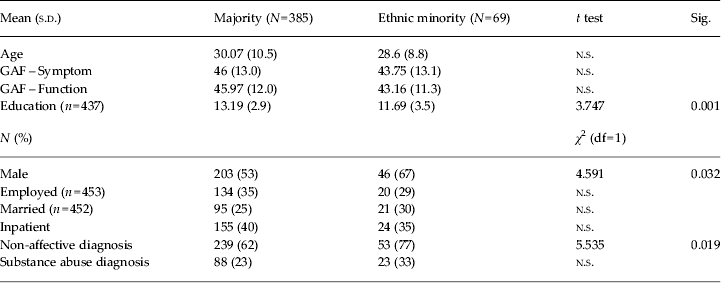
There were few significant differences between the majority and ethnic minority groups on sociodemographic and clinical measures. Participants from ethnic minorities were however more often male, had a diagnosis of non-affective psychosis and less education measured by years at school (see Table 1).
Sociodemographic and clinical distribution for ethnic majority and minority groups

n.s., Non-significant; GAF, Global Assessment of Functioning.
Statistical analysis
Statistical analysis was performed using SPSS v. 21.0 (IBM Corp, 2012). The level of significance was pre-set to <0.05, two sided. Independent t tests and χ 2 tests were used to compare demographic and clinical variables between groups.
As the scores on CTQ subscales and the PANSS P3 (current hallucinations) were not normally distributed, analyses of these were conducted with non-parametric tests; Spearman's rho for correlations and Mann–Whitney U test for between group comparisons. Total trauma scores had a satisfactory normal distribution and were used in later regression analyses; however 10% of both the majority group (n = 40) and ethnic minority group (n = 7) were missing total scores so these analyses have a reduced total sample of 407.
To address whether childhood trauma would be associated with current hallucinatory behaviour and lifetime measures of auditory hallucinations and their relationship to ethnic minority status, we conducted regression analyses with only those measures of hallucination found to be significantly higher in patients with ethnic minority status as dependent variables.
We tested mediation effect using the model suggested by Baron & Kenny (Reference Baron and Kenny1986), the premise of which is significant relationships between the independent variable (ethnic minority status) with both the mediator (CTQ) and the dependent variable of hallucinations. Following this model mediation is confirmed if the relationship between ethnic minority status and hallucinations is reduced when the mediator is added into regression analysis. We measured if the reduction was significant using Sobel's test (Reference Sobel1982). For the continuous dependent variable of current hallucinatory behaviour this was analysed with linear regression and for the dichotomous measure of lifetime auditory hallucinations with logistic binary regression.
To analyse multivariate prediction models independent variables were chosen based on significant correlations with hallucinations. To evaluate the prediction of PANSS P3 hallucinatory behaviour we conducted a multiple linear regression analyses. The final model included age, employment, non-affective diagnosis and total CTQ scores. For the dichotomous measures of lifetime auditory hallucinations (SCID-I, B18) we conducted logistic binary regression analyses. The final model included non-affective diagnosis and total CTQ scores.
Results
Childhood trauma
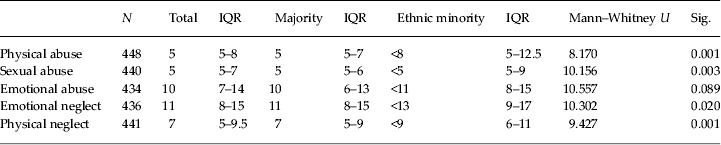
Patients from ethnic minorities reported significantly more childhood trauma (mean 51.2 ± 17.75) than patients from the majority population (mean 43.1 ± 14.73) (t test = −3.866, df = 405, p < 0.001). This difference applied to all subscales but reached the level of statistical significance for physical abuse and physical neglect, sexual abuse and emotional neglect (Table 2). Within the ethnic minority group we found no statistically significant differences in reported childhood trauma based on immigrant generation, region of origin or reason for migration.
Childhood trauma (CTQ score median) for patients with psychosis from ethnic majority and minority groups

CTQ, Childhood Trauma Questionnaire; IQR, interquartile range.
Ethnic minorities and hallucinations
Patients from ethnic minorities had significantly more current hallucinatory behaviour [PANSS P3: median 3, interquartile range (IQR) 1–4] than the patients from the majority (median 1, IQR 1–3) (Mann–Whitney U = 10.942, p < 0.017). Over 30% of the ethnic minority group reported auditory hallucinations of two or more voices conversing, which was significantly higher than the 19% seen in the majority group (χ 2 = 4.692, df = 1, p < 0.03). Current and lifetime hallucinations did not differ significantly for immigrant generations, region of origin or reason for migration.
Childhood trauma, hallucinations and ethnic minority status
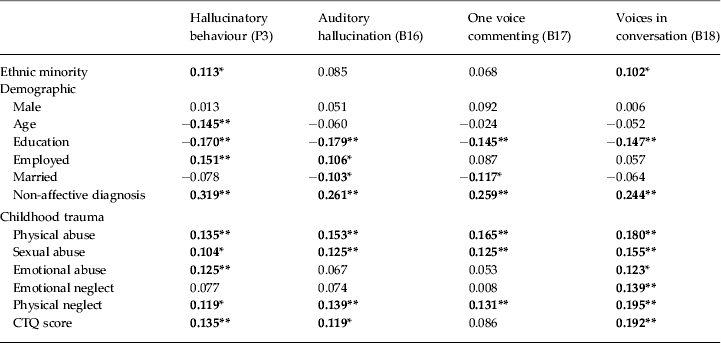
Regression analysis showed that ethnic minority status significantly predicted childhood trauma total scores (F = 14.947, df = 1,405, p < 0.001, adjusted R 2 = 0.033). Childhood trauma total scores and all CTQ subscales was significantly correlated with lifetime hallucinations of two or more voices in conversation (SCID-I, B18) (Table 3). The same was found for current hallucinations (PANSS, P3), with the exception of emotional neglect. Ethnic minority status had a statistically significant positive correlation with current hallucinatory behaviour (PANSS, P3) and lifetime presence of two or more voices conversing (SCID-I, B18). These items were thus the focus of our mediation analyses.
Non-parametric correlations (Spearman's rho) for demographic and ethnic minority status and childhood trauma variables with current and lifetime hallucinations

P3 item from the Positive and Negative Syndrome scale.
B16–B18 items from the Structured Clinical Interview for DSM-IV, section B.
* p < 0.05, ** p < 0.01.
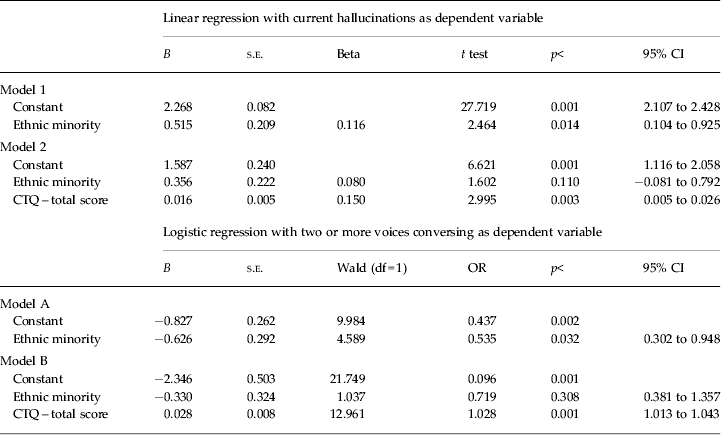
Table 4 presents mediation analysis of indirect effect of childhood trauma on hallucinations. The significant association between ethnic minority status and current hallucinatory behaviour decreased significantly (Sobel test = 2.46, s.e. = 0.05, p < 0.05) when childhood trauma total scores was entered into the model, confirming a mediation effect. Childhood trauma also significantly decreased (Sobel test = 2.64, s.e. = 0.09, p < 0.01) the association between ethnic minority status and lifetime auditory hallucinations of two or more voices conversing, again confirming a mediation effect.
Mediation analysis of indirect effect of childhood trauma on hallucinations

CI, Confidence interval; OR, odds ratio; CTQ, Childhood Trauma Questionnaire.
Model 1: F = 6.074, df = 1,448, p < 0.014, adjusted R 2 = 0 .011.
Model 2: F = 6.958, df = 2,401, p < 0.001, adjusted R 2 = 0.029.
Model A: χ 2 = 4.340, df = 1, p < 0.05.
Model B: χ 2 = 15.895, df = 2, p < 0.001.
In the full multivariate analysis we found that younger age (β = −0.096, p < 0.05), active employment (β = 0.112, p < 0.05), a diagnosis of non-affective psychosis (β = 0.296, p < 0.001) and childhood trauma (β = 0.139, p < 0.01) significantly predicted current hallucinations (P3) explaining 15% of the variance found (F = 17.941, df = 4,398, p < 0.001, R 2 = 0.15). For lifetime auditory hallucinations of two or more voices conversing (SCID I, B18) we found a diagnosis of non-affective psychosis (OR 4.876, p < 0.001) and childhood trauma (OR 1.028, p < 0.001) to be significant predictors, again explaining 15% of the variance (χ 2 = 41.981, df = 2, p > 0.001, Nagelkerke R 2 = 0.15). The contribution of ethnic minority status was non-significant in both models. These analyses can be provided at request.
Conclusions
In a sample of broadly defined psychotic disorders we found that patients from ethnic minorities reported more childhood trauma in general, particularly physical trauma (abuse and neglect) and sexual abuse. Ethnic minorities also had more current hallucinatory behaviour and more often a lifetime experience of auditory hallucinations of two or more voices conversing. Regression analyses indicated that childhood trauma mediated the association between ethnic minority status and more severe current hallucinations, and lifetime hallucinations of two or more voices conversing.
Our finding of a possible effect of childhood trauma on auditory hallucinations in patients from ethnic minorities has to the best of our knowledge not been shown before. This may help explain reports of more positive symptoms in this group (Elmsley et al. Reference Elmsley, Roberts, Rataemane, Pretorius, Oosthuizen, Turner, Niehaus, Keyter and Stein2002; Sohler & Bromet, Reference Sohler and Bromet2003). A number of studies have reported more hallucinations in ethnic minorities with psychotic disorders (Harvey et al. Reference Harvey, Williams, McGuffin and Toone1990; Arnold et al. Reference Arnold, Keck, Collins, Wilson, Fleck, Corey, Amicone, Adebimpe and Strakowski2004; Kennedy et al. Reference Kennedy, Boydell, van Os and Murray2004), and in a literature review childhood abuse was found to be a causal factor in the development of psychosis and schizophrenia, more specifically hallucinations and particularly voices commenting and command hallucinations (Kapur, Reference Kapur2003). We found that two or more voices conversing with each other to be more frequent in ethnic minorities and was mediated by a higher occurrence of childhood trauma. This first-rank symptom is considered sufficient to meet the A criterion of characteristic symptoms of schizophrenia in DSM-IV (APA, 1994). We suggest that this could partially explain the reasons why several studies have found a skewed distribution of psychosis diagnosis, with patients from ethnic minorities receiving more schizophrenia diagnoses and less bipolar disorder diagnoses than patients from the majority population (Schaffer et al. Reference Schaffer, Cairney, Cheung, Veldhuizen, Kurdyak and Levitt2009; Gara et al. Reference Gara, Vega, Arndt, Escamilla, Fleck, Lawson, Lesser, Neighbors, Wilson, Arnold and Strakowski2012).
The current association between childhood trauma and specific psychotic symptoms is in accordance with previous findings both in the general population and in clinical samples. In the general population there are reports of positive correlations between sexual trauma and bullying in childhood with non-clinical psychotic symptoms (Whitfield et al. Reference Whitfield, Dube, Felitti and Anda2005), and a history of childhood trauma with a history of hallucinations (Hammersley et al. Reference Hammersley, Dias, Todd, Bowen-Jones, Reilly and Bentall2003). Moreover, childhood rape is associated with hallucinations both in a non-clinical (Lataster et al. Reference Lataster, van Os, Drukker, Henquet, Feron, Gunther and Myin-Germeys2006) and clinical sample (Bentall et al. Reference Bentall, Wickham, Shevlin and Varese2012). Childhood trauma is associated with positive symptoms in general, specifically hallucinations, but not negative symptoms in patients with first-episode psychosis (Lysaker et al. Reference Lysaker, Buck and LaRocco2007; Wang et al. Reference Wang, Xue, Pu, Yang, Li, Yi, Wang, Liu, Wu, Liu and Rosenheck2013). In bipolar disorder patients both childhood trauma and sexual abuse correlated positively with auditory hallucinations as well (Hammersley et al. Reference Hammersley, Dias, Todd, Bowen-Jones, Reilly and Bentall2003). More recent studies have shown that dissociation, especially depersonalization, mediate the effect between childhood trauma and hallucinations in patients with psychosis, but does not predict delusions (Perona-Garcelan et al. Reference Perona-Garcelan, Carrascoso-Lopez, Garcia-Montes, Ductor-Recuerda, Lopez Jimenez, Vallina-Fernandez, Perez-Alvarez and Gomez-Gomez2012; Wigman et al. Reference Wigman, van Nierop, Vollebergh, Lieb, Beesdo-Baum, Wittchen and van Os2012). None of these studies have, however, had specific focus on ethnic minority groups.
Childhood emotional trauma in non-patients and sexual trauma in patients, in combination with life's problems, has also been found to predict vulnerability for hallucinations in general, and auditory hallucinations in particular (Goldstone et al. Reference Goldstone, Farhall and Ong2012). What we may be observing is a ‘greater force of morbidity’ in ethnic minority groups (Selten & Hoek, Reference Selten and Hoek2008), with childhood trauma contributing to more auditory hallucinations in a group exposed to more environmental risk factors for schizophrenia such as social adversity/disadvantage, urbanity, parental separation and in some contexts malnutrition (Dealberto, Reference Dealberto2007; McGrath et al. Reference McGrath, Saha, Chant and Welham2008; Morgan et al. Reference Morgan, Fisher, Hutchinson, Kirkbride, Craig, Morgan, Dazzan, Boydell, Doody, Jones, Murray, Leff and Fearon2009). Our results support previous findings of an environmental contribution to heightened risk of psychosis in minority groups. We did not find that minority status per se resulted in a specific psychotic symptomatology but rather that this group is exposed to more traumas possibly leading to health disparity. This gives cause for preventive action, specifically for underprivileged groups in society.
The current study has some limitations, such as retrospective assessment of trauma. This is a difficult area of research in general because of possible distortion of memories over time, and specifically in cases of traumatic memories that may be subject to dissociation or repression. Not all subjects are equally forthcoming in all areas of trauma, and this is particularly true for experiences before the age of 6 years (Roy & Perry, Reference Roy and Perry2004). Also what the individual defines as traumatic varies and may be subject to cross-cultural differences in interpretation. For example one study found that even though Black Americans more often endorsed the CTQ item of ‘being hit with a hard object’, they more seldom interpreted this as physical abuse as seen on low scores for the other items in the physical abuse subscale (Thombs et al. Reference Thombs, Bennett, Ziegelstein, Bernstein, Scher and Forde2007). We did find that four out of the five subscales of the CTQ had good internal consistency in both the majority and minority groups in this study, and moderate internal consistency for the physical neglect scale. Increased validity in future studies could be obtained by including both self-report and semi-structured interviews of childhood trauma, specifically in cross-cultural context.
We had a culturally heterogeneous sample where the definition of ethnic minority status was based on being visually distinguishable from the Norwegian majority. Our results cannot be generalized to specific ethnic groups or immigrant status but to minority status per se. We found that ethnic minorities with psychosis reported significantly more childhood trauma, and had more hallucinations, independent of background factors such as reason for migration, region of origin or immigrant generation. Some of the ethnic minorities in our sample have recent immigrant background and pose a challenge to psychiatric assessment tools in general. The SCID-I and PANSS although developed in ethnically varied populations have not been validated for immigrant populations. There are often additional difficulties in assessing this group both because of language difficulties and cultural variations in understanding and presentation of psychopathology. The assessment team members were not blind to the participants' ethnic background which may impact symptom assessment, but they were not made aware of this study-specific hypothesis.
The percent of ethnic minorities in this study was slightly less than that in the catchment area. A large proportion of the participants from ethnic minorities were of Asian descent which included Middle Eastern countries and Turkey. This is as expected as they are the largest immigrant group in the Oslo area. Even though Black African and African immigrant populations have shown the highest risk of psychosis, meta-analyses report a number of studies which also show a more moderate heightened risk in a variety of Asian immigrant groups, specifically from Middle Eastern countries to Northern Europe (Cantor-Graae & Selten, Reference Cantor-Graae and Selten2005; Bourque et al. Reference Bourque, van der Ven and Malla2011). We did not include patients that did not speak a Scandinavian language to reduce the possibility of linguistic misinterpretation, and were not able to register these persons due to ethical considerations. From 11% to 21% of first-generation immigrants from Asia in our catchment area report poor to rather poor language skills (Iversen et al. Reference Iversen, Ma and Meyer2013). This gives us an approximate idea of the percentage of the Asian population that did not participate because of language problems. However, we have no reason to believe that immigrants lacking in language proficiency because of marginalization, recent migration, illiteracy or cognitive impairment would have experienced less childhood trauma or mental health problems.
An important strength to the study is that we recruited from a catchment area-based public healthcare system providing equal treatment services for all groups of the society and with long experience in handling patients from different cultures. Efforts to recruit patients to the study were equal across ethnic groups. Moreover, we have a large sample in this study which strengthens the reliability of the results.
In conclusion, in patients with broadly defined psychotic disorders we found that patients from ethnic minorities have more childhood trauma, particularly physical (abuse and neglect) and sexual abuse. They also had more current hallucinations and lifetime auditory hallucinations of two or more voices conversing with each other. However, this association appeared to be mediated by childhood trauma. Replication studies are needed, and we suggest that future research focus on a broader assessment of both auditory verbal hallucinations and childhood trauma.
Acknowledgements
We thank the participants in the TOP study and the clinicians collaborating in patient recruitment for their contribution. We also thank Thomas Bjella, Eivind Bakken, and Ragnhild Storli. Funding for this study was provided by the Kristian Gerhard Jebsen Foundation, the Research Council of Norway (grant nos. 181831, 147787/320, and 167153/V50) and the Regional Health Authority for South-Eastern Norway Health Authority (grant nos. 2010-074 and 2006-258). Neither institution had any role in study design, data collection, analysis and interpretation, writing of the report, or the decision to submit the paper for publication.
Declaration of Interest
None.