Tracing microorganisms along the food chain has become an indispensable instrument in food safety in recent years, since it provides holistic insight into the progression of contamination scenarios. To study microbial adaptation to a high variety of ecological niches both inside and outside the food chain, Staphylococcus aureus serves as an ideal model organism (Stessl et al. Reference Stessl, Hein, Wagner, Ehling-Schulz and Hoorfar2011). During processing of semi-hard cheeses, the Staph. aureus population is subjected to changes from several stressors, such as drop in pH, a decrease in free water activity (a w) and competition with starter cultures (Pexara et al. Reference Pexara, Solomakos, Sergelidis and Govaris2012). The risk of heat-stable staphylococcal enterotoxin (SE) production and accumulation is substantial when more than 5 log cfu/ml or g are present in food matrices [European Comission (EC) regulation 1441/2007]. Consequently, as a prerequisite for any risk assessment or surveillance operation, Staph. aureus must be reliably detected and enumerated. However, culture-dependent quantification is generally considered time-consuming and vulnerable to ‘false negative’ results. In contrast, culture-independent target specific quantification by real-time PCR advantageously provides higher analytical sensitivity, selectivity and high sample throughput, ideal for automation and the detection of viable but non-culturable (VBNC) and atypical variants (Syring et al. Reference Syring, Boss, Reist, Bodmer, Hummerjohann, Gehrig and Graber2010). Nevertheless, PCR could be hampered by interfering substances in dairy products, underlining the importance of efficient sample preparation (Stessl & Wagner, Reference Stessl, Wagner and Rodríguez-Lázaro2012). Matrix lysis, a sample pretreatment method based on the solubilization of food matrices, addresses the issues of concentrating bacterial cells from a large sample volume and removes PCR inhibiting substances (Mayrl et al. Reference Mayrl, Roeder, Mester, Wagner and Rossmanith2009). To cope with the complexity of artisan cheese making, the actual study was performed in a small-scale dairy in Vorarlberg, a province in western Austria. In Vorarlberg, about 100 alpine and 35 local dairies produce 60 different types of cheese (The Austrian Federal Ministry of Agriculture, Forestry, Environment and Water Management, 2011; Green Report).The aim was to: (i) investigate potential Staph. aureus contaminations during the traditional production of semi-hard raw milk cheese, (ii) to compare outcomes as derived from a microbiological investigation with culture-independent real-time PCR-based quantification of the thermonuclease gene (nuc), (iii) to elucidate the potential of enterotoxin production, Staph. aureus isolates were screened for the presence of SE genes (sea to sej) and further characterized by macrorestriction analysis using pulsed-field gel electrophoresis (PFGE).
Materials and methods
Cheese manufacturing characteristics and sampling
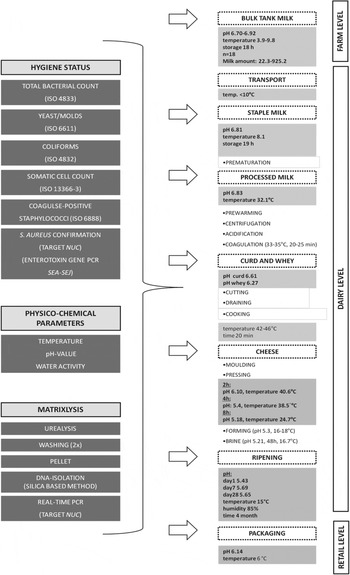
The model dairy produces smear ripened semi-hard and hard cheeses [Vorarlberger mountain cheese Designation of Origin (PDO)] made from heat-treated raw milk (54 °C), which are traditional in alpine regions. About 5000 l silo-free raw milk are delivered daily from 17–18 dairy farms. Bulk tank milk was stored at the dairy for 18 h at 8 °C, to permit maturation of the specific raw milk flora. Thereafter natural non-defined starters were used for acidification. In order to develop the characteristic rind smear, the cheese was soaked for up to 2 d in brine at a pH of 5·0 and then ripened in cellars for four months. The cheeses were treated with brine (10% sodium chloride) twice per week. Bulk tank milk samples were taken aseptically and pooled per bulk tank (n=5; 500 ml) at 18 dairy farms in March (I), and 17 dairy farms in November (II), immediately before milk collection (2 d interval) and after 18 h storage at 8 °C at the dairy. Sampling at the dairy was performed during two separate cheese-making processes (I and II). Consecutively, liquid samples were taken aseptically from vat milk, processed milk, whey and brine (pooled each matrix; n=5; 500 ml). Furthermore, solid samples were taken from curd, cheeses before brine treatment, at different stages of ripening day 1–128, and before consumption (each 3×10 g). Samples were transported to the laboratory after sampling in standardized cool boxes (4 °C) and investigated immediately. The most important processing steps during semi-hard cheese production and the application of methods are given in Fig. 1.
Flow chart of semi-hard cheese processing, physicochemical parameters and applied culture-dependent and independent methodologies.

Physicochemical parameters
pH values were determined with a SevenGo® Portable Routine pH meter (Mettler Toledo, Vienna, Austria). The moisture contents of milk and cheese samples were determined with the Lab Master-aW (Novasina AG, Lachen Switzerland).
Hygiene parameters and Staph. aureus detection
Somatic cell count (SCC) analysis was conducted using the Fossomatic method (Fossomatic 5000 series, FOSS NIRSystems, Laurel, MD, USA).
To determine hygiene parameters [aerobic mesophilic counts (AMC), coliforms, yeast and moulds], and Staph. aureus status in the alpine dairy, 10 g or ml sample were homogenised in a laboratory blender (Stomacher 400, Seward Ltd, London, UK) with sterile Ringer's solution (Oxoid Ltd., Hampshire, UK; 1 : 10) for 3 min. The homogenate was serially diluted in 10-fold steps, up to a dilution of −5. One ml of each dilution was transferred into a sterile Petri dish and 15 ml liquid Plate Count (PC) agar, Violet Red Bile Lactose (VRBL) agar (both Oxoid Ltd.) and Rose-Bengal Chloramphenicol (RBC) agar (Merck KgA, Darmstadt, Germany), were poured and mixed with the corresponding inoculum. PC agar (AMC status) was incubated at 30 °C for 3–4 d (ISO 4833, 2003). VRBL agar for coliform (ISO 4832, 2006) and RBC agar for yeast and moulds enumeration, was incubated at 30 °C for 24 h and at 25 °C for 3–5 d, respectively. The Staph. aureus quantification was performed by surface plating of 1 ml or 100 μl of the prepared dilutions on Baird Parker (BP) agar (Oxoid Ltd.). BP agar was incubated at 37 °C for 24–48 h (ISO 6888-1, 1999).
Generally, all agar plates yielding 10 to 300 target colony forming units (CFU) were included in the arithmetic mean calculation and expressed in cfu/ml or g. Up to five typical and atypical Staph. aureus colonies were confirmed by tube coagulase test (Thermo Fisher Scientific, Remel®, Waltham, MA, USA; ISO 6888-1). DNA extraction of Staph. aureus colonies followed a simple boiling protocol including Chelex® 100-Resin (BioRad, Hercules, CA , USA), based on an approach published by Walsh et al. (Reference Walsh, Metzger and Higuchi1991). Finally, PCR-based nuc gene confirmation was performed, according to Brakstad et al. (Reference Brakstad, Aasbakk and Maeland1992).
Matrix lysis sample pretreatment for the culture-independent approach
The matrix lysis protocol applied in this study was derived from protocols for Staph. aureus quantification in milk and cheese (Mayrl et al. Reference Mayrl, Roeder, Mester, Wagner and Rossmanith2009; Aprodu et al. Reference Aprodu, Walcher, Schelin, Hein, Norling, Radstrom, Nicolau and Wagner2011). During processing of semi-hard cheese, 6·25 g solid samples of curd and cheese and 12·5 g liquid samples as raw milk, whey and product associated samples, such as brine, were mixed with 10 ml lysis buffer II (8 M urea, 1% Lutensol AO-07 (BASF SE, Ludwigshafen, Germany), phosphate buffered saline (PBS) (155·7 mM NaCl, 2·8 mM KCl, 2·97 mM Na2HPO4, and 1·06 mM KH2PO4,; adjusted to pH 8), and homogenized twice in a laboratory blender (Seward Ltd) for 3 mins each. The homogenate was transferred to 50 ml polypropylene tubes (Corning Inc., Tewksbury, MA, US), and lysis buffer added to achieve a final volume of 45 ml. Samples were incubated horizontally in a water bath (37 °C) and shaken at 200 rpm for 30 min. Subsequently, samples were then centrifuged at 3220 g for 30 min at room temperature. The pellet was suspended in 40 ml of washing buffer (0·35% Lutensol® AO-07 and 1×PBS) and again incubated horizontally in a shaking water bath (200 rpm for 30 min at 37 °C). Samples were then centrifuged at 3220 g for 30 min at room temperature, and the supernatant gently discarded. The pellet was resuspended in 500 μl PBS and washed twice in 1 ml PBS with additional centrifugation for 8 min at 5000 g .
DNA isolation and quantitative real-time PCR
After sample pretreatment with matrix lysis, DNA isolation from the remaining bacterial cell pellet was performed by applying the NucleoSpin® tissue kit (Machery-Nagel, Düren, Germany), following the support protocol for Gram-positive bacteria.
Quantitative real-time PCR, targeting the Staph. aureus specific nuc gene, was performed in a M×3000p real-time PCR thermocycler (Stratagene, La Jolla, CA). The 25 μl PCR reaction volume contained 5 μl DNA template. The DNA standard for real-time PCR was prepared using Staph. aureus strain NCTC 1803. One millilitre of a pure culture of Staph. aureus was first subjected to DNA isolation. DNA concentration was measured fluorimetrically using a Hoefer DyNA Quant200 apparatus (Pharmacia Biotech, San Francisco, CA, USA). The copy number of the nuc gene was determined by the assumption that 1 ng DNA, based on the molecular weight of the 2·7- to 2·8-mbp-sized genome of Staph. aureus, equals 3·3×105 times the entire genome and that the nuc gene is a single-copy gene. All samples were tested in duplicate, targeting a 269-bp fragment of the nuc gene (Hein et al. Reference Hein, Jorgensen, Loncarevic and Wagner2005). Real-time PCR-derived target numbers were expressed as Staph. aureus cell equivalents per ml or g of sample (SA CE/ml or g).
Molecular subtyping of Staph. aureus isolates
The presence of enterotoxin genes in Staph. aureus isolates was tested by applying two different sets of multiplex PCRs: one set contained primers for sea, seb, sec, sed, and see (PCR 1) and the other for seg, seh, sei, and sej (PCR 2), as previously published by Gonano et al. (Reference Gonano, Hein, Zangerl, Rammelmayr and Wagner2009).
Genotyping was performed according to the PFGE protocol published by Murchan et al. (Reference Murchan, Kaufmann, Deplano, de Ryck, Struelens, Zinn, Fussing, Salmenlinna, Vuopio-Varkila, El Solh, Cuny, Witte, Tassios, Legakis, van Leeuwen, van Belkum, Vindel, Laconcha, Garaizar, Haeggman, Olsson-Liljequist, Ransjo, Coombes and Cookson2003). Genomic DNA was digested using 50 U SmaI restriction enzyme (MBI Fermentas, St. Leon-Rot , Germany). Restricted DNA was electrophoresed in 1% SeaKem Gold agarose in 0·5×TBE at 6 V/cm on a Chef DR III system (Bio-Rad Laboratories, Inc., Hercules, CA, US). A linear ramping factor with pulse times from 5·0 to 15·0 s (runtime 7 h) and 15 s to 60 s (runtime 16 h) at 14 °C and 120° angle was applied. The gel was stained with 1·5 μg/ml ethidium bromide solution and digitally photographed with Gel Doc 2000 (Bio-Rad Laboratories, Inc.). TIFF images were compared using Fingerprinting II Cluster Analysis (Bio-Rad Laboratories, Inc.), and normalised using the PFGE global standard Salmonella Braenderup isolate H9812.
Statistical analysis
Correlations and linear mixed-effects models (with the farm number as the random effect) were analysed to test the influence of time point, temperature and pH value on SCC, AMC, coliforms, yeast and moulds CFU counts, and Staph. aureus CE (www.r-project.org). Values below the detection threshold were set to zero. All counts were log transformed. For all analyses a P-value of 5% (P<0·05) was seen as significant.
Results
Physicochemical parameters
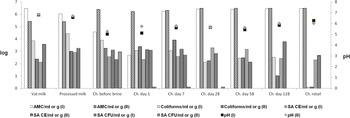
The pH-values of bulk tank milk samples ranged between 6·7 and 6·92 during the first (I) and second (II) sampling event. Seven (38·9%) (I) and 11 (64·7%) (II) bulk milk temperatures exceeded 8 °C (maximum 9·8 °C). During cheese production the pH decreased to 5·12 (I) and 5·74 (II) in cheese at day one of ripening and increased up to 6·26 (I) and 6·02 (II) at retail, respectively (Fig. 2). Free water activity dropped from 0·99 in curd to 0·92 at the end of ripening.
Aerobic mesophilic counts, Staph. aureus counts and pH during cheese production and ripening in March (I) and November (II). AMC/ml or g, Aerobic mesophilic counts per ml or g; SA cfu/ml or g, Staph. aureus colony forming units per ml or g; SA CE/ml or g, Staph. aureus cell equivalents per ml; Ch., Cheese.

Microbiological hygiene parameters, Staph. aureus counts and bacterial cell equivalents in bulk milk
Two bulk milk samples in March (I) and one sample in November (II) indicated higher SCC>250 000/ml, but none of the samples exceeded the hygiene limit of >400 000 cells/ml (range 4·89–5·48 SCC log/ml). SCC were generally higher in November (β=0·671881; t 11=3·269; P=0·0075). Aerobic mesophilic counts (AMC) exceeded in 20% (7/35) of bulk milk samples >100 000 cells/ml (EC regulation1662/2006). Combining the hygiene parameters in linear mixed-effects models only a weak positive correlation between AMC, moulds and yeast counts was found (Pearson's correlation coefficient r=0·3200503, P=0·06089).
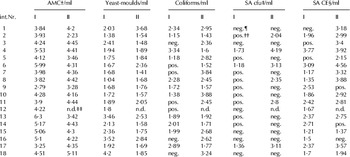
Coliform counts >100 cfu/ml were detected in 42·9% (15/35) of samples, with a trend to higher numbers in November. Thereof, 40% (6/15) were detected in bulk milk samples >8 °C. Overall, 51·4% (18/35) of bulk milk samples were found to be Staph. aureus positive, most of them (34·3%) at the limit of culture-based detection. Staph. aureus positive samples >100 cfu/ml were recorded in 17·1% of bulk milk samples collected mainly during the sampling in November. A higher number of Staph. aureus positive bulk milk samples (94·3%; 33/35) were detected after applying the culture-independent approach (matrix-lysis protocol and real-time PCR). Staph. aureus CE >1000/ml were detected in 54·3% (19/35) of bulk milk samples. Results for Staph. aureus obtained by culture-based and PCR-based methods were significant positively correlated (Spearman's correlation coefficient r=0·5565438, P=0·0006348). During the sampling in March the bulk milk sample of farm 13 exceeded more than three hygiene parameters: pH>8 °C, SCC>250 000/ml, AMC>100 000/ml, coliform counts >100 cfu/ml, and was detected positive for Staph. aureus. Bulk tank milk samples on farm 4 and 14 had both, higher counts for AMC and coliforms, and were positive for Staph. aureus. During the November sampling bulk milk of farm 8 harboured coliforms and Staph. aureus >100 cfu/ml. AMC and coliform counts were increased in bulk milk samples of farm 18 (Table 1).
Microbiological hygiene parameters and Staph. aureus counts (log CFU or log SA CE/ml) for 18 bulk milk samples in March (I) and November (II)

† AMC/ml, Aerobic mesophilic counts per ml
‡ SA cfu/ml, Staph. aureus colony forming units per ml
§ SA CE/ml, Staph. aureus cell equivalents per ml
¶ neg., no target colony grown on the investigated agar, or no fluorescent signal of target DNA (nuc) detected in real-time PCR
†† pos., target colonies detected on the investigated agar were <10 colony forming units (cfu)/ml, or one of the two duplicate fluorescence signals of target DNA (nuc) increased over the background threshold in real-time PCR
‡‡ n.d. not determined; Counts were transformed to logarithmic decimals
Microbiological hygiene parameters, Staph. aureus counts and bacterial cell equivalents in cheese processing samples
The AMC counts ranged at different steps of cheese processing from 2·69 to 6·48 log cfu/ml or g (Fig. 2). In the first sampling (I) the AMC decreased by 1·9 log units during cheese-making until ripening day one. Higher yeasts and moulds counts (>4 log cfu/ml or g) and coliform counts (>1000 cfu/ml or g) were recorded in processed milk and in cheese samples until ripening day seven. Staph. aureus counts in processed milk samples taken during cheese-making were below the limit of culture-based detection. In the first cheese-making approach in March the Staph. aureus counts >100 cfu/g were detectable until ripening day 14.
In November sampling the decrease of Staph. aureus was detected immediately at ripening day 1 as counts stayed <10 cfu/g until day 28. No viable Staph. aureus were detectable during further ripening. The culture-independent PCR quantification indicated >100 Staph. aureus CE/ml or g detected at all stages of cheese-making and ripening (Fig. 2).
Molecular subtyping of Staph. aureus
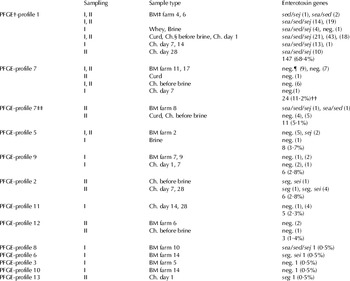
In total, 215 Staph. aureus isolated during the actual study were assigned to 13 Staph. aureus SmaI PFGE-profiles. PFGE-profile 1 was predominant among Staph. aureus isolated from both bulk milk samples (farm 4, 6) and during the two cheese-making processes (68·4%). Staph. aureus PFGE-profile 5, 7, 7 subtype (st) and 9 were also detected at farm level and during different steps of cheese processing (22·8% of isolates). The minority of Staph. aureus isolates was exclusively detected at the dairy level in cheese before brine and at different ripening stages (PFGE profile 2, 11, 12, and 13) (6·9% of isolates). The Staph. aureus enterotoxin genes sea/sed/sej were detected in 67·4% of isolates, present in 143 (97·3%) isolates of the predominant PFGE-profile 1. Further details are depicted in Table 2.
Subtyping results of Staph. aureus isolated from bulk milk samples and during cheese production and ripening in March (I) and November (II)

† PFGE, pulsed-field gel electrophoresis
‡ BM, bulk milk
§ Ch., Cheese
¶ neg., negative
†† Total numbers (percentage)
‡‡ subtype
Discussion
To our knowledge this is the first published study that covers hygiene, Staph. aureus status and physicochemical parameters, combining both culture-dependent and independent quantification of the target population in an artisan Austrian cheese processing facility from bulk tank milk to end product. Additional Staph. aureus subtyping information supported the Staph. aureus source attribution.
Most published reports focusing on the microbiological hygiene status of raw milk cheeses indicate poor hygiene conditions during earlier manufacturing phases and food handling. Pecorino and Monte Veronese, typical Italian semi-hard and hard cheeses, were contaminated to a higher percentage with Enterobacteriaceae (42%), Staphylococcaceae (50%) or Staph. aureus specified (78%) (Poli et al. Reference Poli, Guglielmini, Sembeni, Spiazzi, Dellaglio, Rossi and Torriani2007; Giammanco et al. Reference Giammanco, Pepe, Aleo, D'Agostino, Milone and Mammina2011). Additionally, reports on higher Enterobacteriaceae (5·9–7 log cfu/ml) and Micrococcaceae (up to 5·9 log cfu/ml) counts during the early stages of Portuguese raw milk cheese processing were reported by Kongo et al. (Reference Kongo, Gomes and Malcata2008). After four months of cheese ripening, the latter contaminants were decreased to maximum 1·3 and 3 log cfu/g. In the actual study, bulk milk AMC counts (2·23–6·3 log cfu/ml) were not comparably high as in the Portuguese data set (6·1–8·6 log cfu/ml), but exceeded in 20% of investigated samples 5 log (EC regulation1662/2006). The higher AMC counts are potentially resulting from the traditionally 2 d milk storage at the dairy farms at 8 °C, which is a special arrangement for artisan hard cheese producers, to allow a pre-ripening of bulk milk, which is leading to special cheese flavours and avoids fat damage. The ideal handling of bulk milk temperature to support the growth of special cheese flora and good milk quality is demanding, as 51·4% of bulk milk samples exceeded 8 °C. Coliform and Staph. aureus counts >100 cfu/ml were detected in 42·9 and 17·1% of bulk milk samples. A combination of coliform and Staph. aureus counts >100 cfu/ml in bulk milk was observed in two farms. In some studies Staph. aureus bulk tank milk prevalence varied from 47 to 67% contaminated at low levels (<1 log cfu/ml) to Staph. aureus prevalence up to 94% being contaminated with 1·5–5 cfu Staph. aureus/ml (D´Amico & Donnelly, Reference D'Amico and Donnelly2011; Jakobsen et al. Reference Jakobsen, Heggebo, Sunde and Skjervheim2011; Costa Sobrinho et al. Reference Costa Sobrinho Pde, Marcal de Faria, Silva Pinheiro, Goncalves de Almeida, Vieira Pires and Silva Santos2012). In our approach the Staph. aureus bulk milk contamination was in 34·3% at the limit of culture-based detection.
We conclude that SCC and AMC counts should be supported by other parameters as coliform and Staph. aureus counts to gain more insight into the hygiene status of bulk milk. Solely applied, SCC and AMC counts could not serve as good predictors for the potential absence of pathogenic organisms (Costa Sobrinho et al. Reference Costa Sobrinho Pde, Marcal de Faria, Silva Pinheiro, Goncalves de Almeida, Vieira Pires and Silva Santos2012). Bulk tank milk used for raw milk cheese production seems to be, to a certain extent, contaminated by Staph. aureus. Several studies reported increased Staph. aureus counts during the first 24 h after curdling, which was a result of physical entrapment in the curd or growth of viable cells (Jøergensen et al. Reference Jørgensen, Mørk and Rørvik2005; Delbes et al. Reference Delbes, Alomar, Chougui, Martin and Montel2006; Jakobsen et al. Reference Jakobsen, Heggebo, Sunde and Skjervheim2011). An accurate acidification caused by active starter cultures during the first 6 h of cheese-making should effectively inhibit the growth of Staph. aureus. Charlier et al. (Reference Charlier, Cretenet, Even and Le Loir2009) showed that the process of potential Staph. aureus inhibition is not so simple. Also weakly acidifying Lactococcus lactis starter cultures effectively inhibited the growth of Staph. aureus. In the actual study the pH measurement in cheeses before brine indicated a sufficient acidification (pH⩽5·2). Therefore the application of traditionally applied undefined ‘natural starters’ with possible fluctuations in their culture composition could have caused Staph. aureus counts>100 cfu/g until ripening day 14 during the March sampling. In November cheese processing the initial Staph. aureus load in bulk milk samples was higher (>100 cfu/g in 17% of samples). The starter cultures could have more actively inhibited the further growth of Staph. aureus in cheeses as counts were <10 cfu/g already at ripening day one. A correct decrease in the a w-value from 0·99 (unripened cheese) to 0·92 (at the end of ripening) was recorded. The latter decrease, mainly triggered by the classic smearing approaches with brine (20% v/w), seemed also to impede the further multiplication of Staph. aureus. Therefore, the actual data strongly support the need for additional sampling activities and recording of physicochemical parameters during semi-hard cheese-making and cheese ripening, to estimate the risk of Staph. aureus contamination before consumption.
A striking result was achieved by applying culture-independent matrix lysis based quantitative PCR. Almost all bulk milk samples (94%) were detected positive for Staph. aureus cell equivalents (CE), thereof 54·3% >1000 SA CE/ml. Therefore, the hypothesis could be supported that the constant molecular Staph. aureus quantities throughout the whole sampling approach applying matrix lysis protocol could be caused by VNBC or killed but physically intact bacteria (Mayerl et al. Reference Mayrl, Roeder, Mester, Wagner and Rossmanith2009). A further advantage of matrix lysis in combination with Staph. aureus target specific real-time PCR was the lack of interfering competitive microbiota hampering the detection of target organisms as often observed in culture-based detection on Baird Parker agar (Vicosa et al. Reference Vicosa, Moraes, Yamazi and Nero2010).
The accompanying data from Staph. aureus enterotoxin gene status and PFGE SmaI profiling supported understanding of the pathogen transmission patterns and possible sources of contamination. Jøergensen et al. (Reference Jørgensen, Mørk and Rørvik2005) stated that the contamination of cheese during processing by dairy staff seemed of lower importance as the majority of cows were positive for Staph. aureus sharing one dominant pulsotype. These data are in agreement with the actual dataset, where the predominant Staph. aureus PFGE profile 1 (sea/sed/sej gene positive) was clearly shuttling through the chain. Other authors also found Staph. aureus enterotoxin gene profile sea/sed/sej prevalent in artisan cheeses production (Bernini et al. Reference Bernini, Sgarbi, Bove, Gatti and Neviani2010). Further 12 PFGE profiles were found in the bulk milk and/or processing samples, but these represented the minority. The latter might be related to well-established biofilms on dairy equipment, or undefined starter-cultures, as they were detected for the first time in cheese before brine and at different ripening stages (PFGE profile 2, 11, and 12). A further minority of Staph. aureus isolates could be related to subclinical mastitis. Arcuri et al. (Reference Arcuri, Angelo, Guimarães, Talon, Borges Mde, Leroy, Loiseau, Lange, Andrade and Montet2010) found the same enterotoxin gene profile seg/sei most prevalent among mastitis cow milk and during cheese manufacturing. It could be concluded that livestock-adapted Staph. aureus strains, which affect a herd more or less, could also dominate the cheese flora during ripening.
The combination of techniques poses an advantage over risk assessment studies based on cultures alone, since in the case of enterotoxigenic species, the risk may accumulate with every subpopulation that has been active at any step in the food chain. We therefore suggest that the novel culture-independent screening approach could improve understanding of the effect of stress on bacterial cells that frequently respond by becoming unculturable thereafter. Ultimately, following sample preparation, multiplex real-time PCR targeting the most relevant Staph. aureus enterotoxin genes (sea, seb, sec, sed, see, seg, seh and sei), as applied by Nakayama et al. (Reference Nakayama, Okayama, Hashida, Yamamoto, Takebe, Ohnaka, Tanaka and Imai2006) in milk, could be a helpful tool to prevent unexpected Staph. aureus food poisoning and high economic loss due to contaminated food lots.
This work was supported by the European Union funded Integrated Project BIOTRACER (contract 036272) under the 6th RTD Framework. The authors acknowledge the following for their collaboration during the sampling and characterization period: The participating farmers and the dairy staff, the staff members of the dairy laboratory Dornbirn as well as Fritz Metzler. We would like to thank Dr Cameron McCulloch (Vetmeduni Vienna, Austria) for assistance with the manuscript.