Introduction
Restoring order and stability is the key objective of negotiations to end civil wars. This goal is a distinguishing feature of such talks, referred to also as normalisation negotiations.Footnote 1 Issues of justice are at the heart of these negotiations. They may be part of the problem or part of the solution. Unresolved issues of justice perpetuate the conflict and contribute to impasses in negotiation. Resolved issues ameliorate the conflict and contribute to improved relationships. A substantial literature has examined the influence of justice principles on the processes of interpersonal,Footnote 2 organisational,Footnote 3 and internationalFootnote 4 negotiation. A much smaller number of studies have focused on the role of justice in the implementation of negotiated agreements. The analyses reported in this article address this gap in the literature. They evaluate the relationship between principles of justice and the durability of agreements intended to bring peace to warring parties within nations.
Durability is more likely to be achieved when the sources of conflict are addressed and resolved. Issues of justice are often salient sources of civil wars. Examples of justice issues include amnesty for crimes, prisoner release and reintegration, compensation, military and police reform, and the establishment of human rights commissions. They reflect such principles as restorative (amnesty, reforms), retributive (trials, sanctions), structural (participation, power relations, issue ordering), procedural (vetting, commissions), and distributive (compensation, distribution of positions among groups) justice. These principles can be distinguished as being forward-looking (structural, distributive) and backward-looking (restorative, retributive).Footnote 5 The former provide a foundation for a new order based on the rule of law. The latter address the grievances that restore relationships. To the extent that all the parties (former combatants) adhere to the relevant principles, they contribute to the durability of the agreed terms. However, if the principles serve as mere ‘window dressing’ intended to stop the fighting in the short-term or serve political side effects, they jeopardise the life of the agreements.
Distributive justice
The focus of this study is specifically on the type of justice referred to as distributive. Distributive Justice (DJ) consists of general standards for allocating collective benefits or burdens among the members of a group or community. They are principles of outcome justice as distinct from justice of the process and procedures from which outcomes result. How process and procedural justice relate to distributive justice is much debated in concept and practiceFootnote 6 but the distinctions among the different types of justice remain well established. We have chosen to examine four DJ principles in agreements: equality, proportionality, compensation, and need. Although these principles may assume many meanings, we provide precise definitions applicable to the context of peace agreements.
There are several reasons for focusing attention on DJ. One is that the content of agreements deals mostly with the allocation of gains and burdens. These are matters of distributive justice. Another is that the four DJ principles are well recognised and established in both research and policy-oriented literatures. Given the purpose of this study, it was important to select principles which are widely seen as capturing essential aspects of justice. A third reason is that these principles are suited to the study's methodological requirements. They are defined external to particular parties and situations, and, thus, facilitate the development of reliable indicators. They do not require capturing the parties' perceptions. In other words, tracking these principles in agreements does not depend on information about the parties' own views. Nor does it depend on the manner in which the agreement was negotiated. Other principles of justice, such as ‘impartiality’Footnote 7 and a ‘balanced settlement of conflicting claims’,Footnote 8 are more likely to rely on such information.
Durability of agreements
Research on the conditions and requirements for durable peace – usually defined as the absence of organised violence – has expanded in recent years.Footnote 9 Yet there are few clearly stated or reasonably comprehensive definitions of what constitutes a durable agreement. The Uppsala Conflict Data Program (UCDP) in Sweden defines a peace agreement as durable ‘as long as it is implemented’. Furthermore, such an agreement ‘[…] has failed the date when one of the parties states that the agreement is annulled, or if violence clearly shows that one or both parties have left the agreement.’Footnote 10 Progress has been made in defining various degrees of success in implementing peace agreements, although there is some contention about the meaning of success with both optimistic or ‘liberal’Footnote 11 and pessimistic or ‘conservative’Footnote 12 views being expressed.
Two aspects of durability include:
Duration of the agreement over time: This refers to the number of years it remains in force legally and/or effectively. An agreement may endure legally and effectively even if violations by some parties take place. In fact, this is quite a common phenomenon. On the legal side, however, some agreements do specify under what conditions they will no longer be in force.
Implementation of and adherence to the agreement by parties: This definition captures the parties' behaviour with regard to their adherence to the agreement. This concerns the steps and measures taken to carry out the commitments made either by primary or third parties. It also concerns honouring and living by the terms of the agreement over the longer term.
Drawing on these two aspects, an agreement is durable as long as it is reasonably effective in serving its stated goals. This usually means that there are few (if any) violations, or that violations have at least not undermined the central objectives of the agreement. There may be breaches and other problems, but the agreement is durable to the extent that it manages to do what was intended by the signatories.
DJ and durability: an example
Relationships between DJ and durability have rarely been explored in the context of peace agreements, except perhaps those that deal specifically with power sharing arrangements. By contrast, well-known and well-researched cases from the global and regional environment illustrate well how DJ can influence the durability of agreements.
The l987 Montreal Protocol on Substances That Deplete The Ozone Layer is one such case. The core terms of this agreement were based on three principles of distributive justice. These principles take account of the varied conditions and concerns of signatory states. The proportionality principle drove the Protocol's call for reductions in chlorofluorocarbon emissions proportional to each country's 1986 level beginning in 1993, thus imposing a greater (unequal) cost of regulation on industrialised countries. Compensatory justice informs the provision for financial and technical assistance to the South, and their exemption from the stipulated emission reductions for the first ten years for purposes of economic development. The equality norm was expressed in the long-term goal of the North and the South sharing regulation costs on a basis of parity.Footnote 13 Now into its twenty-second year, the Montreal Protocol has been widely adopted and implemented and is frequently cited as an exceptionally successful example of international cooperation. Another illustration of the relationship between DJ and durability comes from the European acid rain negotiations – the 1994 Oslo Protocol on Further Reductions of Sulfur Emissions.Footnote 14 That case is described briefly below.
In this study, we investigate in some detail the role played by DJ in the durability of peace agreements. That role is evaluated in the context of both relatively high and low conflict environments. Relationships among these variables are specified in a set of hypotheses that is evaluated with 16 peace agreements mostly negotiated just after the end of the Cold War. Peace negotiations are distinct in a number of respects. They typically involve two or a small number of parties characterised by power asymmetries, unlike large-scale multilateral negotiations over global issues such as trade and the environment. They address deep-rooted conflicts which are mostly internal or intra-national, and often in the shadow of violence. Identity issues are salient and security concerns are emphasised. Both statistical and focused comparison methods are used in the analyses. The results bear on the hypotheses and suggest ideas for further research.
In the sections to follow we: a) present the set of hypotheses; b) describe the coding procedures and report reliabilities; c) present the case data set; d) discuss how the data are analysed; e) report the statistical and focused comparison results, and f) develop implications for the hypotheses, including next steps in the research.
Hypotheses
In this section, we discuss sources for a set of ten hypotheses organised into three parts: the relationship between DJ and durability, the conflict environment, and types of distributive justice principles. An attempt is made to present competing hypotheses with regard to the relationship between justice and durability as well as the role played by each of four justice principles.
Distributive justice and durability
Recent writing has provided bases for alternative hypotheses about the justice-durability relationship. On the positive side, Rothchild argued that proportionate representation increases the chances of implementing peace agreements.Footnote 15 With regard to human rights, Bell claimed that agreements last longer when human rights stipulations are included in the texts.Footnote 16 Zartman and Kremenyuk's distinction between forward and backward-looking outcomes is also relevant.Footnote 17 Forward-looking outcomes, emphasising improved future relationships, are thought to lead to more durable agreements than backward-looking outcomes concerned with settling past grievances and reparations. These arguments are based on the idea that justice (or fairness) promotes trust which results in more stable relationships.Footnote 18 Moreover, peace agreements based on principles of distributive justice frequently stipulate some form of power-sharing which, in turn, has been found to increase durability,Footnote 19 particularly with regard to military and territorial issues.Footnote 20 To the extent that principles of distributive justice are included in peace agreements, the chances for durable agreements are thus improved. This positive view can be stated as a hypothesis:
1. The inclusion of DJ principles in an agreement leads to more durable agreements.
An opposing view about the justice-durability relationship has been offered by Snyder and Vinjamuri, Putnam, Bazerman and Neale, and Zartman and Kremenyuk.Footnote 21 Snyder and Vinjamuri claimed that durability may be undermined by including considerations of justice in the terms of the agreement. They suggest that justice considerations be entertained only after politically-expedient bargains that insure peace have been struck. In their words, ‘Once such deals are struck, institutions based on the rule of law become more feasible.”Footnote 22 Putnam argued that durability is not influenced by raising normative considerations during the bargaining process. She went on to say that the absence of provisions for justice, such as human rights, in a peace agreement does not inhibit their inclusion or role in subsequent laws. These arguments are based on the idea that principles of justice stir controversy about the ‘correct’ principle and its implementation, as well as being detrimental to peace-building. Like other principles and values, justice may evoke strong commitments that threaten the negotiation process. This was demonstrated in a series of experimentsFootnote 23 and in a case study.Footnote 24 Such commitments evoked by justice may also jeopardise the durability of the agreement, and may thwart attempts to improve relationships and stabilise the political order.Footnote 25 They may also lead to sub-optimal outcomes that do not last, as noted by Bazerman and Neale. These authors claimed that ‘fairness considerations can lead negotiators to opt for joint outcomes that leave both parties worse off than they would have been had fairness considerations been ignored.’Footnote 26 To the extent that the negotiating parties view a fair outcome as being sub-optimal, the agreement is less likely to endure. And, the ‘fair’ outcome is more likely to be viewed this way if the justice principles focus primarily on past injustices rather than on future relationships.Footnote 27
Another source for this view is the distinction between authentic and tactical justice. The latter is motivated by a need to appear just for reasons unrelated to fairness.Footnote 28 It is a method of persuasion used to promote an agreement that serves the tactician's interests or to manage a conflict that has become costly: Its effectiveness turns on perceptions of the tactician's authenticity. These tactics are more likely to be employed when there is a tension between self and communal interests. The self-interested negotiator is tempted to tamper with the process by offering concessions or espousing ‘win-win’ solutions in order to give the appearance of fairness. This negotiator is masking self-interest behind a veil of apparent joint interest. The communal negotiator is more likely to entertain proposals for revealing underlying interests and needs in a problem-solving format. This negotiator is conveying the importance of fairness during the process. At stake are the consequences of the final agreement for future relationships between the disputing parties. Thus, when justice is used for tactical reasons, to secure an agreement beneficial to one party, the agreement is likely to be less durable.
This then suggests a second hypothesis:
2. The inclusion of DJ principles in an agreement leads to less durable agreements.
The conflict environment
The negative effect of distributive justice principles, suggested by the second hypothesis, is more likely to occur when there are low levels of trust between the parties. Trust is relatively low in highly intense conflicts. Low (high) trust leads to less (more) cooperative negotiations, increasing (reducing) the perceived intensity of the conflict.Footnote 29 Thus, the conflict environment may influence the impact of justice on the durability of an agreement. Analyses performed by Downs and Stedman showed that some conflict environments are more conducive to the implementation of peace agreements than others. They found that four variables were strongly related to implementation success: the existence of a spoiler, the presence of disposable resources, the presence of a neighbouring state that is hostile to the agreement, and the involvement of major powers in the conflict. The more the first three indicators are present, the greater the difficulty in implementing the agreement: Implementation was easier when a major power showed interest in the conflict.Footnote 30
Aspects of the environment such as those measured by Downs and Stedman may be regarded as features or actions that fuel the conflict – for example, the number of soldiers, hostile neighbouring states, and wars of secession. They are symptoms of the underlying issues. Addressing these issues in negotiation can lead to a peace that enables the parties to discuss the root causes, including concerns about injustice. This occurred in the forward-looking Mozambique negotiations. It did not occur in the backward-looking negotiations over Nagorno Karabakh (N-K).Footnote 31 The negotiations on Mozambique took place as the conflict was winding down; the conflict environment was moderately difficult. The negotiations over N-K were convened in the context of a brutal offensive that claimed more than 10,000 lives; negotiators on both sides were motivated to cut their battle costs.Footnote 32 The conflict environment was very difficult. Although both agreements have been durable, the former (Mozambique) has led to progress on resolving the underlying issues of conflict whereas the latter (N-K) has not dealt with these issues. As we will show, distributive justice issues were included in the Mozambique agreement. They were largely absent in the 1994 cease-fire agreement on N-K. These cases provide examples of the way that the environment and justice principles interact in influencing durability.
The interaction question has not been addressed by previous analyses on civil wars. Do the principles serve to increase trust and stabilise relationships as suggested by the ‘positive’ arguments above? Or, do they further decrease trust and de-stabilise relationships as suggested by the ‘negative’ claims discussed above?Footnote 33 A possible way of bridging the competing claims is to consider justice in the context of conflict environments. These considerations suggest that the impact of distributive justice on the durability of agreements is contingent on the conflict environment. This relationship is summarised by two hypotheses:
3. The inclusion of DJ principles in peace agreements will result in less durable agreements when the conflict is more intense.
4. The inclusion of DJ principles in peace agreements will result in more durable agreements when the conflict is less intense.
We examine a relatively large set of peace agreements. Because we are concerned with the relationship between negotiated outcomes and the durability of agreements, we have chosen to focus on principles of distributive justice. We are particularly interested in learning about how durability is influenced by the interaction between these principles and the environments within which they are negotiated. In the next section, we discuss distinctions among various DJ principles and offer a third set of hypotheses.
Types of DJ principles
Each of the four types of DJ principles may be favoured under particular circumstances. The equality principle may be sought in complex negotiations where the parties are roughly equal in power.Footnote 34 It is a salient decision rule or focal point that encourages coordination.Footnote 35 In addition, this principle may be preferred when the negotiation is about changing the political order or establishing new collaborations as a means to promote improved relationships for the future. Such forward-looking discussions often address key sources of conflict in internal conflicts or civil wars.
Support for the importance of the equality principle comes from laboratory studies. Deutsch found that equality, rather than proportionality or need, was the dominant principle used by experimental subjects in distributing resources.Footnote 36 Although the experimental situations differ in many ways from the circumstances of peace negotiations, they share certain dimensions. These are both relational and cognitive: interdependence between the disputing parties, an aspiration for cooperation or solidarity, and uncertainty about the relative advantages to be gained from an agreement or about the future.Footnote 37 Many of the cases analysed in this study contain these features. Equality may be judged as reinforcing the idea that we are in this together. It may also be regarded as the less risky basis for decisions. Thus, equality may be expected to be the key DJ principle in agreements. Further, equality (rather than other DJ principles) leads to more durable agreements.
Another source for the role of equality comes from Uslaner's idea of an inequality trap.Footnote 38 Focusing primarily on corruption, he argues that inequality, mistrust and corruption are mutually reinforcing. His data show that inequality correlates with high ingroup but low outgroup trust. Peace negotiations are between distrusting antagonists. They need to repair the distrust in order to reach agreements. This may be accomplished by including equality principles in the agreement. According to Uslaner's model, these principles will, in turn, enhance trust and reduce the likelihood of corruption or instability. These correlated variables combine to strengthen the durability of the agreement.
Two hypotheses are suggested by these arguments:
5. The equality principle occurs more frequently than other DJ principles in peace agreements.
6. More durable agreements occur when the principle of equality is emphasised in the agreements.
Proportionality may be preferred when there are relevant and recognised differences between the parties which can be assessed in agreed ways; for example, representation in terms of the size of sectarian groups. This principle also addresses a source of conflict by recognising relevant inequalities when present and distributing resources or burdens accordingly.Footnote 39 It has been promoted as a primary principle for addressing conflicts between asymmetrical parties, including through power-sharing. For example, in a post-settlement period, sharing of governmental powers based on proportionality can protect minority interests without endangering the majority group's leadership. It can help still fears of domination, and give minority groups incentives to collaborate with the regime.Footnote 40 Such proportionality considerations may also promote equality over time.
These arguments suggest two hypotheses:
7. The proportionality principle occurs more frequently than other DJ principles in peace agreements.
8. More durable agreements occur when the principle of proportionality is emphasised in the agreements.
Compensation and needs principles are likely to be emphasised under other circumstances. Compensation occurs when parties seek to rectify damages or costs that have been incurred during the conflict or in the past. This principle is backward looking in the sense that it addresses past injustices.Footnote 41 Needs refer to essential living conditions and related wants that have been neglected during the course of a conflict. Many needs are survival relevant, including proper housing, food, and sanitation. Addressing them in negotiation may also be an attempt to rectify past injustices.Footnote 42 Thus, like compensation, needs principles may surface in agreements that deal primarily with the symptoms of conflict. Whatever the case, adherence to the needs principle may improve the living conditions for a discriminated group but does not change the inequalities which are often responsible for the perpetuation of the conflict.
These considerations have implications for durability. Conflicts are more likely to persist when only their symptoms are addressed. These are referred to as backward-looking negotiations.Footnote 43 Although violence may be reduced or eliminated, the issues that gave rise to the dispute remain. For this reason, there is a reasonable likelihood that violence can re-occur. An example is the conflict over Nagorno-Karabahk discussed above. The conflict is less likely to re-ignite when the sources have been resolved, as in the case of Mozambique.Footnote 44 Thus, negotiated agreements that deal with the sources of conflict – such as issues of inequality and/or proportionality – are likely to be more durable than those that address symptoms, such as compensation for past discrimination The former are referred to as forward-looking negotiations.Footnote 45 The needs principle serves basic wants, typically for the weaker party whose life conditions have suffered and deteriorated during the course of conflict. It is essentially backward-looking, particularly when addressing conflict symptoms in this sense. However, by helping to bring disadvantaged parties up to a basic level of well-being, this principle may also contribute to lessening inequalities in the society.
These considerations can be summarised in the form of an hypothesis:
9. Less durable agreements occur when the principles of compensation and/or need are emphasised in the agreements.
A final hypothesis summarises the relationship between the two forward-looking and backward-looking principles and durability:
10. More durable agreements occur when forward-looking (equality and proportionality) – rather than backward-looking (compensation and need) – principles are emphasised in the agreements.
This set of hypotheses is evaluated in this study following discussions of how the variables were coded (including reliabilities) and analysis methods.
Coding distributive justice
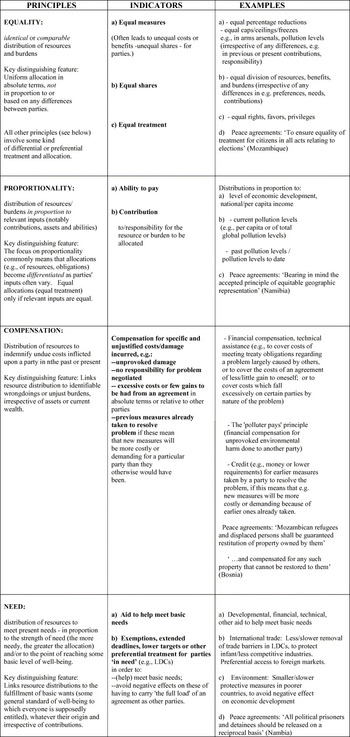
The project developed two documents to be used by coders when evaluating the presence and importance of distributive justice in specific peace agreements. The first was a guide for analysing and coding negotiated agreements. For each of the four principles examined – equality, proportionality, compensation, and need – the guide shown in Figure 1 provides a definition, key indicators and examples of application. Its purpose is to help coders recognise and identify the principles in the texts of agreements. These principles are not always mentioned by name. However, even when they are not mentioned, they may still be present and at work in an agreement. Coders were instructed to judge the presence of each of the four principles. A principle is regarded as being present when it is clearly, beyond reasonable doubt, underlying at least one provision in the agreement, even if not mentioned by name or referred to as a justice issue.
A guide for coding negotiated agreements.

The second document consisted of a series of questions to be addressed for each agreement. The first set of questions concerns identifying the presence of justice in the agreement: Are any of the principles – equality, proportionality, compensation, or need – reflected in the terms of the agreement, either explicitly by name or, if implicitly, clearly present beyond reasonable doubt? For each of the four principles found in the agreement: In what part(s) of the agreement is the principle found? Is it explicitly stated, or implicit (beyond reasonable doubt)? Is the principle strictly applied (the agreement reflects a model/‘exact’ application of the principle), or does it rather guide or influence the agreement's provisions?
The second set of questions asks the coder to assess the importance of justice in the agreement. Importance is measured in two ways. The first is by the number of principles reflected in an agreement. This is based on the notion that a greater number of principles generally reflect a wider range of considerations that are important to take into account in order to establish justice in actual situations.Footnote 46 The second is by the extent to which a principle informs or directs an agreement's core terms. The 1994 Oslo Protocol on Further Reduction of Sulfur Emissions (acid rain) in Europe provides an illustrative example: The principles of proportionality and compensatory justice greatly influenced the core terms for distributing emission cuts and the associated costs. The equality principle underlies the provision for an equal number of seats for each party on a conciliation commission. This was a less central provision given the substance and main objective of the Protocol.
For each justice principle included in the agreement the coder is asked to evaluate how significant it is for its core terms, expressed as a score on a scale from 0 to 2 as follows:
2: Highly significant (at heart of agreement and its core provisions; without this principle the agreement would be fundamentally different);
1.75: Between highly significant and important;
1.5: Important (included in some of the main terms of the agreement);
1.25: Between important and marginal;
1: Marginal (included, but for lesser – not core - issues in the agreement),
0: The principle is not mentioned or implied in the agreement.Footnote 47
The score is an aggregate value across the four principles, and reflects the overall significance of justice. That score ranges from 0 (no principle is significant) to 8 (all four principles are highly significant for the agreement's core provisions).
Coding reliability for distributive justice
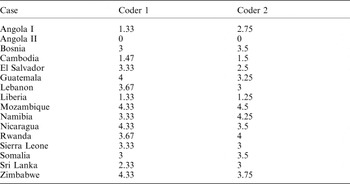
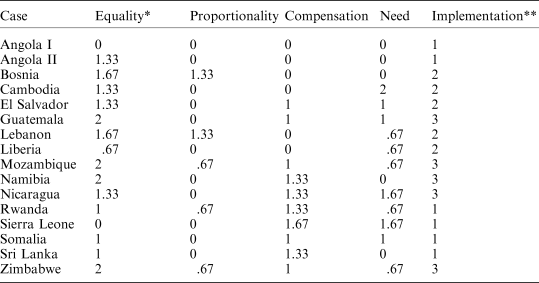
Two coders, working independently, judged each of 16 agreements (discussed below) on the extent to which each of the four principles was significant. Both coders followed the guide shown in Figure 1 and made decisions on the significance scale ranging from 0–2 for each principle. The scores ranged from 0–8 across the four principles. Judgments made by each coder are shown by case in Table 1. The differences are very small in practically all of the cases; the difference exceeded one scale point only in the Angola 1 case. The correlation between their judgments, across the cases, is .87 (p < .001). This is impressive evidence for agreement. We conclude that the DJ codes are highly reliable.Footnote 48
Cases by Distributive Justice Coding Decisions*

* Each agreement judged by independent coders. The scores are aggregates across the four principles, each coded in terms of a scale that ranges from 0–2. The maximum score is 8.
Coding durability
Two approaches were used for coding the durability of each agreement. One, developed by Downs and Stedman, consists of a three-step scale of implementation success, including: failure (1); partial success (2), and success (3).Footnote 49 This approach was used for the correlational analyses.Footnote 50 Another approach, devised by the authors, consisted of two sets of questions. One set concerns duration over time; that is, the number of years it has remained in force legally and in practice. We limited our examination to the five-year period following the date when the agreement entered into force rather than when it was signed, if different. For the peace agreements analysed here, it was deemed to be a sufficient time span.Footnote 51 The coder is asked whether the agreement is still in force in three respects: legally, effectively (the agreement serves its goals reasonably well in practice), and in the eyes of the parties (no party has stated or acted in such a way as to declare that the agreement is annulled). An overall assessment is then made about whether the agreement was still in force after five years. If not, the time span of the agreement is specified as well as the manner in which it was annulled. If so, the number and identity of those parties who had signed and ratified the agreement within two months of its entry into force are specified.
Another set of questions asks whether and to what extent parties have implemented and complied with the terms of the agreement, or violated it, during the five-year period. Only those parties who had signed and ratified the agreement within two months of its entry into force are included. Moreover, only implementation and any violations of the terms of the original agreement are considered, not later additions. The coder is asked to indicate which of the following best describes the status of the agreement during the entire five-year period.
1. The agreement has been fully implemented by all parties; no violations have occurred.
2. There have been minor implementation breaches/violations. This is defined as only a few violations of the agreement have occurred, and these violations have not significantly affected the goals of the agreement.
3. There have been ‘medium’ implementation breaches/violations. This is defined as some parties have violated the agreement, and these violations have undermined some goals of it.
4. There have been serious implementation breaches/violations (without abrogation). This is defined as several (or all) parties have violated the agreement, and these violations undermine the goals of the agreement in significant ways.
Based on his or her answers to the two sets of questions, the coder is asked to rate the overall durability of the agreement over the five-year period on the following scale:
1. Perfect
2. Highly durable
3. Good
4. Some elements of durability
5. Very poor or non-existent
This approach was used in our focused comparison analyses discussed below. Reliability was assessed with a small sample of cases from the peace agreements data set: Cambodia, Bosnia, Rwanda, and Somalia. Judgments made by students in a diplomacy programme at the Australian National University were compared to those made by case experts and by Downs and Stedman.Footnote 52 The students' ratings were similar to those provided by the experts and by Downs and Stedman. The judgments on overall durability were as follows: Cambodia – 4 (students), 4 (experts), partial success by Downs and Stedman; Bosnia – 3.5 (students), 4 (experts), partial success by Downs and Stedman; Rwanda – 5 (students), failed implementation by Downs and Stedman, and Somalia – 5 (students), failed implementation by Downs and Stedman. These judgments are very close and in several cases identical. They provide evidence for the reliability of the durability scale.
Coding forward and backward-looking outcomes
The distinction between forward and backward-looking outcomes refers to whether an agreement emphasised new relationships and institutions or dealt primarily with past injustices including reconciliation or apology, restitution, and retribution for abuses. This idea was captured by a five-step scale that ranged from past (1) to future-oriented (5) agreements. The decision to construct a five-step scale was based on the judgment that most of the peace agreements were mixed in varying degrees: Only a few of the agreements were pure cases of future orientation. The mixed feature was captured by distinctions between more past than future oriented (2), balanced between past and future oriented (3), and more future than past oriented (4). An attempt was made to code all the cases on this variable independent of judgments made on the justice principles. A second independent coder used the scale with a random selection of eight cases to assess reliability. The correlation between the eight pairs of ratings is .65 (p < .08 with 7 df). None of the coding pairs differed by more than one scale step. Three of the cases (Mozambique, Zimbabwe and El Salvador) were coded as ‘pure’ examples of future orientation (5) by the first coder. They were coded as ‘4’ by the second coder. We concluded that the scale is reliable. The first coder's judgments were used to evaluate hypothesis 10.
A peace agreements data set
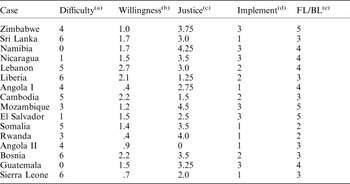
Downs and Stedman provide a data set well suited for evaluating the justice durability hypothesis. The sixteen peace agreements were negotiated during the 1980s and 1990s. The earliest was the 1980 agreement on Zimbabwe implemented by the British; the most recent was the Sierra Leone agreement signed in 1996. Fifteen of the 16 agreements where negotiated in the aftermath of the Cold War, when internal conflicts were frequent. Thus, the findings apply primarily to this period. However this set of cases also provides variety in terms of geographical location, legacy of the conflicts, and types of disputing parties. Thus, the findings may also be regarded as robust. In addition to the three-step scale on implementation success, Downs and Stedman coded difficulty of the conflict environment and willingness of international actors to intervene. The complete data set, with the Downs-Stedman and Druckman/Albin variables, is shown in Table 2.
Peace agreements data set

Note: The cases are listed in a rough chronological order from the Zimbabwe agreement of 1980 to the Sierra Leone agreement in 1996.
(a) scale range from 0–8; high score, more difficult conflict environment (Downs/Stedman)
(b) scale range from 0–3; high score, more willingness (Downs/Stedman)
(c) scale range 0–8; high score, principles are more central to the agreement (Druckman/Albin)
(d) scale range 1–3; high score, more successful or durable (Downs/Stedman)
(e) scale range 1–5, high score, more future-oriented terms (Druckman/Albin)
The conflict environment
Eight indicators of difficulty or conflict intensity included the number of warring parties (two or more), intervention in the absence of a peace agreement (present/absent), likelihood of spoilers (likely/unlikely), a collapsed state (with or without a governing capacity), number of soldiers (more or less than 50,000), disposable natural resources (warring parties do or do not have access), the presence of hostile neighbouring states (stable or unstable region), and wars of secession (wars fought over national sovereignty or over other issues). The either/or codes were summed for an index that varies between 0 (very low difficulty) and 8 (very high difficulty). This index is used to evaluate hypotheses 3 and 4 on conflict intensity.
Three indicators of interest and commitment by international actors included regional power interest (statement made of a security interest in the conflict), willingness of other states to provide financial resources for an intervention, and willingness to take risks by committing soldiers to the conflict. The three dichotomous codes were aggregated for an index that varied from 0 (low willingness) to 3 (high willingness). Although not specified as a hypothesis, the willingness variable is included in the analysis as another aspect of the conflict environment that may influence durability. The difficulty and willingness scores are shown for each case in Table 2. The implementation scores are also shown in the table; they range from 1 (failure) to 3 (success).
Distributive justice
Each of the 16 agreements was also coded for principles of distributive justice following the procedures discussed above. Complete texts of all the agreements were assembled for coding: The agreements varied in length from five (the agreement between the government of Nicaragua and YATAMA) to 52 pages (the agreement between the Republic of Rwanda and the Rwandese Patriotic Front). Although longer texts provide more opportunities for statements related to justice, the emphasis of this project on significance of the principles reduces the problem: We are interested more in the centrality of each principle than in the number of times it is mentioned. Each of the four principles of distributive justice was coded on the two-step significance or centrality scale described above: Highly significant (2), important (1.5), marginal (1), the principle is not mentioned (0). A more finely-tuned scale was created to capture mixed judgments: between important and highly significant (1.75) and between marginal and important (1.25). Aggregating the scores across the four principles resulted in a scale ranging from 0 (no principles in the agreements) to 8 (all principles are highly significant). The index scores are shown in Table 2. They range from a low of 0 (Angola II) to a high of 4.5 (Mozambique) with an average score of 2.9. For many of these cases principles of distributive justice are less central than issues of peace.
Anomalies
A review of the complete set of Downs-Stedman implementation codes revealed only two anomalies. A poorly implemented agreement in Rwanda occurred in a moderately difficult environment where several justice principles were central to the agreement. Paris' account of the Arusha Accords makes evident that this was a coerced agreement.Footnote 53 An embattled president viewed this decision as the least costly alternative in the short run. The principles of justice reflected in the agreement were meaningless in deed. The false justice implied by this situation led us to drop the Rwanda case from the statistical analysis.Footnote 54 This decision may have implications for the correlation results: The correlation between DJ and durability would be deflated (by including Rwanda) or inflated (by dropping Rwanda). The background considerations discussed above led to the decision to drop the case.
Few principles of justice were central to the El Salvador Chapultepec agreement. Downs and Stedman coded this agreement as successfully implemented in a low-difficulty environment. A closer look at the post-agreement conditions reveals that the economic and social reforms stipulated in the agreement were not implemented.Footnote 55 The conditions actually deteriorated with increasing crime and poverty following the agreement. Thus, the conditions that fuelled the conflict remained. This situation led us to change the implementation code from success (3) to partial success (2). Documentation on implementation in the other cases was judged to be consistent with the codes assigned by Downs and Stedman.
Analyses
The set of justice-durability hypotheses was evaluated with both statistical and qualitative analyses. Each approach is discussed in this section.
Statistical analyses
A favourable ratio of cases (15) to variables (4) assures sufficient degrees of freedom to perform statistical tests. The data shown in Table 2 are suited for correlational analyses. Correlations among the variables were computed resulting in 4 × 4 correlation matrices, with a total of 6 pair-wise coefficients in each matrix. These bivariate correlations are, however, inflated or attenuated due to multi-collinearity, which means that all the variables in a set are correlated with each other. The pattern of correlations was diagnosed with a factor analysis. The factor solution reveals both common (highly correlated variables) and distinct (weakly correlated variables) factors. But we also performed partial correlations. The partials remove the variation contributed by a third variable (for example, conflict difficulty) to the relationship between two other variables (for example, justice and outcomes). This type of statistical control provides confidence in the calculated bivariate correlation; it reduces the chances that the correlation is misleading and contributes to the development of a path model. In addition, regressions were computed to provide path coefficients used for evaluating mediating effects. Hypotheses 3 and 4 suggest that justice principles mediate the relationship between the conflict environment (difficulty) and durability. Indirect effects of justice variables are assessed by Sobel's test. The calculations use coefficients and standard errors from two regressions: A regression with difficulty (independent variable) predicting the justice (the mediator) and another with difficulty (independent variable) and justice (mediator) predicting durability (dependent variable). The test statistic (Sobel's z) and associated probability levels show the impact of the mediating variable (justice) on the direct relationship between difficulty and durability. The power of the test reduces with smaller samples; thus, larger impacts are needed for statistical significance with samples of 15 than 50.Footnote 56
In order to evaluate hypotheses 5–9, we performed a disaggregated analysis. Each of the four principles was correlated separately with the other variables. The results indicate which principle(s) was primarily responsible for the direct and indirect relationships between the aggregated justice index and the other variables in the data set, and, thus, provide evidence for the hypotheses.
Focused comparisons
A qualitative approach, referred to as focused comparisons, was used to further evaluate hypotheses 3 and 4 about interactions between DJ and the difficulty of the conflict environment. Based on the logic that supports laboratory experiments, the method relies on the selection of a small number of similar cases rather than sampling of a large number of different cases. Cases are chosen because they are similar in most respects. They differ on only one or a few independent variables. For example, both cases are difficult but vary in terms of the number of justice principles in the agreement; or, both cases are easy but vary in the number of principles. These comparisons were performed with selected cases from the peace agreements data set. However, the limited number of cases – and availability of documented agreements – challenges the ceteris paribus assumption of ‘all other things being equal’. Within these practical limitations, an attempt was made to match the comparison cases as closely as possible: For example, cases from the same region and characteristics of the conflict. These analyses complement the statistical analyses. They bolster the causal argument suggested by the mediator analyses while forfeiting the generality or robustness contribution.Footnote 57
Four cases were chosen from the data set for the focused comparison. The idea is to compare cases matched on difficulty or conflict intensity but varying in terms of justice. Two low-difficulty cases from the same region (Central America) are Guatemala and El Salvador. The former is an example of a high-justice agreement; relatively few principles judged as significant surface in the latter agreement. Two high-difficulty cases are Cambodia and Bosnia. Although these cases differ in several ways, they are both considered to be partial successes and had similar histories of international intervention. The Cambodia agreement contains few principles of justice judged to be significant; Bosnia has relatively many principles judged as being significant. The analysis addresses hypotheses 3 and 4 and answers the question: Does justice influence implementation when the difficulty of the conflict environment is controlled at similar levels?
An evaluation of this question was performed with students in a class on diplomatic negotiation held at the Australian National University. A dozen students were divided into four groups of three. Each group was assigned a case and instructed on how to use the forms described earlier for making judgments of justice and durability. The justice scale ranges from a high of 1.5 (the principle is highly significant) to a low of .5 (the principle is marginal).Footnote 58 A score of 0 is assigned when the principle does not surface in either an explicit or implicit way in the text. The durability scale ranges from perfect (1) to very poor or non-existent (5) durability.
Each group had the complete text of the agreement and was given reading material on the five-year implementation period. They were allowed three days to complete the assignment. The results were recorded and presented at a retreat de-briefing. We turn now to the findings from both sets of analyses.
Results
This section is divided into four parts. First, we present the correlational findings based on the 15-case data set followed by a path model that summarises the findings. Second, we show results from analyses of the separate DJ principles, including the results of the mediation tests. Third, the forward-backward looking results are described. And, fourth, the focused comparison results are presented.
Correlation findings: difficulty, DJ, and implementation
The correlation analyses were performed in a sequence where later steps build on previous results. First, correlations were computed among four variables – difficulty, willingness, DJ, and implementation/durability – across the 15 cases. Partial correlations between pairs of variables were also calculated. Then the correlation matrix was factor analysed. Implications for the justice-durability relationship are summarised, paving the way for the analyses to follow.
The correlation matrix is shown in Table 3.Footnote 59 Key results are as follows:
The strongest correlation is between difficulty and implementation (−.65). This correlation is increased somewhat when difficulty is controlled (−.71, p < .004).
A slightly reduced correlation between difficulty and implementation occurs when justice is controlled. The −.65 correlation drops to −.57 (significant at the .03 level).
The correlation between justice and implementation is .56 (significant at the .03 level).Footnote 60 The correlation is about the same when willingness is controlled (.57).
The correlation between justice and difficulty is −.37.
A correlation of .46 (p < .10) occurs between justice and implementation when difficulty of the conflict environment is controlled. The correlation is the same when both difficulty and willingness are controlled.
Correlations among the variables

* Correlation is significant at the .05 level
** Correlation is significant at the .01 level
The factor analysis of these correlations, shown in Table 4, results in a clear separation of the variables. A two-factor solution indicates that the first component (accounting for 52 per cent of the explained variance) consists of the difficulty-justice-implementation cluster; only willingness loads on to the second factor, which accounts for 27 per cent of the explained variance.
Factor analysis results

* Substantial loading on the factor
These results indicate that justice matters. Principles of justice contribute to the success of implementing peace agreements. However, difficulty remains the primary influence on implementation. The results show a strong correlation between justice and implementation (durability). But, the partial correlation between justice and implementation, controlling for difficulty, is reduced: from .56 to .46. This result provides modest support for hypothesis 1 but not hypothesis 2: The inclusion of justice principles in an agreement leads to more durable agreements.
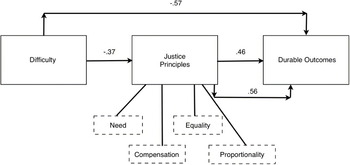
This pattern of correlations is depicted in the form of the model presented in Figure 2. The implied causal path is based on the assumption that the negotiated outcome occurs in the context of a (prior) conflict environment and precedes implementation. Justice principles are shown to moderate the relationship between difficulty and outcomes.Footnote 61 When justice principles are central to an agreement, the negative effects of difficulty are reduced. Similarly, when the principles are not central to an agreement, the negative impact of difficulty is heightened. This finding does not support hypothesis 3. However, in support of hypothesis 4, it may be suggested that when justice principles are central, the durability of implementation is increased in less difficult conflict environments. Thus, justice principles had a modest influence on durability in both more and less-difficult conflict environments. Results of the Sobel's z tests were not significant. These conclusions are explored further in the analyses reported in the following sections.
A Statistical Path Model.

Separate DJ principles
Coding decisions for each DJ principle by case are shown in Table 5 along with the outcome (durability) code. Equality was the predominant principle in most of the agreements (M = 1.27) followed by compensation (M = .75), need (M = .73), and proportionality (M = .29). A Friedman ANOVA for related samples showed that significantly more equality principles were represented in the agreements than the other three principles (F(r) = 17.88, 3 df, p < .0001). Pair comparisons were made with the Wilcoxon signed ranks test for related samples. Equality principles were more central to the agreements than proportionality (z = 3.33, p < .001), compensation (z = 2.07, p < .038), and need (z = 1.89, p < .058).Footnote 62 These findings provide strong evidence for hypothesis 5 but not hypothesis 7. Equality – rather than proportionality, compensation, or need – was the key principle in most of the agreements, including those primarily about sources and those that addressed symptoms.
Cases by principles and durability
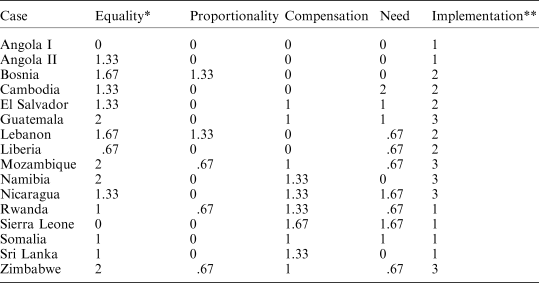
* Each principle was judged on a two-step scale.
** The implementation scores are the outcome scores from Downs and Stedman (2002), with an adjustment for El Salvador from 3 to 2.
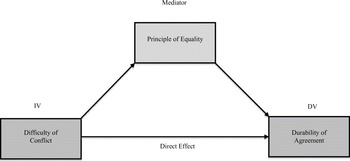
The centrality of equality principles was strongly correlated with durability across the 15 cases (r = .76, p < .001) and when Rwanda is included in the data set (r = .76, p < .001). The correlation remains strong when each of the other three principles is controlled (proportionality: .77; compensation: .75; need: .79). None of the other three principles correlates with durability (proportionality: .10; compensation: .16; need: .10). Thus, in support of hypothesis 6, equality accounts for the relationship reported above between distributive justice and durability. Equality is also shown to moderate the relationship between difficulty of the conflict environment and durability. The correlation between difficulty and durability decreases when equality is controlled, from −.66 to −.52. Similarly, the correlation between equality and durability decreases when difficulty is controlled, from .73 to .63. These findings are consistent with the path model shown in Figure 2. They are bolstered by the results of the Sobel's test for mediating effects. A borderline significant z (1.71, p < .09) suggests that equality mediates the relationship between difficulty and durability.Footnote 63 The mediation model is shown in Figure 3. The causal direction shown in the figure goes from difficulty to durability through equality. The path does not travel in the opposite direction: difficulty of the conflict was not shown to mediate the relationship between equality and durability (z = 1.40, p < .16).
The results also provide strong support for hypothesis 6 but not for hypothesis 8: equality, but not proportionality, led to more durable agreements. Nor do the findings support hypothesis 9: the centrality of compensation and need principles did not correlate with durability. These principles were infrequently mentioned in the agreements.
Mediating effect of equality.

Forward and backward-looking (FL/BL) outcomes
The correlation findings with the FL/BL variable are as follows:
FL/BL correlates significantly with durability (.66, p < .008) and equality (.61, p < .02).
The FL/BL correlation with durability decreases from .66 to .38 (p > .10) when controlling for equality.
The relationship between FL/BL is mediated by equality. A Sobel's z of 1.96 is significant below the .05 level. The relationship between equality and durability is not mediated by FL/BL. The relationship between equality and durability remains the same when FL/BL controlled (r = .61 with and without controls).
A significant negative correlation between FL/BL and difficulty (−.58, p < .02) drops to −.41 when equality is controlled.
FL/BL does not correlate significantly with proportionality (.22), compensation (.20), or need (−.01).
Thus, FL/BL influences durability through equality principles. Although FL/BL correlates with equality, it does not influence durability independent of this DJ principle. These results provide partial support for hypothesis 10. Durability depends to a large extent on the forward-looking principle of equality. It is not influenced by the other DJ principles – proportionality, compensation, need – which may not be indicators of the FL/BL construct.
Focused comparisons
In this section we report the results of the each group's judgments and the pair-comparison findings.
Guatemala: 4.5 (Justice), 4 (some elements of durability)
The high justice score reflects compensatory and needs principles (backward-looking) addressed primarily by the rebel group (URNG), not the government. The weak durability contradicts the judgment of success shown in Table 1 above. According to Paris,Footnote 64 the underlying sources of the conflict were not addressed and, in fact, the economic recovery only served to increase the tensions in the society. This is similar to the post-agreement situation in El Salvador. (The justice coder provided detailed information on the rationale and location of statements on which the codes are based.)
El Salvador: 2.75 (Justice), 3 (good on durability)
These scores corroborate our coding of few justice principles judged as being significant. The students' coding of durability is consistent with our discussion above about anomalous cases. Justice principles were not significant and the sources of conflict (poverty) were not addressed. Thus, our decision to alter the outcome score for the correlation analysis is supported.
Bosnia: 4 (Justice), 3 (good on durability)
These codes corroborate our judgment on the justice principles as well as on durability (partial success). A more forward-looking justice is reflected in the predominance of equality and proportionality principles. Perhaps this is what the US mediation at Dayton had in mind, but used coercive tactics to bring it about.
Cambodia: 2.75 (Justice), 4 (some elements of durability)
The students coded more justice principles – especially equality and proportionality – than we did. The judgment of partial success shown in Table 1 above is perhaps a bit more optimistic than the students' reading of the implementation period.
The results of the pair-comparison control for difficulty are as follows:
Bosnia vs. Cambodia: High difficulty with many (Bosnia) or few (Cambodia) principles.
Bosnia was good on durability, Cambodia was coded as having some elements. This provides support for the relevance of justice principles. The centrality of justice principles attenuates the effects of difficult environments.
Guatemala vs. El Salvador: Low difficulty with many (Guatemala) or few (El Salvador) principles judged as significant.
El Salvador was coded as somewhat stronger on durability than Guatemala. This result does not support the importance of justice principles. However, on closer inspection, the opposite result is apparent. Our appraisal of El Salvador above suggests poor durability. The compensatory and needs principles found in the Guatemala agreement were based on the initiative of the rebel group and did not address the underlying sources of the conflict. This interpretation lends support to hypothesis 1 (but not hypothesis 2) on the justice-durability relationship: Few principles judged as significant and poor durability for El Salvador; superficial (backward-looking) justice and poor durability for Guatemala.
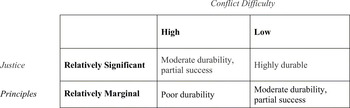
These results bolster the argument that justice principles matter. They make a difference in both high and low-difficult conflict environments. They corroborate the statistical findings: Hypothesis 3 on more intense conflicts (high difficulty environments) is not supported; hypothesis 4 on less intense conflicts (low difficulty environments) is supported. And, according to the correlational patterns and regression results, the two variables interact; they act together in influencing the durability of peace agreements. The interaction is depicted in the form of a 2 × 2 matrix shown in Figure 4.
A 2 × 2 matrix of impacts on durability.

Discussion
The study's results are discussed in three parts: the relationship between the aggregate measure of justice and durability, the role of the equality principle, and suggestions for further research.
Justice and durability
The analyses reported in this article show that the durability of peace agreements depends, at least in part, on principles of distributive justice. This relationship was shown to be contingent on factors in the environment that exacerbate or attenuate the intensity of conflict. These factors are referred to as difficulty. By including difficulty variables in the analyses we provide a more complex rendering of the hypothesis that justice influences the durability of agreements. It is not surprising that agreements are more difficult to implement in environments where the incentives for continued fighting outweigh those for making peace. Examples of these conflict environments were Sri Lanka, Lebanon, Liberia, Cambodia, Somalia, Bosnia, and Sierra Leone. It is interesting to note that, despite the difficulty, four of these agreements were a partial success. For two of these partial successes – Lebanon and Bosnia – justice principles were in play (see Table 2). And, the case of Zimbabwe illustrates success in a moderately difficult environment where all four principles played a role in the agreement (see Table 5). For three failed cases – Angola I, Angola II, Sierra Leone – few justice principles came into play. Thus, justice can offset the negative effects of the conflict environment; it can also reinforce the positive effects of an environment that is more conducive to peace. These findings suggest a modification in the contending hypotheses (1 versus 2). Justice principles contribute to the stabilisation of relationships in both more and less difficult environments. It is not the case that the principles further destabilise relationships in more difficult environments as suggested by the third hypothesis.
The focused comparison results strengthen the argument that justice plays an important role in peace agreements. By selecting cases in each quadrant of a justice-difficulty matrix – all combinations of high and low on both variables – we were able to evaluate the relationship between justice and durability. In effect, we have examined each variable independently. This advantage of the matched-case procedure complements the strengths of statistical analysis of a large number of different cases. The students' judgments for the high-difficulty cases does not support hypothesis 3. Their decisions on the low-difficulty cases do not support hypothesis 4: both these cases were poor on durability. However, upon closer inspection, the opposite interpretation is apparent: The justice principles in the Guatemala agreement were backward-looking. This interpretation then does lend support for hypothesis 4. These findings also illustrate the value of complementary research approaches. The quantitative analyses provide evidence for a general relationship between justice and durability. The qualitative work provides a deeper appreciation for the role played by justice during implementation. Results obtained from these complementary analyses converge on the discovery of modest mediating effects of justice on the relationship between difficulty and durability, in the form of a statistical path model (Figure 2) and a 2 × 2 classification matrix (Figure 3). Both analyses illuminate the value of control, first by using partial correlations and then by selecting cases on the independent variables.
The role of justice in implementation is further strengthened when the willingness (interest and commitment) variable is taken into account. The factor analyses show that this variable is independent of justice, difficulty, and durability. The correlation analyses indicate stronger relationships between justice and durability than between willingness and durability Further, the justice-durability and justice-difficulty correlations change little when willingness is controlled. An interpretation of these findings is that durability depends more on justice principles – especially if they are adhered to during implementation – than on support from regional states. This may be due, at least in part, to the strength of these actors' commitments. Their interest may wane through the long period of implementation in both more and less difficult conflict environments. It may also be due to the offsetting effects of intervention, namely, interveners both fuel and reduce the conflict. As advocates for one or another party, they interfere with implementation. Their role may be more useful when they serve as third parties in the negotiation process, as illustrated by Mozambique, Bosnia, Sri Lanka and other cases in the data set.
The principle of equality
The correlation between distributive justice and durability was largely accounted for by the equality principle. It was the only one of the four DJ principles that correlated strongly with durability, and the correlation remained strong when other factors were controlled. Additional analyses showed that equality mediated the relationship between difficulty and durability. The causal link between the conflict environment and durability travelled through the centrality of equality principles in the agreements (Figure 3): equality principles moderated (enhanced) the impact of relatively negative (positive) conflict environments. Thus, hypotheses 5 and 6 are supported. Hypotheses 7, 8, and 9 are not supported: proportionality, compensation, and need do not distinguish among the cases; this occurs for both the cases that address sources and those that focus more on symptoms; equality was the predominant principle across the cases. And, it is a forward-looking principle as indicated by a strong correlation with an independent measure of FL/BL outcomes. Backward-looking outcomes were rarely accompanied by equality principles. However, it was the equality principles rather than the FL/BL outcomes that influenced durability: equality mediated the relationship between FL/BL and durability. Thus, the principle of equality accounts for the relationships of context (conflict environment) and type of outcome (FL/BL) with durability.
These findings corroborate the laboratory results obtained by Deutsch.Footnote 65 He explained his results in terms of the importance of interdependence and an aspiration for cooperation or solidarity. But, there may be other reasons for the prevalence of equality. This was explored with the student coders participating in the focused comparison exercise.
The students were asked to indicate which of several possible explanations might explain the emphasis on the equality principle in their case. Equality in the Guatemala negotiation was explained in terms of structural equality implied by a willingness to negotiate. Equality in the Bosnia case was explained in terms of a mutual desire to reinforce aspirations for implementing a new relationship. Both explanations were cited for Mozambique but the outcome was understood in relation to actions taken by the mediating team during the negotiating process. The mediators in that case emphasised equality in both structural and relational terms. Thus, there seems to be alternative explanations for the prevalence of equality in these agreements. But, the explanation may be less important than the presence of equal terms in the agreement. Each reason – structures, relations, uncertainty – may serve as a motivating factor for assuring that the parties leave the table with an understanding that they will move forward as equal partners. Such understanding contributes to the durability of the agreement. It must however be sustained through time. This may depend on the extent to which equality enhances trust, particularly the form of trust based on shared identities.Footnote 66 Indeed, trust is central to Uslaner's model linking inequality to corruption and instability.Footnote 67 It may also mediate the relationship between equality and durability. This remains to be explored.
Equality may serve different purposes for the parties to these peace agreements. Power-sharing would seem to be a strong motive for many of the rebellious groups in our cases.Footnote 68 It contributes to political stability.Footnote 69 Stability looms large as an aspiration for the governments. However, these desires may not be realised in the period following the agreement. Many of the agreements provided representation for the former combatants in majoritarian political systems: As minority voices, these groups have limited power over legislation or policies. The hoped-for stability may whither as former rebels realise that they are on the short side of privileges. In his interpretation of Tocqueville's writing, Elster observes that ‘a given difference appears as more intolerable the more equal conditions are in society as a whole.’Footnote 70 The flames of instability are fuelled by equality: the former rebels become less tolerable of small differences between the groups. These interesting ideas remain to be evaluated.
Further research
The framework and analyses reported in this article are first steps in a larger programme of research. A number of next steps are contemplated. One step is to expand the data set to include other peace agreements, for example those that have occurred since the end of World War Two. The large number of cases would bolster the argument for generality. Another step consists of evaluating hypotheses suggested by the anomalous cases. These hypotheses focus on the implementation period, highlighting differences within each of the parties and adherence of both parties to justice principles. The cases also raise the interesting distinction between justice embodied in an agreement and evident during the implementation period. Durability turns on both: failure to adhere to the principles threatens durability; new principles that emerge during implementation may either threaten or strengthen the terms of the agreement. These are new variables to be added to the data set. Each can be coded from case studies that describe the post-settlement period in some detail.Footnote 71
A second step consists of examining the agreement texts for other kinds of justice principles: structure, process, and procedures. Such an examination requires developing hypotheses, constructing coding rules, accumulating material on the process, and performing analyses. Examples of two hypotheses are:
• Structural and process justice are correlated: The more equal the representation of the parties (structure), the less they rely on coercive or deceptive tactics (process).
• Outcome justice co-varies with process and procedural justice: More principles of distributive justice are found in agreements that emanate from fair processes.
Exceptions to the second hypothesis may occur. In some cases the principles that surface in the text may not emerge from a fair process. They may be included for the sorts of political reasons evident in the Arusha Accords. Or, they may be the result of a coercive process engineered by a more powerful party. These examples of false justice decrease the chances of sustaining the terms of the agreement through time. Thus, a third hypothesis can be suggested for further exploration: justice outcomes that emerge from fair processes or procedures are more likely to be sustained; those that emerge from unfair processes or procedures are less likely to be sustained.
A challenge to process analysis is the general lack of appropriate documentation. Few cases are catalogued in the way that HumeFootnote 72 describes the round-by-round discussions on Mozambique or Raszelenberg'sFootnote 73 analytical chronology developed for the Cambodia peace process. However, process documentation does exist for a number of the other cases, albeit varying in detail. This documentation can be a basis for statistical analyses. An alternative research strategy is to perform analyses on a small number of well-documented cases, sufficient for performing focused comparisons. They would also permit process tracing analyses to explore the above hypotheses about possible causal relationships between process or procedural and outcome justice as well as plausibility probes for discovering mechanisms that explain those relationships.Footnote 74
Process documentation provides a data set for evaluating hypotheses about relationships between procedural justice (PJ), outcomes (DJ, FL/BL), and durability. Four types of PJ can be coded: transparency, fair representation, fair treatment/fair play, and voluntary agreement. The PJ-outcome relationship has been examined, most recently in the study by Hollander-Blumoff and Tyler.Footnote 75 The proposed study extends the focus to issues of durability. But, there are other process variables that merit further investigation. These include perceptions of various types of justice, trust, false vs. genuine justice, strategic decision making, and other variables emphasised in the psychological literature on justice.Footnote 76 A challenge is to develop appropriate indicators of these subjective variables.
Third, the justice-durability framework developed for this project applies as well to agreements negotiated in other domains. One of these domains is the environment, as illustrated earlier with the case of the Montreal Protocol. The relevance of the framework is illustrated also by the Oslo Protocol on Acid Rain. Using our codes, that particular case showed a strong relationship between justice principles (4.33 on the eight-step scale, with higher scores indicating more centrality for the principles) and durability (highly durable – 2 on the five-step scale with higher scores indicating less durability). By adding other environmental cases, we can build a data set comparable to the one assembled for peace agreements.
Similar efforts can be made to assemble a data set on trade cases. The Cameron and Tomlin book on NAFTA provides an example of the sort of documentation available in this domain.Footnote 77 With data sets in hand, a three-way comparison of domains (peace, environment, trade) would reveal the generality (or context-specificity) of the justice-durability hypothesis. The experience of working across issue domains would also inform us about the generality of the concept definitions and codes used for these analyses of peace agreements: for example, the difference between terms of exchange – as specific reciprocity – in trade talks, compensation – as a more diffuse reciprocityFootnote 78 – in environmental negotiations, and the less tangible criteria that address relational issues in talks to end civil wars.
Fourth, connections between peace agreements and peace-building activities can be explored. The question of whether forward-looking agreements enhance the prospects for societal transformation remains to be evaluated. This project and others have developed indicators at the micro level for types of peace agreements and the role of justice principles in those agreements. Less has been done along these lines at the macro level of societal change or transformation. The Downs-Stedman index of difficulty provides information relevant to the prospects for change. The index does not, however, capture evolving institutional processes during transitions to democratic systems. The development of macro-level indicators would facilitate performing analyses that connect micro with macro-level processes. They would also provide insight into the sorts of institutional reforms needed for large-scale transformations to occur. These analyses address some larger consequences of justice principles. They are part of an expanded agenda for research on justice and the durability of negotiated agreements.