1. Introduction
It often happens that scientists are unable to study a system in the ways that they think would be most informative. The system may be inaccessible in time or space, or studies of interest may be impractical or ethically unacceptable. In situations like these, scientists seek alternative means of investigation. Often, they look for, or even construct, models of the target system and study those models instead. Whenever they rely on models in this way, however, they face the challenge of arguing that what is learned about a model is informative regarding a target system. This challenge is variously known as the problem of external validity or the problem of extrapolation.
Steel (Reference Stott, Allen and Jones2008) offers one solution to this problem, focusing in particular on extrapolation of causal relationships in biology. Central to his account is comparative process tracing (CPT). CPT involves learning the mechanism by which an effect of interest is produced in a model, identifying stages of the mechanism at which it seems most likely that significant differences in the target system might occur and then checking how similar model and target are with respect to those key stages; in general, the more similar they are, the stronger the basis for extrapolation of the cause and effect relationship (Steel Reference Stott, Allen and Jones2008, 89). By engaging in CPT, Steel argues, scientists sometimes can have strong grounds for claims about cause and effect in a target system—for example, that high doses of a chemical would likely be carcinogenic—even when opportunities for experimentation on the target are limited. Investigation can be further reduced, Steel notes, when later stages of the mechanism in question can be expected to bear distinctive marks of earlier stages; if these “fingerprints” of upstream causal processes are found in the target system, then there is less need to check those earlier stages (90).
Scientists who investigate the causes of recent climate change also speak of “fingerprints”—distinctive spatial and temporal patterns of change that, according to modeling studies, would be produced in response to particular climate forcing factors, such as changes in solar output. In what follows, I argue that these climate change investigations have much in common with Steel's streamlined CPT, though the models used here are computer simulation models—models in which the physical mechanisms at work are quite different from those at work in the climate system. Then, I explain why robustness and variety-of-evidence considerations turn out to be important for understanding the evidential value of these climate change studies.
2. Climate Change Fingerprints
Observations made over the past century indicate that Earth's average near-surface temperature, also known as global mean surface temperature (GMST), is increasing (IPCC Reference Solomon2007). Investigation of what is causing this atmospheric warming relies heavily on models, particularly computer simulation models. These models range from the highly simplified to the extremely complex and are constructed with the goal of simulating in greater or lesser detail the transport of mass, energy, moisture, and other quantities by various processes in the climate system. These processes include the movement of large-scale weather systems, the formation of clouds and precipitation, ocean currents, the melting of sea ice, the absorption and emission of radiation by atmospheric gases, and many others. To represent these processes at the relatively coarse spatiotemporal resolution of the models, scientists rely on a mixture of physical theory, empirically motivated approximations, and educated guesswork.
In recent modeling studies, the evolution of GMST during the twentieth century is approximately reproduced by simulations that include representations of both “anthropogenic” (i.e., human-caused) and “natural” forcing factors. The former include changes in concentrations of greenhouse gases, changes in concentrations of tiny particles known as “aerosols” due to human activities, and changes in concentrations of ozone; the latter include changes in solar output and volcanic eruptions (because such eruptions also lead to changes in aerosol concentrations). Simulations that take into account only natural forcing factors fail to reproduce the marked increase in GMST observed late in the twentieth century. This finding—that late-twentieth-century global warming appears only in simulations that include anthropogenic forcing factors—is considered “evidence for the influence of humans on global climate” (Hegerl et al. Reference Hegerl and Solomon2007, 684).
Yet on its own this finding does not provide particularly strong evidence that the primary causes of twentieth-century changes in GMST have been correctly identified or that their relative importance has been accurately estimated. Seeking additional evidence, scientists investigate in a more formal way the contributions of different forcing factors to observed changes in GMST and to the geographical patterns of change that underlie them.Footnote 1 For these studies, they rely on computer simulation experiments in which one or more forcing factors are included, while the rest are omitted. For instance, greenhouse gas concentrations might be allowed to vary in accordance with estimates of actual historical variation, while aerosol concentrations, solar output, and so forth are held constant. From these simulations, scientists have been able to associate with particular forcing factors (and combinations of forcing factors) distinctive spatial and/or temporal patterns of change in near-surface temperature and in some other variables as well (e.g., Santer et al. Reference Santer2003; Hegerl et al. Reference Hegerl2006).
As noted earlier, these distinctive patterns of change are known as “fingerprints” of particular forcing factors. Two kinds of studies are commonly undertaken with such fingerprints, both of which treat fingerprints as signals (or patterns) whose amplitudes in observational data are to be investigated.Footnote 2 Detection studies investigate whether the amplitude of a given fingerprint/signal in the observational data is too large to be explained by the “noise” of year-to-year and decade-to-decade fluctuations in climate that occur even in the absence of any forcing factors, known as the “internal variability” of the climate system; if so, then the fingerprint is “detected” in the data.Footnote 3 Other studies, known as attribution studies, investigate the extent to which an observed pattern of change, such as a geographical pattern of warming and cooling, can be accounted for by adding together the fingerprints of various forcing factors. In light of what is found, portions of the observed change may be “attributed” to particular forcing factors.
What are the results of fingerprint studies like these? Numerous studies have detected fingerprints of greenhouse gases and anthropogenic aerosols in twentieth-century observations of near-surface temperature (see references in Mitchell et al. [Reference Mitchell and Houghton2001] and Hegerl et al. [Reference Hegerl and Solomon2007]), and “evidence of anthropogenic signals is also emerging in other variables,” such as sea-level pressure, tropopause height, ocean heat content, and ocean salinity (Hegerl et al. Reference Hegerl2006, 5058). Attribution studies have found that various spatial and/or temporal patterns of change in near-surface temperature can be accounted for by a set of fingerprints only if the set includes greenhouse gas or greenhouse plus aerosol fingerprints (Tett et al. Reference Zhang, Zwiers and Stott1999; Stott, Allen, and Jones Reference Tett2003) and that, in many cases, the amplitudes of these fingerprints as estimated from observations are consistent with their model-predicted amplitudes (IDAG 2005; Zhang, Zwiers, and Stott Reference Zhang, Zwiers and Stott2006). Especially for the late twentieth century, but also for the twentieth century as a whole, those amplitudes imply a warming contribution from greenhouse gases that is far larger than that of any other forcing factor considered. These findings are taken to provide significant support for the conclusion that most of the global warming of the last 50 years was caused by increased concentrations of greenhouse gases (Hegerl et al. Reference Hegerl and Solomon2007).
3. Fingerprint Studies, CPT, and Mechanisms
Climate scientists conducting the sorts of fingerprint studies just discussed are engaged in an approach to extrapolation that has much in common with Steel's streamlined CPT: seeking evidence regarding the causes of target system behavior, they are checking the target system for fingerprints understood to be indicative of particular upstream causal processes—those initiated by climate forcing factors—having learned about these fingerprints by studying a model. But Steel's CPT is a mechanisms-based approach to extrapolation; can the same be said of climate change fingerprint studies?
I would argue so. If climate models were simply phenomenological models, that is, equations for transforming inputs into outputs without any associated causal interpretation, then it would be odd to characterize fingerprint studies as mechanisms-based extrapolation. As implied earlier, however, today's climate models are not phenomenological models, but rather models designed to represent important causal processes at work in the climate system. Moreover, the climate forcing factors investigated in fingerprint studies are not just factors that scientists think might somehow bring about changes in climate; for each forcing factor they have conceptualized at least one mechanism by which that factor would increase or decrease GMST (see fig. 1). What are these mechanisms?
Forcing factors are hypothesized to affect GMST through particular mechanisms.

Perhaps the most familiar is that by which increased concentrations of greenhouse gases, such as carbon dioxide, are expected to lead to an increase in GMST. Greenhouse gases are nearly transparent to the incoming “shortwave” radiation from the Sun, some of which reaches and heats Earth's surface. But they absorb and then reemit in all directions some of the longer wavelength radiation that is in turn emitted from Earth's heated surface. Since this “longwave” radiation also produces heating when it is absorbed, the net result is that the atmosphere near Earth's surface is kept warmer than it otherwise would be. As atmospheric concentrations of greenhouse gases increase, more longwave radiation is expected to be absorbed and reemitted in this fashion, leading to even warmer near-surface conditions.
When it comes to increasing aerosol concentrations, scientists hypothesize several global cooling mechanisms. Aerosol particles in the atmosphere scatter and absorb incoming solar radiation, preventing some of that radiation from reaching and warming Earth's surface. As aerosol concentrations increase, more incoming radiation is expected to be scattered and absorbed, further reducing the amount that reaches and warms Earth's surface. This is the so-called direct aerosol cooling mechanism. Several other, “indirect,” cooling mechanisms involve the interaction of aerosols with clouds (see Forster et al. [Reference Forster and Solomon2007] for examples and discussion).
Mechanisms like these are conceptualized on the basis of background knowledge and physical reasoning, much of which is uncontroversial. For example, that carbon dioxide and other greenhouse gases have particular radiative properties—absorbing radiation in some wavelength bands but not in others—is known on the basis of laboratory experiments. Climate scientists bring accepted background knowledge like this to bear on the task of explaining why Earth's climate has changed as it has over the last century, outlining plausible mechanisms by which particular causal factors (i.e., climate forcing factors) could push GMST in one direction or another.
But to make a convincing case that these forcing factors, via these mechanisms, really did contribute significantly to the evolution of twentieth-century GMST, scientists need to move beyond the qualitative terms in which the mechanisms are described above. How much of an increase or decrease in GMST would a given forcing factor produce over time? Very rough estimates might be made by physical reasoning with the help of various simplifying assumptions. For more precise estimates and for information about the spatially varying changes in near-surface temperature that would underlie those increases or decreases in GMST, scientists turn to climate models.
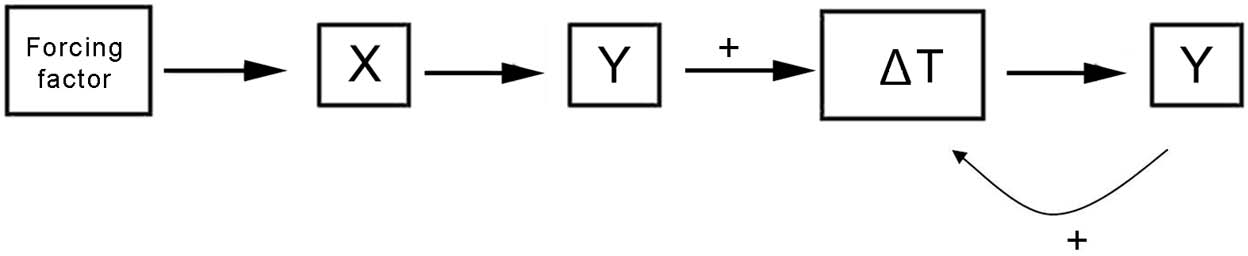
Climate models are needed because the causal processes at work in the climate system are numerous, complicated, and interactive. Indeed, the mechanism descriptions given above are really only partial descriptions; they include what are thought to be the core processes of the mechanisms, but they omit any feedbacks. For instance, as sea ice melts in a warming world, revealing the less reflective ocean surface underneath, more solar radiation will be absorbed at the surface, which can be expected to lead to further warming (see fig. 2). Depending on the strength and sign of such feedbacks, initial changes in GMST due to a forcing factor may be significantly enhanced or offset, and spatial patterns of near-surface temperature change may be affected.
Depiction of a climate change mechanism with a positive feedback.

In the end, given the myriad causal processes at work in the climate system, not even the most insightful scientist can simply foresee, in detail, the spatial and temporal patterns of near-surface temperature change that will be produced by a given forcing factor over a given time period. Instead, many of these processes, including those that figure in the mechanisms by which climate forcing factors are hypothesized to affect GMST, are represented mathematically in climate models, which are used to simulate how climate would change in response to increasing greenhouse gas concentrations, changes in solar output, and so forth.Footnote 4
With these simulation results in hand, scientists set out to identify fingerprints of different forcing factors in order to test hypotheses about the extent to which those forcing factors, via (roughly) specified mechanisms, have contributed to observed changes in GMST. Examining the simulations, they may also notice feedbacks of which they were previously unaware, allowing for a more complete conceptualization of the mechanism by which a forcing factor affects GMST over time. Thus, while the mechanisms literally at work in climate models, that is, in digital computers, are quite different from those at work in Earth's climate system, investigation of mechanisms is still at the heart of fingerprint studies; it is the desire to test hypotheses about the mechanisms responsible for observed changes in global climate that motivates detection and attribution studies in the first place.
4. Fingerprints, Robustness, and Consistency
Nevertheless, a closer look at fingerprint studies reveals that their evidential value is often less clear-cut than one might hope. To begin with, the general approach rests on some questionable assumptions that cannot be directly tested. One is the assumption of additivity, that is, that the response of the climate system when several forcing factors are present is equal to the sum of the responses that each forcing factor would produce in isolation from the others. Additivity has been shown to be a good approximation when it comes to the global-scale responses of some climate models (Santer et al. Reference Santer2003; Meehl et al. Reference Meehl2004) but has been found to break down for some regional-scale responses (Meehl et al. Reference Meehl2003). Since it is relatively easy to think of interactions that can be expected to occur among mechanisms by which different forcing factors affect GMST (see Hegerl et al. [Reference Hegerl and Solomon2007, 670] for a brief example), additivity seems best thought of as an approximation, one whose scope of applicability is not yet well understood.
A second questionable assumption is that climate models simulate enough of the causal processes at work in Earth's climate system, and simulate them accurately enough in the relevant respects, to show scientists, at least approximately, the spatial and/or temporal patterns of change that would occur if one or more of the forcing factors were present while the rest were not. In other words, fingerprint studies assume that climate models are adequate for the purpose of providing this information about how the climate system would respond to different combinations of forcing factors. As with additivity, directly testing this adequacy assumption would require data from counterfactual situations (e.g., for the twentieth century with no greenhouse gas increase). Instead, judgments about the adequacy of climate models for identifying fingerprints have to be made in light of indirect considerations, such as which climate system processes are represented in the models, how they are represented, and how the model performs with respect to observational data that are available.
Even so, in principle, the very success of fingerprint studies, when they are successful, can help to allay worries about both the additivity assumption and the adequacy assumption (and perhaps other assumptions as well). If fingerprints of particular forcing factors are detected in observational data and if the simulated contributions from those forcing factors can together approximately account for an observed pattern of change, this provides reassurance not only that the forcing factors contributing most significantly to the observed pattern of change have been correctly identified but also that the assumptions relied on when estimating the expected contributions of those forcing factors were not so problematic after all. For in this case, observational data and background knowledge—the knowledge relied on in identifying forcing factors and in constructing climate models to investigate their impacts—have been found to “hang together” in ways that seem unlikely to occur just by chance.
But how impressive really are detection and attribution results? This depends on a number of considerations, including the confidence levels attached to such results. A fingerprint is said to be detected at a confidence level of 95% if the analysis indicates no more than a 5% chance that the amplitude of the fingerprint in observations would be produced by internal variability alone, that is, would occur even when no forcing factors were present. Likewise, in an attribution study, a combination of fingerprints is said to be consistent with the observations at a given level of confidence if the best-fit weighting of those fingerprints leaves a residual that is consistent (more precisely, not inconsistent) with internal variability at that level of confidence.Footnote 5 The null hypothesis is that the best-fit weighting and the observations are consistent, and the question is whether that hypothesis cannot be rejected at the chosen confidence level, that is, whether consistency cannot be ruled out. Attribution studies also report whether the amplitudes assigned in the best-fit weighting for a given set of fingerprints are consistent (again, not inconsistent) with the model-predicted amplitudes at some specified confidence level, taking into account uncertainties associated with those best-fit and model-predicted amplitudes.
A brief survey of recent literature indicates that, while greenhouse gas and combined greenhouse gas plus aerosol fingerprints are often detected at high levels of confidence, there is significant variability in the confidence levels at which the consistencies of interest in attribution studies can be claimed. Not infrequently, even the combination of fingerprints that best accounts for a set of observations—that is, the combination whose best-fit weighting leaves the smallest residual—is consistent with those observations only at a relatively low level of confidence (see, e.g., Stott et al. Reference Tett2003). Likewise, when testing whether best-fit and model-predicted fingerprint amplitudes are consistent, a low confidence level (e.g., 10% or 5%) is usually chosen; in some cases consistency (i.e., lack of inconsistency) could be claimed at a higher level of confidence, but overall there is substantial variability (Allen et al. Reference Allen2006; Huntingford et al. Reference Huntingford2006). There are many possible explanations for this situation, some innocuous, some not; considerations of space prevent exploring them here.Footnote 6 What matters for present purposes is that, when consistencies of interest in attribution studies can be claimed only at low levels of confidence, it may be unclear how much reassurance about the additivity and adequacy assumptions is provided; background knowledge and observational data are found to “hang together” but in a somewhat looser sense than one might have hoped.
Matters are further complicated by the realization that the estimation of confidence levels itself requires information that is not easy to come by. As indicated above, in both detection and attribution studies, one needs to know the likelihood that a given change would be produced by internal variability, and in attribution studies information is also needed about the uncertainty associated with the model-predicted fingerprints (due to sampling issues, model error, and forcing error). The former is often estimated from very long simulations in which all climate forcing factors are omitted, whereas the latter is sometimes estimated by assuming that the extent to which the responses produced by different climate models (for a given forcing factor) differ from one another is indicative of the extent to which any particular response differs from the “true” response that the forcing factor would produce (see, e.g., Hasselmann Reference Hasselmann1997; Huntingford et al. Reference Huntingford2006; various alternative approaches are possible). But this means that the estimation of confidence levels itself depends on conclusions about the strengths and limitations of climate models, about which there is some uncertainty.
Moreover, the identification of fingerprints using climate models does not always occur in a manner that is independent of the observational data that will be examined for the presence of such fingerprints. Scientists have already seen various observational data sets for twentieth-century climate, and many (if not all) state-of-the-art climate models have been “tuned” to some extent with some of those data in mind.Footnote 7 Since these climate models are then used to identify the fingerprints of climate forcing factors, this raises the concern that the model data fit that is needed for detection and attribution might occur in part because of prior tuning. While in some cases (i.e., with respect to some fingerprints) scientists may have good reason to dismiss this concern, in others the situation is less clear.
To summarize, climate change fingerprint studies rest on some questionable assumptions, including the additivity assumption and the adequacy assumption. In principle, the very success of fingerprint studies, when they are successful, can help to allay worries about these assumptions, but such reassurance is greater to the extent that, first, positive detection and attribution results are obtained with high levels of confidence and, second, the assumptions of the statistical tests by which such results are produced are themselves well justified. In practice, while greenhouse gas fingerprints and greenhouse plus aerosol fingerprints have been detected at high levels of confidence, there is substantial variability in the levels of confidence at which the consistencies of interest in attribution studies can be obtained. Moreover, some of the assumptions of the statistical tests by which those detection and attribution results are produced are themselves contentious, if not false. The upshot is that the evidential value of a given detection or attribution result can be difficult to gauge.
Given this situation, robustness and variety-of-evidence considerations become important. For instance, the fact that anthropogenic fingerprints can be detected at a high level of confidence in near-surface temperature observations even if climate models are assumed to be significantly underestimating internal variability (Tett et al. Reference Zhang, Zwiers and Stott1999) allows scientists to be more confident in claiming an anthropogenic influence on recent climate (see also Hegerl et al. Reference Hegerl2006, 5067). Likewise, the conclusion that most of the global warming that occurred in the late twentieth century was caused by greenhouse gas forcing is found to be “robust to a wide range of model uncertainty, forcing uncertainties and analysis techniques” (Hegerl et al. Reference Hegerl and Solomon2007, 687). When attempts are made to take into account these uncertainties, the estimated contribution of greenhouse gases to late-twentieth-century warming still far exceeds that of any other forcing factors considered.Footnote 8
Variety-of-evidence considerations provide further reassurance regarding key conclusions about the causes of recent climate change. While formal detection and attribution studies often focus on changes in near-surface temperature, climate scientists emphasize that various patterns of change in the atmosphere farther above the surface (e.g., changes in tropopause height) and in other parts of the climate system (e.g., oceans and sea ice) also fit with what is expected if greenhouse gas forcing is the dominant cause of recent warming. The latest Intergovernmental Panel on Climate Change (IPCC) report states this explicitly, adding, “This combined evidence … is substantially stronger than the evidence that is available from observed changes in global surface temperature alone” (Hegerl et al. Reference Hegerl and Solomon2007, 727). In the end, it is this “physical consistency of multiple lines of evidence” (668)—including but not limited to the robust results of fingerprint studies—that leads the IPCC to judge it “very likely” (i.e. greater than 90% chance of being correct) that most of the observed global warming of the last 50 years was caused by greenhouse gas forcing.
5. Conclusions
Climate change fingerprint studies illustrate how an approach to extrapolation much like Steel's streamlined CPT might be undertaken using models in which mechanisms of interest are simulated rather than physically instantiated. In these studies, computer simulation models are used not to discover the mechanism by which an effect is produced, but rather to quantify and characterize in greater detail the expected effects of mechanisms already conceptualized. To the extent that these detailed effects differ from those associated with other putative causes, they serve as fingerprints whose presence in observational data is investigated as a means of testing claims about the causes of recent changes in climate.
Climate change fingerprint studies rely on some questionable assumptions, including the additivity assumption and the adequacy assumption, and are subject to a number of uncertainties. Nevertheless, results obtained so far are robust in their support for the conclusion that most of the observed global warming of the late twentieth century was caused by increased greenhouse gas emissions. Moreover, these formal detection and attribution studies focusing on near-surface temperature are only one source of evidence; observed changes in other parts of the climate system also favor the conclusion that increased greenhouse gas emissions are the dominant cause of recent global warming.