INTRODUCTION
Factors that influence seed mortality regimes and germination success of tropical trees have the potential to affect the diversity, abundance and distribution patterns of adult trees (Connell Reference CONNELL, den Boer and Gradwell1971, Grubb Reference GRUBB1977, Janzen Reference JANZEN1970). Studies examining the influences of vertebrate fauna on these processes have generally focused on direct effects such as herbivory (Clark & Clark Reference CLARK and CLARK1985, Lopez & Terborgh Reference LOPEZ and TERBORGH2007, Oduor et al. Reference ODUOR, GÓMEZ and STRAUSS2010), seed predation (Bustamante & Simonetti Reference BUSTAMANTE and SIMONETTI2000, Hulme Reference HULME1998, Lopez & Terborgh Reference LOPEZ and TERBORGH2007, Mari et al. Reference MARI, CASAGRANDI, GATTO, AVGAR and NATHAN2008) and seed dispersal (Clark et al. Reference CLARK, POULSEN, BOLKER, CONNOR and PARKER2005, Cordeiro & Howe Reference CORDEIRO and HOWE2001, Jordano et al. Reference JORDANO, GARCÍA, GODOY and GARCÍA-CASTAÑO2007). However, ground-foraging vertebrates may indirectly affect plant recruitment by altering disturbance regimes of the forest floor.
Organisms that modify or maintain structure in the physical environment through activities such as biopedturbation are commonly referred to as ‘ecosystem engineers’ (Jones et al. Reference JONES, LAWTON and SHACHAK1994, Lawton Reference LAWTON1994, Wright & Jones Reference WRIGHT and JONES2006). These species may be important to plant communities by altering microsite diversity available to seeds, and for small-scale vertical and/or horizontal movement of seeds. While primary dispersal is critical for much of the large-scale pattern of seed deposition, and comprises the majority of the seed literature, this small-scale component may have important consequences for final germination success (Chambers & MacMahon Reference CHAMBERS and MACMAHON1994). Subtle movements can increase the chance of landing in depressions where burial is likely or for landing on a microsite suitable for germination. Increased incidence of seed burial by vertebrate disturbance may provide added protection from potential seed predators (Christian & Stanton 2008, Cintra Reference CINTRA1997, Molofsky & Augspurger Reference MOLOFSKY and AUGSPURGER1992) and reduce the costs associated with extended residency times in the soil seed bank (Garcia-Orth & Martinez-Ramos Reference GARCIA-ORTH and MARTINEZ-RAMOS2008, Hulme Reference HULME1998).
The aim of the present study was to explore the role of biopedturbation on seed germination and predation on the forest floor in a lowland West African rain forest. The following were examined by combining field observations with vertebrate exclosure experiments, (1) the effects of vertebrates on seed movement and burial, (2) the effects of burial on seed predation, and (3) the role of a locally abundant but endangered species, the Liberian mongoose (Liberiictis kuhni Hayman), as an ecosystem engineer and its impact on germination of the raffia palm (Raphia palma-pinus Gaertn.), a dominant canopy species in lowland African rain/swamp forest. It was predicted that (1) biopedturbation would enhance seed movement and burial with strongest effects on large seeds for which movement is less affected by abiotic forces, (2) buried seeds would face less removal by seed predators than exposed seeds, and (3) that germination of Raphia palma-pinus would be enhanced when sown within simulated disturbances relative to undisturbed areas.
METHODS
Study site
The study was carried out in the lowland rain forest of Taï National Park in Ivory Coast (Cote d'Ivoire), during the months of March to July (2001). The forest covers 435 km2 and is the largest protected primary rain forest in all of West Africa. It is located in south-western Ivory Coast between the Cavally River (marking the western border with Liberia) and the Sassandra River to the east (5°15΄–6°07΄N, 7°25΄–7°54΄W). Annual rainfall ranges from 1700 mm to 2200 mm (UNEP 2007). Rainfall peaks once in May/June and again in September, followed by a marked dry season from December to February. All experiments were conducted in swamp forest habitat.
Hunting is restricted within the park, and while poaching does occur (personal observation) the protection of the area has allowed for an abundance of large vertebrates and understorey insectivores that may otherwise be rare. Soil- and litter-disturbing vertebrates frequently observed in the area included the Liberian mongoose (Liberiictis kuhni), cusimanse mongoose (Crossarchus obscurus Cuvier), red river-hog (Potamochoerus porcus Linnaeus), white-breasted guinea fowl (Agelastes meleagrides Bonaparte) and Latham's francolin (Francolinus lathami Hartlaub). See Dunham (Reference DUNHAM2008) for a more complete description of the study area.
Focal study organism
While rare and globally endangered, the Liberian mongoose was locally abundant in Taï National Park and its foraging activities created the most frequently observed ground disturbances at the research site. The Liberian mongoose is a medium-sized mammal (3 kg) that forages by digging in the soil for earthworms and travels in family groups of 3–8 individuals (Dunham Reference DUNHAM, Grzimek, Schlager, Olendorf and McDade2004). Its large claws, stout body form and long mobile snout make it well adapted for digging through the soil. Observations from radio-tracking and field sightings, suggested that three family groups of mongooses inhabited the study area and that they created much of the soil disturbance observed there. A density of 1.5–5 individuals km−2 was estimated from individual counts and home-range sizes of three groups (estimated by minimum convex polygon method).
Quantification of biopedturbation by Liberian mongoose
Field observations throughout the study area and daily radio-tracking follows of one group over 3 mo allowed positive identification of Liberian mongoose footprints, scats and foraging scrapes. Their foraging scrapes were recognized by a characteristic conical hole (c. 8 cm diameter) adjacent to displaced soil and leaf litter extending c. 30 cm from the hole. The foraging scrapes were distinctive and could be easily distinguished from disturbances made by other species in the area. The red river-hog made much larger soil disturbances that were less distinct in shape. The diggings of the cusimanse mongoose were more shallow and narrow, while the guinea fowl and francolin were observed only to disturb the surface litter. Qualitative descriptions of Liberian mongoose foraging scrapes were made from measurements taken from 25 disturbances located at least 100 m apart. For each disturbance, the dimensions of the hole and the depths and area of litter and soil displaced by digging were recorded.
Foraging-site selection of the Liberian mongoose was examined using a line-transect method. Five transects, each 250 m in length, were placed in high forest, consisting of well-drained forest (> 200 m asl), as well as five in swamp forest with poorly drained soils and dominated by raffia palm (Raphia palma-pinus). Transects were spaced at least 1.5 km apart in areas accessible by trail but uninterrupted by research paths. While walking along each 10-m section of transect, the presence or absence of foraging scrapes made by the Liberian mongoose within 3 m of either side of the transect line was recorded. Transects were walked the day after a heavy rainfall so that fresh scrapes could be discerned from older ones. Only scrapes estimated to be < 24 h old were recorded. Thus each section represented a subsample of 60 m2. The total area searched per transect was 25 × 60 = 1500 m2 and the area searched per forest type was 10 × 25 × 60 = 15 000 m2. The number of 10-m sections containing foraging activity was taken as an index score for each transect. Foraging indices were tested for normality and were used in a one-way ANOVA to compare foraging-site preference between swamp-forest and high-forest habitat.
Daily radio-tracking follows of one group and transect surveys revealed an almost exclusive use of swamp-forest habitat for foraging by the Liberian mongoose. Thus, five plots (3 × 3 m) were set up in this habitat, placed c. 100 m off-trail for ease of access and each at least 500 m apart. The five plots were monitored twice weekly for 6 mo for foraging scrapes to examine the frequency of mongoose disturbance (March–December).
Experiment 1: seed movement
The movement of tethered seeds in fenced areas was compared with seeds in areas exposed to vertebrate disturbance (after Theimer & Gehring Reference THEIMER and GEHRING1999) to examine the effects of ground-foraging vertebrates. The effects of vertebrate disturbance on movement of seeds of three tree species (Dialium cochinchinense Pierre, Parinari excelsa Sabine, Sacoglottis gabonensis Baillon) and one palm species (Raphia palma-pinus) common in and around swamp forest in the park were evaluated (see Table 1 for seed sizes). The tree species chosen varied also in adult canopy height (Dialium cochinchinense, 8–14 m; Parinari excelsa, 10–26 m; Sacoglottis gabonensis, an emergent species up to 45 m). The seeds were gathered from under parent trees in the study area in early March from fallen ripe fruits or fallen branches with ripe fruit. The seeds were removed from the fruit flesh and cleaned. Damaged and/or parasitized seeds were discarded.
Comparison of percentage burial of seeds after 20 d in sites unprotected from vertebrate disturbance vs sites of vertebrate exclosure (n = 20) in swamp forest of Taï National Park, Ivory Coast (March 2001).

To tether seeds, one end of a brown nylon thread (1 m long) was glued to the outside of each seed and the other end was tied to a metal stake. Each stake was tethered to one seed of each species (four seeds) and placed into the ground. The seeds were positioned 25 cm away from the stake in opposing directions. The original position of each seed was marked by placing a coded wire marker, flush into the ground adjacent to each seed. The stakes were placed in areas of similar vegetation and soil type, >50 m apart. Ten control stakes were allowed free access to terrestrial mammals and birds and 10 were within an exclosure treatment. The latter were surrounded by a 3 × 3 m fence of mesh (5 × 5 mm) placed to exclude larger ground-dwelling mammals and birds. Exclosures were 80 cm high and placed 20 cm into the ground. The top was left open to allow litter accumulation, and to minimize differences in microclimatic conditions. Although this allowed small arboreal birds and climbing mammals to enter, a previous study found this exclosure method effectively kept out ground-dwelling mammals and birds most likely to create disturbance of the forest floor (see Dunham Reference DUNHAM2008). Exclosure and control treatments were randomly assigned among sites where the stakes were placed. After 20 d, the depth of litter and soil that covered the seeds and the distance each seed had moved from its original position were measured.
A two-way ANOVA was then used to examine the effects of species (four levels) and vertebrate disturbance (two levels) on horizontal movement. Effects of vertebrate disturbance on seeds of the different species were examined with separate one-way ANOVAs using a Bonferroni adjustment of significance levels (Sokal & Rohlf Reference SOKAL and ROHLF1995). Because of heteroscedasticity observed in the data, Box–Cox transformations were performed on horizontal-movement data before analysis. To measure how vertebrates affected the variance of depths experienced by seeds of each species, a Levene's Test for homogeneity of variances was used. Each seed was considered an independent sample unit, yielding a sample size of n = 80.
Experiment 2: seed predation
Forty seeds each of Dialium cochinchinense, Parinari excelsa, Raphia palma-pinus and Sacoglottis gabonensis were collected from under their parent trees from fallen ripe fruits or fallen branches with ripe fruit in early March. As done in the previous experiment, seeds were removed from the fruit flesh and cleaned, and damaged and/or parasitized seeds were discarded. The 160 seeds were each tethered to a wire stake by a nylon thread glued to the seed coat. Seeds were randomly divided into two groups such that half those of each species were placed on top of bare soil and half were buried under 3 cm of soil plus litter. Seeds were placed in swamp forest, separated by distances of 10 m in a grid of 10 × 16. Species identity of seed and treatment were randomized within the grid and each seed was considered an independent sample. Twice a week the sites were observed for seed predation/removal or signs of digging around the burial sites. After 20 d, all of the remaining seeds were gathered and counted. Frequency analysis using likelihood-ratio statistics (G2) was used to compare proportion of seeds predated/removed in the two treatments. Unfortunately it was not possible to discern predation from removal by secondary dispersers or seed hoarders. All statistics were done with JMP 4.0.4 (SAS, SAS Institute, Cary, NC, USA).
Experiment 3: Raphia palma-pinus germination
To examine the influence of biopedturbation by the Liberian mongoose on the dominant plant species in the swamp forest, germination experiments were conducted with Raphia palma-pinus seeds in artificial disturbances mimicking characteristics of Liberian mongoose scrapes. Seeds were collected under parent trees, cleaned and checked for damage or parasitism. One hundred Raphia palma-pinus seeds were distributed across five treatments that simulated (1) the centre of a Liberian mongoose disturbance (10 cm depth, 8 cm diameter and no soil coverage), (2) above and (3) below soil and litter piled to a depth similar to that found at the edge adjacent to the disturbance (4–5 cm depth), and (4) above and (5) below undisturbed litter (1–2 cm). To control for canopy variation and because of logistical constraints, the germination tests were conducted in a single vertebrate exclosure measuring 36 m2 from March to July, a period when this species naturally germinates. The exclosure was divided into a grid of 10 × 10 squares each 60 by 60 cm using string as markers. Each of the 100 squares was assigned one of the five treatments using a random number generator to avoid spatial effects. Each square received one seed. Original positions of seeds were marked with flagged wire stakes for future identification. The exclosure was examined weekly for 4 mo for successful germinations, defined here as roots anchored to the soil and first leaves emerging. All seeds placed in the centre of a disturbance became buried under c. 8 cm of soil after the first rain. The effects of seed position (defined as disturbance centre, edge, or undisturbed litter) and burial (above or below soil) were analysed with a two-way frequency analysis using likelihood-ratio statistics (G2) (JMP 4.0.4) with germination data from undisturbed and edge treatments only (the centre had only one depth). Data were then pooled to compare germination success over 4 mo in undisturbed litter, edge of disturbance (mounded soil and litter), and centre of disturbance.
RESULTS
Quantification of biopedturbation by Liberian mongoose
Each foraging bout by a Liberian mongoose resulted in an area of bare soil averaging 7.7 ± 1.0 cm in diameter and dug to a depth of 9.9 ± 0.7 cm below the soil surface. Litter and soil were piled around the bare soil an average width of 30.5 ± 2.1 cm around the edge of the disturbed soil. This mounded litter and soil was approximately three times the depth of surrounding undisturbed soil (disturbance edge = 4.2 ± 0.3 cm, undisturbed litter = 1.3 ± 0.4 cm).
The mongoose foraged predominantly in swamp-forest habitat. An average (± SE) of 59.2% ± 5.6% of all quadrats on transects surveyed in swamp forest contained Liberian mongoose disturbance whereas only 6% ± 2.1% of those surveyed in high forest contained Liberian mongoose scrapes (F1,8 = 73.0, P < 0.0001). Disturbance by red river-hog Potamocherus porcus was also apparent in swamp-forest habitat, affecting 24% ± 16.4% of quadrats, but was significantly less frequent than mongoose disturbance (F1,8 = 6.19, P = 0.038).
Counts of foraging disturbances observed within swamp-forest transects divided by the area surveyed suggest that an average of 16 700 foraging scrapes km−2 d−1 are created by the Liberian mongooses in this area. These scrapes are concentrated within the swamp forest habitat and are not at this density throughout the territory of a group. With disturbance area estimated at ≈ 0.24 m2, it would take about 8 mo for these animals to turn over the entire forest floor in swamp-forest habitat in this region. Twice weekly census of five plots (3 × 3 m) over 8 mo (March–November) in swamp forest revealed that mongooses visited each area at least once per month, disturbing 10–15% of the ground as they foraged. The return time was estimated at 3–4 wk, and was supported by ranging behaviour observed during radio-tracking follows during which individuals returned to the same foraging sites every 16 to 20 d.
Experiment 1: seed movement
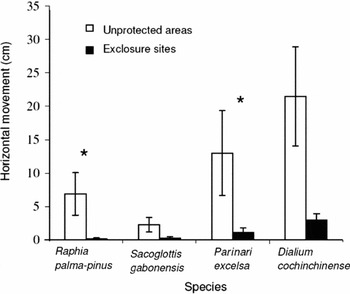
After 20 d, seeds showed only an average of 1.68 cm of horizontal movement in sites protected from vertebrate disturbance, whereas in open areas, seeds were displaced by an average of 10.9 cm (Figure 1). A two-way ANOVA showed that the effect of vertebrate exclosure on horizontal displacement of seeds, though small, was significant overall (F1,71 = 19.1, P < 0.001). The species of the seed also significantly influenced displacement (F3,71 = 7.01, P < 0.01), but there was no interaction between species and exclosure treatment (F3,71 = 0.25, P = 0.86). Separate one-way ANOVAs (with Bonferroni adjustment) for each species showed that seeds of Parinari excelsa and Raphia palma-pinus experienced significantly greater displacement in the presence of vertebrates (F1,8 = 9.93, P < 0.01, and F1,8 = 7.25, P = 0.02 respectively). The two smaller-seeded species, Dialium cochinchinense and Sacoglottis gabonensis showed no significant differences in movement in open versus exclosure sites (F1,8 = 2.88, P = 0.11, and F1,8 = 3.89, P = 0.10, respectively). Variance in the depth of litter and soil covering seeds was significantly greater for seeds exposed to vertebrate disturbance for all seed types except the smallest-seeded species, Dialium cochinchinense (Table 1).
Comparison of the horizontal movement of seeds (n = 20 each) after 20 d in unprotected plots vs plots fenced to exclude vertebrates in swamp forest of Taï National Park, Ivory Coast in March 2001. Error bars represent 1 SE. * indicates significant difference (P < 0.05).

Experiment 2: seed predation
Seeds of Dialium cochinchinense, Parinari excelsa, Raphia palma-pinus and Sacoglottis gabonensis buried under 3 cm of soil for 20 d, experienced no predation or removal, whereas seeds placed on the surface of the ground all experienced some level of predation/removal (50%, 20%, 5% and 25% respectively). This difference was significant for all species except Raphia palma-pinus (Dialium cochinchinense: G = 17.3, P < 0.001, Parinari excelsa: G = 7.65, P < 0.01, Raphia palma-pinus: G = 1.41, P = 0.24, Sacoglottis gabonensis: G = 5.99, P = 0.01).
Experiment 3: Raphia palma-pinus germination
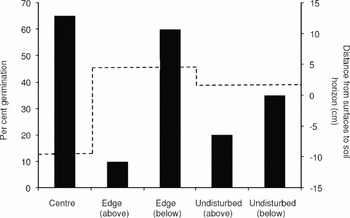
Raphia palma-pinus seeds placed in litter environments simulating undisturbed soil and mounded soil/litter (mimicking mongoose disturbance) showed a significant effect of burial (G2 = 11.9, df = 1, P < 0.001), and position (centre, edge or outside) (G2 = 8.07, df = 2, P = 0.02) but not the interaction between the two (G2 = 3.33, df = 2, P = 0.07). Germination after 20 d was higher in treatments where seeds were buried, and was highest in the centre of the disturbance (where rains buried seeds several cm deep within 2 d) (Figure 2a, b). Decomposition of the test through planned, orthogonal comparisons indicated that germination was significantly higher for seeds in the centre of the disturbance, than disturbance edge (G2 = 4.88, df = 1, P = 0.03) or undisturbed soil (G2 = 7.54, df = 1, P < 0.01). Viability of remaining seeds was not evaluated.
Effects of simulated mongoose disturbance on germination. Bars illustrate the percentage of Raphia palma-pinus seeds germinating in each of five treatments (n = 20) simulating conditions at either the centre or edge of a mongoose disturbance or at an undisturbed site. Placement of seeds above or below litter at each position is indicated. The dashed line represents the distance from the ground surface to the soil horizon for each treatment representing a position within a simulated mongoose disturbance. Positive values indicate mounded leaf litter and soil and negative values represent a depression in the forest floor. The experiment was conducted in swamp forest of Taï National Park, Ivory Coast, March–July 2001.

DISCUSSION
The variability in seed responses of different species to varying litter conditions on the forest floor may be important for determining diversity, abundance and distribution of seedlings in tropical forests (Benitez-Malvido & Kossmann-Ferraz Reference BENITEZ-MALVIDO and KOSSMANN-FERRAZ1999, Garcia-Guzman & Benitez-Malvido Reference GARCIA-GUZMAN and BENITEZ-MALVIDO2003). Some authors have stressed the importance of natural litterfall variation (Cintra Reference CINTRA1997, Green Reference GREEN1999) and abiotic factors such as hurricanes (Guzman-Grajales & Walker Reference GUZMAN-GRAJALES and WALKER1991) in maintaining microsite heterogeneity, but few have considered the role vertebrates may play (but see Ashton & Bassett Reference ASHTON and BASSETT1997, Eldridge & James Reference ELDRIDGE and JAMES2009).
Biopedturbation impacts on seed movement and predation
Results revealed that seeds exposed to vertebrate disturbance experienced significantly increased horizontal movement and greater variation in depth of litter/soil cover than those excluded from vertebrates. However, given the small scale of horizontal movement observed in this study, further research is needed to determine potential effects on seed survival and germination. Other researchers have noted that small-scale movement and disturbance can have important implications for germination success (Chambers & MacMahon Reference CHAMBERS and MACMAHON1994). Subtle movements across the forest floor can increase the likelihood that seeds accumulate in soil depressions where burial is likely (Reichman Reference REICHMAN1984), potentially reducing seedling mortality and enhancing germination (Borchert et al. Reference BORCHERT, DAVIS, MICHAELSEN and OYLER1989).
The variation in microsite encountered by the smallest-seeded species, Dialium cochinchinense, was least affected by exposure to vertebrates. In contrast, larger seeds moved very little from their original position when vertebrates were excluded relative to open areas. Rainfall and other abiotic factors are likely to move small-sized seeds such as Dialium cochinchinense through the leaf litter such that vertebrate disturbance may not significantly increase variability in the micro-environment where the seeds eventually land.
Seeds falling onto areas exposed to ground-foraging vertebrates have an increased chance of subsequent burial, which may confer some degree of protection from seed predators. In this study, seeds of all four species placed on bare soil experienced some level of predation or removal after 20 d, whereas buried seeds were unaffected. This suggests that seed predators were less likely to find seeds covered by soil and litter. The difference was significant for all species except Raphia palma-pinus, which has a hard stony endocarp and may be less susceptible to predation pressures in general. Reduction of seed predation through burial has been shown in other ecosystems (Cintra Reference CINTRA1997, Nilson & Hjalten Reference NILSON and HJALTEN2003) and may be particularly important for species in which seed predation plays a central role in regulating demography (see Silman et al. Reference SILMAN, TERBORGH and KILTIE2003).
Burial may be especially important for large-seeded species, such as those in this study. In neotropical rain forest (Dalling et al. Reference DALLING, SWAINE and GARWOOD1997) and temperate ecosystems (Cerabolini et al. Reference CERABOLINI, CERIANI, CACCIANIGA, DE ANDREIS and RAIMONDI2003, Hulme Reference HULME1998) it has been observed that small seeds accumulate in soils forming persistent seed banks, whereas larger seeds tend to be more transient. This pattern may be explained by an increased probability of burial of small seeds and thereby, a lower probability of predation (Hulme & Borelli Reference HULME and BORELLI1999, Thompson et al. Reference THOMPSON, JALILI, HODGSON, HAMZEH'EE, ASRI, SHAW, SHIRVANY, YAZDANI, KHOSHNEVIS and ZARRINKAMAR2001). Increased predation on larger seeds may pose selective pressures that lessen advantages gained from extended dormancy. In this study, the two smaller-seeded species (Dialium cochinchinense and Parinari excelsa) faced high predation rates on exposed soil, but were more likely to be buried than the two large-seeded species, regardless of the presence of vertebrates. If seed protection by burial is an important factor in soil residency time (Hulme & Borelli Reference HULME and BORELLI1999, Thompson et al. Reference THOMPSON, JALILI, HODGSON, HAMZEH'EE, ASRI, SHAW, SHIRVANY, YAZDANI, KHOSHNEVIS and ZARRINKAMAR2001), increased burial rates induced by ground-foraging vertebrates could increase the size-range of seeds that could take advantage of delayed germination.
In addition to a reduced risk of predation, increased burial may be important for germination success (Molofsky & Augspurger Reference MOLOFSKY and AUGSPURGER1992). Soil disturbance mixes soil and plant litter, forming a nutrient-rich environment for germination. Large seeds may also benefit from burial because they have a tendency for dehydration if not protected by litter or soil (Green Reference GREEN1999). Results show that seeds of the dominant canopy species of the swamp forest, Raphia palma-pinus, are more likely to be buried when exposed to ground-foraging vertebrates and that buried seeds had significantly higher germination success over 4 mo of observation, though it is unknown if remaining seeds were still viable. Soil perturbations by vertebrates may confer an advantage to Raphia palma-pinus recruitment and perhaps other species as well.
Seeds with extended dormancy periods may be repeatedly disturbed by mongooses as they revisit an area. Such a situation may be optimum for seeds of some species that require fluctuating temperatures for germination (Green Reference GREEN1999). Seeds in the soil seed bank that require light for germination may need to become exposed to the surface of the soil when conditions happen to be suitable, such as after the formation of a canopy gap. Repeated vertebrate disturbance may increase the likelihood of seed germination in these circumstances.
The Liberian mongoose as ecosystem engineer?
Though only recently discovered by the scientific community (Taylor Reference TAYLOR1992), results of this study suggest the Liberian mongoose may play an important role as ecosystem engineer by maintaining heterogeneity of the forest floor in a West African rain forest. Its role may be increasingly important in an area plagued by poaching-induced declines of larger mammals such as red river-hog (Brashares et al. Reference BRASHARES, ARCESE, SAM, COPPOLILLO, SINCLAIR and BALMFORD2004, Jeffrey Reference JEFFREY2009) known for its role in soil disturbance (Breytenbach & Skinner Reference BREYTENBACH and SKINNER1982). Foraging activity of the Liberian mongoose altered the micro-environment to which seeds were exposed and results suggest this may have important consequences for predation rates of some common tree species and germination success of a dominant canopy palm.
Based on frequencies of disturbance observed in the study plots it is possible that the entire swamp forest floor may be turned over about every 8 mo by the foraging activities of Liberian mongoose. Disturbance resulting from foraging activity occurred regularly throughout the study period, regardless of monthly rainfall pattern. This suggests that the Liberian mongoose could affect forest floor heterogeneity and seeds during all seasons, regardless of the timing of seed-fall or germination.
Other authors have stressed the importance of primates in the dispersal and germination of canopy species in African forests (Chapman & Chapman Reference CHAPMAN and CHAPMAN1996, Poulsen et al. Reference POULSEN, CLARK, CONNOR and SMITH2002). In Taї National Park, seeds dispersed by the sooty mangabey (Cercocebus torquatus atys) and Diana monkey (Cercopithecus diana) (Koné et al. Reference KONÉ, LAMBERT, REFISCH and BAKAYOKO2008) are very likely to encounter freshly disturbed soil because Liberian mongooses are often found in association with groups of these monkeys (Taylor & Dunham in press). The mongoose facilitates this association with monkeys, presumably as an advantage against a shared predator, the crowned eagle (Stephanoaetus coronatus) (Shultz Reference SHULTZ2002, Taylor & Dunham in press). This study shows that post-dispersal exposure of seeds to vertebrates on the forest floor may have important influence on their ultimate survival and recruitment.
Conclusions and implications
To my knowledge, this is the first study to examine the importance of vertebrate biopedturbation on seed predation/removal, germination and movement in African rain forest. While previous work has shown the important trophic effects of mammals and birds preying on understorey invertebrates (Dunham Reference DUNHAM2008), the present study suggests that ground-foraging vertebrates can also significantly alter the litter environment and thereby indirectly affect seed predation and germination. It is possible that without this guild of litter/soil-foraging species, litter heterogeneity would be decreased such that it would alter the suit of species likely to survive and germinate. This hypothesis could be examined with longer-term exclosure experiments and by comparative studies of areas with and without these fauna.
Litter and soil-disturbing mammals and birds are an important faunal component of many tropical and temperate ecosystems. Many of these species, particularly the insectivorous mammals and birds, tend to be sensitive to habitat fragmentation and other anthropogenic pressures due to their specialized niche and limited dispersal abilities (Martin Reference MARTIN2003, Sekercioglu et al. Reference SEKERCIOGLU, EHRLICH, DAILY, AYGEN, GOEHRING and SANDI2001). The Liberian mongoose is seriously threatened with extinction from habitat loss and intensive hunting for bush-meat throughout its restricted range and is presently listed as endangered by IUCN (http://www.iucnredlist.org). If, as this study suggests, ground-foraging mammals and birds play an important role in plant recruitment through mechanical working of the soil, loss of such species through anthropogenic causes may have important negative consequences for the ecosystems in which they live.
ACKNOWLEDGEMENTS
Thanks to P. Wright, M. Lerdau, C. Janson, P. Waser and V. Rudolf for useful insight and comments. Jerome Tondoh, Centré Suisse, Environmental Ministry of Ivory Coast, PacPNT, M. O. Rodel, R. Noe and the Taï Monkey Project provided logistical support. E. Kamy provided invaluable assistance in the field. Research was supported by the Margot Reis Foundation.