INTRODUCTION
Organizational and contextual changes have occurred in health care over the past two decades. Patients spend less time in the hospital, and are responsible for more self-care before and after a hospital stay. In Sweden, an increasing number of dying patients are cared for by family members, which has a profound impact on the wellbeing of relatives: at the same time, the participation of one or more relatives is often needed to make the care at home successful. The importance of this subject is illustrated by the introduction of a new regulation in Sweden, proposed to take effect in 2009, that will require the Department of Social Services to offer support to persons who care for long-term sick or older relatives (Support to persons who care for or support relatives. Prop. 2008/09:82.).
Research has shown that the relatives' burdens are considerable (Fakhoury et al., Reference Fakhoury and Mc Carthy1998, Axelsson & Sjödén, Reference Axelsson and Sjödén1998; Rollison & Carlsson, Reference Rollison and Carlsson2002; Carlsson & Rollison, Reference Carlsson and Rollison2003). International studies have shown that the most frequently reported reason for hospital admission is family exhaustion (Gomas, Reference Gomas1993) and similar data are also shown for Sweden (Gyllenhammar et al., Reference Gyllenhammar, Thoren-Todoulos and Strang2003). A study (Carlsson & Nilsson, Reference Carlsson and Nilsson2007) describing the situation of bereaved spouses during the first year after the patient's death showed that they felt tired and suffered from sleep disturbance, but the tiredness declined during the year. An evaluation by the Swedish National Board of Health and Welfare (Socialstyrelsen, 1999) revealed that relatives who cared for a next of kin at home were content but tired and sometimes exhausted. The fatigue noted in that study seemed to be attributed to the mental, rather than the physical, burden.
During the last decade, fatigue among cancer patients has received a great amount of scientific interest (Ahlberg et al., Reference Ahlberg, Ekman and Wallgren2005; Fürst & Åhsberg, Reference Fürst and Åhsberg2001; Glaus, Reference Glaus1998; Richardson, Reference Richardson1998). However, only a few studies have examined fatigue in patients' relatives. One of the few reported studies about fatigue among relatives in a palliative home care setting is an older study by Jensen and Given (Reference Jensen and Given1993). They found moderate to severe fatigue in 53% of the relatives surveyed. The only factor that significantly influenced the degree of fatigue was how much the care affected the relatives' daily schedule. However, it is not clear from that study if the patients were treated in a late palliative phase. A pilot study with a comparative and cross-sectional design has been conducted (Carlsson, Reference Carlsson2009) with Multidimensional Fatigue Inventory (MFI-20). Relatives scored high on every dimension on the MFI-20 scale, and they were significantly more tired than the normative group (Schwarz et. al., Reference Schwarz, Krauss and Hinz2003) at every dimension.
The present study is the report of the qualitative data in the above-mentioned pilot study. The aim of the present study was to explore the significance of fatigue among relatives of palliative patients.
METHOD
This qualitative study has a descriptive and cross-sectional design. Relatives of patients cared for in a palliative care unit in Uppsala County (in seven different units) during a specific day were invited to participate in the study. The different care units provided either home care or institutional care. The staff identified the relative who had been, or was currently, most involved in the patient's care and gave verbal and written information about the study.
The questionnaire consisted of a quantitative and a qualitative section. The qualitative section consisted of four open-ended questions focusing on the relatives' experiences of fatigue; what in their situation made them tired, how did fatigue affect their lives, how did they cope with the fatigue, and what did they think the health care system could do to ameliorate their situation.
Data Analysis
Content analysis according to Krippendorff (Reference Krippendorff2004) is a research technique for making valid inferences from texts to the contexts of their use. The analysis was performed using the steps described by Graneheim & Lundman (Reference Graneheim and Lundman2004) and the quantification according to Berg (Reference Berg2004). The following steps were performed:
• All answers were read through several times to get a sense of the whole
• Units of meaning were extracted from the text
• The units of meaning were abstracted into subcategories
• The subcategories were compared with each other and with the original text to create mutually exclusive categories
• Subcategories with a common topic were grouped into main categories
• Finally, the occurrence of each subcategory were counted
• Some answers were not analyzed, because the question was not answered or the answer consisted only of a few words such as “I don't know” or “No”.
Ethical Considerations
Ethical considerations in this study were individual autonomy and dependence, informed consent, and risk of causing emotional injury. To protect the relatives' privacy, all contact with them was via the members of staff who provided verbal and written information about the study. All participants were carefully informed that their participation was voluntary and could be terminated at any time and without explanation. Once the subjects had given verbal consent to participate in the study they were given the questionnaire and an envelope for the completed questionnaire. All data were treated as confidential information by the author who was not involved in the patients' care. Since this was a pilot study, it was not reviewed by an ethics committee.
RESULTS
During the day selected for the study, 73 patients were registered in the county's seven palliative care units, and 56 (77%) relatives completed the questionnaire. Not all relatives answered the four open questions: the number of respondents varied from 34 to 43.
The Causes of Fatigue
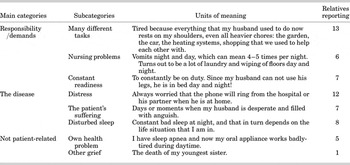
The analysis of responses to the question concerning what causes the fatigue resulted in three main categories and eight subcategories (Table 1). Relatives attributed worries, uncertainty, the patient's suffering, and many demands made on them as the causes for the fatigue. Bad sleep is closely related to the other subcategories, that is, worries contribute to insomnia and sleep quality is also affected by being awakened frequently during the night because of the patient's symptoms (cough, vomiting etc.) or the patient needing help, for example, to the toilet. Only six relatives mentioned causes for fatigue that were unrelated to the patient's disease, and four of them stated these unrelated causes as the only sources of their fatigue. One relative commented that he was not tired.
The causes of fatigue (n = 43)

Some differences were seen between relatives who were children of the patients and those who were partners. The most apparent difference was in the subcategory “many different tasks”. The children had work, their own family, and the care of their sick parent. But it was also obvious that not living with the sick person created a great deal of insecurity, which was tiring. The partners, on the other hand, had to do all the domestic duties that previously were shared, and now also had the care of the patient, especially if the patient was being cared for at home.
Consequences of Fatigue
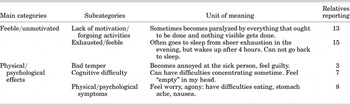
The analysis of consequences of fatigue resulted in two main categories and five subcategories (Table 2). The relatives stated that they felt exhausted, insufficient, and listless and that they had put their own interests aside. They were only able to see their closest family and felt isolated. Some relatives gave examples of physical or psychological symptoms, such as stomach pain, dizziness, nausea, depression, and anxiety. Other consequences were cognitive problems, such as difficulty concentrating and prioritizing tasks, or irritation, which made them feel guilty.
Consequences of fatigue (n = 35)

Coping with Fatigue
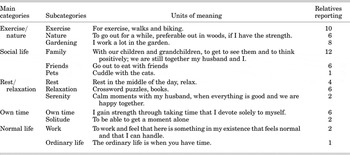
Responses to the questions about where relatives found the strength to carry on resulted in five main categories and 13 subcategories (Table 3). Relatives reported that they derived their strength to cope with the fatigue from a broad range of sources. The two most widely used were exercise/nature and social life. The two subcategories exercise and nature differed as to the primary beneficial factor. Although most of the exercises were done outdoors, the focus in this category was on the physical activity. In the category “nature”, on the other hand, the nature experience, itself, was the predominant factor. Many relatives felt that the company of family and friends gave them the strength to carry on. Grandchildren were often mentioned as the most important sources of strength. Rest and relaxation was also mentioned as were doing crosswords puzzles or reading books. Some relatives appreciated being alone or to having their “own time”. A few relatives mentioned that work counteracted fatigue, because the work acted as a distraction and meant that something in life remained normal.
Coping with fatigue (n = 36)

What the Health Care System Could Do to Improve the Situation
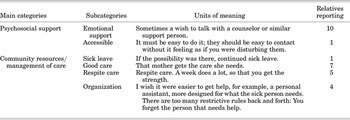
Thirty-four relatives answered the question about what the health care system could do to improve the situation for them: ten responses had no content that allow for an analysis, consisting of only a few words, such as “I don't know” or “No”. The analysis of the rest gives two main categories and six subcategories (Table 4). In the main category, psychosocial support, relatives expressed that they desired emotional support from the health care staff: however, some relatives commented that they already got this support from the staff and that this support helped their situation. Good accessibility, that is, ease of contact with the staff, was also important. In the other main category, society resources/management of care, most comments were in the subcategory good care. Ensuring that the patient received good nursing care was essential, but the need to get practical support was also mentioned. Another important resource was access to respite care, when needed. Even to be on paid sick leave was mentioned as a kind of relief, since this resulted in fewer tasks and demands. Some comments were made about the organization of care. Relatives desired, for example, improved care plans or access to a personal assistant.
Suggestions of what the health care system could do to improve the situation for relatives (n = 34)

DISCUSSION
The main impression from the relatives’ comments is that their situation is very trying. They were very tired and they attributed worries, uncertainty, the patient's suffering, and too many demands as the causes for their fatigue. The most obvious consequences of the tiredness were a lack of motivation, feelings of insufficiency and apathy, and putting their own interests aside. Many relatives felt that the company of their closest family, exercise, and being close to nature gave them strength to carry on. The health care system could make the situation easier by providing good care to the patient, psychosocial support, and respite care for the relatives. The results of this qualitative review of the open questions, together with the quantitative analysis (Carlsson, Reference Carlsson2009) of responses to the MFI-20 questionnaire, showed that relatives of patients cared for in a late palliative phase suffer from great fatigue and require more attention, both scientifically and in the clinical setting.
Some relatives mentioned physical and psychological consequences of their situation and it is obvious that relatives of patients in palliative care are at great risk for developing health problems because of poor sleep and being constantly stressed. A recent Swedish study has shown that relatives of cancer patients have, not only a much greater than average risk for psychiatric diagnoses, but also for circulatory and muscle-skeletal diseases (Sjövall et al., Reference Sjövall, Attner and Lithman2009). Watt et al. (Reference Watt, Groenvold and Bjorner2000) found a strong association between mental fatigue and depression, however, the present study could not explain which comes first, the depression or the fatigue. It is obvious that the patient's impending death affects the relatives' well-being. The relatives scored high on the mental dimension of MFI-20 (Carlsson, Reference Carlsson2009). Furthermore, several studies have shown that depression is significantly associated with the burden of being a caregiver (Grov et al., Reference Grov., Fosså and Sorebo2006; Chetsova-Dutton et al., Reference Chentsova-Dutton, Shucter and Hutchin2002).
The relatives preferred to rest in the company of the patient and their closest family. They read books, did crosswords puzzles, or watched television. This kind of respite resembles what Strang et al. (Reference Strang, Koop and Peden2002) described as a “mental break” and was what care giving relatives in that study most wanted. Respite outside the house, which they called “having a break” was not always seen in their study as relaxation, since the physical separation from the patient increased the relatives' anxiety. This effect was also obvious in the present study but, there were also relatives who tried to get some time to themselves and to do something outside the home, and considered this to be of great value. Relatives' turning to nature to counteract fatigue is in accordance with a study about spiritual coping among Swedish cancer patients (Ahmadi, Reference Ahmadi2006). Ahmadi identified a “Swedish” coping strategy that she called “spiritual sanctification of nature” which was used by all her informants, both religious and nonreligious. The Swedes have a tendency to romanticize nature, and many believe that their well-being depends on having contact with nature (Uddenberg, Reference Uddenberg1995) which is facilitated by the ancient legal right of access to private land (in Swedish “allemansrätten”).
It was somewhat surprising that the relatives offered few proposals about what the health care system could do to improve their situation. The lack of suggestions may reflect a feeling of hopelessness (Milberg et al., Reference Milberg, Strang and Jakobsson2004) or may indicate low expectations. A study by Wennman-Larsen & Tishelman (Reference Wennman-Larsen and Tishelman2002) showed that relatives of patients in palliative home care did not expect support from the staff for their own needs. But the results of the present study point to the obvious need for greater attention by the health care staff to the relatives' situation. Staff must arrange interventions such as respite care. Many relatives will never ask for it because they put their own needs last (Laizner et al., Reference Laizner, Yost and Barg1993). That relatives also commented that high-quality care for the patient improves their situation is in agreement with the discussion above and with Andershed's (Reference Andershed2006) review.
The result of this pilot study, with a cross-sectional design, is only preliminary, but gives a hint of an important and growing problem that requires further exploration. It is important to follow the development of fatigue over time with a longitudinal design and also to investigate more thoroughly how relatives regard the significance of fatigue. This can be done by a qualitative interview study.