Two species of marine turtles nest in the Mediterranean, the green turtle (Chelonia mydas) and the loggerhead turtle (Caretta caretta) (Margaritoulis et al., Reference Margaritoulis, Argano, Baran, Bentivegna, Bradai, Camiñas, Casale, De Metrio, Demetropoulos, Gerosa, Godley, Haddoud, Houghton, Laurent, Lazar, Bolten and Witherington2003). Both are classified as endangered on the IUCN Red List of Threatened Species (http://www.iucnredlist.org/). Nesting normally occurs in the eastern basin (Groombridge, Reference Groombridge1990; Margaritoulis et al., Reference Margaritoulis, Argano, Baran, Bentivegna, Bradai, Camiñas, Casale, De Metrio, Demetropoulos, Gerosa, Godley, Haddoud, Houghton, Laurent, Lazar, Bolten and Witherington2003) while only a few occasional nests have been reported for the western Mediterranean (Llorente et al., Reference Llorente, Carretero, Pascual and Pérez1993; Tomás et al., Reference Tomás, Mons, Martín, Bellido and Castillo2002; in press; Delagerre & Cesarini, Reference Delagerre and Cesarini2004; Bentivegna et al., Reference Bentivegna, Treglia and Hochscheid2005). Here we report on the first loggerhead turtle nest that has ever been recorded in mainland France, and which also presents a new record for nesting activity in northerly latitudes.
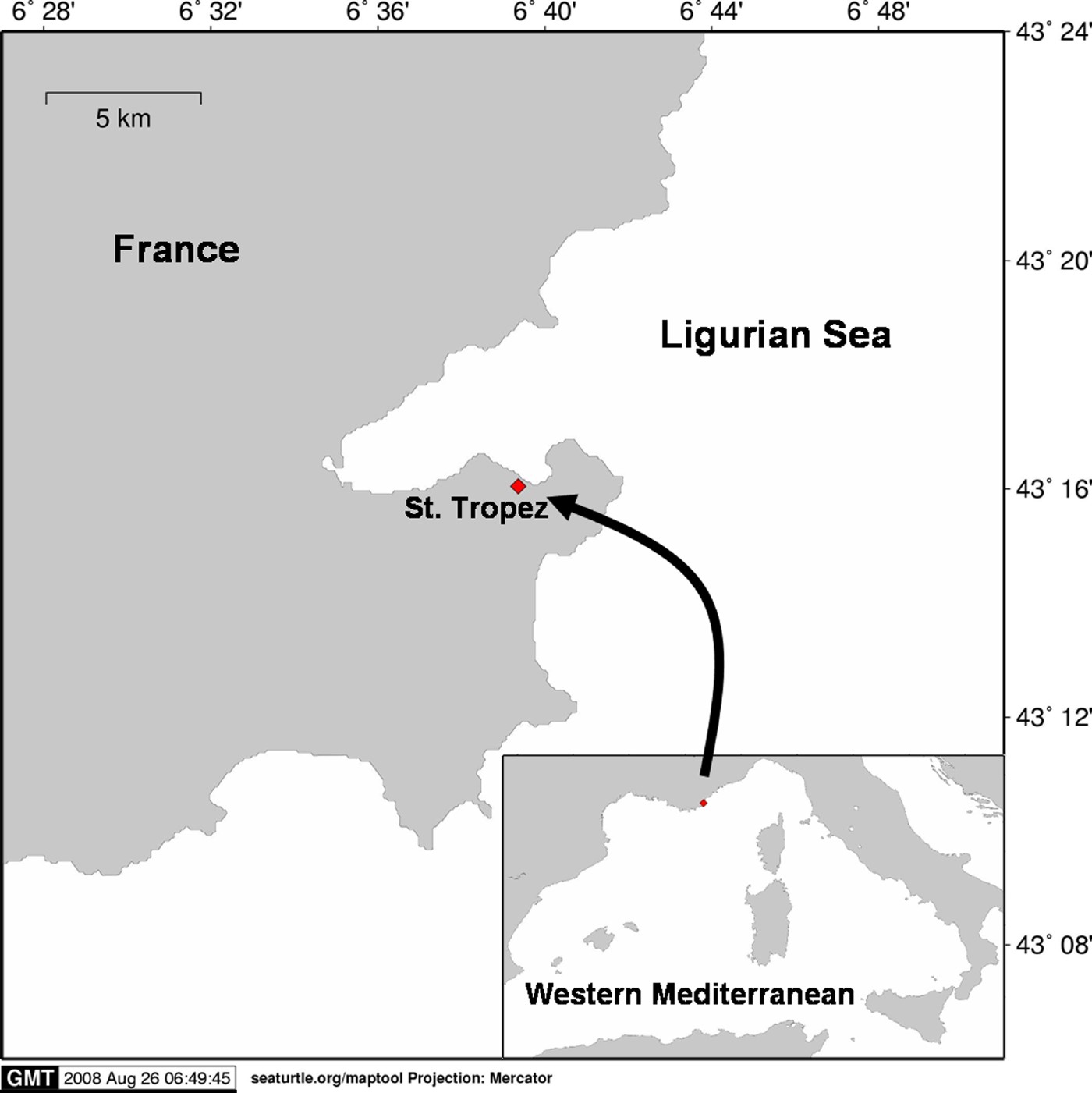
On 18 July 2006 four empty sea turtle egg shells were found on the beach of Saint Elme, St Tropez, France (43°16.05′N 6°39.38′E, Figure 1) and reported to the Museum of Monaco, Monte Carlo and the Réseau Tortues Marines de Mèditerranèe Française (French network for marine turtles). One day later intact eggs were discovered by CestMed (Centre d'Etudes et de Sauvegarde des Tortues en Mediterranée) 20 cm beneath the sand where the shells had been found. The nest was close to vegetation and only 8.5 m distant from the water, where the substrate consisted of a mixture of sand, compact and humid soil, dried sea grass and cobblestones.
Map showing the location of the northernmost loggerhead turtle nest at St Tropez, France. The beach faces to the north/north-east and can be reached only be entering the Gulf of St Tropez and then the Bay of Cannebier.

The nest site was protected by a circular fence (height: 1 m, diameter: 1.5 m) and surveyed daily. From 25 July onwards until nest excavation on 14 September sand temperatures were recorded manually each day every six hours with a hand-held digital immersion thermometer (model 30.1021, TFA–Dostmann GmbH, Wertheim– Reicholzheim, Germany, accuracy: ±1°C). Measurements were carried out in proximity of the nest, at 20 cm and at 40 cm depth, to leave the nest itself undisturbed. These temperatures were assumed to resemble most closely those experienced by the eggs at the top and bottom of the egg chamber, respectively (i.e. top eggs were found at 20 cm, the bottom was assumed to be at 40 cm using a mean nest height from bottom to top of egg chamber of 20 cm, cf. Godley et al., Reference Godley, Broderick, Downie, Glen, Houghton, Kirkwood, Reece and Hays2001) (Figure 1).
The sea level rose during a storm on 14 September and the nest was partially inundated. For this reason the egg chamber was excavated on the same day to recover the eggs. The bottom of the egg chamber was 44 cm deep and 8 cm of the chamber were filled with water. A total of 141 eggs was counted, 25 of which showed marked discoloration indicating failed development; these were separated from the other eggs and kept for subsequent analysis. One hundred and sixteen eggs were then transferred to the Aquarium of Le Grau-du-Roi (CestMed) where they were artificially incubated at 25–26°C for 19 days in plastic boxes filled with sand from the nest site. The incubation method was similar to method 1 detailed in McLlean et al. (Reference McLlean, Dutton, Whitmore and Mrosovsky1983) except that up to six eggs were kept together in one box with a distance of 3 cm between them. On 3 October 2006, 78 days had elapsed since the initial discovery of the clutch (with an even longer total incubation period). As this greatly exceeded the typical incubation of loggerhead turtles in the Mediterranean (Godley et al., Reference Godley, Broderick, Downie, Glen, Houghton, Kirkwood, Reece and Hays2001) the clutch was considered to have failed and the eggs removed for analysis of the embryonic stages.
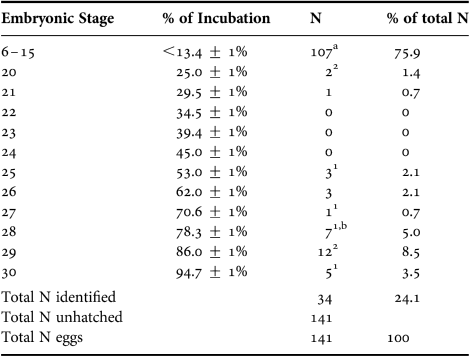
All eggs were examined to determine the developmental stage at which the embryo had died following the descriptions of Miller (Reference Miller and Gans1985). The stages are numbered from 0 to 31, whereby Stage 6 is already reached at the time of oviposition, and the other stages occur at specific proportions of the incubation period (Table 1).
Developmental stages of embryos identified in the eggs of the loggerhead turtle nest in St Tropez, France. Note: % of incubation period indicates at which intervals the corresponding stages can be observed, after Miller (Reference Miller and Gans1985).

N, number of eggs; apex numbers indicate number of eggs found with invertebrate infestation; a, yolk but no discernible development; b, two eggs with apparent characteristics of Stage 29.
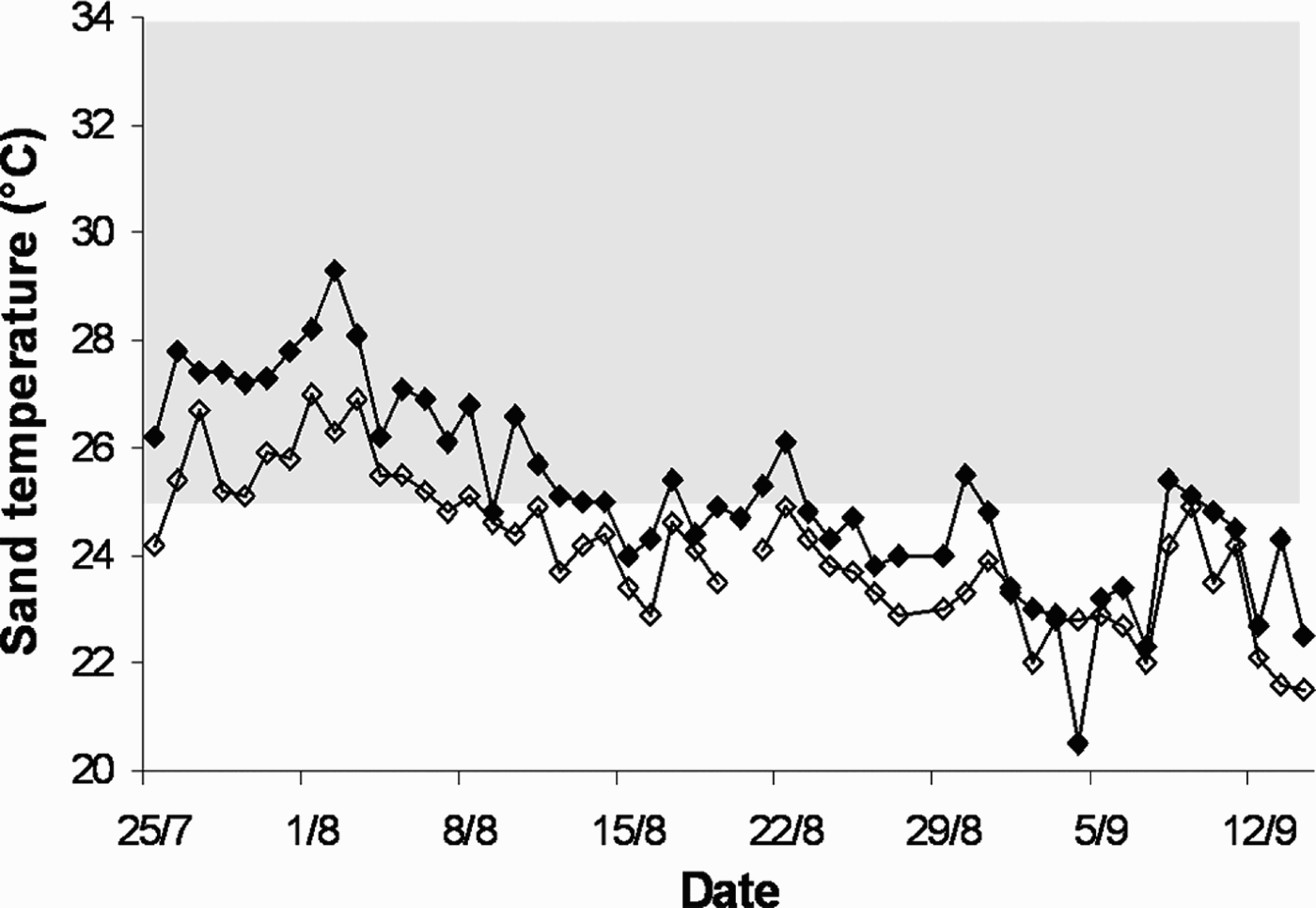
Sand temperatures showed a declining trend and started to fall below 25°C on 7 August (Figure 2). Over the measurement period mean ± SD sand temperatures at 20 cm and 40 cm depth were 25.0 ± 2.0°C and 24.1 ± 1.2°C, respectively and ranged from a minima of 20.5°C and 21.3°C, to a maxima of 32.2°C and 27.0°C.
Temperatures recorded manually every 6 h at the loggerhead turtle nest site in St Tropez, France, during the incubation period. Sand temperatures were measured at 20 cm (filled symbols) and 40 cm (open symbols). The shaded area indicates the range of temperature at which Caretta caretta eggs normally incubate successfully. Note: data do not cover the complete incubation period, see text for explanation.

One hundred and seven (76%) of the 141 unhatched eggs contained yolk, but no embryo could be detected (Table 1). Of the remainder three embryos developed to Stages 20–21, 14 reached Stages 25–28 and 12 reached Stage 29 (Table 1). Only five eggs contained embryos which had almost completed development and had died at Stage 30. Infestation by insect larvae was observed in eight eggs containing embryos of the higher developmental stages (Table 1). In some cases the eyes of the embryo were missing and the flippers appeared to have been consumed.
The St Tropez nest is the northernmost record of a loggerhead nest in the Mediterranean and it also exceeds the northernmost records for both the Atlantic (at Island Beach State Park, Ocean County, New Jersey, 39.8°N, Brandner, Reference Brandner1983) and the Pacific (Fukushima Prefecture, Japan, 37°N, Kamezaki et al., Reference Kamezaki, Matsuzawa, Abe, Asakawa, Fujii, Goto, Hagino, Hayami, Ishii, Iwamoto, Kamata, Kato, Kodama, Kondo, Miyawaki, Mizobuchi, Nakamura, Nkashima, Naruse, Omuta, Samejima, Suganuma, Takeshita, Tanaka, Toji, Uematsu, Yamamoto, Yamato, Wakabayashi, Bolten and Witherington2003). The nest site is untypical in that it provided none of the characteristics of nesting beaches normally preferred by loggerhead turtles: it was not easily accessible, almost level with the sea, at a short distance from the water, and the substrate consisted partly of compact soil (see Miller et al., Reference Miller, Limpus, Godfrey, Bolten and Witherington2003). The failure of the clutch to produce live hatchlings may mostly be due to the unsuitability of the nest environment, including inundation, low temperatures and compact nest substrate (Carthy et al., Reference Carthy, Foley, Matsuzawa, Bolten and Witherington2003). In fact, the eggs incubated at the lower range of temperatures permissible for successful incubation and fell below the lower limit during the second part of incubation (see Figure 2; Kaska et al., Reference Kaska, Downie, Tippett and Furness1998; Miller et al., Reference Miller, Limpus, Godfrey, Bolten and Witherington2003). The presence of insect larvae in some of the eggs has also been reported for other Mediterranean nesting beaches (Broderick & Hancock, Reference Broderick and Hancock1997; Özdemir et al., Reference Özdemir, Türkozan, Ilgaz and Martin2004). But infestation occurred in only a minority of the clutch (<6%). Considering that the level of fertility in loggerhead turtles is normally greater than 80%, probably exceeding 95%, infertility was probably not the reason for the high proportion of undeveloped eggs. It is more likely that these were caused by either intraoviducal death or early embryonic death (Miller, Reference Miller, Lutz and Musick1997). However, these events are difficult to determine in eggs that have been lying beneath the sand and then in an artificial incubator for more than 78 days (Miller, Reference Miller, Lutz and Musick1997).
It can only be speculated as to why a turtle would choose such an unlikely nest site, since no information on the female is available. Hence, we do not know the origin of the female and whether it was a first nester or a remigrant. It is clear, however, that the behaviour is an example of abandoned or undeveloped nest site fidelity and philopatry, with the nest site being more than 1000 km away from the known Mediterranean rookeries (e.g. 1500 km from Zakynthos, Greece) and even further away from Atlantic rookeries. Disturbances, either environmental or anthropogenic, may cause females to move to other nesting sites or to attempt to nest in unsuitable areas (Schroeder et al., Reference Schroeder, Foley, Bagley, Bolten and Witherington2003). Reports on occasional nests in the western Mediterranean appear to have become more frequent recently (e.g. Tomás et al., in press; Bentivegna et al., unpublished data) and although the available data are still too few, a possible connection to global warming should not be excluded. A rise in temperature of the western basin can alter sea turtle behaviour and distribution (cf. Hawkes et al., Reference Hawkes, Broderick, Godfrey and Godley2007). The presence of juvenile loggerhead turtles in the western Mediterranean is well documented (e.g. Camiñas & de la Serna, Reference Camiñas and Serna1995; Laurent et al., Reference Laurent, Casale, Bradai, Godley, Gerosa, Broderick, Schroth, Schierwater, Levy, Freggi, Abd El-Mawla, Hadoud, Gomati, Domingo, Hadjichristophorou, Kornaraky, Demirayak and Gautier1998; Bentivegna et al., Reference Bentivegna, Ciampa, Mazza, Paglialonga, Travaglini, Margaritoulis and Demetropoulos2003; Cardona et al., Reference Cardona, Revelles, Carreras, San Félix, Gazo and Aguilar2005), but the use of this area by adult and potentially reproductive turtles should be observed in relation to the trends in climate change.
ACKNOWLEDGEMENTS
We would like to thank the following persons, in alphabetical order, for their assistance during the nest survey and egg examination: F. Baraffe, A. Bigotte, S. Bouderbala, J.M. Couves, M. Darthois, J.M. Decugis, P. Devullder, N. Dragon, M. Flamey, Mr and Mrs S. Folco, R. Guezel, E. Guldner, B. Henckel, Mr Julien, R. Naurais, A.M. Nicolas, G. Oliver, M.B. Rasotto, S. Taviot, G. Treglia and Mr and Mrs B. Trinquet. We also wish to acknowledge use of the Maptool program (by SEATURTLE.ORG) for the graphics in Figure 1.