Pulmonary arterial hypertension remains an important factor for morbidity and mortality in patients with congenital cardiac defects. Among the new medical therapies for pulmonary arterial hypertension, the oral dual endothelin receptor antagonist, Bosentan (Actelion Pharmaceuticals Ltd., Allschwil, Switzerland), has gained a central position. Long-term improvement of both symptoms and haemodynamic data,1–3 and improved survival,4 is documented in adults with idiopathic pulmonary arterial hypertension and some forms of secondary pulmonary arterial hypertension. In children, congenital systemic-to-pulmonary arterial shunts represent an important aetiology of pulmonary arterial hypertension. Eisenmenger's syndrome shares both clinical, histopathological, and pathophysiological properties with idiopathic pulmonary arterial hypertension.5 The open shunt, however, represents a significant haemodynamic difference, and the natural history is more favourable than for idiopathic pulmonary arterial hypertension.6–8 The role of new medical therapies against pulmonary arterial hypertension for patients with Eisenmenger's syndrome is not yet established, although preliminary uncontrolled short term studies show some benefits.9–12 A short-term safety study in children not including patients with Eisenmenger's syndrome demonstrated haemodynamic improvement.13 A retrospective study including 24 children with unoperated cardiac defects demonstrated clinical and haemodynamic improvement from treatment with Bosentan at a mean of 14 months, but there was no separate analysis of the subgroup with Eisenmenger's syndrome.14 Our present study, therefore, aims to describe the effects of Bosentan over the intermediate term in children and adolescents with Eisenmenger physiology. Our primary hypothesis was that a selective reduction of pulmonary vascular resistance would decrease the degree of desaturation. Our secondary aim was to search for other non-invasive variables that might prove valuable in the monitoring of treatment in patients with Eisenmenger's syndrome.
Material and methods
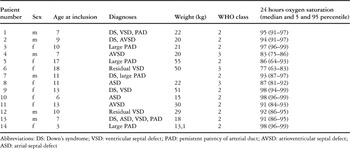
We define Eisenmenger's syndrome as a systemic-to-pulmonary shunt permitting reversed or bidirectional flow due to high pulmonary vascular resistance. We included patients with both pre- and post-tricuspid lesions if they satisfied our definition. The indications for treatment ranged from the possibility for cure and corrective operation in the younger and less symptomatic patients, to relief of symptoms in those most affected. We identified 14 patients with the syndrome as thus defined referred for evaluation at a tertiary centre over the years 2003 and 2004, and all agreed to participate in the study. Informed consent was obtained from all patients or their providers of care. The patients were in a clinically stable condition at enrolment. No change had been made to their medical treatment over the preceding 12 months. Of the 14 patients, 11 had undergone catheterization of the right heart with vasodilator testing prior to treatment. The ratio of pulmonary to systemic vascular resistances at baseline ranged from 0.36 to 1.0, with a mean of 0.6, and was at the time considered a contraindication for surgical treatment. Demographic and clinical data at baseline are presented in Table 1.
Table 1. Baseline demographic and clinical data.

Design of the study
The study was prospective, uncontrolled, single centre, open-label, and performed during the period from 2003 to 2005. After the baseline examinations, treatment was started with Bosentan at 1 milligram per kilogram twice daily, increasing to 2 milligrams per kilo twice daily after four weeks. Initiation and control of treatment was done in-hospital. In this way, physical activity was held at a controlled and low level. Patients were re-examined at one, three, six, nine and 12 months. At all visits, clinical examination, echocardiography, electrocardiogram, 24 hour pulse oximetry, blood tests and a symptom score were performed in all patients. In the 6 patients able to exercise, treadmill testing was performed. The study was approved by the local ethics committee and conducted in agreement with the Helsinki declaration of 1975, revised in 1983.
Pulse oximetry
Peripheral transcutaneous saturations of oxygen were measured distal to the shunt for 24 hours, using Masimo SET® (USA) pulse oximeters. Saturation and pulse data were analysed with Download 2001® (UK) software. For each 24 hour measurement, the following parameters were calculated: mean oxygen saturation, median oxygen saturation with 5th and 95th percentiles and mean heart rate. The 5th percentiles were assumed to reflect activity related desaturations. The 95th percentile was assumed to represent maximal saturation. The range between 5th and 95th percentiles was registered as a parameter of variation in the saturations of oxygen. Similar values were calculated for 6 hour sleep samples from the same registration. Sleep was identified by a stable, low heart rate at night time.
Clinical assessment and laboratory values
In addition to a standard clinical examination, symptoms were registered according to a five issues score for symptoms of childhood pulmonary hypertension.15 The score of each issue ranges from one to four points. The lowest possible sum of five points represents serious disability, whereas the highest score of 20 points corresponds to normal exercise ability. Functional class was registered according to the World Health Organization adaptation of the New York Heart Association classification of heart failure. Haematological parameters, and a set of standard blood tests including uric acid analysis and natriuretic peptides (Nt-proANP or Nt-proBNP), were performed at all controls. Liver enzymes were checked at monthly intervals as required for treatment with Bosentan.
Echocardiography
A standard echocardiographic assessment was done at all visits, including estimation of chamber areas and deviation of the ventricular septum where applicable. The maximal velocities of the jets from tricuspid and pulmonary regurgitation were registered, as well as the direction, timing, and velocity of flow across the shunt.
Exercise testing
We were able to perform a treadmill test in 6 patients, with measurement of peak uptake of oxygen. Young age, and presence of Down's syndrome, were the limitations in the remaining 8 patients. Testing was done by a specially trained physiotherapist and the same cardiologist at all assessments. The tests were conducted to volitional fatigue on treadmill (Technogym, Italy), using the Oslo-protocol for children.16 Uptake of oxygen was assessed by an oxygen analyzer (SensorMedics Vmax 229, USA). Electrocardiograms were recorded during the tests using Siemens Megachart (Germany).
Statistics
All values are reported as means plus or minus standard deviations. The differences between findings at baseline and after 12 months of treatment were analysed by use of single sample t-tests, with a level of significance of 0.05. The relationship between changes in symptoms and saturations of oxygen was investigated with linear regression. With respect to the limited number of participants, no statistical analyses were performed for the results at three, six and nine months. The values at six months are, however, included in the figures.
Results
Clinical data
Of the children, 6 were males, and five had Down's syndrome. Except for 3 patients with atrioventricular septal defects, all had simple defects, as described in Table 1. Surgery had been previously performed in 2 patients to close ventricular septal defects, but both patients had non-restrictive residual shunts. All patients survived to the last follow-up. At enrolment, one patient was receiving captopril, and two others digoxin. The fourth patient had hepatic enlargement, but no other signs of right ventricular failure. The tenth patient received nebulized iloprost after nine months of treatment with Bosentan. No other change of supplementary medication was made during the period of study, and none received supplementary oxygen. No significant increment of hepatic enzymes was registered. The second patient reported persistent nasal congestion. He developed obstructive sleep apnoea and worsened general condition at nine months, with nocturnal desaturation. No improvement was seen with reduced doses, but the symptoms disappeared after cessation of treatment at 12 months. No other serious side effects were seen. Diastolic blood pressure declined by 10 plus or minus 11.2 millimetres of mercury (p is equal to 0.009) following treatment with Bosentan. There was no change of systolic blood pressure (p is equal to 0.9).
Symptoms
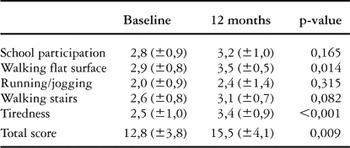
All patients but the second reported either improvement, in 8 cases, or stayed stable, as in the remaining 5 in regard to symptoms from baseline to 12 months follow up. Improvement was seen in 3 of the 5 children with Down's syndrome. The pulmonary hypertension symptom score increased from baseline to 12 months by 2.7 plus or minus 3.3 (p is equal to 0.009). The individual changes are shown in Figure 1, and the scores of the different issues of the questionnaire are presented in Table 2. Significant improvement was seen for the flat walking and tiredness subscores, and a positive trend was seen for walking stairs. The fourth patient improved from functional class 3 to 2 as graded using the system of the World Health Organization.

Figure 1. Individual changes of the total pulmonary hypertension symptom score at baseline, and after 6, and 12, months of treatment. A higher score signifies fewer symptoms.
Table 2. Reported performance before and after 12 months of therapy with Bosentan. Values represent symptom score as mean plus or minus standard deviation.

Exemplary cases
Our fourth patient was a boy, aged seven years, with uncorrected atrioventricular septal defect, severe hypoxaemia, and erythrocytosis. Before treatment, his mother carried him from ground to first floor at home due to dyspnoea. After treatment with Bosentan, he could run the same distance, and had abandoned the wheelchair for everyday use. Former headaches and large mood variations had disappeared. Previous attendance at school had been no more than half-time, but with Bosentan he could attend school throughout the day. During the same period, peak uptake of oxygen during treadmill testing declined from 83 to 66 millilitres per 0.67 kilo. His mean saturation over 24 hours remained unchanged during the period of study, but his mean saturation over six hours of sleep declined from 96% to 90%. Selective daytime increase could explain these findings.
Our ninth patient was a 13 old year girl with Down's syndrome and a non-restrictive ventricular septal defect. Prior to treatment with Bosentan, she was passive and difficult to mobilize. After 6 months follow-up, her parents reported a marked improvement in her mood and initiative. In contrast to her stopping multiple times with blue lips when climbing the small hill to their mountain cabin, she was now able to walk this distance rapidly with a pink-lipped smile. Measurement of mean saturations of oxygen over 24 hours declined from 97.3% to 94.7%, albeit that night time saturations improved from 85.3% to 88.1%.
Saturations of oxygen
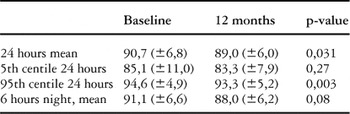
Baseline mean levels ranged from 85% to 95%. Patients with normal baseline saturations at rest demonstrated significant desaturations during exercise. Six hours of sleep, including night time saturations, were analysed as a separate parameter. Group values before and after 12 months of treatment are presented in Table 3, and the individual values of the mean saturations over 24 hours are shown in Figure 2. The average of 24 hour mean heart rate at baseline was 84.2 plus or minus 12.2, and at 12 months was 80.8 plus or minus 12.0 beats per minute (p is equal to 0.12). The saturations of oxygen improved in one patient, were stable in seven, and declined in six. Changes were minor, except for the third and seventh patients. We could not identify any special characteristics in these two patients, and no relationship could be found between changes in saturation and symptoms. Even with the exclusion of the second patient, who developed nasal congestion, differences in saturations over 24 hours were significant (p is equal to 0.05).

Figure 2. Individual values of mean 24 hour oxygen saturation at baseline, and after 6 and 12 months of treatment.
Table 3. Group oxygen saturation variables before and after 12 months of Bosentan treatment. Scores are for the mean plus or minus standard deviations.

The saturations showed large variations within each registration. The mean value of the difference between the 5th and 95th percentile from all recordings was 10.7% plus or minus 5.9. This marker of variation was similar at baseline and 12 months (p is equal to 0.7). In most patients, significant resting variation was observed. Figure 3 shows the variation in mean and median saturations from standardized 30 minutes resting measurements in our fourth patient during 8 consecutive days.

Figure 3. Example of standardized, supine 30 minute measurements in one patient at the same time of the day for eight consecutive days.
Exercise testing
We were able to complete treadmill testing in 6 patients. The individual values of peak uptake of oxygen are shown in Figure 4, indicating a gradual fall in exercise tolerance during the period of study. The mean reduction of peak uptake adjusted for age was 7.7 plus or minus 6.9 millilitres per 0.67 kilo (p is equal to 0.045). All treadmill tests were conducted to volitional fatigue, and we failed to register any significant falls in blood pressure, signs of ischaemia, or arrhythmias. Saturations of oxygen at end exercise declined to levels below the reliability of our equipment, and could not be compared. Submaximal exercise capacity also showed a trend to decline as represented by the uptake at 80% of maximal heart rate. Mean reduction was 15.3 plus or minus 15.7 millilitres per 0.67 kilo (p is equal to 0.06). Mean slope of minute ventilation plotted against uptake increased with 12.2 plus or minus 7.4 from above normal levels at baseline (p is equal to 0.01). A trend towards increased slope of minute ventilation to production of carbon dioxide was found. The mean increment was 7.1 plus or minus 7.4 (p is equal to 0.06).

Figure 4. Individual values of peak oxygen uptake as percent of the average for age and gender.
Blood tests
All patients had blood tests performed at all assessments in addition to the monthly control of hepatic enzymes. No significant change was seen in levels of haemoglobin or haematocrit from baseline to 12 months follow-up. A mean rise in serum uric acid of 25 plus or minus 24 units was seen during the same period (p is equal to 0.05). Values of Nt-proANP were normal in all but the second and eighth patients, who had moderately elevated values, ranging from 1800 to 2200 throughout the period of study.
Echocardiography
Because of the varying anatomy, no parameter was found suitable for comparison on a group level. No definite echocardiographic changes were registered in any individual patient.
Discussion
This is, to our knowledge, the first study over the intermediate term of treatment with Bosentan addressing specifically children and adolescents with the Eisenmenger syndrome. We registered a small but significant fall in saturations of oxygen, and reduced exercise tolerance in a subset. Despite this, the patients reported symptomatic relief.
With regard to saturations of oxygen, invasive measurements of pulmonary vascular resistance employing the Fick method may be imprecise, and the findings during general anaesthesia do not necessarily reflect the natural condition of the patient. Besides, cardiac catheterization is not without risks in this group of patients. We thus chose to use non-invasive endpoints, with saturation as the most important. The primary hypothesis was that, in the presence of a reversed systemic-to-pulmonary shunt, a reduction of pulmonary vascular resistance should decrease the degree of desaturation, either at rest in hypoxaemic patients, or during physical activity in those who were normoxaemic. There is no gold standard for measurements in this situation. Traditionally, saturations have been registered in the supine position for a short period. As demonstrated in Figure 3, this may be imprecise and unreliable. In analogy with measurements of blood pressure taken over 24 hours, we believe that a long-time recording increases the representivity and validity of the findings. A major advantage with the chosen equipment is the possibility of computerized registration and calculation of data. Several mechanisms may account for the observed decline in saturations after 12 months of treatment with Bosentan. Symptomatic improvement resulting in increased physical activity could lead to more frequent or longer lasting desaturations. Registrations, however, were done in hospital at stable and low levels of activity, and the value of the fifth centile for saturation remained unchanged. In a recently published randomised controlled trial of Bosentan in adults with Eisenmenger's syndrome, a borderline significant reduction in systemic vascular resistance was observed.17 We suggest that systemic vasodilation is the most likely explanation for the small but statistically significant fall in saturation observed in our patients. This is supported by the reduction of diastolic blood pressure. Measurements taken at night time show a less pronounced decline than the values for the 95th centile. There were individual variations, but preservation of cerebrovascular saturation during sleep, and increased cardiac output, could be a mechanism of the significant reduction of tiredness.
With regard to symptoms, our study differs markedly from other studies in including patients almost exclusively in functional class 2 of the system of the New York Heart Association. The improved functioning reported by the patients and their parents may, of course, represent a placebo effect. Such a mechanism, however, would be expected to fade away with time, and in several cases, we registered a marked and long-lasting improvement. The relief of symptoms in spite of lower saturations of oxygen may be explained by improvement of cardiac output, following reduction of both systemic and pulmonary vascular resistances. Improved cardiac function and increased coronary arterial flow by antagonists of endothelin receptors are described in experimental models.18–20 We did not include measurements of cardiac output in this study.
Exercise testing, with measurement of uptake of oxygen, is validated in children and regularly used as a core parameter of cardiopulmonary function in our department.16 It is also useful for the assessment of pulmonary hypertension.21 In our study, significant improvement of flat walking distance was reported, which implies improved submaximal exercise tolerance. This is difficult to integrate with the decline in peak uptake of oxygen. One explanation may be that a reduced systemic vascular resistance improves cardiac output at submaximal exercise, while increased desaturation becomes a limiting factor at higher intensity levels. Increased ventilation perfusion mismatch during maximal exercise may also be a factor of importance.
Levels of uric acid in the serum correlate with severity and survival in idiopathic pulmonary hypertension, possibly reflecting peripheral oxygenation of the tissues.22 In our study, such levels increased, but values of haemoglobin and haematocrit were stable, supporting preserved oxygenation.
Our study has the general limitations of uncontrolled observational studies. Eisenmenger's syndrome is assumed to be a stable condition at this age. All patients were clinically stable during their last year before starting treatment. This makes the use of the patients as their own controls more reliable. Stable low values of natriuretic peptides strongly contradict development of heart failure. We cannot excluded completely, however, the possibility that deterioration may have been prevented by treatment with Bosentan. The outcome in our study may have become affected by a deviant treatment response in patients with genetic predisposition for development of pulmonary hypertension. This may apply particularly for our 2 patients with atrial septal defects, and for the 5 patients with Down's syndrome, who represent a large proportion of our cohort. The distribution, nonetheless, is probably representative for the occurrence of Eisenmenger's syndrome in childhood. The most important limitation of the study is our failure to measure cardiac output.
Other reports of treatment with Bosentan in pulmonary arterial hypertension are almost uniformly positive. Previous uncontrolled studies, including both patients with and without Eisenmenger's physiology, report positive clinical and hemodynamic effects at 16 weeks.9, 12, 14 Recent small-scale, uncontrolled trials in adults with Eisenmenger's syndrome demonstrated improvement in saturations of oxygen, and in echocardiographic, haemodynamic, and exercise parameters at 16 weeks.10, 11 Our findings are also partly in conflict with the findings of Apostolopoulou et al. in younger patients,9 albeit that the different methods for measuring saturations of oxygen must be kept in mind. The first randomized trial of Bosentan in adults with Eisenmenger's syndrome demonstrated non-inferiority of the primary end point of saturations of oxygen, and a slight improvement of 6 minutes walk test after 16 weeks of treatment.17 Placebo-controlled short-term studies will, however, only answer some of the questions related to treatment of this complex group of patients, and our protocol was designed to study the effects after one year. In contrast to other patients with pulmonary hypertension, patients with Eisenmenger's syndrome could be re-exposed to pulmonary hyperflow in case of therapeutic success. We emphasize, therefore, the need for studies of long-term outcome.
In conclusion, our data suggest that saturations of oxygen in mildly symptomatic children and adolescents with Eisenmenger's physiology are not improved by treatment with Bosentan as judged by follow-up at one year. In contrast to the original hypothesis, our findings indicate that giving Bosentan in children with Eisenmenger's syndrome does not cause a selective reduction in pulmonary vascular resistance. Our findings may indicate, nonetheless, that there is symptomatic improvement. A possible explanation may be improved cardiac output, following a fall also in the systemic vascular resistance. For a proper understanding of the complex haemodynamic alterations, it is necessary to address ventilation-perfusion mismatch and cardiac output, in addition to vascular resistances and clinical findings. Our study does not permit conclusions to be drawn regarding the long term therapeutic benefit from Bosentan as given to young patients with Eisenmenger's syndrome.
Acknowledgements
We thank all the nursing staff at our section for paediatric cardiology, and at ward two of the paediatric department of the Rikshospitalet for their practical help with the patients and families during our assessments.
Financial support
This work was supported financially by the Norwegian association for children with congenital heart disorders (patient organization) and southern Norway regional health authority.
Conflicts of interest
Henrik Brun has received travel grants from Actelion Pharmaceuticals for participation at three international meetings, and Henrik Holmstrøm has received one similar grant. Henrik Brun has also received a similar travel grant from Schering AG.