Introduction
Public attitudes about mental illness are of great importance mainly for two reasons: First, they may impact on people's help-seeking behaviour for mental health problems, the use of mental health services and the choice of treatment options (Schomerus & Angermeyer, Reference Schomerus and Angermeyer2008). Second, they may influence to what extent people with mental illness are discriminated against in society, and, therefore, have an enormous impact on their lives (Maggiolo et al. Reference Maggiolo, Buizza, Vittorielli, Lanfredi, Rossi, Ricci, Cicolini and Lasalvia2010; Sharac et al. Reference Sharac, McCrone, Clement and Thornicroft2010). Against this backdrop, it is of interest to know whether there exist gender differences in public attitudes, as this may have practical implications for the provision of care (Holzinger et al. Reference Holzinger, Matschinger and Angermeyer2011) and for the planning of interventions aimed at raising public awareness and reducing the stigma attached to mental illness (Clement et al. Reference Clement, Jarrett, Henderson and Thornicroft2010; McCrone et al. Reference McCrone, Knapp, Henri and McDaid2010).
In the medico-sociological literature, a number of theories and hypotheses have been proposed on how men and women may differ in their help-seeking attitudes. It has been suggested that women are socialized in such a way that they more readily adopt the sick role than men. Therefore, they may favour seeking professional help (Mechanic, Reference Mechanic1978). Some theories also contend that men are not permitted to be expressive in their illness behaviour or postpone seeking help in an effort to conform to a socially prescribed male role where weakness and need for help are not believed to be masculine (Robertson, Reference Robertson1995; Möller-Leimkühler, Reference Möller-Leimkühler2002). Among men, the additional fear of stigma, and in consequence avoiding psychiatric treatment, may play a greater part than among women (Nam et al. Reference Nam, Chu, Lee, Lee, Kim and Lee2010). As mental disorders such as mood or anxiety disorders are more prevalent among women (Alonso et al. Reference Alonso, Angermeyer, Bernert, Bruffaerts, Brugha, Bryson, de Girolamo, de Graaf, Demyttenaere, Gasquet, Haro, Katz, Kessler, Kovess, Lépine, Ormel, Polidori and Vilagut2004a) and as women also use professional services more frequently than men (Alonso et al. Reference Alonso, Angermeyer, Bernert, Bruffaerts, Brugha, Bryson, de Girolamo, de Graaf, Demyttenaere, Gasquet, Haro, Katz, Kessler, Kovess, Lépine, Ormel, Polidori and Vilagut2004b), according to the modified contact theory (Holzinger et al. Reference Holzinger, Matschinger and Angermeyer2011), they may be better informed about mental illness and also be more ready to recommend professional help. A stronger tendency among women to conceive problems in psychological terms and to also seek help from mental health professionals has been suggested by the theory of psychological mindedness, as women are reported to be more psychologically minded than men (Shill & Lumley, Reference Shill and Lumley2002).
In the medico-sociological literature, various theories on the role of gender in public attitudes towards the mentally ill have also been put forward. Addressing the question whether women react to people with mental illness differently than men, one hypothesis proposes that women may have greater empathy than men towards people with mental problems and, therefore, may display more favourable reactions (Horwitz, Reference Horwitz1982). According to the contact theory (Pettigrew, Reference Pettigrew1998), one might also expect greater tolerance in women, as they themselves suffer more frequently from mental disorder and, therefore, are more familiar with it. It has also been suggested that the gender of the person reacting to someone with mental disorder may be contingent on the particular problem in question. Thus, depression may be tolerated more by women than by men because of the association of depression with the open expression of affect. Similarly, one might also expect men to be more tolerant of those whose behaviours are associated with masculine behaviours such as alcohol use (Schnittker, Reference Schnittker2003).
Other theoretical assumptions focus on the role of the gender of the person with a mental illness, addressing the question as to whether the public reacts to women and men differently. According to labelling theory (Scheff, Reference Scheff1966), women with mental disorder are labelled more readily and, in turn, tolerated less than men because of their lower social status. Similarly, according to Link & Phelan's (Reference Link and Phelan2001) more recent conceptualization of stigma, whether a social group is being stigmatized or not depends on its social, political and economic power. Since women are less powerful than men in this regard, they should be at a higher risk of being stigmatized. In contrast, the functional gender-role theory (Tudor et al. Reference Tudor, Tudor and Gove1977) maintains that mental disorders are sooner tolerated in women than in men, as they less frequently fulfil social roles, particularly the work role, where interferences with carrying out these roles due to mental problems are tolerated less. Therefore, women should be at a lower risk of being stigmatized. The theory of gender type-scripts proposes that behaviours conforming to feminine gender-role expectations, such as passivity and emotionality, may be more tolerated in women, while behaviours that match masculine role expectations, such as aggressiveness, may be more tolerated in men (Harris, Reference Harris1977). Following this reasoning, women with depression may be tolerated more than depressed men and women with alcoholism may be tolerated less than men with the same health problem.
While, as shown, quite a number of theories and hypotheses about gender differences in beliefs and attitudes have been proposed, the empirical evidence, particularly evidence based on population studies, is rather scarce (Schnittker, Reference Schnittker2003). In a previous non-systematic review of population studies, findings on gender differences had been described as quite inconsistent. In the majority of cases (18 times) where the influence of gender on attitudes was examined no association between the two had been observed. In 11 instances, men expressed more negative attitudes than women, in six instances the opposite had been found (Angermeyer & Dietrich, Reference Angermeyer and Dietrich2006). In view of the methodological limitations of a non-systematic review, we set out to carry out a systematic review of population studies on public beliefs about mental illness and attitudes towards the mentally ill in western countries, addressing the following questions:
• Are there gender differences in the public's knowledge about mental illness?
• Are there gender differences in public attitudes towards help-seeking and treatment?
• Are there gender differences in the public's attitudes towards people with mental illness? More specifically, do women react to people with mental illness differently from men? And, do female patients provoke different reactions than do male patients?
Methods
Our study is based on a systematic review of all representative population-based studies on public beliefs about mental disorders and attitudes towards people with mental illness that have appeared until 31 March 2011. Besides reports published in scientific journals or books, we also included documents published online and so-called ‘grey literature’, i.e. reports not published in commercially available books or journals. To detect all relevant studies, we took a stepwise approach according to the systematic literature review guidelines of the Centre for Reviews and Dissemination (2009) and the Cochrane Collaboration (2009).
Searching methods
In order to find all studies examining public attitudes and beliefs regarding mental illness on a population level, we conducted a literature search in the electronic databases PubMed, PsychINFO and Web of Science, using the terms (‘mental illness’ OR ‘mental disorder’ OR ‘schizophrenia’ OR ‘depression’ OR ‘alcoholism’ OR ‘alcohol abuse’ OR ‘alcohol depend*’ OR ‘alcoholic’ OR ‘anxiety disorder’ OR ‘obsessive compulsive disorder’ OR ‘dementia’ OR ‘Alzheimer's disease’) AND (‘attitudes’ OR stigma OR ‘mental health literacy’ OR ‘causal beliefs’ OR ‘causal attributions’ OR ‘stereotype’ OR ‘social distance’) AND (‘representative’ OR ‘population’). There was no restriction on language. We expanded this initial database search by screening the bibliographies of all relevant reports and by performing electronic searches for further relevant articles by the first author of any identified study. Additionally, we contacted experts in the field of psychiatric attitude research and asked them about any relevant study not published in peer-reviewed journals or other relevant ‘grey literature’ known to them. Finally, based on all reports identified by this procedure, we conducted a full-text search of all reports specifically looking for those providing information on gender differences in beliefs and attitudes about mental illness.
Review procedure
The initial database search was conducted by G.S. Two researchers (G.S. and M.C.A.) then independently screened titles, abstracts and, where appropriate, the full text of all identified reports in order to minimize the possibility of discarding potentially relevant reports. A.H. and M.C.A. screened bibliographies of relevant reports and conducted electronic searches for further relevant articles by all first authors. M.C.A. contacted experts in the field of psychiatric attitude research. Finally, the full-text analysis of all previously identified reports was carried out independently by M.C.A. and A.H., looking for reports with information on gender differences in public beliefs and attitudes about mental illness. At this stage, native speakers were contacted to provide translations of reports if necessary. Disagreement about inclusion of individual reports was resolved by discussion at both stages (screening and full-text analysis).
Selection criteria
We retained all reports on studies that met the following criteria: First, the focus of the study was on the general public. Studies investigating beliefs and attitudes of particular subgroups such as consumers, health professionals or students were excluded. Second, in order to avoid selection effects, studies should have been based on representative population samples obtained either by random or quota sampling methods. Third, as gender roles vary between cultures only studies that had been conducted in western countries were included. Fourth, studies should provide information on gender differences with regard to knowledge about mental disorders, attitudes towards help-seeking and treatment preferences or attitudes towards those suffering from mental illness. Fifth, in order to avoid confounding effects apart from gender the effect of other socio-demographic characteristics (especially age and educational attainment) should have been controlled for. Sixth, information on the strength of the association between gender and attitudes was provided. Either a p-value of ≤0.05 or a 95% confidence interval served as the criterion for determining whether an association was statistically significant or not.
Results
Overview of studies providing data on gender differences in public beliefs and attitudes about mental disorders
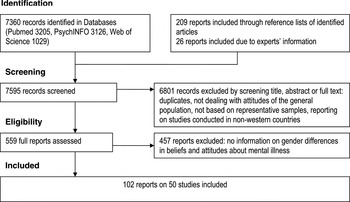
Results of our systematic literature search are presented in Fig. 1. Our initial database search yielded 324 reports, citation-chasing and first-author searches resulted in another 209 reports that met our inclusion criteria. Twenty-six further reports were identified by contacting experts. Thus, our search strategy yielded in total 559 reports, 102 of which were written in languages other than English.
Systematic review of population-based studies on gender differences in beliefs and attitudes about mental disorders (PRISMA flowchart adopted from Moher et al. Reference Moher, Liberati, Tetzlaff and Altman2009).

From these 559 reports, we identified 102 reports (16 of which were not written in English) on 50 studies providing data on gender differences in public beliefs and attitudes about mental disorders. Almost all studies (47) focused on gender differences in the beliefs and attitudes of the respondents; only eight additionally (5) or exclusively (3) on differences depending on the gender of the mentally ill person. Twenty-four of these studies originated from Europe, 18 from North America and eight from Australia. Characteristics of the studies included are shown in supplementary material.
Gender differences in knowledge about mental disorders
We were able to locate nine studies with information on whether gender has an impact on the recognition of mental disorders. Five studies did not show any gender difference; in three studies women tended to be more able to identify mental disorders as such. In one study, this applied only to depression, while with psychosis no gender difference was found. In five out of nine studies, women were more inclined than men to endorse psycho-social causes of mental disorder, while in four studies there was no difference between women and men. As concerns biogenetic causes, in the majority of studies no gender difference was observed (Table 1).
Gender and knowledge about mental disorders
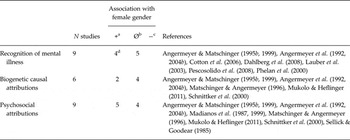
a + , Statistically significant positive association between female gender and indicators of knowledge.
bø, No statistically significant association.
c − , Statistically significant negative association.
dIn one study depression +, psychosis ø.
Gender differences in help-seeking and treatment preferences
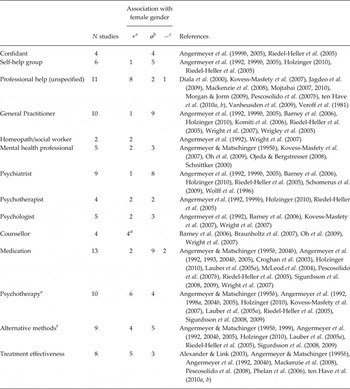
Almost all studies with relevant information indicate that there is no gender difference with regard to attitudes towards seeking informal help, individual or in groups. The opposite is true when it comes to professional help: in almost all studies women were more ready to recommend (unspecified) professional help than men. However, if one has a closer look at the different sources of help, this seems to apply primarily to non-medical professions (psychotherapist and counsellor) rather than to medical professions (general practitioner and psychiatrist) where no gender difference does show up (Table 2).
Gender and help-seeking and treatment preferences

a + , Statistically significant positive association between female gender and endorsement of sources of help or treatment modalities.
bø, No statistically significant association.
c − , Statistically significant negative association.
dIn one study depression +, psychosis ø.
eIn one study depression ø, schizophrenia +.
fIn one study depression +, schizophrenia ø.
As regards the various treatment modalities, there is a clear preponderance of studies reporting a stronger endorsement of psychotherapy by women than by men. In contrast, for medication most studies did not show a gender difference, in some it was endorsed more strongly by women, in some more strongly by men. Out of nine studies on alternative treatments like acupuncture, five reported no gender difference, in four women were more in favour of it. In general, according to the studies we were able to track, women seem to evaluate the effect of treatment more positively than men (Table 2).
Gender differences in attitudes towards people with mental illness
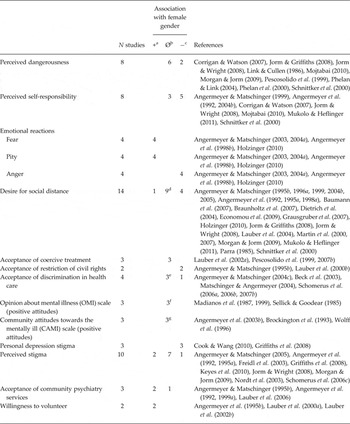
As mentioned above, studies addressing the question whether women and men display different attitudes towards people with mental illness prevailed over those investigating differences in the public's reaction to female and male patients. In most studies, the stereotype of dangerousness was equally prevalent among men and women. In contrast, women seem to perceive people with mental disorder less frequently responsible for their illness than men. Out of seven studies, five pointed in this direction, two did not reveal any gender difference. As concerns emotional reactions towards people with mental illness the results are mixed: on the one hand in all four studies with relevant data women expressed more positive reactions and less anger, on the other hand they also showed more fear than men. From most studies on the desire for social distance no difference between both genders has been reported. Similarly, no gender differences were found as concerns the acceptance of coercion in the treatment of mentally ill persons and the acceptance of their discrimination with regard to the allocation of financial resources to health care. Women seem to be more opposed only to restrictions of civil rights of the mentally ill. There were only two studies dealing with attitudes towards community psychiatry services. In both, women turned out to be more accepting than men. Women also seem to be more ready to volunteer and engage themselves in the care of people with mental illness (Table 3).
Gender and attitudes towards people with mental illness

a + , Statistically significant positive association between female gender and attitudes towards people with mental illness.
bø, No statistically significant association.
c − , Statistically significant negative association.
dIn one study schizophrenia and borderline personality disorder ø, depression −.
eIn one study schizophrenia and depression ø, alcoholism +.
fIn two studies all scales ø, in one study social integration ø, social discrimination and social restriction −, social care +.
gIn two studies all scales ø, in one study exclusion, benevolence and social control ø, integration +.
There are only a few studies reporting on the influence of the gender of the person with mental illness on public attitudes. As concerns the stereotype of dangerousness, in one study female patients were considered less dangerous than male patients (Pescosolido et al. Reference Pescosolido, Monahan, Link, Stueve and Kikuzawa1999; Schnittker, Reference Schnittker2003); in two studies, this applied only to persons with schizophrenia, while there was no gender difference in case of depression (Braunholtz et al. Reference Braunholtz, Davidson, Myant and O'Connor2007; Jorm & Griffiths, Reference Jorm and Griffiths2008). In three out of four studies the gender of the mentally ill person did not play a role in the perception of self-responsibility (Schnittker et al. Reference Schnittker, Freese and Powell2000; Wirth & Bodenhausen, Reference Wirth and Bodenhausen2009; Mukolo & Heflinger, Reference Mukolo and Heflinger2011), while in one study women were at greater risk of being blamed for their illness than men (Angermeyer et al. Reference Angermeyer, Matschinger and Siara1992). There was no study dealing with gender differences as regards the other two major stereotypes, unpredictability and untreatability. Five studies contained information on the desire for social distance. In three of them female patients faced less rejection than male patients (Schnittker, Reference Schnittker2003; Braunholtz et al. Reference Braunholtz, Davidson, Myant and O'Connor2007; Martin et al. Reference Martin, Pescosolido, Olafsdottir and McLeod2007; Mukolo & Heflinger, Reference Mukolo and Heflinger2011), and in one study this did hold only for schizophrenia, while with depression the gender did not make a difference (Jorm & Griffiths, Reference Jorm and Griffiths2008). The fifth study reported no gender difference (Angermeyer et al. Reference Angermeyer, Matschinger and Siara1992).
Discussion
From our review, a fairly consistent pattern emerges as concerns public beliefs about mental disorders and help-seeking and treatment preferences. The majority of relevant studies points to women as being more ready to seeking professional help and evaluating treatment outcomes more favourably. Thus, we were able to replicate on a population level what already had been observed on the basis of samples of convenience (e.g., Nam et al. Reference Nam, Chu, Lee, Lee, Kim and Lee2010). Our result is in line with the theories proposed in the literature. However, it remains unclear as to what extent the potential mediators (e.g., familiarity with mental illness, traditional masculine behaviour, stigma avoidance, etc.) account for this phenomenon. There is a need for studies explicitly trying to examine their impact on help-seeking, as this may allow reframing mental health services to be more appropriate as well as more responsive to the needs of their potential clients.
Women seem to favour psycho-social conceptualizations of mental illness more than men and, consequently, to recommend more frequently non-medical sources of help (counsellor and psychologist) and to endorse psychotherapy more frequently. Interestingly enough, this is not at the expense of the endorsement of biogenetic causal explanations, where in most studies no gender differences have been observed. This is also not at the expense of recommending medical professionals (General Practitioner and psychiatrist) and endorsing medication for treatment. The popularity of psychotherapy among women is reflected in actual rates of treated patients where women outnumber men by far, even if gender differences in the prevalence of mental disorders are taken into account (Alonso et al. Reference Alonso, Angermeyer, Bernert, Bruffaerts, Brugha, Bryson, de Girolamo, de Graaf, Demyttenaere, Gasquet, Haro, Katz, Kessler, Kovess, Lépine, Ormel, Polidori and Vilagut2004b). In general, ‘softer’ forms of treatment seem to be held in higher esteem among women than among men. This is also indicated by the result that if gender differences were reported, it was always women who tended to recommend alternative treatments such as acupuncture or natural remedies more strongly.
In contrast to help-seeking and treatment preferences, gender differences appear less pronounced in attitudes towards those suffering from mental illness. In most studies, men and women displayed similar attitudes as measured by the Opinion about Mental Illness (OMI) scale or the Community Attitudes towards the Mentally Ill (CAMI) scale, expressed the same desire for social distance or accepted to the same extent the discrimination of the mentally ill in health care. Thus, our review does not support theories discussed in the literature, suggesting a more accepting attitude among women. There are only a few exceptions: Women apparently tend to blame mental patients less for their illness and tend to be more reluctant to accept restrictions of civil rights. They also appear to be more willing to volunteer in patient care, a phenomenon that can also be observed in somatic medicine (Warburton & McLaughlin Reference Warburton and McLaughlin2006), and which is reflected in an overrepresentation of women actually being engaged in the non-professional care for the mentally ill (Angermeyer et al. Reference Angermeyer, Matschinger and Grobel1995a). There was only little support for the hypothesis that the gender of the person reacting may be contingent on the particular form of mental disorder: In one study, women were more ready to accept discrimination in health care in the case of alcoholism, while in the case of depression and schizophrenia no gender differences were found; in another study, women expressed less desire for social distance in depression, while with schizophrenia and borderline personality disorder the gender did not play a role.
In contrast to what one might expect according to labelling theory and modern stigma theory, there was little support for the notion that female mental patients may face more rejection than male patients. It turned out to be rather the opposite, as women tended to evoke less rejection than men, particularly those suffering from schizophrenia. About the reasons, one can only speculate. One explanation might be that studies included in our review suggest that female patients suffering from schizophrenia are perceived as less dangerous than male patients. The stereotype of dangerousness in schizophrenia thus may interact with the stereotype of more aggressive, dominant behaviour in males, and male patients with schizophrenia may therefore evoke more fear and, in consequence, stronger desire for social distance. As demonstrated in a number of studies, it is particularly the stereotype of dangerousness that plays an important part in the public's attitude towards mentally ill people (Angermeyer et al. in press). However, the relevance of these gender differences is unclear: a large international study on stigma experiences of people with schizophrenia did not find differences in the number of experiences of negative discrimination (Thornicroft et al. Reference Thornicroft, Brohan, Rose, Sartorius and Leese2009). Also, a meta-analysis of studies on self-stigma in mental illness did not find significant gender differences (Livingston & Boyd, Reference Livingston and Boyd2010). Stigma experiences thus seem to be quite similar in men and women with mental illness.
Some limitations of this review need to be mentioned. First, although all studies were based on representative population samples, there was a considerable variation as concerns sampling frame (national v. local/regional), number of respondents (from 142 up to 29 248), overall response rate (19–89.7%), data collection (face-to-face interview, telephone interview and postal survey), stimulus (vignette, diagnostic label and mental illness in general) and instruments for the assessment of attitudes. This makes a direct comparison between studies quite problematic and it remains an open question to what extent differences in results might be due to differences in methods. Second, because of the methodological heterogeneity of the studies a meta-analysis was not possible. Third, as in some studies, apart from socio-demographic characteristics, the effect of other variables, which themselves may moderate gender effects (for instance value orientations), had been controlled for; the effect of gender may be under-estimated. Fourth, as only in 15 out of 50 studies attitudes referring to two or more specific mental disorders had been assessed, and in the majority of these studies the different diagnoses had been lumped together and had not been analysed separately, nothing can be said about variations of gender effects on attitudes according to the type of mental disorder.
Despite these limitations, the conclusion seems warranted that gender matters as regards public beliefs and attitudes about mental illness. However, two qualifications seem necessary: first, in over half of all comparisons between both genders, no difference was found. Second, the variance explained by gender as by other socio-demographic variables appears rather small (e.g., Angermeyer et al. Reference Angermeyer, Beck and Matschinger2003a). As in most studies gender was simply being used as control variable and only a handful was addressing the gender issue explicitly, further studies, testing theory-driven hypotheses, are needed. This could provide us with important clues as to how develop tailor-made interventions aimed at raising the willingness to seek professional help and reducing discriminating attitudes towards people with mental illness.
Declaration of interest
All five authors declare that no competing interests exist.
Supplementary material
The Supplementary material referred to in this article can be found online at journals.cambridge.org/eps.