Implications
Ruminant production contributes significantly to global greenhouse gas emissions. Consequently, the identification of appropriate strategies to reduce methane (CH4) is becoming increasingly important. Diet formulation is one of the most promising strategies for reducing CH4 production from ruminants. Increasing the concentration of lipid in the diet of beef cows, by replacing grass silage with brewers’ grains, reduced CH4 emissions by 17%. As brewers’ grains are a widely available by-product feed, their use in ruminant diets provides a practical solution to reduce the environmental impact of beef enterprises.
Introduction
Ruminants play a crucial role in food security, being able to convert forages and non-human edible food into products for human consumption through enteric fermentation of cellulosic carbohydrates. However, enteric fermentation is the main source of ruminant emissions, where methane (CH4) is an end product of the microbial digestion process. Enteric CH4 emissions represents a loss of feed energy to the animal (estimated at 6% to 10%), which could be used by the animal for production (e.g. deposition of lean meat; Cottle et al., Reference Cottle, Nolan and Wiedemann2011; Gerber et al., Reference Gerber, Steinfeld, Henderson, Mottet, Opio, Dijkman, Falcucci and Tempio2013a and Reference Gerber, Hristov, Henderson, Makkar, Oh, Lee, Meinen, Montes, Ott, Firkins, Rotz, Dell, Adesogan, Yang, Tricarico, Kebreab, Waghorn, Dijkstra and Oosting2013b).
There is increasing interest internationally to develop sustainable approaches to reduce CH4 production from cattle. Breeding, enterprise or system management and diet formulation are all useful strategies (Cottle et al., Reference Cottle, Nolan and Wiedemann2011), with diet formulation representing one of the most practical and promising approaches. It has been widely demonstrated that the nutritional composition of the diet significantly affects CH4 emissions (Cottle et al., Reference Cottle, Nolan and Wiedemann2011). Dietary strategies to reduce CH4 emissions are generally based on one of the following principles: (i) reducing the production of hydrogen during fermentation, (ii) direct inhibition of methanogenesis or (iii) providing alternative pathways for the use of hydrogen within the rumen (Martin et al., Reference Martin, Morgavi and Doreau2010). One promising approach, and the main focus of this paper, relates to increasing the concentration of dietary lipid, which has been demonstrated to effectively reduce CH4 emissions from ruminants (Martin et al., Reference Martin, Morgavi and Doreau2010; Grainger and Beauchemin, Reference Grainger and Beauchemin2011; Hristov et al., Reference Hristov, Oh, Firkins, Dijkstra, Kebreab, Waghorn, Makkar, Adesogan, Yang, Lee, Gerber, Henderson and Tricarico2013; Patra, Reference Patra2013). Lipids reduce CH4 emissions through various mechanisms: fatty acids are not fermented in the rumen and therefore increasing their proportion in the diet reduces the proportion of feed which is fermentable within the rumen; lipids can also reduce CH4 production by coating fibre particles, reducing their digestibility, and by reducing the numbers and activity of the rumen methanogens and protozoa responsible for methanogenesis (Johnson and Johnson, Reference Johnson and Johnson1995; Patra, Reference Patra2013). Dietary lipid can be increased through the addition of plant oils to the diet or through the use of lipid-containing plant by-product feeds from distilleries, breweries or plant oil extraction (Brask et al., Reference Brask, Lund, Weisbjerg, Hellwing, Poulsen, Larsen and Hvelplund2013). The use of by-product feeds from these industries may be cost-effective and represents an important energy source in ruminant diets. Cereals used for brewing beer or distilling spirits predominantly use the starch portion for ethanol production with the resultant by-product feed available to the ruminant feed market being proportionately higher in fibre, protein and lipid. Brewers’ grains are a widely available animal feed for both beef and dairy cattle. Commonly, diets fed to housed beef cows in the winter include large proportions of forages, which are low in digestibility, for example barley straw. Baseline data on CH4 emissions from cows offered diets low in digestibility are currently sparse, as is information on effective CH4 mitigation strategies for these diet types.
Evidence to support breed differences in CH4 emissions is also limited. Most studies have focussed on breeds of beef cattle that are typically managed more intensively, but a small number have investigated breeds more suited to extensive grazing systems (Fraser et al., Reference Fraser, Fleming and Moorby2014; Richmond et al., Reference Richmond, Wylie, Laidlaw and Lively2015). One could speculate that breeds suited for hill and upland systems may have developed significant physiological or behavioural differences to suit the harsher environments. They may also differ in CH4 production when offered a straw-based, poor quality diet in comparison with breeds typically managed more intensively and selected for improved growth and carcass yield.
The aim of this study was therefore to investigate the effect of increasing the concentration of dietary lipid in a barley-straw-based diet, typical of industry practice, by replacing grass silage with brewers’ grains, on CH4 emissions of pregnant, non-lactating spring calving beef cows of two breeds.
Material and methods
This study was conducted at the Beef and Sheep Research Centre, SRUC situated 6 miles south of Edinburgh, UK. The experiment was approved by the Animal Experiment Committee of SRUC and was conducted in accordance with the requirements of the UK Animals (Scientific Procedures) Act 1986.
Experimental design, diets and animals
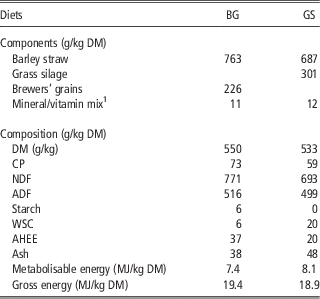
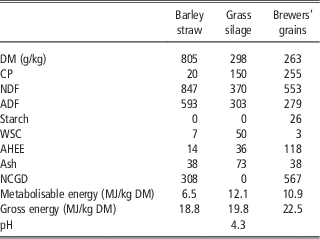
The experiment was of a two×two factorial design, comprising two barley-straw-based diets with either (i) grass silage or (ii) brewers’ grains as alternative protein sources and two cow breed types (LIMx, crossbred Limousin; LUI, purebred Luing). The two experimental diets consisted (g/kg dry matter (DM) basis) of (i) barley straw (687) and grass silage (301; GS) or (ii) barley straw (763) and brewers’ grains (226; BG), which were offered as total mixed rations (TMR). The ingredient and chemical composition of the experimental diets are given in Table 1. The chemical composition of individual dietary components is given in Table 2. The DM contents of individual components were determined twice weekly and bulked feed samples (three per component) were analysed. Feed samples were analysed for DM, ash, CP, ADF, NDF, acid-hydrolysed ether extract (AHEE), water-soluble carbohydrate, starch and neutral cellulose and gamminase digestibility (Ministry of Agriculture Fisheries and Food, 1992) and gross energy by adiabatic bomb calorimetry. The LIMx cows were all Limousin-sired from a two-breed (Limousin and Aberdeen Angus) reciprocal crossing programme, whereas the Luings were all purebred Luing cows. The breeds were selected to represent two commercially relevant breeds where crossbred Limousin cows represent the most common continental sired beef breed in the United Kingdom, whereas the LUI breed is typical of a more extensively managed hardy hill and upland breed.
Component composition and calculated chemical composition of experimental diets (BG, barley straw–brewers’ grains; GS, barley straw–grass silage)

WSC=water-soluble carbohydrate; AHEE=acid-hydrolysed ether extract.
1 Mineral/vitamin mix (Norvite, Insch, Aberdeenshire, UK) supplied (mg/kg unless stated otherwise) vitamin A, 500 000 international units (IU); Vitamin D 100 000 IU; Vitamin E 4000; Fe, 5271; Mn, 5000; Zn, 3600; I, 1000; Co, 90; Cu, 3000; Se, 35.
Chemical composition of components (g/kg DM)

DM=dry matter; WSC=water-soluble carbohydrate; AHEE=acid-hydrolysed ether extract; NCGD=neutral cellulose and gamanase digestibility.
In total, 48 cows (n=24 of each breed type) were group-housed in equal numbers of each breed type across two pens, and each diet type was allocated to one pen. Thus, 12 animals were allocated to each diet×breed combination. Treatments were balanced for age at the start of the experiment, number of days into pregnancy and BW. In the group-pens, all cows were bedded on wood fibre and sawdust to ensure that consumption of bedding did not contribute to nutrient intake. Fresh water was provided ad libitum using a water trough, and both TMR diets were offered ad libitum to all cows twice daily using electronic feeders (HOKO, Insentec, Marknesse, The Netherlands). The TMR’s were formulated to meet the cow’s average nutrient requirements for maintenance and pregnancy according to AFRC (1993). Before measurements using respiration chambers, feed intake and weekly BW and body condition score (BCS) had been measured for a minimum of 3 weeks, following a 4-week adaptation period to acclimatise to the diets.
Emissions measurement in respiration chambers
The cows were originally allocated to six respiration chambers over an 8-week period, using a replicated (two times) randomised block design (each block consisting of 4 weeks). Thus, each component of the two×two factorial (breed×diet) experimental design was allocated twice to each respiration chamber. The cows were allocated to minimise variation in stage of pregnancy and BW on entry into the respiration chambers. Before entry to the respiration chamber, cows were loose-housed for a period of 6 days individually in training pens within the same building of identical size (4×3 m) and shape to the pens within the respiration chambers to allow them to acclimatise to being housed individually. The cows were then moved to individual respiration chambers where they remained for 3 days. Cows were fed once daily with ad libitum access to their respective TMR’s and feed consumption was monitored from weigh cells located in feed bins with records made at 10 s intervals. Data for dry matter intake (DMI) during the 3-day chamber measurement period were averaged per animal. Front doors of chambers were briefly opened and closed at ∼0800 h daily to remove feed bins and again to replace bins with fresh feed at ∼0900 h. The pens were cleaned daily between 0800 and 0900 h. Exact times when doors were opened and closed were recorded.
The methodology for measuring emissions using respiration chambers has been previously described in Rooke et al. (Reference Rooke, Wallace, Duthie, McKain, de Souza, Hyslop, Ross, Waterhouse and Roehe2014). Briefly, six indirect open-circuit respiration chambers were used (No Pollution Industrial Systems Ltd, Edinburgh, UK). The total chamber volume (76 m3) was ventilated to give approximately 2.5 air changes/h. Temperature and relative humidity were set at 15°C and 60%, respectively. Total air flow, temperature and humidity were recorded at 5 s intervals. Chambers were operated under negative pressure (50 N/m2). CH4 concentrations were measured by infrared absorption spectroscopy (MGA3000; Analytical Development Co. Ltd, Hoddesdon, UK). The analyser was calibrated before and after each 3-day chamber measurement period using calibration gases for zero (99.998% Nitrogen, BOC Ltd, Surrey, UK) and span (500 ppmv CH4, 1975 ppmv CO2, 20.9% O2; BOC Ltd). Gas concentrations were recorded for each chamber and for inlet air every 6 min. Before the beginning of the experiment, gas recoveries were measured by releasing carbon dioxide at a constant rate into each chamber. The mean recovery was 98% (s.e.m.=3.0), which was not different from 100%. The final 48 h of a 72 h measurement period were used to calculate daily gas production. To minimise bias caused by the entry of air when the doors to the chamber were opened for feeding, and as cows did not have access to feed at this time, gas concentrations measured during this period were not used for further analysis. Instead, and to minimise bias, these values were replaced by the mean value of measurements made in the last hour before the doors were opened. If a cow had consumed feed during that period, mean values for the hour preceding feed consumption was used. During the 8-week period, because of failures in air recirculation (n=3) within chambers and with gas analysis (n=6), and poor DMI from one cow (n=1), data from only 38 cows were obtained and therefore an extra set of measurements were obtained in a 9th week (for five of 10 cows above) to bring total number of observations to 43. On completion of the experiment, critical appraisal of the data caused three of these measurements to be rejected because of gas analysis problems and therefore there were 40 observations available for analysis (n=10 for each breed×treatment combination).
Rumen sampling and volatile fatty acid (VFA) analysis
Rumen fluid samples were taken from each animal within 2 h of animals leaving the respiration chambers. Animals had ad libitum access to feed until removal from chambers at 0900 h (no fresh feed was provided on the morning of removal). Approximately 50 ml of rumen liquid were taken by inserting a stomach tube (16×2700 mm Equivet Stomach Tube, JørgenKruuse A/S, Langeskov, Denmark) nasally and aspirating manually. This liquid was filtered through two layers of muslin. A 5 ml sample of the filtered liquid was deproteinised by adding 1 ml metaphosphoric acid (215 g/l) and 0.5 ml methylvaleric acid (10 g/l) was added as an internal standard. These samples were stored at −20°C between collection and analysis. VFA concentrations were determined by HPLC as described in Rooke et al. (Reference Rooke, Borman and Armstrong1990).
Statistical analysis
For all traits other than DMI (kg/day), statistical analyses were conducted using the mixed procedure of SAS software (SAS Institute Inc., Cary, NC, USA). The fixed effects were diet (BG and GS) and breed (LUI and LIMx), and random effects included were week (instead of block to account for the extra week of chamber measurements) and chamber. The interaction between diet and breed was also included in the model when these effects proved significant (P<0.05). For comparison of daily DMI at different measurement periods, data were analysed using the mixed procedure of SAS software using a repeated measures ANOVA including the effects of diet (BG and GS), breed (LUI and LIMx) and measurement period (group pen, training pen, chamber). There were no interactions between diet, breed and period and thus no interaction terms were included in the model. Probability values were deemed as significant where P<0.05. Data are reported as means with their standard errors of the mean (s.e.m.).
Results
BW and BCS
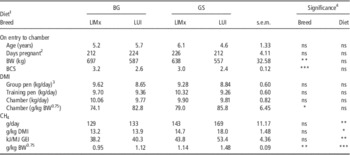
Mean values for BW and BCS parameters determined in this study are presented in Table 3. Due to cow allocation to treatments, there were no diet or breed differences for either age or number of days into pregnancy on entry to the chamber (P>0.05). Furthermore, there were no between-diet differences for BW or BCS on entry to the chamber (P>0.05). BW was affected by breed where LUI cows had lower BW than LIMx cows (572 v. 668 kg; P<0.01). BCS was affected by breed where LUI cows had poorer BCS than LIMx cows (2.5 v. 3.1; P<0.001).
Age, BW and body condition score (BCS) of cows at allocation, intakes and CH4 production as measured from the respiration chambers (means with average s.e.m.)

DMI=dry matter intake; GEI=gross energy intake; LIMx=crossbred Limousin; LUI=purebred Luing.
1 BG=barley straw-brewers’ grains; GS=barley straw-grass silage.
2 Three animals were identified as not in calf (all LUI, one allocated to BG and two allocated to GS diet).
3 Measured throughout 1 week before entry to training pen.
4 The interaction effect of breed×diet was not significant for any trait except days pregnant (P<0.01).
*P<0.05; **P<0.01; ***P<0.001.
DMI
No diet or breed differences were observed for DMI expressed as kg per day (Table 3; P>0.05). DMI differed between measurement periods where cows had lower DMI (kg/day) within the group-pen environment compared with DMI measured in the training pens and respiration chambers (group pen=9.10 kg/day, training pen=9.66 kg/day, chamber=9.88 kg/day; P<0.05; s.e.m.=0.259). There was no interaction of measurement period with diet or breed (P>0.05). However, when expressed as a proportion of metabolic BW (BW0.75), LUI cows had greater DMI within the chambers than LIMx cows (84.5 v. 75.7 g DMI/kg BW0.75; P<0.05).
CH4 emissions
Cows offered the BG diet (Table 3) produced less CH4 per day than GS-fed cows (131 v. 156 g/day; P<0.01). Whether expressed as g/kg DMI (13.5 v. 16.4 g/kg DMI; P<0.05) or kJ/MJ gross energy intake (GEI; 39.2 v. 48.6 kJ/MJ GEI; P<0.01) BG-fed cows produced less CH4 than cows offered the GS diet. Luing cows consistently produced more CH4 (g/day, g/kg DMI and kJ/MJ GEI) than LIMx cows, although the breed effect was not significant (P>0.05). However, when CH4 emission was expressed as a proportion of metabolic BW, LUI cows produced more CH4 than LIMx cows (1.30 v. 1.05 g CH4/kg BW0.75; P<0.01).
VFA molar proportions
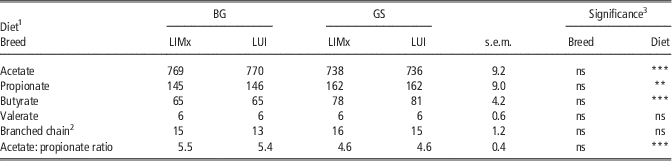
Molar proportions of acetate (Table 4) were higher in rumen fluid samples from cows fed BG compared with GS (769 v. 737 mmol/mol; P<0.001), whereas the proportions were lower for both propionate (146 v. 162 mmol/mol; P<0.01) and butyrate (65 v. 80 mmol/mol; P<0.01). The proportions of valerate did not differ between diet types (P>0.05). Thus, the acetate to propionate ratio was greater in cows fed the BG than the GS diet (5.5 v. 4.6; P<0.001). There was no difference between the two breeds for VFA molar proportions (P>0.05).
Volatile fatty acid molar proportions (mmol/mol) in rumen fluid samples taken on exit from respiration chambers (means and average s.e.m. are given for effects of breed and diet)

LIMx=crossbred Limousin; LUI=purebred Luing.
1 BG=barley straw-brewers’ grains; GS=barley straw-grass silage
2 Branched chain is sum of iso-butyrate and iso-valerate.
3 The interaction effect of breed×diet was not significant for any trait.
*P<0.05; **P<0.01; ***P<0.001.
Discussion
Diet effects on CH4 emissions
Increasing the concentration of lipid in ruminant diets reduces CH4 emissions (Martin et al., Reference Martin, Morgavi and Doreau2010; Grainger and Beauchemin, Reference Grainger and Beauchemin2011; Hristov et al., Reference Hristov, Oh, Firkins, Dijkstra, Kebreab, Waghorn, Makkar, Adesogan, Yang, Lee, Gerber, Henderson and Tricarico2013; Patra, Reference Patra2013). However, the effectiveness of dietary lipid depends on the type and amount of lipid added to the diet (Brask et al., Reference Brask, Lund, Weisbjerg, Hellwing, Poulsen, Larsen and Hvelplund2013; Hristov et al., Reference Hristov, Oh, Firkins, Dijkstra, Kebreab, Waghorn, Makkar, Adesogan, Yang, Lee, Gerber, Henderson and Tricarico2013). However, less attention has been paid to the nature of the basal diet. The present study demonstrated that incorporating brewers’ grains into a straw-based diet reduced CH4 emissions from beef cows; replacing grass silage with brewers’ grains increased the lipid concentration from 20 to 37 g AHEE/kg diet DM and reduced CH4 yield (g/kg DMI) by 17%. In recent reviews, Grainger and Beauchemin (Reference Grainger and Beauchemin2011) found that CH4 yield decreased 1 g/kg DMI for every 10 g/kg DM increase in dietary lipid, and Martin et al. (Reference Martin, Morgavi and Doreau2010) reported that CH4 yield decreased by 3.8% with every 10 g lipid/kg DM increase. In the present study, CH4 yield decreased by 1.6 g/kg DMI or 10% for every 10 g AHEE/kg diet DM increase upon inclusion of brewers’ grains, which is greater than the above reports. In the present study, however, cows were observed to attempt to select brewers’ grains from the mixed feed. This would result in a higher proportion of brewers’ grains consumed compared with that offered. It was not anticipated that the cows would attempt to select specific dietary constituents, thus it is important to consider the potential differences in the composition of the consumed diet. To explore the potential difference in dietary lipid consumed, a corrected estimate of the ratio of barley straw to brewers’ grains was calculated based on the assumption that all refusals consisted solely of barley straw and did not contain brewers’ grains. Based on 216 observations, the consumed ration was calculated as (g/kg DM basis) 334 brewers’ grains and 666 straw instead of the formulated ration of 226 brewers’ grains and 763 straw. Based on this corrected ratio, the lipid content of the diet would have increased to 49 g AHEE/kg diet DM compared with 37 g AHEE/kg diet DM in the formulated ration. This brings the results in line with the findings of Grainger and Beauchemin (Reference Grainger and Beauchemin2011), where at this corrected concentration a 1 g/kg reduction in CH4 for every 10 g/kg increase in dietary lipid was observed. Furthermore, the effect of dietary lipid may be greater within a diet containing a high proportion of low digestible fibre such as barley straw. Martin et al. (Reference Martin, Morgavi and Doreau2010) reported that the effects of dietary lipid were greater on a hay diet than a maize silage diet and previous findings have demonstrated greater reductions in CH4 production on forage than concentrate-based diets (Lovett et al., Reference Lovett, Lovell, Stack, Callan, Finlay, Conolly and O’Mara2003; Troy et al., Reference Troy, Duthie, Dewhurst, Hyslop, Roehe, Ross, Wallace, Waterhouse and Rooke2015).
The use of by-products containing dietary lipid can be an effective strategy for reducing CH4 emissions from cattle. Troy et al. (Reference Troy, Duthie, Dewhurst, Hyslop, Roehe, Ross, Wallace, Waterhouse and Rooke2015) investigated the addition of cold-pressed rapeseed cake to the diet of finishing beef steers and found that the addition of rapeseed cake, which is higher in lipid than brewers’ grains (174 g AHEE/kg DM), to a mixed forage and concentrate diet (52 g AHEE/kg diet DM) resulted in a reduction in CH4 yield of 3.3% (0.83 g/kg DMI) per 10 g/kg DM increase in dietary lipid, which is slightly lower than the results reported here. Brask et al. (Reference Brask, Lund, Weisbjerg, Hellwing, Poulsen, Larsen and Hvelplund2013) added rapeseed cake (173 g crude fat/kg DM) to the diet of dairy cows and found a greater CH4 yield reduction of 4.6% for every 10 g/kg DM increase in dietary lipid. Relatively, few studies have reported the effects of including brewers’ grains in the diet on CH4 production. However, Moate et al. (Reference Moate, Williams, Grainger, Hannah, Ponnampalam and Eckard2011) used brewers’ grains, hominy meal and a combination of hominy meal and cold-pressed rapeseed in dairy cow diets, where the diets contained 51, 65 and 52 g crude fat/kg diet DM, respectively (compared with the control, which contained 26 g crude fat/kg diet DM). Moate et al. (Reference Moate, Williams, Grainger, Hannah, Ponnampalam and Eckard2011) observed a 5% reduction of CH4 yield on both the brewers’ grains and combined hominy meal and rapeseed treatments, and 12% on the hominy meal treatment; the greater reduction on the hominy meal treatment was likely due to the higher lipid concentration in the diet. They demonstrated for each 10 g/kg DM increase in dietary lipid concentration, CH4 emissions were reduced by 3.5%. Although the majority of studies to date have not investigated the persistency of the effects of lipid on suppressing CH4 production, Moate et al. (Reference Moate, Williams, Grainger, Hannah, Ponnampalam and Eckard2011) demonstrated a persistency of their dietary effects over more than 7 weeks. The effect of lipid persisted throughout the current experiment (9 weeks) as there was no effect of measurement week (P=0.50) on CH4 production.
One of the mechanisms by which lipid is thought to suppress CH4 production is through increased production of propionate v. acetate and thus reduction in the amounts of hydrogen generated through fermentation. The meta-analysis of Patra (Reference Patra2013) demonstrated that although total VFA concentrations were not altered by increasing the dietary lipid content, the proportion of propionate to acetate increased and the proportion of butyrate decreased with increasing concentration of lipid, which supports the above mechanism. In contrast, an increase in acetate and decrease in propionate on the BG diet was observed in the present study alongside a reduction in butyrate. Increasing the concentrate proportion of the diet is normally associated with increases in propionate molar proportions, although the response is likely to depend on the nutrients supplied by the diet. In the present study, 964 g/kg DM in diet BG was accounted for by NDF, CP, AHEE and ash, whereas only 649 g/kg DM was accounted for by these constituents in diet GS. The constituents unaccounted for in GS include fermentation acids, particularly lactic acid. Since there is a positive correlation between silage lactic acid concentration and rumen propionic acid molar proportion (Martin et al. Reference Martin, Chamberlain, Robertson and Hirst1994), the greater propionic acid molar proportions in the GS diet most likely reflected the lactic acid in the silage and the low concentrations of starch in the brewers’ grains. From the above, decreased hydrogen supply to the rumen archaea from increased production of propionic acid does not appear to be the most likely mechanism of action of lipid in the present experiment. More likely mechanisms may be physical coating of fibre by the lipid and the reduction in rumen-fermentable substrates as a result of lipid addition. Furthermore, apart from the increased lipid content of the diet, the other main changes in the composition of the diet when brewers’ grains replaced grass silage were increased NDF and CP contents. The greater acetate to propionate ratio observed for diet BG is consistent with the increase in NDF but there was no increase in branched-chain VFA on diet BG, which might be expected from increased protein degradation. However, the increase in acetate to propionate ratio on diet BG was not associated as might be expected with an increase in CH4 emissions and therefore it is likely that the increase in dietary lipid was the major factor underlying the reduction in CH4 emissions observed when BG rather than GS was fed.
At high concentrations in the diet, lipid can negatively affect DMI and productivity, but low concentration of dietary lipid can be used with no adverse effects (Brask et al., Reference Brask, Lund, Weisbjerg, Hellwing, Poulsen, Larsen and Hvelplund2013). Based on a meta-analysis, Patra (Reference Patra2013) demonstrated that lipid supplementation in excess of 6% causes problems with productivity. Diets that negatively affect productivity are unsuitable for livestock producers, and therefore, in the present study the concentration of lipid in the BG diet was 37 g AHEE/kg diet DM in the formulated ration. As expected, and consistent with the literature, this concentration of dietary lipid did not suppress DMI. Even if we assume the animals preferentially selected the diet as observed, the diet would still not have reached a concentration of lipid expected to suppress DMI. However, at this corrected level of BG inclusion a marked decrease in CH4 production was observed without adverse effects on DMI. Therefore, the use of by-products such as brewers’ grains, represents an attractive strategy for use in beef cow diets from both an animal productivity and CH4 mitigation perspective.
In the present study, mean CH4 yields for each of the BG and GS diets were 0.039 and 0.049 MJ/MJ GEI, respectively, considerably lower than the value currently adopted by the Intergovernmental Panel on Climate Change (IPCC, 2006) (0.065 MJ/MJ GEI). The IPCC (2006) approach does not account for differences in the digestibility of diets and as a result over-estimates CH4 yield from diets containing large proportions of forages, which are low in digestibility.
Respiration chambers are generally considered to be the most accurate technology for measuring CH4 emissions from ruminants. However, one of the major challenges associated with this technology is avoiding a reduction in feed intake within the chamber environment, where the animals are individually housed. This is necessary for CH4 emissions data to be representative of normal feeding behaviour in a group-housed environment (Garnsworthy et al., Reference Garnsworthy, Craigon, Hernandez-Medrano and Saunders2012; Bickell et al., Reference Bickell, Revell, Toovey and Vercoe2014). In the present study, no reduction in DMI was observed from group-housing to respiration chambers, but there was a small increase in DMI per day of 9%.
Breed effects on CH4 emissions
There is limited experimental evidence to support differences in CH4 emissions between breeds. Rooke et al. (Reference Rooke, Wallace, Duthie, McKain, de Souza, Hyslop, Ross, Waterhouse and Roehe2014) examined CH4 emissions from crossbred Limousin and crossbred Aberdeen Angus, and found no difference between these breeds in CH4 yield whether expressed per level of DMI or GEI. Troy et al. (Reference Troy, Duthie, Dewhurst, Hyslop, Roehe, Ross, Wallace, Waterhouse and Rooke2015) compared two breeds of finishing beef steers (purebred Luing and crossbred Charolais) and reported no differences between breeds in CH4 whether expressed as g/day, g/kg DMI or kJ/MJ GEI. These studies were both conducted using the same respiration chambers and methodologies to those used in the current study.
Differences in grazing behaviour between breeds is likely to have a large impact on CH4 emissions, as demonstrated in a modelling study by Ricci et al. (Reference Ricci, Umstätter, Holland and Waterhouse2014). Based on the potential for differences in animal physiology or behaviour to influence CH4 production, a number of recent studies have been conducted within outdoor grazing environments to examine CH4 emissions from breeds, which are suited to extensive grazing systems compared with more intensively managed breeds selected for increased growth and carcass yields. Measurements of CH4 in grazing environments are possible using the SF6 tracer technique (Deighton et al., Reference Deighton, Williams, Hannah, Eckard, Boland, Wales and Moate2014). In the studies of Fraser et al. (Reference Fraser, Fleming and Moorby2014) and Richmond et al. (Reference Richmond, Wylie, Laidlaw and Lively2015), where two breeds were studied on two pasture types (lowland v. upland pasture), no difference between breeds (or interactions with pasture type) were identified for CH4 expressed on a daily, DMI or GEI basis. Rooke et al. (Reference Rooke, Duthie, Holland and Waterhouse2015) reported CH4 emissions of lactating beef cows of the same two breeds considered in the present study on either reseeded predominantly perennial ryegrass pasture or rough hill grazing. Consistent with previous findings, daily CH4 emissions were influenced by pasture type, but not breed. The results of the present study, although measured in chamber environments, were consistent with Rooke et al. (Reference Rooke, Duthie, Holland and Waterhouse2015) where these breeds of beef cow did not influence CH4 when expressed as g/day, g/kg DMI or kJ/MJ GEI. These expressions of CH4, however, do not take account of the differences in BW of these two breed types. Within the present study, LUI cows were considerably smaller than the LIMx cows (572 v. 668 kg BW) and produced greater levels of CH4 per kg metabolic BW compared with the LIMx cows. This greater level of CH4 is driven by the differences in DMI/kg BW0.75, where LUI cows consumed greater DMI per kg metabolic BW than LIMx cows. When considering the difference between breeds, it is important to take additional characteristics of the animals (such as DMI/kg BW0.75) into account as these have an important influence on CH4 production.
Increasing the dietary lipid concentration has been shown to effectively reduce CH4 production from ruminants provided the amount fed is less than that which adversely affects digestion and feed intake. However, the practicality and sustainability of this approach is dependent on the type of lipid used. Pure oils that could be used for human food are of high cost, or indeed where production is controversial (palm oil) may not represent the best sustainable solution. The use of by-products from ethanol production (biodiesel and alcoholic beverages) or oil extraction produces feeds that are better balanced in protein and lipid/energy supply than the parent feeds and are well established for use within ruminant diets. Thus the use of by-products, such as brewers’ grains represents a cost-effective and sustainable solution for mitigation of CH4 from ruminant systems.
Acknowledgements
The authors are grateful to all support staff at SRUC’s Beef and Sheep Research Centre for their technical assistance. SRUC receives funding from Scottish Government’s Rural and Environmental Science and Analytical Services Division. This work was funded by the UK Department for Environment, Food and Rural Affairs (DEFRA), the Scottish Government, the Northern Ireland Department for Agriculture and Rural Development (DARD) and the Welsh Government, as part of the UK’s Agricultural GHG Research Platform (www.ghgplatform.org.uk).