The frequent inability of long-established corporations to respond effectively to radical changes in market conditions, or disruptive innovation, is a well-established phenomenon. The dynamic capabilities literature suggests that institutionalized capabilities may lead to “incumbent inertia” when faced with environmental changes, with even minor innovations having the potential to undermine the value of a firm's deeply embedded knowledge.Footnote 1 This has been explained in terms of a sclerotic process whereby interdependencies between individual elements of the business model grow and harden across time, making changes to any element progressively more difficult.Footnote 2
A connected phenomenon is growing organizational homogeneity, which can reduce internal criticism of the business model.Footnote 3 Homogeneity is likely to be particularly strong in situations where managers are promoted from workers with common functional and skill backgrounds, especially where other types of diversity, such as gender or ethnicity, are weak or absent.Footnote 4 Alan Raucher identified such problems in interwar American chain stores, where higher management positions were generally filled by people who had entered as trainee store managers.Footnote 5
This article examines the causes of managerial inertia in consumer-durables firms that used their own direct sales forces to sell their products, through case studies of the two largest vacuum firms of the 1920s, Hoover and Eureka. Direct sales firms were particularly vulnerable to managerial homogeny. Their workforces and, especially, their white-collar staff were dominated by salesmen, while sales-related functions represented the bulk of their managerial positions and carried particularly high status and influence. Moreover, chronic labor turnover and a geographically dispersed sales force led to heavy investments in “selling” the firm's methods and “mission” to their employees—to strengthen organizational commitment.Footnote 6 While strong organizational commitment has a range of positive impacts, it can also act to restrict organizational flexibility, innovation, and adaptability, while promoting blind faith in the firm's established business model—particularly those elements that are perceived to be the distinctive managerial innovations underpinning its earlier success.Footnote 7
After briefly discussing the rise of the vacuum cleaner industry, this article explores the strategies used to develop organizational commitment and conformity to the dominant firms’ increasingly standardized business models. It then focuses on how, from the second half of the 1920s, they faced growing organizational rigidity, in areas such as sales support, staff training and motivation, and organizational goal-setting. Such problems intensified during the Depression, accentuated by the rise of a new foreign entrant: Electrolux. We then use data from a detailed 1939 investigation of Hoover by consultant engineers Ford, Bacon & Davis to show how Hoover failed to modify its business model to counter Electrolux's competitive threat and overinvested in sales support activities to such an extent that it had insufficient profits to match Electrolux's sales commission rates.
The Rise of the Door-to-Door Vacuum Cleaner Manufacturing and Sales Firm
The first practicable powered vacuum cleaners appeared at the beginning of the twentieth century and by 1914 had been transformed into portable, electrically powered appliances suitable for the housewife. Until 1924, entry to the sector was tightly controlled under an agreement between the holder of the industry's fundamental (Kenney) patent and the Vacuum Cleaner Manufacturers Association (representing early licensees of the Kenney patent), which effectively blocked the granting of further licenses and, in turn, market entry. This led to the early industry being characterized by high profits, high and stable prices, and nonprice competition.Footnote 8
Most major interwar vacuum manufacturers were established during this period. Hoover owes its origins to James Murray Spangler, an asthmatic janitor who devised a crude portable electric vacuum in 1907. He sold the idea to W. H. (“Boss”) Hoover, a man of considerable sales acumen, who started manufacturing cleaners in 1908 at his leather-goods works in North Canton, Ohio.Footnote 9 America's second most important vacuum manufacturer of the 1920s, Eureka, was established by salesman Fred Wardell, who marketed the Eureka Model 1 from 1909 and, in 1910, founded the Eureka Vacuum Cleaner Co. in Detroit.Footnote 10 Most other major manufacturers—such as Frantz Premier Vacuum Cleaner Co. (founded in 1910), Apex Electric Manufacturing Co. (1913), and P. A. Geiger Co. (1905)—were also based in or around Ohio, reflecting a geographical clustering evident in other consumer-durables sectors, such as washing machines (Iowa, especially Newton) and automobiles (southeast Michigan).
National output rose from 702,000 units, retailing at $42,120,000, in 1919 to 1,396,000 units, retailing at $64,811,000, in 1929. During the 1920s Hoover and Eureka vied for market leadership, collectively representing 40 percent of national unit sales in 1921 and 41 percent in 1927. Even after the expiration of the Kenney patent, early entrants continued to dominate (until the rise of Electrolux in the 1930s), owing to their development of “detail” patents that provided brand-specific advantages, and—more importantly—their early development of large sales forces that typically greatly outnumbered their production staff.
The 1920s provided a rapidly growing potential market, owing to the spread of household electrification and the “scientific homemaking” movement, which advocated the use of scientific management methods to improve the efficiency of the homemaker, via a combination of modern housework techniques and new laborsaving technologies.Footnote 11 Consumer durables were presented as taking the drudgery out of housework, thus enabling middle-class housewives to do their own housework without transgressing the social norm that heavy or dirty household tasks were unladylike.Footnote 12 Scientific homemaking both promoted the new durables and legitimized the salesman's call at the door, as he could introduce himself as an instructor on methods to improve household efficiency. Door-to-door selling was a key promotional device for other electric durables, such as radios, refrigerators, and washing machines, though these tended to rely more heavily on local retailers’ salesmen, whereas vacuums were primarily marketed by salesmen recruited, trained, monitored, and paid by the manufacturers.Footnote 13
Vacuum firms were sales-driven companies. As Hoover's official history notes, “the sales department is the most important part of an operation like this.”Footnote 14 The largest firms also placed substantial emphasis on product quality and innovation, though this reflected their need to develop strong proprietary features, so that salesmen could trumpet superiority over rival brands. Hoover's principal selling point was its patented cleaning system—“carpet agitation”—promoted with the slogan “It Beats as It Sweeps as It Cleans.”Footnote 15 In 1926, when its original agitator patents expired, Hoover introduced “positive agitation”—with replaceable brushes and a rigid metal beater bar spiraled around the roller to more efficiently remove dirt. Eureka stressed its variety of innovative attachments, including paint-spraying and hair-drying functions.Footnote 16 Such “features” were underpinned by heavy investments in research and development. Hoover's Experimental Department, established in 1919 to test materials and conduct R&D, employed one hundred people by 1938.Footnote 17
Rather than following the Fordist strategy of achieving market dominance by undercutting competitors’ prices, Hoover and Eureka followed the practice of earlier market leaders in standardized machinery, such as Singer and McCormick Harvesting Co. These firms had set prices at the top of the range for their sectors, capitalizing on any scale economies in production by investing lavishly in sales and marketing.Footnote 18 Indeed, despite substantial rises in output, vacuum retail prices and costs actually rose in real terms during the 1920s. Leading manufacturers’ avoidance of price competition was also evident in other consumer-durables sectors, such as refrigerators, washing machines, and (in the 1920s) radio.Footnote 19
Vacuum manufacturers soon learned that the best way to demonstrate brand-specific advantages, and overcome strong consumer inertia and resistance, was door-to-door selling. Hoover moved to direct sales around 1910, after observing that its retailers were not pushing Hoovers any more than the other products they stocked. The company then placed salesmen in each dealer's store, in what became known as the “resale system.” In return for this service, dealers accepted a lower commission (15 percent, rather than the customary 33.3 percent of the selling price), with the remaining 18.3 percent paying the salesman and the costs of his training and management. Then, from 1921, Hoover moved to a strategy of house-to-house canvassing (rather than going to people's homes only if asked for a demonstration), though the retailer was still paid the 15 percent commission—for providing sales leads, allowing salesmen to call on prospects using its name, stocking inventory, and providing the installment credit on which most vacuums were sold.Footnote 20
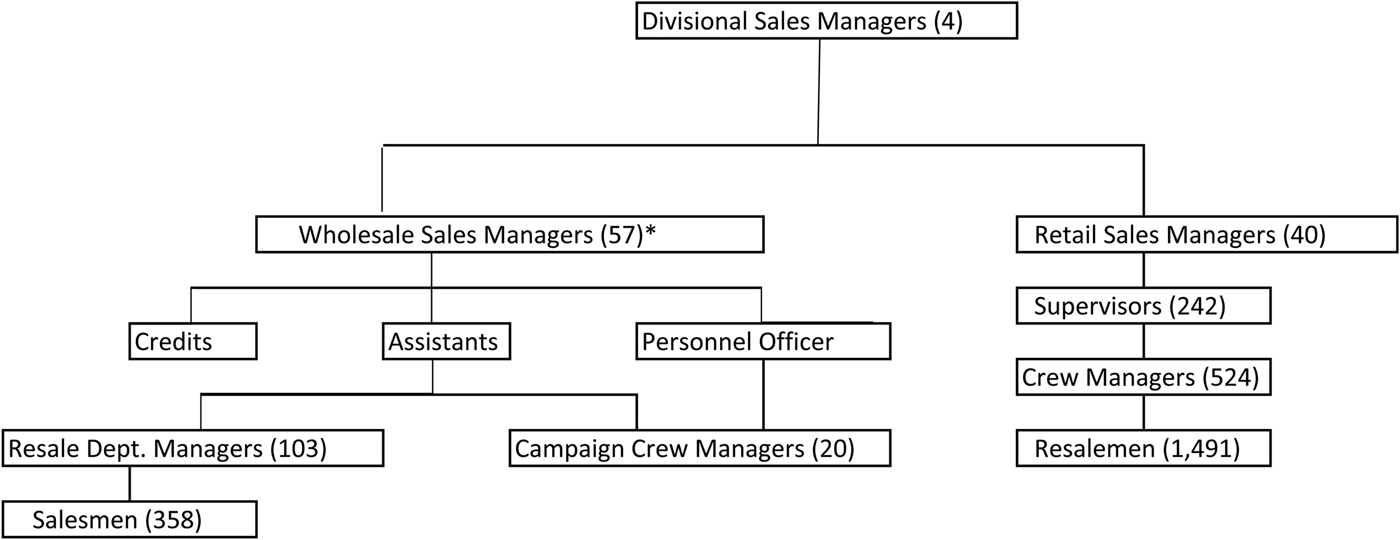
The major firms developed large sales forces, organized geographically into regions and territories. For example, in May 1927, Eureka's national sales operation comprised four regional divisions, managing thirty branch territories. Each territory was structured into a wholesale section (serving the conventional store trade) and a retail section, selling under the resale system (see Figure 1).Footnote 21 At this time Eureka employed 2,835 men in its outside sales organization, while its total factory workforce numbered 625. In other words, it took 4.5 people to sell the output of each production worker (excluding the contribution of the independent retailers with whom the firm's sales force collaborated).Footnote 22 Direct sales dominated total selling costs, though the major companies also invested substantially in advertising, to boost brand recognition and assert superior performance and proprietary features in advance of the salesman's call.Footnote 23
Eureka Vacuum Cleaner Co. outside sales organization, May 1927. Notes: * Wholesale sales manager numbers include assistants. Eureka also employed a staff of eight auditors and, at each important branch, a personnel officer. (Source: Report of interview with Mr C.W. Phister, Eureka Vacuum Cleaner Co., 26 May 1927, in 2069/9/16, Victor Talking Machine Co., Consignment selling folder, Victor Talking Machine Co. field survey, 1926–27, Hagley Museum and Library, Wilmington, DE.)

Corporate Strategies for Cementing Organizational Commitment
One of the greatest challenges facing vacuum companies was the recruitment and retention of sales staff, owing to the job's irregular (and often low) income together with its low status—even among salesmen. Ford, Bacon & Davis found that some 90 percent of applicants for Hoover salesmen's jobs were people without money who desired security and only considered sales because they could not find jobs offering a similar guaranteed income. Conversely, “Men who have been successful as salesmen in other lines will not take a job selling vacuum cleaners as they consider it beneath them. The public is inclined to look down on the work . . . so the fear of ridicule on the part of applicants is one of the principal things to be overcome.”Footnote 24
Selling vacuums lacked the romance of high profile “masculine” products (such as cars) and was considered more distasteful even than selling washing machines—which in turn was more distasteful than selling refrigerators or radios.Footnote 25 The major firms thus devoted considerable time and resources to “selling” the job to current and prospective salesmen. In addition to attracting salesmen through advertisements, which either carried the local dealer's name or were “blind” (not specifying the employer or the exact nature of the work), Hoover also used its existing salesmen, managers, and dealers as recruiting agents. In the mid-1920s, around 50 percent of Hoover salesmen were recruited through newspaper advertising, 25 percent through personal contact with the sales manager, 10 percent through Hoover salesmen, 5 percent through Hoover dealers, 5 percent through Hoover users, and the remaining 5 percent through other sources.Footnote 26 Similar methods were still being used in the late 1930s, though there appears to have been more emphasis on “get-a-man” campaigns, whereby prizes were offered to salesmen who brought in new recruits.Footnote 27
Manpower was viewed as the key determinant of sales. As a 1934 Hoover sales managers’ manual emphasized, “A Senior Manager's major responsibilities are – building manpower and developing Field Managers to absorb manpower. . . . [T]he Senior Manager who is unable to perform these two major operations, falls short of fulfilling his obligations.”Footnote 28 This emphasis on recruitment reflected chronic sales labor turnover, ranging, in 1939, from 100 percent per annum for Hoover's 1,500 leading salesmen (who generated 80 percent of sales) to about 500 percent for the other salesmen on its list. Leading salesmen earned around thirty-one dollars per week and others regarded as “productive” about thirteen dollars per week, while the rest—numbering some 2,500 to 3,000—sold only around one cleaner per month, on which they would earn about thirteen dollars.Footnote 29
High labor turnover compelled sales managers to undertake two conflicting tasks: infusing the sales force with positive messages—the value of the product, their sense of mission, and their ability to achieve sales goals—while avoiding heavy investments of time in salesmen who were never going to make the grade.Footnote 30 Hoover relied on payment by commission to weed out weaker salesmen while seeking to support stronger salesmen through further training, sales quotas, competitions, and other incentives. Pressure to achieve targets sometimes tempted salesmen to use dubious, or even criminal, tactics, and the vacuum firms—like the chain stores—found it necessary to develop systems to identify and address opportunistic behavior.Footnote 31 Hoover's monitoring included looking out for improbably high sales figures, which might reflect dubious methods, while Eureka employed a detective to check on their salesmen.Footnote 32
Problems of sales-force monitoring and motivation were accentuated by the fact that door-to-door salesmen and their field managers were physically distanced from top managers—a problem also faced by chain stores.Footnote 33 However, the vacuum companies felt this more acutely, owing to chronic labor turnover and the typically lower caliber of their recruits. The solutions developed to deal with this problem were, in turn, broadly similar to those embraced by other sales-orientated firms, based on a behavioralist set of management theories later formalized by the “human relations” school.Footnote 34
Hoover's system had strong similarities to the “inspirational” management formula pioneered by John H. Patterson at National Cash Register from the 1880s, which also acted as the blueprint for Frigidaire's early direct-selling operation.Footnote 35 This encompassed both how sales managers communicated with their salesmen and the broader “positioning” of Hoover as a company with a mission and social conscience. Techniques pioneered by Patterson that were adopted by Hoover included sales quotas (and clubs for salesmen who made quota); systematic sales training; the use of detailed scripts to standardize the sales process; contests; motivational sales conventions; a model factory with a cafeteria, hospital, and recreational facilities; and, more broadly, a strategy of combining material incentives for staff with “purposeful” (symbolic) incentives.Footnote 36 Eureka appears (on the basis of the much thinner archival evidence for this company) to have adopted broadly similar strategies.Footnote 37
Managers were expected to employ interpersonal skills to identify salesmen's motivations and align their personal goals with those of the company.Footnote 38 Meanwhile, salesmen's masculine credentials were boosted by stressing their sales “mission,” the competitive nature of their calling, and the rewards for success—encompassing immediate financial rewards, symbolic incentives, and promotion prospects.Footnote 39 Hoover and Eureka emphasized their culture of meritocratic internal promotion by, for example, trumpeting the success of senior managers who had risen through the ranks. While Hoover made some senior appointments externally, especially during its early rapid-growth phase, it increasingly focused on internal promotion. In 1927, Bill Steele—a former medical student who had taken a summer job selling vacuums for Hoover and never returned to his studies—became the first person to rise from the position of salesman to director of sales, where he pursued a policy of internal promotion.Footnote 40 Hoover also emphasized the salesmanship credentials of its top managers. For example, during the 1920s Hoover's president, Herbert W. Hoover Sr., introduced the “sales pilgrimage”: all executives who had any connection with sales were required to sell vacuums door to door for one week each year, in an unknown area with no leads or help, and make the standard sales quota.Footnote 41
Vacuum manufacturers also invested intensively in symbolic methods of boosting staff loyalty, effort, and conformity. This included building a “social” element into the firm's dealings with its sales force. Francesca Carnevali has shown how collective social events, involving such rituals as parades, fancy dress, and other forms of pageantry and associational activity, assisted in the development of nineteenth-century trade associations as “social structures” by embedding their members in a “community” and thereby tempering opportunistic behavior.Footnote 42 From the late nineteenth century, companies also began sponsoring picnics, dances, and other social events, together with the provision of social and recreational facilities, to present themselves as a community, harmonize employee relations, raise morale, and strengthen the bond between employee and firm.Footnote 43
Such strategies were more problematic for companies with a geographically dispersed workforce, who could not be expected to travel several hundred miles for a company picnic. Hoover therefore focused on large annual events to bring its sales force together. In 1921, Hoover held its first “International Sales Convention.” Managers and salesmen alike were accommodated in “Hoover Camp,” a tented city for 160 men, comprising their entire managerial workforce together with those salesmen who had met their “Maximen grade” sales target. The event was designed to downplay differences in rank and emphasize the esprit de corps of the sales team. As an unpublished firm history notes, “The men slept, ate, and bathed under canvas. This event marks the time when the real Hoover spirit was brought to full flower.”Footnote 44
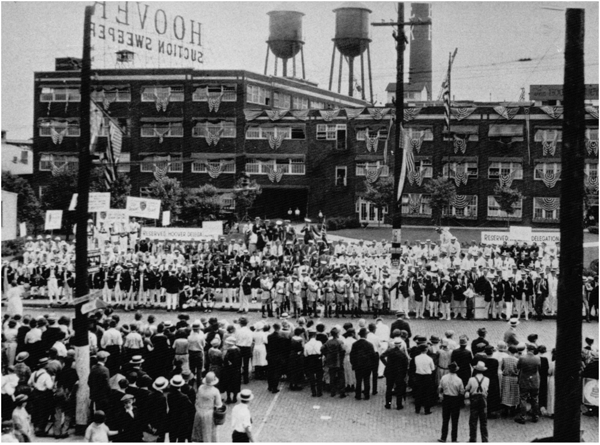
The following year's convention opened with a spectacular parade through North Canton, featuring costumed delegations from the field offices and elaborate floats representing the headquarters’ departments. Then in 1923 the third international convention saw a more impressive parade, with almost two thousand participants—including Hoover's entire factory and office personnel in costume.Footnote 45 Subsequent conventions in the 1920s witnessed ever more elaborate pageantry and entertainments.
Crowds assembled for one of the early Hoover international convention parades. (Source: Hoover Co., “Pictorial History of Hoover International Conventions,” n.d. [ca. 1923], Hoover Historical Center, Walsh University, North Canton, OH.)

The conventions served a number of important functions, including celebrating the organization's values and acclaiming individual and collective success, to bolster sales force commitment.Footnote 46 They allowed successful salesmen opportunities to develop links with managers from field and headquarters operations, cemented by the shared experiences of the conventions’ antics. They also provided opportunities for bonding between sales teams spanning the United States, Canada, and much of Europe, including elements of “misrule”: ritual events during which workers subverted the hierarchy in controlled settings, which were characteristic of sales conventions during this era.Footnote 47
For example, the 1927 convention witnessed the usual fireworks, treasure hunts, vaudeville nights, skits, kangaroo courts, and an incident where, after director of sales Bill Steele had arranged to have the director of Hoover's European sales organization, M. C. Dizer, thrown in the swimming pool, “the entire European delegation induced the fully clothed Mr Steele that he should join Mr Dizer.”Footnote 48 Such public displays of community both helped to build group solidarity and assert group “legitimacy.”Footnote 49 This was particularly important for a form of selling that had low public status and was widely seen as “un-masculine” (in that it involved demonstrating work generally done by the housewife or maid).
Coordinating the efforts of large sales teams required employees to share not only the corporation's goals, but its “ideology” (a group of driving ideas regarding its sales mission, often expressed as ethical principles, such as serving the community).Footnote 50 Strong corporate ideologies and cultures boosted staff loyalty by instilling a sense of company “ownership” in the workforce. Loyalty was important for effort, retention, and probity, while it also reduced the risk of salesmen betraying the firm's selling “system” to competitors.Footnote 51
Corporate ideologies were introduced to salesmen during their initial training and subsequently promoted through sales team meetings and sales manuals, flyers, and employee magazines. Hoover launched its first magazine, Hoover Sweepings, for its salesmen and dealers in 1911; one of the earliest issues included items on countering customers’ objections, booklets available from its “Dealer's Cooperation Department,” and a report on a recent dealer sales contest.Footnote 52 Hoover's magazines—which later branched out to serve individual constituencies, such as its executives (Hoover Manager) and its retailers (Hoovergrams)—served not only to communicate information but to humanize and harmonize the salesman's relationship with the company by celebrating the activities and achievements of the workforce and emphasizing the company's internal culture and sense of community.Footnote 53 This boosted the “affective commitment” of the sales force, a particularly useful strategy in a sector where direct monitoring was problematic.Footnote 54
Hoover was careful to ensure that relationships between sales managers and their salesmen were also embedded in a strong social milieu. A 1925 field managers’ manual began with the following advice on sales meetings:
Make of each meeting a good fellowship-get-together that will help to cement the bonds of friendliness and good will for every member of your organization. Wherever possible, it is always a good idea to have some kind of music at sales meetings. Let some fellow volunteer with his banjo, guitar, fiddle, or mouth organ. Begin each meeting with a rousing and enthusiastic song session. Have plenty of singing.Footnote 55
The manual also advised that “occasionally the meetings should take a distinctly social turn, at which time not only the woman demonstrators, office people, and representatives should be present, but the wives, sweethearts and mothers should be welcome and urged to attend. This creates a spirit that builds for permanency. . . . It will carry the Hoover spirit of loyalty and enthusiasm into the home life of your salesmen and will do more good than a dozen lectures from your table.” It also emphasized the importance of serving food and drinks (ideally made up on site) in fostering “Informality” and “Sociability.”Footnote 56 Staff were encouraged to compose “Hoover songs,” set to the tune of popular hits, for singing at these events.
Fostering organizational commitment involved developing a system that was an “assemblage” of various components, configured to achieve these objectives.Footnote 57 These included appropriate incentive systems, carefully specified and standardized training methods, staff magazines, an inspirational and motivational management style, and social events ranging from regular field-based meetings to annual grand conventions. As Kenneth Lipartito notes, parades, meetings, company songs, and so forth are “expressive” activities; they contributed to the assemblage that could be called Hoover's “system” precisely because they were not reducible to economic incentives but instead shaped shared identities.Footnote 58 Hoover's portfolio of commitment strategies evolved partly through a process of trial and error but progressively hardened into an integrated system, owing to entrenched interdependencies between their various organizational commitment strategies, and between these strategies and other elements of their business model.Footnote 59
Hoover's selling formula and sales management model were also becoming increasingly standardized, which diffused what Hoover and Eureka perceived to be best practice but decreased the scope for individual innovation. Salesmen were given scripted arguments, a rigid demonstration set out in a series of predetermined steps, and set responses to common objections by prospective customers.Footnote 60 For example, in June 1924, Hoover introduced a “standard” vacuum sales pitch in The Hoover Sale, a booklet setting out a twenty-eight-step demonstration said to have been compiled from contributions by its sales force. In 1932, the company sought further standardization, via a new “Standard Way” plan of predetermined sales steps—again emphasizing that the plan had been distilled from “months spent in the field accompanying some of our most consistently successful salesmen.”Footnote 61 By 1936, Hoover's sales manual covered forty-seven pages, largely consisting of step-by-step sales dialogue.Footnote 62
A recurring theme was the importance of persistence—wearing down the prospect's resistance by a series of prepared demonstrations, to be continued until the sale was closed. As the Standard Way counseled, “Keep on Demonstrating until you have either sold The Hoover or exhausted every possibility of closing the sale.”Footnote 63 Similarly, Steps to the Hoover Sale had fifteen pages under the heading “KEEP ON SELLING,” beginning with the following advice: “Every demonstration results in a sale – either you sell the prospect or the prospect sells you. The prospect has many excuses to sell you, any one of which, if you buy, defeats your sale.”Footnote 64 This echoed a contemporary industry view that salesmen principally competed against their prospects, pitting their willpower, assertiveness, and above all persistence against (typically) that of the housewife.Footnote 65
Vacuum salesmen appear to have been universally male (with the exception of female canvassers, used by a few firms to arrange the salesman's call). This may have reflected the need to haul a heavy cleaner from door to door, though it was true of most speciality direct sales work at this time. Employing women would have run counter to the masculine sales cultures that Hoover, Eureka, and other sales-dominated companies sought to create and might have challenged their emphasis on meritocratic promotion, at a time when women were almost entirely excluded from corporate management roles.Footnote 66
Maturity, Rising Costs, and the New Competition
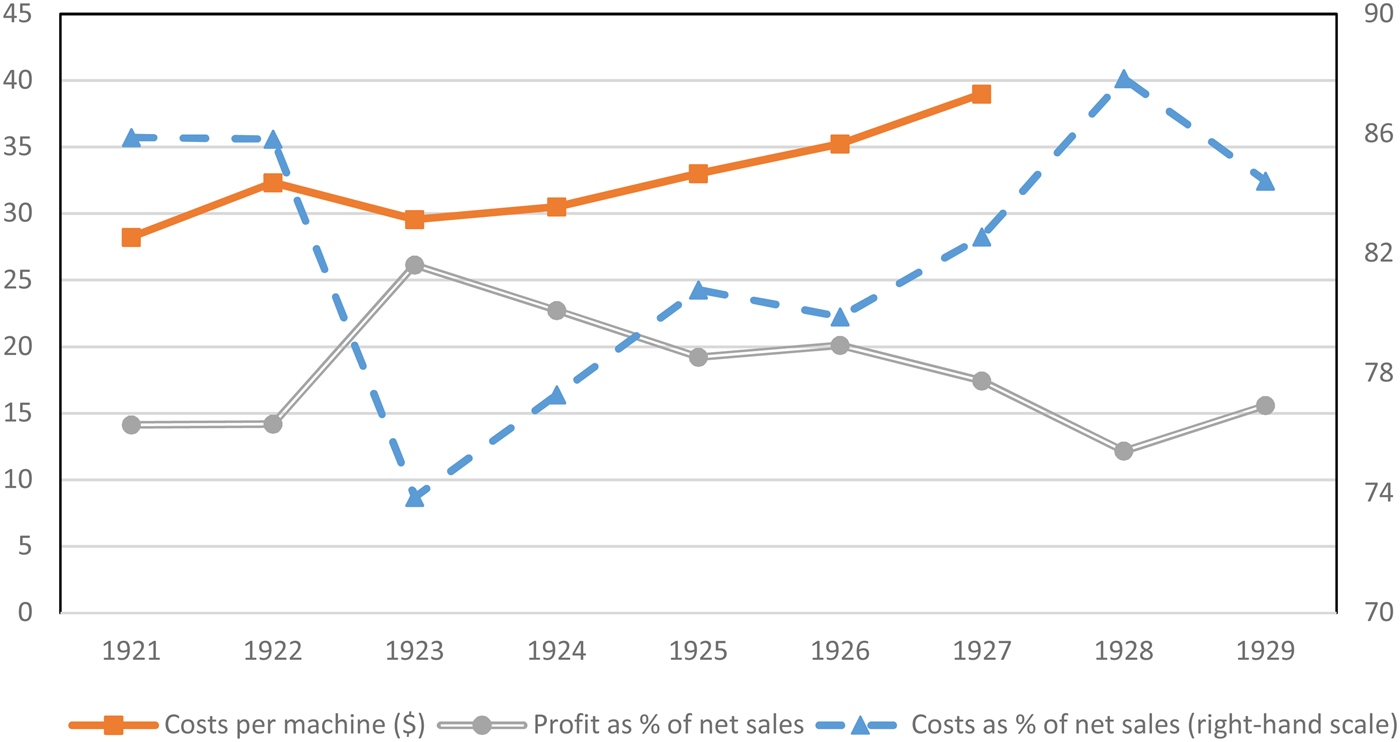
The dominant vacuum firm business model, based on an implicit assumption that sales maximization was synonymous with success, led to the use of increasingly high-cost marketing methods that inflated list prices and produced decreasing returns on investment in sales support and manpower by the late 1920s. For example, Hoover's national advertising spend per vacuum sold rose from an average of $1.00 in the period from 1919 to 1923 to $1.69 over 1924 to 1927 and $2.15 over 1928 to 1930.Footnote 67 More comprehensive data for Eureka are shown in Figure 3. From 1921 to 1923, a rise in annual net sales from $3,107,000 to $8,215,000 was matched by a fall in the ratio of costs to sales and a major increase in profits. However, despite further substantial growth in net sales—to $12,780,000 by 1927—the ratio of costs to sales rose from 73.86 to 82.56 percent, while profit rates declined markedly and costs per unit rose from $29.58 to $39.00. This culminated in a fall in net sales to $10,100,000 in 1928 and, despite some recovery in 1929, Eureka's profit ratio remained lower than in any year since 1923 while its cost ratio was higher than in any year from 1923 to 1927.
Costs and profits as a proportion of net sales, and costs per machine, for Eureka, 1921–29. Figures for 1929 include Eureka's new London sales subsidiary. Costs include depreciation. Profits are shown before deductions of fixed charges and federal taxes. (Sources: For 1921–22 data, “Report of interview with Mr C.W. Phister,” Eureka Vacuum Cleaner Co., 26 May 1927, in 2069/9/16, Victor Talking Machine Co., Consignment selling folder, Victor Talking Machine Co. field survey, 1926–27, Hagley Museum and Library, Wilmington, DE.; for 1923–29 data, Moody's Investors Service, Moody's Manual of Investments, American and Foreign; Industrial Securities [New York, 1929], 54, and [New York, 1930], 604.)

While more disaggregated data are not available, it seems extremely likely that total costs were being driven up by sales-related activities rather than by production costs. Eureka had a trend of rising dollar and unit sales (during a period of only moderate inflation), while the sector demonstrated a long-term decline in production costs, relative to total costs. Production costs were estimated at 51.7 percent of all costs for the three largest vacuum manufacturers in 1921 but had declined to only 27.6 percent of Hoover's total costs in 1938 (excluding dealer discounts).Footnote 68
Yet there is no evidence of internal criticism regarding rising sales support and manpower costs. Hoover and Eureka had built up hierarchies of sales executives, promoted mainly from the ranks. Young companies tend to recruit people who fit well with the corporate culture shaped by the skills, aptitudes, and values of their founders; for example, Henry Ford, a “gifted tinkerer . . . surrounded himself with other tinkerers, twenty years younger than he was, but like Ford without formal education.”Footnote 69 Policies of internal promotion accentuated this bias by restricting the pool of candidates to those who had already been prescreened to match the firm's dominant discipline and values.Footnote 70 Moreover, it deprived them of the benefits of external hiring, which has been identified as a significant mechanism for disrupting established routines and facilitating change. The benefits are found to increase with the age of the corporation, as external hires stimulate explorative activities, diminish “groupthink” and resistance to change, and introduce “distant knowledge” derived from working in other organizations.Footnote 71
Executive conformity was accentuated by their training, their indoctrination into the Hoover culture, and—as junior managers—their task of convincing salesmen that the firm's products, system, and extensive investments in sales support activities constituted the optimum business model. In a sector where belief in the product and the sales formula took on almost religious connotations, skepticism of the orthodox approach could easily be interpreted as heresy. The scope for criticism had been further reduced by the introduction of increasingly standardized and bureaucratized sales force training procedures, which prized strict conformity to their systems. This parallels Raucher's finding that economic maturity brought with it organizational rigidity for the variety store chains, with executives ingrained in their firm's system struggling to react to the new conditions of the late 1920s and the Depression era.Footnote 72 Hoover's self-image as a sales-orientated organization also inhibited challenges to the firm's dominant sales logic from staff in other managerial disciplines, such as accounting. Scholars have identified a tendency for companies to disproportionately attract, reward, and listen to people whose skills reflect the firms’ “dominant discipline,” or function, while those from functions seen as subordinate typically have weaker influence.Footnote 73
Clayton Christensen, Thomas Bartman, and Derek van Bever identify a tendency toward business-model rigidity, owing to growing interdependencies between the model's individual elements, which leads to innovation focused on “sustaining innovations”—value-adding improvements to existing products for current target markets. This pattern was evident in Hoover, which focused throughout the interwar years on improvements to its upright cleaner format. They also predict that when such investments no longer generate adequate additional profitability, cost-reducing innovations aimed at improving the efficiency of the business model will increasingly dominate, as “the voice of the shareholders drowns out the voice of the customer.”Footnote 74 However, at Hoover these pressures were severely muted, because it was a private, family-owned firm until 1943 and was headed by members of the Hoover family until 1966 (apart from John Frank Hattersley's brief term as president from 1951 until January 1954, when he was ousted following an acrimonious family battle).Footnote 75
In the 1920s vacuum manufacturers had faced an expanding market owing to rapid growth in the number of wired homes together with rising prosperity, the escalating cost of domestic servants, and growing popular familiarity with powered domestic appliances. However, the Depression witnessed a dramatic fall in sales. From 1929 to 1933, annual unit sales of floor-type vacuum cleaners declined from 1,253,000 to 548,000, in contrast to refrigerators and washing machines, which recovered beyond their 1929 unit sales.Footnote 76 Conversely, vacuum manufacturers generally managed to maintain list prices, despite sharp price falls for most other durables, and witnessed relatively few corporate liquidations. However, the two leading firms of the 1920s, Hoover and Eureka, both witnessed severe falls in market share.
Eureka was by far the worst affected. In 1930 it employed an army of over four thousand door-to-door salesmen, supported by 35 major branch offices in large U.S. cities and 100 to 150 sub-branches (sales offices) that ran the customer credit, stocked inventories, and supervised retailers working with Eureka under the resale plan.Footnote 77 Around 50 percent of sales were made directly, around 25 percent under the resale plan, and the remainder from dealers who purchased cleaners outright from the factory. The heavy costs of Eureka's branch network, inventories, and installment accounts impacted the prices of all their machines—even those sold through conventional retail channels—as it was impractical to charge one price to final customers purchasing from a door-to-door salesman and a lower price for the same models sold through stores.Footnote 78 During the Depression, high costs translated into huge losses. Eureka's sales had peaked in 1927 at $12,780,000, generating a profit of $1,806,000; however, sales fell sharply after 1929—to $4,297,000 in 1931, with an annual loss of $1,163,000.Footnote 79
Faced with potential bankruptcy, Eureka responded by terminating its main direct sales operation, closing its sub-branches, slashing its branch office staff, and focusing on sales via the resale system and through “distributor-dealers” who paid their own salesmen's commission and acted as wholesalers for local retailers. This gave the company a tiny profit of $18,420 for the first six months of 1932, but on a drastically reduced turnover of only $1,360,360 for the whole of 1932.Footnote 80 Yet, direct selling per se was not the real problem; a trade article noted that total 1933 vacuum sales were almost completely down to four companies—Hoover, Electrolux, Air-Way, and Premier—that relied on direct selling as their sole or (for Premier) main sales channel. Indeed, Air-Way's strong door-to-door selling performance, despite raising its prices, was said to have exerted a strong demonstration effect on other manufacturers.Footnote 81 Despite some improvement during the mid-1930s, Eureka's sales volume and profitability never recovered; over the four years preceding World War II it had cumulative losses of $1,200,000, while its 1941 vacuum sales represented only 7 percent of the industry total.Footnote 82
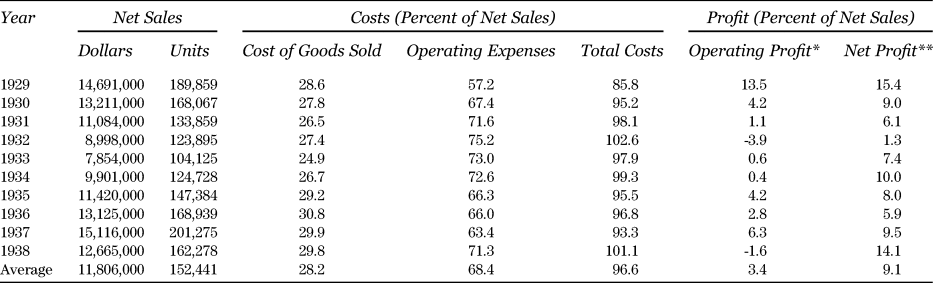
Hoover avoided an existential crisis, but nevertheless faced a decline in market share to only 14.04 percent of unit sales by 1939 and a crisis of profitability, as shown in Table 1.Footnote 83 Operating profit had fallen continuously during the Depression, from 13.5 percent of net sales to a an operating loss of 3.9 percent in 1932, and though it recovered over 1935–1937, it remained below half of the 1929 ratio. Net profit was markedly higher, presumably reflecting Hoover's extensive overseas operations, where it generally faced fewer competitors. Dollar and unit sales also remained below 1929 levels, with the exception of 1937. Cost of goods sold as a proportion of net sales was relatively stable, moving pro-cyclically. Conversely, operating expenses (mainly sales and administrative expenses) rose sharply during the Depression, and, while they fell during the recovery, they remained substantially higher than for 1929.
Hoover's Sales, Costs, and Profits, 1929–1939

Sources: For unit sales, Lee P. Heinrich, Hoover chronology, n.d. [ca. 1940s], Hoover Historical Center, Walsh University, North Canton, OH (hereafter HHC); for other data, Ford, Bacon & Davis, “Report: Business and Sales Operations, The Hoover Company, North Canton, Ohio,” 14 Feb. 1940, vol. 2, exhibit 1, filing cabinet 78.033#52, HHC.
Notes: * Net sales minus total costs, plus other net income affecting operations. ** Operating income plus other net income, before taxes.
Hoover's problems reflected the rigidities of its “core competencies/capabilities”—interrelated, interdependent knowledge systems encompassing technical systems, managerial systems, skills/knowledge base, and values and norms that differentiate a company strategically. These tend to reflect the “imprint” of the company's founders, early leaders, and initial successes, creating a “dominant logic” for the firm based on a shared history.Footnote 84 The dynamic capabilities literature suggests that institutionalized capabilities may lead to “incumbent inertia” in the face of environmental changes. Under such circumstances even minor innovations can undermine the value of the firm's deeply embedded knowledge.Footnote 85 This is particularly true for “architectural innovations,” which involve changes in how a product is configured, as opposed to innovations in individual components. Architectural innovations present incumbents with a subtle, but strong, challenge, because a firm's information channels, information filters, and accumulated “architectural knowledge” are all based around their existing configuration.Footnote 86
Hoover and Eureka faced such a challenge in the form of Electrolux, which introduced the high-powered “tank-type” cleaner to the U.S. market. This format dates back to the initial experimental phase of vacuum cleaner development in the 1900s, though by the end of World War I the upright vacuum cleaner had emerged as the “dominant design” in the United States. Electrolux, formed in 1919 by the merger of two Swedish firms, Svenska Elektron AB and Lux AB (which had commenced manufacturing tank-type cleaners before World War I), continued to develop the tank-type format, which proved popular in Europe (possibly reflecting the smaller houses of many European countries). Their Model V cleaner was exported to the United States from 1924, but both this and its successor, Model 11 (introduced in 1927), were regarded as substantially underpowered in America, where they were mainly used as “dusters” for furniture and upholstery, or—as in New York, where sales were concentrated—for small apartments.Footnote 87
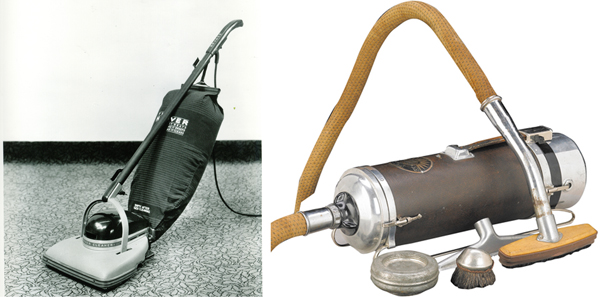
The Electrolux Model 12, launched in 1933, constituted the first high-powered tank-type cleaner on the U.S. market, combining both strong ease of use and dirt removal (see Figure 4). This rapidly catapulted Electrolux—which had opened a factory in Old Greenwich, Connecticut, to manufacture it—into the top position among U.S. vacuum brands.Footnote 88 The Model 12 can be regarded as a “competence-destroying” technological discontinuity, in that it essentially represented a new product class, with the key characteristic of ease of use (especially for nonfloor uses such as stairs, furniture, and curtains).Footnote 89 While it never achieved the status of a “dominant design” (displacing the upright cleaner), the Model 12 enjoyed huge popularity. In 1934 (its first full sales year), Electrolux overtook Hoover for the first time, selling 136,687 vacuums for $10,542,070, while Hoover sold 124,728 vacuums for $9,901,000.Footnote 90 In 1937, the Model 12 was replaced by the even more successful Model 30—a design icon that sold millions of units before being discontinued in 1954.
The Hoover Model 150 Ensemble and the Electrolux Model 12. (Sources: Hoover model 150 ensemble photo courtesy of Hoover Historical Center, Walsh University, North Canton, OH; Electrolux Model 12 photo reproduced by kind permission of Tom Gasko.)

Other durables sectors also witnessed new competitors during the Depression using architectural innovations and leaner supply chains as the basis of their competitive advantage. Three of the four largest radio manufacturers of the 1920s failed to survive the Depression as significant players in the market, partly because of the development of the smaller, cheaper “midget” radio format aggressively marketed by new entrants such as Emerson and Philco.Footnote 91 The refrigerator and washing machine sectors also witnessed aggressive market entry, both by new manufacturers, such as Crosley, and—more importantly—by retailer brands such as Sears, Roebuck and Company and Montgomery Ward, who cut prices chiefly through integrating production and distribution.Footnote 92 Successful entrants varied in their business models, but a common factor was the squeezing of sales/distribution costs.
Research commissioned by Ford, Bacon & Davis found that while Hoover owners were more enthusiastic about their vacuum's cleaning performance, Electrolux owners were more enthusiastic regarding ease of use—Electrolux's “tank-type” design was easier to carry, easier to use with attachments, easier for cleaning furniture without moving it, easier in its disposal of dirt, less noisy, and “not so hard on rugs.” Ford, Bacon & Davis concluded that “housewives are buying Electrolux because they prefer its ease of use features which are apparent to them compared to the cleaning efficiencies of the Hoover which are not so apparent.”Footnote 93
Hoover struggled to counter Electrolux's strong ease-of-use advantages, largely because those advantages were inherent to the tank-type format, which sucked in dirt through a long, lightweight hose. For Hoover, switching to this format would involve abandoning much of its cumulative investments in vacuum features. For example, its famous “positive agitation” system and its more recently introduced “headlight” to illuminate dirt could not be transferred to a dust collector that was separated from the main body of the cleaner via a long hose. Yet Hoover's competitive problem was compounded by the fact that its sales demonstration continued to emphasize efficiency in removing dirt, apparently unaware of the need to modify its sales pitch to counter Electrolux's strong ease-of-use appeal. This was particularly important in what had become a mature product market, with most major brands being relatively successful in removing dirt compared with earlier cleaners.
In August 1936, Hoover introduced the Model 150 Ensemble, which sold for $79.50 plus $16.50 for its cleaning tools (see Figure 4). This model boasted a variety of new features together with a classic modernist design. Hoover advertised it as “The First Basically New Cleaner in 10 Years,” emphasizing its range of new mechanical innovations and features and, especially, its ease of use:
One little lift or push says “How light. How easy it rolls.” Hoover engineers have brought into the home for the first time a new metal amazing for its lightness – magnesium – until now used only in airplanes. One-third lighter than aluminium yet as strong. Only the new Hoover Cleaner offers the back-saving lightness of this new wonder-metal.Footnote 94
The heaviness of Hoover cleaners (compared with both tank-type and other upright brands) had always been Hoover's Achilles heel, leaving it open to periodic inroads in market share from firms with lighter models, such as Air-Way and Eureka in the early 1920s.Footnote 95 The Model 150 Ensemble weighed 16.25 pounds (compared to 18 pounds for its predecessor) and had various new ease-of-use features, including a simpler converter for attachments, a “time-to empty” signal, and an easy-to-empty filter bag.Footnote 96 However, its accompanying new sales booklet, Steps to the Hoover Sale, followed its predecessors in focusing on the Hoover's traditional strength of efficiency in drawing out dirt, demonstrated through various “tests” on the prospect's carpet. Ease of use was not mentioned until page 12, in the context of “improved features.”Footnote 97 Moreover, the booklet made no mention of the need to modify the traditional Hoover demonstration to counter the competitive threat from Electrolux.
The Audit of Hoover
In 1939 Hoover commissioned Ford, Bacon & Davis to review its operations and business methods, with a view to making recommendations on how to increase their effectiveness and profitability. The consultants’ report emphasized Hoover's very low operating profit and return on investment relative to other leading consumer-durables firms.Footnote 98 This was supported by available data on large durables manufacturers. Hoover's profits between 1936 and 1938 were found to average only 4.2 percent of gross investment applicable to operations, compared with 48 percent for Electrolux and 18 percent for America's leading washer manufacturer, Maytag.Footnote 99
Moreover, this problem could not be solved simply through higher sales. Using figures supplied by Hoover (including an element of forecast for higher sales levels), the report estimated that operating profit would rise from 3.1 percent of sales at 150,000 cleaners per year to a peak of around 7.4 to 7.5 percent at 210,000 to 240,000 per year and then decline, to 6.9 percent at an output of 300,000. This reflected the large proportion of selling expenses that either varied directly with volume or—as with bonuses to executives and senior managers—increased more than proportionately with volume.Footnote 100 Even these figures were said to be optimistic, as they assumed considerably higher relative sales for Hoover's more profitable “Norca” cleaners than had yet been achieved. Norcas had been introduced in 1937 for “over the counter” sales by department and similar stores and had a much higher profit margin than Hoover-branded cleaners, owing to lower distribution costs.Footnote 101 If the projected Norca figures were excluded, net profit was substantially lower, peaking at 4.9 percent of net sales.
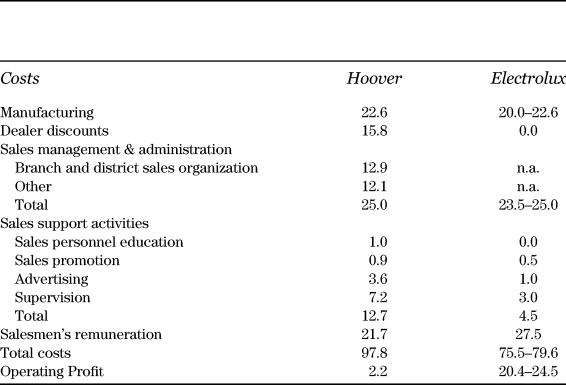
Table 2 sets out the value chain for Hoover in 1938, together with estimates for Electrolux, provided by Ford, Bacon & Davis. Hoover's net operating profit averaged only 2.2 percent, compared with 20.4 to 24.5 percent for Electrolux. The source of the Electrolux data was not identified, but its high profitability is supported by data from the Electrolux archives showing a 1934 net profit ratio of 18.0 percent.Footnote 102 The value chain highlights two principal differences in cost structures, which account for most of Electrolux's higher profits. First, Electrolux provided higher commission to its salesmen but spent considerably less on supporting their activities through advertising, promotion, training, and supervision—the areas in which Hoover had made progressively larger investments to boost its market share. Second, while 15.8 percent of Hoover's list price went to the participating retailer, under its resale system, Electrolux's direct sales supply chain had no dealer role and thus no costs under this heading.
The Value Chains for Hoover and Electrolux in 1938 (percentage of net sales)

Source: Ford, Bacon & Davis, “Report: Business and Sales Operations, The Hoover Company, North Canton, Ohio,” 14 Feb. 1940, vol. 1,71, filing cabinet 78.033#52, Hoover Historical Center, Walsh University, North Canton, OH.
Notes: Electrolux's figures are estimates made by the consultants Ford, Bacon & Davis.
The 15.8 percent dealer discount was found, in a large proportion of cases, to be excessive relative to services rendered under the resale system (letting Hoover use the retailer's name when calling on prospects; allowing salesmen to solicit demonstrations in-store; stocking inventory; dealing with instalment credits; and bearing part of the cost of any machines that reverted back to them). It was noted that Electrolux had built up its market share without using dealers, and market research indicated that many customers saw no advantage in the link with the dealer. The consultants thus recommended that Hoover should consider either discontinuing dealer participation or cutting its discount to dealers who did not render substantial sales promotion services from 15 percent (excluding bonuses) to a maximum of 12.5 percent.Footnote 103
Ford, Bacon & Davis noted that Hoover's brand managers believed they could secure the same sales volume without dealer participation.Footnote 104 The same point had been made in May 1937 by C. B. Colston, managing director of Hoover's U.K. subsidiary, which produced and marketed Hoovers for sale in Europe and the British Empire (excluding Canada). Colston (arguably the most senior Hoover executive who was not a family member) believed that British Hoover's selling costs could be very substantially reduced by employing better salesmen, which would require a substantially higher commission rate. He suggested that British Hoover might follow the plan of its Belgian sales subsidiary, where sales made directly by Hoover salesmen required no commission to dealers. E. L. Colston (British Hoover's sales director) then explained “at very great length” that in Europe the dealer was often more of a handicap than an asset and was not essential to instalment credit because, after the first four months of the agreement, the finance company took responsibility for the loan.Footnote 105 However, this argument appears to have fallen on deaf ears (though it may account for a marginal reduction in dealer commission, from 14 to 13 percent, at some point in the late 1930s).
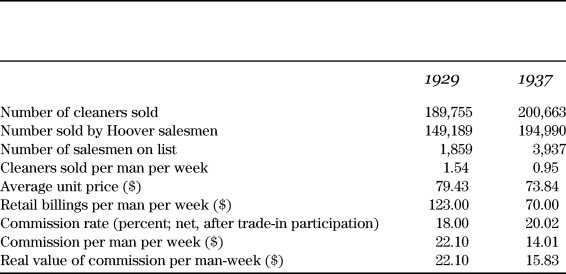
The consultants also questioned Hoover's longstanding assumption that increased sales depended primarily on increased manpower, showing that Hoover's annual sales correlated much better with the index of industrial production than with its number of salesmen.Footnote 106 This raised a question: “Why is it necessary to have 3,937 salesmen in 1937 to sell the same volume as was sold by 1,859 salesmen in 1929.”Footnote 107 They argued that this mainly reflected the lower productivity of each salesman, obliging the company to increase the sales force to maintain volume. As Table 3 shows, average weekly unit sales per salesman had fallen by 38 percent and the real value of commission had declined to only 72 percent of its 1929 value.
Comparison of Hoover's Salesmen's Productivity, 1929 and 1937

Source: Ford, Bacon & Davis, “Report: Business and Sales Operations, The Hoover Company, North Canton, Ohio,” 14 Feb. 1940, vol. 1, 87, 162, filing cabinet 78.033#52, Hoover Historical Center, Walsh University, North Canton, OH.
The declining productivity of salesmen was attributed in part to Hoover's heavy cost structure, relative to Electrolux, which enabled Electrolux to offer higher commission to salesmen and thus gain a labor market advantage. Two other major vacuum firms that used direct sales, Air-way and Rex Air, also had markedly higher commission rates than Hoover.Footnote 108 Ford, Bacon & Davis also noted Electrolux's strong ease-of-use advantages, which, as noted above, were more obvious to the housewife than Hoover's superior cleaning efficiency. The consultants recommended that Hoover should explore how to improve its ease-of-use advantages and adapt the sales process to further emphasize ease of use. They also had more general criticisms of Hoover's sales formula and training, arguing that the firm's sales manuals, other sales aids, and training program had, in their opinion, “insufficient inspiration. . . . The material appears to be of routine character to an extent likely to become boresome.”Footnote 109
Perhaps their most fundamental criticism was that Hoover's senior managers focused on sales maximization to such an extent that they neglected profitability: “The management is quite definitely volume-minded and is not sufficiently profit-minded. Whether the volume will produce adequate returns . . . has not been predetermined and no means such as thorough budgetary procedure . . . have been set up for predetermining profit objective for the business.”Footnote 110 Hoover was found to have insufficient budgetary control as well as “a most conspicuous lack of profitmindedness on the part of the organization as a whole. In a two-day session of senior sales managers . . . only once was profitability of operations even mentioned and then there was no elaboration or discussion of it.”Footnote 111
Ford, Bacon & Davis emphasized that direct selling per se was not the problem, despite its high costs, reflected in high prices ($69.00 to $71.00 for the median models of vacuum firms that relied mainly on direct selling, compared with $43.00 to $49.50 for those using conventional retail channels).Footnote 112 They noted that vacuum companies that had switched to dealer distribution had failed to match either the sales of Hoover and Electrolux or the profit rate of Electrolux—a finding corroborated by the collapse in Eureka's sales volume following its termination of direct selling, discussed above. Interviews with retailers found no evidence of a trend toward growing over-the-counter distribution for vacuums; most admitted that in this sector demonstration was key, by showing the inefficiency of the housewife's existing cleaner (which was less evident than for an old refrigerator, washing machine, or radio), a result echoed by a 1940 U.S. government investigation.Footnote 113 While models lacking distinctive features had to be sold over the counter and compete on price, those with such features could most profitably be sold direct. Moreover, Hoover's Norca cleaners, together with sales to dealers of factory-rebuilt traded-in Hoovers (“Specials”) allowed them to tap the over-the-counter market without compromising their main brand.Footnote 114
Like Eureka before them, Hoover's managers reacted to their crisis in a manner that proved deeply counterproductive. Rather than implementing the consultants’ key recommendation—that commission income should be redistributed from over-rewarded retailers to under-rewarded salesmen—Hoover's sales department tabled alternative proposals that, perversely, maintained retailer commission rates and placed the main burden of cuts on the direct sales organization. They offered savings of $439,000 per year (trumping the $359,000 estimated savings from Ford, Bacon & Davis's recommendations) through cuts to the sales department's and service department's staff compensation plans; expense savings in these two departments; and a reduction in dealer trade-in participation. Detailed information on the revised compensation plans has not survived, though; given that they involved a substantial reduction in sales staff compensation (for equivalent sales), they must have involved a reduction in salesmen's commission rates.Footnote 115
The revised compensation plans were introduced on May 27, 1940. Despite the week ending April 27 having seen the highest sales in Hoover's prior history, the new system was followed by a sales slump, which was at least partly attributed to this new plan.Footnote 116 Further modifications to sales policies were cut short in 1941, when Hoover was called on to make an early start in munitions production, even before the United States had formally entered the war. Its main contract involved manufacturing (eventually) 25 million highly secretive variable time proximity fuses—a task that testified to the company's considerable engineering skills (having been likened in difficulty to compressing the components of an aircraft engine into the shape of an ice cream cone).Footnote 117
However, the problems identified by the consultants continued to plague Hoover after World War II; in 1954, profits amounted to only 3 percent of sales, while Hoover's market share had fallen to 9 percent.Footnote 118 Its engineers again came to the rescue—ironically, through finally developing a tank-type cleaner, the Hoover Constellation. Claimed to be the quietest vacuum on the market, the Constellation boasted a highly innovative mobility feature, the “Air-ride,” which floated the cleaner like a hovercraft, using its own exhaust as the air source, while a striking space-age circular design accentuated its novelty. The Constellation improved Hoover's market share—though Hoover continued to be plagued by low profitability.Footnote 119
Conclusion
Hoover's declining profitability and the collapse of Eureka's direct sales system illustrate how previously successful corporate practices, performance benchmarks, and value chain relationships can develop rigidities over time, reducing responsiveness to changes in market or competitive conditions. Moreover, the two firms’ reactions to their respective crises suggest that these same rigidities inhibited them from acknowledging and addressing the fundamental problems underlying their falling profitability. Such behavior is by no means exceptional; the “threat rigidity” literature identifies numerous examples of companies reacting to crises via policies that act to compound their difficulties (and predictably so)—typically explained in terms of a tendency for organizations to behave conservatively rather than innovatively in threatening situations—especially under conditions of prior organizational rigidities.Footnote 120 Such conservative responses were also typical of incumbents in other durables sectors during the Depression, particularly the dominant radio firms of the 1920s, which failed to effectively react to new entrants that capitalized on leaner supply chains and cost-reducing architectural innovations.
As Michael Tushman and Philip Anderson have noted, “liabilities of age and tradition” can constrain incumbents facing competence-destroying discontinuities.Footnote 121 Hoover in particular appears to have fallen into a “competency trap”: its core competencies—extensive sales support investment (including dealer participation) and formidable R&D activities focused primarily on more efficient dirt removal, in conjunction with assumptions that profits were driven by sales and, in turn, by manpower—had become core rigidities.Footnote 122 As David Teece, Gary Pisano, and Amy Shuen note, “In dynamic environments, narcissistic organizations are likely to be impaired.”Footnote 123 Values that had initially served partly to “sell” Hoover's product, “system,” and “mission” to its sales force had become “core” to all levels of the company, even making a cut in sales force compensation that ran directly counter to the recommendations of their consultants more acceptable than the alternative—departing from the system that had represented the “gospel” of vacuum salesmanship for most Hoover executives throughout their working lives.