Introduction
The term ‘dementia’ groups together various manifestations of cognitive decline attributed to a variety of neurodegenerative pathologies. Cognitive impairment, neuropsychiatric symptoms and personality changes appearing in one dementia sub-type may have unique implications for strains on the care-giver. That is, the diversity of care-giving demands and experiences may be related to unique dementia presentation (Hooker et al. Reference Hooker, Monahan, Bowman, Frazier and Shifren1998, Reference Hooker, Manoogian-O'Dell, Monahan, Frazier and Shifren2000; Thommessen et al. Reference Thommessen, Aarsland, Braekhus, Oksengaard, Engedal and Laake2002). While the impacts of cognitive, behavioural and neuropsychiatric domains of dementia on care-givers are well established, the literature varies by definition, dementia stage, sample and psychometric instrument used. These conceptual and methodological inconsistencies make it difficult to draw conclusions about the impact of unique dementias on informal care-givers (Pinquart and Sörensen Reference Pinquart and Sörensen2003). Furthermore, unique care-giver populations are rarely examined across neurodegenerative diseases (Clipp and George Reference Clipp and George1993).
This paper aims to extend our understanding of dementia care-giving by introducing a typology that considers care-giving across neurodegenerative diseases. The organisational framework examines four disease groups: mild cognitive impairment (MCI), Alzheimer's disease (AD), dementia with Lewy bodies (DLB) and Parkinson's disease-associated dementia (PDD); their specific presentations of dementia-related symptoms (i.e. cognitive, motor, neuropsychiatric); and the relationship of these symptoms with care-giver strains. According to the Stress Process Model (Pearlin et al. Reference Pearlin, Mullan, Semple and Skaff1990), primary stressors are specific dementia-related symptoms, including aetiology, cognitive impairment, functional ability and behaviour. Primary stressors can have both a direct and indirect effect (through burden and health) on subsequent secondary strains and outcomes of care-giver wellbeing. Secondary strains are a direct result of caring for a person with dementia, and show up as strained life roles and internal self-perceptions, such as loss of self, stigma and lifestyle constraints. Outcomes are the net result of stressors and strains, and indicate overall emotional, psychological and physical wellbeing (Pearlin et al. Reference Pearlin, Mullan, Semple and Skaff1990). This paper highlights the relationship between specific dementia-related primary stressors (e.g. cognitive impairment) and secondary care-giver strains (e.g. strained life roles). The direct effect of primary stressors (i.e. motor decline) on care-giver wellbeing outcomes (e.g. burden, depression, etc.) is also examined.
Dementia-related diseases
Dementia spans different disease groups and is associated with a large amount of heterogeneity. MCI is defined as cognitive decline beyond normal healthy ageing (Seeher et al. Reference Seeher, Low, Reppermund and Brodaty2013). This is important as UK memory clinic studies suggest adults with MCI develop dementia at a rate of 10–15 per cent per year, compared to 1–2 per cent for healthy controls (Petersen et al. Reference Petersen, Doody, Kurz, Mohs, Morris, Rabins, Ritchie, Rossor, Thal and Winblad2001). Memory deficits are the most prominent feature of MCI, particularly visual and verbal memory, in addition to planning and emotional problems (Dean and Wilcock Reference Dean and Wilcock2012; Lu et al. Reference Lu, Austrom, Perkins, Bakas, Farlow, He and Gamst2007; Roberto et al. Reference Roberto, Blieszner, McCann and McPherson2011). Over 800,000 people in the UK and nearly 36 million worldwide are diagnosed with dementia; 62 per cent of persons diagnosed with dementia in the UK have AD, the most common cause of dementia. AD is characterised by progressive deterioration of cognitive abilities and memory, leading to executive dysfunction, changes to behaviour, communication difficulties and eventual activities of daily living (ADL) impairment (Erder et al. Reference Erder, Wilcox, Chen, O'Quinn, Setyawan and Saxton2012).
Lewy body dementia is the second most common cause of neurodegenerative dementia and accounts for 100,000 dementia cases in the UK. The Lewy body dementia spectrum includes DLB and PDD. DLB is clinically typified by the presence of two of the following: Parkinsonian symptoms (two of: rest tremor, bradykinesia, rigidity and postural instability), cognitive fluctuations and hallucinations (Auning et al. Reference Auning, Rongve, Fladby, Booij, Hortobágyi, Siepel, Ballard and Aarsland2011; Galvin et al. Reference Galvin, Duda, Kaufer, Lippa, Taylor and Zarit2010a; Leggett et al. Reference Leggett, Zarit, Taylor and Galvin2011; Pucci Reference Pucci2006). Although Parkinson's disease is primarily considered a movement disorder, associated subcortical dementia may manifest (Ferreri, Agbokou and Gauthier Reference Ferreri, Agbokou and Gauthier2006; Hanagasi and Emre Reference Hanagasi and Emre2005; Shin et al. Reference Shin, Youn, Kim, Lee and Cho2012; Stella et al. Reference Stella, Banzato, Quagliato, Viana and Christofoletti2009). Parkinson's disease is estimated to affect one in every 500 persons in the UK, and over the course of the illness 50–80 per cent of those with Parkinson's disease may experience dementia. PDD presents with more frequent and severe neuropsychiatric symptoms, attention and executive dysfunctions (Aarsland et al. Reference Aarsland, Brønnick, Ehrt, De Deyn, Tekin, Emre and Cummings2007; Ferreri, Agbokou and Gauthier. Reference Ferreri, Agbokou and Gauthier2006; Hanagasi and Emre Reference Hanagasi and Emre2005; Naismith et al. Reference Naismith, Pereira, Shine and Lewis2011; Shin et al. Reference Shin, Youn, Kim, Lee and Cho2012; Stella et al. Reference Stella, Banzato, Quagliato, Viana and Christofoletti2009; Watson and Leverenz Reference Watson and Leverenz2010).
Methods
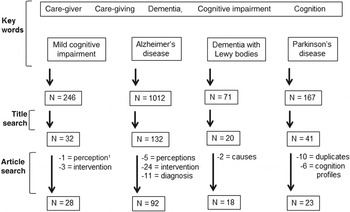
A literature search (EBSCO Publishing, Elsevier, National Institutes of Health, US National Library of Medicine) was conducted between November 2012 and January 2013 to identify research on care-giving in the four dementia sub-types. The key terms were: care-giver, care-giving, dementia, cognitive impairment and cognition. The search resulted in 1,496 articles, 161 of which contained information relevant to a relationship between symptoms, strains and outcomes (Figure 1). Specifically, dementia-related symptom prevalence in each disease was extracted, as well as any relationship (qualitative and quantitative) presented between dementia symptoms and secondary care-giver strains, and between primary stressor (symptom) and care-giver outcome. The literature search was restricted to informal (spouse, adult child, family) care-givers.
Literature search strategy.

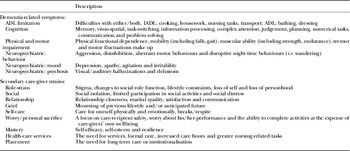
The dementia-related symptoms include: ADL limitation, cognition, physical/motor impairment and neuropsychiatric symptoms (behaviour, mood and psychosis). The secondary care-giver strains resulting from symptoms refer to: role-strains, social, relationship, grief, self-care, worry/personal sacrifice, mastery, health-care services and placement (Table 1). These dementia symptoms and care-giver strains result in a variety of measurable outcomes of wellbeing for the care-giver: burden, depression, distress, anxiety, quality of life, positive affect and health.
Description of dementia-related symptoms and secondary care-giver strains

Notes: ADL: activities of daily living. IADL: instrumental activities of daily living.
Quantitative evidence of the relationship between symptom–strain and symptom–outcome was extracted from relevant articles, including: standardised regression coefficients (β), coefficients of determination (R 2), correlation coefficients (r) and risk ratios (odds ratio (OR), hazard ratio and relative risk). Data were averaged (mean±standard deviation) for each quantitative relationship when they were repeated in more than one study for the relationship between the same variables [i.e. behaviour-relationship β=0.83±0.99 averaged from: β=0.33 (Goldsworthy and Knowles Reference Goldsworthy and Knowles2008), β=0.18 (Norton et al. Reference Norton, Piercy, Rabins, Green, Breitner, Østbye, Corcoran, Welsh-Bohmer, Lyketsos and Tschanz2009) and β=0.98 (Seeher et al. Reference Seeher, Low, Reppermund and Brodaty2013)]. When only one study presented a relationship between symptom–strain or symptom–outcome, the data were presented as is. The average quantitative relationship for each symptom–strain and symptom–outcome was ranked (β, R 2, r, risk ratios). For example, the relationship between ADL and health-care services/care hours (β=0.53, r=0.47, Mrate of change=0.46) was stronger than the relationship between ADL and mastery (r=0.17, no β or Mrate of change reported).
Qualitative reports were also extracted and compared with the quantitative results. Thematic analysis was conducted; the presented data were searched, and recurrent patterns were identified and contextualised into themes. The relationships were graphed. The symptoms were then combined into clusters. For example, care-giver relationships refer to spousal interactions or child–parent interactions. As such, they were classified with role-strains. Then the data were examined to see whether particular symptoms were more strongly associated with particular strains. When a relationship was evident, those strains and symptoms were grouped as a classification within the typology. To determine the classifications common to each disease, all studies examining the relationship between a particular symptom and strain captured within the classification, whether significant or not, were tallied as a percentage of all studies included in the typology.
Results
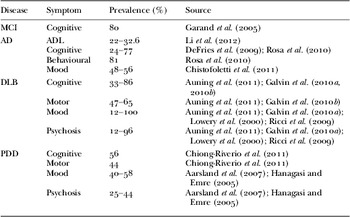
The literature included various methodological designs: cross-sectional quantitative (N=96), qualitative (N=30), literature review (N=12), randomised controlled trial (N=11), longitudinal quantitative (N=7), case report (N=4) and mixed-methods (N=1). The dementia-related symptoms and their prevalence vary from study to study and with each disease (Table 2). We now turn to a discussion of the relationships between dementia symptom and care-giver strain and between dementia symptom and care-giver outcome, followed by the typology itself and a discussion of the typology across the four dementia diseases.
Reported prevalence of symptom for each disease

Notes: MCI: mild cognitive impairment. AD: Alzheimer's disease. DLB: dementia with Lewy bodies. PDD: Parkinson's disease-associated dementia. ADL: activities of daily living.
Dementia symptoms and care-giver strain
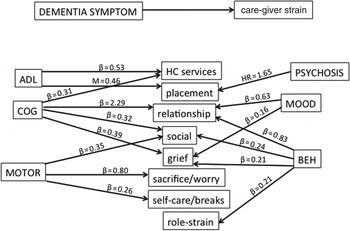
The impact of dementia symptom on care-giver strain also varies by symptom (Figure 2). For ADL limitations, the strongest relationship exists with the need for health-care services and greater care hours. Health-care services/care hours is the strongest explanatory variable (β=0.53) (Bergvall et al. Reference Bergvall, Brinck, Eek, Gustavsson, Wimo, Winblad and Jönsson2011) and strongest association (r=0.47) (Ryan et al. Reference Ryan, Weldon, Huby, Persad, Bhaumik, Heidebrink and Giordani2010) with ADL. In addition, ADL limitations can necessitate placement (M=0.46) (Nikzad-Terhune et al. Reference Nikzad-Terhune, Anderson, Newcomer and Gaugler2010), which is corroborated with qualitative reports (Kelsey, Laditka and Laditka Reference Kelsey, Laditka and Laditka2010). Other, weaker, associations appear with role-strain (β=0.17) (Dean and Wilcock Reference Dean and Wilcock2012; Leggett et al. Reference Leggett, Zarit, Taylor and Galvin2011) and mastery (r=0.17) (Pioli Reference Pioli2010).
Relationships between dementia-related symptoms and secondary care-giver strains.

Cognitive impairment has the greatest effect on relationship (β=2.29±3.0) (Norton et al. Reference Norton, Piercy, Rabins, Green, Breitner, Østbye, Corcoran, Welsh-Bohmer, Lyketsos and Tschanz2009; Seeher et al. Reference Seeher, Low, Reppermund and Brodaty2013), corroborated by qualitative reports (Austrom and Lu Reference Austrom and Lu2009). Cognitive impairments also significantly curtail care-giver social activities (β=0.32±0.19; R 2=0.51) (Aarsland et al. Reference Aarsland, Larsen, Karlsen, Lim and Tandberg1999; Goldsworthy and Knowles Reference Goldsworthy and Knowles2008; Morley et al. Reference Morley, Dummett, Peters, Kelly, Hewitson, Dawson and Jenkinson2012), corroborated with qualitative narratives (Austrom and Lu Reference Austrom and Lu2009; Lu and Haase Reference Lu and Haase2009). This necessitates an almost two-fold increase in formal health-care utilisation (OR=1.87) (Gaugler et al. Reference Gaugler, Wall, Kane, Menk, Sarsour, Johnston and Newcomer2011); cognitive impairment explains health-care service use (β=0.31±0.13) (Bergvall et al. Reference Bergvall, Brinck, Eek, Gustavsson, Wimo, Winblad and Jönsson2011; Goldsworthy and Knowles Reference Goldsworthy and Knowles2008), also corroborated by qualitative reports (Kelsey, Laditka and Laditka Reference Kelsey, Laditka and Laditka2010; Lu and Haase Reference Lu and Haase2009; McIlvane et al. Reference McIlvane, Popa, Robinson, Houseweart and Haley2008). Grief is evident in care-givers of cognitive impairments (β=0.39±0.02; R 2=0.31±0.11) (Carter et al. Reference Carter, Lyons, Lindauer and Malcom2012), who are almost three times more likely to suffer from sleep difficulties (OR=2.67) (McCurry et al. Reference McCurry, Gibbons, Logsdon, Vitiello and Teri2009).
Motor difficulties create the most personal sacrifice and worry in care-givers (β=0.80; R 2=0.17–0.49) (Aarsland et al. Reference Aarsland, Larsen, Karlsen, Lim and Tandberg1999; Carter et al. Reference Carter, Lyons, Lindauer and Malcom2012), corroborated with qualitative reports (Carter et al. Reference Carter, Lyons, Lindauer and Malcom2012). Motor difficulties explain limited social activities in care-givers (β=0.35) (Morley et al. Reference Morley, Dummett, Peters, Kelly, Hewitson, Dawson and Jenkinson2012). They also limit self-care and decrease the frequency of breaks (β=0.26±0.09) (Carter et al. Reference Carter, Lyons, Lindauer and Malcom2012; Goldsworthy and Knowles Reference Goldsworthy and Knowles2008; Morley et al. Reference Morley, Dummett, Peters, Kelly, Hewitson, Dawson and Jenkinson2012), corroborated with qualitative notations (Carter et al. Reference Carter, Lyons, Lindauer and Malcom2012). Other, weaker, associations include the greater use of health-care services (r=0.4) (Ryan et al. Reference Ryan, Weldon, Huby, Persad, Bhaumik, Heidebrink and Giordani2010) and increased self-efficacy in care-givers (r=0.16) (Romero-Moreno et al. Reference Romero-Moreno, Losada, Mausbach, Márquez-González, Patterson and López2011).
Neuropsychiatric profiles include three domains: behaviour, mood and psychosis. Behavioural symptoms have the greatest influence on the care-giver/care-recipient relationship (β=0.83±0.99) (Goldsworthy and Knowles Reference Goldsworthy and Knowles2008; Harris et al. Reference Harris, Adams, Zubatsky and White2011; Norton et al. Reference Norton, Piercy, Rabins, Green, Breitner, Østbye, Corcoran, Welsh-Bohmer, Lyketsos and Tschanz2009; Seeher et al. Reference Seeher, Low, Reppermund and Brodaty2013), and lead to social isolation (β=0.24±0.09) (Leggett et al. Reference Leggett, Zarit, Taylor and Galvin2011). They also lead to role-strain (β=0.21±0.10) (Leggett et al. Reference Leggett, Zarit, Taylor and Galvin2011) and cause grief for care-givers (β=0.21; r=0.69) (Garand et al. Reference Garand, Lingler, Deardorf, DeKosky, Schulz, Reynolds and Dew2012). Other, weaker, associations appear with mastery (r=0.11), resilience (r=0.24; R 2=0.05), self-efficacy (r=0.21) (Pioli Reference Pioli2010; Romero-Moreno et al. Reference Romero-Moreno, Losada, Mausbach, Márquez-González, Patterson and López2011; Wilks et al. Reference Wilks, Little, Gough and Spurlock2011) and sleep (r=0.16) (Elliott, Burgio and DeCoster Reference Elliott, Burgio and DeCoster2010).
Dementia-related changes to care-recipient's mood predict declining relationship closeness between care-giver and care-recipient (β=0.63±0.39) (Fauth et al. Reference Fauth, Hess, Piercy, Norton, Corcoran, Rabins and Tschanz2012) and is corroborated with qualitative reports (Harris et al. Reference Harris, Adams, Zubatsky and White2011). Mood also causes grief among care-givers (β=0.16, R 2=0.39) (Carter et al. Reference Carter, Lyons, Lindauer and Malcom2012). Finally, in qualitative narratives, psychotic disturbances are embarrassing for care-givers (Pucci Reference Pucci2006) and lead to increased placement (hazard ratio=1.65) (Gaugler et al. Reference Gaugler, Wall, Kane, Menk, Sarsour, Johnston and Newcomer2011; Kelsey, Laditka and Laditka Reference Kelsey, Laditka and Laditka2010). Mood is considered the most disturbing symptom in qualitative reports (Hanagasi and Emre Reference Hanagasi and Emre2005).
Dementia symptoms and care-giver outcomes
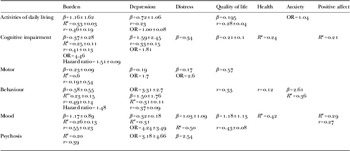
Interestingly, care-giver outcome does not vary by dementia-related symptom. All symptoms have a relationship with all of the outcomes examined; burden, depression, distress, quality of life, health, anxiety and positive affect. Much more research has focused on burden and depression than the other outcomes. Because outcome does not vary by symptom, research on outcomes is not used in the construction of the typology. A summary of all quantitative symptom–outcome relationships is listed in Table 3.
Relationships between dementia-related symptoms and care-giver outcomes

Notes: Data are listed as mean±standard deviation of all studies that report the relationship. If only one report of this relationship was found in the literature, that single value is listed. β: beta regression coefficient. OR: odds ratio. R 2: coefficient of determination and proportion of variance explained by model. r: Pearson correlation coefficient.
The typology: three care-giver classifications
A three-way classification typology of the relationship between symptom presentation (‘stressor’) and secondary care-giving strain emerges from this literature. First, caring for persons with diminished cognition results in changing relationship dynamics and limited social engagement, or ‘role-strain’, for the care-giver. Second, care-givers of persons with motor dysfunction are hyper-vigilant, worry and may neglect self-care, referred to here as ‘consumed by care-giving’. Third, care-givers of persons with ADL limitations, advanced cognitive decline and psychoses report a need for increased care service use.
‘Role-strain’. Cognitive decline and changes in social and role functioning take a debilitating toll on social relationships (Chiong-Rivero et al. Reference Chiong-Rivero, Ryan, Flippen, Bordelon, Szumski, Zesiewicz and Vickrey2011). The transition to care-giver–care-receiver roles can create significant relational deprivation, characterised by the loss of intimacy, less effective communication, shared activities and shared future goals (Adams Reference Adams2006; Dean and Wilcock Reference Dean and Wilcock2012; Seeher et al. Reference Seeher, Low, Reppermund and Brodaty2013). When spouses first become care-givers, an adjustment period is accompanied by negative feelings about the unpredictable burden of dependence (Williams Reference Williams2011). As the disease progresses, the marital relationship is in constant flux and the roles of ‘husband’ and ‘wife’ change. Interview data suggested that a role-shift occurs and the role of ‘spouse’ becomes independent from that of ‘care-giver’; e.g. the role of ‘wife’ is lost to that of ‘care-giver’, ‘nurse’ or ‘guardian’. Thus, disease progression is associated with increased uncertainty regarding the nature of the marital relationship (Harris et al. Reference Harris, Adams, Zubatsky and White2011). Notably, early onset persons with dementia (<40 years) and their care-givers may experience more difficulty coping with the social and role changes compared with later onset (>60 years).
Older married couples typically lead interconnected lives, with linked roles and identities. Dementia alters the intimate and functional aspects in spouses' relationship and daily lives (i.e. activities, responsibilities, pleasures) (Roberto, McCann and Blieszner Reference Roberto, McCann and Blieszner2013). Thus, self-identity of spouse care-givers requires re-conceptualising marital roles to include changes to division of labour, family responsibilities, activities, decision-making and overall daily management. Marital roles are also altered through the loss of relationship rituals and decreased affection. Gradual loss of intimacy, sexual activity, future plans, social and recreational interactions can be troublesome and affect emotional involvement with the other spouse; this may lead to distress, depression, fatigue and social isolation (Austrom and Lu Reference Austrom and Lu2009; Davies et al. Reference Davies, Newkirk, Pitts, Coughlin, Sridhar, Zeiss and Zeiss2010). Dementia prognosis may decrease marital quality and compound existing marital problems (Blieszner and Roberto Reference Blieszner and Roberto2010; Norton et al. Reference Norton, Piercy, Rabins, Green, Breitner, Østbye, Corcoran, Welsh-Bohmer, Lyketsos and Tschanz2009; Roberto, McCann and Blieszner Reference Roberto, McCann and Blieszner2013; Schölzel-Dorenbos et al. Reference Schölzel-Dorenbos, Draskovic, Vernooij-Dassen and Olde Rikkert2009). As such, marital satisfaction, consensus and relational deprivation are secondary care-giver strains (Dean and Wilcock Reference Dean and Wilcock2012; Fauth et al. Reference Fauth, Hess, Piercy, Norton, Corcoran, Rabins and Tschanz2012; Lu and Haase Reference Lu and Haase2009; Savla et al. Reference Savla, Roberto, Blieszner, Cox and Gwazdauskas2011; Seeher et al. Reference Seeher, Low, Reppermund and Brodaty2013; Williams Reference Williams2011).
Married partners may experience uncertainty as a result of cognitive deterioration, which, according to qualitative interviews, can lead to communication problems and conflicts (Roberto et al. Reference Roberto, Blieszner, McCann and McPherson2011). Cognitive alterations can also create deficits in language in early disease stages that progress with cognitive decline (Egan et al. Reference Egan, Bérubé, Racine, Leonard and Rochon2010; Gómez-Gallego, Gómez-Amor and Gómez-García Reference Gómez-Gallego, Gómez-Amor and Gómez-García2012). Specifically in AD and MCI, the progression of memory problems affects the couple's ability to engage bilaterally in conversation; difficulty with the natural flow and increased misunderstanding (Lu and Haase Reference Lu and Haase2009). Care-givers report simplifying a conversation or holding back complex thoughts to avoid frustrating the care-recipient, which in turn increases care-giver frustration (Davies et al. Reference Davies, Newkirk, Pitts, Coughlin, Sridhar, Zeiss and Zeiss2010). In PDD, care-givers discuss physical loss of voice volume (‘hypophonia’) in care-recipients and its impact on social networks, roles and self-identity (Chiong-Rivero et al. Reference Chiong-Rivero, Ryan, Flippen, Bordelon, Szumski, Zesiewicz and Vickrey2011). Care-recipients who are less communicative participate in less physical and social activity and show more disturbing changes in behaviour, resulting in decreased physical and social engagement for care-givers (Gómez-Gallego, Gómez-Amor and Gómez-Reference Gómez-Gallego, Gómez-Amor and Gómez-García2012). Poor communication between care-giver and care-recipient can result in conflict, changes in behaviour and isolation (Davies et al. Reference Davies, Sridhar, Newkirk, Beaudreau and O'Hara2012).
Not only do care-givers report gradual erosion of the spousal relationship, but also a progressive alienation from the world around them. Both the care-recipient and care-giver report feeling stigma when interacting in social settings or in the workplace, resulting from a noticeable dependence of the person with dementia on the care-giver (Chiong-Rivero et al. Reference Chiong-Rivero, Ryan, Flippen, Bordelon, Szumski, Zesiewicz and Vickrey2011). Both care-givers and care-recipients perceive others feel sadness, anxiety, pity, shame or even resentment, and thus they feel embarrassed. This social isolation in care-givers leads to emotional distress and a sense of loss over the roles they once held in relation to each other, family and friends (Chiong-Rivero et al. Reference Chiong-Rivero, Ryan, Flippen, Bordelon, Szumski, Zesiewicz and Vickrey2011).
‘Consumed by care-giving’. Assisting persons with combined dementia and mobility challenges requires considerable time and physical effort. The level of physical dependence increases as cognitive impairment and neuropsychiatric complications emerge, likely contributing to multifactorial functional impairment (Chiong-Rivero et al. Reference Chiong-Rivero, Ryan, Flippen, Bordelon, Szumski, Zesiewicz and Vickrey2011; Leroi et al. Reference Leroi, Harbishettar, Andrews, McDonald, Byrne and Burns2012a). Motor symptoms have the potential to increase dementia care-giver strains, such as hyper-vigilance and isolation (Galvin et al. Reference Galvin, Duda, Kaufer, Lippa, Taylor and Zarit2010b). In qualitative interviews, spousal care-givers discuss vigilance and worry associated with ensuring the care-recipient with both cognitive and motor symptoms is safe (Kelsey, Laditka and Laditka Reference Kelsey, Laditka and Laditka2010; Nikzad-Terhune et al. Reference Nikzad-Terhune, Anderson, Newcomer and Gaugler2010). Dementia care-givers may become consumed by managing motor symptoms, constantly watching for falls and assisting the care-recipient with daily activities due to increased disability (Leverenz and McKeith Reference Leverenz and McKeith2002). Thus, as the care-recipient becomes more functionally dependent, care-givers increase watch over safety and the frequency of respite from care-giving decreases.
With the progression of dementia and functional decline, daily life routines begin to shrink and care-givers report constraints in the psychological, social and physical facets of their life space. Life space is all the factors in the physical and psychological environment of an individual that influence behaviour. Physical functional decline in the care-recipient leads to ADL dependence and continuous care needs, resulting in physical activity restriction and social isolation for care-givers, as reported in quantitative surveys (Mausbach et al. Reference Mausbach, Coon, Patterson and Grant2008; Stella et al. Reference Stella, Banzato, Quagliato, Viana and Christofoletti2009). In addition to physical declines, changes in cognition and behaviour impact the care-recipient's ability to socialise, and increased care responsibilities may exacerbate care-giver life space constraints, according to qualitative interviews (Blieszner and Roberto Reference Blieszner and Roberto2010; Dean and Wilcock Reference Dean and Wilcock2012; Roberto et al. Reference Roberto, Blieszner, McCann and McPherson2011; Savla et al. Reference Savla, Roberto, Blieszner, Cox and Gwazdauskas2011), quantitative analysis (Bruce et al. Reference Bruce, McQuiggan, Williams, Westervelt and Tremont2008; Ryan et al. Reference Ryan, Weldon, Huby, Persad, Bhaumik, Heidebrink and Giordani2010) and literature reviews of cross-sectional quantitative data (Seeher et al. Reference Seeher, Low, Reppermund and Brodaty2013). These symptoms increase feelings of inadequacy and isolation as a care-giver, making it more difficult to seek social support (Adams Reference Adams2006).
Loss of independence occurs early in dementias that present with motor impairments (Galvin et al. Reference Galvin, Duda, Kaufer, Lippa, Taylor and Zarit2010a), which leads to loss of independence for care-givers. Faced with a wide variety of motor, cognitive and behavioural changes, DLB and PDD care-givers report increased care-recipient dependence. They assist with more motor impairment and falls and higher levels of disability than care-givers of non-motor dementias, such as MCI and AD (Ricci et al. Reference Ricci, Guidoni, Sepe-Monti, Bomboi, Antonini, Blundo and Giubilei2009). The combined motor and neuropsychiatric symptoms may result in more serious functional deficits in PDD compared with AD (Shin et al. Reference Shin, Youn, Kim, Lee and Cho2012). Quantitative research demonstrates combined mobility and cognitive symptoms in persons with PDD significantly influence the amount of time care-givers dedicated to caring tasks (Carter et al. Reference Carter, Lyons, Lindauer and Malcom2012; Morley et al. Reference Morley, Dummett, Peters, Kelly, Hewitson, Dawson and Jenkinson2012).
‘Care-service use’. Level of functional dependence increases progressively as cognitive impairment advances, resulting in instrumental (IADL) and basic ADL dependence among dementia care-givers (Bergvall et al. Reference Bergvall, Brinck, Eek, Gustavsson, Wimo, Winblad and Jönsson2011; Germain et al. Reference Germain, Adam, Olivier, Cash, Ousset, Andrieu and Salmon2009; Marciniak et al. Reference Marciniak, Choo, Toledo, Semik and Aegesen2011; Ornstein et al. Reference Ornstein, Gaugler, Devanand, Scarmeas, Zhu and Stern2012; Yeager et al. Reference Yeager, Hyer, Hobbs and Coyne2010; Zucchella et al. Reference Zucchella, Bartolo, Pasotti, Chiapella and Sinforiani2012). Dementia symptoms, such as visuo-spatial deficits, psychosis and fluctuating cognitive abilities, reduce care-recipient's ability to complete IADL/ADL. Care-givers report having to assist with ADL-related tasks, such as errands, transportation, cooking, business affairs and nursing (i.e. medication administration) (Garand et al. Reference Garand, Dew, Eazor, DeKosky and Reynolds2005; Leverenz and McKeith Reference Leverenz and McKeith2002; Ryan et al. Reference Ryan, Weldon, Huby, Persad, Bhaumik, Heidebrink and Giordani2010; Seeher et al. Reference Seeher, Low, Reppermund and Brodaty2013). As such, cognitive and IADL/ADL stressors lead to the secondary strain of increased care service use in care-givers (Leverenz and McKeith Reference Leverenz and McKeith2002).
Literature reviewed by Austrom and Lu (Reference Austrom and Lu2009) and Dean and Wilcock (Reference Dean and Wilcock2012) demonstrate MCI and AD care-givers often feel most challenged with IADL and decision-making, attributed to care-recipients' declining cognition and sense of independence. The use of assistive care services and medical information by care-givers, even in the early disease stages, becomes important (Dean and Wilcock Reference Dean and Wilcock2012). To manage, care-givers express a need for help with a litany of IADL, including: housekeeping, performance capacity, financial and legal advice, long-term planning and coping strategies (Lu and Haase Reference Lu and Haase2009). Specifically, MCI care-giver needs relate to neuro-behavioural symptoms and an increased responsibility for decision-making, errands and business affairs; whereas needs among AD care-givers are related to cognitive functional disability (Ryan et al. Reference Ryan, Weldon, Huby, Persad, Bhaumik, Heidebrink and Giordani2010). Faced with unique challenges of combined physical, psychotic and cognitive symptoms, DLB and PDD care-givers report decreased ADL capabilities. Early loss of independence in DLB and PDD increases care-givers' need for prolonged health service use (Carter et al. Reference Carter, Lyons, Lindauer and Malcom2012; Galvin et al. Reference Galvin, Duda, Kaufer, Lippa, Taylor and Zarit2010a; Morley et al. Reference Morley, Dummett, Peters, Kelly, Hewitson, Dawson and Jenkinson2012).
Throughout disease progression, care-givers are challenged to cope with new responsibilities, changes in behaviour and planning for future care needs (Ducharme et al. Reference Ducharme, Lévesque, Lachance, Kergoat, Legault, Beaudet and Zarit2011). As the disease progresses, declines in ADL capacity require considerable time and physical effort. As such, dementia care-givers are in need of greater sources of information and support (Galvin et al. Reference Galvin, Duda, Kaufer, Lippa, Taylor and Zarit2010a, Reference Galvin, Duda, Kaufer, Lippa, Taylor and Zarit2010b; Ricci et al. Reference Ricci, Guidoni, Sepe-Monti, Bomboi, Antonini, Blundo and Giubilei2009). Spousal dementia care-givers reveal a preference for adult day service (ADS) and respite programmes that provide care-recipient supervision and assist in reducing care-giver's sense of isolation (Galvin et al. Reference Galvin, Duda, Kaufer, Lippa, Taylor and Zarit2010b). ADS is especially useful for care-givers managing changes to behaviour, like advanced AD, because it reduces care-giver and care-recipient ADL workload. In addition, ADS activities provide physical, cognitive and social stimulation for care-recipients, leading to reduced disturbing behaviours at home among those with AD (Zarit et al. Reference Zarit, Kim, Femia, Almeida, Savla and Molenaar2011).
Continuous care needs attributed to mounting ADL dependences increase vulnerability to institutionalisation. Dementia is associated with earlier nursing home placement, especially if the care-recipient experiences behavioural and cognitive disturbances, including aggression, wandering, a danger to self or others, nocturnal behaviours, misplaces and/or hides things, apathy and motor over-activity (Agüera-Ortiz et al. Reference Agüera-Ortiz, Frank-García, Gil and Moreno2010; Cupidi et al. Reference Cupidi, Realmuto, Lo Coco, Cinturino, Talamanca, Arnao and Lo Coco2012; Hanagasi and Emre Reference Hanagasi and Emre2005; Leroi et al. Reference Leroi, McDonald, Pantula and Harbishettar2012b; Mausbach et al. Reference Mausbach, Coon, Patterson and Grant2008; Rowe et al. Reference Rowe, McCrae, Campbell, Pe Benito and Cheng2008; Stella et al. Reference Stella, Banzato, Quagliato, Viana and Christofoletti2009; Watson and Leverenz Reference Watson and Leverenz2010). Limited ADL capacity in combination with psychopathological manifestations (i.e. hallucinations) and neuropsychiatric symptoms (i.e. apathy) result in increased use of health-care services and shorter time to institutionalisation (Gaugler et al. Reference Gaugler, Wall, Kane, Menk, Sarsour, Johnston and Newcomer2011; O'Rourke et al. Reference O'Rourke, Kupferschmidt, Claxton, Smith, Chappell and Beattie2010; Stella et al. Reference Stella, Banzato, Quagliato, Viana and Christofoletti2009, Reference Stella, Canonici, Gobbi, Santos-Galduroz, de Castilho Cação and Gobbi2011). Increased motor and movement disabilities also contribute to institutionalisation (Leggett et al. Reference Leggett, Zarit, Taylor and Galvin2011). Care-recipients who struggle and resist care-giver help, due to dementia, intensify the stressfulness of the situation (Leggett et al. Reference Leggett, Zarit, Taylor and Galvin2011). Some care-givers of persons with changes to behaviour use the support of assisted living facilities during transition to institutionalisation and report less negative emotions and guilt during future moves to institutionalisation (Kelsey, Laditka and Laditka Reference Kelsey, Laditka and Laditka2010; Nikzad-Terhune et al. Reference Nikzad-Terhune, Anderson, Newcomer and Gaugler2010).
Classifications common to neurodegenerative diseases that present with dementia
Each neurodegenerative disease is related to distinct care-giver strains. Thus, the care-giver classifications in the typology are better represented in some diseases. Dementia-related symptom presentation is important, as care-giver strains will vary accordingly.
In the role-strain classification, cognitive changes in personality, communication and social engagement result in relationship dynamic changes. This is most evident in MCI (50%) and AD (47%) care-givers, and relates to communication and stigma in PDD. Support related to relationship and communication needs to be emphasised in care-givers of persons with personality and communication challenges, since both MCI and AD care-giving results in increased service needs and role-strain. This demonstrates that different presentations of dementia create different care-giving strains, necessitating specialised support.
Motor dysfunction leads to care-givers being consumed by carer needs. This second classification is most common in PDD (46%); however, DLB (33%) care-givers also care for motor dysfunction. This is consistent with motor-dominant symptom presentation in PDD and Parkinsonian aspects of DLB. Dementia-motor decline care-givers need to be educated on seeking support and self-care, including respite and social activities.
Finally, ADL limitations and cognitive decline lead to increased care services. This classification is most common among AD care-givers (43%); however MCI (23%), PDD (20%) and DLB (14%) can also be categorised within this group. Note that all disease sub-types experience this strain to different degrees; however, stressors that contribute to this strain vary by groups. As such, resources related to memory and planning need to be directed to MCI and AD care-givers managing ADL tasks. Supporting ADL needs specific to cognition-psychosis and cognition-motor is important in DLB and PDD care-givers.
Study quality and limitations
This review highlights several areas for future research. In MCI, quantitative surveys (Lu and Haase Reference Lu and Haase2009; Ryan et al. Reference Ryan, Weldon, Huby, Persad, Bhaumik, Heidebrink and Giordani2010), qualitative interviews (Adams Reference Adams2006; Blieszner and Roberto Reference Blieszner and Roberto2010; Garand et al. Reference Garand, Dew, Eazor, DeKosky and Reynolds2005, Reference Garand, Lingler, Deardorf, DeKosky, Schulz, Reynolds and Dew2012; Savla et al. Reference Savla, Roberto, Blieszner, Cox and Gwazdauskas2011) and literature reviews (Austrom and Lu Reference Austrom and Lu2009; Dean and Wilcock Reference Dean and Wilcock2012; Seeher et al. Reference Seeher, Low, Reppermund and Brodaty2013) report role-strain and lifestyle constraints. Missing are longitudinal analyses of care-giver role adaptation and changes with symptom fluctuations. Qualitative studies (Blieszner and Roberto Reference Blieszner and Roberto2010; Davies et al. Reference Davies, Newkirk, Pitts, Coughlin, Sridhar, Zeiss and Zeiss2010; Roberto, McCann and Blieszner Reference Roberto, McCann and Blieszner2013) and literature reviews (Adams Reference Adams2006; Dean and Wilcock Reference Dean and Wilcock2012; Seeher et al. Reference Seeher, Low, Reppermund and Brodaty2013) demonstrate communication and intimacy concerns among MCI; however, large-scale quantitative analyses are needed to confirm communication and relationship issues in relation to burden in the larger population.
AD symptom management includes quantitative surveys/trials (Cheng et al. Reference Cheng, Lam, Kwok, Ng and Fung2013; Gómez-Gallego, Gómez-Amor and Gómez-García Reference Gómez-Gallego, Gómez-Amor and Gómez-García2012) and literature reviews (Ducharme et al. Reference Ducharme, Lévesque, Lachance, Kergoat, Legault, Beaudet and Zarit2011; Egan et al. Reference Egan, Bérubé, Racine, Leonard and Rochon2010). Evidence is primarily comprised of large-scale cross-sectional surveys that demonstrate increased care-giver burden with cognitive decline, behavioural issues and functional dependence (Bergvall et al. Reference Bergvall, Brinck, Eek, Gustavsson, Wimo, Winblad and Jönsson2011; Cheng et al. Reference Cheng, Lam, Kwok, Ng and Fung2013; Ornstein et al. Reference Ornstein, Gaugler, Devanand, Scarmeas, Zhu and Stern2012; Zucchella et al. Reference Zucchella, Bartolo, Pasotti, Chiapella and Sinforiani2012). Despite the amount of evidence available, qualitative designs that probe into the transition/adaptation to care-giver role and relationship uncertainty are missing. Qualitative interviews and systematic reviews (Egan et al. Reference Egan, Bérubé, Racine, Leonard and Rochon2010) report that communication stresses relationships and transitions to institutionalisation is based on disturbing changes to behaviour.
Insufficient DLB resources was reported in quantitative surveys (Galvin et al. Reference Galvin, Duda, Kaufer, Lippa, Taylor and Zarit2010b; Leggett et al. Reference Leggett, Zarit, Taylor and Galvin2011). Thus, qualitative study is needed to further explore isolation, community support and misunderstanding. DLB symptom progression as it relates to care-giver distress is demonstrated through quantitative and clinical surveys (Galvin et al. Reference Galvin, Duda, Kaufer, Lippa, Taylor and Zarit2010a; Ricci et al. Reference Ricci, Guidoni, Sepe-Monti, Bomboi, Antonini, Blundo and Giubilei2009), qualitative interviews and narratives (Auning et al. Reference Auning, Rongve, Fladby, Booij, Hortobágyi, Siepel, Ballard and Aarsland2011; Pucci Reference Pucci2006). The unique challenges faced by DLB care-givers and limited existing knowledge necessitates more research to better support the individual needs of DLB care-givers.
Quantitative surveys (Aarsland et al. Reference Aarsland, Larsen, Karlsen, Lim and Tandberg1999, Reference Aarsland, Brønnick, Ehrt, De Deyn, Tekin, Emre and Cummings2007; Leroi et al. Reference Leroi, McDonald, Pantula and Harbishettar2012b; Marciniak et al. Reference Marciniak, Choo, Toledo, Semik and Aegesen2011; Stella et al. Reference Stella, Banzato, Quagliato, Viana and Christofoletti2009) and literature reviews (Hanagasi and Emre Reference Hanagasi and Emre2005; Watson and Leverenz Reference Watson and Leverenz2010) present multifactorial function decline in PDD that influences care-giver burden and health. Both qualitative designs (Chiong-Rivero et al. Reference Chiong-Rivero, Ryan, Flippen, Bordelon, Szumski, Zesiewicz and Vickrey2011) and quantitative surveys (Goldsworthy and Knowles Reference Goldsworthy and Knowles2008) demonstrate relationship, sense of stigma and loss. The limited available evidence and the increased burden uniquely experienced by PDD care-givers suggest the need for more specific investigation within this group.
The typology derived here from existing literature has developed three classifications of care-giving outcomes in four neurodegenerative diseases that present with dementia; however, we acknowledge the limitations of this work. The variability of definitions proved a challenge when comparing or contrasting research findings, particularly when examining terms with broad meanings such as ‘care-giving’, ‘symptom’ and ‘strain’. Drawing generalisable categories from the dementia care-giving literature was also made more difficult by the need to combine disease severities, ages, gender and duration. Future work should investigate unique dementia trajectories within the same design, paying particular attention to gender differences in care role progression and care-givers who are in their mid-life period.
Conclusions
This paper proposes a theoretical typology of care-giving based on dementia symptom presentation and resultant secondary care-giver strains. Dementia presentation (e.g. cognition/behaviour, memory, hallucinations, apathy) differs in the four care-giver groups examined and uniquely impacts care-giver strains. As such, a major conclusion derived is that we cannot provide the same support to all care-givers under the umbrella term ‘dementia’.
The findings presented in this typology highlight significant unmet needs for care-givers, specific to dementia presentation. A greater understanding of dementia symptoms and resultant care-giving strains will improve targeted intervention services. The first two classifications have important implications for the third, service use. Understanding changes to a relationship is important in the role-strain classification when considering the implications of dementia on individual and health-care systems, as satisfaction with all forms of intimacy impact long-term decisions about service use and placement. A strong identity as a couple is associated with fewer negative stressors and more social support. As such, interventions need to focus on supporting care-givers and care-recipients as a unit (i.e. supportive social outlets) to improve relationship quality and changing roles in daily life management (Goldsworthy and Knowles Reference Goldsworthy and Knowles2008). Also, programmes and strategies that enhance verbal communication are needed to improve care and help mitigate associated burdens (Egan et al. Reference Egan, Bérubé, Racine, Leonard and Rochon2010; Letts et al. Reference Letts, Edwards, Berenyi, Moros, O'Neill, O'Toole and McGrath2011). Caring for persons with dementia and motor decline increases worry and isolation in care-givers in the consumed by care-giving classification; this highlights the importance of taking breaks (Goldsworthy and Knowles Reference Goldsworthy and Knowles2008), getting out of the house and ensuring social support. Thus, dementia care-givers caring for persons with motor dysfunction have an increased need to seek respite services, as well as home-care resources for managing the physical safety of the care-recipient (i.e. grab bars, walking aids). Finally, in the service use classification of care-givers managing ADL limitations, especially MCI and AD, formal support is needed from the time of diagnosis to help care-givers: understand the illness, develop coping and decision-making skills, organise care responsibilities, become aware of available services and develop expectations to enable future care plans (Ducharme et al. Reference Ducharme, Lévesque, Lachance, Kergoat, Legault, Beaudet and Zarit2011). Targeted care management techniques, social resources and emotional support may decrease uncertainty and improve self-efficacy and life satisfaction in dementia care-givers (Chou et al. Reference Chou, Yan, Lin, Tsai, Chen and Woung2012). The resulting reductions in care-recipient and care-giver burden and health-care utilisation could have significant public health implications.
Acknowledgements
This work was supported by a Post Doctoral Fellowship Award from the Canadian Institutes of Health Research (CIHR): Gender, Work and Health (grant to K.P.R.). The funding body (CIHR) had no involvement in the design, in the collection, analysis and interpretation of data; in the writing of the manuscript; and in the decision to submit the manuscript for publication. Kaitlyn P. Roland is currently funded by CIHR (Gender, Work, and Health) (2012–2014) and Michael Smith Foundation for Health Research (2013–2016) Post-Doctoral Awards. The authors report no conflicts of interest. The corresponding author (K.P.R.) accepts full responsibility for this work, has access to the data and controlled the decision to publish. The co-author has read the paper and is aware of the submission. Both authors have made a substantial contribution: K.P.R.: (a) conception, design, analysis and interpretation of data, (b) drafting of article, revising it critically, (c) approval of version to be published; N.L.C.: (a) conception, design and interpretation of data, (b) revising the article critically for important intellectual content, (c) approval of version to be published.