Introduction
Surgical site infections following cardiac surgery remain a significant cause of morbidity, mortality, and healthcare resource utilization despite advances in perioperative care. Deep sternal wound infections (DSWI) occur in 0.5%–5% of patients undergoing median sternotomy. In a recent meta-analysis of over 400,000 patients, Gaudino et al identified a DSWI rate of 1.6%. Reference Perezgrovas-Olaria, Audisio and Cancelli1 Superficial sternal wound infection (SSWI) affects an additional 2%–8% of patients. Reference Ridderstolpe, Gill, Granfeldt, Ahlfeldt and Rutberg2,Reference Toumpoulis, Anagnostopoulos, Derose and Swistel3 These complications contribute to mortality rates exceeding 10% and additional costs ranging from $20,000 to $100,000 per patient. Reference Graf, Ott, Vonberg, Kuehn, Haverich and Chaberny4,Reference Hollenbeak, Murphy, Koenig, Woodward, Dunagan and Fraser5
Traditional quality improvement approaches have predominantly focused on identifying and addressing deficiencies through root cause analysis and standardized protocols. Reference O’Brien, Rogers and Jamtvedt6 The concept of positive deviance offers an alternative paradigm that identifies individuals whose practices consistently produce superior outcomes compared to their peers. Reference Bradley, Curry, Ramanadhan, Rowe, Nembhard and Krumholz7,Reference Marsh, Schroeder, Dearden, Sternin and Sternin8 This approach has been successfully applied to healthcare quality improvement, demonstrating reductions in healthcare-associated infections and improving hand hygiene compliance. Reference Marra, Guastelli and de Araujo9,Reference Evans, Kralovic and Simbartl10 This principle has also been successfully applied in cardiac surgery. Reference Shahian, OBrien and Filardo11,Reference Birkmeyer, Stukel, Siewers, Goodney, Wennberg and Lucas12
The Society of Thoracic Surgeons Adult Cardiac Surgery Database provides a robust platform for risk-adjusted outcome assessment, enabling sophisticated statistical modeling to identify surgeons whose outcomes exceed expectations. Reference Shahian, Jacobs and Badhwar13 The objective of this study was to use this data to determine if there are significant differences in the inter-individual risk-adjusted rates of DSWI, SSWI, and total sternal wound infection at a single institution with the identification of positive deviants to characterize practice strategies that could be communicated for quality improvement.
Methods
Although all applicable patient data was used in the analysis, one surgeon opted to have his individual data removed from graphical presentation in the final manuscript. This study was approved by the Ottawa Health Science Research Ethics Board (Protocol#: 20250640-01H). Patient consent was waived. Preoperative, intraoperative, and postoperative data was prospectively collected on all patients undergoing cardiac surgery at the University of Ottawa Heart Institute to comply with our participation with the Society of Thoracic Surgery National Database. Surgeon identity in each case was anonymized with a code known only to the chief of the service (P.V.). For the purposes of this evaluation, inclusion was limited to patients operated upon between January 1, 2021, and June 30, 2025. Data for patients prior to that point was discontinuous and incomplete. The study was confined to patients undergoing isolated coronary artery bypass grafting (CABG) using the STS definitions (Procedure Identification Table, STS Adult Cardiac Surgery Database, V4.20.2). Patients undergoing CABG through a mini-thoracotomy were excluded as were patients from surgeons with less than 100 total patients.
All patients were treated with standardized practices according to WHO recommendations Reference Allegranzi, Bischoff and de Jonge14,Reference Allegranzi, Zayed and Bischoff15 including hair clipping, nares decontamination, preoperative skin wash with chlorhexidine, skin preparation with chlorhexidine scrub and painting. Patients received prophylactic cefazolin or vancomycin within one hour of skin incision with repeated doses as required. In this time frame in the STS, compliance for duration, selection, and timing of antibiotic administration was 99.98%, which represented between the 59th and 82nd percentile of all participants in the STS for the three variables. All surgeons used iodine-impregnated incisional drapes (IIID, 3MTMIobanTM 3 M Health Care, St. Paul MN). For the study period, all patients had careful glucose monitoring with intravenous glucose management according to recommended guidelines. Reference Lazar, McDonnell and Chipkin16 All patients were treated at normothermia intra- and postoperatively with active warming as necessary to comply with guidelines. Reference Crisafi, Grant and Rea17
Outcomes
The primary outcome was total sternal wound infection (sum of DSWI and SSWI) within 30 days with DSWI and SSWI as secondary outcomes. DSWI and SSWI were diagnosed according to the criteria set forth by the Centers for Disease Control and Prevention (CDC). 18
Practice patterns
Surveys were distributed to senior residents, registered nurse assistants, and MD assistants addressing techniques of each surgeon related to CABG during the study period (2021–2025). This group represented the members of the team most directly exposed to first assisting each surgeon. Each candidate was approached in person to participate and then each received an implied consent and survey by e-mail (see Supplement). Seven surgical techniques were assessed: (1) Ioban adherence (5-point ordinal scale: 1=poor adherence with visible wrinkles/gaps, 5=optimal adherence with complete contact); (2) cautery usage amount (5-point ordinal scale: 1=minimal tissue-sparing use, 5=extensive use); (3) bone wax usage (binary); (4) vancomycin paste usage (binary); (5) wound irrigation at closure—saline, diluted povidone-iodine, or diluted vancomycin (binary); (6) liberal incision length to avoid skin tension (binary); and (7) double skin preparation with both chlorhexidine and povidone sequentially (binary). For each surgeon, survey responses across multiple observers were aggregated to yield a single characterization of routine practice for each technique. For ordinal scale techniques, the median score was calculated for each surgeon. The seven factors were chosen by consensus with a quality committee of surgeons and nurses established to address surgical wound infections. The surveys were collated by the Division chief (P.V.), and the results were anonymized to be linked to the outcomes data by the PI (F.D.R.).
Statistical methodology
Continuous variables were expressed as mean (standard deviation, SD) or median (interquartile range, IQR). Categorical variables were expressed as counts and proportions. χ2 was used to compare categorical variables between groups. The Shapiro–Wilk test was used to test normalcy of data. Non-normal continuous data between groups was tested with the Wilcoxon rank sum test.
Risk adjustment was used to address any potential differences in referral patterns using the covariates in Table 1 Suppl. Logistic regression models were created for total infections (SSWI + DSWI) using the Least Absolute Shrinkage Selection Operator (LASSO) function as there were sufficient events. This is a supervised machine learning method to select the best subset of predictors for an outcome by applying a penalty (Lambda) to the OLS least square, causing some coefficients to shrink to zero excluding them from the model, resulting in a parsimonious model. Ten-fold cross-validation (CV) was utilized to prevent overfitting and to pick the model with the largest out of sample r-square and minimum CV mean prediction error. Continuous variables were modeled in linear terms. Postestimation, the model was then tested by assessing the following: area under curve, Hosmer–Lemeshow goodness of fit, linktest, and predicted probability calibration and distribution plots. If necessary, interaction terms were introduced to optimize the model. Mixed-effects logistic regression analyses were utilized with the surgeon as a random effect in the model. Observed to expected ratios of each outcome based on the derived logistic regression were then plotted. Positive deviancy was defined by the upper bound of the 95% CI less than unity; thus, a positive deviant was identified as any surgeon achieving statistically significant superior performance (95% confidence interval excluding 1.0).
To facilitate comparative analyses, surgeons were stratified into performance groups based on point estimates of O/E ratios for the primary outcome: Better Performers (O/E <1.0, indicating fewer infections than expected), Worse Performers (O/E ≥ 1.2, indicating substantially more infections than expected), and Average Performers (O/E 1.0–1.19). A positive deviant was identified as any surgeon achieving statistically significant superior performance (95% confidence interval excluding 1.0). Surgical technique data from the survey was then linked to the previously determined performance groups to enable comparative analysis between the positive deviant, other better performers, and worse performers. Average performers were excluded from comparative technique analyses to ensure distinct performance groups and maximize discriminative power.
Given the low event rate for the secondary outcomes DSWI and SSWI, Firth’s bias-reduced logistic regression was used to obtain stable parameter estimates in the presence of rare events. Reference Puhr, Heinze, Nold, Lusa and Geroldinger19 This method applies a penalty term to the likelihood function that reduces small-sample bias commonly encountered with maximum likelihood estimation in rare event scenarios. Model performance was assessed using Spearman’s rank correlation between predicted linear predictors and observed outcomes, as standard postestimation diagnostics (Hosmer–Lemeshow test, linktest) are not appropriate for penalized likelihood models. The C-statistic was calculated as (ρ + 1)/2, where ρ represents the Spearman correlation coefficient. Model selection was performed using likelihood ratio tests comparing nested models. Given the exploratory nature of the analysis with limited events, we focused on effect size estimation and confidence intervals rather than formal hypothesis testing. Reference Heinze, Wallisch and Dunkler20
Linkage of total infection O/E ratios (primary outcome) to performance surveys
Following performance classification based on O/E ratios, each surgeon’s technique characterizations were linked to their performance group and aggregated using volume weighting. To account for both the magnitude of performance differences and the statistical precision of performance estimates, volume-weighted analysis was applied using the formula: Weight = |O/E ratio - 1.0| × √(case volume/100). Statistically significant positive deviants were analyzed separately from other better performers to characterize techniques unique to exceptional performance versus those common among better performers generally. For binary techniques, weighted usage rates were calculated as the sum of (technique usage × surgeon weight) divided by the sum of weights within each performance group. For ordinal scale techniques (Ioban adherence quality, cautery usage amount), weighted means were calculated similarly. This approach appropriately weighted each surgeon’s contribution to group-level technique patterns based on both their performance deviation from expected and their case volume, preventing undue influence from low-volume outliers.
All analyses were performed using R version 4.3.0 or StataNow/BE version 19.5, (StataCorp, College Station Texas).
Results
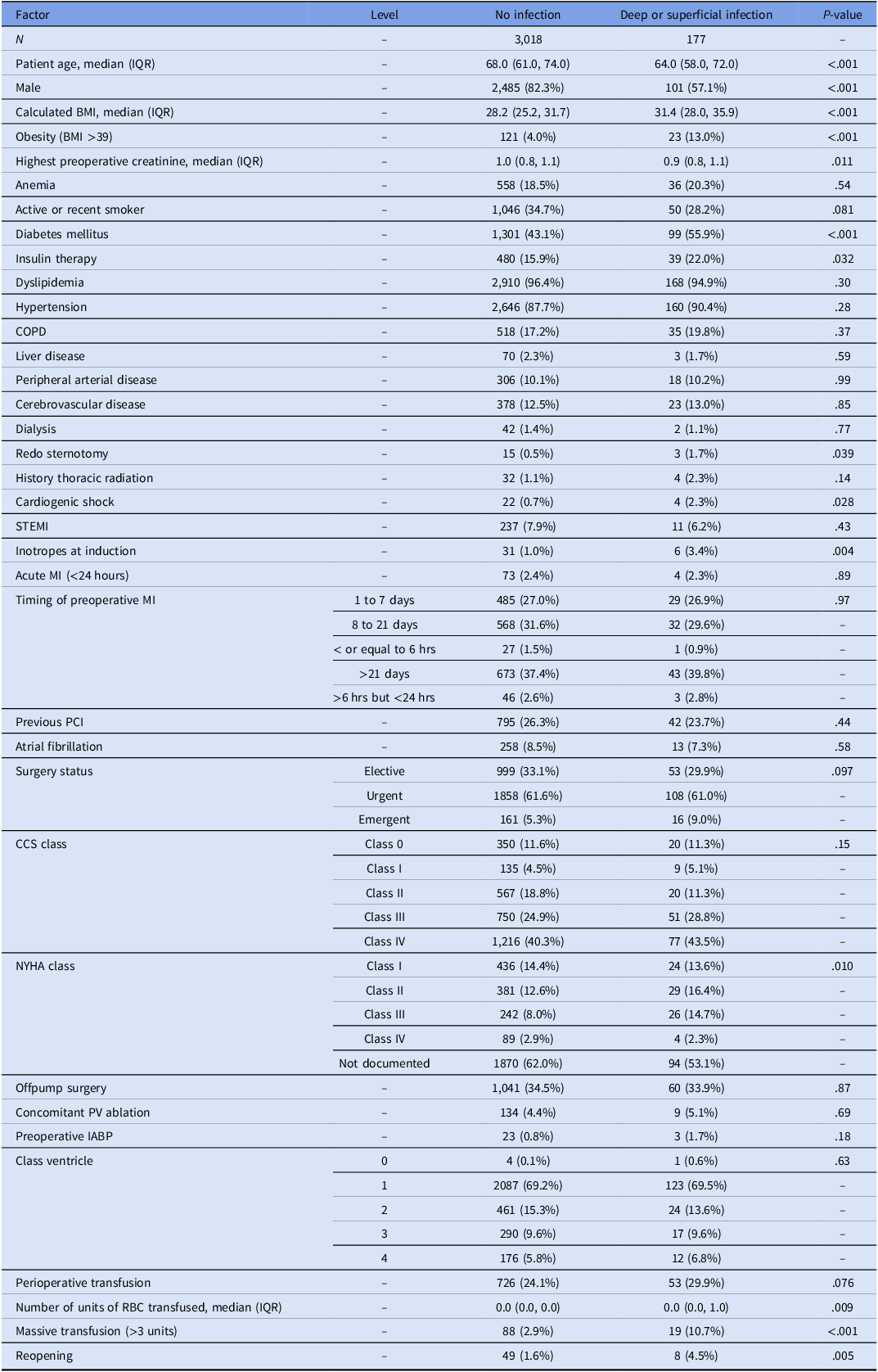
There were 3,195 patients in the final analysis. There were 10 surgeons with an average practice range of 15.0 ± 9.6 years, with a range of 2–30 years in practice. The characteristics of the patients are presented in Table 1 Suppl. There were 135 SSWI within 30 days (4.2%). The incidence was 9.8% in women and 3.0% in men (P < .001). There were 42 DSWI (1.3%) with an incidence of 2.9% in women and 1.0 % in men (P < .001). The patient characteristics of those developing and not developing total infection, DSWI or SSWI are presented in Table 1, Table 2 suppl and Table 3 suppl. Factors associated with the development of any (total) sternal wound infections included younger age (P < .001), female sex (P < .001), obesity (P < .001), lower preoperative creatinine (P = .014), diabetes mellitus (P = .001), insulin therapy (P = .044), redo sternotomy (P = .043), inotropes at induction (P = .002), NYHA Class (P = .004), increased number of red cell units transfused (P = .007), massive transfusion (P < .001), and reopening (P = .006).
Characteristics of patients not developing and developing any (total) sternal wound infection (deep or superficial)

Table 1. Long description
The table presents a detailed comparison of characteristics of patients who did and did not develop any sternal wound infections, categorized into deep or superficial infections. It includes 3,195 patients analyzed by 10 surgeons with an average practice range of 15.0 years. Key factors associated with sternal wound infections include younger age, female sex, obesity, lower preoperative creatinine levels, diabetes mellitus, insulin therapy, redo sternotomy, use of inotropes at induction, NYHA Class, increased number of red cell units transfused, massive transfusion, and reopening. The table has 38 rows and 6 columns, with headers including Factor, Level, No infection, Deep or superficial infection, and P-value. Notable trends include higher infection rates in women and associations with specific medical conditions and procedures.
COPD, chronic obstructive pulmonary disease; STEMI, ST segment elevation myocardial infarction; PCI, percutaneous coronary intervention; CCS, Canadian Cardiovascular Society; NYHA, New York Heart Association; PV, pulmonary vein; IABP, intra-aortic balloon pump; RBC, red blood cell; IQR, interquartile range.
Model development
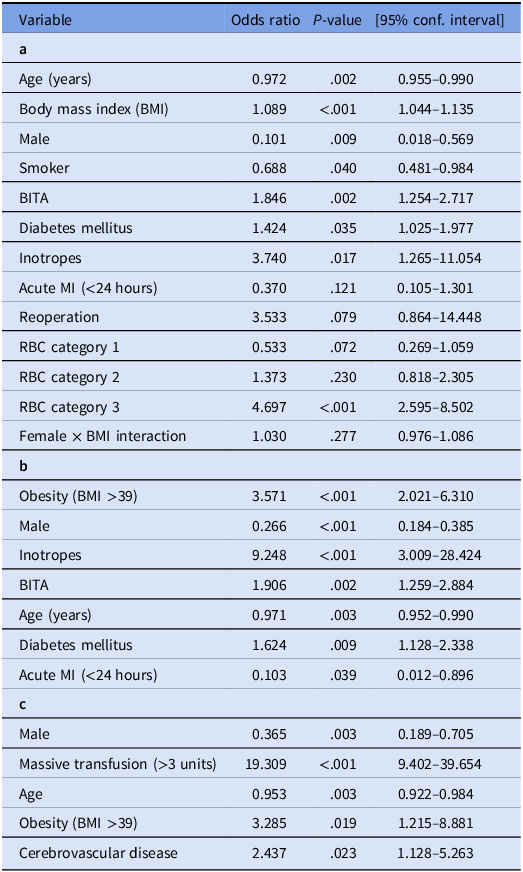
The final models for total infection, DSWI, and SSWI ion are presented in Table 2a–c. The total sternal infection model was validated by goodness of fit and linktest. The diagnostics for total sternal infection model are presented in Figure 1 Suppl. On mixed-effects analysis, there was no statistically significant surgeon effect in total sternal infection (P = .094) DSWI (P = .36) or SSWI (P = .28).
Multivariable logistic regression for a) total sternal wound infection, b) superficial sternal wound infection, and c) deep sternal wound infection. RBC Category Index (1= 0 units, 2 = 1 unit, 3 = 2–3 units, 4 = ≥4 units)

Table 2. Long description
The table presents multivariable logistic regression data for three types of sternal wound infections: total, superficial, and deep. It includes variables such as age, body mass index, gender, smoking status, bilateral internal thoracic artery use, diabetes mellitus, inotropes, acute myocardial infarction within 24 hours, reoperation, red blood cell category, and interactions. The table is divided into three sections: a) total sternal wound infection, b) superficial sternal wound infection, and c) deep sternal wound infection. Each section lists the odds ratio, p-value, and 95% confidence interval for each variable. Notable findings include significant associations with age, body mass index, gender, smoking status, bilateral internal thoracic artery use, diabetes mellitus, inotropes, and red blood cell category.
Performance classification
Based on observed-to-expected (O/E) ratios for total sternal infections, surgeons were classified as: Better Performers (O/E < 1.0, n = 5): Surgeons 2, 3, 4, 11, and 15; Worse Performers (O/E ≥ 1.2, n = 3): Surgeons 1, 5, and 14; Average Performers (O/E 1.0–1.19, n = 1): Surgeon 7.
Positive deviant identification
One surgeon (Surgeon 2) met the criteria for positive deviancy for total sternal infections with an O/E ratio of 0.61 and 95% confidence interval [0.40–0.94] that excluded unity. This surgeon also had the highest case volume (543 cases, 16.5% of total cohort).
Surgeon-specific unadjusted observed rates for total sternal infection, DSWI, and SSWI are presented in Figure 1a–c. Funnel plots demonstrating the incidence of total infection, DSWI, and SSWI related to patient volume, are presented in Figure 2 Suppl (a–c). Random effects analysis as it relates to each surgeon in terms of total sternal infection, DSWI, and SSWI are presented in Figure 3 Suppl (a–c). Observed to expected rates of infection for total infection, DSWI, and SSWI on are presented in Figure 2a–c.
Surgeon-specific unadjusted observed rates for (a) total sternal infection, (b) DSWI, and (c) SSWI.

Figure 1. Long description
The image contains three bar graphs. The first graph, labeled (a), shows the total sternal wound infection rates by surgeon from 2021 to 2025. The x-axis represents unadjusted rates sorted from highest to lowest, and the y-axis represents the total sternal rate in percentage. The bars show varying infection rates, with the highest rate around 8.5 percent and the lowest around 3.5 percent. The second graph, labeled (b), displays the deep sternal wound infection rates by surgeon from 2021 to 2025. The x-axis again represents unadjusted rates sorted from highest to lowest, and the y-axis represents the DSWI rate in percentage. The bars indicate infection rates ranging from approximately 2.5 percent to 0.5 percent. The third graph, labeled (c), illustrates the superficial sternal wound infection rates by surgeon from 2021 to 2025. The x-axis shows unadjusted rates sorted from highest to lowest, and the y-axis shows the superficial sternal rate in percentage. The bars depict infection rates from around 7.5 percent to 2.5 percent. All values are approximated.
Observed to expected rates of infection for (a) total sternal infection, (b) DSWI, and (c) SSWI.

Figure 2. Long description
The image contains three caterpillar plots comparing observed to expected (O/E) infection rates for different types of sternal infections from 2021 to 2025. Each plot features a horizontal axis labeled ‘Provider ID’ and a vertical axis labeled ‘O/E Ratio’. The first plot (a) shows the total sternal infection rates, the second plot (b) displays the deep sternal wound infection (DSWI) rates, and the third plot (c) illustrates the superficial sternal wound infection (SSWI) rates. Each plot includes markers indicating whether the infection rates are not significant, better than expected, or worse than expected, with marker sizes proportional to case volume. The plots show variations in infection rates across different providers, with some providers having higher or lower than expected rates. The dashed horizontal line at an O/E ratio of 1.0 serves as a reference point for expected rates. All values are approximated.
Relationship of positive deviancy to surgical technique
The survey was completed by five senior residents, two registered nurse assistants and two MD assistants. There was a 100% response rate. Figure 3 demonstrate technique usage patterns across performance groups, revealing distinct profiles that differentiate better and worse performers. Two techniques were used exclusively by Surgeon 2 with zero usage among all other surgeons classified as better or worse performers: wound irrigation at closure (100% vs 0%) and double skin preparation with both chlorhexidine and povidone (100% vs 0%). Surgeon 2 demonstrated superior IIID adherence quality compared to both other better performers and worse performers (5.0/5 vs 3.7/5 vs 3.2/5 respectively). Cautery usage was also different, with Surgeon 2 using minimal cautery (1.0/5) compared to other better performers (3.2/5) and worse performers (3.5/5). Surgeon 2 used liberal incision length to avoid tissue tension (100% weighted usage). Among other better performers, volume-weighted usage of liberal incisions was 46.0% (driven primarily by one average-performing surgeon), while worse performers showed 0% usage.
Technique usage heatmap demonstrating practice patterns across surgeon performance groups. Color scale: green = protective/high quality, red = risk/low quality (inverted for cautery where lower = better). Binary techniques are shown as percentages; ordinal scales (IIID adherence and cautery usage) are shown as weighted means on 1–5 scale. Volume weighting: Weight = |O/E ratio - 1.0| × √(case volume/100). Average performer excluded from comparison. Positive deviant highlighted with dashed border.

Figure 3. Long description
The bar graph compares surgical technique usage patterns across three performance groups: Positive Deviant, Other Better Performers, and Worse Performers. The x-axis lists surgical techniques: Double Skin Preparation, Wound Irrigation at Closure, Cautery Usage Amount, Ioban Adherence Quality, Bone Wax Usage, Vancomycin Paste Usage, and Liberal Incision Length. The y-axis shows percentages or weighted means on a 1-5 scale. Each technique is represented by three horizontal bars, one for each performance group. The color scale ranges from green (high quality) to red (low quality), with green indicating protective/high-quality techniques and red indicating risk/low-quality techniques. Cautery usage is inverted, where lower values are better. Binary techniques are shown as percentages, while ordinal scales like Ioban Adherence and Cautery Usage are shown as weighted means. The Positive Deviant group is highlighted with a dashed border. Notable trends include 100% usage of Double Skin Preparation, Wound Irrigation at Closure, and Vancomycin Paste Usage in the Positive Deviant group, while the Worse Performers group shows lower adherence to these techniques. The graph also indicates variations in Cautery Usage Amount and Ioban Adherence Quality across the groups. All values are approximated.
Vancomycin paste showed universal adoption by all better performers (100%) but only 66.7% among worse performer weighted cases (P = .03). Bone wax usage was absent in better performers (0%) but present in 24.4% of worse performer weighted cases.
Discussion
This manuscript presents a novel application of positive deviancy methodology to identify and characterize surgical practices that minimize sternal wound infections following isolated CABG procedures. This strategy represents an innovative approach to quality improvement in cardiac surgery. The approach aligns with the theoretical framework established by Ivanovic et al., who demonstrated the value of surgeon-specific outcome reports combined with continuous quality improvement seminars based on positive deviance principles. Reference Ivanovic, Mostofian and Anstee21
The use of LASSO regression with ten-fold CV demonstrates methodological rigor in model development. The empirical Bayes shrinkage estimation approach, similar to that employed in the STS Congenital Heart Surgery Database, Reference Jacobs, O’Brien and Pasquali22 appropriately addresses the challenge of small sample sizes when estimating surgeon-specific effects. The mixed-effects logistic regression with surgeon as a random effect provides a further framework for hierarchical data analysis.
The systematic collection of seven surgical techniques through anonymized surveys represents a comprehensive approach to characterizing practice patterns. The volume-weighted analysis methodology accounts for both performance magnitude and statistical precision, preventing over-influence from low-volume outliers.
The identification of techniques exclusive to better performers provides immediately actionable intelligence for quality improvement. The effectiveness of IIID has been demonstrated across multiple surgical specialties. Bejko et al. conducted a large propensity-matched study of 5,100 cardiac surgery patients and found that IIID significantly reduced overall surgical site infection rates compared to standard drapes (1.9% vs 6.5%, P = .001), with the most pronounced effect on SSWI (1.6% vs 5.1%, P = .002). Reference Bejko, Tarzia and Carrozzini23 This study also demonstrated substantial cost savings of €773,495 in favor of the IIID despite its higher purchase price. A comprehensive systematic review and cost-consequence analysis by Sworn et al. further validated these findings, reporting that IIID in cardiac surgery patients provided cost savings of £549 per patient, with the intervention being cost-saving in 100% of 10,000 probabilistic sensitivity analysis runs. Reference Sworn, Poku and Thokala24
The IIID-Adherent protocol, used in 40% of patients in the better performer group and not in worse performers, represents a fundamental infection prevention technique that can be immediately implemented. Grove and Eyberg revealed that separation of incise drapes from skin has been associated with a sixfold increase in infection rates compared to procedures where drapes remain adherent. Reference Grove and Eyberg25 Clinical evidence supporting this adherence-efficacy relationship comes from Hanada et al., who demonstrated in their study of 181 arthroplasty patients that intraoperative bacterial contamination was significantly associated with peeling of iodine-containing drapes from skin. Reference Hanada, Hotta, Furuhashi and Matsuyama26 Furthermore, a systematic review by Nicholson et al. of nine studies including 4,119 patients found that iodine-impregnated drapes achieved a 47% reduction in surgical site infection rates (RR 0.53, 95% CI 0.32–0.88, P = .01), with the authors emphasizing that drape adherence was critical for maintaining the protective antimicrobial barrier. Reference Nicholson, Ho and Chon27 These findings collectively demonstrate that the effectiveness of IIID in preventing surgical site infections is directly dependent on maintaining optimal adherence throughout the surgical procedure,
The identification of double skin preparation (chlorhexidine and povidone-iodine) as an exclusive protective technique aligns with emerging evidence supporting combination antiseptic approaches in surgical site infection prevention. A recent study by Davies et al demonstrated that preoperative skin preparation using both chlorhexidine and povidone-iodine significantly reduced surgical site infection rates by 88% compared to either agent alone (adjusted odds ratio 0.12, 95% CI 0.02–0.63) in 1,146 neurosurgery procedures. Reference Davies and Patel28
The findings of this study also align with high-level evidence supporting the use of diluted povidone-iodine solutions for surgical wound irrigation. Groenen et al. conducted a comprehensive systematic review and network meta-analysis of 41 randomized clinical trials involving 17,188 patients, which found that prophylactic intraoperative incisional wound irrigation with antiseptic solutions was associated with a reduction in SSIs compared with no irrigation (RR, 0.60; 95% CI, 0.44–0.81; high level of certainty). Reference Groenen, Bontekoning and Jalalzadeh29 This finding is supported by the World Health Organization’s evidence-based global guidelines for surgical site infection prevention. Reference Allegranzi, Zayed and Bischoff15 The recommendation that antibiotic incisional wound irrigation should be avoided is supported by antimicrobial stewardship principles. The same systematic review by Groenen et al. concluded that the use of antibiotic wound irrigation be avoided due to the inferior certainty of evidence for its outcome and global antimicrobial resistance concerns, a viewpoint shared by the WHO. Reference Groenen, Bontekoning and Jalalzadeh29
The significant difference in cautery usage between performance groups (3.33 vs 2.73 on a 1–5 scale for worse vs better performers) highlights the importance of judicious electrocautery application in infection prevention. Excessive cautery use can contribute to surgical site infections through multiple mechanisms including tissue devitalization, impaired local immune responses, and creation of necrotic tissue that serves as a nidus for bacterial growth. Soballe et al. demonstrated in a rat model that electric coagulation current significantly lowers the bacterial contamination threshold required for infection, with coagulation current causing more inflammation, necrosis, and abscesses than scalpel incisions at all bacterial levels tested. Reference Soballe, Nimbkar, Hayward, Nielsen and Drucker30 Rappaport et al. found that electrocautery coagulation current was associated with significantly reduced tensile strength in healing wounds, with more extensive tissue necrosis and inflammation compared to scalpel incisions. Reference Erstad, Gales and Rappaport31 Clinical studies have confirmed these experimental findings, with Kumagai et al. reporting that electrocautery use was associated with more frequent bacteremia and higher mortality rates in contaminated surgical wounds. Reference Kumagai, Rosales and Hunter32 Our finding that better performers used less cautery suggests that minimizing electrocautery application, when clinically feasible, represents a modifiable technique for reducing sternal wound infection risk. This aligns with contemporary surgical principles emphasizing tissue preservation and gentle handling to optimize wound healing outcomes. The dose-dependent relationship between cautery usage and infection risk identified in our analysis provides quantitative guidance for surgical technique modification, suggesting that reducing cautery intensity and duration may yield measurable improvements in infection prevention while maintaining adequate hemostasis.
Total sternal wound infection was selected as the primary outcome for surgeon performance classification and technique analysis rather than DSWI alone for several methodological reasons. First, the higher event rate for total infections (5.5%, n = 177) compared to DSWI (1.3%, n = 42) provides substantially greater statistical power for detecting meaningful differences in surgeon performance and technique effectiveness. The larger sample size enables more precise estimation of observed-to-expected ratios and reduces the confidence intervals around performance metrics, thereby improving the reliability of positive deviant identification. Second, both SSWI and DSWI share common pathophysiological mechanisms, predominantly involving bacterial contamination at the time of surgery. The same surgical techniques that prevent bacterial seeding and promote optimal wound healing—such as meticulous skin preparation, appropriate antiseptic protocols, and gentle tissue handling—would be expected to reduce both SSWI and DSWI through identical mechanisms. Third, from a quality improvement perspective, preventing any sternal wound infection represents a clinically meaningful outcome that affects patient morbidity, length of stay, and healthcare costs. Therefore, using total sternal infections as the primary outcome optimizes statistical validity while maintaining clinical relevance and mechanistic coherence for identifying protective surgical practices.
Several limitations should be acknowledged. The single institution design limits generalizability, though it provides robust internal validity for technique comparison. The number of available surgeons limits the ability to do a comparative analysis and examine associations however we have provided a strategy for surgical units to use this methodology to address surgical wound infections in a pragmatic and reproducible manner. It did not appear that there was a correlation between years of practice and positive deviancy, however there may be other unmeasured aspects of surgical practice and behavior that contributed to the infection rate differences that warrant further investigation. The retrospective survey methodology introduces potential recall bias, though anonymization reduces reporting bias. There may also be variation as to how the survey respondents interpret the Likert scale that was utilized. The 30-day follow-up may miss delayed infections, and unmeasured confounding factors may influence outcomes. Finally, the results of this analysis are hypothesis-generating and a larger study would be required to generalize the recommendations of practices related to positive deviance in the setting of cardiac surgery.
Positive deviancy methodology identified four exclusive protective techniques—IIID-Adherent protocol, wound irrigation with povidone, and double skin preparation, and minimization of cautery usage—providing immediate opportunities for quality improvement. These findings provide guidance for implementing positive deviancy principles in cardiac surgical quality improvement, with specific focus on immediately implementable interventions that can improve patient outcomes while reducing healthcare costs.
Supplementary material
The supplementary material for this article can be found at https://doi.org/10.1017/ice.2026.10481.
Acknowledgements
None.
Financial support
None reported.
Competing interests
All authors report no conflicts of interest relevant to this article.