Paediatric pulmonary hypertension is a heterogeneous disorder that is associated with high morbidity and mortality. It is defined as a mean pulmonary artery pressure ⩾25 mmHg. At present, one of the largest growing populations of children with pulmonary hypertension is extremely low birth weight infants (birth weight ⩽1000 g). Advances in medical technology in the last 2 decades have improved survival of extremely low birth weight infants in the industrialised world, but have created a cohort of patients who are at risk of chronic lung disease due to underdevelopment of the lungs. Previous studies have reported mortality ranging from 14 to 38% in premature infants with chronic lung disease.Reference Abman 1 – Reference An, Bae and Kim 4 Bronchopulmonary dysplasia remains the most common form of chronic lung disease in premature infants, characterised by arrested lung development affecting both alveologenesis and the pulmonary vasculature.Reference Jobe and Bancalari 5 According to the Tracking Outcomes and Practice in the Paediatric Pulmonary Hypertension registry, bronchopulmonary dysplasia was the most frequent disorder associated with pulmonary hypertension due to respiratory disorders or hypoxaemia in infants.Reference Berger, Beghetti and Humpl 6 The incidence of bronchopulmonary dysplasia is inversely proportional to the degree of prematurity, and the incidence of pulmonary hypertension continues to increase as these patients have improved survival.Reference Stoll, Hansen and Bell 7 , Reference Bhat, Salas, Foster, Carlo and Ambalavanan 8 A recent prospective study examined 145 extremely low birth weight infants and found that 77% had some form of bronchopulmonary dysplasia and that one in every six (18%) of extremely low birth weight infants developed pulmonary hypertension.Reference Bhat, Salas, Foster, Carlo and Ambalavanan 8
Although early diagnosis can lead to improved prognosis, the diagnosis of pulmonary hypertension can be difficult because the clinical symptoms are subtle, such as increased oxygen requirement, tachypnoea, and failure to thrive, in this patient population and can be masked by the bronchopulmonary dysplasia. At present, there is no universally accepted standard screening test for pulmonary hypertension in extremely low birth weight infants. Cardiac catheterisation is the gold standard for diagnosing pulmonary hypertension by direct measurement of pulmonary arterial pressure in infants, children, and adults. Unfortunately, it has limited utility in extremely low birth weight infants due to the risk of vascular injury associated with this invasive procedure in these small patients. Non-invasive techniques using Doppler echocardiography can estimate the right ventricular pressure and have been validated with reasonably good correlation against pressures obtained at cardiac catheterisation.Reference Currie, Seward and Chan 9 , Reference Skinner, Stuart, O’Sullivan, Heads, Boys and Hunter 10 At present, echocardiography is the most common modality used to screen and diagnose pulmonary hypertension in premature infants.Reference Khemani, McElhinney and Rhein 3 , Reference An, Bae and Kim 4 Current management protocols vary by institution, and they utilise screening echocardiography for screening or when there is clinical suspicion of pulmonary hypertension, particularly when supplementation with high levels of oxygen is required. Recently, Bhat et alReference Bhat, Salas, Foster, Carlo and Ambalavanan 8 performed a prospective study using early screening echocardiography in extremely low birth weight infants at 1 month of age. They found that screening echocardiograms at 1 month of age may miss as many as 66% of those infants who will develop late pulmonary hypertension (⩾4 weeks of age) in their clinical course.Reference Bhat, Salas, Foster, Carlo and Ambalavanan 8 Therefore, there is a clinical need for a better screening tool for the early detection of late pulmonary hypertension in extremely low birth weight infants. We hypothesise that the amount of oxygen required on day of life 30 may be used as a surrogate or screening tool for the detection of late pulmonary hypertension in extremely low birth weight infants.
Materials and methods
After institutional review board approval, we performed a single-centre retrospective study. We included all infants with birth weight ⩽1000 g who were admitted to All Children’s Hospital between January, 2008 and December, 2011. Infants were excluded if they had haemodynamically significant CHD or they did not survive for >30 days of life. Demographic data, birth history, and clinical findings, including the diagnosis of pulmonary hypertension on the discharge summary, echocardiographic evidence of pulmonary hypertension at >30 days of life, amount of supplemental oxygen at day of life 30, co-morbidities, and mortality, were recorded from the electronic medical record. Infants were classified as having pulmonary hypertension if a discharge diagnosis was recorded on the discharge summary and an echocardiogram demonstrated clinical evidence of late pulmonary hypertension.
In 2000, the National Institute of Child Health and Human Development/National Heart, Lung, and Blood Institute Workshop developed a severity-based definition for infants under 32 weeks of gestation to grade the severity of bronchopulmonary dysplasia.Reference Jobe and Bancalari 5 This scoring system includes assessment of the fraction of inspired oxygen or positive pressure ventilation at 36 weeks post-menstrual age. The grades define mild bronchopulmonary dysplasia as the need for supplemental oxygen for at least 28 days but not at 36 weeks post-menstrual age or discharge, moderate bronchopulmonary dysplasia as the need for supplemental oxygen for at least 28 days and treatment with <30% oxygen at 36 weeks post-menstrual age, and severe bronchopulmonary dysplasia as the need for supplemental oxygen for at least 28 days requiring at least 30% oxygen and/or positive pressure ventilation at 36 weeks post-menstrual age. The other clinical characteristics that were studied included presence of severe intra-ventricular haemorrhage (grade III or IV), ligation of the patent ductus arteriosus, diagnosis of necrotising enterocolitis, and the need for surgery for retinopathy of prematurity.
Diagnosis of pulmonary hypertension
The diagnosis of pulmonary hypertension is traditionally made by cardiac catheterisation with a mean pulmonary artery pressure >25 mmHg in children and adults. In this retrospective study of neonates, we used echocardiography to estimate the right ventricular pressure to diagnose pulmonary artery hypertension. Pulmonary artery systolic pressure was estimated by measuring the peak systolic pressure gradient from the right ventricle to the right atrium, calculated using the Bernoulli equation=4×maximum velocity of the tricuspid regurgitation jet measured by continuous wave Doppler, and adding the estimated right atrial pressure of 5 mmHg. No national or institutional guidelines exist to determine when a neonate gets an echocardiogram to screen for pulmonary artery hypertension. The echocardiograms performed in this study were carried out at the clinician’s discretion to screen for pulmonary artery hypertension. All echocardiograms were reviewed during the clinical course of these patients. A diagnosis of pulmonary hypertension was made if the tricuspid regurgitation jet was >3 m/s, right ventricular pressure was estimated to be >50% of the systemic blood pressure, or septal flattening. Late pulmonary hypertension was defined as any pulmonary hypertension diagnosed by echocardiography in an infant after 4 weeks of life. Infants with persistent pulmonary hypertension that resolved before 4 weeks were not included in the category of late pulmonary hypertension.
Statistical analysis
Demographic and clinical characteristics were summarised by pulmonary hypertension status using counts, with percentages, for categorical variables and means, with standard deviation, or medians, with range, for continuous variables. Comparison between groups was performed using χ2 test or Fisher’s exact test for categorical variables and Student’s t-tests or Wilcoxon Mann–Whitney test for continuous variables. The association of late pulmonary hypertension was tested with different oxygen supplementation levels of 30, 35, and 40% at day of life 30. The 30% oxygen supplementation was found to be the best cut-off. The association between oxygen supplementation of 30% or higher at day of life 30 and the diagnosis of late pulmonary hypertension was estimated with an odds ratio and 95% confidence interval using logistic regression. Receiver operating characteristic curve analyses, computing the area under the curve and corresponding 95% confidence intervals, were performed to compare the requirement of oxygen supplementation of 30% or higher in predicting pulmonary hypertension. Statistical analyses were performed using SAS 9.3 (SAS Institute, Cary, North Carolina, United States of America). All statistical tests were two-sided with the threshold for statistical significance set at p<0.05.
Results
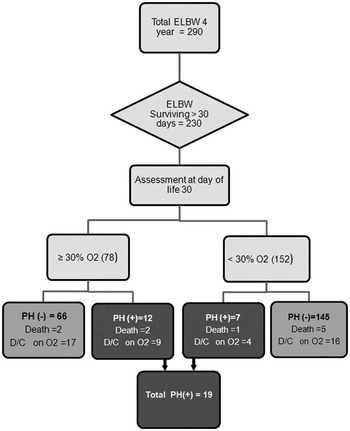
A total of 290 extremely low birth weight infants were admitted over a 4-year period to the neonatal intensive care unit at All Children’s Hospital; 60 infants were excluded before day of life 30 due to early neonatal death (n=56) or the presence of haemodynamically significant CHD (n=4). Among all, 230 infants who survived beyond day of life 30 were included in the study (Fig 1). At day of life 30, 78 of the 230 infants (34%) required oxygen supplementation at 30% or higher and 12 of the 78 had a diagnosis of pulmonary hypertension. In comparison, 152 infants out of the 230 infants had a supplemental oxygen requirement of <30%. Of the 152 requiring oxygen supplementation, seven (4.6%) patients had a diagnosis of pulmonary hypertension. A total of 19 out of 230 infants in both the groups (8.3%) met the criteria for the diagnosis of late pulmonary hypertension.
Flowchart of the infants in the study. O2=oxygen; D/C=discharge; ELBW=extremely low birth weight infant; PH(+)=infant with pulmonary hypertension; PH(−)=infant with no pulmonary hypertension.

Patient characteristics
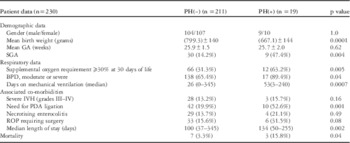
The demographic characteristics for infants with late pulmonary hypertension and without late pulmonary hypertension are shown in Table 1. No differences existed in relation to gender (p=1.0) or gestational age (p=0.62) between the two groups. Infants with late pulmonary hypertension were more likely to have a lower mean weight at birth (667.1±144 versus 799.3±140 g, p=0.0001), to be small for gestational age defined as birth weight <10th percentile for age (47.4 versus 14.2%, p=0.004). These findings suggest that extremely low birth weight infants with pulmonary hypertension are more likely to be small for gestational age and have had some form of intra-uterine growth restriction.
Comparison of patient data in 230 extremely low birth weight infants with and without late pulmonary hypertension.

BPD=bronchopulmonary dysplasia; GA=gestational age; IVH=intra-ventricular haemorrhage; PDA=patent ductus arteriosus; PH(+)=infant with pulmonary hypertension; PH(−)=infant with no pulmonary hypertension; ROP=retinopathy of prematurity; SGA=small for gestational age
Chronic lung disease characteristics
Clinical characteristics are shown in Table 1. Infants with pulmonary hypertension were more likely to need at least 30% oxygen supplementation at 30 days of life (63.5 versus 31.3%, p=0.005), moderate-to-severe bronchopulmonary dysplasia (89.4 versus 65.4%, p=0.04), and longer median duration of mechanical ventilation (53 versus 26 days, p=0.0007). These data suggest that extremely low birth weight infants with pulmonary hypertension have more significant lung disease compared with their counterparts without pulmonary hypertension.
Co-morbidities and mortality
Extremely low birth weight infants with pulmonary hypertension were more likely to require a patent ductus arteriosus ligation (52.6 versus 19.9%, p<0.001), had longer median length of stay (134 versus 100 days, p=0.002), and had increased mortality (15.8 versus 3.3%, p=0.04) compared with infants with no pulmonary hypertension. No statistically significant changes were seen in relationship to the incidence of severe intra-ventricular haemorrhage, necrotising enterocolitis, or retinopathy of prematurity requiring surgery (see Table 1). The increased length of stay and mortality suggest that extremely low birth weight infants have significant morbidity and mortality associated with this disease process.
Oxygen requirement as a predictor of late pulmonary hypertension
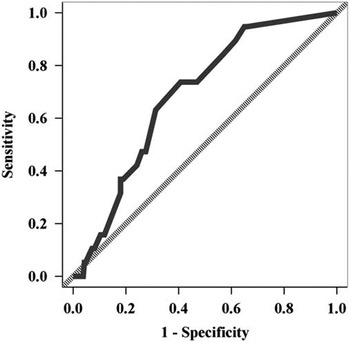
Assessments of oxygen requirement in all the infants at day of life 30 were recorded, and logistic regression analysis determined that 30% oxygen supplementation was the most sensitive point for screening for pulmonary hypertension in extremely low birth weight infants. We found that 33.9% (78/230) required supplemental oxygen at 30% or higher. Infants requiring supplemental oxygen at 30% or more had an increased risk of developing pulmonary hypertension (odds ratio=3.77, 95% confidence interval=1.42–10.00, p=0.008) compared with those requiring supplemental oxygen under 30%. This increased risk persisted, although attenuated and of borderline significance, after adjusting for birth weight (odds ratio=2.47, 95% confidence interval=0.89–6.84, p value=0.08). Receiver operating characteristic curve analysis showed an area under the curve of 0.69 (95% confidence interval=0.58–0.79, p=0.0006) for oxygen supplementation in predicting late pulmonary hypertension (Fig 2) and revealed that oxygen requirement at 30% or higher at day of life 30 as a screening tool for the diagnosis of late pulmonary hypertension in an extremely low birth weight infant was 63.2% sensitive (95% confidence interval=38.4–83.7%) and 68.7% specific (95% confidence interval=62–74.9%).
Receiver operating characteristic curve for oxygen requirement ⩾30% at day of life 30 as a screening test for late pulmonary hypertension in extremely low birth weight infants.

Discussion
All clinicians including neonatologists, cardiologists, pulmonologists, general paediatricians, mid-level providers, and bedside nurses, who care for extremely low birth weight infants, need to be aware of the inherent risks that pulmonary hypertension can have on their patients and how to detect those patients at risk of developing pulmonary hypertension. The detection of pulmonary hypertension may be difficult due to the lack of physical exam findings and may be commonly missed by routine echocardiography screening in extremely low birth weight infants. Although the sensitivity of 63% and specificity of 69% are modest numbers, this test is useful in identifying a sub-group of infants who would be at high risk of developing pulmonary hypertension later on during their hospital course. This readily available and cost-effective tool has better clinical utility than previously tested screening tools of monthly echocardiography, which can miss as many as 66% of extremely low birth weight infants at risk of developing late pulmonary hypertension.Reference Bhat, Salas, Foster, Carlo and Ambalavanan 8 This would avoid the use of excessive screening echocardiograms for all extremely low birth weight infants and focus echocardiography resources on those most likely to have clinical disease.
Our study demonstrated that both small for gestational age and lower mean birth weight were risk factors for the development of pulmonary hypertension. This is consistent with the Barker hypothesis that an abnormal foetal environment leads to end-organ changes that can then predispose to multiple chronic adult medical conditions including pulmonary artery hypertension, obesity, type 2 diabetes, systemic hypertension, and early coronary artery disease.Reference Aucott, Donohue and Northington 11 Small for gestational age is a measure of foetal growth restriction. This may be due to constitutional issues (genetics) within the foetus or due to abnormalities within the foetal environment such as maternal health issue, environmental toxin/medication, placental insufficiency, or umbilical cord abnormality.Reference Aucott, Donohue and Northington 11 Small for gestational age is a well-known risk factor for increased mortality in infants including those with cardiovascular disease.Reference Aucott, Donohue and Northington 11 , Reference Sochet, Ayers and Quezada 12 In our cohort, we also saw a high incidence of late pulmonary hypertension in small-for-gestational-age infants with almost 50% developing the disease. The findings in this study are similar to previous studies that reported high incidence of late pulmonary hypertension in infants who are small for gestational age, have more severe bronchopulmonary dysplasia, increased length of mechanical ventilation, more days of ventilation, and require patent ductus arteriosus ligation during their hospital course.Reference Danhaive, Margossian, Geva and Kourembanas 13
Bronchopulmonary dysplasia exists as a continuum of disease within extremely low birth weight infants and can be graded as mild, moderate, or severe in nature. The pathophysiology of pulmonary hypertension in a premature neonate with bronchopulmonary dysplasia includes abnormal muscularisation of pulmonary vessels and reduction of the alveolar–capillary surface area.Reference Baker, Abman and Mourani 14 This abnormal pulmonary vasculature remodelling process leads to impairment of gas exchange and a need for a prolonged oxygen requirement.Reference De Paepe, Mao and Powell 15 As this process may take several months, most extremely low birth weight infants will not develop significant pulmonary hypertension until the 3rd or 4th month of life. This makes early echocardiographic screening in the first few months of life difficult.Reference Poets, Stebbens, Richard and Southall 16 – Reference Dimaguila, Di Fiore, Martin and Miller 18 Therefore, the requirement of high oxygen supplementation early in the clinical course of preterm infants at day of life 30, irrespective of the severity of bronchopulmonary dysplasia, may be a better screening tool than echocardiography. At present, in our institution, any extremely low birth weight infant requiring >30% oxygen at day of life 30 is screened for pulmonary hypertension with a complete echocardiogram. The echocardiography is repeated every month, if there is persistent high oxygen requirement.
Very recently, two prospective studies on preterm infants have found a positive association between early pulmonary hypertension, diagnosed between 7 and 14 days, and the development of bronchopulmonary dysplasia;Reference Mourani, Sontag and Younoszai 19 , Reference Mirza, Ziegler, Ford, Padbury, Tucker and Laptook 20 one of these studies by Mourani et al,Reference Mourani, Sontag and Younoszai 19 which prospectively studied 277 premature infants ⩽1250 g, reported 14% prevalence of late pulmonary hypertension. In their cohort, screening echocardiography was performed at 7 day of life (early) and then at corrected gestational age of 36 weeks (late). Of all the infants who were diagnosed with late pulmonary hypertension at 36 weeks, around 40% did not show any evidence of pulmonary vascular disease in the early echocardiography. In the other study by Mirza et al,Reference Mirza, Ziegler, Ford, Padbury, Tucker and Laptook 20 which included a cohort of 120 premature infants of <28 weeks of gestation, the prevalence of late pulmonary hypertension was reported as 4%. Interestingly, late pulmonary hypertension in this cohort was found only in one-tenth (10%) of the infants presenting with early pulmonary hypertension. Although the findings of both the studies support the hypothesis of early pulmonary vascular disease contributing to bronchopulmonary dysplasia, their results also demonstrate the limitations of early echocardiography screening for the diagnosis of late pulmonary hypertension.
We report a prevalence of 8.3% of late pulmonary hypertension in this cohort of 230 extremely low birth weight infants, which is close to the 11.7% reported by Bhat et alReference Bhat, Salas, Foster, Carlo and Ambalavanan 8 in a previous prospective study with 140 infants. Although this study is limited by its retrospective design, the hourly recording of oxygen requirement in an electronic medical record makes it possible to accurately identify the average amount of oxygen required on any day and minimises recall bias. In addition, echocardiography was only performed when clinically indicated by the managing neonatal intensive care team; therefore, it is possible that the overall incidence could have been higher than that reported in our study, as milder cases may have been missed and self-resolved.
Although echocardiography is the most commonly used diagnostic modality to detect pulmonary hypertension in infants, it has a limited role in the risk stratification of extremely low birth weight infants early in their clinical course and has significant cost associated with its utility. We have shown that the need for oxygen supplementation of 30% or higher on day of life 30 can be used to screen extremely low birth weight infants at risk of developing late pulmonary hypertension. Identification of this high-risk sub-group will allow application of echocardiographic screening to subsequently detect pulmonary hypertension during the hospital course. In addition, screening based on supplemental oxygen requirement is the point-of-care testing, which is more readily available and is much more cost effective than echocardiography. We conclude that adjunctive use of oxygen requirement screening at 30 days of life will improve the rate of detecting late pulmonary hypertension in extremely low birth weight infants. Small for gestational age may further impact the risk of developing late pulmonary hypertension in these infants. Further prospective studies are recommended to further validate this screening tool, in the hopes that it will lead to earlier diagnosis and treatment of infants with pulmonary hypertension.
Acknowledgement
The authors acknowledge Dr Michael Fant, MD, PhD (Director, Neonatal-Perinatal Fellowship Program, University of South Florida) for his continued guidance in this research study.
Financial Support
This research received no specific grant from any funding agency, commercial, or not-for-profit sectors.
Conflicts of Interest
None.