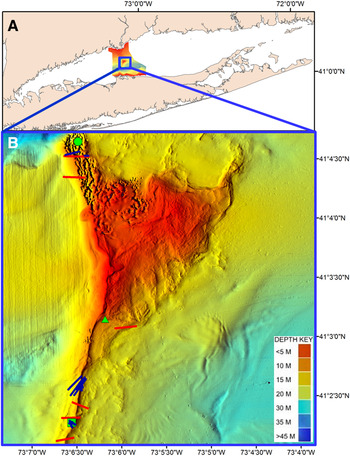
Stratford Shoal is a topographic high running north–south across Long Island Sound, separating the western and central basins of this large estuary in the north-west Atlantic (Figure 1A; Knebel & Poppe, Reference Knebel and Poppe2000). Currents over the shoal are primarily tidally-generated and run in an east–west direction, with accelerated flows occurring over the shoal (Knebel & Poppe, Reference Knebel and Poppe2000). The southern portion of the shoal has a linear, north–south-tending boulder reef along the crest (10–25 m in depth; Figure 1B) that descends to depths of 30–35 m with sediments composed of cobble to coarse sands and shell debris. While there had not been a systematic biological monitoring programme focused on Stratford Shoal, this area had been visited multiple times from 1991 to 2012 using remotely operated vehicles, camera sleds and divers to acquire imagery of the seafloor for various projects (Figure 1B). We used this archived imagery to produce a time-series of presence–absence data for epifaunal organisms, allowing a coarse resolution assessment of community changes over time.
(A) Long Island Sound showing the location of Stratford Shoal; (B) bathymetry of southern half of Stratford Shoal showing survey locations. Green triangle, June 1991, MiniRover MkII remotely operated vehicle (ROV); green square, May 2007, ISIS towed camera platform and divers; green circle, April 2010, Hela ROV; red lines, October 2012, SEABOSS camera-grab system; blue lines, December 2012, ISIS towed camera platform (bathymetry map modified from Poppe et al., Reference Poppe, Ackerman, Doran, Beaver, Crocker and Schattgen2006).

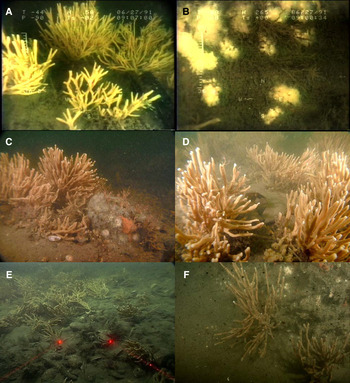
Initial observations in 1991 revealed a community on the boulder reef dominated by suspension-feeding, epifaunal invertebrates (>80% cover of rock surfaces; on average > 2 H. oculata colonies per m2; authors, unpublished data). Dominant taxa in the community included Haliclona oculata (Linnaeus, Reference Linnaeus1759; branching sponge), Astrangia poculata (Ellis & Solander, Reference Ellis and Solander1786; northern star coral), Mytilus edulis (Linnaeus, Reference Linnaeus1758; blue mussel) and erect bryozoans occurring at high densities. The same community was identified from 2007 and 2010 image records (Figure 2A–F). While we did not return to the same locations each year, all observations were consistent with this community type being distributed throughout the reef. These observations suggest a nearly 20-year period of community stability.
Exemplar benthic community at Stratford Shoal boulder reefs illustrating dominance of Haliclona oculata (height range: 10–40 cm): June 1991 (A & B); May 2007 (C & D); April 2010 (E & F). Other species present include: Astrangia poculata (B, C, F) and Halichondria sp. (D).

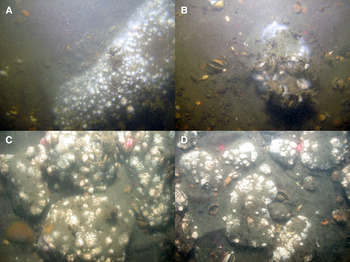
In October 2012, seafloor images of Stratford Shoal were collected as part of a systematic biological survey to produce an ecological map of Long Island Sound. These images include five transects perpendicular to the boulder reef (total transect length: 1500 m; Figure 1B). While A. poculata was still abundant, H. oculata was entirely absent in this imagery (Figure 3A, B). Current, weather and visibility constrained the area of the reef we were able to observe, so we returned in early December 2012 to search a larger area (total transect length: ~2000 m) and confirm our initial assessment (Figure 1B). While the resolution of the imagery taken makes it impossible to rule out the presence of microscopic resting stages (gemmules; Fell, Reference Fell1974), no adult sponges were found (Figure 3C, D). Haliclona oculata, with its characteristic branching morphology, was absent in 2012, but other sponges exhibiting massive (Cliona celata (Grant, Reference Grant1826)) and encrusting (Microciona sp.) growth forms were present in very low abundance (≤1 colony/m2). Whether the observed change reflects a short-term disturbance from which the community will recover or a shift in long-term community state remains unclear. Subsequently, detailed video surveys of the reef in May 2013, only eight months after our first indication that H. oculata was gone, revealed continued absence of this species. Because of the ad hoc and aperiodic nature of previous, simple presence–absence surveys, the driver of such change remains unknown.
Exemplar benthic community at Stratford Shoal boulder reefs demonstrating the loss of Haliclona oculata: October 2012 (A & B); December 2012 (C & D). Distances between laser points in the centre of panels B, C and D are 20 cm.

There are a number of mechanisms that may have contributed, individually or synergistically, to the die-off of H. oculata at Stratford Shoal. The first possibility, that our survey in October 2012 was late enough in the year for adult sponges to have regressed into an overwintering stage, is unlikely. Though the shallow water sponge Haliclona loosanoffi (Hartman, Reference Hartman1958) exhibits an annual growth, reproduction and regression cycle in New England, such cycles are rare in marine sponges (Fell, Reference Fell1978). Koopmans & Wijffels (Reference Koopmans and Wijffels2008) found reduced growth rates in adult H. oculata during winter months, but no overall die-off. Dredge sampling in Fishers Island Sound (an extension of the eastern end of Long Island Sound) found active adult H. oculata throughout the year for three years (1971–1974; Fell, Reference Fell1974). Additionally, full-sized adult sponges were observed on Stratford Shoal in April 2010, which would not be expected if sponges regressed during colder months (Figure 2E, F).
If the Stratford Shoal population of H. oculata in Long Island Sound was the result of a one-time pulse recruitment event, subsequent senescence of adult sponges could lead to the sudden disappearance of the entire population. Given that the recruitment dynamics of isolated, mid-Sound populations and the typical lifespan of H. oculata are unknown, recruitment failure and adult senescence as mechanisms for population loss are speculation. However, H. oculata populations in Fishers Island Sound were found to be reproductively active on an annual basis (reproductive structures present March–June) over a three-year (1971–1974) sampling period (Fell, Reference Fell1974). This suggests that the Stratford Shoal H. oculata population would have been reproductively active during at least some years between 1991 and 2010. In addition, examination of images across the time-series reveals sponges across a range of sizes, suggesting but not confirming the presence of multiple cohorts, as size variation could simply be due to variable growth rates (Kaandorp, Reference Kaandorp1999).
Interspecific interactions such as predation or competition could impact sponge populations but are not likely to be the sole driver of community change in this case. Numerous predators are known to prey on H. oculata, including echinoderms (Henricia sanguinolenta (O.F. Müller, Reference Müller1776); Dijkstra et al., Reference Dijkstra, Lambert and Harris2012), nudibranchs (Koopmans et al., Reference Koopmans, Martens and Wijffels2009) and fish (Chase, Reference Chase2002). However, predation events for sponges tend to be sub-lethal (Wulff, Reference Wulff2006). The branching growth form of H. oculata with a small area of attachment even for large individuals gives H. oculata the potential to be a strong competitor on hard substrates where the primary limiting resource is space (e.g. Bell, Reference Bell2007). If H. oculata had been competitively excluded, its replacement was not obvious in the October 2012 survey. Crepidula fornicata (Linnaeus, Reference Linnaeus1758) stacks found growing on boulders could have undercut H. oculata, either weakening the sponges' attachment or dislodging the sponges altogether. However, H. oculata was found to be associated with C. fornicata communities in southern England (Barnes et al., Reference Barnes, Coughlan and Holmes1973). But while no strong evidence suggests that interspecific interaction was a primary driver, we cannot discard the possibility that predation and competition played roles in the disappearance of H. oculata at Stratford Shoal. Generally, there is limited field evidence for competition or predation in sponges because dead sponges rapidly disintegrate and damaged areas quickly repair (Wulff, Reference Wulff2006). The 2.5 year lapse between the 2010 and 2012 observations makes it impossible to determine if there was a temporary pulse of predators or competitors that could have resulted in the total loss of adult sponges.
Unlike annual regression or recruitment failure followed by senescence of the adult population, thermal stress induced by increasing temperatures as a result of climate change may be more likely to have been involved in the loss of H. oculata from benthic habitats on Stratford Shoal. Long Island Sound has warmed over the last 40 years (Howell & Auster, Reference Howell and Auster2012). The summer of 2011 was particularly warm, with surface temperatures in the central and western sound reaching 26.3 to 27.3°C, respectively, in August (unpublished data, My Sound Oceanographic Observation Buoy; www.mysound.uconn.edu). The thermal tolerances of H. oculata have never been directly tested, but some evidence exists. A shallow water branching sponge identified only as Haliclona sp. from Long Island Sound was reproductively active in water as warm as 25°C (Fell et al., Reference Fell, Parry and Balsamo1984). In the western Atlantic, H. oculata is found from the Gulf of St Lawrence in the north to North Carolina in the south, but is often found in deeper waters (Hartman, Reference Hartman1958). Historically, bottom temperatures from these areas have ranged from 1 to 20°C, annually (Hartman, Reference Hartman1958). A mass mortality of H. oculata in The Netherlands in 2006 was hypothesized to be the result of an unusually warm summer (~23°C; Koopmans & Wijffels, Reference Koopmans and Wijffels2008), but this was not tested. Perhaps the most relevant evidence in favour of thermal stress as a strong driver is the continued conspicuous presence of both A. poculata and C. celata, on Stratford Shoal. Astrangia poculata can tolerate summer temperatures up to 27°C (Jaques et al.,Reference Jaques, Marshall and Pilson1983). Members of the C. celata species complex share H. oculata's Atlantic distribution (and therefore, its Atlantic temperature distribution), but are also found in the Gulf of Mexico (Hartman, Reference Hartman1958; Xavier et al., Reference Xavier, Rachello-Dolmen, Parra-Velandia, Schönberg, Breeuwer and van Soest2010) in areas where water temperatures can exceed 30°C (Miller et al., Reference Miller, Strychar, Shirley and Rüzler2010). Higher thermal tolerances for these two species would allow them to persist even at temperatures that would negatively affect H. oculata.
Increased temperatures may also work synergistically with disease, which could have caused a die-off. Increased water temperatures are linked to increased virulence of sponge disease, and environmental stress may reduce innate immune systems in sponges (Webster, Reference Webster2007). Theoretically, the branching morphology should be the most effective at battling disease because of the relative ease of compartmentalizing diseased areas (Webster, Reference Webster2007), but Shield & Witman (Reference Shield and Witman1993) found that diseased areas were often found at the base of the sponge, potentially weakening the sponge and increasing the chance of dislodgement. Rapid disintegration of dead tissue makes detection of sponge disease difficult (Webster, Reference Webster2007). Disease was attributed as the cause of a H. oculata die-off in northern Wales in 1988–1989, but no testing was undertaken to determine the presence of a pathogen (Webster, Reference Webster2007).
A major event that could have affected mid-Sound populations of H. oculata in Long Island Sound between 2010 and 2012 was Hurricane Irene. Heavy rainfall in the Rivers Housatonic, Connecticut and Thames watersheds resulted in freshwater and terrigenous sediment inputs into Long Island Sound up to two orders of magnitude greater than before the storm (USGS, 2013). Surface salinities in the sound were reduced to as low as 21.5 psu (unpublished data, My Sound Oceanographic Observation Buoy; www.mysound.uconn.edu; 1991 to 2007 average: 26.21–30.05 psu; Whitney, Reference Whitney2010), and the River Connecticut was visibly discoloured with sediment (NASA, 2013). Reduced salinities could have affected sponge populations. While H. oculata has decreased growth rates at lower salinities (Koopmans & Wijffels, Reference Koopmans and Wijffels2008), A. poculata also may have reduced abundances at low salinities (Patrizzi, Reference Patrizzi2010) and salinities below 20 ppt would also negatively affect C. celata populations (Hartman, Reference Hartman1958). Since A. poculata and C. celata were apparently not affected, low salinity due to Hurricane Irene was likely not the primary driver of the H. oculata die-off at Stratford Shoal.
Increased sedimentation due to Hurricane Irene is unlikely to have had strong negative effects on H. oculata. Populations of H. oculata in waters off New Brunswick are usually found in areas with silt and sedimentation (Ginn, Reference Ginn1997). In Lough Hyne, Ireland, sponge richness is greatest at the site with the most sedimentation (Bell, Reference Bell2007). Even some encrusting sponges can live under sediment (Bell, Reference Bell2007), but tubular sponges are able to actively avoid sedimentation by deflecting settling sediment with their exhalent water jet (Bell, Reference Bell2004). Multi-tube sponges such as H. oculata may be less suited to avoid sedimentation in that manner; however, they still may be able to withstand occasional increased sediment loads (Bell, Reference Bell2004). Additionally, while the H. oculata population is no longer present at Stratford Shoal, large, healthy-looking C. celata sponges, which presumably would also have been negatively affected by increased sediment loading, were found during our surveys.
Along with freshwater and sediment input, Hurricane Irene also caused strong wind-driven water movement in Long Island Sound with a maximum wave height of 5.27 m and maximum wind speed of 32.1 m s−1 in the central sound (unpublished data, My Sound Oceanographic Observation Buoy; www.mysound.uconn.edu). These surface conditions can translate to significant increases in shear stress at the seafloor during storms based on wave–current interactions. A previous study at a 20 m deep site in the central sound measured maximum daily tidal flows at 20–40 cm s−1 with average peak shear stress of 3 dyn cm−2 during calm conditions (Wang et al., Reference Wang, Bohlen and O'Donnell2000). During a storm event that produced significant wave heights up to approximately 1.7 m, shear stress increased to a peak value of 36 dyn cm−2, a factor of 10 from nominal tidal induced stresses (Wang et al., Reference Wang, Bohlen and O'Donnell2000). Wave height during the period of maximum impact of Hurricane Irene, approximately 3 times that of the smaller storm, would have produced greatly increased bottom stresses along the entire reef. Because of their small point of attachment, arborescent sponges such as H. oculata are more likely to be dislodged during storms than massive sponges such as C. celata. Haliclona oculata is one of a number of sponge species that produces gemmules: encapsulated masses of cells thought to be resting stages to wait out unfavourable environmental conditions (Fell, Reference Fell1974). Unlike the shallow water sponge Haliclona loosanoffi, gemmules in H. oculata do not appear to be winter resting stages but may assist with asexually re-establishing populations after adult sponges are dislodged (Fell, Reference Fell1974). An average of 76% of Haliclona oculata individuals collected year-round in Fishers Island Sound had gemmules located at the base of the sponge, where they may survive even if the sponge is dislodged (Fell, Reference Fell1974). Because of the proximity of Hurricane Irene to the imaging of Stratford Shoal in 2012, even if gemmules were able to persist through the storms, H. oculata communities may not have yet had time to recover to the point of detection by remote imaging.
In addition to the effects of extreme events, western Long Island Sound is subject to seasonal summer hypoxia (defined as dissolved oxygen as less than or equal to 3.0 mg l−1). The southern shoal region is classified in the fourth decile (i.e. 30–40%) in terms of years that the area has experienced seasonal hypoxia from 1991–2011, with a seasonal low dissolved oxygen level between 2.0–2.99 mg l−1 at the end of August 2011 just prior to Hurricane Irene (CT DEEP, 2011). Clearly, the sponge population at Stratford Shoal persisted despite multiple hypoxic events over most of the time period of our observations. However, the periods of exposure and magnitude of hypoxia are unresolved, so the roles of acute or chronic exposure to reduced oxygen remain unclear as an explanation for their local extirpation.
In locations where H. oculata is found, populations tend to be stable over many years (e.g. Kluijver & Leewis, Reference Kluijver and Leewis1994; Ginn, Reference Ginn1997; Bell et al., Reference Bell, Burton, Bullimore, Newman and Lock2006; Koopmans & Wijffels, Reference Koopmans and Wijffels2008). In addition to the current observations, only two other mass die-offs of H. oculata have been recorded: one in Wales that was attributed to disease and one in The Netherlands that was potentially the result of high temperatures (Webster, Reference Webster2007; Koopmans & Wijffels, Reference Koopmans and Wijffels2008). The analysis presented here suggests that increased temperatures in Long Island Sound combined with the effects of water movement driven by Hurricane Irene are likely the primary drivers of the H. oculata die-off at Stratford Shoal, with interspecific interactions and disease as potential, but untestable, synergistic drivers. However, in the absence of an intensive monitoring programme, determining the causes of sponge die-offs in the field is extremely difficult because dead sponges rapidly disintegrate, taking evidence of mechanisms with them (Wulff, Reference Wulff2006).
This case study highlights the need for additional monitoring of important habitats such as Stratford Shoal and increased understanding of the biology and ecology of the species found there. Hard substratum reefs are spatially rare in Long Island Sound, especially in the central and western basins and in deep (>10 m) water (Knebel & Poppe, Reference Knebel and Poppe2000; Poppe et al., Reference Poppe, Knebel, Mlodzinska, Hastings and Seekins2000). Isolated, mid-Sound hard substrate communities in Long Island Sound also have few or no conspicuous non-native species, unlike near shore habitats, where non-native species are abundant (authors, unpublished data). The boulder reef at Stratford Shoal had, prior to this study, been sampled three times in the last two decades, and H. oculata is a highly conspicuous sponge with some biological data available from previous studies (e.g. Hartman, Reference Hartman1958; Fell, Reference Fell1974; Kluijver & Leewis, Reference Kluijver and Leewis1994; Ginn, Reference Ginn1997; Bell et al., Reference Bell, Burton, Bullimore, Newman and Lock2006; Koopmans & Wijffels, Reference Koopmans and Wijffels2008). However, lack of systematic monitoring and local process studies precludes any understanding of the fine time scale dynamics of change in this community, allowing us to only hypothesize what the drivers of change may be. Understanding of the dynamics of isolated, mid-Sound reef communities and the functional roles of component species (e.g. H. oculata can be important habitat for fish, Houziaux et al., Reference Houziaux, Haelters and Kerckhof2007) is needed in order to assess the role of natural variation versus human-caused drivers and to link management actions to goals for conservation and sustainable use.
ACKNOWLEDGEMENTS
Funding was provided by the Long Island Sound Seafloor Mapping Fund administered cooperatively by the EPA, Long Island Sound Study and the Connecticut Department of Energy and Environmental Protection (DEEP). We thank the captains and crews of the RV ‘UConn’ (1991), the OSV ‘Bold’ (2007), the RV ‘Lowell Weicker’ (2007), the NOAA Ship ‘Victor Loosanoff’ (2010, 2012) and the RV ‘Connecticut’ (2012), as well as all of the pilots and engineers responsible for multiple remotely operated vehicle and camera platform operations. Dr James O'Donnell and Ms Kay Howard-Strobel kindly provided oceanographic data from the MySound ocean observatory network (www.mysound.uconn.edu). This manuscript was greatly improved by comments from Liz Huett.