In 1839, Benjamin Love, the author of the provincial guide Manchester As It Is, observed that ‘wherever a country becomes populous, nature is always compelled to give way to the convenience or the caprice of man. . .the whole forms a scene rich and magnificent, rarely equalled, perhaps nowhere excelled’.Footnote 1 For the past two centuries this ‘scene’ of industrial provincial England has proved a compelling subject for social commentators, politicians and novelists alike. Some, like Benjamin Love, celebrate its visual magnificence, while others, including Carlyle, Dickens and Disraeli, present a darker vision of manufacturing towns.Footnote 2 Such literary descriptions made a powerful and lasting contribution to the identities and popular perceptions of towns such as Manchester, Birmingham and Sheffield. Yet, equally influential was the mass of visual imagery that acquainted readers, viewers and consumers with the emerging iconography of industrial England. Although visual representations of the urban environment have benefited from some historical commentary, this article seeks to go beyond what has already been done. In particular, it aims to expand and develop the historical-visual analysis of early nineteenth-century provincial towns in two main ways. The first of these is to challenge the tendency to employ visual material as mere illustrations to historical arguments.
In recent years visual material has acquired a more prominent position in the historiography of the urban environment. However, despite this increasing awareness of visual evidence, its role continues to be predominantly illustrative. Where mortality statistics and town plans are the staple content of urban histories, extensive studies of visual urban representations have, for the most part, been restricted to art historical and literary enquiries, most of which focus upon London.Footnote 3 With the exception of the work of a minority of historians such as Simon Gunn and Lynda Nead, the vast majority of studies of nineteenth-century urbanization rely upon statistics, official reports and cartography to reconstruct and analyse the urban environment.Footnote 4 Such resources are crucial in establishing a chronology of sanitary improvement or when seeking an overview of the social structure. However, if, as Simon Gunn has suggested, the transformation of the urban environment at this time resulted in a ‘re-imagining’ of the urban sphere, then such resources are, by their nature, limited in their insights.Footnote 5 Attempts have been made to develop methodologies for categorizing and interpreting visual representations of the urban environment. Terms such as ‘panoramic’ and ‘episodic’ or ‘view’ and ‘sketch’ have been used to categorize urban imagery.Footnote 6 Yet, in each case, where scholars have engaged with visual material, their attention has been directed towards ‘high art’ and oil paintings rather than the printed image, ephemeral object or exhibition arena.Footnote 7 If visual material is to be truly useful to the urban historian it must be recognized and employed, not merely illustratively but as a valuable and central tool for ‘reading’ and understanding towns, cities and the process of urbanization.
This article is based upon research into approximately 700 printed images of provincial towns produced between c. 1770 and 1860, the vast proportion of extant printed topographical imagery pertaining to Manchester, Leeds, Birmingham, Sheffield, Liverpool and Bristol from the period.Footnote 8 Such material has, in the past, been deemed generally to be ephemeral, and therefore insubstantial, by archivists and historians alike. Consequently, it is often poorly catalogued and relegated to the all-inclusive class mark of ‘local interest’. The initial phase of this research therefore necessitated a comprehensive survey of archives and collections ranging from local studies libraries, the Bodleian and British Libraries and public and private collections including those of Manchester Art Gallery and the Company of Cutlers, Sheffield. Such a broad and inclusive survey revealed a vast quantity of visual imagery that is rarely consulted or considered by the academic community. Within this mass of topographical material exist a number of pictorial sub-genres such as views of civic institutions, parks and gardens and private residences, all of which invite further study. Focusing upon the towns of Sheffield and Birmingham, and using printed and ephemeral imagery, this article will concentrate on just one of the pictorial sub-genres identified: the visual representation in commercial advertising of perhaps the most significant evolution in the early nineteenth-century townscape, the manufactory.
The towns of Sheffield and Birmingham are ideal for such a study as the metal-ware industry was well established in these locations prior to the urban population explosions that accompanied the industrial revolution.Footnote 9 Furthermore, unlike the cotton-processing manufactories of Manchester and Lancashire, small independent metal-ware manufacturers continued to operate alongside larger, centralized manufactories throughout the nineteenth century. This combination of small-scale manufacture and gradual centralization spawned a rich body of pictorial advertising that has benefited from relatively rigorous electronic and manual cataloguing in the respective libraries. Both the large quantity of material produced in these towns and its present accessibility ensure that this study is supported by a substantial and diverse body of evidence.
The second objective of this article is to challenge the tendency to polarize nineteenth-century responses to the town. From the time that provincial industrialization and urbanization were first recognized as radical and permanent phenomena, debates and questions about their physical, political and social consequences accompanied every topographical modification. Urbanization, urban migration and the changing landscape became objects of public scrutiny. When addressing this period of rapid urban change, urban historians and historical geographers alike have tended to interpret literary and visual accounts of urbanization as expressing either euphoric celebration or unadulterated despair.Footnote 10 In recent years the anxious voice of despair has prevailed in historical commentary as research on nineteenth-century cities has privileged the Victorian metropolitan environment and its dramatic images of social inequity, material degradation and decay.Footnote 11 Urbanization, particularly when fuelled by industry, has been represented as a moral contrast to the innocence of rural living, or as Raymond Williams frames it, ‘worldliness’ as opposed to nature.Footnote 12 The demonic, Babylonian city described so vividly in Lynda Nead's Victorian Babylon has become a popular, almost inescapable idiom among urban, social and cultural historians.Footnote 13 Certainly, by the 1830s, topographical change in England was advanced enough to prompt informed critical reflection. There were a number of high-profile condemnations of the urban realm and particularly its ‘slums’, perhaps most famously Friedrich Engels' damning verdict on Manchester in 1844.Footnote 14 Yet this was not an image of urbanization known to a generation of early nineteenth-century observers who had yet to witness municipalization, the impact of railways and the social problem writing of Dickens and Mayhew. Although condemnation made up a substantial section of popular opinion, it should be understood as only one response in a wide spectrum of attitudes towards the urban environment, and one which was far more prevalent in later decades than in the early years of the century. An altogether different urban ‘scene’ is represented in literature and imagery produced in the first few decades of the nineteenth century.Footnote 15
By focusing on the first half of the nineteenth century, it is hoped that this article will demonstrate the extent to which early nineteenth-century responses to provincial urbanization were informed by eighteenth-century urban values such as architectural improvement and commercial and civic integration. Although, in later years, the visual and environmental impact of urbanization and industry would be widely condemned, during the first half of the nineteenth century it was still possible to perceive urban and industrial expansion as complementary to aesthetic beautification and civic prestige.Footnote 16 Therefore, in order to identify and understand the values that informed contemporary interpretations of early nineteenth-century urbanization, it is necessary to consider these representations from the perspective of continuity with the past, rather than searching for precursors of the Victorian Babylonian model. The cultural and social consequences of what Peter Borsay has dubbed the ‘English urban renaissance’ of the eighteenth century continued to define the provincial urban environment and the wider urban hierarchy in the early decades of the following century.Footnote 17 The fundamental values of employment, prosperity and aesthetics, which in the eighteenth century had informed many aspirations for provincial towns, still dominated their visual representation and popular image.Footnote 18
Modes of visual advertising
Provincial urban identity at the beginning of the nineteenth century comprised a number of components, each of which was communicable through visual imagery. Topographical beauty was represented in impressive panoramic townscapes, and cultural institutions were illustrated in small wood-engraved vignettes in guide books and directories. A town's commercial or ‘industrial’ character could be represented in each of these forms, as well as in the additional arena of advertising and promotional imagery. Taken collectively, ‘advertising’ represents a vast corpus of images that not only acquaints the viewer with an area's industrial architecture, but also with more general attitudes towards urbanization. Furthermore, as advertising gradually permeated the national press, commercial advertisements became the most widespread and accessible visual representations of provincial towns.
The sheer range of imagery, objects and exhibitions that constitute commercial advertising during this period indicates the diversity of audiences and markets to which promotional images were directed. The most common form, the printed advertisement, was also the cheapest and one of the earliest to emerge, although this genre in itself incorporates many variations. Since the arrival of ‘Advertisers’ in the eighteenth century, the front pages of such newspapers were frequently given over to notices of commercial, civic and social events.Footnote 19 As commercial activity expanded and printing technology became progressively sophisticated, small motifs or vignettes were increasingly incorporated into formerly text-based columns of advertisements, creating what Brian Lake has dubbed ‘display’ advertising.Footnote 20 During the early decades of the nineteenth century these increasingly pictorial advertisements broadened in their content to incorporate views of premises, goods and, in later decades, accolades such as exhibition medals. Unlike the column-headers that preceded them, this new generation of visual advertising presented the viewer with a pictorial reference to the architecture, occupations and achievements of specific towns and their inhabitants.
This evolution of printed advertising was enabled, in part, by rapid developments in the technology of print manufacture. During the eighteenth century, print manufacture had continued to operate on two distinct levels. At the cheaper end of the market were low-quality wood cuts and wood engravings. Although in some instances wood cuts could be highly desirable, as in the case of the work of Thomas Bewick, many were relatively crude and their subjects tended to be equally simplistic.Footnote 21 By their nature wood cuts were limited in size and, although occasionally coloured by hand, they did not permit the rendering of depth and form through tone.Footnote 22 In contrast, stand-alone prints, as well as those bound in expensive volumes destined for connoisseurs at the high end of the market, were usually produced by the copper-etching process. This ensured a high-quality image and allowed the engraver to develop a degree of tonal variation and fine detail.Footnote 23 However, although capable of producing high-quality imagery with the potential for mass-appeal, this process was not suitable for large edition numbers, as the soft copper plate degraded with each edition. The arrival of steel-engraving in 1824, and steam-powered printing presses in the 1830s, meant that publishers could combine the quality of copper-plate engraving with the high edition numbers necessary for effective commercial advertising.Footnote 24 The potential of printed advertisements was realized further with the arrival of lithography, which was in common use by the end of the 1830s. Although initially restricted to monochrome illustrations, lithography eventually enabled the mass-production of colour imagery for both commercial and fine art prints. Andrew Hemingway has argued that these different print media tended to be used for different functions, with line engraving used predominantly for picturesque topography and lithography for ‘modern’ subjects.Footnote 25 However, this distinction is not always apparent. Instead, the nature of the publication and the market to which it was directed dictated the quality and cost, and therefore the technique used to produce urban imagery. Trade cards for prestigious firms were as likely to be produced by copper-plate engraving as picturesque scenes or folio plates.
Just as printing techniques evolved, so too did the range of material in which printed advertisements could be found; pictorial advertisements for provincial manufacturers, wholesalers and retailers found their way into an increasingly varied range of media. As provincial firms grew in scale and influence, advertisements for their products crept into the pages of the national press and specialist periodicals. As the advertising supplement to the successful Art Journal demonstrates, even advertisements targeted at the metropolitan retail market might incorporate explicit references to the provincial manufacturer. In one example, the London retail address of the Birmingham glassware manufacturer F. and C. Osler is advertised as the source of an ‘extensive stock’ of decorative glassware for the metropolitan customer. Nevertheless, it is an image of the firm's Birmingham manufactory that heads the advertisement.Footnote 26
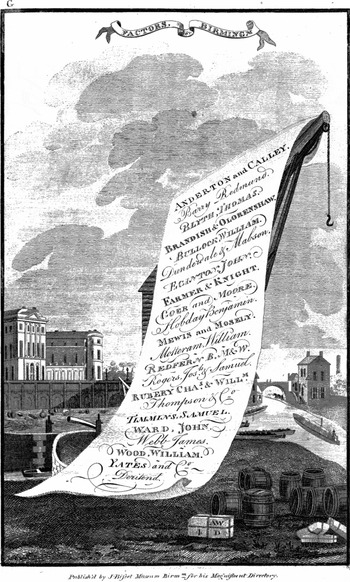
Notwithstanding the expanding scope and potential of newspaper advertising, perhaps the most prolific sources of this type of imagery are national and local trade directories. Half-page, full-page and even large fold-out advertisements were bound into numerous commercial directories published by firms such as Blackwell and Pigot and Company.Footnote 27 In such instances, advertisements were not incorporated into a larger page of text, as was the case in newspapers, but instead occupied entire sheets that were inserted as additional pages, some of which were larger than the standard page size of the publication and were consequently trimmed or folded to fit the volume. Although, in most cases, advertisements were not the focal point of a volume, in some instances they were recognized as an important component of a topographical guide. Advertisements could be combined with street indices, as in the case of Tallis' London Street Views of 1839, where plates depicting premises and commercial streets form a kind of visual index to a town.Footnote 28 As one particularly elaborate collection of such lists, Bisset's Magnificent Guide; Or Grand Copper Plate Directory for the Town of Birmingham (1808) demonstrates, the industrial or commercial identity of a town could be powerfully communicated by the text and image combination that characterizes this form of advertising (Figure 1).Footnote 29 In this instance, topographical views, street scenes and trompe l'oeil trade cards, as well as illustrations of individual premises, form a visual equivalent to the names, trades and products advertised in the text. In most cases the pages follow the convention of listing the businesses located along a particular street. Listed in this manner, the names of manufacturers and their companies appear alongside those of physicians, lawyers and other urban professionals.Footnote 30 The result is a comprehensive index of urban diversity that associates manufacturing within the most prestigious strata of professional urban society, as well as highlighting the prominent position of industry in some of the grandest urban thoroughfares. The manufactory and warehouse are included as familiar and integral components of the urban scene rather than symbols of aggressive urban reorganization.
Page from J. Bisset, Bisset's Magnificent Guide or Grand Copper Plate Directory for the Town of Birmingham (Birmingham, 1808). Reproduced by kind permission of Birmingham City Council.

By presenting trade and commerce within an embellished and heavily illustrated volume, the very structure of Bisset's directory suggests a perceived synthesis between the values of manufacture and commerce and those of polite and fashionable consumption within the urban environment. The publication itself represents a kind of emporium in which the manufactures of the great toy shop of Birmingham are displayed for appraisal and purchase. This sophisticated cross-fertilization between the urban experience of polite consumerism and the visual representation of industry suggests wide spread tolerance, and even active appreciation, of urban manufacturing.
Advertisements for industrial and retail premises could also be found at the rear of, or even illustrating, the increasingly popular tourist guides and road books.Footnote 31 In some cases these forms of commercial representation replicated the scale and artistic ambition of high-quality topographical engravings. F. Edington's 1808 advertisement for Boulton's Soho Manufactory on the outskirts of Birmingham, which featured in Bisset's Guide, is one such example.Footnote 32 While such ambitious images are not uncommon, other forms of pictorial advertising were more modest in scale. Throughout the period, trade cards and bills of trade constituted two of the most ubiquitous forms of advertising.
The role of the trade card in commercial promotion was firmly established in the early eighteenth century when their visual content was predominantly decorative. During the latter half of the century this cartouche model was slowly superseded by a preference for more specific imagery including individual premises and products.Footnote 33 In addition to these relatively small trade cards, by the early nineteenth century bills of trade and commercial correspondence were also frequently headed with images of particular premises or occasionally even an entire townscape.Footnote 34 There are various possible explanations why townscapes were incorporated into advertisements. Julie Anne Lambert has suggested that some proprietors may have thought a general view more attractive than that of their own premises or their immediate vicinity.Footnote 35 Equally, the decision may have arisen from a civic-minded desire to raise the profile of their town, or even out of an aspiration to associate a business with the increasingly prestigious genre of landscape painting. Whatever the motivation, by the early decades of the nineteenth century topographical views of both individual premises and entire townscapes dominated commercial advertising.
With private commercial interests driving the production of both sheet advertisements and urban guide books, falsification and embellishment must be assumed to be inherent features of this genre. Yet, in many cases, it is the subjects and forms of these exaggerations that provide the most valuable insight into the construction and evolution of provincial urban identities. Although advertisements were subject to a degree of artistic licence, changes in scale and emphasis in these visual representations do not so much indicate a conscious misrepresentation of the urban scene as suggest a familiarity with a number of slowly evolving aesthetic norms, conventions or ‘models’ that could be invoked to present a tableau of urban prosperity.
The ‘vignette model’ and early nineteenth-century advertising
During the early decades of the nineteenth century, the foundries, works and wares of Sheffield and Birmingham were increasingly presented to the public through the various modes of advertising outlined above. The companies advertised range from individual edge-tool grinders to comparatively large-scale steel foundries, as well as trades unrelated to the metal-ware industries.Footnote 36 Yet, the advertisements that represented this diverse assortment of goods and services were less varied in format than the trades they promoted. In general, they conform to the pictorial conventions of urban representation as defined by guide-book illustrations.
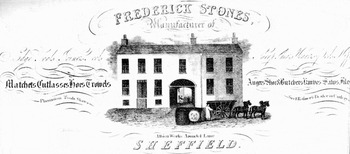
In such images, individual buildings and works are often depicted in isolation, with the tone and orientation of the view emphasizing the front aspect of the premises. In most cases this elevation favoured administrative buildings rather than manufacturing sheds. Advertisements such as that for Frederick Stones' Albion Works, Sheffield (1828), typify this form (Figure 2).Footnote 37 Here the grinding works are represented by an almost wholly two-dimensional façade as seen from the street, indicative of the simplified vignettes that increasingly illustrated guide books. Although commercial activity is suggested implicitly by the obviously promotional intent behind the image, explicit references to manufacturing are confined to the surrounding text. Over the following century a number of new, more sophisticated forms of printed advertisement would emerge. Nevertheless, this representational model continued to be used well into the 1860s.Footnote 38
Advertisement for ‘Frederick Stones' Albion Works, Arundel Lane, Sheffield’, Blackwell's Directory of Sheffield (Oxford, 1828). Reproduced by kind permission of Sheffield City Council.

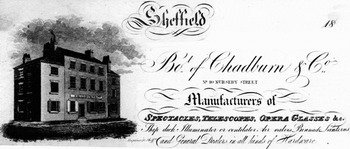
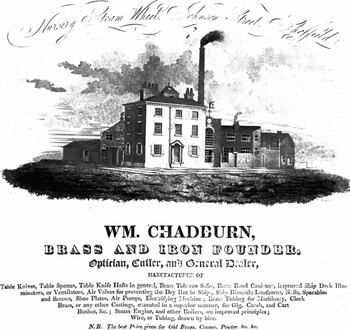
Another example of the vignette model can be seen on a bill of trade for Chadburn and Company, manufacturers of ‘spectacles, telescopes, opera glasses etc’ (c. 1825) in which the firm's Nursery Street premises are represented as almost indistinguishable from a townhouse, high street retailer or possibly an urban public house (Figure 3).Footnote 39 Of course, a great number of Sheffield manufacturers at this time operated on a very small scale. After the Cutlers Company effectively lost its control over the industry, as the consequence of an act of parliament in 1814, the title of ‘manufacturer’ became relatively simple to acquire: one needed merely to stamp and market finished products rather than be principally responsible for their production.Footnote 40 However, a slightly later sheet advertisement for the Chadburn firm, published in 1828, demonstrates how even where significant processes of manufacture were undertaken, such as grinding or forging, the preferred aspect remained that which depicted industrial premises in a scale commensurate with Georgian urban architecture (Figure 4).Footnote 41 In this instance it is the Johnson Street aspect that dominates the view, with the smaller manufacturing sheds and the steam wheel, so celebrated in the heading, receding behind the Georgian façade. Characteristically industrial buildings that resist the scale and aesthetic treatments of the traditional vignette model are minimized within the overall view. It may be argued that premises such as these, which combined the activities of manufacturing and retail, might justifiably emphasize only one of these activities in an advertisement targeted for trade suppliers or private retail customers respectively. However, as similar, if not identical, images of premises were employed in trade directories, tourist guides and bills of trade, it must be concluded that the decision to minimize manufacturing processes in visual advertisements owed more to the survival of an established pictorial conceit than to an attempt to target specific audiences.
Bill of trade for ‘Chadburn and Company, 40 Nursery Street, Sheffield’ (1825). Sheffield Local Studies Library, picture number S10079. Reproduced by kind permission of Sheffield City Council.

Advertisement for ‘Chadburn and Company, Brass and Iron Founder, Sheffield’, Blackwell's Sheffield Directory (1828). Reproduced by kind permission of Sheffield City Council.

Whilst acknowledging an evident preference on the part of advertisers and their printers for established pictorial conventions, it is important to recognize that this was not merely achieved by entirely excluding manufacturing processes from scenes. Many advertisements include explicit references to furnaces and workshops. However, in advertisements dating from the earlier decades of the nineteenth century, these symbols of industry are most usually contextualized alongside other, more traditional urban structures. In the earlier of the Chadburn advertisements, the retail premises, offices and proprietor's residence help to balance the chimney stack and manufacturing sheds to the rear of the view. Clearly, although technology was advancing and the scale of production increasing behind numerous neo-classical façades, the urban ‘face’ of manufacturing continued to conform to an inherited pictorial model.
Screening or ‘balancing’ industrial sheds and foundries, and preventing them from interrupting conventional urban topography, was not the only manner in which conventional views of façades contributed to the continuing influence of eighteenth-century aesthetic and commercial values upon the townscape. In addition, the visual emphasis upon doorways and entrances to premises suggests the endorsement and even celebration of commercial exchange between the contrasting spheres of the street and the manufactory. These gateways are almost always depicted open, with products, customers and workers moving between the urban street and the industrial warehouse or foundry. One highly finished advertisement for the Sheffield timber and slate merchants, L.G. Reed and Company, c. 1840, depicts a labourer occupying the pavement alongside a fashionable couple, as large qualities of timber pass from the yard into the smart thoroughfare.Footnote 42 Thus, although screened from the streets that surrounded them, it seems clear that industrial premises were understood and appreciated as being integral to the urban structure.
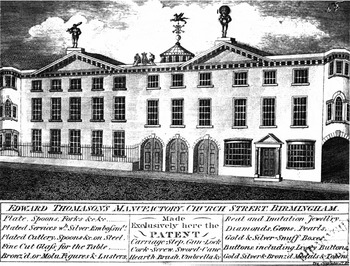
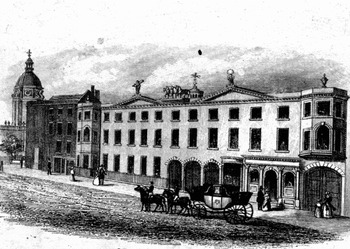
The degree to which manufactories were recognized and endorsed as a crucial component of urban improvement is evident in two representations of Edward Thomason's manufactory buildings on Church Street, Birmingham (Figures 5 and 6). To some extent the earlier of the two images, taken from Bisset's lavish Guide (1808), adheres to the model of pictorial isolation described above.Footnote 43 No explicit reference is made to the wider townscape, but the inclusion of a thoroughfare and pavement in the foreground suggests the manufactory's situation within a conventional urban high street. In this early view the retail entrance is even indicative of domestic premises of the time and, with the exception of bay windows, reflects the architectural conventions of the wider building. The premises are depicted as an integral piece of a well-established urban fabric rather than an agent in the redefinition of the townscape. The products of the manufactory are listed explicitly in the accompanying text but the view of the building exhibits little evidence of its industrial purpose.
Tradesman's list for ‘Edward Thomason's Manufactory, Church Street, Birmingham’, Bisset's Magnificent Guide or Grand Copper Plate Directory for the Town of Birmingham (Birmingham, 1808). Reproduced by kind permission of Birmingham City Council.

Advertisement for ‘Edward Thomason's manufactory, Church Street, Birmingham’ (c. 1825), Birmingham Local Studies Library WK/B11/4170. Reproduced by kind permission of Birmingham City Council.

Although it is important to appreciate the potential significance of text–image relationships in advertisements that incorporate both verbal and visual references, it is wrong to assume that the presence or content of letterpress completely transformed the manner in which an image was received and interpreted. As trades had historically been advertised to a semi-literate public via a series of visual icons, it is reasonable to give the visual components of advertisements an equal or even dominant status over the verbal content. Furthermore, unlike later advertisements that, as a consequence of cheaper printing processes could be produced for highly specific purposes, the reliance upon stock views for most early nineteenth-century printed advertisements, guide books and souvenirs means that attempting to distinguish between the semiotic structure of these different genres is misleading. Instead, it is fair to surmise that the conventional ‘topographical print’ format of the 1808 view of the Thomason premises attributed to the company the ‘traditional’ qualities of urban prestige, elegance, good taste, permanence and integration, without compromising the commercial function of the letterpress listings.
This integration of the Thomason premises within the surrounding urban fabric is suggested further by the scale and elevation of the view. The close vantage point, taken from the far side of the street, replicates the enclosed, foreshortened visual range permitted by the urban environment. The spatial and architectural integration of industry within the townscape is also demonstrated in a slightly later image of the same premises (c. 1825).Footnote 44 Here, the vantage point permits a wider view of Church Street, revealing additional premises and the imposing tower of St Philip's Church to the left of the Thomason works. However, the visual scope again replicates that of the urban pedestrian with the immediate vicinity of the works populated by a range of urban society. In addition to quoting the ‘human motif’ so prevalent in picturesque landscapes and adopted in many townscapes, the conspicuous presence of women and children attributes to the street the qualities of safety, civility and leisure, as well as production and commerce. The positive connotations of these ‘human motifs’ is reiterated by the inclusion of a grand carriage, complete with crest, that not only testifies to the fashionable clientele of the business but also to the quality and desirability of the company's manufactures. Implicit in such a conspicuous reference to private wealth is the recommendation of the wider town as a location of social and commercial consequence. Birmingham is represented not only as the site of production, but also, significantly, as a suitable location for the purchase and consumption of the locally manufactured goods. By demonstrating the manufactory's integration into the urban environment and society in this way, the image reveals the compatibility of civic-minded attempts at urban promotion and those ambitions motivated by private, commercial interest. Manufacturing was not only spatially and physically integrated into the urban infrastructure, but also, and perhaps even more importantly, there was a synthesis of purpose between civic and commercial promotion.
In the sense that their prosperity and population relied upon manufacturing, large conurbations like Birmingham were certainly understood as ‘commercial’ or ‘industrial’ towns during the first half of the nineteenth century. However, the architecture, mammoth scale and pollution that would later be so closely associated with industrial towns had not yet come to dominate visual representations of the provincial urban environment.
The shift in balance between street and manufactory
As the century progressed, attitudes and expectations towards industrial activity altered, demanding a revised model for commercial advertisements. A pictorial realignment occurred that was so fundamental that it can only be understood as the result of a substantial reorganization of the value system upon which the urban hierarchy was structured. This period of ideological and pictorial transition can be traced in a number of advertisements for W. Greaves and Sons' Sheaf Works, Sheffield, produced between 1825 and the 1850s.
Built in 1823, William Greaves' Sheaf Works represented a new urban landmark as well as a relatively new model for steel manufacture in Sheffield. Whereas most steel manufactured in the town continued to be produced in small workshops and passed between forge, grinder and finisher, Greaves and Sons' factory centralized a number of the primary processes within one large site.Footnote 45 The consequent large size of the works and its numerous bottle furnaces did not conform to the model of small-scale manufacture and urban integration of the type so celebrated in earlier advertising. Thus, the Sheaf Works, along with the increasing number of progressive factories that followed suit, not only represented a departure from an older model of production, but also, by necessity, from former models of advertisement.
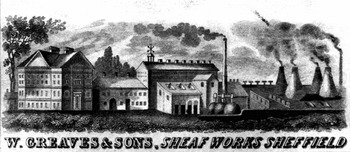
An image from 1825 indicates both a shift in ambitions for urban industry and the beginnings of a visual reconfiguration commensurate with this change in values (Figure 7).Footnote 46 By virtue of its extent, layout and location, William Greaves' premises represent a physical analogy to this period of ideological transition. Bordered on two sides by the urban thoroughfares of Cadman Street and Maltravers Street, and on a third aspect by the new Sheffield and Tinsley canal (opened in 1814), the location of the works is historically resonant, situated as it was at the intersection of the traditional urban high street and a wider regional and national network.
Advertisement for W. Greaves and Sons' Sheaf Works, Sheffield (c. 1825), Sheffield Local Studies Library, picture number S09762. Reproduced by kind permission of Sheffield City Council.

In many ways the aesthetic treatment of the site in this advertisement adheres to the inherited model of the guide-book vignette. The trees to the left and rear of the buildings quote the picturesque motifs popularly used in the depiction of rural landscapes throughout the late eighteenth and early nineteenth centuries.Footnote 47 The grandeur of the administrative and retail building suggests a similar comparison. The industrial structures, although revealed, remain distinct and segregated from the smarter architecture of the grand frontage. In a similar fashion to earlier advertisements, the Sheaf Works appear as a façade of structures. Although in this instance it is composed predominantly of industrial furnaces and sheds, the lack of depth to the site implies a degree of spatial confinement. Industry is no longer concealed, but it remains contained.Footnote 48 The human vantage point used in this image also demonstrates compositional and ideological continuity with earlier models. Here the site is viewed from the side, rather than being contextualized within the urban street, but the premises are still viewed from street level. Nothing is revealed to the viewer that would not be perceptible to an observer from the same location.
By the late 1840s the form and motifs of traditional topographical advertisements were no longer reconcilable with the ambition and scale of new manufacturing practices. Although the historical provenance of a firm continued to be appreciated in guide books and directories, the new virtues of mass production and centralization of manufacture superseded more traditional qualities as indicators of commercial prestige.Footnote 49 Whereas visual advertisements had formally contextualized manufactories within wider schemes of urban improvement, the new model promoted industrial development to the almost complete exclusion of all other urban qualities. The comparative influences of civic and industrial values upon the composition of urban identity were reversed. Industry now dictated the form of the most widely circulated representations of provincial manufacturing towns. Industrial production – its scale, architecture and skyline – became the definitive visual motif for towns in which it had been previously integrated.
The ‘microcosm model’ of the mid-nineteenth century
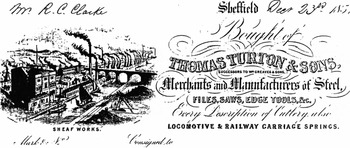
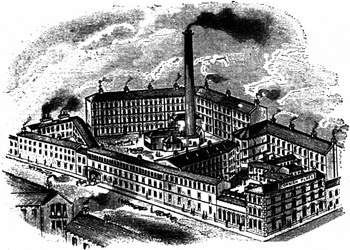
In response to this shift in the aspirations of manufacturers and the expectations of the marketplace, a new pictorial formula evolved within the genre of commercial advertising. This new model not only championed manufacturing by the inclusion of industrial landmarks such as chimneys and bottle furnaces, but also by the endorsement of premises that occupied increasingly larger geographical areas. Vast industrial microcosms, and the centralization of production they enabled, became increasingly synonymous with successful commercial enterprise. This shift towards the idealization of large-scale, centralized manufacture affected commercial advertising in a number of ways. However, what is perhaps most striking is the abandonment of the human vantage point. The impact of this change in perspective is illustrated by the contrast between the 1825 advertisement for the Sheaf Works and a later bill heading for the same premises used by Greaves' successors, Thomas Turton and Sons, throughout the 1850s (Figure 8).Footnote 50 In this image the human vantage point has been abandoned in preference for an aerial, or ‘bird's-eye’ view of the site.
Bill of trade for ‘Thomas Turton and Sons' Sheaf Works, Sheffield’ (c. 1854), in William Fawcett's scrap book, Sheffield Local Studies Library, ACC 082.2 SSTQ. Reproduced by kind permission of Sheffield City Council.

The bird's-eye view had always been a popular genre among artists and their audiences. The elevated perspective upon which it relied provided not only visual novelty, but also practical advantages as it enabled large geographic areas to be ‘taken in’. The resulting images combined visually fantastic perspectives with the informative benefits of a cartographic survey. Notwithstanding the popularity of previous examples such as the Buck brothers' prospects of the 1730s and 1740s, the genre was developed and exploited to dramatic effect during the early nineteenth century in an array of formats and for a variety of audiences.Footnote 51 In addition to relatively traditional panoramic views, aerial perspectives were translated into three-dimensional dioramas, panoramas and ‘globes’ that astonished and enthralled those who entered their specially constructed viewing theatres.Footnote 52 Dramatic natural landscapes and historic battle scenes were among the most popular subjects for such shows, but the popularity of the aerial perspective informed every type of topographical imagery. A new dimension of depth was introduced into townscapes and views of urban premises, which served to alter the concept of the urban realm, its permeability and its expansion. What Barbara J. Black has described as the bird's-eye view's ‘fantasy of supremacy’ supplanted the intimacy of the street-level encounter in views of manufactories and large commercial premises.Footnote 53 Rather than replicating the human perspective, aerial views of manufactories afforded viewers privileged visual access to premises, along with an unapologetic proclamation of their size and industrial purpose.
This adjustment in the preferred visual model from an essentially two-dimensional vignette to an inclusive, expansive view of premises was not limited to the Sheffield Sheaf works, nor was that site the first to be represented in this fashion. It is difficult and unprofitable to attempt to locate a single historical moment or even a specific town in which attitudes and expectations towards the preferred character of urban industry shifted in the manner outlined above. However, by mid-century early versions of what might be deemed the ‘microcosm model’ were in evidence throughout advertisements for all the major manufacturing trades.
This shift in perspective was progressive and did not reach its apex until the latter half of the century. An advertisement for Dixon and Son's premises (c. 1855) illustrates the manner in which this new model was increasingly accentuated and refined over the following decades (Figure 9).Footnote 54 Here the vantage point is so high as to reveal every building, yard and pathway. In this instance the chimney is not only in evidence but actually provides a central focal point for the viewer. The sheer size of the works and scale of manufacture is represented in the individual delineation of every window, roof and yard. Decorative detail and general beautification have been sacrificed for the benefit of a complete, inclusive map of the site. The urban infrastructure of streets and squares is replaced by the pathways and yards that made up the internal cartography of industrial premises, leading to their appearance as almost entire townscapes in themselves. This extreme of the microcosm model was reproduced in countless advertisements for numerous firms in the later decades of the century. Within Sheffield, Jessop and Sons used a similar vantage point in an advertisement for their Brightside Works (c. 1870), and in 1878 John Andrew and Company used the same formula for a special advertisement commemorating their success in the Paris Exhibition of that year.Footnote 55 Numerous other examples exist in the local studies archive at Sheffield and comparable collections throughout the United Kingdom.Footnote 56
Advertisement for ‘James Dixon and Son's Silver Street Works, Sheffield’ (c. 1855), Sheffield Local Studies Library, picture number S10905. Reproduced by kind permission of Sheffield City Council.

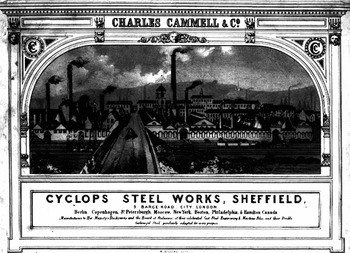
Rather than being a component of a wider urban environment, industrial premises were evolving and being represented as complex and expansive superstructures in their own right, independent of their urban situation. This autonomy from the urban infrastructure is demonstrated powerfully in M. Billing's 1858 colour lithographic advertisement for Charles Cammell and Company's famous Cyclops Works (Figure 10).Footnote 57 In this example the now familiar aerial vantage point and expansive view are clearly in evidence. However, in addition, the entrance to the premises is now a broad long thorough fare. The use of a road, or later a railway line, to reproduce the experience of approaching a location is a common visual conceit within many townscapes and topographical views. By adopting this vantage point the premises are attributed the same qualities of autonomy, importance and commercial consequence that had been previously attributed to entire townscapes.
M. Billing, colour lithographic advertisement for ‘Charles Cammell and Co.'s Cyclops Steel Works, Sheffield’ (1858), Sheffield Local Studies Library, picture number S09740. Reproduced by kind permission of Sheffield City Council.

By the mid-nineteenth century the images of provincial urban manufacture in circulation owed less and less to the modest vignette model inherited from the previous century. Advertisements now reflected the prominent role of manufacturing in the changing shape, appearance, politics and society of the urban provinces. Centralization and large-scale industrial activity were recognized not only as commercial aspirations, but also as evidence of urban prestige. Heavy industry had emerged as a central and significant urban value, and nowhere was this value more enthusiastically endorsed and eulogized than in the Great Exhibition of 1851. In its unequivocal celebration of mass production and centralization, the Great Exhibition was an official endorsement of the values that informed the microcosm model of advertising. The machinery court in the British nave attracted a huge amount of public attention and, as Jeffrey Auerbach has rightly noted, it was classes five and six, those designated for heavy machinery, that dominated published commentaries of manufacturing processes.Footnote 58 The various stands and displays that made up the British section were, in effect, a physical translation of those advertisements where scale as well as ingenuity and style were celebrated.
Conclusion
Throughout the early nineteenth century the reorganization of the traditional urban hierarchy was mirrored by the evolution of a new visual vocabulary with which the urban scene was articulated. Views of provincial towns, their commercial and architectural features, displayed a clear shift in the actual and perceived form and function of provincial conurbations. As many towns expanded in geographical size, established vantage points and historic premises were consumed by urbanization and redevelopment, prompting fine artists and printers to seek new approaches to illustrating individual structures and the wider townscape. However, contrary to received historical wisdom, this process led initially to a visualization of towns like Sheffield and Birmingham that was anything but bleak and demonic.
Decades into the nineteenth century, representations of these towns continued to rely upon inherited eighteenth-century urban values and visual formulae that presented manufactories as integral to the urban fabric. The centralization and expansion of provincial urban manufacturing certainly led to the transformation of the provincial townscape. However, notwithstanding this reorganization of the urban environment, provincial urban manufacturing continued to be represented as a fundamental and desirable urban value throughout the first half of the nineteenth century. During the period covered here, pictorial advertising suggests that this transformative process resulted in neither the universal improvement nor the complete destruction of the urban environment. Instead, it reflects the transition from a view of manufacturing as being integral to a broad range of urban values and functions, to a more focused view of specific cities as predominantly and even exclusively industrial. More broadly, the images discussed here, and the large evidence base from which they have been selected, suggest a general shift away from the notion of ‘the town’ as a centre of balanced production and consumption, towards one where the urban realm was visualized primarily in terms of its productive capacity. Within this context of urban production and consumption it is not only useful, but also crucial, that the currency of that commercial nexus – the advertisements and images that regenerated the market – are elevated to a more significant and fundamental status within historical research. Only with further research into these previously dismissed pictorial sources will the true complexity and contradictions of early nineteenth-century attitudes to provincial urban development be revealed and, it is hoped, the tendency to dichotomize these attitudes definitively rejected.