Introduction
In most developing countries, poultry keeping is a widely practised activity. More than 90% of rural families in most developing countries keep one or more poultry species (i.e. chickens, ducks, guinea fowls, geese, pigeons etc), and all ethnic groups tend to be involved in family poultry production (Guèye, Reference GUÈYE2005). Family poultry is an appropriate system for supplying the growing population with high-quality protein, while providing additional income to the generally resource-poor small farmers in developing countries (Guèye, Reference GUÈYE2005; Sonaiya, Reference SONAIYA2007). In the Republic of Benin, poultry keeping is an important source of protein that contributes between 10% and 22% to the total meat production, and is a lucrative enterprise that serves as a source of income to farmers (Fanou, Reference FANOU2006).
Family poultry producers face many constraints, including high bird mortality rates, due mainly to Newcastle disease and the avian influenza (AI) in recent times (Guèye, Reference GUÈYE2009). The outbreak of AI, commonly known as bird flu, has decimated the contribution of home-produced poultry to family food security through loss of both birds and income (Sonaiya, Reference SONAIYA2007). A serious threat of bird flu to animal health and consequently transmission to humans through poultry consumption has been shown (Gueye, 2007; FAO, Reference FAO2009). Studies conducted in Nigeria show that small-scale and household level producers, especially in rural areas, were most severely affected by the AI outbreaks. Affected backyard producers suffered up to a 100% income loss, and non-affected producers witnessed poultry income losses as high as 68% (UNDP 2006; Obi et al., 2008). In Kenya, the supply-and-demand problems caused by a major AI scare reduced the prices of broiler chickens and table eggs by 15% and 15%, respectively, and the prices of indigenous eggs and chickens by 7% and 27%, respectively (Kimani et al., Reference KIMANI, OBWAYO and MUTHUI2006).
The Republic of Benin, like the rest of the world, has been exposed to various problems due to the avian influenza outbreaks. For example, because of outbreaks in neighbouring countries, the demand for eggs and chicken meat declined by more than 80% and 60% respectively in Benin, even before avian flu outbreaks were observed on 7th November 2007 (Fanou, Reference FANOU2006). Consumers’ perceptions and panic about the disease, as well as trade restrictions, resulted in sharp decreases in demands for poultry products. These typically lead to modifications in the structure, conduct and performance, and especially profitability, of the chicken markets. Using the Kolokonde and Kassoua chicken markets, the objective of this paper is to describe the performance of chicken markets in the Republic of Benin before, during and after the AI outbreak. The paper also examines the factors affecting performance in these markets. When AI broke out in Benin measures were instituted and/or strengthened to reduce its impact. For example, in the study areas, namely Kolokonde in Djougou municipal and Kassoua in Ouaké municipal, the public and poultry sectors were informed about the AI outbreak and bans were imposed on poultry trade. In the frontier (border) areas such as Ouaké, the control of poultry movements was strict and sellers sometimes had meat and eggs seized and destroyed. This study aims to evaluate the extent of the avian influenza outbreak on the poultry markets and provide strategies in order to withstand and build competitive advantages during similar crises.
Studying markets
The empirical studies on the structure, conduct and performance (SCP) paradigm have evolved over time since the early 1950s, and Lee (Reference LEE2007) and Edwards et al. (Reference EDWARDS, ALLEN and SHAIK2006), provide some review on the approaches. Most empirical work on SCP was characterised by the use of inter-industry cross-section data. Many of the empirical studies on SCP conducted in the 1960s and 1970s provided some support for the SCP hypothesis that concentration is a determinant of profitability. Variables representing barriers to entry that have been found to be significant determinants of profitability include advertising intensity, product differentiation and growth of demand. Edwards et al. (Reference EDWARDS, ALLEN and SHAIK2006), provided a review of many recent studies such as Ahmed and Khababa (Reference AHMED and KHABABA1999), McDonald (Reference MCDONALD1999), Frech and Mobley (2000), Lee et al. (Reference LEE, LEE and LEE2000), Ganesan (Reference GANESAN2001), Eriotis et al. (Reference ERIOTIS, FRANGOULI and VENTOURA-NEOKOSMIDES2002), and Kambhampati and Parikh (Reference KAMBHAMPATI and PARIKH2003), which investigated the factors affecting the performance of various industries in the context of market structure and conduct. Some of these studies use the traditional measures of profit or profit margin as indicators of performance to examine the SCP hypotheses.
However, Edwards et al. (Reference EDWARDS, ALLEN and SHAIK2006), used efficiency measures as a proxy for performance to test the SCP hypothesis. They estimated stochastic frontier production and SCP models for the trucking industry in the United States using panel data for the period 1994-2003, with output and efficiency measures as endogenous variables. They used Battese and Coelli (Reference BATTESE and COELLI1992) specifications to test the effects of variables, and the results from their study revealed that the average length of haul, average load and market concentration significantly affect the efficiency of firms.
Like previous studies on the SCP paradigm, Aleksandrova and Lubys (Reference ALEKSANDROVA and LUBYS2004) used different regression specifications to capture the effects of market concentration, market share, entry barriers (industry capital intensity and average company assets), company size (measured by assets), and financial leverage on gross margins (profits) of selected companies in Latvia. Results from their study suggested that: (a) large companies, low debt levels, moderate market power, and low capital intensity have higher profitability; (b) market concentration and firm market share have negative quadratic effects on profitability.
Surveying the Benin poultry markets
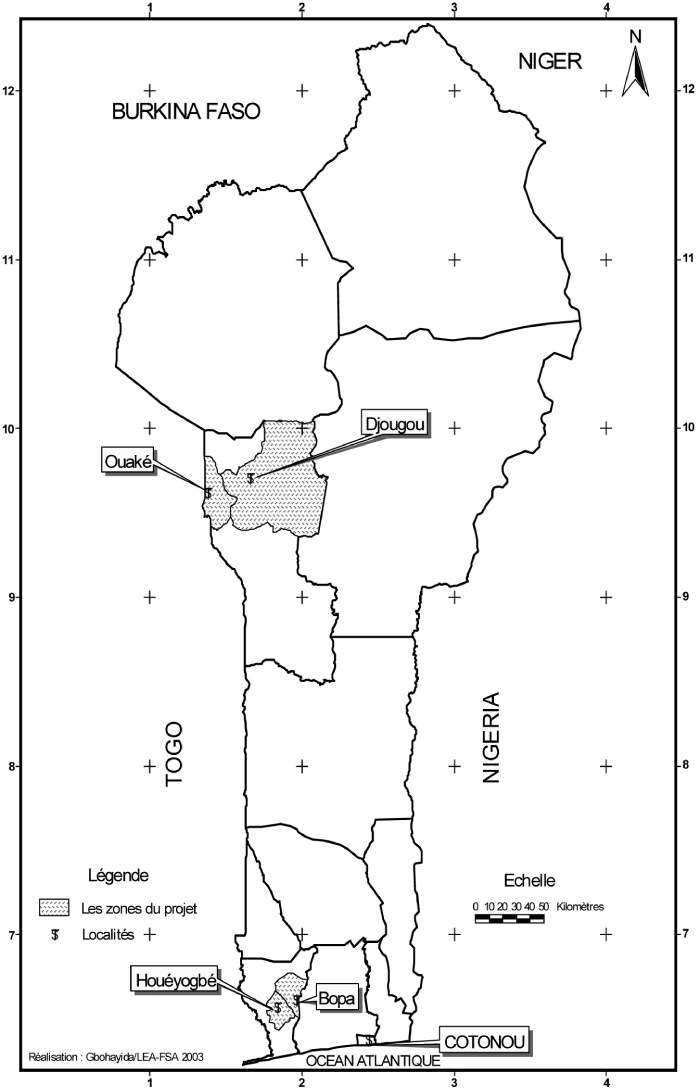
Two important markets in Benin, namely, Kolokonde and Kassoua markets, were selected for the study. Kolokonde and Kassoua markets are located in Djougou and Ouaké Municipals, respectively. Figure 1 presents the Republic of Benin, showing Djougou and Ouaké Municipals. The two regions were purposely selected because they are important markets in Benin (for poultry keeping and trade) and were likely to have experienced the effects of the AI outbreak. Kassoua market is a frontier market located at about 25 km away from Kara (a Togolese city), where there was an avian influenza outbreak, while Kolokonde market is a non-frontier market located at 18 km from Djougon, an important market town in North – West Benin. It is therefore interesting to compare the effects of the avian influenza on the two markets, frontier and non-frontier markets. The two municipalities have benefited from the PADAV (Programme d'Appui au Développment de l'Aviculture Villageoise) program, which was set up to support and help develop the village poultry farming. PADAV project provides technical assistance on small-scale poultry production and financial support to farmers.
The Republic of Benin showing Djougou and Ouaké Municipals.

The survey was tested in Djougou Municipal and the responses used to finalise the field survey, which was conducted between December 2008 and January 2009, on market days. Poultry producer-sellers (both participants and non-participants of PADAV) and middlemen were identified and purposely selected for the survey. A total of 100 respondents were interviewed. After data cleaning, 86 completed questionnaires made up of 60 producer-sellers (including 30 producer-sellers each for Kolokonde and Kassoua Markets) and 26 middlemen (including 11 and 15 middlemen for Kolokonde and Kassoua Markets, respectively) were used for the analysis. For data in monetary values, real values were estimated using the consumer price index as a deflector.
Assessment of the performance of the market
The average volume of sales per market day per seller was plotted against time (2006, 2007 and 2008) and used to describe the market trend. The average net profit and net profit per chicken realized by the seller are used as indicators of performance. The net profit was estimated as:
Profit = total revenue (TR) – total cost (TC).
The total revenue was obtained as:
TR = Q × P
where Q = number of chicken sold and P = average selling price per bird. The total cost was obtained as:
TC = FC + VC
where FC = fixed cost and VC = variable cost. The fixed cost included housing for the chicken, whilst the variable component include feeding, drugs and vaccines costs, other material costs, cost incurred in preventing AI, and birds’ purchase cost and transport cost. The average revenue, cost and profit are estimated for the markets and used to describe the performance of the markets for before (2006), during (2007) and after (2008) the AI outbreak.
To examine the factors affecting the performance of the poultry markets, the traditional measure of profit (i.e. profit margin) was regressed on selected socio-economic factors. Following Aleksandrova and Lubys (Reference ALEKSANDROVA and LUBYS2004) work, the profit margin, defined as ratio of profit to the total sales (revenue) was used as a proxy for the performance of the poultry market. The profit function was specified as:
 (1)
where,
• π represents the profit margin per market day (a measure of performance);
• Age represents the age of respondent (in years);
• Astrag represents additional selling strategy such as calling their faithful clients, going to retailers house to sell to them (1 if yes; 0 otherwise);
• Availaf represents the availability of finance (1 if yes; 0 otherwise);
• Availas represents the availability of shelters for the sellers (1 if yes; 0 otherwise);
• Blockw represents perceived blockade by Djougou's wholesalers (1 if yes; 0 otherwise).
According to 58% of the sellers from Kolokonde market, the wholesalers from Djougou prevent wholesalers from other localities from entering Kolokonde to purchase chicken. According to these sellers, they could improve their profit if more wholesalers were allowed to enter Kolokonde;
• Ethni represents the ethnicity of respondent (1 if Lokpa; 0 otherwise);
• Gend represents the gender of respondent (1 if male; 0 if female);
• Insufoff represents insufficient offer of live birds (1 if yes; 0 otherwise);
• Leveduc represents the educational level of respondent (1 if literate; 0 otherwise);
• Levy represents the levy payment before entering the market (1 if yes; 0 otherwise);
• Market represents the market the seller belongs to (1 for Kassoua; 0 otherwise);
• Markg represents a membership of a marketing group (1 if yes; 0 otherwise);
• Typesel represents the type of seller (1 if producer-seller; 0 if middleman);
• Volsa represents the respondent's average sales volume per market day.
Astrag, levy, markg, and volsa represent SCP paradigm variables; Age, Ethni, Gend, and Leveduc are socio-characteristics variables, while availaf, availas, blockw, insufoff, market, and typsel, are other variables that could influence profit.
From equation (1) the fitted equations for the markets are:
Kolokonde market:
 (2)
Kassoua market:
 (3)
Markets Combined:
 (4)
The Generalized Method of Moments (GMM) regression estimation is used to analyse the panel data. Three forms of GMM are estimated under the following assumptions:
GMM 1 Assumptions: GMM weights are formed assuming that there is cross-section heteroskedasticity. No generalised least squares (GLS) weights are formed and for computing the coefficient standard errors, the cross-section seemingly unrelated regression (SUR) method is selected. This coefficient covariance method is robust to unrestricted unconditional variances, but places additional restrictions on the conditional variance matrix. This method of analysis corrects for the cross-section heteroskedasticity only.
GMM 2 Assumptions: GMM weights are formed assuming that there is period heteroskedasticity and general correlation of observations within a cross-section. GLS weights are formed assuming the presence of cross-section heteroskedasticity and for computing the coefficient standard errors, the cross-section SUR method is selected. The GMM 2 corrects for general correlation of observations within a cross-section, and both period and cross-section heteroskedasticity.
GMM 3 Assumptions: GMM weights are formed assuming that there is cross-section heteroskedasticity. GLS weights are formed assuming the presence of period heteroskedasticity and the white diagonal method is selected for computing the coefficient standard errors. This coefficient covariance method is robust to observation specific heteroskedasticity in the disturbances but not to correlation between residuals for different observations. The GMM 3 corrects for both cross-section and period heteroskedasticity.
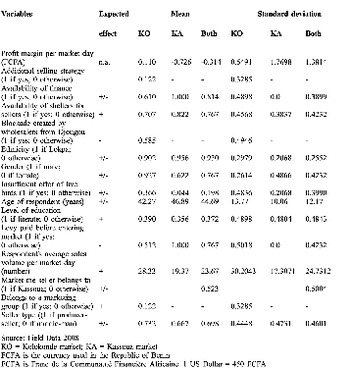
Using the statistical results namely, the F-value, R-squared (adjusted R-squared) and the t-values, the best estimated model among the three GMM forms is selected and discussed. The expected effects of the explanatory variables, mean and the standard deviation of the regression variables are presented in the Table 1.
Mean, standard deviation and the expected effects of the regression variables.

Source: Field Data 2008
KO = Kolokonde market; KA = Kassoua market
FCFA is the currency used in the Republic of Benin
FCFA is Franc de la Communauté Financière Africaine: 1 US Dollar = 450 FCFA
All the respondents from the Kassoua market pay levies to the municipal authority compared to 51% for those in Kolokonde market and 77% for the two markets combined. Most of the respondents have shelter for selling their birds (77%) and are male (77%). In Kolokonde, the most listed sources of income are crop production (98%), rearing of poultry (93%) and trade (44%). In Kassoua, the most listed sources of income are rearing of poultry (87%), trade (66.7%) and crop production (64%).
Results of the survey
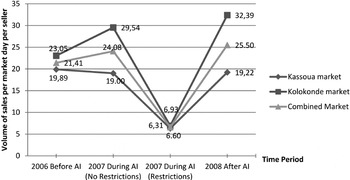
The volume of birds sold and the profit realised by the poultry sellers were used to describe the performance of the markets. The average volumes of sales per market day per seller are presented in Figure 2.
Average volume of sales per market day per seller in Kolokonde and Kassoua markets Source: Field Data 2008

The estimated average volumes of sales per market day per seller before the AI outbreak (2006), for Kolokonde and Kassoua markets were 23 and 20 chickens, respectively. The average sold for the two markets is 21 chickens. At the time of the AI outbreak in 2007, but before the restrictions were imposed by municipal authorities, while Kolokonde market experienced approximately 28% increase in the average volume of chickens sold per market day per seller, the Kassoua market experienced a 4% decline. For both markets, the average volume of chicken sold per market day per seller increased by 12%. During the imposition of poultry trade restrictions, Kolokonde and Kassoua markets registered sales volume of seven and six chickens per market day per seller, representing a decrease of 70% and 68%, respectively, from pre-outbreak sales levels. During the period of the AI outbreak and trade restrictions, the average volume of chickens sold per market day per seller for both market was approximately seven chickens, representing a 69% decline. The sellers in Kolokonde market did not experience any seizure and destruction of poultry products. The decline in the sales volume recorded at Kolokonde market may be because the wholesalers ceased trading between regions to buy chicken, following the inter-municipality trade ban on poultry. On the other hand, some sellers in Kassoua market experienced seizure and culling of birds, whereby 11% of the sellers had their poultry products seized and destroyed. The Kassoua market similarly experienced a slowdown of inter-municipal and frontier markets trade with dealers from Togo and some sellers stopped selling chickens altogether.
After the AI outbreak (2008), the average volume of chickens sold per market day per seller increased by 367% and 205% in the Kolokonde and Kassoua markets respectively. For the two markets combined the increment was 286% after the AI outbreak (2008). The sharp increases in the sales volumes after the ban on poultry trade was lifted suggest that consumers regained confidence in the local chicken market and has faith in the measures instituted during the outbreak by the authorities. Between 2006 and 2008 there was an upward trend, in general, in the average volume of sales per seller per market day in Kolokonde market, while a slightly downward trend (a decline of 3%) was observed in the Kassoua market. The decline in the volume traded in Kassoua market may be due to other factors affecting supply of chicken, such as the scarcity of chickens and/or slowdown of frontier market trade due to the AI scare and outbreak. In general from 2006 to 2008 there was an upward trend in the average volume of sales per market day for the two markets combined.
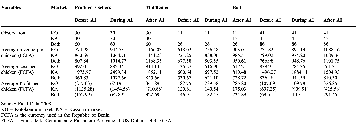
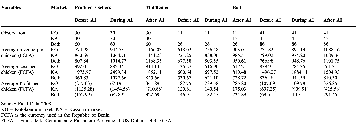
The average total cost per chicken, revenue per chicken and profit per chicken realised by both producers/sellers and middlemen are presented in Table 2
Profit per chicken realized by sellers in the markets before, during and after the AI outbreak.
Source: Field Data 2008
KO = Kolokonde market; KA = Kassoua market;
FCFA is the currency used in the Republic of Benin
FCFA is Franc de la Communauté Financière Africaine: 1 US Dollar = 450 FCFA
.
Both the producers/sellers and middlemen in Kolokonde market observed upward trends in their profits per chicken, between 2006 and 2008. Though the profit level was expected to decrease during the AI outbreak and its related restrictions on trade, the profits per chicken increased for both the producers/sellers and middlemen. This may be explained by the fact that, compared to the period before the outbreak, there was a 7% decrease in the average cost per chicken and 22% increase in the average revenue per chicken (Table 2) during the outbreak. Moreover, during the outbreak period before the trade restrictions began, the average volume of sales per market day per seller (Figure 2) and average price increased by 28% and 22%, respectively. Comparing the average profits per chicken, the producers/sellers performed better than the middlemen in 2008, because the producers/sellers reported an 8% decrease in the average cost per chicken and 22% increase in average revenue per chicken, while the middlemen reported a 19% increase in both the average cost and revenue per chicken (Table 2). In general, the overall performance of the producers-sellers from 2006 to 2008 was better than that of the middlemen. Overall, the AI outbreaks did not impact negatively on profits from Kolokonde market.
The producers/sellers in Kassoua market reported negative profits (i.e. losses), while the middlemen showed positive average profits for the period before, during and after the AI outbreak (Table 2). During the outbreak, the producers/sellers had greater losses compared to before the outbreak period. After the outbreak, increases in the average profits per chicken were observed for both middlemen and producers/sellers, even though the latter still reported an average loss. In December 2007 (i.e. during the outbreak period) PADAV organised promotional sales, through advertisements and information campaigns targeted at the population, to help the producers/sellers sell their birds and this might have helped to reduce the average loss per chicken reported. From 2006 to 2008, the middlemen in the Kassoua market performed generally better than the producers/sellers, and the AI outbreak somehow had a negative effect on the average profit of the producer/sellers of this market.
Before, during and after the AI outbreak, the sellers in the two markets combined showed an upward trend in their profits. The sellers in Kolokonde market experienced positive average profits while the sellers in Kassoua market experienced negative average profits (Table 2). During the AI outbreak, while the sellers in Kolokonde market obtained a 203% increase in their average profit per chicken, the sellers in Kassoua market experienced a 30% decrease. After the AI outbreak, the sellers in Kolokonde market observed a 198% increase in their average profit per chicken, while the sellers in Kassoua market observed a 54% increase in their average profit per chicken.
The results imply that the sellers in Kolokonde market performed better than the sellers in Kassoua market and the latter was affected more adversely by the AI outbreak. For the two markets combined, both producers-sellers and middlemen observed upward trends in their profits between 2006 and 2008, though in 2006 and 2007 the average profits per chicken for the producers-sellers were negative (Table 2). Overall, the AI outbreak did not have a negative impact on profits for poultry dealers (both producers/sellers and middlemen).
factors affecting the performance of the poultry market
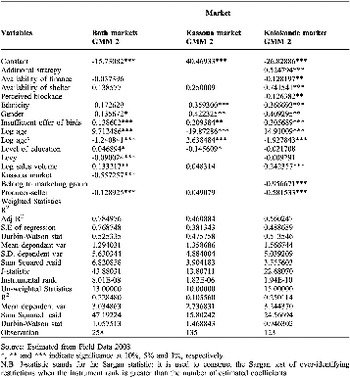
Three methods of the Generalized Method of Moments (GMM) namely GMM 1, GMM 2 and GMM 3 have been estimated to explain the factors that affect the performance of the chicken market. The GMM 1 estimation corrects for the cross-section heteroskedasticity. The GMM 2 estimation corrects for general correlation of observations within a cross-section and both period and cross-section heteroskedasticity, while the GMM 3 estimation corrects for both cross-section and period heteroskedasticity. Using the estimated R-squared values and the t-statistics of the explanatory variables, the GMM 2 proved to be the best model estimation and has been selected for further discussion. The results of the GMM 2 regression estimation are presented in Table 3.
Results of the GMM 2 regression estimation.

Source: Estimated from Field Data 2008
*, ** and *** indicate significance at 10%, 5% and 1%, respectively.
N.B: J-statistic stands for the Sargan statistic: it is used to construct the Sargan test of over-identifying restrictions when the instrument rank is greater than the number of estimated coefficients.
The estimated R-squared values for the Kolokonde market, Kassoua market and two markets combined suggest that the explanatory variables included explain 49%, 38% and 77%, respectively, of the variation in their profit margins. Thus, the results for the two markets combined provide better explanation of the influence of the explanatory variables than the results for the individual markets.
The market structure, conduct and performance (SCP) variables included in the regression estimations are levy payment, volume of sales, selling strategy and marketing group membership of the poultry sellers. As was expected, the levy paid before entering the market decreases the profit margin significantly for the two markets combined, but the effect of levy is insignificant for Kolokonde market. In the Kassoua market all the respondents paid the levy. The effect of volume of sales per market day on profit margin is positive and significant for the two markets combined and Kolokonde market, but insignificant for the Kassoua market. A percentage increase in the volume of sales per market day increase the profit margins for the combined market and Kolokonde market by 0.13% and 0.24%, respectively. Hence, more volume of sales will generate greater profit, which is consistent with expectations. Also, additional selling strategy significantly increases the profit margin in the Kolokonde market. The effect of belonging to a marketing group on the profit margin for a seller in Kolokonde market is negative and significant. The marketing group membership helps a member to sell her/his chickens on the market day, and offers assistance to its membership, but the regression results suggest that these efforts tend to have a negative influence on the profit margin of members compared to non-members.
The insufficient availability of chickens (i.e. poor supply of birds) significantly increases the profit margins by 0.14, 0.21 and 0.31% for the two markets combined, Kassoua market and Kolokonde market, respectively. Insufficient chickens leads to a situation where the demand is greater than the supply and therefore providing the sellers with the opportunity to increase their selling price, probably, to take advantage of the situation and make more profit. The availability of finance significantly decreases the profit margin of poultry sellers in Kolokonde market by 0.13%, but the effect is insignificant for the combined markets data. All the sellers in Kassoua market have finance available to them.
The availability of market shelters has positive and significant effects on the profit margin of sellers in the Kolokonde market, but the effect is positive and insignificant for the Kassoua market and combined markets. The availability of shelters encourages the sale of chicken on non-market days, providing them with the opportunity of increasing their sales. The perceived blockade created by the wholesalers from Djougou decreases the profit margin of the poultry sellers in Kolokonde market. About 58% of the sellers complained that the wholesalers from Djougou prevented wholesalers from other localities from getting to Kolokonde market to buy chickens. According to the sellers, they can improve their profit if more wholesalers or customers were allowed to come to Kolokonde market, and the regression results confirmed this. When the seller is also a producer, the profit margin decreases significantly for the two markets combined and Kolokonde market, respectively, but the effect is insignificant for the Kassoua market. The negative effect of being a producer/seller (compared to being a middleman) suggests that specialisation of poultry activities (i.e. production and marketing) may be important. Also, if the seller is located in Kassoua market, then the profit margin decreases significantly.
For the two markets combined, when the seller is a male, the profit margin decreases, but increases when the seller is literate. The results suggest that, in general, poultry selling is more favourable to literate, female sellers in the Republic of Benin. The regression results suggested that the poultry market is more favourable for non-Lokpa sellers in Kassoua market, but favourable for Lokpa sellers in Kolokonde market. The effect of the age of the seller on profit margins provided mixed results. For the combined market and Kolokonde market the profit margin increases as the youngest sellers increase in age, but at older ages the profit margin decreases as the seller's age increases. The net effect of age is negative for the sellers in the two markets combined and Kolokonde market. On the contrary, the findings for the Kassoua market suggest that profit margin decreases as the seller's age increases and then increases as the seller becomes older in the Kassoua market. The net effect of the age variable is positive for the sellers in Kassoua market.
Conclusions
A three-year panel data (2006 – 2008), obtained from purposely selected poultry producers-sellers and middlemen, was used to investigate the impact of the avian influenza (AI) outbreak on the business of the chicken markets in Benin. The trends in sales volume and profit were used as proxy for performance. In general, the AI outbreak affected the performance of the markets during the imposition of restrictions on poultry trade. When the AI broke in Benin and restrictions were imposed on poultry trade, the markets registered decline in sales volume per market day per seller by 69%, compared to the period before AI outbreak. Overall, the AI outbreak did not have adverse effect on profit for poultry dealers.
From the GMM regression results, it can be concluded that the chicken markets for the Republic of Benin is more favourable in terms of performance (profit margin) for female traders, literates, young people, middlemen (not being a producer-seller) and sellers in Kolokonde market. The performance is also affected negatively by the municipal authority's levy and positively by less supply than demand (not over supplying), average volume of sales per market day and provision of market shelter for some markets. These results have implications for policies involving setting the level of state authority's levy, provision of market infrastructure, women and youth empowerment programmes and behaviour of market suppliers in the poultry sector.