INTRODUCTION
In recent years considerable research has been devoted to understanding the formation and structure of parasite communities of fish (e.g. Karvonen et al. Reference Karvonen, Cheng and Valtonen2005; Blasco-Costa et al. Reference Blasco-Costa, Koehler, Martin and Poulin2012; Roij and MacColl, Reference Roij and MacColl2012), the vast majority being studies from northern temperate latitudes (Kennedy, Reference Kennedy2009). Tropical parasite communities have also been examined (e.g. Kennedy, Reference Kennedy1995; Salgado-Maldonado and Kennedy, Reference Salgado-Maldonado and Kennedy1997; Vidal-Martínez and Kennedy, Reference Vidal-Martínez and Kennedy2000; Vidal-Martínez and Poulin, Reference Vidal-Martínez and Poulin2003; Aguirre-Macedo et al. Reference Aguirre-Macedo, Vidal-Martínez, González-Solís and Caballero2007; Luque et al. Reference Luque, Felizardo and Tavares2008; Bellay et al. Reference Bellay, Lima, Takemoto and Luque2011; Lima et al. Reference Lima, Giacomini, Takemoto, Agostinho and Bini2012; Lacerda et al. Reference Lacerda, Bellay, Takemoto and Pavanelli2013), however, these investigations are too few to provide robust information about the structure of tropical parasite communities. More studies are needed from tropical latitudes, to at least objectively verify the generality of the conclusions derived from studies of the north temperate latitudes.
Studies that detect repeatable patterns in space and time are necessary to understand the processes that structure parasite communities (Kennedy, Reference Kennedy2009). In general, helminth communities across the same host species are spatially and temporally variable, with few repeatability patterns (Kennedy, Reference Kennedy2001, Reference Kennedy2009; Poulin and Valtonen, Reference Poulin and Valtonen2002; Roij and MacColl, Reference Roij and MacColl2012). There is evidence that helminth communities in fish span the full range from isolationist to interactive. Helminth component communities in fish have been considered to be isolationist and unstructured, stochastic processes playing a major part in determining their composition, because these communities are generally species-poor assemblages, far from packed with species, characterized by low densities, low diversity, high dominance, having available niches for additional species, and low in between population similarity (Kennedy, Reference Kennedy, Esch, Bush and Aho1990, Reference Kennedy2009; Kennedy and Guégan, Reference Kennedy and Guégan1994, Reference Kennedy and Guégan1996; Goater et al. Reference Goater, Baldwin and Scrimgeour2005). However, predictable parasite communities in freshwater fish, with diverse assemblages, high densities, interactive and structured, have also been described (Carney and Dick, Reference Carney and Dick1999; Poulin and Luque, Reference Poulin and Luque2003).
Species richness in a component community (i.e. the number of parasite species found in a given population of hosts of the same species; Holmes and Price, Reference Holmes, Price, Kikkawa and Anderson1986), is related to the number of species in the parasite fauna (i.e. the inventory of parasite species recorded to infect those host species along its entire geographical range; Poulin, Reference Poulin2007). Empirically, the number of species of a component community is effectively limited by how many species from the parasite fauna of the host species can reach it (Poulin, Reference Poulin2007). In this context, the proximity, or the distance between localities is the most important factor determining the similarity amongst parasite communities (Poulin and Morand, Reference Poulin and Morand1999; Poulin, Reference Poulin2003; Karvonen and Valtonen, Reference Karvonen and Valtonen2004; Karvonen et al. Reference Karvonen, Cheng and Valtonen2005). Frequent contacts and exchanges of parasites between adjacent host populations of the same species would lead to highly homogeneous component communities, all consisting of the same species. In contrast, host populations physically isolated from one another should have very different component communities (Poulin, Reference Poulin2007), but this is not always the case, even in different parts of a single metapopulation (Kennedy, Reference Kennedy2001).
The present investigation was conducted in order to determine the species pool of helminth parasites of Heterandria bimaculata (Heckel) (Teleostei: Poeciliidae) inhabiting the upper Río La Antigua basin in East-central Mexico, and to examine the variability in helminth component communities from the same host species across different locations within this small scale. Looking for spatial patterns, this investigation allows us to examine the composition and richness of helminth parasites of a tropical freshwater fish and its variability amongst locations from the upper and more isolated reaches of a tropical drainage basin. Following Kennedy (Reference Kennedy2001), our approach is from the point of view of metapopulation dynamics because it concerns a set of local helminth populations occurring in different host populations which interact via individuals moving between them; the whole upper watershed of Rio La Antigua including its small tributaries can be viewed as a metapopulation and locations in the river and tributaries as populations. The investigation allowed us to seek for any repeatable pattern in structure or alternatively, to ask if these are mere stochastic assemblages of species.
Our objective is to characterize the helminth fauna of H. bimaculata in the upper Río La Antigua basin. We aim to generate basic data on composition of the helminth fauna, the structure of the component communities, and their similarity and complementarity. Our interest is to examine the exchange of parasites between nearby sites, and to recognize the role of the helminth species in locally structuring the community of parasites and their contribution to the general diversity. To do so we test the prediction that helminth species may be recognized as common or rare. We explore two hypotheses: (A) A constant unidirectional downstream drift of invertebrates and other small organisms should lead to both free-living infective stages and small intermediate hosts harbouring parasites, moving downstream so that upper reaches will be in general poor foci of transmission for parasites, leading to impoverished component communities. Because of drift, lower resources, lower temperature and greater physical disturbances such as higher current speed and shallower waters upstream reaches consist of less stable, low density populations of organisms (Blasco-Costa et al. Reference Blasco-Costa, Koehler, Martin and Poulin2012). We therefore expect impoverished helminth component communities. (B) Frequent contacts and exchange of parasites between adjacent host populations of the same species should lead to highly homogeneous component communities; if different host populations are physically isolated from one another, we may expect them to develop very different component communities. We therefore anticipate a decay of similarity between component communities with increasing distance between them.
MATERIALS AND METHODS
General
The Río La Antigua basin is located in the eastern Eje Neovolcánico, Trans Mexican Volcanic Belt, in the central area of Veracruz state, Mexico. The Río La Antigua and its tributaries drain the central highlands and lowlands of the state of Veracruz, flowing S-E towards the Gulf of Mexico. Its headwaters rise to a maximum elevation of 3500 m a.s.l. on the eastern and northern slopes of the Cofre de Perote and Pico de Orizaba volcanoes (Fig. 1). Headwaters of the Río La Antigua basin are very dissected with steep slopes (20–45°) and bordered by an altitudinal divide ≈500 m altitude that effectively isolates the upper basin from the rest of the Río La Antigua drainage basin. High river slopes and sharp inclination of terrain preclude fish from the medium and lower basins to reach upstream reaches.
The Río La Antigua drainage basin of east-central Mexico: general localization, complete basin and fish collection sites from upper (sites 1 to 6) and middle (site 7) basin. The general position of Cofre de Perote volcano and Xalapa, Coatepec, Xico and Teocelo towns are shown. (1, Rancho Tizapán; 2, San Miguel (avestruces); 3, pond Agua Bendita; 4, Río Huitzilapan; 5, Texolo; 6, Río Los Pescados; 7, Apazapan).

The poeciliid H. bimaculata distribution ranges from Veracruz, Mexico southward to Nicaragua, following the Atlantic slope. It is found in springs, creeks, rivers, swamps, ponds and lagoons, preferring slow-moving waters, and is mainly a carnivorous fish, whose maximum known size reaches 80 mm standard length (Miller et al. Reference Miller, Minckley and Norris2005; Mercado-Silva et al. Reference Mercado-Silva, Lyons, Díaz-Pardo, Navarrete and Gutiérrez-Hernández2012). It is the only fish species inhabiting the upper reaches of Río La Antigua. We attempted to sample a number of localities on at least one occasion, but either failed to catch any fish or caught too few. We examine assemblages of helminths of H. bimaculata from five locations in the upper basin of Río La Antigua, and one more locality from the middle basin of this river (Fig. 1). The scale of our study is small concerning the magnitude of the streams (1st to 6th order), and altitude (294–1470 m), hence our data are in general comparable. However, the locations are physically separated enough to allow examination of the similarity patterns of parasite assemblages related to geographical distance between them. Since this is a small fish (less than 80 mm TL) with limited dispersal capabilities, it seems reasonable to assume that there was little movement of fishes between the locations because of their small size and the comparatively considerable distances between locations. This scale allows us to presume that all helminth species have access to every location, in such a degree that all helminth species must be present along the range of distribution of the host in the area.
One hundred H. bimaculata were collected from five localities from the upper Río La Antigua basin, and one more locality, Arroyo Apazapan, located at the beginning of the medium basin of this river. In general, sampled localities were characterized by lower water temperatures (<17°), smaller stream width (<5 m), smaller basin area and a distance to the ocean >100 km. All rivers and streams considered here share a common drainage basin and are hydrologically and biologically connected (Fig. 1); all helminth species have at least the theoretical potential to disperse throughout the sampled areas in this study. In August 2005, the following localities were sampled: a spring ‘Arroyo Seco’ at Rancho Tizapán (19°24′24″N, 97°00′52″W, altitude 1277 m), n = 15 fish examined; a spring at San Miguel (avestruces) (19°24′11″N, 97°02′31″W, altitude 1470 m), n = 9 fish examined; the Agua Bendita pond (19°24′41″N, 97°00′52″W, altitude 1290 m) n = 15 fish examined. On May 2006, the following localities were sampled: Río Huitzilapan locally also known as Río Tilapa (19°11′49″N, 97°03′23″W, altitude 1454 m), n = 25 fish examined; Río Los Pescados (19°21′51″N, 96°49′34″W, altitude 459 m) n = 11 fish examined; Agua Bendita pond (19°24′41″N, 97°00′52″W, altitude 1290 m) n = 9 fish examined; 16 more fish were examined in July 2007 from Apazapan spring (19°19′00″N, 96°43′00″ W, altitude 294 m). Locations Agua Bendita (a small pond) and Río Tizapán are closer to one to another, but they are independent and also wide apart from Río Huitzilapan =Río Tilapa, that belongs entirely to a different affluent of the main body of the Río La Antigua basin. Río Los Pescados and Apazapan are located downstream; the latter is situated in the medium Río La Antigua basin (Fig. 1).
Fish were caught by electrofishing from each locality, transported alive to the laboratory in containers with aeration until parasitological examination. All of them were examined within 8 h of capture. The fishes were weighed, total and standard body length were measured, sex was determined by direct inspection of the gonads. All tissues, including skin, scales, fins, buccal cavity, gills, digestive tract, body musculature and internal organs were examined for helminth parasites. During necropsy, each organ was placed in an individual Petri dish and examined using a stereomicroscope. Helminths were counted and recorded separately for each fish. All helminths were fixed in near-boiling 4% formalin. Platyhelminths were preserved until stained to make whole mounts. Nematodes were studied in non-permanent slides, cleared with glycerin.
Overall parasite population structure was described using prevalence (per cent of hosts infected), mean intensity (mean number of helminth individuals of a given species per infected host) and abundance (mean number of helminth individuals of a given species per examined host), as described by Bush et al. (Reference Bush, Lafferty, Lotz and Shostak1997).
Analyses of community structure
Analyses were carried out at the component community level (Holmes and Price, Reference Holmes, Price, Kikkawa and Anderson1986), i.e. all the helminths in all the individuals of H. bimaculata in each of the specific collection sites. The total number of helminth species observed per locality was one of the measures of component community structure adopted. Since different component communities were not evenly sampled, sampling adequacy for all component communities was evaluated using randomized (100×) sample-based species accumulation curves computed in EstimateS (version 8.0 RK Colwell, http://viceroy.eeb.unconn.edu/estimates). For each component we examined the asymptotic richness based on Clench's model equation (Soberón and LLorente, Reference Soberón and LLorente1993) as well as the final slope of the randomized species accumulation curve (Jiménez-Valverde and Hortal, Reference Jiménez-Valverde and Hortal2003) that is, the gradient between the final two sampling points. A final value of the slope of the species accumulation curve no higher than 0·1 species per sample was used as the criterion for adequate sampling because empirically this final slope of accumulation curve indicates that at least 70% of the species in the component have been sampled already (Jiménez-Valverde and Hortal, Reference Jiménez-Valverde and Hortal2003). Clench's model is described by the following function:
 $$V2 = (a* V1)/(1 + (b* v1))$$
where V2 is the observed richness, V1 is the number of hosts examined, and a and b are parameters of the curve, a equals the rate of adding new species and b is a parameter related to the shape of the curve; these values were calculated iteratively using the EstimateS and Statistica software, as in Jiménez-Valverde and Hortal (Reference Jiménez-Valverde and Hortal2003). The slope of the cumulative species curve was calculated as a/(1+b∗n)2 where a and b are the above parameters and n is the number of hosts examined from a given component. Clench's model equation allows estimation of the total number of species in a component as a/b.
To improve the species richness values obtained from each component community sampled, we used a non-parametric species richness estimator as suggested by Poulin (Reference Poulin2007). Therefore, in order to answer how many species are likely to have been missed by inadequate sampling, we estimated the number of rare species missing from each component community using the bootstrap non-parametric richness estimator, (S b ) (Poulin, Reference Poulin1998, Reference Poulin2007; Magurran, Reference Magurran2004):
 $$S_b = S_o + \sum {[1 - (h_j /H)]^H} $$
where S o is the observed species richness, H is the number of host individuals sampled from the component community, and h j is the number of host individuals in the sample in which parasite species j is found.
The numerically dominant species of helminths in each component were identified by analysis of the abundance distribution of helminth species in each component, plotting a rank/abundance species curve. In order to deduce the spatial distribution of helminth species that make up the component communities within the study area, we examined the local and general distribution of species, as common/rare, by means of the method of quartiles of Gaston (Reference Gaston1994). This method allows plotting the frequency of appearance of species in each of the localities sampled, expressed as the prevalence, against the abundance (logarithmic transformed as Ln (X+1)) of helminth species. The medians of both distribution values (prevalences and abundances) were plotted at both axes, resulting in four quadrants, two of these important for our analysis: frequent and abundant (common) species and non-frequent and non-abundant (rare) species; the other two quadrants identify restricted or localized species (abundant and non-frequent) and frequent and non-abundant species. We followed the definition of rarity by Gaston (Reference Gaston1994) where rarity is defined simply in terms of low abundance or small range size.
Shannon index, Simpson's index, and equitability for each component community were calculated as in Magurran (Reference Magurran2004).
To put emphasis in the abundance of dominant species, the similarity between pair of components of community was evaluated using Bray–Curtis measure, as calculated in Magurran (Reference Magurran2004):
 $$B = \sum {\left| {X_{ij} - X_{ik}} \right|} {\big /}\sum {(X_{ij} + X_{ik} )} $$
where, X ij , Xik equal the number of helminth individuals in species i in each component.
This procedure was carried out for autogenic and allogenic species separately to stress the importance of colonization ability. Autogenic and allogenic species were defined as in Esch et al. (Reference Esch, Kennedy, Bush and Aho1988): autogenic species complete their life cycles in water and are incapable of crossing land barriers between freshwater bodies; allogenic species use birds as definitive hosts, and they are capable of being moved by their definitive host from one aquatic locality to another.
In order to evaluate the effects of geographical distance on compositional similarity (Distance Decay) we calculated the distance overland in km between all pairs of localities and plotted the calculated Bray–Curtis index as a function of distance. A linear function was drawn to examine the general tendency of the scatter plot. The analyses were made using Matlab software.
RESULTS
The helminth fauna
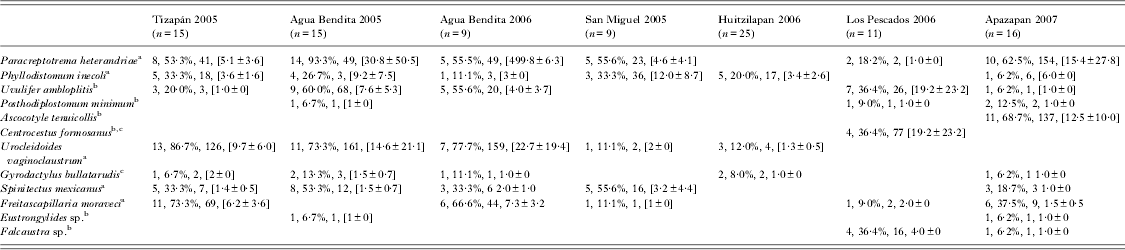
The helminth fauna of H. bimaculata in the upper catchment of the Río La Antigua basin is constituted by 12 helminth species (Table 1). Five of these species are specialists, found only as parasites of this fish species; all five are autogenics, completing their life cycle in water and incapable of crossing land barriers between freshwater bodies. Six more species found as larvae are generalist allogenics, using birds as definitive hosts. Two species, the metacercariae of Centrocestus formosanus, and the monogenean Gyrodactylus bullatarudis are introduced species.
Number of hosts infected, prevalence %, total number of individuals counted [mean intensity±s.d.] of 12 species of helminth parasites recovered from H. bimaculata collected from seven component communities of upper Río La Antigua basin, Mexico

Date of collection and sample size, i.e. number of fish examined, are noted below location name.
a Specialist autogenic species.
b Generalist allogenic larval form.
c Introduced helminth species.
All five specialist autogenic species are common and frequent species, occurring in most of the component communities (Table 1). Prevalence of these autogenic specialists was generally high (>25%), as was their mean intensity, varying between 1–12 helminths per infected host. Contrarily, generalist allogenic species were less frequent, scattered in component communities and in general with comparatively low prevalence ≈10%.
Richness
The number of helminth species observed in the component communities ranges from one to ten (Table 1), and do not correlate with sample size (number of hosts examined from each component) (r = 0·21), nor with host body size (r = −0·30); and shows a negative, but not significant correlation with weight of fishes (r = −0·58) in each component.
The analysis of species accumulation curves (Table 2) shows that the inventory of helminth species of the component communities was almost complete for all; the slope of the last point of each curve calculated from Clench's model was ⩽0·1 (Table 2), indicating a good coverage of helminth species recovered from each component community. The observed species richness from each component of community was no less than 80% of the asymptotic value, i.e. the real number of species in each component. Estimation of richness by means of Clench's model parameters (Table 2) confirms the patterns of richness observed, indicating a richness ranging from four (Huitzilapan) to 14 species (Apazapan 2007). In general, the values of the Bootstrap non-parametric estimator follow the same pattern of richness, being more conservative than Clench's model estimator. Huitzilapan was the impoverished component community while Apazapan was the richest.
Summary of the richness analysis and parameters of the cumulative curves of species for seven component communities of helminths of H. bimaculata from upper basin of Río La Antigua, Veracruz, Mexico (in all cases the correlation coefficient R 2 between observed data and Clench's model >0·97)

Abundance distribution and dominance/rarity
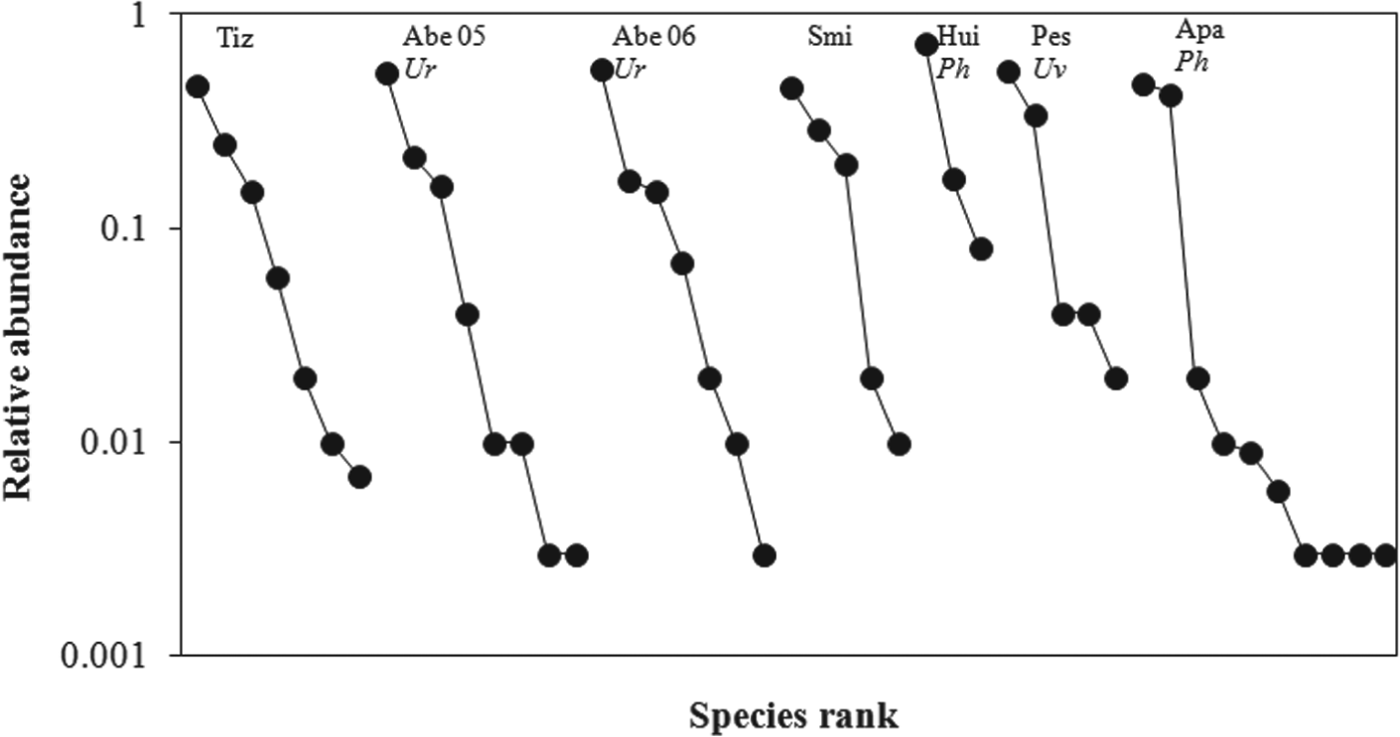
Component communities examined were strongly dominated by an autogenic specialist species, either the monogenean Urocleidoides vaginoclaustrum, the dominant species in Tizapán and Agua Bendita, or the trematode Phyllodistomum inecoli which numerically dominates in San Miguel, Huitzilapan and Apazapan. The only exception to this was the component community of Río Los Pescados, where the generalist Uvulifer ambloplitis was the dominant species (Fig. 2).
Patterns of relative abundance of 12 species of helminths in seven component communities of H. bimaculata from upper basin of Río La Antigua, Veracruz, Mexico (localities: Tiz, creek at Rancho Tizapán; Abe, swampy pond at Agua Bendita; Smi, creek at San Miguel (avestruces); Hui, Río Huitzilapan; Pes, Río Los Pescados; Apa, stream Apazapan. Dominant helminth species: Ur, Urocleidoides vaginoclaustrum; Ph, Phyllodistomum inecoli; Uv, Uvulifer ambloplitis).

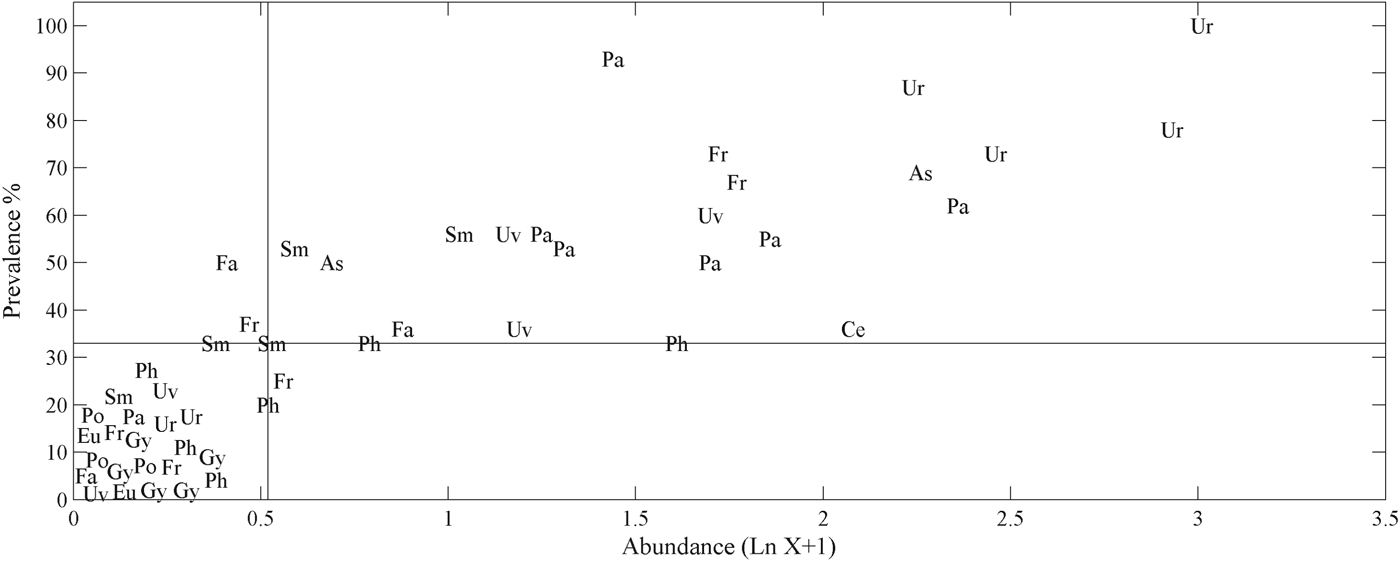
Data show that specialist autogenic species are numerically dominant in each component community, and that these species were also frequent and abundant in the whole area sampled; whereas generalist allogenic species displayed low abundance and were localized. The analysis of distribution of species (Fig. 3) showed that locally dominant species are frequent and abundant (common) in most locations in which they were found, whereas rare species have low abundances and were limited to a few hosts in a few locations. Specifically the monogenean U. vaginoclaustrum, the trematode Paracreptotrema heterandriae, the nematode Freitascapillaria moraveci and the nematode Spinitectus mexicanus, were common in the area sampled (Table 1, Fig. 3). These species appeared as rare in some samples, but less frequently. The metacercariae of U. ambloplitis appears as rare in two locations and as common in other three. The metacercariae of Ascocotyle tenuicollis, not recorded from the upper basin localities, was frequent and abundant in a single location (Apazapan, a middle basin location). Also, the introduced C. formosanus was recorded from a single locality, appearing as frequent and abundant. The rare species group included the introduced monogenean G. bullatarudis, the metacercariae of Posthodiplostomum minimum and the larvae of the nematode Eustrongylides sp. The numbers of rare species recorded in the component communities range from 0 to 5 (Table 1) and do not correlate with sample size (r = 0·27).
Relationship between prevalence and abundance of helminth parasites of H. bimaculata from eight component communities (data from Table 1). Ploted lines are the medians of the distributions of prevalences and transformed abundances Ln (X+1) Helminth species are abbreviated as: Ur, Urocleidoides vaginoclaustrum; Pa, Paracreptotrema heterandriae; Ph, Phyllodistomum inecoli; Sm, Spinitectus mexicanus; Fr, Freitascapillaria moraveci; Fa, Falcaustra sp.; As, Ascocotyle tenuicollis; Eu, Eustrongylides sp.; Gy, Gyrodactylus bullatarudis; Uv, Uvulifer ambloplitis; Po, Posthodiplostomum minimum.

Similarity of component communities
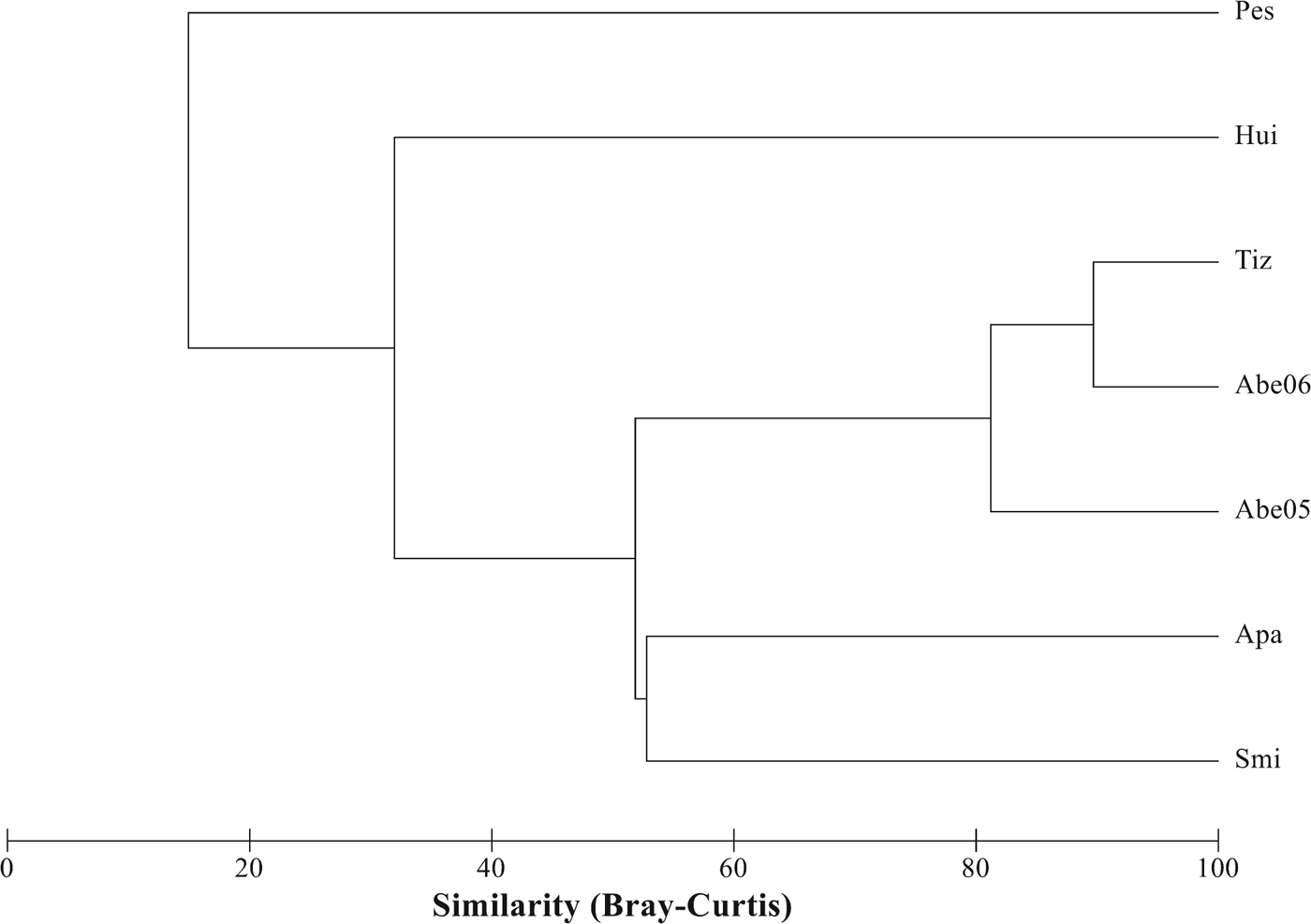
The comparison between the component communities based on the Bray–Curtis measure using the relative abundance of all helminth species recorded shows that their composition is very similar to one another; Los Pescados was the least similar (≈15% similarity) locality, followed by Huitzilapan, displaying a ≈50% similarity with the other component communities (Fig. 4). The rest of the component communities examined formed two distinct groups with >50% similitude between them; Tizapán and Agua Bendita locations were the most similar to one another, while Apazapan grouped with San Miguel. Repeating the same comparisons based on the Bray–Curtis measure, for only the specialist autogenic species (i.e. eliminating allogenic helminth larvae of the analysis), there is evidence of stronger links between components following the patterns already described. The geographic distance between these locations (Fig. 5) clearly explains the observed similitudes. Sharing of parasite species is particularly evident between Tizapán and Agua Bendita, and between Los Pescados and Apazapan (Table 1, Fig. 4).
Dendrogram resulting from similarity matrix based on Bray–Curtis measure for seven component communities calculated with all helminth species, of H. bimaculata from upper Río La Antigua basin.

Relationships between Bray-Curtis similarity and distance for all pairwise comparisons between component communities.

Huitzilapán was the only component community more different from the others, however, as previously explained, it was the most distant one.
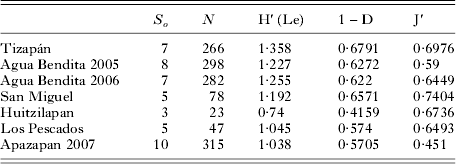
The inspection of diversity indices (Table 3) show a pattern of close diversity values for all component communities, Apazapan being the most diverse, while less diversity was recorded from the poorest (S o = 3) Huitzilapan component community; moreover a more equitable abundance distribution of species was observed from San Miguel when compared with all other locations (see also Fig. 2).
Values of several diversity indices for 7 component communities of helminth parasites of H. bimaculata from the upper Río La Antigua basin (S o, richness, number of observed species; N, total number of helminths counted; H′, Shannon index (calculated with base e logarithms); 1 – D, complement of Simpson´s index; J′ evenness)

DISCUSSION
Communities of helminth parasites of H. bimaculata in the upper Río La Antigua basin are not mere stochastic assemblages of species coming together at random, but are a highly structured and predictable set of species. Our data show a clear pattern: a suite of specialist autogenic helminth species making up the core of common species of each component community sampled. These species are locally constant, and in general abundant in the area sampled. The prediction that it is possible to recognize common and rare species was met. This suite of autogenic specialist species leads to highly homogeneous component communities. Present data suggest consistency in taxonomic composition of component communities, with autogenic common species dominating all components throughout space.
Autogenic species, those completing their life cycle in water, are incapable of crossing land barriers between freshwater bodies. They have a limited colonizing capability, depending entirely on the vagility of their host (Esch et al. Reference Esch, Kennedy, Bush and Aho1988). Some of these species may need other intermediate hosts. In this study, these intermediaries are molluscs, copepods, several insect larvae, and perhaps oligochaete worms; all of these have a more limited dispersal capability compared with the fish hosts. This indicates that specialist autogenic helminth species must be widely spread along the upper Río La Antigua basin, entirely available for every component community. The physical isolation of the small streams and creeks sampled and the ability of specialist autogenic helminth species to disperse widely mean that the distribution of these parasites across the landscape was not random.
The suite of specialist autogenic helminth species form a predictable species subset among component communities of H. bimaculata. In contrast, generalist allogenic species form a less predictable species subset. The occurrence of allogenic species was erratic and showed no pattern. The communities studied here are predictable because of dominance by specialist autogenic species, and the absence of autogenic generalist species, particularly acanthocephalans. The absence of any other fish species in the localities studied from which generalists might be able to transfer make our localities unique, and explains its difference in this respect from the locations studied in north temperate latitudes (see Kennedy, Reference Kennedy2001).
The geographic scale of our study is rather small, and may cast doubts about the independence of the fish samples between different locations. However, distance between sample locations and their spatial position on the watershed allows for significant comparisons of component communities. We assume distances in this system were large enough to allow the formation of distinct subpopulations of H. bimaculata which were characterized by different parasite infection levels. Heterandria bimaculata tends to be restricted to particular parts of the system.
The difference in helminth assemblages was increased with geographic distance, which is consistent with previous findings (Poulin and Morand, Reference Poulin and Morand1999; Karvonen and Valtonen, Reference Karvonen and Valtonen2004), and does not support the views of Kennedy (Reference Kennedy2001) and Karvonen et al. (Reference Karvonen, Cheng and Valtonen2005). It indicates that geographic distance may have a major role in shaping parasite assemblages even on a scale as small as a section of a drainage basin. Exchange of helminth species between component communities is dependent upon host and parasite mobility. Indeed, vagility and dispersal habits of the host H. bimaculata seem to be the most important traits promoting homogeneity with respect to the composition and richness of parasite component communities.
Other than vagility, several host characteristics such as habitat preference (springs, creeks, small rivers, swampy pools, slow-moving water places) and diet (largely a carnivorous fish) of H. bimaculata further appear as factors promoting a greater homogeneity for their component communities having predictable species composition, with a same set of helminth species occurring in most component communities (Carney and Dick, Reference Carney and Dick2000; Nelson and Dick, Reference Nelson and Dick2002; Poulin, Reference Poulin2007).
Subtle differences observed between taxonomic composition and densities of component communities can be explained by variations in local conditions and local characteristics of each host population. Most variability in richness and taxonomic composition was related to the erratic presence of allogenic species.
Present data shed a new light on helminth community structure of tropical poeciliid fishes, differing drastically from the concepts stated by Pineda-López et al. (Reference Pineda-López, Salgado-Maldonado, Soto-Galera, Hernández-Camacho, Orozco-Zamorano, Contreras-Robledo, Cabañas-Carranza, Aguilar-Aguilar, Uribe and Grier2005) about the helminth parasites of these fish. Previous studies have pointed out quite impoverished component communities in the Poeciliidae, with a numerical dominance by allogenic, generalists species and few specialists. Specifically, the previously known species richness of H. bimaculata ranges from S = 1–5 (data from four component communities from neighbouring basin Río Papaloapan where number of H. bimaculata examined n = 10, S = 1; n = 21, S = 1; n = 16, S = 2; n = 15, S = 5; and from four component communities from Río Balsas basin: n = 37, S = 0; n = 13, S = 0; n = 13, S = 1; n = 25, S = 2; see Salgado-Maldonado et al. Reference Salgado-Maldonado, Cabañas-Carranza, Caspeta-Mandujano, Soto-Galera, Mayén-Peña, Brailovsky and Báez-Valé2001, Reference Salgado-Maldonado, Aguilar-Aguilar, Soto-Galera, Cabañas-Carranza and Caspeta-Mandujano2005). The present study indicates that the upper Río La Antigua basin is an area where parasite component communities of H. bimaculata are consistently more species rich than in other regions, and where specialist species are numerically dominant. Why have these component communities diversified in this way?
As stated in one of the hypotheses explored in this research, in our study we expected to find impoverished communities because the localities sampled were small springs and creeks, small bodies of water belonging to the upper reaches of a river basin. Species richness of most taxa decreases with increasing altitude. Host H. bimaculata populations are not large in these bodies of water; this is the only fish species inhabiting bodies of water all along the upper catchment of Río La Antigua basin. These habitat and biological characteristics correlates with poor communities rather than with rich ones. These are not favourable to high species richness, rather these are factors favouring impoverished parasite component communities.
Stability of habitats favours, given enough time, an increase in richness in component communities (Guégan and Kennedy, Reference Guégan and Kennedy1993). Absence of catastrophic natural events over time favours integrity of H. bimaculata populations and their parasites in the upper catchment of Río La Antigua. Our data suggest that a comparatively rich and diverse fauna has developed in these habitats, in such a way that component communities of helminth parasites of H. bimaculata from the upper Río La Antigua basin have had a long time to develop to the observed potential, increasing component community richness over time.
A highly homogeneous composition of helminth component communities associated with a small, non-migratory fish host, H. bimaculata, indicates a wide distribution of parasites in the study area. This suggests a stable, predictable habitat through time, allowing for a slow dispersion process limited by host and parasite species capabilities. It seems that the upper reaches of this basin have been stable for a long time, until very recently. These bodies of water probably date from the late Miocene to early Pliocene corresponding to the uplift of the Eje Neovolcánico, Trans Mexican volcanic belt. The springs and creeks forming the upper reaches of the Río La Antigua basin originated from the ice melt of nearby mountains, mainly from the Cofre de Perote (altitude 4200 m) and the Citlaltépetl (Pico de Orizaba) (altitude 5610 m). Moreover, rainfall rates are high in this region, so these are perennial, undisturbed interconnected small bodies of water. These have been favourable habitats for developing a diverse helminth community closely associated with the only host species available, H. bimaculata. Also of importance in explaining the observed richness is that the Río La Antigua basin is the heartland of H. bimaculata; this geographical area is the original habitat for this host species. This could explain the number of specialist parasite species recorded (Kennedy and Bush, Reference Kennedy and Bush1994; Poulin and Mouillot, Reference Poulin and Mouillot2004; Kennedy, Reference Kennedy2009), because the further a host population is displaced from its heartland, the less rich and fewer specialist parasite species are included/available in the new habitats. Furthermore, the previously discussed specialist autogenic species of H. bimaculata appear to be endemic to the Río La Antigua basin (Salgado-Maldonado and Quiroz-Martínez, Reference Salgado-Maldonado and Quiroz-Martínez2013) with the exception of the nematode S. mexicanus which has been recorded from the neighbouring Río Papaloapan basin (Caspeta-Mandujano, Reference Caspeta-Mandujano2010).
What the present work shows is that helminth communities of a freshwater tropical fish inhabiting in its heartland are far from being a stochastic assemblage of species; these communities are highly structured and composed of a predictable set of species composed by a suite of specialist autogenic helminth species that are locally constant and abundant in the geographical area studied. The processes that shape the development of component communities and the parasite fauna of H. bimaculata in the upper Río La Antigua basin include stable, predictable habitats through time, allowing for a slow gradual dispersion process limited by host and parasite species capabilities. These processes eventually lead to highly homogeneous component communities in a given geographical area, where neighbouring communities are more similar than distant ones. Therefore, our investigation gives additional support to the proposal by Kennedy (Reference Kennedy2001) that metapopulation theory can assist prediction of community composition and understanding of spatial and temporal community variability.
ACKNOWLEDGEMENTS
Thanks are due to Rosario Landgrave from the Instituto de Ecología, A. C., Xalapa, and to Felipe Villegas Marquez, from the Instituto de Biología, Universidad Nacional Autónoma de México, for preparing the map.
FINANCIAL SUPPORT
This work was supported by the Consejo Nacional de Ciencias y Tecnología (CONACyT), Mexico (GSM grant no. 155372).