INTRODUCTION
Biogas produced from anaerobic piggery wastewater treatment plants in Taiwan contains methane (CH4) (60·1–77·0%), carbon dioxide (CO2), a low proportion of nitrous oxide and hydrogen sulphide (H2S) (Su et al. Reference Su, Liu and Chang2003). Global warming potential (GWP) indicates the heat-trapping potential of a greenhouse gas in the atmosphere. The GWP of CH4 is 25, i.e. 25 times more potent than CO2 in causing global warming (IPCC Reference Solomon, Qin, Manning, Chen, Marquis, Averyt, Tignor and Miller2007). Thus, promotion of biogas utilization or combustion can help to reduce greenhouse gas emissions (especially CH4) from the livestock sector. Biogas produced from livestock farming is an alternative energy source in several countries (Omer & Fadalla Reference Omer and Fadalla2003; Chen Reference Chen2004; Kapdi et al. Reference Kapdi, Vijay, Rajesh and Prasad2005; Murphy & McCarthy Reference Murphy and McCarthy2005; Prasertsan & Sajjakulnukit Reference Prasertsan and Sajjakulnukit2006; Craggs et al. Reference Craggs, Park and Heubeck2008; Ihara et al. Reference Ihara, Toyoda, Watanabe and Umetsu2008; Lieffering et al. Reference Lieffering, Newton and Thiele2008), but power generators normally demand that the biogas used contains <280 mg/m3 of H2S. The anaerobic wastewater treatment process used in the paper industry can produce H2S concentrations as high as 42 000 mg/m3 (Schieder et al. Reference Schieder, Quicker, Schneider, Winter, Prechtl and Faulstich2003), while that of biogas from anaerobic piggery wastewater treatment is up to 5600 mg/m3 in Taiwan. Therefore, combustion of biogas containing H2S limits the use of biogas for heat and especially power generation.
H2S can be removed from biogas either by non-microbial or microbial processes. Non-microbial processes include either dry oxidation or liquid phase oxidation processes (Kapdi et al. Reference Kapdi, Vijay, Rajesh and Prasad2005), while microbial processes use certain photoautotrophic and chemotrophic bacteria immobilized in bioreactors to remove H2S from gas streams (Kantachote et al. Reference Kantachote, Charernjiratrakul, Noparatnaraporn and Oda2008). Reactors and systems for H2S removal involving chemotrophic bacteria include the gas-fed batch reactor, the continuous stir-tank reactor (CSTR), bio-scrubbers, bio-filters and bio-trickling filters (Syed et al. Reference Syed, Soreanu, Falletta and Béland2006). Two stages of H2S removal in systems using bio-scrubbers (fixed film) are absorption of H2S by a liquid and biological oxidation of H2S in the liquid (Potivichayanon et al. Reference Potivichayanon, Pokethitiyook and Kruatrachue2005). A bio-filter is a three-phase bioreactor (gas, liquid and bio-carriers) made with a highly porous filter bed with buffer capability, nutrient availability and moisture retention capability to promote the growth of target micro-organisms. The current study analysed the performance of a pilot-scale biogas bio-filter system (BBS) operated for >630 days on a 9000-pig commercial farm equipped with anaerobic digesters and biogas storage bags in Taiwan. The main objective was to evaluate the efficiency of the BBS facility in removing H2S and to identify optimal operating parameters for efficient removal of H2S from biogas.
MATERIALS AND METHODS
Pilot-scale BBS
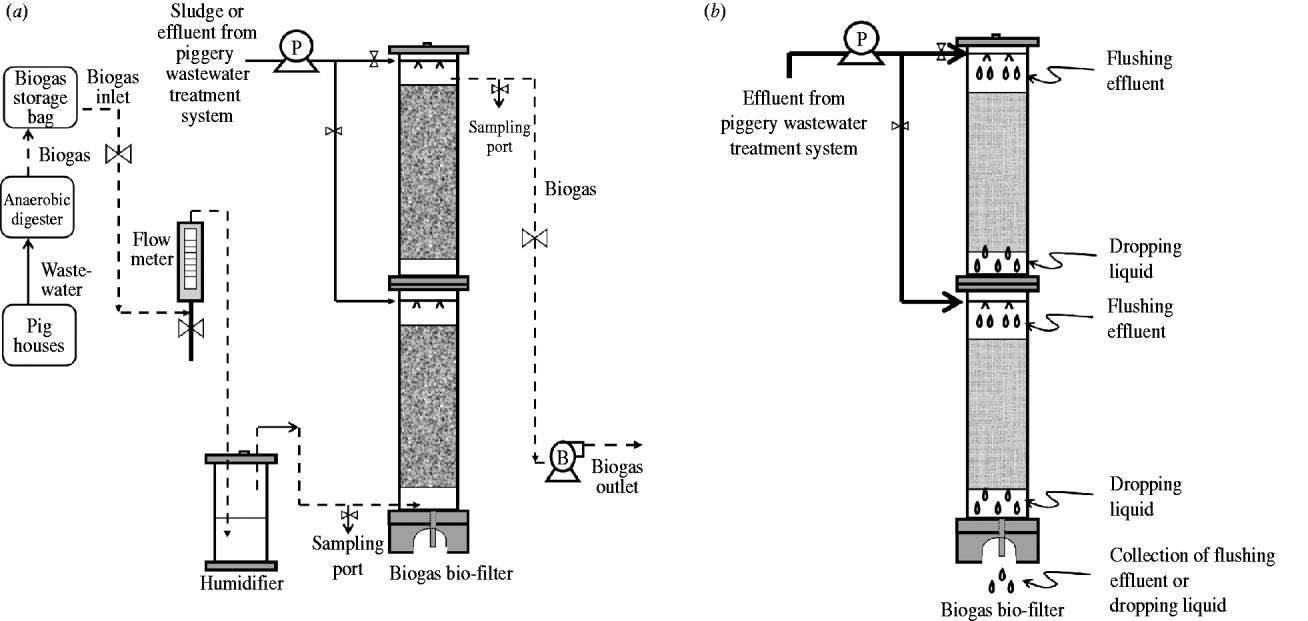
The BBS was wrapped with thermal insulation layers and installed beside two plug-flow anaerobic digesters of the same commercial pig farm. The BBS consisted of two separate acrylic plastic columns (internal diameter (i.d.) 0·2 × 1·0 m) in series (Fig. 1a). Each 62·8-litre column was packed with dried aerial roots (50·2 litres), and flow rates of 4 litres/min and 6 litres/min were tested in order to find the optimal flow rate for H2S removal from biogas. In the current study, oxygen, essential for growing sulphur-oxidizing bacteria, was allowed into the BBS through an annular gap in the connector of the biogas inlet pipeline by removing an O-ring from the connector. From the stoichiometry of sulphide oxidation, the oxygen supplied enabled the oxidation of both sulphide (4H2S + CO2 + O2 → CH2O + 4S + H2O) and sulphur (2S + 3O2 + 2H2O → 2H2SO4). For bio-carriers used in the current study, aerial roots were used unless indicated. The BBS was operated for 120 days before performing a 100-day continuous time-course experiment to evaluate the potential of the different packing materials in removing H2S. Initially, activated sludge (5 litres) was added to the top of the biogas bio-filter when the efficiency dropped below 70% to maintain stable H2S removal efficiency and bio-film activity. A humidifier (i.d. 200 × 450 mm) was also installed to ensure that the humidity of biogas entering the BBS was 85% or higher, followed by the biogas bio-filter unit. The humidifier had a working volume of 14 litres and was filled with 8 litres of clean tap water. Dried aerial roots of a common tree fern were used as a BBS bio-carrier. The roots were soaked in a mixture of activated sludge from pig farms, pond water and soils. After soaking, the aerial roots were screened through a rough-mesh (5 mm) sieve and packed into the reactor. H2S concentrations were measured at the inlet and the outlet by H2S detectors and removal efficiency calculated. Simultaneously, inlet temperature, outlet temperature and relative humidity were also measured and recorded. A 0·5 HP air vacuum pump (TECO Electric & Machinery Co., Taiwan) was installed at the outlet of the BBS to withdraw biogas from the storage bags and introduce it into the BBS by negative pressure. The biogas produced from the commercial pig farm anaerobic digester was introduced into the inlet of the BBS using PVC pipelines.
(a) Sketch of bio-filter setup. (b) Sketch of sampling sites of liquid samples from the BBS.

For the later time-course experiment, a mixture of dried aerial roots (35·3 litres) and small plastic rings (15 litres) was used as the bio-carrier. Biogas was introduced into the bio-filter system through a flow meter (Tohama 10B, Yeong Shin Co., Taiwan), a humidifier and the BBS before being withdrawn with a 0·5 HP air vacuum pump. The oxygen was c. 7% (v/v), measured at the outlet with a portable multi-gas leak detector (MX6 iBRID, Industrial Scientific Co., USA) with a resolution of 0·1%. All micro-organisms used for the current study were isolated and identified for capability of sulphur oxidation, based on experimental results (Su et al. Reference Su, Chen, Chang and Tang2008).
Bio-carriers
The two bio-carriers used in the current study were dried aerial roots of the common tree fern (Sphaeropteris lepifera) and small plastic rings. The dried aerial roots were c. 30–70 mm long and are commonly used as carriers for cultivating orchids in Taiwan. The small plastic rings (double spherical shape: 32 × 38 mm) (Sheng-Fa Plastics Inc., Touyuan, Taiwan) were made of polypropylene (PP) plastic. The aerial roots were used on days 0–97 as the sole bio-carrier; it can retain more moisture than the small plastic rings. A mixture (2·4 : 1) of aerial roots and plastic rings was used from day 98 and throughout the rest of the time-course experiment, to minimize accumulation of elemental sulphur on the bio-film surface of aerial roots.
Analysis
Ion chromatography (IC) for liquid sample analysis
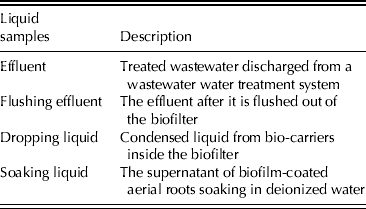
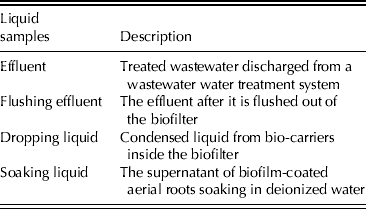
Samples (12 ml) of the liquid from bio-filter operation and the soaking liquid (Table 1) were collected (Fig. 1b) and analysed by IC (Su et al. Reference Su, Chen, Chang and Tang2008). In addition, liquid samples were taken periodically and analysed for chemical oxygen demand (COD), biochemical oxygen demand (BOD) and suspended solids (SS) using standard methods (APHA et al. 1995). The pH of the samples was measured by a pH meter (Metrohm 780 pH meter, Herisau, Switzerland).
Description of liquid samples for IC analysis
Measuring H2S, temperature and relative humidity of biogas
Inlet and outlet H2S concentrations were determined using H2S detector tubes (Gastec Co., Japan) with a gas sampling pump (GV-100C gas sampling pump; Gastec Co., Japan) using either detector tube 4LL (detection range of 0·3–168 mg/m3, detection limit = 0·14 mg/m3) or detector tube 4H (detection range of 14–5600 mg/m3, detection limit = 2·8 mg/m3). Removal efficiency for H2S was also calculated. A portable electronic H2S detector was used to complement H2S measurements for outlet biogas (PortaSens II, Gas Leak Detector; Analytical Technology Inc., Collegeville, USA) (accuracy ±5%; sensitivity 1% of sensor module range). Inlet and outlet temperatures and relative humidity were determined simultaneously by thermal/humidity meters (TES-1364; TES Electrical Electronics Co., Taiwan).
Measuring elemental sulphide on aerial root surfaces
Dried aerial root samples (5 g) were taken from the BBS and elemental sulphur was extracted from the aerial root samples by 25 ml chloroform solution in 50-ml plastic centrifuge tubes (Rethmeier et al. Reference Rethmeier, Rabenstein, Langer and Fischer1997; Hurse & Abeydeera Reference Hurse and Abeydeera2002). The sulphur residues inside the condensation bottles were then flushed with 5 ml methanol. The methanol solution was filtered through a 33 mm syringe filter (0·22 μm, hydrophilic Durapore, Millex Syringe Filter Unit, Millipore, USA) then analysed by high-performance liquid chromatography (HPLC) (Hitachi, Japan). Sulphur powder (99·5%, Scharlan, Spain) was used as the standard reagent. The detector wavelength was 270 nm and injection volume was 20 μl. A methanol solution was used for the mobile phase (methanol : deionized water = 98 : 2; v/v) and the flow rate was 1 ml/min (Rethmeier et al. Reference Rethmeier, Rabenstein, Langer and Fischer1997; McGuire & Hamers Reference McGuire and Hamers2000).
Statistical analysis
The experimental data of different samples were then analysed using the ANOVA procedure of SAS (1992).
RESULTS
The time-course experiments for days 0–42 and days 58–61 were performed under biogas flow at a rate of 6 litres/min; otherwise, a rate of 4 litres/min was used. Thus, biogas retention time was 15·7 min (62·8 litres/4 litres per min = 15·7 min). On days 1–97, the effluent (5 litres) from selected pig farms was used weekly to flush the bio-filter, remove elemental sulphur deposits and maintain the bio-film. After 99 days, activated sludge (5 litres) combined with the effluent (5 litres) from selected pig farms was used monthly to flush the bio-filter and to maintain the bio-film.
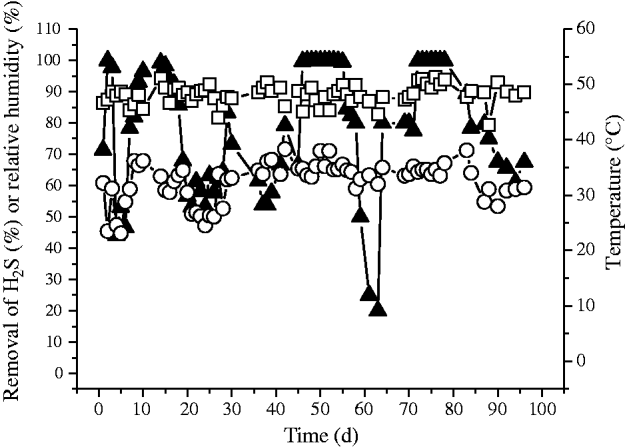
For days 1–99, the relative humidity of inlet biogas was 79·3–99·8% and the temperature was 15·2–38·4 °C. Outlet relative humidity was 75·5–99·8%, and the temperature was 23·1–38·0 °C. Inlet H2S concentrations were 1540–5600 mg/m3 and in some instances possibly even higher since the maximum concentration detectable by H2S tubes is only 5600 mg/m3. Concentrations of H2S in the biogas at the outlet, after passing through the bio-filter, were 0–2240 mg/m3 and removal efficiency of H2S was 27·3–100% (removal efficiency of H2S was calculated based on inlet H2S = 5600 mg/m3). The results indicated a wide variation in H2S removal efficiency over days 1–99 (Fig. 2). When sludge or effluent was added to the bio-filter, removal efficiency of H2S was high (c. 99%) (days 46–55 and 72–78). However, H2S removal efficiency decreased to 60% or even lower after several days; periodical observation found that H2S removal efficiency was impaired because the elemental sulphur accumulated on bio-carrier surfaces blocked direct contact between sulphide-oxidizing bacteria and H2S. Using the effluent to regularly flush away these elemental sulphur deposits from the bio-carrier surfaces appeared to increase the efficiency of H2S removal again.
Variation of H2S removal (▲), relative humidity (□) and temperature (○) for flow rates of 4 litres/min and 6 litres/min.
During days 27–42 and 58–61, biogas flow was adjusted to 6 litres/min to test the efficiency of biogas de-sulphurization. Thus, biogas retention time was 8·3 min. The relative humidity and temperature of inlet biogas were 99·9% and 28·6–38·6 °C, respectively, while those of the outlet biogas were 85·3–93·0% and 27·6–38·3 °C, respectively. H2S concentration at the inlet was 3360–5600 mg/m3 and 700–4480 mg/m3 at the outlet. Thus, H2S removal efficiency was 20·0–79·2% (removal efficiency of H2S was calculated based on inlet H2S = 5600 mg/m3) (Fig. 2). These results indicated that H2S removal efficiency was enhanced at 4 litres/min. Thus, periodically cleaning elemental sulphur deposits inside the bio-filter is simple and inexpensive, yet essential for successful operation.
During days 62–97, the BBS flow was fixed at 4 litres/min, but elemental sulphur (S0) still accumulated between and on the surfaces of bio-film-coated aerial roots (i.e. H2S → S0). The excess elemental sulphur destabilized biogas de-sulphurization by the BBS. The relative humidity of inlet biogas was 99·9%, and the temperature was 28·5–38·2 °C. The H2S concentrations in inlet biogas were 5040–5600 mg/m3 or higher. The H2S concentrations in outlet biogas were 0–1960 mg/m3. The experimental results showed that H2S removal efficiency was 61·1–100% (efficiency of H2S removal was calculated according to inlet H2S = 5600 mg/m3). Daily observation found that excess elemental sulphur accumulation on the bio-film of aerial roots could decrease the space between aerial roots, which would channel biogas through short flow paths inside the bio-filter and increase outflow of H2S without microbial sulphide oxidation.
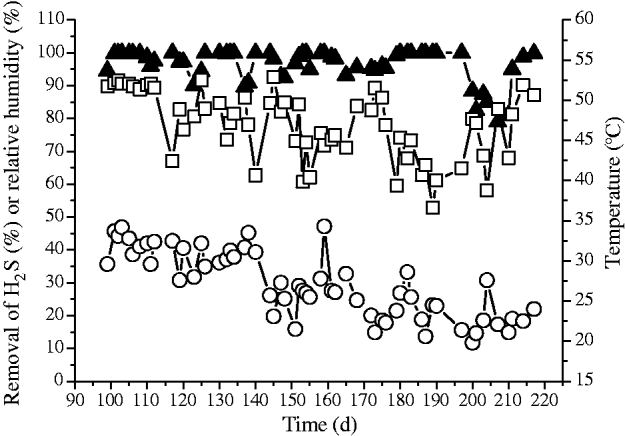
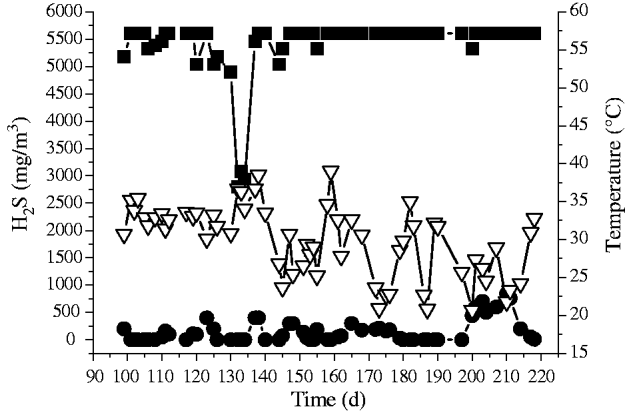
To minimize elemental sulphur accumulation on aerial root surfaces, a different bio-carrier, small Raschig rings (32 × 28 mm), was used as a second bio-carrier for the bio-filter on day 98. On days 99–217, the average inlet relative humidity of biogas was 99·9% and the temperature range was 20·8–39·0 °C. Outlet relative humidity was 52·8–92·7%, and the temperature range was 20·6–34·3 °C. The experimental results showed that efficiency of H2S removal was 90·0–100% (Fig. 3). The H2S concentrations in the inlet biogas were 2800–5600 mg/m3 or higher and the H2S concentrations in the outlet biogas were 0–560 mg/m3 (Fig. 4). Thus, 26·9 g H2S/m3/h was removed under these conditions (5600 mg/m3 H2S × 0·24 m3/h÷0·05 m3 bio-carriers = 26·9 g H2S/m3/h). Under optimal operation management conditions, efficiency of H2S removal from the biogas was gradually stabilized.
Variation of H2S removal (▲), relative humidity (□) and temperature (○) for a flow rate of 4 litres/min.
Variation of inlet (▪) and outlet (●) concentrations of H2S and inlet temperature (▽) over time.
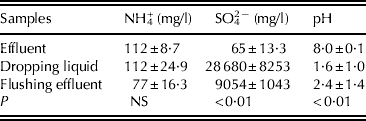
Both dropping liquid (Fig. 1b) and soaking liquid samples contained higher sulphate concentrations than other liquid samples resulting from oxidation of H2S: the effluent samples (pH = 8·0 ± 0·2) from the piggery wastewater treatment system, dropping liquid samples (pH = 2±1·0) from the bio-filter and flushing effluent samples (Table 1) (pH = 2±1·4) from the bio-filter were analysed by IC for anions and cations. Some sulphur oxidizers had previously been isolated from the BBS under acidic conditions (Su et al. Reference Su, Chen, Chang and Tang2008), and can oxidize H2S to elemental sulphur or even sulphate, creating acidic conditions in the BBS.
The analytical results showed that SO42− concentrations in piggery effluent, dropping liquid and flushing effluent samples were 65 ± 13·3, 28 680 ± 8253, and 9053 ± 1043 mg/l, respectively (P < 0·01) (Table 2), resulting in low pH for these liquid samples (P < 0·01). The dropping liquid sample contained high concentrations of SO42−, indicating that sulphide-oxidizing bacteria in the bio-filter were oxidizing H2S in the biogas to elemental sulphur and then to sulphate (i.e. H2S → S0 → SO42−). Further, the analytical results showed that ammonium (NH4+) concentrations in piggery effluent, dropping liquid and flushing effluent samples were 112 ± 8·7, 112 ± 24·9 and 77 ± 16·3 mg/l, respectively (P > 0·05).
Sulphate, ammonium and pH (± s.d.) in three liquid samples from bio-filter by IC
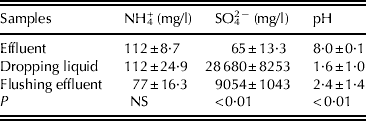
Data presented as means±s.d.
NS, not significant.
In addition, liquid samples including piggery effluent, dropping liquid and flushing effluent (pH = 1±0·2), and soaking liquid of aerial roots were taken and analysed for COD, BOD and SS. The analytical results showed that the soaking liquid contained the highest concentrations of COD (7026 ± 760 mg/l), BOD (889 ± 400·5 mg/l) and SS (6615 ± 2195 mg/l) (Table 3). These data indicate that the accumulated sulphur on bio-film coated aerial roots contains high concentrations of organic matter (e.g. biofilm) and sulphate. Based on a BOD : COD ratio value, i.e. the amount of biodegradable organic matters in the liquid samples, they were 0·53 : 1, 0·03 : 1, 0·10 : 1 and 0·13 : 1 for effluent, flushing effluent, dropping liquid and soaking liquid, respectively. This revealed that all except the effluent samples contained less biodegradable organic matter than the original effluent. All analytical and measurement data indicated that the biogas bio-filter effectively removes H2S through a microbial process (S2− → S0 → SO42−). Efficiency of H2S removal is stable when using a mixture of dried aerial roots and small plastic rings as the bio-carrier, but not when using 100% dried aerial roots (Fig. 3).
Water quality for different liquid samples during BBS operation

Data presented as means±s.d.
Seven bio-film coated aerial root samples (20 g/sample) with elemental sulphur were taken from the bio-filter and soaked in 200 ml deionized water for 20 min. The supernatant was filtered with 0·22 μm filter discs and then analysed for anions and cations by IC. Analytical results showed the filtered supernatant (pH = 1·8 ± 0·5) contained 1449 ± 172 mg SO42−/l (Table 4). The low pH of the sample resulted from a high concentration of SO42−. This implied that sulphide-oxidizing bacteria had proliferated inside the bio-filter. In a recent study, sulphur-oxidizing bacteria were isolated and identified from activated sludge and bio-filter bio-carriers (Su et al. Reference Su, Chen, Chang and Tang2008). In addition, an aerial root sample was randomly taken from the biogas bio-filter and analysed for elemental sulphur by HPLC. The preliminary analytical results showed 1 g of dried aerial roots contained 0·084 ± 0·008 g of elemental sulphur.
Soaking liquid of the bio-film coated aerial root samples from BBS by IC

Data presented as means±s.d.
DISCUSSION
Removal of H2S (7–7000 mg/m3) from biogas or other contaminated gases has been studied using different microbial approaches (e.g. bio-filtration, bio-scrubbing and bio-trickling). These methods achieve gas flows of 18 litres/h to 44 200 m3/ h (laboratory scale to full scale) and H2S removal efficiency of 65–100% (Syed et al. Reference Syed, Soreanu, Falletta and Béland2006). The fixed bed material must be flushed regularly with cleaning liquid to supply nutrients for Thiobacillus spp. and to rinse out elemental sulphur deposits. Under normal operating conditions, the efficiency of H2S removal is ⩾90%. H2S in the outlet gas of the facility is subsequently 140 mg/m3 or even less (Schieder et al. Reference Schieder, Quicker, Schneider, Winter, Prechtl and Faulstich2003) and therefore suitable for use in a power generating system, e.g. combined heat and power (CHP) unit.
Hybrid reactors combining chemical oxidation and biological oxidation have also been used to remove H2S (Son & Lee Reference Son and Lee2005). Gadre (Reference Gadre1989) applied a 50 ml glass reactor to treat 187·5 mg H2S/d and H2S removal efficiency was only 69·5%. In addition, a 7-litre aerobic bioreactor with an air compressor providing air was used to treat up to 45 g H2S/m3/h in 2500 h under a superficial gas velocity of 100 m/h (residence time = 27 s) and H2S removal efficiency exceeded 90% (Elias et al. Reference Elias, Barona, Arreguy, Rios, Aranguiz and Penas2002). The pilot-scale BBS described in the current study can remove 26·9 g H2S/m3/h using bio-filter approaches that operate at a 7% (v/v) O2 level continuously for >200 days.
Analysis of elemental sulphur and concentrations of sulphate indicated the pilot-scale BBS with novel bio-carriers (a mixture of aerial roots and plastic rings) efficiently removed H2S (removal efficiency up to 100%). The results of the pilot-scale BBS for treating 5600 mg/m3 H2S were superior to those by Chung et al. (Reference Chung, Lin and Tsen2004) for treating 1·4–210 mg/m3 H2S gas with a small-scale bio-filter reactor. The pilot-scale BBS is the first biogas bio-desulphurization facility for livestock farm designed in Taiwan. The experimental data indicated that biogas de-sulphurization was achieved by a microbial process rather than by a physical adsorption phenomenon or chemical reactions with elemental sulphur and sulphate formed inside the bio-filter by sulphide-oxidizing bacteria. The piggery effluents contained high concentrations of nitrogen (total Kjeldahl nitrogen (TKN) = 170 ± 67·6–220 ± 32·0 mg/l) and total phosphorous (total P = 132 ± 13·4–160 ± 29·7 mg/l) (Su et al. Reference Su, Liu, Shu and Wu1997). Thus, piggery effluent can be used in the bio-filter to flush elemental sulphur accumulation from aerial root surfaces and to provide nutrients for microbial proliferation. The same phenomenon was observed in the study of Syed et al. (Reference Syed, Soreanu, Falletta and Béland2006).
CH4 and CO2, two of the main greenhouse gases produced from anaerobic piggery wastewater treatment plants must be reduced (Su et al. Reference Su, Liu and Chang2004) or recycled. As petroleum energy supplies dwindle, renewable energy (e.g. biogas) has received increased attention. The H2S in biogas is produced by microbial degradation of sulphur-containing amino acids added to the feed (methionine and cystine). The Taiwan Feeding Standards recommend daily allowances of sulphur-containing amino acids of 2·2–6·2, 9·2–10·9, 6·6, 5·0–5·5 and 17·6–21·4 g/pig for piglets (1–20 kg), growing pigs (20–100 kg), bred gilts and boars (80–120 kg), pregnant sows (110–210 kg) and lactating sows (150–230 kg), respectively (COA 1990). However, pig farmers often add more essential amino acids (including sulphur-containing amino acids) to the feed, which may explain the high H2S concentrations in the biogas.
CONCLUSIONS
In the current study, a pilot-scale BBS was tested and proven to remove H2S in biogas from pig farms efficiently. Periodical observation found that most H2S was oxidized to elemental sulphur and accumulated on the surface of dried aerial roots in the biogas biofilter unit. At this point, effluents from piggery wastewater treatment facilities were used weekly to flush the BBS and provide N and P nutrients for sulphide oxidizers on the bio-carrier surfaces. In addition, elemental sulphur identified in the extraction solvent of dried aerial roots taken from the bio-filter revealed that H2S was oxidized to elemental sulphur and/or sulphate by the sulphur oxidizers. The pilot-scale biogas bio-filter was wrapped with two layers of plastic sheets for insulation purposes. Thus, elemental sulphur accumulation affected H2S removal, but atmospheric temperature did not significantly affect H2S removal. The experimental results showed that efficiency of H2S removal by a bio-filter using a mixture of aerial roots and plastic rings (H2S removal = 90·0–100%) was better than using aerial roots only (H2S removal = 20·0–79·2%).