INTRODUCTION
Changes in climate, particularly rainfall, can affect biotic interactions strongly (Branson Reference BRANSON2008, Preisser & Strong Reference PREISSER and STRONG2004, Stenseth et al. Reference STENSETH, MYSTERUD, OTTERSEN, HURRELL, CHAN and LIMA2002, Wilf et al. Reference WILF, LABANDEIRA, JOHNSON, COLEY and CUTTER2001). Along a rainfall gradient, changes in leaf characteristics may influence herbivore feeding and development and thus have important consequences for interactions at higher trophic levels. For example, in seasonally dry tropical forests, plants produce thin, short-lived leaves that are high in nitrogen concentration (Givinish Reference GIVINISH1999, Santiago & Mulkey Reference SANTIAGO and MULKEY2005). In wet tropical forests, leaves are longer-lived, contain more fibre and thus are mechanically tougher (Santiago & Mulkey Reference SANTIAGO and MULKEY2005, Santiago et al. Reference SANTIAGO, KITAJIMA, WRIGHT and MULKEY2004). It has been speculated that plant defences against herbivores increase from dry to wet forests and from deciduous to evergreen hosts (Coley & Aide Reference COLEY, AIDE, Price, Lewinsohn, Fernandes and Benson1991, Coley & Barone Reference COLEY and BARONE1996, Dyer Reference DYER, Carson and Schnitzer2007, Wilf et al. Reference WILF, LABANDEIRA, JOHNSON, COLEY and CUTTER2001, Wright Reference WRIGHT, Pugnaire and Valladares1999) and there is evidence to suggest that herbivory is greater though highly seasonal in dry versus wet forests (Basset et al. Reference BASSET, KITCHING, MILLER and NOVOTNY2003, Coley & Barone Reference COLEY and BARONE1996). If those results prove valid, an explanation could be that caterpillars eating highly defended leaves suffer retarded development, exposing them to predators and parasitoids for longer periods, and that could explain the lower caterpillar densities associated with wet forests (i.e. the slow-growth–high-mortality hypothesis; Benrey & Denno Reference BENREY and DENNO1997, Coley & Barone Reference COLEY and BARONE1996, Dyer Reference DYER, Carson and Schnitzer2007, Price et al. Reference PRICE, BOUTON, GROSS, MCPHERSON, THOMPSON and BOECKLEN1980). Furthermore, the lack of seasonal disruption in plant productivity and insect activity in a wet forest might result in year-round selective pressure from insect herbivores (Leigh et al. Reference LEIGH, DAVIDAR, DICK, PUYRAVAUD, TERBORGH, TER STEEGE and WRIGHT2004, Van Bael & Brawn Reference VAN BAEL and BRAWN2005, Wright Reference WRIGHT, Pugnaire and Valladares1999), which may in turn select for greater plant defences. In contrast, insects are generally more abundant in dry forests during the wet season following the mass flush of new leaves (Borghesio & Laiolo Reference BORGHESIO and LAIOLO2004). Dry-forest insect herbivores may also escape early wet-season mortality from natural enemies whose numbers may still be too low to track them (Aiello Reference AIELLO, Quintero and Aiello1992, Coley Reference COLEY1998, Godfray Reference GODFRAY1994). In a study by Stireman et al. (Reference STIREMAN, DYER, JANZEN, SINGER, LILL, MARQUIS, RICKLEFS, GENTRY, HALLWACHS, COLEY, BARONE, GREENEY, CONNAHS, BARBOSA, MORAIS and DINIZ2005), the incidence of parasitism of caterpillars increased as year-to-year variability in precipitation decreased, providing strong evidence of a correlation between rainfall seasonality and intensity of top-down pressures. Parasitoid wasps in particular are negatively affected by dry conditions through desiccation due to their small size (Hance et al. Reference HANCE, BAAREN, VERNON and BOIVIN2007, Shapiro & Pickering 2001).
Variation in plant defences and herbivore development may occur between the understorey and the canopy, since canopy leaves are more vulnerable to desiccation and exposure to ultraviolet light (Loiselle & Farji-Brener Reference LOISELLE and FARJI-BRENER2002, Lowman & Moffett Reference LOWMAN and MOFFETT1993, Yanoviak & Kaspari Reference YANOVIAK and KASPARI2000). Canopy leaves are thicker and tougher than understorey leaves and possess greater concentrations of defensive compounds (Dominy et al. Reference DOMINY, LUCAS and WRIGHT2003) and thus may prolong herbivore development, increasing their exposure to natural enemies.
To understand the effects of rainfall seasonality and forest stratification on tri-trophic interactions we collected and reared caterpillars from a seasonally dry and a wet forest in Panama to test the following hypotheses: First, caterpillars are less abundant in wet versus dry forests. Second, caterpillar abundances are related to the prevalence of parasitism. Third, caterpillars are less abundant in the canopy versus the understorey. Fourth, canopy versus understorey differences in caterpillar abundances are related to the prevalence of parasitism. And finally, the parasitoid community is dominated more by flies than by wasps in the dry versus wet forests.
Previous studies have shown that caterpillar feeding niche (i.e. shelter builders and external feeders) can strongly influence the risk of parasitism (Gentry & Dyer Reference GENTRY and DYER2002, Hawkins Reference HAWKINS1994) though conflicting results have been reported. Studies from tropical rain forests suggest that shelter builders suffer higher parasitism, in particular by parasitoid flies, compared with external feeders (Gentry & Dyer Reference GENTRY and DYER2002) yet the opposite trend was found in a seasonal Brazilian cerrado (Rodovalho et al. Reference RODOVALHO, LAUMANN and DINIZ2007). We therefore also tested the hypothesis that forest seasonality and feeding niche influences caterpillar abundance and susceptibility to parasitism.
METHODS
This research took place in two lowland Panamanian forests that differ significantly in mean annual precipitation and seasonality; on the Pacific side of Panama (9°0′2.11″N, 79°33′5.60″W) a seasonally dry forest (~1850 mm of annual rainfall), Parque Natural Metropolitano (PNM) characterized by secondary growth; and on the Atlantic coast, the more floristically diverse wet forest (~3600 mm of annual rainfall), Fort Sherman (FTS) (9°21′50.5″N, 79°57′33.3″W) (http://www.stri.org/tesp). Access to the canopy was made possible by use of a canopy crane, owned by the Smithsonian Tropical Research Institute (STRI) that has a boom stretch of 40 m and reaches a height of 35 m.
In 2003, from April to November, caterpillars were collected on alternate days at PNM and FTS and were reared to assess the prevalence of parasitism. Sampling was conducted in the understorey (predominantly trail edges, roadsides and forest edges) in PNM and FTS, and also in the canopy (PNM only; the crane became unavailable at FTS). Understorey caterpillars were located by carefully examining trees, shrubs and herbaceous plants using cues such as fresh leaf damage, folded leaves and caterpillar frass. Only third to fifth instars were collected to ensure caterpillars had had sufficient opportunity to have been parasitized in the field. Caterpillars were placed in plastic bags or containers with fresh leaf material and kept in an ice chest for transportation to the rearing facilities.
In the canopy, focal trees were selected based upon their accessibility from the crane. One individual of each of the following species was surveyed: Luehea seemannii Planch. & Triana, Cecropia peltata L., Cecropia longipes Pitt., Castilla elastica Cerv., Anacardium excelsum Skeels, Ficus sp., Annona spraguei Saff. and the understorey shrub Piper reticulatum L. that reached midway to the canopy. Caterpillars were located following the same methods both in the understorey and from the crane.
Caterpillars were reared in plastic bags or cups in ambient conditions and fed fresh leaves every 2 d until pupation. Extra plant material was kept in an ice chest or placed in plastic containers with water. Each caterpillar collected was assigned a unique number and those that could not be identified were given a unique morphospecies name. Host plants from which the caterpillars were collected were also recorded along with caterpillar life-history data, e.g. morphology, feeding habit (shelter builder, SHB; or external feeder, EXF), and pupation dates. Autopsies were carried out on dead caterpillars to ensure that endoparasitoids that had not yet emerged were not discounted. Upon emergence, parasitoids were stored in ethyl-alcohol, and at eclosion, adult Lepidoptera were placed in glassine envelopes and frozen. Vouchers are deposited in the insect collection at STRI, Panama. For analyses comparing caterpillar abundances between forests, data were square root-transformed to meet assumptions of normality. Prevalence of parasitism was calculated as the proportion of parasitoids reared from caterpillars. This data set included only caterpillars that were reared to adult or that yielded parasitoids. Caterpillar abundance was calculated as the mean number of caterpillars collected per hour each day and averaged per month. Statistical analyses were performed using ANOVA and chi-square tests in SAS and Minitab.
RESULTS
A total of 1582 caterpillars representing 14 families were collected and reared between the months of April and November, however, many caterpillars died from causes other than parasitism. Thus, for parasitism analyses the sample size was reduced to 431 at PNM (382 in the understorey and 49 in the canopy) and 300 at FTS.
At PNM, 684 caterpillars were collected in the understorey over 37 d (111.6 h), 121 caterpillars were collected in the canopy over 18 d (58.5 h), and 609 caterpillars in the understorey at FTS over 27 d (95 h). The collecting effort in the understoreys at the two forests was similar (ANOVA: F1, 62 = 1.9, P < 0.17) with an average of 3.23 ± 0.19 h d−1. However, sampling effort was lower in the canopy (ANOVA: F1, 53 = 13.9, P < 0.001) with an average of 1.82 ± 0.23 h d−1.
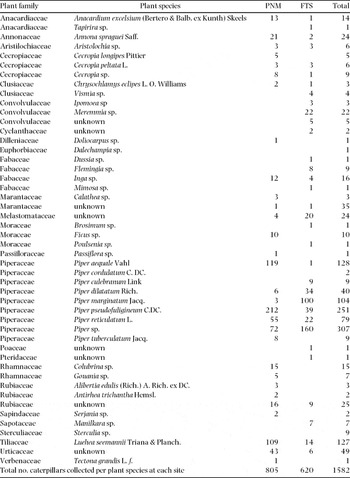
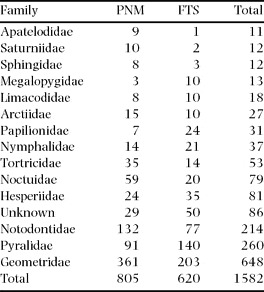
Caterpillars were sampled from plants representing a total of 25 families; 18 in each forest (Table 1), with the genus Piper, Piperaceae, representing 67% of the host plant collection records due to the high abundance of geometrid caterpillars found on plants of this genus. The most commonly collected caterpillar groups were: Geometridae, Pyraloidea, Notodontidae, Hesperiidae and Noctuidae (Table 2); with notodontids and pyraloids experiencing the highest levels of parasitism, 34% and 40% respectively. At least 4% and 8% of caterpillars collected at PNM and FTS respectively were microlepidoptera and could not be identified to family.
Number of caterpillars collected for each plant species at the seasonally dry forest, Parque Natural Metropolitano (PNM) and the high-rainfall forest, Fort Sherman (FTS).

Number of caterpillars belonging to each of the following families of Lepidoptera collected from the seasonally dry forest, Parque Natural Metropolitano (PNM) and the high-rainfall forest, Fort Sherman (FTS).

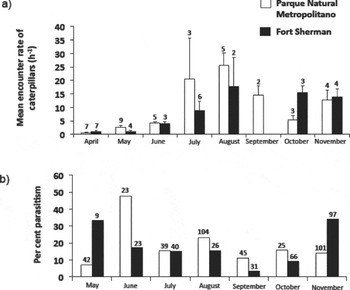
Contrary to our expectation, overall levels of parasitism in the understorey were nearly identical in the dry forest (18.7%, n = 382) and the wet forest (18.1%. n = 300). There was also no significant difference in the mean number of caterpillars collected in each forest, with an average of 7.81 ± 1.83 caterpillars h−1 at PNM and 8.41 ± 1.81 caterpillars h−1 at FTS (ANOVA: F1, 62 = 0.55, P < 0.46). Caterpillar abundances did exhibit significant seasonal differences in the two forests, with lower abundances in both during April and May, and reaching their peaks during August, and being more pronounced in the dry forest (two-way ANOVA: F1, 62 = 46.5, P < 0.001) (Figure 1a). However, in contrast to the patterns observed in caterpillar abundances, we did not observe a gradual seasonal peak in the prevalence of parasitism (Figure 1b).
Seasonal patterns in caterpillar abundance (a) and parasitism (b) at the seasonally dry forest, Parque Natural Metropolitano (PNM) and the high-rainfall forest, Fort Sherman (FTS). The mean encounter rate is calculated as: the number of caterpillars collected, by the number of hours searched, averaged across days per month. Sample size above the bars represents the number of days spent collecting each month. No data are presented for Fort Sherman in September as caterpillars were collected on only one day (37 caterpillars collected over 2 h). Error bars represent 1 SE. Prevalence of parasitism is calculated as the proportion of parasitoids reared for caterpillars that were reared to an adult or parasitoid. Figures above the bars represent sample size.

In support of our hypothesis, the prevalence of parasitism was greater in the canopy (43%, n = 49) versus understorey (18%, n = 382) (χ2 = 16.2, P < 0.0001); these results appear to be independent of caterpillar abundances at the different strata as we found no difference between the abundance of caterpillars in the understorey versus canopy with an average of 6.58 ± 2.18 caterpillars h−1 (ANOVA: F1, 53 = 0.94, P < 0.336).
Analysis of shelter builders and external feeders was limited to the understorey due to the small sample sizes in the canopy. The prevalence of parasitism for shelter builders was 27% (n = 62) and 29% (n = 114) and for external feeders 16% (n = 320) and 11% (n = 183) in the dry and wet forest respectively. We found that shelter builders exhibited a higher prevalence of parasitism than external feeders in both the dry and wet forest (PNM; χ2 = 4.38, P < 0.036, FTS; χ2 = 14.2, P < 0.001), however no difference in parasitism was found between the two forests for feeding niche (EXF; χ2 = 1.40, P = 0.236, SHB; χ2 = 0.09, P = 0.752). We also found no significant difference in the abundances of shelter builders (1.42 ± 0.311 caterpillars h−1, 2.39 ± 0.53 caterpillars h−1) and external feeders (8.27 ± 1.91 caterpillars h−1, 5.49 ± 1.54 caterpillars h−1) between the dry and wet forest respectively (ANOVA: SHB; F1, 62 = 2.87, P < 0.096, EXF; F1, 62 = 1.49, P < 0.227). Interestingly, we found significant differences in the dry forest, with external feeders being more abundant than shelter builders (ANOVA: F1, 62 = 18.9, P < 0.001), however no difference between these two life styles was found in the wet forest (ANOVA: F1, 62 = 2.57, P = 0.115). When data from the two forests were combined, external feeders were more abundant than shelter builders (EXF; 7.02 ± 1.26, SHB; 1.06 ± 0.27 caterpillars h−1, t = −4.33, P < 0.001, df = 89) and the proportion of parasitoids reared from shelter builders was greater than that from external feeders (32% and 14.9% respectively).
Our results of 132 parasitized caterpillars did not reveal any significant differences in the proportion of flies or wasps reared from the seasonally dry forest and the wet forest (χ2 = 1.55, P = 0.213). However, when we combined the data from the understorey of the two forests and the canopy collections we did find a significant difference in the proportion of flies and wasps reared from shelter builders (flies = 38, wasps = 19; n = 57) and external feeders (flies = 21, wasps = 54; n = 75) (χ2 = 19.6, P < 0.0001). This trend also held when the analyses included understorey collections only (χ2 = 16.4, P < 0.0001) with external feeders suffering a higher prevalence of parasitism by wasps at both PNM and FTS and shelter builders suffering equal parasitism by flies and wasps at PNM, but a higher prevalence of flies at FTS (Table 3). Overall, a higher proportion of flies was reared from shelter builders (65.8%), while a higher proportion of wasps was reared from external feeders (72%). Differences in the proportions of flies and wasps reared from the canopy versus the understorey were not significant (χ2 = 3.76, P < 0.0525). This result may be an artefact of sampling given that twice as many shelter builders than external feeders were collected from the canopy.
Proportion of flies and wasps reared from the total number of identified parasitoids from each feeding niche in the understorey of the dry and wet forest. EXF = external feeder, SHB = shelter builder.

DISCUSSION
We did not find any support for the hypothesis that the prevalence of parasitism in caterpillars increases from dry to wet forest, or that caterpillar abundance is lower in wet forests. Despite the fact that these forests differ significantly in plant species composition and annual precipitation, caterpillar abundance and prevalence of parasitism were almost identical, though we cannot discount the possibility that differences occur in egg parasitism or parasitism of early instars. Our results support those of Van Bael & Brawn (Reference VAN BAEL and BRAWN2005) who found similar densities of arthropods between PNM and FTS. Furthermore, seasonal increases in caterpillar abundance were mirrored in both forests, suggesting that caterpillar populations may be responding to similar cues (Figure 1a).
Seasonality in the population dynamics of tropical insects has been noted previously, and rainfall may be a cue for reproduction or for emergence from diapause (Wolda Reference WOLDA1978, Reference WOLDA1988). In addition, synchronous leaf flushing at the beginning of the wet season is thought to be a strategy to satiate herbivores (Aide Reference AIDE1993) as young leaves are consumed at a greater rate than mature leaves due to lower defences and higher nutritive value (Aide Reference AIDE1993, Coley Reference COLEY1998).
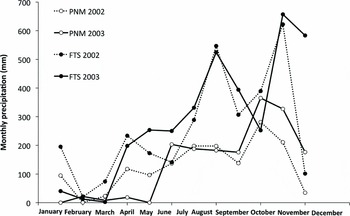
Although Fort Sherman is a high-rainfall forest it does experience a very short dry season, which may be sufficient to induce leaf production, and thus cannot be strictly classified as aseasonal. In 2003, the duration of the dry season was 3 mo at Fort Sherman and 5 mo at Parque Natural Metropolitano (PNM) (Figure 2). In a review of 53 tropical sites, van Schaik et al. (Reference VAN SCHAIK, TERBORGH and WRIGHT1993) found that leaf production and flowering are generally concentrated within 1 mo at the onset of the rainy season in forests that have more than 2 mo of drought. Thus, it seems likely that the seasonal pattern in caterpillar abundance was driven by the increase in food availability at the beginning of the wet season in both forests.
Monthly precipitation patterns in 2002 and 2003 for the seasonally dry forest, Parque Natural Metropolitano (PNM) and the high rainfall forest, Fort Sherman (FTS). Data from the Smithsonian Tropical Research Institute (http://www.stri.org/tesp).

Although caterpillars exhibited a seasonal increase in abundance, in neither forest did the prevalence of parasitism appear to track their hosts’ abundance. In the wet forest, parasitism remained relatively constant for the first half of the wet season before peaking at the end, while in the dry forest parasitism exhibited more seasonality following a distinct peak at the beginning of the wet season (Figure 1b). Though our samples were small it is somewhat surprising that parasitism was highest at the beginning of the wet season in the dry forest given that parasitoids, particularly wasps, are known to be sensitive to desiccation, and yet wasps were more prevalent than flies. This observation suggests that parasitoid wasps quickly rebound following the dry period or that the duration and severity of the preceding dry season did not substantially reduce their population size. Our results conflict with those of a previous study conducted at PNM in 1998 which showed that wasps were relatively scarce until the end of the wet season, while flies dominated the early part of the wet season (Van Bael et al. Reference VAN BAEL, AIELLO, VALDERRAMA, MEDIANERO, SAMANIEGO and WRIGHT2004). The extended dry season of 1998 due to the El Nino Southern Oscillation resulted in a massive caterpillar outbreak with large trees being almost completely defoliated (Van Bael et al. Reference VAN BAEL, AIELLO, VALDERRAMA, MEDIANERO, SAMANIEGO and WRIGHT2004). Therefore, results from these two studies may be explained by differences in collections of external feeders and shelter builders or annual variability in dry-season length and its impact on decoupling caterpillar and parasitoid populations.
Although there was no significant difference in the abundances of shelter builders and external feeders collected between forests, external feeders were significantly more abundant than shelter builders in the dry forest. While this may explain why wasps were more abundant, it still is not understood why the prevalence of parasitism was highest at the beginning of the wet season, before the peak in caterpillar abundance. In the current study the dry season was extended by 2 mo in PNM and 1 mo at FTS compared with the previous year (Figure 2). Although it was an El Niño year, the effects were much less dramatic than those observed in 1998, however, the extended dry season may have been sufficient to alter the timing of caterpillar and parasitoid emergence. It is also possible that natural enemies of parasitoids such as hyperparasitoids, spiders and birds became more abundant in the dry forest as the wet season progressed and perhaps exhibited less seasonality in the wet forest. Unfortunately, there are very few data on the seasonality of herbivores and their natural enemies in tropical forests to test this assumption. Thus, we found no support for our hypothesis that caterpillars are more susceptible to parasitism by flies in the dry versus the wet forest due to the vulnerability of wasps to the extended dry season.
In general, we found that external feeders were more abundant than shelter builders, and significantly so in the dry forest. Shelter builders also were more vulnerable to parasitism, particularly by flies in the wet forest, FTS; a finding that supports previous work by Hawkins (Reference HAWKINS1994) and Gentry & Dyer (Reference GENTRY and DYER2002). Why shelter builders are more susceptible to attack by flies may be due to their more sedentary lifestyle, which facilitates parasitism by flies whose strategy is deposition of planidial larvae and microtype eggs onto the host plant where they are then consumed by caterpillars. Shelters may also provide effective defence against social wasps, ants and birds, particularly in cases where shelters are completely sealed using caterpillar silk (Jones et al. Reference JONES, CASTELLANOS and WEISS2002). Some shelter builders are also known to chew holes in the leaf as an escape route in case of attack (Aiello & Solis Reference AIELLO and SOLIS2003, Gentry & Dyer Reference GENTRY and DYER2002), a behaviour that may be a response to predation by birds, social wasps and parasitoids in general. Early instars of external feeders may be easier targets for parasitoid wasps, as they exhibit weaker defences than later instars and do not have a protective shelter. Furthermore, external feeders that are unpalatable to predators have been shown to provide a refuge for parasitoids (Gentry & Dyer Reference GENTRY and DYER2002).
Overall, our findings do not support the notion that caterpillars are less abundant in wet forests due to the slow-growth–high-mortality hypothesis on better-defended plants, at least in the case of those that feed on plants along the forest edges. Interestingly, a recent study has empirically demonstrated higher leaf damage by herbivores in a wet versus dry forest in Panama, implying that wet-forest plants are less well defended (Brenes-Arguedas et al. Reference BRENES-ARGUEDAS, COLEY and KURSAR2009). Although the authors note that this is an unlikely explanation, results from both this and the current study beg the question as to why similar herbivore densities are observed between these forest types yet differences occur in levels of herbivory. Addressing this question will require identifying the type of herbivore damage and correlating this with herbivore abundances and rates of herbivory.
Our analysis of the canopy versus the understorey revealed that caterpillars were equally abundant across this vertical gradient; however the prevalence of parasitism was significantly greater in the canopy, which may have been due to a higher sample size of shelter builders (29 SHB versus 20 EXF). Therefore, these results should be treated with caution. More extensive sampling in the canopy will be required to ensure that these results are not biased by the smaller sample size and narrower range of host plants searched due to limitations imposed by the crane.
In summary, our results represent only 1 y of study, and years can and do differ dramatically in seasonality and rainfall in the same forest. Therefore we cannot yet compensate for the fact that caterpillar abundances and prevalence of parasitism vary significantly from year to year between these forests (Wolda Reference WOLDA1978). Long-term data collections will be necessary to address the role of precipitation more adequately, both during the study and in the months just prior to it, in regulating insect population dynamics. Care must also be taken not to assume that linear trends occur between dry and wet forests as demonstrated by a recent study revealing a higher prevalence of parasitism for caterpillars occurring in moist versus dry and wet forests (Connahs et al. Reference CONNAHS, RODRÍGUEZ-CASTAÑEDA, WALTERS, WALLA and DYER2009).
Theoretical models that are supported by recent empirical data predict that precipitation events will become more intense, less frequent, and generally less predictable with current climate warming trends (Knapp et al. Reference KNAPP, BEIER, BRISKE, CLASSEN, LUO, REICHSTEIN, SMITH, SMITH, BELL, FAY, HEISLER, LEAVITT, SHERRY, SMITH and WENG2008). Though numerous studies have examined the effects of water stress on plant–herbivore interactions, there still is no general predictive framework on the outcome of these interactions and their impact on the third trophic level (Alberti et al. Reference ALBERTI, MONTEMAYOR, ALVAREZ, AGUSTINA, LUPPI, CANEPUCCIA, ISACCH and IRIBARNE2007, Joern & Mole Reference JOERN and MOLE2005, Wirth & Leal Reference WIRTH and LEAL2001). Long-term study of these interactions across habitats that vary in precipitation may provide insightful clues as to how populations of tropical herbivores and their natural enemies fluctuate in response to predicted climatic shifts.
ACKNOWLEDGEMENTS
This research was funded in part by a short-term fellowship to H. Connahs from the Smithsonian Tropical Research Institute. Thanks also to E.A. Herre who funded part of this research and E. Teppe who assisted with Piper identifications. We are also grateful to an anonymous reviewer whose comments improved the manuscript.