Those Pretty Little Things
“Viewers who see our live shows often share with us, ‘You aren’t as ugly and fat as I thought!’” Ji-young of the South Korean women R&B vocal band the Bubble Sisters made this self-deprecating remark during an interview with a popular YouTube channel that features minor Korean celebrities (Geunhwangolimpik 2023).Footnote 1 In response to Ji-young’s comment, the other members of the Bubble Sisters, of which Ji-young has been a member since 2013, burst into loud laughter.
The Bubble Sisters made their debut in 2003 during what the South Korean media dubbed “an era of sexy women singers” (Im Reference Im2003).Footnote 2 Countering this mainstream trend, the four band members strove to differentiate themselves by emphasizing their strong R&B and jazz-based vocal talents and by refusing to conform to the typical beauty standards expected of Korean women singers: tall, slender, young, and pretty. Further contrasting themselves to the K-pop ideal, the singers performed in blackface on live TV, adopting what they described as a “Black” concept for the overall visual and musical identity of their debut album. Titled First Impression (2003) under the slogan, “We will show those pretty little things” (i.e., we will prove the tall, slender, young, and pretty K-pop stars wrong), the debut album included a jacket featuring a photograph of the four women with darkened faces, Black-hair wigs, and exaggerated lips, to accompany the album’s 14 tracks of jazz, funk, soul, and blues numbers.
The Bubble Sisters’ use of blackface was intimately tied to their identities as women entertainers, whose vocal talents were measured against the industry’s emphasis on surface-level beauty. The blackface of Korean women entertainers like the Bubble Sisters requires a double take: While the artists’ use of blackface makeup and wigs evoke the historical traditions of blackface minstrelsy, such use is equally bound up with how Korean women entertainers’ bodies are continuously reshaped to conform to the beauty standards and gender inequalities within the South Korean pop cultural industry. Within this performance economy, blackface functions as a racialized currency used to garner attention.
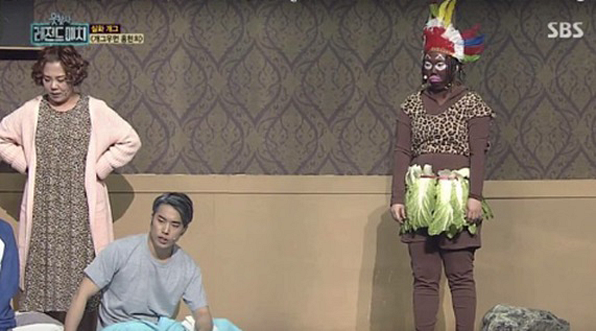
Comedy actor and TV personality Hong Hyeon-hee is another Korean woman entertainer whose blackface performance drew global attention. Hong became embroiled in a controversy following her performance in blackface makeup in a 2017 episode of Utchatsa legeondeu maechi (People Looking for a Laugh: The Legendary Corners), a televised comedy show produced by the South Korean broadcasting station SBS. The show was performed in front of a live audience and was later broadcast after some postproduction edits. With Hong’s skits appearing between the 184th and 190th episodes of the show, the specific episode in question aired on 19 April 2017, as the 188th episode. Although the video clip once available on YouTube has since been taken down, it remained accessible on the SBS website as of July 2024 (Utchatsa 2017a). In this episode, Hong’s blackface makeup included exaggerated lips, a crudely feathered tribal headdress, and a skirt made from cabbage leaves, all worn over a light brown leotard to denote skin tone. She entered the stage carrying a prop boulder, further imbuing the performance with the symbolism of primitive nature and superhuman strength.
The blackface performances of the Bubble Sisters and Hong, though 14 years apart, were both nationally televised and received significant local and international media coverage—so much so that they have come to serve as evidence of the rampant antiblack sentiment in Korean popular culture. Indeed, both controversies quickly gained attention from an international online readership, especially among English-speaking audiences, as Korean popular cultural fandom has grown over the years. Korea’s blackface scandals often appear in news media and forum network pages under headlines such as “The Bubble Sisters and Racism in Korea” or “Blackface in Korea? AGAIN?” (Roboseyo 2012; Temidire Reference Temidire2003). The Bubble Sisters, Hong Hyeon-hee, and other South Korean women entertainers appearing in blackface, or in the Korean term heuginbunjang (dressing up as a black person), are instantly used as definitive evidence that South Korea is indeed racist and antiblack.
These cases also frequently appear in the relevant literature on racial politics of Korean popular culture, including Gil-Soo Han’s much-cited work on blackface in Korean culture, which argues that blackface performances by Korean entertainers like the Bubble Sisters are active manifestations of “Korean nationalism with their racial mimicry of African-Americans” (Han Reference Han2015:5). Similarly, Sarah Olutola, building on Han’s work, contends, “racist depictions and racist conceptions of African-Americans” in Korean popular media performances demonstrate the culture’s “predilection toward whiteness” (2024:14). Chinua Thelwell, also citing Han as well as the example of the Bubble Sisters, further points out that the increased visibility of Korean popular culture on the internet has placed these blackface performances of the Bubble Sisters and Hong under close international scrutiny, all while South Korea navigates its place in the global economy by adopting “neoliberal ideologies of economic competition and the idea that ‘losers’ can and should be publicly humiliated” (2020:205–06).
However, taken together, the performances of both the Bubble Sisters and Hong require a multilayered reading that exceeds narrow interpretations of blackface as signifying Korean women’s aspirations toward whiteness or South Korea’s advancements in global popular culture materializing in blackface. Rather, these women entertainers’ experiences of fat-shaming and constant pressure to undergo extreme dieting and cosmetic surgery provide a context for their choices. They engage in blackface as a strategy to attract attention and, in turn, capital and material resources. This context for contemporary Korean blackface controversies, often minimally addressed in discussions on Korean pop culture and its intersectional cultural politics of race and gender, illuminate how the Bubble Sisters’ and Hong’s uses of blackface reflect workings of the so-called gwanjonggyeongje (economy of attention seekers), a perverse form of attention economy shaped by locally specific gender politics.
Within the South Korean pop culture landscape, the misogyny inherent in gwanjonggyeongje dictates a particular stylization of blackface adopted by women entertainers, whose bodies superimpose tropes of antiblack femininity onto the Korean women’s already internalized negative body images. In other words, the visual markers of blackface performed by these artists were gendered in the way that their own perceived ugliness—associated with their weight and facial characteristics—was packaged through the caricaturized tropes of Black women’s bodies. The visual markers of blackface caricature were performed not only through costuming with makeup and wigs but also through mimicry, visual editing, and the use of prosthetics of protruding buttocks and enlarged breasts that are evocative of the hypersexualization of Saartjie Baartman (1789–1815). Just as the commodified body on display, such as Baartman’s, demands affective work of the spectacularized Black body (Carosi Reference Carosi2025:78), Korean women entertainers perform affective work to garner public attention as a valuable resource, doing so by exaggeratedly embodying tropes of Black femininity to make them appear grotesque and ugly. Blackface becomes an abject performance tactic to navigate the precarious financial structure of South Korea’s competitive pop culture industry.
Therefore, Korean women entertainers’ blackface offers a particularly productive site to foster a more robust discussion regarding the entangled relationship between blackness, beauty economies, and global blackface geographies. This more capacious approach does two related things. On the one hand, it challenges the narrow focus of discussions on the Korean pop culture industry’s beauty norms that tend to center around an understanding of cosmetic surgery and the Korean skincare routine (otherwise known as K-beauty) as a form of neoliberal self-management overcoming ordinary and nonnormative bodies. On the other hand, the approach remaps the global geographies of blackface in ways that locate local gender politics and its relationship to the beauty economy beyond what Crystal Anderson describes as a binaristic “black-white paradigm” (2007:662).
In the case of the Bubble Sisters and Hong, the artists’ relationship to racialized grotesquerie by means of exaggerated blackface does not outright attack ugliness nor does it aspire to any version of ideal beauty (which is often understood as desiring local forms of heteronormative whiteness); instead, it relies on an active mobilization of blackness as an expression of self-abjection. To be clear, examining how the Bubble Sisters and Hong Hyeon-hee, particularly in the early stages of their careers, employed blackface to get attention and accumulate capital does not defend blackface as somehow less racist than historical blackface minstrelsy. Both cases are distinct from other instances of blackface by Korean male entertainers, which might be seen as recuperating racialized Asian masculinity “forfeited in response to historical trauma” of Japanese colonialism and the US occupation (Kim Reference Kim2020:97); Korean women entertainers’ blackface is also distinct from that of other Asian women, specifically Japanese, which has been interpreted as an ambivalent act of “transgress[ing] the dominant standard of Japanese femininity” while potentially revealing the US empire’s racial triangulation of whiteness, blackness, and Asianness by interned Nisei Japanese American women (Roxworthy Reference Roxworthy2013:135–36). The Bubble Sisters and Hong were clearly purposeful in applying blackface to their repertoire as a strategy to negotiate what they perceived as the unfair treatment of Korean women in the entertainment industry. These examples highlight how local blackface, rather than being understood as an offshoot of historical minstrel performances from the US, the British Empire, and its Anglophone world, can instead be understood as an economic value-making practice responding to specific gender politics while trafficking in global tropes of blackness.Footnote 3
Abject Blackness and the Korean Beauty Economy
The Bubble Sisters, who made their debut in 2003 with the full-length album First Impressions, appeared in blackface in their music video for “Bubble Song” and in live performances of the same.Footnote 4 In these performances, the band members wore silk pajamas, wigs with curlers, and makeup that accentuated their lips to appear fuller and wider. To gain more attention from mainstream media and the audience, they needed to both efface their otherwise “mediocre”—or some may say, ugly—appearances. They did so by adopting the hypervisual blackness of blackface performance, both in their official music video and on a televised stage.
In various interviews, they cited pretty K-pop stars and their mediocrity as entertainers as their reason for specifically using blackface makeup: “There are people who can’t sing, yet they see a meteoric success in the mainstream media just because they are young and pretty. You could even say that they are impersonating a professional singer,” said Seung-hee, one of the members (Myeong Reference Myeong2003; emphasis added). The Bubble Sisters’ perception of women entertainers as “impersonating” professional singers parallels their own self-perception as masquerading or “hiding behind blackface makeup” to relieve their anxiety (Heo Reference Heo2003). When asked about the racist implications of the blackface performance, the band said in an interview that the Bubble Sisters’ blackface performance was all about “undermin[ing] the typical Korean band, who are pretty but don’t have any talent,” and wanting to “open doors to musically talented people who, if they don’t fit into this compartment, are usually forced to [remain] underground” (in Temidire Reference Temidire2003). Similarly, in the 2003 YouTube interview mentioned previously, Seo Seung-hee, one of the group’s original members, emphasized the pressures faced by the Bubble Sisters and other women vocalists who do not conform to the singing styles, fashion choices, and body types of dance divas and idols preferred by producers and managers.
World Music, the entertainment company that first represented the Bubble Sisters, initially focused on producing dance musicians whose bodies and dance abilities were the source of their popularity in the early 2000s South Korean music scene. To diversify its talent roster, World Music later signed R&B artists such as Yoon Mi-rae (also known as Natasha Shanta Reid), expanding beyond its original focus, a shift that included managing the Bubble Sisters. Nevertheless, the Korean music industry remained dominated by pretty dancers at the time, and the Bubble Sisters felt the need to stand out among these popular entertainers. Seo Seung-hee explains, “Honestly, we didn’t have the appearance [of pretty dance musicians]. We instead did what we do best: sing” (Geunhwangolimpik 2023). In an effort to market the band’s uniqueness among dance-focused artists, the Bubble Sisters’ use of blackface was likely conceived and produced with the involvement and support of their management company.
The opening scene of the Bubble Sisters’ debut music video of “Bubble Song” (2003) is in fact an explicit reference to the group’s anxiety about navigating the mainstream South Korean popular music scene, which at the time was dominated by dance-focused, idol-like celebrities including Lee Hyori, BoA, and Chae Yeon, whom Sugyeong Kim likened to “fairies” (Kim Reference Kim2003).Footnote 5 The music video opens with a scene full of young, slender, pretty, straight-haired, and suggestively dressed Korean women bobbing to techno music—the most popular musical style of the early 2000s South Korean club scene. Suddenly, the doors to the club burst open for the entrance of the Bubble Sisters in blackface makeup and colorful pleather track suits. When they enter, the techno music stops, transitioning to a slow, bluesy piano melody to announce their arrival. The women who had been dancing to techno music turn their heads to look at the four women and cheer for the Bubble Sisters’ vocal performance of brass- and bass-heavy funk and post-soul music, occasionally embellished with a gospel-style chorus.
The singers do not perform in blackface throughout the music video. Many of the scenes, especially for viewers familiar with South Korean music culture of the early 2000s, are recognizable as citations of iconic women K-pop dance artists, a parody that renders the original sleek and sexy images comical and purposefully amateurish. Nevertheless, the music video repeatedly cuts to a concert scene where the four members perform in blackened makeup and Black wigs. The jarring quick cuts to their blackface bears no immediate relation to the lyrics, which were meant to address the violence related to body image and female beauty in South Korea. In the lyrics, the Bubble Sisters repeat, “I hate my ugly face, I hate it, I hate it, I hate it,” and they plead to God, asking why they can’t be “just a little prettier” and “skinnier.” The singer says there is “nothing” that she likes about her “eyes, nose, lips,” and that she thinks her body is “blowing up.” She secretly hopes that her crush does not notice her fat body and ugly face, which she vows to “change” for her crush (Bubble Sisters n.d.).Footnote 6
The blackface performance nullifies what the music video and its lyrics might otherwise have offered as a potentially meaningful social critique of gender inequality and misogyny in the Korean pop industry, which has long promoted harmful body image standards and the sexualization of female celebrities. Although the lyrics might have attempted a tongue-in-cheek response to the social pressures on Korean women (Bubble Sisters and pretty K–pop stars alike)—relentless dieting, workout routines, cosmetic surgery, and the resultant body dysmorphic disorder—the lyrics and the performances of blackface ultimately reinforce Korean women’s aspiration toward normative beauty ideals.
The artists’ adoption of what they perceived as the grotesquerie of blackness as a form of cultural capital may be understood within the cycle of capitalist transaction that So-Rim Lee observes as contingent upon public shaming of women’s bodies and appearance found in South Korean reality makeover shows (2020:112). In Korean makeover shows like Let Me In, the contestants publicly shamed for their appearance would then be “propelled [into] competing for a new body” that might ostensibly replace their “grotesque, repulsive, and unnatural” bodies (112). In these reality makeover shows, the women’s faces and bodies are often described using racialized language. In one instance, the hosts likened a contestant’s hooded eyelids, thick lips, and overbite to those of the enslaved African character Kunta Kinte from the 1977 US TV show Roots, calling the contestants Kuntakintenyeo (Kunta Kinte girl) (Kwon Reference Kwon2011). According to So-Rim Lee, the contestants’ appearance is disavowed as “a threat” to patriarchy, “as almost but not quite normal in its unmarriable, therefore unreproducible, state” (112). Here, it is important to note that the normative beauty ideal cannot exist without its referential relationship to its counterpart—in this case, the “grotesque, repulsive, and unnatural” features of a Korean woman’s face and body as racialized through tropes of blackness.
The Bubble Sisters’ “Bubble Song” ultimately relies on the same tropes of blackness that subtend the Korean beauty economy. Their blackface also highlights the group’s indebtedness to African American folk and popular music styles and structures, which are prominently featured throughout “Bubble Song,” including antiphony (the call and response between the lyrics “hate it, hate it, hate it,” and “God, I pray”), tremolos and guttural sounds, shouting (in apparent imitation of Black spirituals), and group harmonies. Because the “blackness” of African American cultural traditions is supposed to undergird their distinctive and authentic vocal talents, in contrast to the pretty but talentless Korean idols, the Bubble Sisters’ blackface becomes a visual proof that the singers sonically and corporeally embodied blackness as a form of raw material used to negotiate their place within the beauty economy of the K-pop industry.
Valuing Blackness, from Minstrelsy to South Korean Globalization
The social abjection and economic precarity that blackness imparts in the cases of the Bubble Sisters’ and Hong Hyeon-hee’s blackface cannot be understood solely by examining surface-level racial impersonation as a form of racist appropriation. Importantly, the modes of blackface embodied by the Bubble Sisters and Hong Hyeon-hee did not involve citations of extant tropes of US blackface minstrelsy such as the “Mammy,” “Sambo,” or “Jim Crow” figures. Rather, the Bubble Sisters’ and Hong’s blackface performances collide with the practices of US minstrelsy through their shared participation in the systemic accumulation of capital (material or otherwise) from the global traffic in blackness. What matters here is recognizing blackface’s material outcomes and extraction of values shared across the global and historical geographies of blackface.
Douglas A. Jones’s analysis of early blackface minstrelsy is particularly instructive for considering the political-economic interests that subtend blackface minstrelsy. In the United States, blackface minstrelsy initially cohered as a social practice that was enacted “for, by, and about the white community” and which pushed actual African Americans out of its theatrical frame; US minstrelsy provided its white male audiences with “structures used to buffer the ongoing vicissitudes of industrialization and the entrenchment of wage labor capitalism” (Jones Reference Jones2014:52). In other words, US blackface minstrelsy disavowed Black performers and audiences’ participation and intervention, while fulfilling the need for a political critique and negotiation of the social abjection that its white working-class performers and spectators suffered from the transition to an economy of waged labor. South Korean women entertainers’ use of blackface traces an interesting parallel. Here, they respond to their own economic precarity by identifying with signs of abject blackness while disavowing actual Black people, thereby sharing the mirrored racial-visual logic of blackface dependent on political-economic precarity of the 19th-century young white American working-class men, who imagined their “socioeconomic betterment at the expense of African Americans” (50).
This political economy of blackface—in which blackness serves as a raw material to be processed and repurposed in relation to economic precarity—encompasses a vast span of time and space, extending from the 19th-century US blackface minstrelsy to the post-1990s South Korean global economy that has undergirded Korea’s popular cultural industry and racialized beauty economy. Sharon Heijin Lee observes that today’s K-pop stars and their “‘looks’ are micromanaged by entertainment companies and then commodified alongside their music and dance” (2016:5), which has deep historical roots dating back to the aftermath of the Korean War (1950–1953), when plastic surgery involved not only the reparative care for war victims but also introduced racialized aesthetics influenced by the US’s involvement and “imperialist attachments to beauty” (10). Due to the widespread impact of Cold War–era US cultural imperialism, post–Korean War popular culture promulgated the belief that “Koreans should emulate all things American” including “the expression of a hegemonic white American culture,” which was manifested in the staging of blackface in post–Korean War theatre productions (Lee Reference Lee2012:731).
Paradoxically, such valorization of white US culture and its racial hierarchy influenced local cultural constructions of race and racial visuality, working in tandem with the reconstruction of an ethnically homogenous Korean identity—previously undermined under Japanese colonial rule—through the building of a stronger postcolonial, postwar nation-state. For instance, beliefs in the “one ethnicity, one nation” ideology championed by Syngman Rhee, the first president (1948–1960) of the independent South Korean government, facilitated what Kimberly D. McKee calls the transnational adoption industrial complex. In collaboration with the US Senate, many multiracial children including Korean Black children fathered by American soldiers were sent to be adopted into American families (Graves Reference Graves2020; McKee Reference McKee2016). The multimillion-dollar adoption industry targeting multiracial war children, in part, contributed to the early development of the domestic economy by so-called “dollar earning” (oehwa beori), demonstrating that the solidification of an ethno-nationalist discourse was directly tied to profits from racial exclusion, an idea that was partly informed by both US racial hierarchy and Korean nationalism.
Much of South Korea’s ethnic nationalist discourse and policies, particularly through their association with strong, militarized, and authoritative patriarchy, were further consolidated during the Park Chung-hee regime (1963–1979). During this time, the “national ethics” of minjokjuui (ethnic nationalism) were transmitted through collaboration with intellectuals and educational institutions (Moon Reference Moon, Elaine and Chungmoo1997:60–61). The establishment of a strong belief in a patrilineal bloodline of one ethnicity also had a specifically economic motivation. John Lie outlines the integral role of modernity and postindustrial capitalism in South Korea’s nation-building process, noting that “the state [contributed] to the establishment of the new patriarchal ideology” as the country transitioned from an agrarian economy to a new “male” capitalist economy (1996:38). This historical context offers insight into South Korea’s present-day nationalistic discourse, in which it strives to appear on the global stage as a globalized, multicultural liberal democracy that has successfully overcome its struggles as a once-colonized, war-torn nation.
Following South Korea’s emergence as a politically and economically stable nation in the 1980s under its authoritarian military regime, blackface figures began to appear more in popular cultural representations and commercial products during the country’s economic globalization. For instance, a 1986 advertisement for Korean “chocopie”—a chocolate-covered snack cake well-known both locally and internationally—featured “blackface ‘natives’ [attempting] to snatch chocopies from Korean explorers in a jungle” (Fedorenko Reference Fedorenko2023:182). By portraying these “natives” as desiring the Korean product, blackfaced figures are pulled into what Olga Fedorenko calls the “affective economy of othering,” which, she argues, “supports the subimperialist drive of South Korean capital” at the dawn of the global era (179).
Transitioning from a government-led, export-oriented economy to a more globally neoliberal, finance-driven economy after the 1990s—a transition marked by the introduction of the highly exploitative Industrial Trainee System (1993–2004), which brought in a migrant labor force from South and Southeast Asia, as well as the massive economic restructuring triggered by the impact of the 1997 Asian Financial Crisis—further shaped economic precarity and fueled local racism. Ji-Hyun Ahn highlights how, as South Korea’s immigration policy began incorporating multiculturalism as a core agenda, TV programs began to feature various non-Korean, nonwhite individuals, engaging with “a kind of nationalist drive to represent a diverse country by featuring mixed-raced characters, migrant workers, and marriage migrants” (2022:6).
In this era’s popular media, non-Korean and nonwhite characters stood in contrast to the presumed ethnic homogeneity of Korea. Benjamin Han observes that this “representational strategy” in TV and films integrates Black characters as signs of South Korea’s progress as a multicultural nation catering to global audiences (2022:159). As the national embrace of multiculturalism demonstrates, tropes and appropriations of blackness in Korea have never been stable since their “cultural meanings and boundaries have been transformed in accordance with how Korea has imagined itself as a nation-state” (Ahn Reference Ahn2014:393). Here, blackness becomes more than just a racial representation; it serves as a value-making material deeply intertwined with political-economic interests and South Korea’s rise in the global market.
Accumulating Attention
Within this broader political-economic context, the Bubble Sisters and Hong Hyeon-hee negotiate the economic conditions of the Korean popular cultural industry by trading on global repertoires of blackness. Their performances rely on a political economy of blackness founded on the absence of actual Black people. In what can be described as a wrinkled relationship—that is, a transnational and transhistorical relationship characterized by irregular, differential, and intermittent citations resulting in an eclectic mix of tropes of blackness—between the Bubble Sisters, Hong Hyun-hee, and historical practices of blackface minstrelsy, blackness becomes a common trope of precarity and abjection that manifests in forms and methods specific to local priorities. The Bubble Sisters and Hong Hyeon-hee’s blackface performances share what Thelwell notes as blackface’s “extractive cultural logics” (2020:19). Their blackface functions as an “extraction” of the abjection and precarity attributed to blackness. They use this extracted blackness to make sense of their place in the popular culture industry and as a means to accumulate capital through their performances.
Part and parcel of this economy of Black extraction and capital accumulation is the significant role of attention used as a commodity and a valuable resource (Crogan and Kinsley Reference Crogan and Kinsley2012:2–3). Attention is coveted among struggling comedy actors in the South Korean cultural scene, and the process of gaining attention is uneven across the gender hierarchy (see BER staff 2020). The plot of Hong Hyeon-hee’s skits in 2017 demonstrates the struggle to garner the kind of attention needed to participate in South Korean popular culture. Hong Hyeon-hee’s skits generally depicted her as an unemployed daughter striving to achieve her dream of becoming a full-time comedy actor. Her character is framed as unsuccessful; despite being an adult, she still lives with her parents and younger brother.
The skits aired weekly between the 184th and 190th episodes of the show, wherein Hong appeared in a succession of over-the-top costumes (changed for each episode) representing what she would wear to her audition in the hopes that, this time, she will finally be hired as a regular cast member on a TV show. Throughout the skits, her parents and brother remain skeptical of her aspirations, often dismissing her without looking up at her costumes and suggesting that she should give up. To them, she is just a homebound slacker who does not contribute anything to the household. However, their attitudes change when they finally look up and see her costume and makeup, and they burst into laughter—laughter shared by the audience attending the live production of Utchatsa legeondeu maechi every week and, presumably, by the TV viewing audience as well. Each episode ends on a note of optimism, suggesting that one day, the daughter will become a successful comedian, mirroring the real–life aspiration of Hong Hyeon-hee herself.
In the episode featuring blackface makeup, after receiving criticism from her skeptical parents in the skit (who nevertheless appear to stifle their laughter), Hong invites a professional tap dancer onto the stage and dances together with him to showcase her hard work on the audition material. In other episodes, Hong portrays a bald cyclops in a glittery skirt and white leotards, a dog adorned with a giant pair of colorful feathered wings, Harry Lyme from the Home Alone movie franchise, and a Joseon-era bandit sporting a neon red wig and leopard print crop top.
The plots of Hong’s skits draw from her personal experiences struggling to become a successful comedy actor after leaving a relatively stable job at a pharmaceutical company. Her journey mirrors a familiar narrative: aside from celebrity stars, most South Korean comedy actors reportedly survive on meager incomes, averaging between 200,000 to 300,000 Korean won (approximately US$150–250) per month, even if they are full-time employees at major TV broadcasting stations as recurring cast members in the station’s comedy shows (Gwak Reference Gwak2021). In this precarious economy, increased visibility means more money: individuals are expected to do almost anything to capture the attention of TV producers and the public, even stunts that provoke feelings of disgust and aversion.
Indeed, Hong’s blackface performance elicited shock from the audience. Sianne Ngai’s analysis of disgust offers insight into why negative emotions such as shock and disgust can be profitable for women entertainers. Unlike desire, disgust is susceptible to appropriation and can be “instrumentalized in oppressive and violent ways” to police the boundaries between subject and object, thereby promulgating forms of misogyny, racism, and homophobia (2005:340). Racist and grotesque performances like those in Hong’s skits braid together laughter and disgust—an affective entanglement that highlights how both Hong and her audience, albeit fleetingly, recognize the objectification of Hong’s body. Through her participation in the attention economy, her body becomes emblematic not only of the precarious conditions faced by women entertainers but also of the abject racialized image deployed. The fact that attention—even negative attention, or disgust—serves as a resource in the South Korean media landscape underscores the dual position of women entertainers: they must seek attention for financial stability while subjecting themselves to misogynistic scrutiny as part of this attention-seeking process.
Hong’s self-deprecating comedy routines highlight her perceived flaws—such as ugliness, fatness, and incompetence—as a recurring theme in her performances. For instance, in “The Red” (2011), Hong emphasizes her supposed unattractiveness by portraying herself as a lonely woman sitting at a bar in a skintight red satin dress that accentuates the bumps of her stomach and buttocks. When a handsome man rejects her advances, she berates and physically assaults him. This scene of a monstrous and ugly femininity hinges on Hong’s repeated self-disparagement regarding her body image. In fact, it was the pressure to achieve fame that led Hong to gain 20 kilograms during her years as a struggling actor, when she received minimal to no payment. Hong’s fluctuating weight has often become headline news, with media coverage obsessively focusing on the dramatic cycle of weight loss and gain.
Thus, attention-seeking behavior for women entertainers is both a vulnerable act that exposes them to public criticism—including misogynistic attacks from (especially male) viewers—and a necessary measure for survival in a patriarchal, capitalist society. Success for these entertainers is often driven by increased media exposure alone. While many women in the entertainment industry choose plastic surgery and other regimens to meet the prevailing beauty standards of Korean popular culture, others—like Hong and the Bubble Sisters—resort to performing racial grotesquerie that generates media sensation and controversy to avoid remaining mumyeong (in obscurity), despite the risk of criticism. With the latter strategy in particular, the goal is not simply to appear nonconforming or distinctive but to deliberately stand out as an objectionable figure—one that defies the industry’s expectations for beauty and is provocative enough to appear in as many news headlines as possible.
A much-publicized debate on Twitter in 2013 illustrates this duality. Korean novelist Gong Ji-young lamented Korean women entertainers “competing to bare their skin or to get plastic surgery” due to the lack of job security. Clara Lee, a TV personality often ridiculed as gwanjong (attention seeker), responded to the writer by explaining that garnering attention through increased visibility—especially when generated by media controversy, such as undergoing excessive plastic surgery or flaunting a grotesque appearance—was, for her, a means of attaining job security (JoongAng Ilbo 2014). She further related attention to a monthly wage, explaining that a lack of attention would mean forced retirement (JoongAng Ilbo 2014). Viewed within this context, blackface performances by Korean women entertainers not only demonstrate the workings of a perverse attention economy but also illustrate how their economic precariousness depends on performing blackness and, particularly, Black femininity.
Adding Race, Adding “Unprettiness”
The Bubble Sisters and Hong Hyeon-hee utilize their perceived unattractiveness to attain fame and success. In this process, bodily modification, harm, and injury are often part of their craft, which translate into racial abjection in Hong’s blackface performance. Hong herself acknowledges this reality, as evidenced by her interview inserted as a commentary at the beginning of Episode 189, which aired a week after the blackface performance. In the interview, Hong describes enduring the effects of adhesives and harmful chemicals required for the heavy stage makeup, including blackface, used in her performances for five consecutive weeks. Despite experiencing constant pain, she “did not feel like taking it easy,” because she wanted to keep “giving the audience the joy of laughter” (Utchatsa 2017b). As Hong indicates, blackface functions as a tool, however crude, for women performers who otherwise lack the characteristics of conventional beauty.Footnote 7
This performance economy of South Korean women entertainers’ blackface demonstrates how race, as Hortense Spillers observes, is “traversed and worked over by gender as sexual difference” (Spillers Reference Spillers, Catharine and Herdt2014:394). In her critique of a racist pseudo-scientific blog post by a Japanese psychologist claiming that “black women” have “the lower average level of physical attractiveness” (2014:394; see Moss Reference Moss2011), Spillers analyzes race as a fundamental marker of social differentiation, thereby revealing a plurality of racial stigmata that become measurable in a way that fosters the opinion that “some people [have] more of ‘it’ than others” (2014:397, 400). Spillers’s observation instructs a reading of Korean women entertainers’ blackface as engaging in a process where blackness adds race to their Korean bodies as a means of subsuming their abjection and precarity into resources. The racial calculus here positions blackness as adding the “unattractiveness” of race to the entertainers’ undesirable features. Although, compared to Douglas Jones’s case study mentioned above—where Jones shows that blackface minstrelsy carries an identification with blackness while erasing the presence of Black people—blackface by Korean women entertainers, as seen in examples like the Bubble Sisters and Hong Hyeon-hee, ultimately disavows any alignment or identification with blackness through a notion of shared abjection. Instead, it becomes part of the global traffic of tropes around blackness, using it to hypervisualize the idea of abject unattractiveness, making Korean women’s precarity legible by relying on blackness as a visual marker to signify their social and economic vulnerability.Footnote 8
The dynamics of this performance economy—and the tactic of adding unprettiness through blackness—can be seen in the TV show Unpretty Rapstar (2015–2016). Serving as a spinoff of Show Me the Money (2012–2022), a rap battle–themed reality competition featuring exclusively Korean male rappers, Unpretty Rapstar showcased women rappers exclusively. The premise of the show revolved around recognizing women’s strengths, not based on conventional K-pop idol beauty standards, but rather on their talent as rappers.Footnote 9 The show uses the neologism “unpretty” in its title as an obvious reference to the “pretty” rappers in K-pop girl groups. This approach challenged the extreme expectations placed on female K-pop idols to undergo extreme dieting and cosmetic surgery for media appearance and rigorous dance routines. By contrast, Myoung-sun Song observes that on Unpretty Rapstar it is the performers’ appearance that seems to have defined the talents of the women contestants, with the assumption that women rappers somehow “must be unpretty to be associated with” real hip hop (Song Reference Song2019:163).
In this context, rap and rap battles serve as important symbols that counter the prevailing standards of beauty in South Korean pop culture. Contestants on Unpretty Rapstar embraced their perceived “unprettiness” to draw attention solely to their skills in composing and rapping. Phrases like “girl crush” or ssenunnie (badass sister) were commonly preferred descriptors. These women deliberately rejected traditional notions of femininity to assert their talent and resilience in the rap battles. The cyphers—the show’s favored circle formation in which each contestant took turns performing their improvised verses—provided a platform for contestants and producers to engage in critical dialog against the sexist standards in South Korea. These standards often hindered the careers of women entertainers, despite their considerable talents. Yet, as in the Bubble Sisters’ and Hong’s blackface, Unpretty Rapstar trafficked in Korean women’s extensive uses and citation of Black cultural practices—including the grammars of hip hop and the African American vernacular language—as a claim to unprettiness against K-pop beauty standards. Just as blackness, unprettiness, and counter-femininity are entangled in the case of the Bubble Sisters and Hong Hyeon-hee, whose unprettiness has marked their bodies as aberrant ever since their debut, Unpretty Rapstar’s case supports how blackness becomes a marker of abject “ugliness,” which is used to garner attention as a form of (negative) fame and capital.
After all, this is a risky business. There is only so much attention one can garner by trading on racial capital. Even if a Korean woman entertainer mobilizes blackness to participate in the attention economy despite well-justified antiracist criticism, her very participation in Korean popular culture means that she cannot escape the wider public scrutiny of her body or condemnations for her attention-seeking behaviors.Footnote 10 Thus, for Korean women entertainers, the use of blackface in an attempted transformation of social abjection and economic precarity into valuable attention invariably ends up as an incomplete project. Blackface, which Tara Rodman describes as a “bad surface,” subject to “cracks, warps, or runs,” ultimately “disrupt[s] the structuring logic of racial ideology” (Rodman Reference Rodman2021:197). The blackface surface, instead of fully masking the identities of Korean women entertainers, eventually becomes a sticky aperture. It reveals rather than conceals, opening a view onto these women’s perceived “ugliness” and their status in the Korean beauty and celebrity industries. Rather than achieving erasure through blackface, this appropriation accentuates Korean women entertainers’ aberrant, fungible roles within a national narrative shaped by ethno-racial politics and an exploitative entertainment economy.
Blackface’s Afterlife
The Bubble Sisters’ and Hong’s attention-seeking blackface elicited attacks online, though comments and media coverage did not necessarily aim at attaining antiracist justice. Attention to their blackface extended to the artists’ appearance in general. Media coverage frequently covered their weight gain and loss; speculated whether they had or will have cosmetic surgery; or used metaphors and descriptors that evoke their body shapes and sizes.Footnote 11
While the Bubble Sisters and Hong Hyeon-hee have moved on from their blackface performances, issues of gender inequality and oppressive beauty standards in South Korea’s popular culture persist and continue to provoke use of blackface by women entertainers. Screen captures and videos of the blackface performances from 2003 and 2017 remain online, floating around without the critical discourse that could anchor these in broader geographies of blackface. Moreover, as South Korea has leaned toward the Right politically in recent years, meaningful critiques on blackface are now derided as political correctness (see Kim Reference Kim2024).
With BIPOC communities, both local and overseas, seen as competing groups amid rising global inequality (Kim Reference Kim2023; Lee Reference Lee2021), blackness remains a powerful source material driving the global success of the Korean popular cultural industry, which generates 423.8 billion won (US$311 million) in export revenue for South Korea (Choi Reference Choi2023). This reality underscores the complex entanglement of local gender politics, economic precarity, and global racial politics that continue to shape South Korea’s evolving discourse on the intersections of race and gender.
Ultimately my critical intervention calls not only for an end to blackface in South Korean pop culture but also for a framework that recognizes how local gender inequality mobilizes globally circulating forms of abject blackness. Far from breaking with the legacy of historical blackface minstrelsy, particularly its US American forms, these localized practices reveal how deeply rooted the racial-visual logic of abject blackness remains. The persistent tropes surrounding Black women in particular act as raw material for capitalist extraction, no matter how minimal the yield. In the wrinkled relationality to blackness, Korean women entertainers’ blackface does not require direct citation of US minstrelsy but rather exists in a parallel relationship, bound by the shared logic of value extraction from blackness. Crucially, the Korean women performers’ blackface acts demonstrate that these dynamics are no longer confined to the nation-state but travel globally and are shaped by local experiences. From this, a necessary beginning to an antiracist dialog that truly engages with blackface in Korean popular culture while recognizing its global connections would be to understand how race is intertwined with Korean beauty standards and worked through local gender politics within the industry’s increasingly global political economy.