Introduction
Depression has been associated with disturbances in executive function, working memory, attention, and memory (see Clark, Chamberlain, & Sahakian, Reference Clark, Chamberlain and Sahakian2009, for a review). Impairments in prospective memory (PM), the ability to remember to perform an intended action in the future, have also been documented in depressed individuals (Altgassen, Kliegel, & Martin, Reference Altgassen, Kliegel and Martin2009; Rude, Hertel, Jarrold, Covich, & Hedlund, Reference Rude, Hertel, Jarrold, Covich and Hedlund1999). Importantly, depression itself has been identified as an independent predictor of a variety of instrumental activities of daily living, including forgetting to take medications among those with chronic medical problems (see Grenard et al., Reference Grenard, Munjas, Adams, Suttorp, Maglione, McGlynn and Gellad2011, for a review). Therefore, understanding the mechanisms underlying depression-related PM impairments could lead to the development of interventions to improve clinical outcomes. This is the first study to use a standardized, clinically relevant measure of PM, the Memory for Intentions Screening Test (MIST; Raskin, Buckheit, & Sherrod, Reference Raskin, Buckheit and Sherrod2010), to investigate the pattern of PM deficits in depression. Specifically, we examine how PM deficits vary as a function of cue type and delay interval.
For time-based PM (assessed with tasks requiring a PM response at a specific time), impairments have been found in laboratory-based studies among participants with depression (Rude et al., Reference Rude, Hertel, Jarrold, Covich and Hedlund1999) or induced sad mood (Kliegel et al., Reference Kliegel, Jäger, Phillips, Federspiel, Imfeld, Keller and Zimprich2005), compared to controls (but see Albiński, Kliegel, Sędek, & Kleszczewska-Albińska, Reference Albiński, Kliegel, Sędek and Kleszczewska-Albińska2012). When participants are required to make a PM response to an event embedded in an ongoing task (event-based PM task), one study reported PM impairments as a function of depression (Altgassen et al., Reference Altgassen, Kliegel and Martin2009), but two others did not (Albiński et al., Reference Albiński, Kliegel, Sędek and Kleszczewska-Albińska2012; Altgassen, Henry, Bürgler, & Kliegel, Reference Altgassen, Henry, Bürgler and Kliegel2011). To our knowledge, no study has directly compared whether the magnitude of PM deficits associated with depression varies as a function of cue type in a single standardized clinically relevant PM measure. This is important as, according to the multi-process view of PM (Einstein & McDaniel, Reference Einstein and McDaniel2005), time-based PM tasks require more self-initiated strategic monitoring than event-based PM tasks. Furthermore, according to Hertel's (2000) cognitive initiative framework, depression is associated with reduced initiative or ability to voluntarily direct attention to relevant tasks. We subsequently predicted that depression-related PM deficits would be greater for time-based, compared with event-based, PM on the MIST.
The present study also evaluated the profile of depressed individuals for another important variable, the PM task delay interval. Delay interval refers to the period between the formation of an intention, and the appropriate time for its execution. During this interval, the individual usually performs other engaging ongoing activities, while also monitoring for PM retrieval cues. The multi-process theory posits that greater strategic monitoring demands are imposed as delay interval lengthens (Einstein & McDaniel, Reference Einstein and McDaniel2005). This could be due to the decaying activation of PM task goals in memory with longer intervals (Anderson & Lebiere, Reference Anderson and Lebiere1998), making it more difficult to remember to allocate resources to PM tasks. Consistent with this, laboratory studies with healthy individuals have shown poorer PM with longer delay intervals (Martin, Brown, & Hicks, Reference Martin, Brown and Hicks2011). Furthermore, clinical groups with compromised executive function (e.g., ecstasy users, individuals with Parkinson's disease) have displayed greater vulnerability to the effects of longer PM delay intervals than healthy controls (Raskin et al., Reference Raskin, Woods, Poquette, McTaggart, Sethna, Williams and Tröster2011; Weinborn, Woods, Nulsen, & Park, Reference Weinborn, Woods, Nulsen and Park2011). Based on the cognitive initiative framework's assumption that depression is associated with a reduced initiative to direct attentional resources, we predicted that PM deficits for the depressed group compared to the non-depressed group would be greater for longer (15 min) compared with shorter (2 min) delay intervals. To our knowledge, no previous study has examined whether depression-related PM deficits vary as a function of delay interval.
Method
Participants
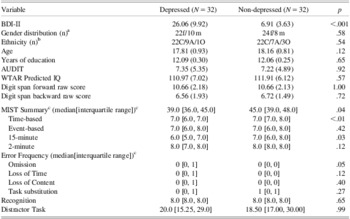
Approximately 800 undergraduate psychology students completed the Beck Depression Inventory-Second Edition (BDI-II) or the Depression Anxiety and Stress Scales-21. Students with scores in the upper and lower quartiles of the distribution on either questionnaire were invited to participate, and subsequently screened again using a common method (the BDI-II) on the day of testing to allow for allocation into depressed and non-depressed groups based on current mood.Footnote 1 Based on a self-report medical and psychiatric history questionnaire, participants with substance/alcohol dependence, neurological or psychiatric conditions unrelated to mood, or use of substances within the past 5 days were excluded. For the second screening, those in the depressed group (N = 32) had moderate to severe depressive symptomatology (BDI-II scores between 13 and 53), whereas the non-depressed group (N = 32) had no, or minimal depressive symptomatology (BDI-II scores of 0–12). Nine participants in the depressed group reported a previous diagnosis of major depression and five were taking antidepressants. The depressed group had a mean BDI-II score in the moderate to severe range (see Table 1), similar to means reported for depressed groups in previous PM studies (e.g., Altgassen et al., Reference Altgassen, Henry, Bürgler and Kliegel2009, Reference Altgassen, Kliegel and Martin2011; Rude et al., Reference Rude, Hertel, Jarrold, Covich and Hedlund1999). The groups did not differ significantly in gender distribution, ethnic composition, predicted IQ, years of education, alcohol use, or digit span scores (all ps > .10, see Table 1).
Demographics and neuropsychological and MIST variables for depressed and non-depressed participants

Note. Values are means (standard deviations) or medians [interquartile ranges] unless otherwise specified.
af = female; m = male.
bC = Caucasian; A = Asian; O = others. Group differences based on t-tests unless otherwise indicated.
cMann-Whitney test.
BDI-II = Beck Depression Inventory-Second Edition; AUDIT = Alcohol Use Disorder Identification Test; WTAR = Weschler Test of Adult Reading, performance based estimate; MIST = Memory for Intentions Screening Test; Omission = Failing to perform intended action at all; Loss of Time = failing to perform intended action at the right time; Loss of Content = failing to remember the specific action to be performed despite knowledge that an action has to be performed; Task substitution = replacing an appropriate intended action with the action of another task.
Materials and Procedure
The study was approved by the University of Western Australia Human Research Ethics Office. Participants completed questionnaires on basic demographics, medical history, and alcohol use (i.e., the Alcohol Use Disorder Identification Test). Predicted IQ and basic attention function were assessed with the Wechsler Test of Adult Reading and Wechsler Adult Intelligence Scale-III, Digit Span subtest. Participants then completed the research version of the MIST (Woods, Moran, Dawson, Carey, & Grant, Reference Woods, Moran, Dawson, Carey and Grant2008), with minor task modifications for the young adult sample (see Weinborn, Woods, Nulsen, & Park, Reference Weinborn, Woods, O'Toole, Kellogg and Moyle2011 for details). The MIST is a well-validated PM measure that has been used extensively in healthy (e.g., Woods et al., Reference Woods, Moran, Dawson, Carey and Grant2008) and clinical groups (e.g., Raskin et al., Reference Raskin, Woods, Poquette, McTaggart, Sethna, Williams and Tröster2011, Weinborn, Woods, O'Toole, Kellogg, & Moyle, Reference Weinborn, Woods, Nulsen and Park2011), with a duration of 30 min.The experimenter gave instructions for each of eight PM tasks successively while participants completed an engaging word search puzzle (i.e., distractor task) as quickly and accurately as possible. The MIST contained four time-based and four event-based tasks. Half of the time-based and event-based tasks had a delay interval of 2 min, and half had a delay interval of 15 min.Participants needed to perform the time-based action at the appropriate time (within 1 min of the specified time for 2-min tasks, or 2 min for 15-min tasks), or needed to perform the event-based action when the cue appeared, to receive the maximum 2 points for that task. Participants received 1 point if they performed the correct action at the wrong time or the wrong action at the right time. No points were awarded for no PM response. See Woods et al. (Reference Woods, Moran, Dawson, Carey and Grant2008) for more details on scoring criteria. Participants also completed a three-choice recognition test for each PM task.
Results
Indices typically reported from the MIST include the Summary, Time-based and Event-based subscale scores (aggregated across the two delay intervals), and 2-min and 15-min subscale scores (aggregated across the two cue types). Descriptive statistics for these traditional indices along with Mann-Whitney tests are reported in Table 1. However, for the purpose of the current study, we categorized the eight MIST items into four 2-item scales: (1) time-based/2 min, (2) time-based/15 min, (3) event-based/2 min, (4) event-based/15 min (scores ranged from 0 to 4). This allowed us to perform a 2 × 2 × 2 repeated-measures mixed analysis of variance (ANOVA)Footnote 2 with group (depressed vs. nondepressed) as the between-subjects variable, and cue type (event-based vs. time-based) and delay interval (2-min vs. 15-min) as within-subjects variables.
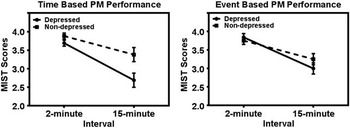
A main effect of group, F(1,62) = 4.90, p = .03, ηp 2 = .07 was qualified by a significant group by cue type interaction, F(1,62) = 4.93, p = .03, ηp 2 = .07. As shown in Figure 1, the difference in PM performance between depressed and non-depressed groups was greater for time-based (depressed, M = 3.19; SD = 0.67; non-depressed, M = 3.63; SD = 0.52), compared to event-based tasks (depressed, M = 3.42; SD = 0.49; non-depressed, M = 3.50; SD = 0.57). Tests of simple effects confirmed that the groups differed significantly on time-based, t(62) = 2.91, p = .01, d = .74, but not event-based PM, t(62) = 0.59, p = .56.
Prospective memory performance (MIST = Memory for Intentions Screening Test) as a function of group and delay interval. The left hand panel represents the time-based tasks, and the right hand panel represents the event-based tasks. Error bars represent standard error of the mean. PM = prospective memory.

A main effect of delay interval was also found, F(1,62) = 55.63, p < .01, ηp 2 = .47. This main effect and the aforementioned main effect of group, were qualified by a significant group by delay interval interaction, F(1,62) = 4.90 p = .03, ηp 2 = .07. As shown in Figure 1, the difference in performance between depressed and non-depressed groups was greater for 15-min (depressed, M = 2.84; SD = 0.86; nondepressed, M = 3.31; SD = 0.68) compared to 2-min (depressed, M = 3.77; SD = 0.28; nondepressed, M = 3.81; SD = 0.42) delays. Tests of simple effects confirmed that the groups’ PM performance differed significantly on the 15-min, t(62) = 2.42, p = .02, d = .62, but not 2-min delay interval tasks, t(62) = 0.53, p = .60. No other main effects or interactions were found (all Fs < 1).
Importantly, there was no group difference on the MIST distractor or recognition tests (see Table 1). Thus, the observed PM deficits in the depressed group are unlikely to be due to a differential trade-off between groups in the attention they devoted to the PM task relative to the ongoing distracter task, or the ability of the two groups to retain the PM instructional set in retrospective memory (i.e., encoding of the cue-intention pairs).
Discussion
Previous studies have found PM deficits in depressed individuals for both event-based and time-based laboratory tasks (e.g., Altgassen et al., 2008; Rude et al., Reference Rude, Hertel, Jarrold, Covich and Hedlund1999). However, this is the first study of depression to have used a single standardized clinically relevant measure that manipulated multiple important PM task characteristics (cue type, delay interval). As predicted, we found interactions between group and cue type, as well as between group and delay interval. The depressed group demonstrated impaired time-based, but not event-based PM. Furthermore, the depressed group demonstrated impaired PM for tasks with 15-min, but not 2-min, delay intervals. Of note, the medium-to-large effect sizes found between the groups as a function of cue type and delay interval, as well as the level of performance for the depressed group, were similar to those seen in other clinical groups on the modified MIST (e.g., ecstasy users, Weinborn, Woods, Nulsen, & Park, Reference Weinborn, Woods, O'Toole, Kellogg and Moyle2011). Importantly, these findings are unlikely to be artifacts of differences in demographics, general attentional function, ongoing task/PM task trade-offs, or inadequate encoding of cue-intention pairs as the groups did not differ on measures of these variables.
Multi-process theory (Einstein & McDaniel, Reference Einstein and McDaniel2005) postulates that time-based PM tasks require more self-initiated strategic monitoring than event-based PM tasks. Furthermore, the cognitive initiative framework (Hertel, Reference Hertel2000) posits that depression is associated with reduced ability to voluntarily direct attentional resources. Consistent with Rude et al. (Reference Rude, Hertel, Jarrold, Covich and Hedlund1999) and Kliegel et al. (Reference Kliegel, Jäger, Phillips, Federspiel, Imfeld, Keller and Zimprich2005), we found time-based PM deficits in the depressed group (but see Albiński et al., Reference Albiński, Kliegel, Sędek and Kleszczewska-Albińska2012). Furthermore, consistent with the predictions of both relevant theoretical accounts, we found greater depression effects for time-based compared to event-based PM. The null group effect for event-based tasks is consistent with two previous studies that found no depression-related event-based PM deficits (Albiński et al., Reference Albiński, Kliegel, Sędek and Kleszczewska-Albińska2012; Altgassen et al., Reference Altgassen, Henry, Bürgler and Kliegel2011). However depression-related deficits have been demonstrated when event-based PM targets were non-focal to ongoing tasks, and thus required more attentional resources to detect (Altgassen et al., Reference Altgassen, Kliegel and Martin2009). The strong semantic associations between the event-based cue-intention pairs on the MIST, which might have enhanced the likelihood intentions were spontaneously retrieved (Einstein & McDaniel, Reference Einstein and McDaniel2005), could explain the current null findings. This is unlikely, however, because we found an effect of delay interval on event-based PM, suggesting that the MIST event-based tasks required participants to allocate attentional resources, albeit less so than for time-based tasks.
It is likely that we found depression effects on tasks with 15-min compared with 2-min delays because longer delay intervals reduced the likelihood that the depressed group effectively allocated attentional resources to the PM tasks. This group by delay interval interaction parallels outcomes for previous studies that examined the effects of PM delay interval among ecstasy users (Weinborn, Woods, Nulsen, & Park, Reference Weinborn, Woods, O'Toole, Kellogg and Moyle2011), HIV-positive patients (Morgan et al., Reference Morgan, Weber, Rooney, Grant and Woods2012), and Parkinson's disease patients (Raskin et al., Reference Raskin, Woods, Poquette, McTaggart, Sethna, Williams and Tröster2011). Although a 15-min delay interval remains modest compared to more “real world” PM tasks (which could have delay intervals of days/weeks), it is important to note that research with other clinical samples has shown PM deficits on the MIST (with 15-min delays) to be associated with “real world” outcomes such as medication adherence (Poquette et al., Reference Poquette, Moore, Gouaux, Morgan, Grant and Woods2012) and self-reported PM lapses in everyday living (Weinborn, Woods, O,Toole, Kellogg, & Moyle, 2011). However, the use of longer delay intervals in future research is warranted. Additionally, research regarding the relationship between PM and medication adherence, or psychotherapy outcomes, among depressed individuals would be an important avenue for future investigations.
Some caution should be exercised in interpreting the nonsignificant interaction between group, cue type, and delay interval in our analysis since the MIST provided only two PM trials for each cue type by delay interval combination. Future research incorporating more PM trials per combination would be desirable. However, note that, relative to using MIST indices, our analysis did not substantially change the way the main effects of delay and cue type, and their interactions with group, were assessed (because scores for each delay or cue-type condition were based on four items).
The current findings are consistent with research indicating disturbances to attention and/or executive function in depression (Clark et al., Reference Clark, Chamberlain and Sahakian2009). Note, however, that the null group effects observed for MIST recognition task performance do not entirely rule out the contribution of impaired episodic memory to the observed PM deficits. Specifically, the MIST does not assess free recall of the cue-intention pairs, but instead only assesses their recognition. If strategic attention allocation deficits indeed underlie PM impairments in depression, interventions could be directed toward teaching planning and encoding strategies that capitalize on spontaneous retrieval processes and minimize dependence on strategic monitoring processes, such as the formation of implementation intentions (McDaniel, Howard, & Butler, Reference McDaniel, Howard and Butler2008). Alternatively, goal maintenance training (Levine et al., Reference Levine, Robertson, Clare, Carter, Hong, Wilson and Stuss2000) may improve the quality of attentional resource allocation for depressed individuals.
Acknowledgment
This research received no specific grant from any funding agency, or commercial or not-for-profit organization. We acknowledge that the information in this manuscript and the manuscript itself has never been published either electronically or in print. The authors have no conflicts of interest to declare.