INTRODUCTION
As the field of religion and politics has emerged as an important area of inquiry in political science, scholars have attempted to explain political behavior by examining the denominational affiliation, beliefs or religiosity of citizens. Most of this burgeoning research has focused on the mass public and has demonstrated the effects of religious variables on voting behavior, attitudes on political issues, and various kinds of political activity (Layman Reference Layman2001; Smidt, Kellstedt, and Guth Reference Smidt, Kellstedt, Guth, Smidt, Kellstedt and Guth2009). Despite the growing consensus on the importance of religious factors in politics, scholars have spent relatively little effort exploring the effects of religion on the attitudes and behaviors of the American political elite.
Most of the extant literature addresses the effects of religion on attitudes toward domestic issues or policies rather than foreign policy issues. Yet it seems that in the post-September 11, 2001 era, religious affiliation and beliefs might play a central role in the formation of foreign policy issue positions for both American citizens and their leaders. Many of the most important contemporary international actors are identified by religious affiliation (“Islamic fundamentalists”), and American religious institutions are increasingly active in their efforts to influence a wide range of foreign policy issues (Hertzke Reference Hertzke2004). Further, the religious views of recent American presidents have been the subject of much controversy in the international context (Domke Reference Domke2004).
In this article, we attempt to fill part of the void in the literature on the role of religion among political elites by analyzing the October 2003 roll call vote on Iraq War funding in the United States House of Representatives. We use data on the religious affiliations of House members to test the effects of religion on support for President Bush's request for funding, an early and central action in the president's “War on Terror.”
RELIGIOUS TRADITIONS AND FOREIGN POLICY
In recent years, there has been an enormous upsurge in scholarly interest regarding the nexus between religion and international issues. While the theory of realism, which dominated scholarship during the Cold War era and continues to see some resurgence in recent times (Walt Reference Walt1998), would seem to discount religious considerations in the realm of world conflict, recent scholarship in international relations has seen a notable “turn to religion” (Kratchovil Reference Kratchovil2009). The resurgence of Islam as a factor in international politics inspires much of this renewed interest, but international relations scholars have also focused on the rise of other religious groups as “transnational actors.” This is true not only in the developing world, but in modernized societies as well. In addition, there has been a proliferation of historical or qualitative studies on the purported role of religion in the American foreign policy process, much of it coming from journalists, academics outside the social sciences, or European scholars (see Guth Reference Guth, Smidt, Kellstedt and Guth2009a).
American political scientists, however, have paid little attention to the intersection between religion and foreign policy. There are a number of reasons for this. As Robert Jervis (Reference Jervis2002, 37) has noted, “most social scientists find this subject uninteresting, if not embarrassing.” Even for scholars who are not embarrassed and are interested, there are conceptual and methodological barriers to examining the role of religion in foreign policy. First, there has been a widespread assumption that religion influences “hot button” social issues, such as abortion and gay rights, but has little impact on attitudes or decisions relating to other dimensions of public policy, especially foreign policy. Second, even where this assumption does not deter scholars, there is a notable lack of theorizing about which religious variables should influence foreign policy and why. Third, even where theory abounds, data do not. Few public opinion surveys contain both sophisticated religious questions and a substantial number of foreign policy items, making it difficult to do more than produce an occasional tantalizing finding (Guth Reference Guth, Smidt, Kellstedt and Guth2009a).
In this article, we address the relationship between religious affiliations of United States House of Representatives members and their votes to support funds to conduct the Iraq War in October 2003. Piecing together the scattered theoretical and empirical literature on religion and foreign policy, we can state and test several hypotheses about the behavior of House members on this critical vote, which was a key bill for George W. Bush and the “War on Terror.” Our main expectation is that representatives from different religious traditions will exhibit distinct voting patterns.
There are several reasons to expect distinct voting patterns from each of these groups. First, as ethnoreligious historians remind us, America's major religious traditions have also been intertwined with ethnicity, sometimes producing powerful influences on specific foreign policy issues. A few historical and contemporary examples might illustrate the relevance of ethnoreligious traditions to foreign policy attitudes. John Judis has argued that early Evangelical Protestantism in the United States fostered a powerful urge to “spread Christian civilization” in the nineteenth century (Judis Reference Judis2005). The distinctive attitudes of Irish Catholics toward Great Britain, the isolationism of German Lutherans and Catholics during the early twentieth century, and Catholic anticommunism in the 1940s and 1950s are yet other examples (Hero Reference Hero1973). More recently, the persistent support of American Jews for Israel and the interest of African-American Protestants in Africa are two additional instances of the special concerns of a host of American “ethnoreligious fragments” (Uslaner Reference Uslaner, Cigler, Allan and Loomis2007). Indeed, some scholars have feared that American foreign policy might be unduly influenced by such ethnoreligious “diasporas” (Huntington Reference Huntington2004, 285–291). More positively, the growth of these religious minorities might encourage a new kind of cooperative internationalism in American foreign policy: as the United States looks more like a United Nations, for example, it may cooperate more with the United Nations (Guth Reference Guth2009b).
Ethnoreligious traditions may well shape citizens' (and legislators') perspectives on foreign policy issues, but more purely “religious” factors such as theological orientations may have an influence as well. Most of the recent attention to such influences has focused on tendencies in conservative Protestant theology such as dispensationalism, often invoked to explain Evangelicals' support for the state of Israel or their propensity to support militaristic foreign policies (Barker, Hurwitz, and Nelson Reference Barker, Hurwitz and Nelson2008; Froese and Mencken Reference Froese and Mencken2008; Baumgartner, Francia, and Morris Reference Baumgartner, Francia and Morris2008). Despite this focus, there is evidence that other aspects of religious belief such as exclusivism, moralism, or dogmatism may contribute to these propensities of Evangelicals — or those of other traditions (Guth Reference Guth2009b).
Although the major focus of the journalistic and scholarly literature has been on the distinctive beliefs of Evangelical Protestants, other religious traditions possess doctrinal or theological emphases that might be expected to influence adherents' attitudes on international issues. For example, the mainline Protestant and Catholic traditions have been strongly influenced by a communitarian social theology that should conduce to a more “cooperative” foreign policy, focused on social welfare, economic development, and protection of the natural global environment (Leege and Kellstedt Reference Leege and Kellstedt1993, 216–234; Guth et al. Reference Guth, Green, Smidt, Kellstedt and Poloma1997, 58–77; Kurtz and Fulton Reference Kurtz, Goran Fulton, Wuthnow and Evans2002). Other theological emphases, such as mainline Protestantism's support for religious pluralism may also produce a more cooperative or conciliatory set of foreign policy attitudes (Hoge, Johnson, and Luidens Reference Hoge, Johnson and Luidens1994; Tipton Reference Tipton2007; Guth Reference Guth2009b). Similarly, the distinctive Black Protestant theological focus on “liberation” may well foster identification with the “dispossessed” of the world, leading to more emphasis on international assistance for the Third World, and less support for “hegemonic” policies such as military options. The Jewish tradition likewise has a number of emphases such as tzedakeh, the obligation of charity and justice, which is often associated with Jewish propensities for internationalism and liberalism — and “liberal internationalism” (Greenberg and Wald, Reference Greenberg, Wald, Maisel and Forman2001, 162).
Beyond ethnoreligious influences and theological emphases, religious leadership may well influence the foreign policy attitudes of adherents to different religious traditions. The degree to which religious elites influence the laity is still a matter of considerable controversy. Some scholars doubt that the foreign policy cues from denominational or pastoral sources have much impact on laity (Hero Reference Hero1973; Quinley, Reference Quinley1974). However, others find that leadership guidance on foreign policy matters can make a difference, at least under the right conditions (Wald Reference Wald1992; Guth Reference Guth2007a).
The leaderships of most American religious traditions have developed distinctive emphases on foreign policy questions. Evangelical Protestant organizations and denominations, such as the National Association of Evangelicals and the Southern Baptist Convention have often been supportive of a “strong” American military posture and less enamored of multilateral entanglements with organizations such as the United Nations (Marsh Reference Marsh2007). This posture also characterizes most major Christian Right organizations that have emerged from the tradition. Mainline Protestant bodies, on the other hand, have been critical of American military adventures, favorable toward international organizations, and more concerned with issues such as world poverty (Tipton Reference Tipton2007). Parish clergy in each tradition generally share the stances of their denominational leaders (Guth et al. Reference Guth, Green, Smidt, Kellstedt and Poloma1997), although Evangelical clergy often appear more in tune with the views of the laity than their mainline counterparts are.
The American Catholic hierarchy and clergy have often had distinctive positions on a wide range of foreign policy questions. Since the 1970s, both the Vatican and the United States Catholic Bishops Conference have increasingly espoused reducing militaries and military tension, fostering international organizations to keep the peace and aid international economic development, and programs to assist the poorest nations of the earth. Catholic leadership does not always speak with one voice, but certainly comes closer to expressing authoritative positions than is possible in less centralized denominations and traditions. As noted above, there is at least some strong circumstantial evidence that Catholic leaders have had some success in shaping the foreign policy attitudes of lay Catholics.
There is less evidence on the extent of the influence of clergy in other traditions. Certainly, African-American Protestant clergy have been important political figures for generations — and remain so, as evidenced by the prominence of figures such as Rev. Jeremiah Wright, President Obama's ex-long-time pastor, whose “Third-World” liberation theology revealed important rhetorical emphases present in many other African-American Protestant churches. At least some evidence indicates that Jewish rabbis exercise a modicum of influence over their congregations (Sokhey and Djupe Reference Sokhey and Djupe2006). Of course, just as Christian Right spokespersons may influence Evangelical opinion, in both the Black Protestant and Jewish traditions there are leadership sources such as civil rights organizations and Jewish community groups that provide alternative cues on foreign policy questions.
This brief review of potential religious influence on American foreign policy attitudes suggests a number of potential lines of influence: ethnoreligious leanings, theological beliefs, and leadership cues. Of course, these do not always run in the same direction in any religious tradition; nor for that matter, are they similar for all members of a tradition. Nevertheless, ethnoreligious, theological, and leadership factors do tend to converge in most American religious traditions, allowing us to make predictions, even in the absence of direct measures for some of the potential religious influences.
RELIGION, POLITICAL ELITES, AND FOREIGN POLICY
Most research on religion and foreign policy attitudes has focused on the mass public and there has been little examination of the role of religion on the behaviors of political elites. One exception is Guth's (2007b) study of religious influence on roll-call votes in the United States House from 1997–2002. Even after controlling for member and district partisanship, religious factors were strong predictors of voting behavior across a range of issues, including foreign policy votes. A few other studies of specific issues in Congress, such as Middle East policy and the Darfur genocide, have also found religious influences (Oldmixon, Rosenson, and Wald Reference Oldmixon, Rosenson and Wald2005; Rosenson, Oldmixon, and Wald Reference Rosenson, Oldmixon and Wald2009; Uscinski et al. Reference Uscinski, Rocca, Sanchez and Brendan2009).
Certainly, the decision on the major vote to fund the Iraq War is an important case for uncovering potential religious influences on members. We examine H.R. 3289, the “Emergency Supplemental Appropriations Act for Defense and for the Reconstruction of Iraq,” which passed by 303 votes to 125 votes. This highly politically charged bill presents an excellent example to examine the role religion may play in political elite behavior. Our dependent variable is the House member's vote, coded as (1) if the representative voted for the bill and zero (0) if the legislator voted against. We employ in the analysis several variables to assess the influence of religious affiliation on legislator support for the war effort, including other variables long seen as central to explaining legislative voting behavior.
Religious Tradition
As we argued above, there is increasing evidence that ethnoreligious affiliations, specific religious beliefs, and distinct leadership cues may be linked to specific foreign policy stands among the mass public. Unfortunately, we do not have detailed surveys of the religious traits of all members of the United States House. As a result, we must use an available religious measure as a proxy. The most obvious choice is members' adherence to religious traditions, which, as we have seen, do vary systematically in terms of religious belief, practices, and communicated leadership cues. To collapse denominations into larger traditions, we follow the scheme increasingly used with minor variations by political scientists (Smidt, Kellstedt, and Guth Reference Smidt, Kellstedt, Guth, Smidt, Kellstedt and Guth2009) and sociologists (Steensland et al. Reference Steensland, Park, Regnerus, Robinson, Wilcox and Woodberry2000). This classification scheme combines United States religious denominations into distinct traditions based upon the historical development, doctrinal emphases, and organizational ties of each, utilizing web searches, interviews, and other techniques.
For our purposes, we create seven separate traditions: mainline Protestants, Catholics, Evangelical Protestants, African-American Protestants,Footnote 1 Jewish members, Latter-day Saints, and “Other minority” religions. The 108th House included 147 mainline Protestants (55 Democratic and 92 Republican),Footnote 2 125 Catholics (71 Democratic and 54 Republican), 75 Evangelical Protestants (10 Democratic and 65 Republican), 32 African-American Protestants (all Democrats), 12 Latter-day Saints (3 Democratic and 9 Republican), 26 Jewish members (25 Democratic and 1 Republican), and 18 members of other religions or having no religious affiliation (10 Democratic and 8 Republicans). As the mainline Protestant tradition has historically dominated Congress, mainline Protestants serve as the omitted reference category for our analysis.
Given the findings in the emerging literature on religion and foreign policy attitudes in the mass public and the dominant direction of leadership cues in each tradition, we generate the following hypotheses:
H1:
Evangelical Protestants will be more likely to vote for the Iraq funding bill.
Most doctrinal tendencies of this tradition point toward more support for military action and concern for the safety of Israel in the Middle East. At the same time, most leadership cues coming from Evangelical denominations and clergy supported President Bush's request (Marsh Reference Marsh2007). The support of most Christian Right groups, and the considerable degree of identification of the President himself with the evangelical community should also serve to reinforce these tendencies.
H2:
Catholic representatives will be less likely to vote for the Iraq funding bill.
The communitarian doctrinal bias of the Catholic tradition, associated with a preference for multilateral action, should work against the president's proposal. Similarly, the “just war” theological tradition would seem to militate against pre-emptive military action. That theological supposition was clearly reinforced by the Vatican's outspoken condemnation of American military action and the subsequent reiteration of that position by the United States Catholic bishops (Allen Reference Allen2002; Catholic News Service n.d.; United States Conference of Catholic Bishops 2002)
H3:
Black Protestants will be less likely to vote for the Iraq funding bill.
Both the liberationist theological emphases of the Black church and the overwhelming opposition of African-American religious leaders to the war lead to this expectation, which follows from public opinion research on minority views of militarism (Nincic and Nincic Reference Nincic and Nincic2002).
H4:
Members of “minority” religious traditions (as well as “seculars”) will be less likely to vote for the Iraq funding bill.
Evidence from mass public surveys shows religious minorities are more inclined to oppose American military action, especially when taken unilaterally, and more supportive of programs of peaceful cooperation
We will not state any expectations for other religious traditions. Although we might expect — on balance — that mainline Protestant representatives would reflect the communitarian and liberal social theology of mainline leaders and their representatives, such as the National Council of Churches, in the following analysis, we use mainliners as the omitted reference group. We expect that Jewish members would have mixed concerns on the Iraq war, with special concern for Israel competing with a general tendency to support international cooperation and avoid war (cf. Spiegel Reference Spiegel, Maisel and Forman2001). Finally, for purpose of conceptual clarity, we also include Latter-day Saints in the analysis.
In addition to the religious variables, we also introduce controls for the representative's party identification, ideology, constituency pressures, and other individual characteristics often identified as influential on such issues:
Military Service: Prior studies suggest that those with military experience may view public policy, particularly foreign affairs, much differently from those who have not served in the armed forces. Some scholars suggest that soldiers are socialized to view national security issues in terms of military actions, discounting economic or diplomatic resolutions (Sagan Reference Sagan, Sagan and Waltz2003; Walt Reference Walt1987). Others suggest that military veteran politicians are less supportive of the initial use of military force, but, once force is utilized, are more willing to escalate war efforts and less likely to place restrictions on military discretion (Betts Reference Betts1991; Gelpi and Feaver Reference Gelpi and Feaver2002). Based on prior findings, as this vote concerns continuation of support rather than the initiation of force, we would expect that those with prior military service will be more supportive of the military spending bill. We include a variable tapping whether the representative has prior experience in the active military (1), the military reserves (0.5), or no prior armed forces experience (0). In the 108th House, 316 members had no prior military service, 36 spent time in the reserves, and 83 had served in the active military.Footnote 3
Gender: Barker, Hurwitz, and Nelson (Reference Barker, Hurwitz and Nelson2008) find that women are generally less likely than men to support militarism, nationalism, or militaristic aid for Israel. Thus, we hypothesize that male House members should support the Iraq War funding bill at higher rates than their female counterparts. Our study of the 108th House includes 59 female members and 376 males.
Hispanic Members: Recent research has also revealed distinctions in foreign policy preferences between those of different races (Smith and Seltzer Reference Smith and Seltzer1992). While studies have found differences between African-Americans' opinions in military issues and the opinions of other races (Nincic and Nincic Reference Nincic and Nincic2002), we do not include a separate variable for African-American representatives because of the high overlap with the “African-American Protestant” variable.Footnote 4 Prior research has noted that Hispanic political elites generally display weaker support for defense initiatives than other issues (Pachon and De la Garza Reference Pachon, De la Garza, Pachon, De la Garza and Pachon2000). Thus, we expect Hispanic representatives would be less supportive of the military funding bill than white representatives.
Partisanship: The literature on legislative roll-call votes is dominated by the influence of party membership on vote choice (see, for example, Bullock and Brady Reference Bullock and Brady1983; Cox and McCubbins Reference Cox and McCubbins1993; Kingdon Reference Kingdon1989; Patterson and Caldeira Reference Patterson and Caldeira1988; Weisberg Reference Weisberg1978). The size of the respective majorities when party voting takes place (i.e., party unity) has been very high in recent years, often in the range of 85% (Poole n.d.). Since the 1980s ideological polarization and party divisions in the electorate and in the legislative parties have increased. In the case of the vote on war funding, the record indicates that the Republican leadership was strongly in favor of passage, as was President Bush, while Democratic congressional leaders were divided. Given the unity of Republicans on the issue, we expect, ceteris paribus, that Republicans are more likely to have supported the bill than are Democrats. The 108th Congress included 229 Republicans and 206 Democrats.
Ideology: While partisanship continues to be a strong predictor of voting behavior, scholars have recently examined more nuanced proxies for political ideology (Poole and Rosenthal Reference Poole and Rosenthal1997). Cronin and Fordham (Reference Cronin and Fordham1999) have found that while the relationship between ideological orientation and foreign policy has varied in roll-calls votes in the United States Senate, after the mid-1960s conservatives have consistently tended to favor legislation increasing United States military strength and attempting to enlarge American influence in international affairs while liberals have opposed such legislation (see also Holsti Reference Holsti2004). To control for political ideology, we incorporate DW-Nominate scores (Poole and Rosenthal Reference Poole and Rosenthal1997) as a proxy for each representative's ideological orientation. The actual range of DW-Nominate scores for this study spanned from –0.834 (most liberal) to 1.0 (most conservative), with a mean of .076. Representatives with higher Nominate scores should be more likely to support the funding bill.
The inclusion of controls for partisanship and ideology raise important questions for our analysis of religious influence. If religious tradition influences support for the funding bill after controlling for partisanship and/or ideology, we can be confident that religion has at least some direct influence on representatives' behavior. However, given that partisanship and ideology of American political elites, like those of the electorate, are increasingly characterized by religious differences, a lack of findings for the religious variables may indicate that religious factors are so interrelated with partisanship and ideology that distinct influence may not be distinguishable.
Veteran Constituents: A representative's behavior may also be influenced by the composition of that representative's district. Numerous prior studies have examined policy congruence between the constituency's sentiment on issues and the representative's voting behavior on those issues (see Erikson and Wright Reference Erikson, Wright, Dodd and Oppenheimer1993). These studies have focused on such factors as racial composition (Grofman, Griffin, and Glazer Reference Grofman, Griffin and Glazer1992), religious membership (Green and Guth Reference Green and Guth1991), and constituency opinion on particular issues (see Bartels Reference Bartels1991). One contextual factor important in this spending bill may be the percentage of veterans residing in a representative's district. Veterans have been shown to be more supportive of the military, including favoring higher spending for the military, and more likely to believe that the armed forces are essential (Segal et al. Reference Segal, Freedman-Doan, Bachman, O'Malley, Feaver and Kohn2001; Schriber Reference Schreiber1979, 830). Representatives concerned with reelection may tailor their behaviors to meet the wishes of their pro-military constituents. Thus, we predict that, as the number of veterans in a district increases, the representative's likelihood of supporting the war funding bill should also increase. In our data, the district percentage of veterans ranged from 3.7% to 24%, with an average of 12.6% (Barone and Cohen Reference Barone and Cohen2003).
Support for Republican President George W. Bush: Another constituency influence on representatives would clearly be the voters' partisanship and support for the current president. In the “War on Terror,” President Bush was the chief supporter and made numerous speeches about the importance of military intervention in Iraq. While we lack district-level measures of contemporaneous public opinion of President Bush, we employ the percentage of votes from the 2000 presidential election won by Bush as a proxy for constituent support for the President. If a member of the House represents a district that strongly supported President Bush in the 2000 election, this could put added pressure on the representative to support the President's efforts. We predict that the higher the percentage of voters that support Bush in the 2000 eleciton, the more likely the representative will vote for the bill. In our data, Bush's percentage of the vote for Bush per district ranged from 5% to 75%, with a mean of 47.7%.
RESULTS
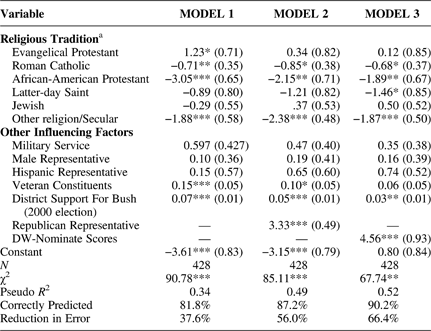
As the dependent variable (the individual member's vote for or against the funding bill) is dichotomous, we utilize binary logistic regression with robust standard errors to examine the factors influencing legislative behaviors (Liao Reference Liao1994). For this project, we estimated three separate models to test the influence of religious traditions. Model 1 examines the religious orientations, while excluding controls for ideology and partisanship, to assess the influence of the independent variables. As one would expect, partisanship and DW-Nominate scores are highly correlated, negating the use of both in one model. Therefore, Model 2 includes a control for party identification and Model 3 includes a control for ideology to determine if religious orientation has an effect distinctive from partisanship or ideology.
Results from these three separate models are displayed in Table 1. The results from Model 1 support our initial expectations: Evangelicals were more likely than mainline Protestants (the reference category) to support the bill, while Catholics, African-American Protestants, and members of other traditions were more likely to oppose HR 3289. Members of the Church of Latter-Day Saints and Jewish members do not differ significantly from Mainline Protestants. Nor do personal traits such as gender, Hispanic ethnicity, or prior military service show significant effects. Constituency pressures played a role as well, as the coefficient for veterans in the district is positive and statistically significant as well as the district's support for President Bush in the 2000 eleciton.
Logit model indicating support for military funding in iraq and afghanistan (robust standard errors in parentheses)
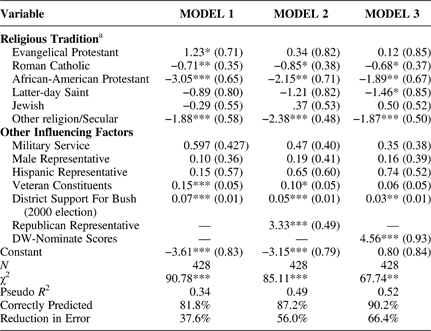
Notes: p ≤ .05=*; p ≤ .01=**; p ≤ .001 (one-tailed).
aFor the religious variables, Mainline Protestants served as the reference category.
Model 2 includes the representative's party affiliation. Not surprisingly, House Republicans were significantly more likely to support the bill than were Democrats. However, the inclusion of party affiliation assists in clarifying the influence of religious tradition on the vote. Even controlling for party affiliation, the negative coefficient for Catholic members, African-American Protestants, and those of other religions remains statistically significant, while the positive coefficient for Evangelicals loses statistical significance. This suggests that the influence of Evangelical affiliation is largely related to party affiliation: most Evangelicals in the House are Republicans. On the other hand, the influence of Catholic, African-American Protestant, and “Other” affiliation goes beyond that transmitted through partisanship. This is particularly interesting for Catholic members, as they are a very diverse group in terms of both partisanship and ideology. Again, in Model 2, we see that constituency factors are important, but that individual characteristics of the representative were not siginifcant.
Model 3, in the last column, includes DW-Nominate scores as a proxy for ideology. As we might expect, the inclusion of this measure produces the best fit overall, with the highest pseudo R 2, the highest percentage of correct predictions, and the greatest reduction in error. Conservatives were more likely than liberals to support military funding for the use of force in Iraq. Note, however, that substituting ideology for party affiliation does not substantially alter the findings for religious traditions. Once again, Catholic members, African-American Protestants, and those included in our “other” category were still significantly more likely to oppose the bill, as compared to Mainline Protestants, although significant findings were still not reported for Evangelical Protestants. Once we control for ideology, we also see that members of the Church of Latter-day Saints also appear significantly less likely to support the bill than Mainline Protestants.
Thus, in all three models, we see a clear indication that Catholics, African-American Protestants, and those in our residual category were consistently more likely to oppose the bill than were Mainline Protestants. On the other hand, Evangelical Protestants are more supportive, but that influence is closely interrelated with partisanship and ideology. This comports with findings that these members are among the most partisan and most conservative members of the House (Guth Reference Guth2007b). Catholic members, however, are more diverse in terms of partisanship and ideology, allowing for a more distinct display of religious influences, even after controlling for other factors. While we cannot rule out the influence of religion on the behaviors of other groups, the results point to a clear effect on Catholics, African American Protestants, and those representatives of other religions on support or opposition to HR 3289, an effect that exists even after controlling for traditional political influences.Footnote 5
DISCUSSION AND FURTHER RESEARCH
This study adds a nuanced approach to how our discipline understands the role of religious preferences in the behavior of political elites. While partisanship and ideology clearly play influential factors in politically-charged issues, religion appears to play a role as well. Just as religious affiliations shape citizen opinion, it appears that political elites also respond to religious influences, at least in some contexts. Even when controlling for the two classic motivators of legislator behavior, partisanship and ideology, we find that the religious tradition of members often adds explanatory power on the kind of issue that many scholars might expect to lie “beyond” the influence of religious variables. Even in the case of Evangelical Protestants, where controls for party and ideology wipe out the direct influence of affiliation, there is an important story to be told: Evangelicals are so overwhelmingly Republican and conservative that in many ways they have come to define the ideological coloration of the Republican conference.
There are a number of directions that research on religion and elite decision-making on foreign policy should take. First, we need to look beyond issues of war and militarism that have been the focus of studies on both the mass public and decision-makers. Votes on issues such as Iraq War funding no doubt tap the foreign policy dimension that Eugene Wittkopf (Reference Wittkopf1990) famously dubbed “militant internationalism.” However, they do not provide much insight into legislative reactions to issues involving “cooperative internationalism,” or to other potential dimension of public and elite foreign policy attitudes that have emerged more recently. In some ways, the scholarly fashion of reducing legislative ideology to a single dimension such as DW-Nominate has ignored the possibility that distinct sub-dimensions may exist in different policy arenas — as argued by an earlier tradition in legislative voting studies. Addressing the distinct ways that religious factors may influence such arenas is an important question for our understanding of religious influence.
In addition, we need to continue to define our religious measures for our work with political elites. Our reconnaissance of religious variables suggests that religious tradition may serve as a valuable proxy for beliefs, religious worldviews, and leadership cues, but there is certainly much to be gained by measuring these factors directly. Only rarely have scholars been able to develop the access to undertake such work, and then typically only with a sample of legislators (Benson and Williams Reference Benson and Williams1982). The value of more detailed religious measures has been repeatedly confirmed in studies of the mass public, and should be even more useful among political elites with their higher degree of issue constraint. Ultimately, our studies of the impact of religious variables on legislator behavior on foreign policy needs to be both broader — increasing the range of issues considered — and deeper, using more sophisticated religious measures in our analysis.
Finally, future studies may need to examine the religious composition of legislators' constituencies. A few earlier studies have used variables estimating the religious composition of House districts and found that both legislators' religion and that of their constituents have distinct effects on congressional voting behavior (Green and Guth Reference Green and Guth1991; Guth Reference Guth2007b). Unfortunately, it has become increasingly difficult, time-consuming — and even problematic — to produce estimates of district religious composition from the available county-level statistics. Until we develop new means of accurately estimating such membership, we are hampered in our efforts to delineate the full extent of religion's influence on legislator behavior, and our understanding of the relative importance of different paths that influence may take.