Introduction
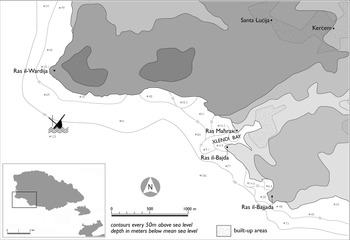
In 2014, work began on the survey of a 7th century-BC shipwreck off the south-west coast of the island of Gozo. The survey formed part of the GROPLAN project, financed by the French National Science Foundation. It was undertaken by the Department of Classics and Archaeology of the University of Malta, alongside the Centre National de la Recherche Scientifique (CNRS) and the University of Aix-Marseille, and in close collaboration with the Superintendence of Cultural Heritage, Malta. The wreck was first discovered during an initial survey of Maltese territorial waters between 2007 and 2010 undertaken by a team from the AURORA Trust, in collaboration with local Maltese heritage entities. The site is located at a depth of 110 m under the headland of Ras il-Wardija on Gozo (Figure 1), and belongs to a well-preserved and seemingly undisturbed cargo of clay vessels and stone querns, allowing one to trace the perimeter of what must have been the ship's hull, in a spread measuring 11 m long and 4 m wide (Gambin et al. Reference Gambin, Drap, Cheminsky, Hyttinen and Kozak2021).
Map of the southwest coast of Gozo showing the location of the shipwreck in relation to the Xlendi Bay inlet (Drawing by M. Anastasi).

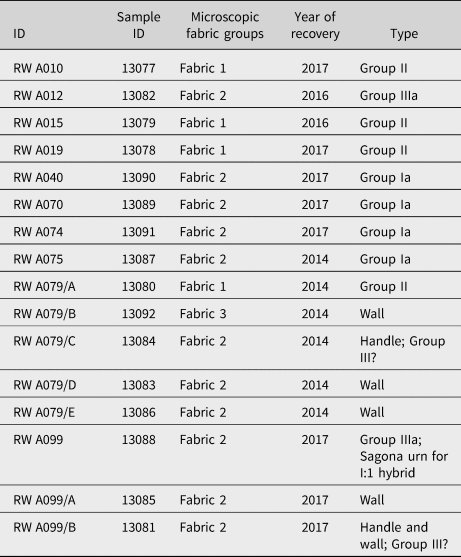
The primary aim of the 2014 project was to survey and document the deep-water site using photogrammetry; a relatively cost-effective technique used in the challenging circumstances of an inaccessible deep-sea site (Gambin et al. Reference Gambin, Drap, Cheminsky, Hyttinen and Kozak2018). Over three campaigns (2014, 2016 and 2017) a series of objects were recovered from the wreck following detailed in situ recording (Table 1). The objects consisted of large worked saddle querns and rubbers made in volcanic stone, and a series of amphorae and pottery containers. The forms making up the latter part of the cargo have been identified as primarily Archaic Phoenician-period containers dateable to the first half of the 7th century BC (Gambin et al. Reference Gambin, Sourisseau and Anastasi2021). The purpose of this article is to present the first results of the petrographic analysis carried out on samples of the ceramic cargo lifted between 2014 and 2017, which was undertaken in order to determine the provenance of the more prevalent amphorae forms recovered from the wreck to date.
List of ceramic vessels recovered and sampled from the Xlendi shipwreck (2014, 2016 and 2017).

This study builds on a growing body of existing archaeometric data for Maltese pottery, stemming from the seminal petrographic analysis carried out on the fabrics of two Roman amphorae types suspected to be local to Malta (Bruno and Capelli Reference Bruno, Capelli, D'Amico and Tampellini2000). This study was eventually followed by a variety of macroscopic, as well archaeometric, analyses paying close attention to the variety of local fabrics dating from the Neolithic and Bronze Age (Tanasi Reference Tanasi, Tanasi and Vella2011; Barone et al. Reference Barone, Mazzoleni, Raneri, Tanasi, Giuffrida, Tanasi and Vella2015; Pirone and Tykot Reference Pedley and Hughes Clarke2017), Phoenician and Punic (Sagona Reference Renzulli, Santi, Gambin and Bueno Serrano2002; Mommsen et al. Reference Iliopoulos, Cau, Montana, Gualtieri, Bandini and Fabbri2006; Schmidt and Becthold Reference Schmidt and Becthold2013), Roman (Anastasi Reference Anastasi2019) and the post-Medieval periods (Palmer et al. Reference Palmer2018, Palmer Reference Nizzo2020).
The ceramic cargo
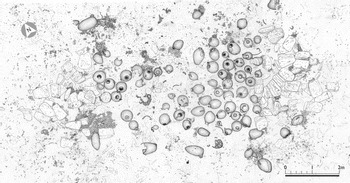
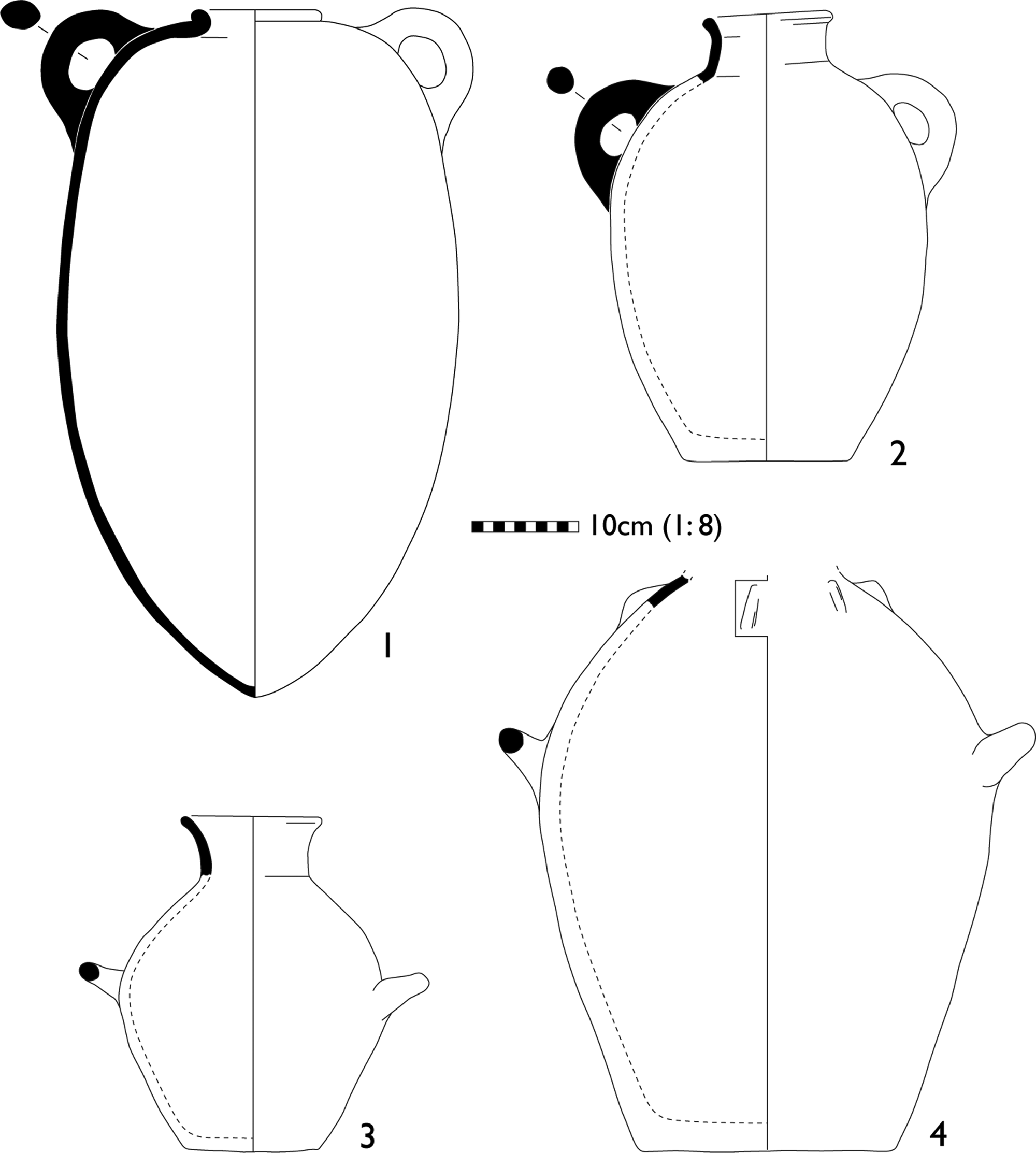
As of 2017, a total of 14 vessels were raised from the seabed, following detailed digital recording and documenting of the objects in situ (Table 1; Figure 2). A further seven fragments were recovered from the inside of two of the complete examples lifted (RW A079 and A099). At least five distinct forms have so far been identified amongst those lifted off the seabed (Figure 3), however the same repertoire appears to persist throughout the rest of the site. A detailed study of the forms has recently been published, and details the typological and chronological evidence pertaining to the objects recovered from the wreck to date (Gambin et al. Reference Gambin, Drap, Cheminsky, Hyttinen and Kozak2021). The pottery containers that make up a significant part of the cargo have been dated by published parallels to the first half of the 7th century BC; to date, the earliest known shipwreck in the central Mediterranean. This site provides a unique opportunity to study the composition of the cargo to determine what kinds of goods were being produced, transported, and traded in the Archaic central Mediterranean. Parallel petrographic analyses have already confirmed the source of the saddle querns to the island of Pantelleria (Renzulli et al. Reference Ramón Torres2019), whilst on-going residue analysis of the amphora walls are being carried out to determine the possible contents of these containers.Footnote 1 The purpose of the petrographic characterisation of these containers is to determine the source of the ceramic component of the cargo, as well as to complement the typological classification by combining morphology and fabric features.
Schematic diagram of the cargo emphasising the division of the cargo, with saddle querns and ceramic containers (stippled) (Department of Classics and Archaeology, University of Malta/Groplan Project).

Pottery forms recovered from the Xlendi Bay Phoenician shipwreck. (1) Group II amphora (RW A010); (2) Group Ia amphora (RW A074); (3) Group IIIa olla (RW A099); (4) Group IIIa jar (RW A012) (drawing by M. Anastasi).

Analysis was carried out to determine the provenance of three of the five ceramic forms identified as the ship's cargo. The first, and one of the most prevalent types (Group Ia) belongs to a type previously unknown to the Maltese islands. It consists of an ovoid body on a wide flat base, with two vertical handles attached to the shoulder, and a low collared rim (Figure 3(2)). The form shares features with an eastern Mediterranean amphora within the ZitA (Zentral-italische Amphoren) series dateable to between the 9th and early 8th century BC (Docter et al. Reference Docter, Annis, Jacob and Blessing1997). The closest parallel so far identified for the specific type recovered from the Xlendi wreck comes from the necropolis of San Montano on Pithecusae, dated to the Late Geometric II period (c. 720–680 BC) (Buchner and Ridgway Reference Buchner and Ridgway1993, 413, tav. CXCII and 199; Nizzo Reference Mommsen, Bonanno, Chetcuti Bonavita, Kakoulli, Musumeci, Sagona, Schwedt, Vella, Zacharias, Maggetti and Messiga2007). The second, and equally common form, belongs to a Phoenician-period amphora (Group II) belonging to forms similar to Ramón's T-2.1.1.1/3.1.1.2 (Ramón Torres Reference Pirone and Tykot1995) and the Karthago 1 A3 form from Carthage (Docter Reference Docter, Niemeyer, Docter, Schmidt and Bechtold2007, 623–624, fig. 340) typical of the early Phoenician presence in the central Mediterranean (Figure 3(1)). The third type (Group IIIa) consists of a squat globular vessel with a wide flat base with a straight or flaring simple collar rim and neck, with two horizontal round-section handles attached to the widest part of the body (Figure 3(3)). Pottery jars similar to this type have been recorded in at least three tomb contexts in Malta, which has been dated by Sagona to her Archaic I phase (Sagona Reference Renzulli, Santi, Gambin and Bueno Serrano2002, 93–94, Figures 103.8, 104.2 and 105.1, tomb 361). A single example of a large variant of the Group IIIa form (RW A012) was also lifted, and contained distinctive raised vertical lugs around the neck (Figure 3(4)). Exact parallels for this form remain unknown.
A further three types of ceramic vessels were recovered from the seabed (Gambin et al. Reference Gambin, Drap, Cheminsky, Hyttinen and Kozak2021). However, none of these were sampled and included in this study. Only vessels that were evidently broken or damaged during their time on the seabed or accidentally whilst being lifted were subjected to the destructive sampling required for Thin-section analyses.
Method
Shortly after being raised from the seabed, all the ceramic containers were subjected to a period of desalination. Once the vessels were sufficiently desalinated and dried, fabric samples from 16 vessels were selected for thin-section study under a polarizing light microscope (Table 1). Only the vessels that displayed part of the exposed fabric due to unintentional damage were sampled; those that were found complete were not sampled.
During the typological study and sampling exercise, macroscopic identification of the fabrics suggested that samples belonging to Group I and III forms shared a similar fabric, which was consistent with coarse fabrics considered to be local to the Maltese islands. This fabric ranged in colour from orange/red to brown and white/yellow to grey; in most cases with a reduced core, and fine white and yellow inclusions (Sagona Reference Renzulli, Santi, Gambin and Bueno Serrano2002, 78–79). This observation sat well for the Group IIIa form (RW A99) since a number of parallels have been recorded in local tomb contexts in Rabat, Malta, associated with other forms deemed to be local to the islands (Sagona Reference Renzulli, Santi, Gambin and Bueno Serrano2002, 93–94, urn form I:1). A source for the remaining form (Group Ia) seemed more problematic in as far as the shapes have not been recorded elsewhere in Archaic contexts on the Maltese islands. Closer parallels can be found with pottery from tombs in Pithecusae dated to the same period, which initially pointed towards a central Tyrrhenian source (Buchner and Ridgway Reference Buchner and Ridgway1993; Gambin et al. Reference Gambin, Drap, Cheminsky, Hyttinen and Kozak2021). However, the fabric itself points towards a local source.
Results and Discussion
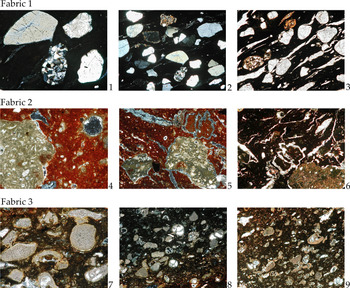
The samples were divided into three main fabric groups (1–3) based on the initial macroscopic analysis. The thin-section study confirmed the division of these groups, and allowed for further detailed textural and compositional characterization (Figure 4), which also highlighted the presence of post-depositional weathering – namely the crystallization of carbonates, Fe-hydroxides and rare pyrite –, which in some cases, provoked changes in the macroscopic colour, consistent with an underwater context.
Microphotographs of fabric groups. (1–3) Fabric 1, sample no. 13080; (4–6) Fabric 2, sample no. 13090; (7–9) Fabric 3, sample no. 13092. Left column: crossed nicols, 1.3 x 1 mm; centre column: crossed nicols, 3.2 x 2.4 mm; right column: parallel nicols, 3.2 x 2.4 mm (Photographs by C. Capelli).

Fabric Group 1 is quite homogeneous (Figure 4(1–3)). The fabrics are characterized by a Ca-rich or Ca-Fe-rich ‘pure’ clay matrix (macroscopically yellow to orange or brown in colour) with very scarce silty inclusions and an abundant, well-sorted, coarse temper (mostly 0.3–0.7 mm) composed of rounded quartz grains, subordinate calcareous elements (limestone fragments and fossils) and rare quartz-sandstone fragments. It can also be noted that the presence of large planar voids, often filled by secondary carbonates, are parallel to the surfaces and consistent with wheel-throwing. The primary calcareous components are generally preserved, which points to firing temperatures below 900°C.
The textural features clearly suggest the intentional addition of a marine/aeolian sand as a temper. The petrographic composition of the fabric, and particularly the dominance of (partly rounded/aeolian) quartz is typical of most of North African (Tunisian) pottery from all periods. Moreover, the presence of accessory quartz-sandstone clasts, compatible with the Numidian flysch, could restrict the provenance to a North Tunisian source (Capelli and Bonifay Reference Capelli, Bonifay, Poulou-Papadimitriou, Nodarou and Kilikoglou2014). The four samples included in this fabric group all belonged to the same amphora form (Group II) identified with Ramón T-2.1.1.1/3.1.1.2 (Ramón Torres Reference Pirone and Tykot1995).
Fabric Group 2 is distinguished by a Ca-rich (yellow) to Fe-rich (red, brown or grey) clay matrix with a scarce silty (quartz) fraction and moderately abundant calcareous microfossil inclusions (mostly foraminifera, both benthonic and planktonic, including Globigerina and Globigerinoides, up to 0.5 mm in size); and coarse angular fragments (up to about 2 mm across) of biomicritic limestone and rare Fe-rich clay/siltstone (Figure 4(4–6)).
The samples within this group also showed several features that suggest the vessels were handmade and fired in poorly controlled conditions. These features include:
• Abundant voids, which are irregular in shape and distribution; features that are not consistent with wheel-throwing;
• A clay matrix that is poorly to almost completely vitrified, and where the calcareous components range from well preserved to completely thermally decomposed, which suggests wide-ranging firing temperatures, either below or over the calcite's upper stability limit (around 850°C);
• In some cases, only the external surfaces are well oxidized (red, whereas the core is grey or black), which suggests a short firing time.
A few sub-groups were recognized, which supports some initial typological suggestions when the fabrics were analysed macroscopically. These were particularly relevant for the loose sherds recovered from inside two of the complete vessels (RW A079 and A099). The fabrics for sherds RW A079C, D and E had a Ca-rich yellow matrix with a few visible fragments, which are clearly homogenous across the three samples. This homogeneity supports the initial conclusion that all three sherds belong to the same vessel, despite them not joining.
The source of this group is very probably local to the Maltese islands. In fact, the characteristics of the clayey raw material are highly compatible with those of the Blue Clay Formation, which is very suitable for pottery production and is present along the western coast of Malta, and along the interior and coast of Gozo (Pedley et al. Reference Palmer, Raneri, Mazzoleni, Vella, Barone and De Clercq1976; Reference Pedley, House and Waugh1978). The variability in the carbonate content inside the Formation could account for the fluctuations in the Ca/Fe ratio observed in the fabrics. Moreover, the fabrics are quite similar to those of other prehistoric, Punic and Roman-period pottery recovered in Malta, and which have been attributed to a local production (Bruno and Capelli Reference Bruno, Capelli, D'Amico and Tampellini2000, gruppo A; Barone et al. Reference Barone, Mazzoleni, Raneri, Tanasi, Giuffrida, Tanasi and Vella2015; Schmidt and Becthold Reference Sagona2013; and unpublished material from the database of the DISTAV laboratory).
Also the angular biomicrite/claystone inclusions can be related to non- or poorly-plastic layers present in the Blue clays, or at the transition with the Globigerina Limestone Formation or the Greensand Formation, which composes the Cenozoic Maltese sedimentary sequence (Pedley et al. Reference Palmer, Raneri, Mazzoleni, Vella, Barone and De Clercq1976, Reference Pedley, House and Waugh1978). However, it is not clear if their presence should be attributed to an intentional addition of ground rocks by the potters, or that the component was naturally present in the raw materials. The possibility that these fragments represent a chamotte, as suggested by Barone et al. (Reference Barone, Mazzoleni, Raneri, Tanasi, Giuffrida, Tanasi and Vella2015) for the Borġ in-Nadur pottery, cannot be disregarded but seems less probable, at least in this case.
Concerning typology, the second group of fabrics belong to the Group Ia and IIIa forms. Five of the loose sherds sampled also belong to this fabric group, two of which are handle fragments which probably belong to Group IIIa containers. A local provenance for the latter form was already suspected on account of the discovery of this type in funerary contexts on Malta, also dateable to the 7th century BC (Sagona Reference Renzulli, Santi, Gambin and Bueno Serrano2002, 92–93). However, this is the first time the latter type of flat-bottomed amphora type has been recorded in a Maltese context.
With regard to the latter flat-bottomed amphora form, the possibility of a source from Pithecusae or Greece, which was taken into account on an archaeological and typological basis, can be disregarded for all the fabrics studied. Ischia is a volcanic island and Greek fabrics are often rich in metamorphic and/or volcanic inclusions, which are completely lacking in this case, sometimes associated with sedimentary (limestone, chert) ones. In the case of a source in Sicily, those Sicilian fabrics that have been studied to date (i.e. from Mozia and Solunto: see Iliopoulos et al. Reference Gras2009; western Sicily: see Bechtold et al. Reference Bechtold, Montana, Randazzo and Schmidt2015) show different characteristics to those presented here.
Fabric 3 was recognized in only one thin-section sample (RWA/79/B) (Figure 4(7–9)). It is characterized by a Fe-Ca-rich clay matrix and an abundant, rather well-sorted temper (mostly 0.2–0.7 mm) composed of calcareous microfossils, which include benthonic (including Miliolidae), and planktonic (including Globigerina and Globigerinoides, foraminifera, coralline algae, with rare echinoid spines and gastropods) species, which can only to be found in a Quaternary marine sand.
The fabric is oxidized in the external parts only, probably due to a short firing time. The calcareous components are also preserved, which points to low firing temperatures (below 850°C).
The sample belonged to an undiagnostic wall sherd, which probably once formed part of a container-type vessel. When compared with the samples from the fabric-2 group, this sherd's wall is much thinner and the fabric visibly harder, indicating a completely different type of vessel altogether. A local production cannot be excluded also in this case, as the observed microfossils are present in the Maltese stratigraphy (Pedley and Hughes Clarke Reference Pedley, House, Waugh, Nairn, Kanes and Stehli2002). It is noteworthy to mention the peculiar absence of quartz in the sand used, which is also very rare in the local geology. However, the hypothesis of a western Sicilian source for this fabric could also be taken into account, based on the typological data, as well as the widespread presence in that area of marine sandy sediments of Quaternary (Lower Pleistocene) age, namely belonging to the Sintema di Marsala (Di Maggio et al. Reference Di Maggio, Agate, Contino, Basilone and Catalano2009). This is well compatible with the temper of the studied sample, and the similarities with close comparisons with the fabrics of some medieval ceramics attributed to the area of Marsala on archaeological bases (Capelli et al., Reference Capelli, Cabella, Piazza, Molinari A and Meoin press). However, no similar fabric is described in western Sicilian Punic productions studied up to now (Iliopoulos et al. Reference Gras2009; Bechtold et al. Reference Bechtold, Montana, Randazzo and Schmidt2015).
Archaeological significance
The implications of this thin-section study are manifold. The samples from the raised ceramic objects have revealed a heterogeneous cargo of North Tunisian wheelmade amphorae and a range of Maltese handmade storage jars that were being shipped together with new stone querns from Pantelleria. The shipwreck, being discovered within the vicinity of the south-west of Gozo, experienced a catastrophic end at some point during the first half of the 7th century BC. Recent archaeological research has already demonstrated that Maltese-made amphorae and other pottery vessels were being traded to other settlements in the central Mediterranean from the early Punic period (Ciasca Reference Ciasca1985; Anastasi Reference Anastasi and Kouremenos2018; Bechtold Reference Bechtold, Vella, Frendo and Vella2018). However, the scale of such an activity, as well as its antiquity has always eluded researchers because of the fragmentary nature of the evidence available. The significance of this particular wreck is its primary context, which provides a unique opportunity to simultaneously investigate Maltese pottery production and central Mediterranean trading routes, as well as to shed light on the potential of Maltese agricultural production in the Archaic period.
The fact that a significant portion of the cargo contained a variety of pottery containers made using Maltese-sourced clays is significant because it confirms the long-suspected hypothesis that Phoenician-period pottery was being made on the Maltese islands. In addition, the new insight gained about the manufacturing technology, brought about by observing the fabric structure, suggests that despite the pottery being handmade and fired using relatively simple methods, the containers were sufficient enough to be used for transporting local agricultural products or otherwise to overseas destinations. Indeed, there is much scope to continue further research whether pottery wheel technology became more commonplace later during the Phoenician occupation of the islands; and also raises the question of the degree of influence and integration between indigenous islanders and the early Phoenician settlers.
A Maltese provenance offers a significant opportunity to investigate the contents that were carried in the pottery vessels. Indeed, residue analysis of the interior walls of the containers (both local and those from North Africa) will shortly be concluded and will provide a scientific basis for ascertaining this. Concurrently, a review of the typology indicates that all but one of the local forms are already recognized in Maltese funerary contexts. The latter form (Group Ia) has never been recognized outside of this wreck site; the closest typological parallels only known from Archaic tombs at Pithecusae and, which belong to flat-bottomed forms known to have circulated in the Tyrrhenian area (Gras Reference Gambin, Sourisseau and Anastasi1985). The discovery of this type made in Maltese clays raises several more interesting questions about the nature of Greek and Phoenician cultural contact and exchange during a time when the western Mediterranean was being settled by new groups – namely the Phoenicians and Greeks from the eastern Mediterranean – both with very distinctive material cultural traits. Through this lens, the Maltese islands can be viewed as a place where the material remains truly reflects a melting-pot of a diverse range of cultures.
Lastly, a Carthaginian source supporting the typology of the Group II amphora is also an important component in the snapshot of this wreck. Unlike the two local forms, archaeological evidence for this early Punic amphora demonstrates that it was produced and circulated quite extensively within the central Mediterranean, particularly at sites along the Andalusian coast, and the Tyrrhenian coast of Italy from the second half of the 8th to early 7th century BC (Ramón Torres Reference Pirone and Tykot1995; Bechtold Reference Bechtold, Russo, Guarneri, Xella and Zamora López2019, 158). That containers, presumably carrying Maltese agricultural goods were found within a cargo hold also carrying Carthaginian wine and/or olive oil, and brand new Pantellerian milling stones is indicative that Maltese inhabitants were active agents within this important trade route.
Conclusion
The data generated through this first petrographic study of the pottery from the Xlendi Phoenician wreck have contributed greatly to our knowledge of the composition of the wreck's cargo. Primarily that of the three fabrics recognized, one can be confidently sourced to North Tunisia; and a second group to the Maltese islands. The third fabric, although only identified from one undiagnostic sherd, indicates that there is potential for further types of ceramic vessels that remain to be identified on the wreck. Together with a growing body of parallel scientific analyses and high-resolution image data capture, the objects from this site are gradually revealing the story behind the ship's last movements.
Acknowledgements
This work forms part of the Phoenician Shipwreck Project, which was supported by the Honor Frost Foundation, the Malta Tourism Authority, the Malta International Airport, Heritage Malta and the Ministry for Gozo. The authors are also grateful to the reviewer who provided valuable suggestions to improve the paper.