Introduction
Quality of life (QoL) is a complex construct that encompasses information about various relevant aspects of a person's life. For this reason, interventions designed to treat people with dementia are expected to improve not only one specific aspect like memory, but their QoL (Banerjee et al., Reference Banerjee2009).
Although increasing emphasis has been placed on the QoL of patients with dementia over the past two decades (Mack and Whitehouse, Reference Mack and Whitehouse2001), its evaluation is not simple or straightforward. For example, several assessment tools have been introduced to research and clinical practices (e.g. Logsdon et al., Reference Logsdon, Gibbons, McCurry and Teri1999; Ready and Ott, Reference Ready and Ott2003; Smith et al., Reference Smith2005a; Reference Smith2005b) since the subjective nature of the concept of QoL has been highlighted, but still there is no agreement on how best to define QoL in dementia, nor an agreed procedure to assess it (Banerjee et al., Reference Banerjee2006; Reference Banerjee2009; Rabins and Black, Reference Rabins and Black2007). It is unclear who should provide the information about the various components commonly used to assess QoL: i.e. the patient, the carer (paid or unpaid), or both (e.g. Karlawish et al., Reference Karlawish, Casarett, Klocinski and Clark2001; Fossey et al., Reference Fossey, Lee and Ballard2002; Logsdon et al., Reference Logsdon, Gibbons, McCurry and Teri1999; Reference Logsdon2002; Smith et al., Reference Smith2005a; Vogel et al., Reference Vogel, Mortensen, Hasselbalch, Anderson and Waldemar2006). There is also uncertainty about whether the patient's sum of item ratings should have precedence over the carer's ratings in a composite score (Logsdon et al., Reference Logsdon, Gibbons, McCurry and Teri1999), as it has been argued that the perception of QoL of the patient should not be dismissed (Conde-Sala et al., Reference Conde-Sala, Garre-Olmo, Turro-Garriga, Lopez-Pousa and Vilalta-Franch2009). Finally, if carers are asked to rate the QoL of people with dementia, should they be asked to rate it as they (as carer) perceive it or according to what they believe would be the perception of the patient (Logsdon et al., Reference Logsdon, Gibbons, McCurry and Teri1999; Pickard and Knight, Reference Pickard and Knight2005; Smith et al., Reference Smith2005b)? Would these different perspectives yield different QoL ratings?
Several studies have reported differences in QoL ratings between patients with dementia and their caregivers (paid or unpaid), with patients’ ratings commonly yielding higher scores than carers’ (Thorgrimsen et al., Reference Thorgrimsen, Selwood and Spector2003; Sands et al., Reference Sands, Ferreira, Stewart, Brod and Yaffe2004; Hoe et al., Reference Hoe, Katona, Orrell and Livingston2007; Conde-Sala et al., Reference Conde-Sala, Garre-Olmo, Turro-Garriga, Lopez-Pousa and Vilalta-Franch2009). These differences between patient and proxy ratings are also found in other chronic diseases and have been discussed in the context of the so called “disability paradox” – a tendency for caregivers to report lower levels of QoL than the patients (Albrecht and Devlieger, Reference Albrecht and Devlieger1999; Ready and Ott, Reference Ready and Ott2003; Vogel et al., Reference Vogel, Mortensen, Hasselbalch, Anderson and Waldemar2006). This phenomenon illustrates the possibility of adaptation and resilience despite adversity (Livingston et al., Reference Livingston, Cooper, Woods, Milne and Katona2008), which can be counterintuitive to external observers, such as carers (paid or unpaid). For example, older adults with Alzheimer's disease (AD) tend to rate their QoL as highly as people of the same age without dementia (Ready et al., Reference Ready, Ott and Grace2004; James et al., Reference James, Xie and Karlawish2005). These differences between self-reported and carer-reported QoL ratings have been interpreted as indicative of low level of agreement (e.g. Conde-Sala et al., Reference Conde-Sala, Garre-Olmo, Turro-Garriga, Lopez-Pousa and Vilalta-Franch2009), disagreement (e.g. Vogel et al., Reference Vogel, Mortensen, Hasselbalch, Anderson and Waldemar2006), moderately low correlation (Smith et al., Reference Smith2005b), and even high correlation (e.g. Hoe et al., Reference Hoe, Katona, Orrell and Livingston2007). In other words, it is unclear if the differences between QoL ratings simply disagree or agree but are subject to systematic rater bias, with carers’ ratings shifted downwards.
Another question that has not been conclusively addressed relates to the factors that influence the perception of QoL in patients and other informants. So far, a number of potential explanatory factors have been suggested (Karlawish et al., Reference Karlawish, Casarett, Klocinski and Clark2001; Garre-Olmo et al., Reference Garre-Olmo, Lopez-Pousa, Vilalta-Franch, Turon-Astrada, Hernandez-Ferrandiz and Lozano-Gallego2002; Logsdon et al., Reference Logsdon2002; Thorgrimsen et al., Reference Thorgrimsen, Selwood and Spector2003; Sands et al., Reference Sands, Ferreira, Stewart, Brod and Yaffe2004; Selwood et al., Reference Selwood, Thorgrimsen and Orrell2005; Snow et al., Reference Snow, Dani, Souchek, Sullivan, Ashton and Kunik2005; Hoe et al., Reference Hoe, Hancock, Livingston and Orrell2006; Reference Hoe, Katona, Orrell and Livingston2007; Schiffczyk et al., Reference Schiffczyk, Romero, Jonas, Lahmeyer, Müller and Riepe2010; Vogel et al., Reference Vogel, Mortensen, Hasselbalch, Anderson and Waldemar2006; Banerjee et al., Reference Banerjee2009; Conde-Sala et al., Reference Conde-Sala, Garre-Olmo, Turro-Garriga, Lopez-Pousa and Vilalta-Franch2009; Hurt et al., Reference Hurt2010), including the type of relationship between patient and carer, functional autonomy, cognitive and neuropsychiatric symptoms of the patient, caregiver burden, caregiver depression, patients’ anosognosia, and gradual adjustment to their goals and expectations. However, most studies examining factors associated with QoL in dementia have focused on a limited number of predictors, an isolated feature, or specific population groups, such as patients with dementia living in residential care facilities. In addition, there is some concern that by focusing on one particular area (e.g. cognitive function) other equally important factors associated with QoL in dementia might be neglected (Banerjee et al., Reference Banerjee2006; Reference Banerjee2009). If we aim to develop more efficacious and targeted interventions to improve the QoL of people with dementia, we will need to enhance our understanding of the factors associated with QoL in this population.
We designed the present study to determine: (1) the agreement in QoL ratings between community-dwelling patients with mild to moderate dementia and family carers; and (2) the factors associated with self-reported and two types of carer-reported QoL ratings: carer–carer perspective and carer–patient perspective. Based on the findings of the studies described above, we hypothesized that patients and carers do not agree in their ratings of QoL, regardless of the perspective adopted by the carer (i.e. rating as the carer sees it or how the carer believes the patient sees it). We also predicted that QoL ratings by carers, but not patients, would be directly correlated with the cognitive function of patients.
Methods
Study design
This study was designed as a cross-sectional study. It was also a stand-alone study, i.e. not part of a larger study designed for another purpose.
Participants and setting
This project reports data on 80 patients with AD and their carers. We recruited 80 community-dwelling patients with the diagnosis of probable AD of mild/moderate severity (Perneczky et al., Reference Perneczky, Wagenpfeil, Komossa, Grimmer, Diehl and Kurz2006) to NINCDS-ADRD criteria (McKhann et al., Reference McKhann, Drachman, Folstein, Katzman, Price and Stadlan1984). All participants had a total score of 10 or more on the Mini-Mental State Examination (MMSE; Folstein et al., Reference Folstein, Folstein and McHugh1975) at the time of recruitment. The carer had to have regular contact with the patient with AD (i.e. at least three times per week over the preceding year). Recruitment was conducted from various sources, such as memory clinics in the Perth metropolitan area and advertisements in the local media (Figure 1).
Flowchart participants: the diagram shows the flow of participants from invitation to inclusion in the study.

We excluded from participation people with a positive history of alcohol or substance abuse (APA, 1994), and those with a medically unstable illness that could compromise survival (such as metastatic cancer). Participants with AD could be taking cholinesterase inhibitors or memantine, but could not be participating concurrently in an experimental study of medications for AD. All participants were competent in written and spoken English.
The Ethics Committees of the University of Western Australia, Royal Perth Hospital, Mercy Hospital, and Western Australian Department of Health–NMAHS Mental Health approved the study protocol. All participants and their carers provided written informed consent, and the project was conducted in accordance with the Helsinki Declaration of Human Rights.
Outcome measure
The QoL-AD was the primary outcome measure of this study (Logsdon et al., Reference Logsdon, Gibbons, McCurry and Teri1999; Reference Logsdon2002). The QoL-AD is a short, easy to administer, widely used Health Related Quality of Life (HR-QoL) instrument for the assessment of people with dementia that has well-established psychometric properties (Logsdon et al., Reference Logsdon2002; Thorgrimsen et al., Reference Thorgrimsen, Selwood and Spector2003; Whitehouse et al., Reference Whitehouse, Patterson and Sami2003). The scale is composed of 13 items that measure different domains of functioning, selected to reflect relevant domains of the QoL of older adults. Each item offers four possible answers that range from scores of 1 (“poor”) to 4 (“excellent”), producing a total score ranging from 13 to 52, where higher scores indicate better QoL. Patient and carer versions are available. Item 7 “Marriage” of the QoL-AD did not apply in this sample, because 36% of the participants were widowed or not in a relationship. For that reason, this item was not included in the total score in this study.
In order to delineate between different carer perspectives (Pickard and Knight, Reference Pickard and Knight2005), we asked every carer to complete the QoL-AD carer version in two different ways: carer–patient perspective and carer–carer perspective. The instructions of the original carer form of the QoL-AD (Logsdon et al., Reference Logsdon, Gibbons, McCurry and Teri1999) are not explicit regarding which perspective the carer should use to ascribe his/her rating. That is, the instructions are as follows: “Please think about each item, and rate your relative's current quality of life in each area (. . .).” Therefore we used two carer forms for each carer: one for the carer–patient perspective (the carer rating the scale as he/she believes the patient would rate it) and one for the carer–carer perspective (the carer rating the scale as they see it).
To avoid a priming effect, the two forms were both handed out simultaneously (or put on the desk in front of the carer), and instructions (also printed on top of each form) were read aloud as follows: “The following questions are about your relative's quality of life. When thinking about your relative's quality of life, there are different aspects you can think of, some of which are listed below, like his/her physical health (point to item 1). Please think about each item. We would like you to rate these items in two different ways: one, how you think your relative would rate his/her current quality of life, and two, how you rate your relative's quality of life, so your opinion about his/her quality of life. There are no right or wrong answers; the answers on one form might be different from the other, the answers might be the same.” In addition, the patient and their carer were assessed separately.
Explanatory variables
We collected demographic, lifestyle, and clinical information from participants and their carers, including age, gender, country of birth, education, marital status, number of children born alive, living arrangements (alone, living with others than the carer, living with the carer), religious practice, hobbies, involvement in community activities, use of medication, medical conditions, alcohol use and smoking, falls in the last six months, visit(s) to general practitioner (GP) or hospital, admission to hospital in the last six months, and sensory impairment (hearing and vision).
In addition, we assessed participants with the following instruments:
• Cambridge Cognitive Examination of the Elderly (CAMCOG-R; Roth et al., Reference Roth, Huppert, Mountjoy and Tym1998): the CAMCOG-R is a widely used neuropsychological test that assesses various aspects of orientation, memory, language, praxis, attention, and executive function. Possible scores range from 0 to 105, with higher scores indicating better cognitive function.
• Hospital Anxiety and Depression Scale (HADS, Zigmond and Snaith, Reference Zigmond and Snaith1983): the HADS has robust psychometric properties for the assessment of symptoms of depression (HADS-D) and anxiety (HADS-A) in people of all ages (e.g. Mykletun et al., Reference Mykletun, Stordal and Dahl2001), including those with medical comorbidity (Flint and Rifat, Reference Flint and Rifat2002). Reliability has been shown in a range of settings, and there is evidence that it is a suitable measure of anxiety and depression in populations of older adults with or without cognitive impairment or dementia (Clare et al., Reference Clare, Wilson, Carter, Breen, Berrios and Hodges2002; Richmond et al., Reference Richmond, Law and Kay-Lambkin2011).
• Informant Questionnaire on Cognitive Decline in the Elderly (IQCODE, Jorm, Reference Jorm1994; Knafelc et al., Reference Knafelc2003): the IQCODE was designed to measure the severity of cognitive and functional decline of the patient according to the subjective view of an informant. The IQCODE has good internal consistency, reliability, and face validity (Jorm and Jacomb, Reference Jorm and Jacomb1989; Jorm, Reference Jorm1994).
• Guidelines for the Rating of Awareness Deficits (GRAD, Verhey et al., Reference Verhey, Rozendaal, Ponds and Jolles1993; Zanetti et al., Reference Zanetti1999): the GRAD is a scale designed to measure awareness of memory and other cognitive deficits. Through a four-question structured interview and open conversation, the physician rates insights from 1 to 4, with lower scores implying lower insight. The scale has good psychometric properties (Verhey et al., Reference Verhey, Rozendaal, Ponds and Jolles1993).
• Anosognosia Questionnaire (AQ, Migliorelli et al., Reference Migliorelli, Petracca, Tesón, Sabe, Leiguarda and Starkstein1995; Starkstein et al., Reference Starkstein, Jorge, Mizrahi and Robinson2006): this is a 30-item questionnaire divided into two sections. The first assesses performance in basic activities of daily living (BADL) and instrumental activities of daily living (IADL). The second examines changes in mood and behavior. Two forms of the AQ are used: Form A is independently answered by the patient and Form B by the carer only. The final score is obtained by subtracting the scores on Form B from Form A. Thus, positive scores indicate that the caregiver rated the patient as more impaired than the patient himself/herself.
• Katz's Activities of Daily Living scale (ADL; Katz et al., Reference Katz, Ford, Moskowitz, Jackson and Jaffe1963; Katz, Reference Katz1983): this is a widely used scale to measure basic activities (including personal care, clothing, moving, going to the toilet, eating) as reported by a carer. Each scale item is rated as “independent,” “needs assistance,” and “dependent,” with higher scores indicating greater dependence.
• Lawton and Brody's (Reference Lawton and Brody1969) IADL assessment scale: this was used to assess abilities in instrumental activities of daily living (IADL), such as making phone calls, shopping, driving, and using money, according to an informant. This measure has good validity (e.g. Vittengl et al., Reference Vittengl, White, McGovern and Morton2006). Again, each scale item is rated as “independent,” “needs assistance,” and “dependent,” with higher scores indicating greater dependence.
• Neuropsychiatric Inventory (NPI; Cummings et al., Reference Cummings, Mega, Gray and Rosenberg-Thompson1994; Cummings, Reference Cummings1997): the NPI is a widely used interviewer-rated scale for rating behavioral and psychological symptoms of dementia (BPSD). The NPI consists of 12 subscales that assess the frequency and severity of delusions, hallucinations, agitation, depression, anxiety, euphoria, apathy, irritability, disinhibition, aberrant motor activity, night-time behavior disorder, and appetite or eating change. The score of each subscale is calculated by multiplying the frequency (range 1–4) by the severity (range 1–3), and the sum yields an overall NPI score (range: 0–144). The NPI carer distress subscale (NPI-D) provides a quantitative measure of the distress experienced by carers (ranging from 0 “not at all,” to 5 “very severely or extremely”) in each domain assessed (Kaufer et al., Reference Kaufer1998). The NPI has good psychometric properties (Cummings, Reference Cummings1997).
Procedures
We posted the study questionnaire, as well as the HADS, IQCODE, AQ, ADL, and IADL scales to participants for completion prior to a face-to-face assessment, which took place at the hospital or the home of participants (whichever was the most convenient for participants). During the face-to-face assessment, responses to each of the posted questionnaires were checked for completeness and the QoL-AD, GRAD, NPI, and CAMCOG-R were administered. The QoL-AD was administered with the patient and the carer separately to avoid awareness of each other's answers.
Statistical methods
This project was originally designed as a hypothesis generating study. The aim was to identify potentially modifiable factors associated with QoL in AD that could be targeted by interventions. We provisionally estimated, based on the findings of previous studies (Logsdon et al., Reference Logsdon2002; Edelman et al., Reference Edelman, Fulton, Kuhn and Chang2005; Vogel et al., Reference Vogel, Mortensen, Hasselbalch, Anderson and Waldemar2006; Hoe et al., Reference Hoe, Katona, Orrell and Livingston2007), that the association between cognitive function and QoL scores would be moderate to poor for the patient (r = 0.15) and moderate (r = 0.45) for the carer. With α of 5% (two-tailed) and power of 80%, we calculated that we would need a sample size of 74 participants. We recruited 80 people with AD.
Continuous variables were described by their mean and standard deviations, and categorical variables by their count and proportions. We logged or squared continuous variables whenever appropriate. For further analyses, the following variables were square transformed: HADS Anxiety, HADS Depression, NPI total score, and NPI burden-of-care subscore. The IQCODE was log transformed. Variables at baseline were compared using Student's t-tests or Pearson's χ2 statistics. Pearson's correlations were computed to assess the association between self- and carer-ratings of the QOL-AD total score, demographic variables, and other exposure measures. The guidelines of the original QoL-AD scale (Logsdon et al., Reference Logsdon, Gibbons, McCurry and Teri1999) recommend that the total score should be the sum of patients’ ratings multiplied by two and carers’ ratings multiplied by one. However, in order to compare the three different perspectives in our study, all ratings were kept separate. Bland-Altman plots were generated to guide the interpretation of agreement (defined as within the range of 1.96 SD) between self-reported and carer-reported ratings of QoL, by visualizing the distribution of all the ratings. A series of stepwise backwards regression analyses were performed, with a 0.05 level of significance as level of removal from the model. Case complete analysis was conducted, as the small number of missing values did not warrant imputation methods. Data were analyzed using the SPSS software statistical package (version 11.0, SPSS Inc, USA) and STATA (version 10.1, StataCorp, 2009).
Results
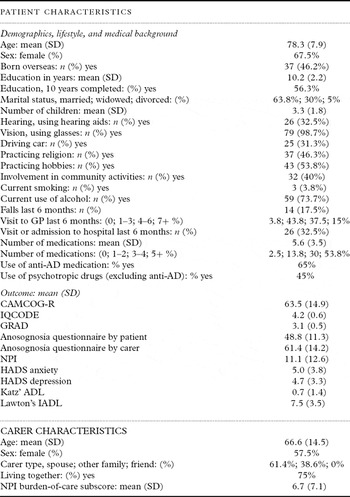
The mean age of our 80 patients with AD was 78.3 years (SD 7.9; range 56–92), 67.5% were women, and 75% lived with their carer. The mean age of the carers was 66.6 years (SD 14.5) and 57.5% were women. The demographic and clinical characteristics of participants are summarized in Table 1.
Characteristics of the AD patients and their carers

Abbreviations: AD = Alzheimer's disease; GP = general practitioner; CAMCOG-R = Cambridge Cognitive Examination of the Elderly Revised; IQCODE = Informant Questionnaire on Cognitive Decline in the Elderly; GRAD = Guidelines for the Rating of Awareness Deficits; NPI = Neuropsychiatric Inventory; HADS = Hospital Anxiety and Depression Scale; Katz ADL = Katz' Activities of Daily Living scale; IADL = Lawton and Brody's Instrumental Activities of Daily Life assessment scale.
Agreement between QoL ratings
The mean total QoL-AD score by self-rating (mean ± standard deviation; 34.7 ± 5.3) was higher than the carer–carer rating (29.5 ± 5.4; t-paired = 7.04, p < 0.001). The mean total QoL-AD score by self-rating was also higher than the carer–patient rating (32.1 ± 6.1; t-paired = 3.91, p < 0.001). Carer–carer ratings were lower than carer–patient ratings (t-paired = 4.60, p < 0.001).
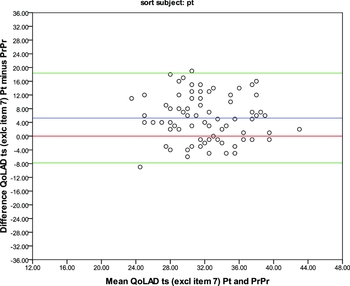
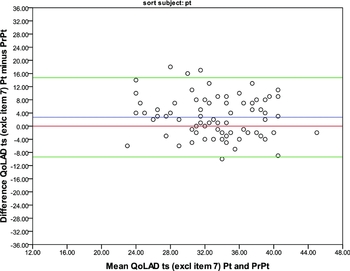
Figures 2a and 2b show the agreement between patients and their carers in the rating of the QoL-AD using Bland-Altman plots. The results demonstrate that there was acceptable agreement in the rating of the QoL-AD between patients and their carers (i.e. within the ±1.96 SD range). Only 2/79 self-ratings (i.e. 2.5%) did not agree with the carer–carer ratings (i.e. fell outside the ±1.96 SD range, see Figure 2a), and 4/80 (5%) self-ratings did not agree with the carer–patient ratings (Figure 2b). However, there was a systematic difference in the rating of the QoL-AD, with patients rating their own QoL more highly than their carers (or, vice-versa, carers rating the QoL of patients systematically lower than the patients themselves).
Bland-Altman plot for agreement on the QoL-AD total score between AD patients and carer with carer–carer perspective. A difference of 0 would indicate perfect agreement, as indicated by the red line. The average difference between patient and carer is indicated with a blue line. The +1.96 SD and –1.96 SD area are indicated with green lines. Item 7 (QoL in relation to “Marriage”) was not included in the total score of the QoL-AD score, because “Marriage” (or other form of relationship) was not applicable to 36% of the participants with AD.

Bland-Altman plot for agreement on the QoL-AD total score between AD patients and carer with carer–patient perspective. A difference of 0 would indicate perfect agreement, as indicated by the red line. The average difference between patient and carer is indicated with a blue line. The +1.96 SD and –1.96 SD area are indicated with green lines. Item 7 (QoL in relation to “Marriage”) was not included in the total score of the QoL-AD score, because “Marriage” (or other form of relationship) was not applicable to 36% of the participants with AD.

Factors associated with QoL ratings
Univariate analyses
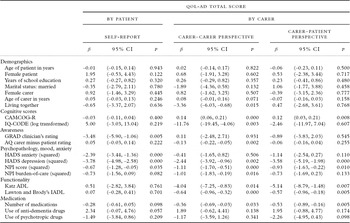
The independent associations between QoL ratings and exposure factors are summarized in Table 2. Apart from “living together” for the carer–carer ratings, demographic factors were not associated with QoL. Cognitive function, as measured by the CAMCOG-R, was not associated with self-ratings of QoL, but showed a significant positive correlation with both carer ratings. We also found that self-reported QoL ratings were inversely associated with anxiety, depression, NPI, and GRAD scores.
Univariate analyses of independent associations between QoL ratings and exposure factors

Abbreviations: CAMCOG-R = Cambridge Cognitive Examination of the Elderly Revised; IQCODE = Informant Questionnaire on Cognitive Decline in the Elderly; GRAD = Guidelines for the Rating of Awareness Deficits; AQ = Anosognosia Questionnaire; HADS = Hospital Anxiety and Depression Scale; NPI = Neuropsychiatric Inventory; Katz ADL = Katz' Activities of Daily Living scale; IADL = Lawton and Brody's Instrumental Activities of Daily Life assessment scale; CI = confidence interval.
For the carer–carer ratings of QoL, we found an inverse association with the IQCODE, HADS depression, and Katz ADL scores. The carer–patient QoL ratings were inversely associated with HADS depression, NPI, ADL, and IADL scores, as well as with the number of medications. The carer–patient QoL ratings showed a direct association with the cognitive scores of patients.
Multivariate analyses
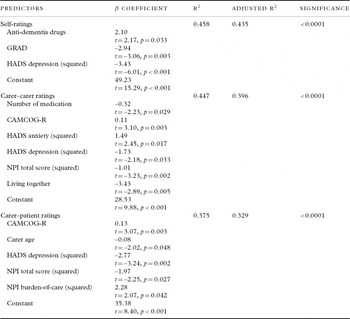
We used backwards linear regression to examine the association between measured exposures and QoL ratings (Table 3). The final model of the predictors of QoL self-ratings explained 48.3% of the variance (p < 0.001). The individual explanatory variables that retained significance in the multivariate model were insight and depression scores (inverse association), and use of anti-dementia drugs (direct association).
Final predictive models of three different views on QoL ratings based on stepwise backwards regression analyses

Abbreviations: CAMCOG-R = Cambridge Cognitive Examination of the Elderly Revised; GRAD = Guidelines for the Rating of Awareness Deficits; HADS = Hospital Anxiety and Depression Scale; NPI = Neuropsychiatric Inventory.
The parsimonious model investigating the factors associated with QoL carer–carer ratings explained 44.6% of the variance of the data (p < 0.001). QoL ratings showed a direct association with the CAMCOG-R and HADS anxiety scores, and an inverse association with the total number of medications that patients consumed, HADS depression, NPI ratings, and not cohabiting with the patient.
For the carer–patient QoL ratings, the final parsimonious model explained 37.5% of variance of the data (p < 0.001). QoL ratings showed a direct association with the CAMCOG-R and NPI burden-of-care, and inverse association with the age of the carer, HADS depression, and NPI scores.
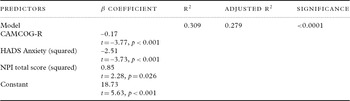
We completed a backwards stepwise regression to determine the variables that were significantly associated with the difference in QoL ratings of patients and carer (carer–carer view). These results are summarized in Table 4. CAMCOG-R, NPI, and HADS anxiety scores explained about 31% of the variance of these data.
Post-hoc model of difference between self-reported and carer–carer view on QoL ratings based on stepwise backwards regression analyses (parsimonious model)

Abbreviations: CAMCOG-R = Cambridge Cognitive Examination of the Elderly Revised; HADS = Hospital Anxiety and Depression Scale; NPI = Neuropsychiatric Inventory.
Finally, as the QoL-AD includes an item that assesses, mood (depression), it is possible that the association between QoL ratings and the HADS-D could have been driven by this overlap. Post-hoc analyses were performed, where we excluded the item “mood” from the QoL-AD total score and reran all predictive models. The associations remained unchanged (data not shown).
We also performed post-hoc analyses to examine the associations of the original QoL-AD composite score with the measured explanatory variables in our dataset. We did this separately for the carer–carer and the carer–patient QoL-ratings. The only significant associations remaining were the HADS depression for both viewpoints and the age of the carer for the carer–carer viewpoint.
Discussion
The results of the present study led us to reject our first hypothesis that QoL ratings by patients with mild to moderate AD and QoL ratings by their carers show an acceptable level of agreement, although carers systematically underrate QoL compared with patients. We also found that the factors that drive QoL ratings in people with mild to moderate dementia vary according to the rater and his/her perspective: cognitive function is directly correlated with QoL ratings of carers, but not with patients’ QoL ratings, whereas depressive symptoms are inversely associated with QoL ratings of both patients and carers. In addition, QoL ratings according to the carer–carer perspective are inversely associated with the number of medications consumed by the patient, symptoms of anxiety, and living together, while the carer–patient perspective is inversely associated with the carers’ age and burden-of-care. The differences between patients’ and carers’ QoL ratings were associated with cognitive scores and neuropsychiatric symptoms.
The findings are limited by some characteristics of the study. First, regarding internal validity, this is an observational cross-sectional study that shows associations rather than causality. Consequently, we cannot dismiss the possibility of reverse causality entirely (e.g. poor QoL causing patients to become depressed). Longitudinal data would be valuable in this regard, as the temporal sequence between exposure and outcome can be observed in a more reliable manner. Secondly, this study had a reasonable sample size (N = 80 AD patients and their carers), but multiple testing may have contributed to produce some chance associations. We would argue, however, that the consistency of our observations with those of other studies suggests this would be an unlikely explanation for our findings (Garre-Olmo et al., Reference Garre-Olmo, Lopez-Pousa, Vilalta-Franch, Turon-Astrada, Hernandez-Ferrandiz and Lozano-Gallego2002; Thorgrimsen et al., Reference Thorgrimsen, Selwood and Spector2003; Sands et al., Reference Sands, Ferreira, Stewart, Brod and Yaffe2004; Snow et al., Reference Snow, Dani, Souchek, Sullivan, Ashton and Kunik2005; Hoe et al., Reference Hoe, Hancock, Livingston and Orrell2006; Reference Hoe, Katona, Orrell and Livingston2007; Conde-Sala et al., Reference Conde-Sala, Garre-Olmo, Turro-Garriga, Lopez-Pousa and Vilalta-Franch2009; Schiffczyk et al., Reference Schiffczyk, Romero, Jonas, Lahmeyer, Müller and Riepe2010). Thirdly, we considered the main effect of variables, but refrained from examining the possible interactions between risk factors because of relatively small numbers.
Regarding the generalizability of our findings, the participants of this study were not randomly selected, i.e. only patients diagnosed with AD with a cognitive severity of mild to moderate (MMSE ≥10) were selected, and most were known to the specialized services we approached for recruitment. At this point it is unclear if these results would be equally applicable to people with severe AD living in the community or to those living in residential care facilities.
This study has the merit of having used, for the first time, an approach to analyze the distribution of all QoL ratings of older adults with AD and their carer that goes beyond the absolute concordance of scores. Our finding of a discrepancy in QoL ratings is in line with the findings of other studies (Thorgrimsen et al., Reference Thorgrimsen, Selwood and Spector2003; Sands et al., Reference Sands, Ferreira, Stewart, Brod and Yaffe2004; Ready et al., Reference Ready, Ott and Grace2006; Hoe et al., Reference Hoe, Katona, Orrell and Livingston2007; Conde-Sala et al., Reference Conde-Sala, Garre-Olmo, Turro-Garriga, Lopez-Pousa and Vilalta-Franch2009). However, the way the ratings behave has not been described with the use of Bland-Altman plots as a visual guide in the interpretation of this discrepancy. With this approach, we were able to demonstrate that carers and patients show acceptable agreement in their ratings (i.e. within ±2 SD), although carers systematically underestimate QoL ratings compared with the patients. This finding is in line with the suggested disability paradox that we have previously described.
In addition, our results suggest that agreement between raters occurs across the range of mild to moderate dementia. One might therefore expect that changes of scores over time according to patients would be rated in the same direction by carers (i.e. if QoL scores decline according to the patient, they will also decline according to the carer, and vice-versa). Longitudinal studies will be required to confirm such a prediction.
We also used a novel approach to ascertain QoL that allowed carers to rate the perceived QoL of patients using two different perspectives: carer–carer and carer–patient perspectives (Pickard and Knight, Reference Pickard and Knight2005). Our results show that the scores yielded by such an approach are not interchangeable, although both agree with the ratings of patients according to Bland-Altman plots. In fact, the demographic and clinical variables associated with these ratings overlap but are not the same. This highlights the need for consistency in the use of raters and of perspectives to ascribe QoL scores to older people with mild to moderate AD.
Our findings suggest that the double weighting of the patient ratings according to the original instructions of the QoL-AD privileges the ratings of the patient as opposed to the carer and might be less informative than using separate ratings. Information about clinical factors that are associated with disparate views of patients and carers is lost in the original administration. It may be more informative, for clinicians and researchers, to use the ratings of patient and carer as complementary and not as a composite score, and to be more explicit about which viewpoint of the carer was used. For example, falling QoL ratings according to the patient might suggest the presence of depressive symptoms, while falling QoL ratings according to the carer might indicate cognitive decline.
The predictive models revealed that self-reported QoL (as measured with the QoL-AD) are inversely associated with depression and insight, and directly associated with the use of anti-dementia drugs. The observed association between QoL and depression is in line with previous studies (Sands et al., Reference Sands, Ferreira, Stewart, Brod and Yaffe2004; Selwood et al., Reference Selwood, Thorgrimsen and Orrell2005; Snow et al., Reference Snow, Dani, Souchek, Sullivan, Ashton and Kunik2005; Hoe et al., Reference Hoe, Hancock, Livingston and Orrell2006; Reference Hoe, Katona, Orrell and Livingston2007; Vogel et al., Reference Vogel, Mortensen, Hasselbalch, Anderson and Waldemar2006; Conde-Sala et al., Reference Conde-Sala, Garre-Olmo, Turro-Garriga, Lopez-Pousa and Vilalta-Franch2009), as is the association with anti-dementia agents (Birks, Reference Birks2006; Hoe et al., Reference Hoe, Katona, Orrell and Livingston2007). As previously described by Hoe et al. (Reference Hoe, Katona, Orrell and Livingston2007), the link between self-reported QoL and the use of cholinesterase inhibitors may have been due to reverse causality, and this is an issue that requires further investigation. Carers’ perspectives of the patients’ QoL was inversely associated with the severity of depressive symptoms (as one of the main predictors) and directly associated with cognitive scores. As already noted by Conde-Sala et al. (Reference Conde-Sala, Garre-Olmo, Turro-Garriga, Lopez-Pousa and Vilalta-Franch2009), previously reported associations with lower QoL ratings – namely apathy, autonomy of ADL, and caregiver burden – could be considered to be related to depression, i.e. depressive symptoms increase functional disability (ADL), increase presence of non-cognitive symptoms, and increase caregiver burden (Garre-Olmo et al., Reference Garre-Olmo, Lopez-Pousa, Vilalta-Franch, Turon-Astrada, Hernandez-Ferrandiz and Lozano-Gallego2002). In many ways, it is not surprising that QoL-AD scores were associated with depression, particularly because one of the 13 items of the QoL-AD measures the perception of QoL in relation to the patient's mood. Post-hoc analyses were performed in which we excluded the item “mood” from the QoL-AD total score and reran the predictive models. This revealed that the associations remained unchanged, and therefore we can be confident that depression has a significant impact on non-specific aspects of QoL.
With regards to the inverse association of self-reported QoL and insight (or awareness), this finding is in line with the study of Hurt et al. (Reference Hurt2010), who showed that insight was related to patient's perception of QoL. That is, they found that impairment in insight is associated with better self-reported QoL in moderate dementia, but insight was not associated with carer perception of the patient's QoL. Our data suggest that carers do not seem to consider the degree of awareness as a predictor of patients’ experience of QoL.
Both carer perspectives showed a moderate inverse association between QoL and cognitive scores, in contrast to patients’ self-report. It is possible that patients with AD adapt their expectations as time goes by, and that the link between cognitive function and QoL is not linear or is subject to a threshold effect. The disability paradox (Albrecht and Devlieger, Reference Albrecht and Devlieger1999) and the response shift theory (Schwartz et al., Reference Schwartz, Andresen, Nosek and Krahn2007) may explain these associations, at least in part. Longitudinal data would be required to determine how changes in cognitive function and insight modulate QoL in people with AD.
We are not aware of a study in this field that included a similar wide range of measurable patient and carer candidate predictors of QoL in mild to moderate AD (i.e. demographic, lifestyle, medical background, cognitive, psychobehavioral, depression, anxiety, insight, (I)ADL factors and burden-of-care). Hoe et al. (Reference Hoe, Katona, Orrell and Livingston2007) also concluded that QoL ratings by patients with AD and carers are different regarding the predictors of reduced QoL, but they restricted their analyses of possible predictors to demographics, ADL, and neuropsychiatric symptoms of AD. Our study included a broader range of risk factors. Other important differences between the study of Hoe et al. (Reference Hoe, Katona, Orrell and Livingston2007) and our own are: (1) they included AD patients living at home and in 24-hour residential care settings (36.6%) whereas we restricted our participants to community-dwelling people with AD patients; (2) Hoe et al. included AD patients with MMSE scores ranging from 0–29 (mean 14.7, SD 8.3) whereas our participants with AD had MMSE scores of 10 or more (mild to moderate dementia); and (3) we included two different carers’ viewpoints, a strategy that has not been explored in any particular setting. This enabled us to model the contribution of clinically modifiable variables to QoL in mild to moderate dementia from different views.
To conclude, these findings show that mild to moderate community-dwelling AD patients and their carers (regardless of the carer's perspective used) agree within an acceptable range in their QoL ratings but with a systematic tendency of higher ratings by patients. Notwithstanding this agreement, the ratings of QoL provided by patients and carers with different perspectives are driven by different factors and, consequently, are not interchangeable. This has implications for research and clinical practice. When conducting research investigating the predictors and effectiveness of clinically targeted interventions on HR-QoL in dementia, it may be necessary to consider the choice of rater and the rater's perspective. Also, if improved QoL is “the ultimate goal” of our clinical interventions, then the use of different raters may be more informative than a unified composite score.
Conflict of interest
None.
Description of authors' roles
PB conceived and designed the study with OA's assistance and also drafted the original manuscript together with OA. The paper was critically reviewed for important intellectual content by all authors. PB completed all analyses with HA's assistance. PB and JE collected the data. All authors approved the submission of the paper for publication. PB acts as the guarantor regarding the accuracy of the data reported.
Acknowledgments
We sincerely thank participants for their generous contribution to the study.