





Social withdrawal in youth, reflecting a relatively low rate of peer interaction or a high rate of solitary behavior, disrupts foundational social experiences and influences the relationships that form during critical stages of development (Rubin et al., Reference Rubin, Coplan and Bowker2009). Socially withdrawn youth often occupy peripheral positions in social contexts. They prefer to be alone, keep things to themselves, and have little to do with others. For instance, they may consistently sit apart from their classmates or remain alone during recess. Unlike many other youth with peer difficulties, they often limit engagement from the outset rather than attempting interaction and failing (Bowker & White, Reference Bowker and White2021).
Importantly, social withdrawal is multifaceted and can reflect various underlying motivations. Some youth withdraw because they are shy or anxious in social interactions. Others may have little interest in social interaction or simply prefer solitude (Coplan et al., Reference Coplan, Ooi and Baldwin2019). Therefore, social withdrawal should not be considered synonymous with shyness or behavioral inhibition, and its developmental implications may vary depending on the processes underlying withdrawal.
Although socially withdrawn youth can develop friendships, they often find these interactions to be tense or uncomfortable (Rubin et al., Reference Rubin, Wojslawowicz, Rose-Krasnor, Booth-LaForce and Burgess2006). They also rate their closest friendships as providing less help and guidance, involving less intimacy, and resolving conflicts less easily compared to their socially connected peers. Consistent with this finding, the best friends of socially withdrawn youth describe these friendships as less enjoyable, supportive, and of lower overall quality. These difficulties may be more relevant for young people who withdraw due to shyness or inhibition than for those who withdraw due to low social motivation or a preference for solitude. Consequently, maladaptive interaction patterns may prevent socially withdrawn youth from developing the skills necessary for healthy adult relationships (Dryburgh et al., Reference Dryburgh, Ponath, Bukowski and Dirks2022).
Social withdrawal arises from interacting biological, psychological, and environmental influences (Rubin et al., Reference Rubin, Coplan and Bowker2009). Early in life, some children show biologically based differences in arousal, including a low threshold for responding to novelty and social stimulation. This heightened reactivity has been linked to amygdala-based fear circuitry and physiological markers, such as right frontal EEG asymmetry and elevated cortisol responses to stress (Fox et al., Reference Fox, Henderson, Marshall, Nichols and Ghera2005).
Biological indicators often cluster with behavioral inhibition and early reticence. These temperamental tendencies can make infants more difficult to soothe and may influence parental responses, including overprotection and heightened concern. Such caregiving patterns can further restrict opportunities for social engagement and reinforce social withdrawal. In combination, child reactivity and parenting responses may increase the risk of insecure attachment (Rubin et al., Reference Rubin, Coplan and Bowker2009), with negative effects for social relationships more generally.
Social withdrawal is often stigmatized (Chang, Reference Chang2003), which increases the risk of exclusion, rejection and victimization (Oh et al., Reference Oh, Rubin, Bowker, Booth-LaForce, Rose-Krasnor and Laursen2008; Rubin et al., Reference Rubin, Wojslawowicz, Rose-Krasnor, Booth-LaForce and Burgess2006). Over time, this can create a feedback loop in which withdrawal elicits negative peer responses, which in turn strengthen solitary behavior and negative self-perceptions (Rubin & Chronis-Tuscano, Reference Rubin and Chronis-Tuscano2021).
At the same time, social development depends on learning through interaction and observation of peers (Laursen & Veenstra, Reference Laursen and Veenstra2021, Reference Laursen and Veenstra2023). These experiences are central for building social skills and improving perspective taking. When such interactions are limited, socially withdrawn youth may have fewer chances to acquire the social competencies needed for effective functioning in later life.
The developmental meaning of withdrawal may also change with age and context. A heightened preference for solitude becomes increasingly maladaptive from early childhood to early adolescence. Then, it becomes increasingly adaptive through late adolescence and emerging adulthood (Coplan et al., Reference Coplan, Ooi and Baldwin2019). However, greater acceptance of solitude in adulthood may not necessarily erase the cumulative effects of early unsociability. Negative spirals associated with early withdrawal, such as missed opportunities for peer interaction, may persist and continue to shape adult outcomes, leaving a potential long shadow despite changing social norms.
Developmental tasks in early adulthood
Early adulthood is a critical time for learning the social and cultural skills that are essential for long-term well-being, social integration, and economic stability. Historically, research in this area has emphasized a set of sequential milestones, including forming stable romantic partnerships, managing households, raising children, building social networks, taking on civic responsibilities, entering the workforce, and adopting gendered social roles. Mastery of these tasks reflects prior developmental successes and shapes one’s ability to overcome later life challenges (Havighurst, Reference Havighurst1956). For instance, establishing a stable career or family in early adulthood was often considered an indicator of long-term well-being and social integration.
However, the nature and timing of these developmental tasks have shifted significantly in recent decades. In many parts of the world, traditional milestones such as marriage and parenthood are now being achieved later in life, if at all. This change reflects broader societal shifts in education, economic demands, and cultural norms regarding family, careers, and identity (Arnett, Reference Arnett2000; Van Wijk & Billari, Reference Van Wijk and Billari2024). Consequently, early adulthood has become a period marked by growing diversity, during which individuals pursue various pathways, such as focusing on career advancement, personal growth, or alternative family structures, rather than following a single prescribed timeline.
Contemporary frameworks have broadened our understanding of developmental tasks, emphasizing adaptive functioning in modern adulthood (Roisman et al., Reference Roisman, Masten, Coatsworth and Tellegen2004). Although these tasks are no longer bound by strict time constraints, the competencies acquired during adolescence and early adulthood continue to be important for later well-being and adjustment. For example, recent longitudinal evidence indicates that social competencies and other developmental assets acquired during adolescence are associated with well-being and mental health in young adulthood (Morneau‐Vaillancourt et al., Reference Morneau-Vaillancourt, Thibault, Bilodeau- Houle, Comtois-Cabana, Boivin, Côté, Geoffroy, Landry and Ouellet- Morin2026). Key indicators of adaptive functioning in early adulthood include romantic competence, residential autonomy, peer competence, work competence, and financial competence.
Romantic competence refers to the ability to approach, form, and maintain intimate relationships adaptively (Bibby & Davila, Reference Bibby and Davila2026). Romantic competence involves capacities for intimacy, communication, and balancing individual and relational needs, whether through traditional partnerships or other forms of emotional connection. These factors contribute to long-term relationship satisfaction and mental health (Braithwaite & Holt-Lunstad, Reference Braithwaite and Holt-Lunstad2017).
Residential autonomy, or living independently from one’s parents, signals self-sufficiency, responsibility, and adaptive functioning. However, its timing varies across social and cultural contexts and depends on individual capacities and preferences, employment, economic resources, housing opportunities, and family circumstances (Schwanitz et al., Reference Schwanitz, Rampazzo and Vitali2021). Thus, remaining in the parental home does not necessarily indicate poor adaptation. Yet, in societies that value independent living, prolonged dependence without progress toward autonomy may suggest difficulties with financial management, problem-solving, or social integration. Residential autonomy therefore involves not only physical separation but also the skills needed to manage daily life effectively (Cherlin et al., Reference Cherlin, Scabini and Rossi1997).
Peer competence involves the ability to form and maintain meaningful friendships and supportive social relationships. During emerging adulthood, friendships often become more central as young adults leave home for education or employment and adjust to new social networks. Difficulties in forming friendships or engaging socially may limit access to support and increase vulnerability to loneliness and adjustment problems (Nelson & Millett, Reference Nelson, Millett, Coplan, Bowker and Nelson2021).
Work competence involves achieving stability, satisfaction, and productivity in occupational roles. It also entails developing professional skills, collaborating with colleagues, and adapting to workplace demands. Challenges in this area, such as chronic unemployment, are strongly linked to economic insecurity and psychological distress (Strandh et al., Reference Strandh, Winefield, Nilsson and Hammarström2014).
Financial independence and security involve managing personal finances responsibly, avoiding chronic financial distress, and achieving economic self-sufficiency. This indicator encompasses budgeting, saving, and navigating economic challenges without relying on external support, such as welfare or family assistance. Financial security reduces stress and creates opportunities for personal and professional growth (Schoon & Duckworth, Reference Schoon and Duckworth2010).
Social withdrawal and developmental tasks
The growing diversity in how individuals navigate developmental tasks raises important questions about the origins of these disparities. Because peer relationships play a foundational role during childhood and adolescence, differences in mastering developmental tasks may reflect earlier social experiences, including social withdrawal. Positive peer interactions help develop social skills and foster competencies that extend into later relationships and broader life functioning (Rubin & Chronis-Tuscano, Reference Rubin and Chronis-Tuscano2021; Viner et al., Reference Viner, Ozer, Denny, Marmot, Resnick, Fatusi and Currie2012). Conversely, limited engagement with peers, as observed in socially withdrawn individuals, has been associated with difficulties in developing social skills, heightened psychological vulnerability, and challenges in establishing and maintaining relationships (Rubin et al., Reference Rubin, Coplan and Bowker2009). Socially withdrawn individuals may struggle with introducing themselves to new people at parties, asking people out on dates, building up the courage to go on job interviews, working well in group settings, and becoming financially independent. All of these are crucial for adaptive functioning (Asendorpf et al., Reference Asendorpf, Denissen and van Aken2008; Rubin et al., Reference Rubin, Coplan and Bowker2009). These challenges can hinder personal fulfillment and limit access to the social support and opportunities necessary for successful adaptation in adulthood.
A recent meta-analysis (Gazelle et al., Reference Gazelle, Shafer Lundin, Lei, Cao and Litchfield2024) provides evidence that that social withdrawal is associated with delays in achieving developmental milestones related to societal participation, including education, work, and family life, indicating that these difficulties may extend into adulthood. Building on this evidence, our study examines a broad set of indicators of adaptive adult functioning within the same longitudinal framework. These indicators include romantic competence, residential autonomy, friendship satisfaction, work competence, and financial competence (see also Barzeva et al., Reference Barzeva, Richards, Meeus and Oldehinkel2021; Caspi et al., Reference Caspi, Elder and Bem1988). The availability of two prospectively followed cohorts and extensive childhood data enabled us to assess the consistency of these associations across population and high-risk samples, as well as after considering several potential alternative explanations. Rather than asking only whether adolescent social withdrawal predicts poorer adult adjustment, we examine how broadly and robustly its developmental correlates extend across major domains of adult functioning. We hypothesized that socially withdrawn adolescents would be less likely than their non-withdrawn peers to complete key developmental tasks as adults.
Other major antecedents
We examined whether the likelihood of completing developmental tasks was related not only to social withdrawal but also to major covariates. First, the social and economic consequences of being bullied are significant. Victims of bullying have more difficulty forming and maintaining friendships (Wolke et al., Reference Wolke, Copeland, Angold and Costello2013). They are also more likely to be single, receive less social support, experience a lower quality of life by age 50 (Takizawa et al., Reference Takizawa, Maughan and Arseneault2014), and have a harder time maintaining employment (Wolke et al., Reference Wolke, Copeland, Angold and Costello2013). For that reason, we hypothesized that peer victimization would hinder the development of young people, making it less likely that they would complete important developmental tasks as adults.
Second, lower cognitive abilities could affect mastery of developmental tasks as well. For instance, children with weaker executive functioning or lower IQ scores may have difficulty with social interactions and academic or occupational achievement (Richmond-Rakerd et al., Reference Richmond-Rakerd, Caspi, Ambler, d’Arbeloff, de Bruine, Elliott, Harrington, Hogan, Houts, Ireland, Keenan, Knodt, Melzer, Park, Poulton, Ramrakha, Rasmussen, Sack, Schmidt, Sison, Wertz, Hariri and Moffitt2021). Lower cognitive capacity affects effective problem-solving, emotional regulation, and adaptive behaviors, making it more difficult to achieve social and developmental challenges (e.g., forming relationships or reaching career milestones). We hypothesized that higher cognitive abilities would facilitate the development of young people, increasing the likelihood that they would complete important developmental tasks as adults.
Third, family socioeconomic status and instability may also affect mastering developmental outcomes. Lower socioeconomic status is associated with fewer resources, higher stress levels, and limited access to opportunities, all of which can hinder developmental progress. Children from disadvantaged backgrounds may withdraw due to environmental stressors, such as parental conflict or financial strain, rather than intrinsic social difficulties (McLoyd, Reference McLoyd1998). Similarly, family instability (e.g., divorce or frequent moves) can disrupt attachment and socialization, which increases the risk of social withdrawal and poor adjustment (Amato, Reference Amato2010). We hypothesized that socioeconomic disadvantage and family instability would hinder youth development, reducing the likelihood of reaching important milestones in adulthood.
Finally, social withdrawal, as well as later adjustment and variation in developmental tasks, may be genetically influenced and their association thus confounded. In other words, the same genes may increase the risk of both social withdrawal and later difficulties achieving developmental tasks associated with compromised mental well-being. To account for this potentially shared genetic basis, we include a polygenic score for depressive symptoms, which served as a proxy for genetic risk for internalizing problems, as a covariate. We hypothesized that genetic risk for internalizing problems would hinder the development of young people, reducing the likelihood that they will master key adult developmental tasks.
Gender differences
Few studies have examined gender differences in the relation between social withdrawal and developmental tasks. However, the peer relationship processes of girls and boys differ in ways that may shape the consequences of social withdrawal. Girls tend to prioritize connection, engaging more in conversation, self-disclosure, and emotionally supportive friendships. In contrast, boys tend to participate more in larger, group-based interactions characterized by competition and dominance (Rose & Rudolph, Reference Rose and Rudolph2006). These differences become more pronounced across development and may mean that limited peer engagement has different implications for later social and interpersonal functioning. Therefore, we explored whether the associations between social withdrawal and adult developmental tasks differ between girls and boys.
The present study
Relatively few recent studies have examined how early social withdrawal impacts the mastery of developmental tasks in adulthood. This limits our understanding of how withdrawal shapes long-term developmental pathways and hinders the development of targeted interventions to support those at risk of maladjustment. Using the TRacking Adolescents’ Individual Lives Survey (TRAILS) which has followed individuals from pre-adolescence into their late twenties, we examined associations between social withdrawal during late childhood and adolescence (ages 11–16) and the completion of developmental tasks that exemplify the transition to adulthood. First, we examined whether social withdrawal predicted the mastery of developmental tasks in early adulthood. Specifically, we examined romantic relationship status as an indicator of romantic competence, independent living as an indicator of managing a household, friendship satisfaction as an indicator of peer competence, integration into the labor market as an indicator of work competence, and welfare independence and the absence of financial problems as indicators of financial competence. We hypothesized that socially withdrawn adolescents would be less likely to master these developmental tasks in adulthood.
Additionally, we examined major covariates of the likelihood of reaching significant milestones in adulthood. We hypothesized that peer victimization, cognitive disability, socioeconomic disadvantage, family instability, and genetic risk for internalizing problems might hinder youth development and reduce the likelihood of completing important developmental tasks in adulthood.
Finally, we explored whether the associations differed depending on whether participants had been in contact with child mental health services prior to entering the study and whether they were boys or girls.
Methods
Procedure and participants
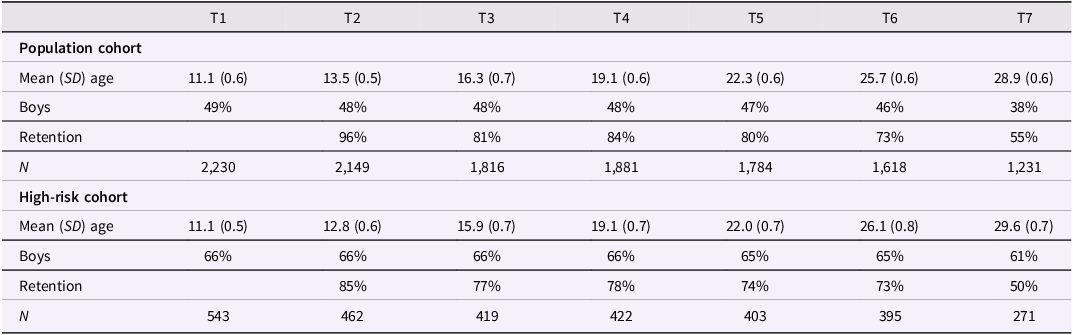
TRAILS comprises two cohorts: a population-based cohort and a high-risk cohort. Participants in the population-based cohort were recruited through primary schools across five municipalities in the north of the Netherlands (school response rate: 90%). Of all the eligible children, 2,228 (76%) took part in the study (de Winter et al., Reference de Winter, Oldehinkel, Veenstra, Brunnekreef, Verhulst and Ormel2005). Participants in the high-risk cohort had been in contact with specialized mental health services in the north of the Netherlands before the age of ten. Of all eligible high-risk participants who were invited, 543 (43%) participated. Data collection procedures were largely identical across cohorts, with assessments taking place approximately every three years (Oldehinkel et al., Reference Oldehinkel, Rosmalen, Buitelaar, Hoek, Ormel, Raven, Reijneveld, Veenstra, Verhulst, Vollebergh and Hartman2015), when participants were ∼11 (T1), 13.5 (T2), 16 (T3), 19 (T4), 22 (T5), 26 (T6), and 29 (T7) years old. The gender ratio in the population cohort was almost equal at baseline, but boys were overrepresented in the high-risk cohort. Most participants were ethnically Dutch, comprising 86.5% of the population cohort and 97.6% of the high-risk cohort. All non-Dutch participants in the high-risk cohort had a non-Western background. In the population cohort, 2.9% had a Western background, whereas 10.6% had a non-Western background. Table 1 provides an overview of the two cohorts, including the mean age, percentage of boys and retention rate for each wave. Retention rates decreased slowly over the years, most notably from ages 13.5 to 16 (e.g., from 96% to 81% in the population cohort) and from ages 26 to 29 (e.g., from 73% to 50% in the high-risk cohort). Retention was higher among female participants than among male participants. The study was approved by the national Central Committee on Research Involving Human Subjects (CCMO) and the local Medical Ethics Review Board. Informed consent was obtained from both parents (up to child age 16) and participants.
TRAILS participants across the data collection waves
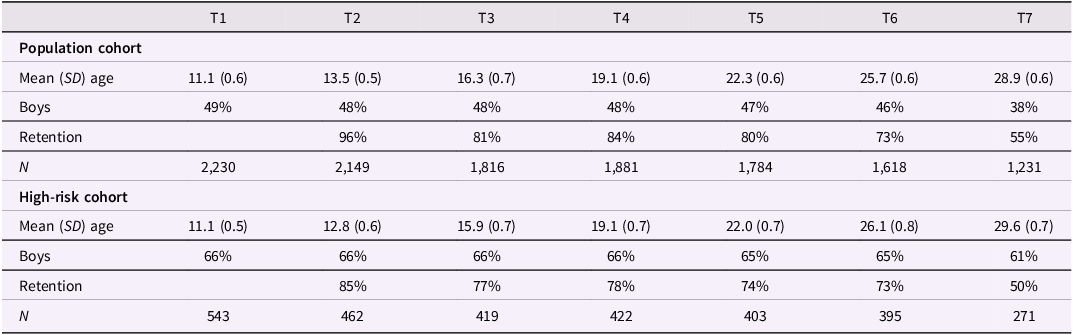
Table 1. Long description
The table compares two cohorts, population-based and high-risk, across seven data collection waves. It has two main sections: Population cohort and High-risk cohort. Each section includes columns for T1 to T7, representing different ages. The table has 7 rows and 14 columns. Row 1: Mean (SD) age. Row 2: Boys. Row 3: Retention. Row 4: N. Population cohort: Row 1: T1, 11.1 (0.6); T2, 13.5 (0.5); T3, 16.3 (0.7); T4, 19.1 (0.6); T5, 22.3 (0.6); T6, 25.7 (0.6); T7, 28.9 (0.6). Row 2: T1, 49%; T2, 48%; T3, 48%; T4, 48%; T5, 47%; T6, 46%; T7, 38%. Row 3: T1, 96%; T2, 81%; T3, 84%; T4, 80%; T5, 73%; T6, 55%. Row 4: T1, 2,230; T2, 2,149; T3, 1,816; T4, 1,881; T5, 1,784; T6, 1,618; T7, 1,231. High-risk cohort: Row 1: T1, 11.1 (0.5); T2, 12.8 (0.6); T3, 15.9 (0.7); T4, 19.1 (0.7); T5, 22.0 (0.7); T6, 26.1 (0.8); T7, 29.6 (0.7). Row 2: T1, 66%; T2, 66%; T3, 66%; T4, 66%; T5, 65%; T6, 65%; T7, 61%. Row 3: T1, 85%; T2, 77%; T3, 78%; T4, 74%; T5, 73%; T6, 50%. Row 4: T1, 543; T2, 462; T3, 419; T4, 422; T5, 403; T6, 395; T7, 271.
Note. Two participants from the population cohort withdrew and their data were removed. The maximum sample size for that cohort is now 2,228 participants.
Measures
Social withdrawal
Social withdrawal was assessed during the first three waves (from ages 11 to 16) with the same five items from the Youth Self-Report (self-report) and the Child Behavior Checklist (parent report) Withdrawn subscales. The YSR/CBCL items assessed if participants preferred to be alone rather than with others; if they refused to talk; if they were secretive or kept things to themselves; if they were too shy; or if they tried to have little to do with others. The YSR/CBCL Withdrawn subscales demonstrate high test-retest reliability and correlate moderately positively with measures of anxiety and social introversion (Achenbach et al., Reference Achenbach, Dumenci and Rescorla2003). The items were selected based on face validity and previous research (Booth-LaForce & Oxford, Reference Booth-LaForce and Oxford2008; Eggum et al., Reference Eggum, Eisenberg, Spinrad, Valiente, Edwards, Kupfer and Reiser2009; Tang et al., Reference Tang, Van Lieshout, Lahat, Duku, Boyle, Saigal and Schmidt2017), and they demonstrated longitudinal measurement invariance in TRAILS (Barzeva et al., Reference Barzeva, Meeus and Oldehinkel2019, Reference Barzeva, Richards, Meeus and Oldehinkel2020). Responses referred to the past six months and were rated on a three-point scale ranging from 0 (not at all) to 2 (always or often true). Latent factor analyses across the three waves supported a three-level structure, with items nested within reporter within wave. Appendix 1 presents the item wording and parameter estimates for the ten items per wave (5 from parents and 5 from adolescents themselves). The model fit was acceptable, with RMSEA (90%CI) = 0.035–0.039, SRMR = 0.048, CFI = 0.90, and TLI = 0.89. We derived a latent factor score from this model to represent social withdrawal in subsequent analyses.
Mastery of developmental tasks. Self-reports at four waves (T4 to T7) were used to assess developmental tasks from age 19 to age 29. Romantic competence was measured by asking participants if they had ever been in a stable romantic relationship. Participants’ responses were coded as 0 if they had never been in a stable relationship and as 1 if they had been in one. Residential autonomy was assessed by asking about the residence in which participants lived most or all of the time. Participants’ responses were coded as 0 if they lived in their parents’ home or in an institution by age 29, and 1 if they had lived independently at any wave by age 29. Friendship satisfaction was assessed at age 26 (T6). Participants completed ten items measuring the quantity and quality of their friendships as well as the frequency of contact. The ten items constitute a composite scale created from established friendship questions and additional items, rather than from a previously validated instrument. The scale was internally consistent, α = 0.87. Scores above 3, the scale midpoint, were coded as satisfied with friendships, whereas scores below 3, were coded as unsatisfied. Work competence was measured by asking whether participants had paid work in the past month. Answer options were “no, never had paid work,” “no, not anymore,” or “yes.” We coded responses as 0 if participants had never been employed or had only been employed once and 1 if they had been employed at least twice by age 29. Financial independence was measured by asking participants if they had received welfare payments. Responses by participants who reported receiving welfare payments at least twice were coded as 0, while responses of those who reported receiving such payments only once or never were coded as 1. Financial security was assessed by asking whether participants had struggled financially in the past year. Answer options were “no trouble at all,” “no trouble, but I have to watch my spending,” “a bit of trouble,” or “a lot of trouble.” Responses were coded 0 if participants reported a lot of financial trouble at any wave and 1 if they reported at the most some trouble across waves.
To ensure consistency, we dichotomized all outcomes, with a value of 1 indicating mastery of the task. Specifically, indicators of romantic relationship status, residential autonomy, employment, financial independence, and financial security were recoded into binary variables at each assessment. Then, these indicators were combined across waves to identify whether participants had achieved each milestone at any point during the observation period. For outcomes defined as having achieved a milestone at least once, such as entering a romantic relationship or becoming residentially autonomous, a reported achievement at any wave was retained, even if there were missing observations at later waves. Therefore, subsequent attrition did not reverse an already achieved milestone. For outcomes based on repeated experiences across waves (employment, financial independence, and financial security), classifications were based on available observations according to the aforementioned criteria. Importantly, participants who did not meet the mastery criterion and lacked valid observations at two or more waves were coded as missing rather than as having failed to master the task.
Covariates (as assessed at age 11). We estimated associations between social withdrawal and mastery of developmental tasks adjusted for peer victimization, cognitive abilities, and family socioeconomic status and instability. Peer victimization was measured using one item from the YSR (Achenbach & Rescorla, Reference Achenbach, Rescorla and Archer2006): “I am being bullied by others.” Responses ranged from 0 (never) to 2 (often). Overall, 26.3% of participants in the population cohort and 33.8% of participants in the high-risk cohort reported sometimes experiencing victimization, and 5.7% and 12.5% reported frequent victimization. Child cognitive abilities were measured using the Wechsler Intelligence Scale for Children-revised (vocabulary and block design subtests). This two-subtest short form was chosen on the basis of its high correlation (r = .90) with the complete WISC-R (Silverstein, Reference Silverstein1975).
Family socioeconomic status (SES) was constructed from family income, mothers’ and fathers’ educational levels and occupational levels, using the International Standard Classification of Occupations (Ganzeboom & Treiman, Reference Ganzeboom and Treiman1996). The resulting scale captures 61.2% of the variance in the five items and has an internal consistency of .84. Missing values (e.g., when there is only one parent in the family) did not affect this scale’s association with other variables. Family instability contrasted participants who have lived with the same two parents since birth and those who have experienced either single parenthood since birth or some form of instability in the parental relationship.
Polygenic scores are molecular markers based on genome-wide association scores that can be easily implemented in population studies to capture part of the genetic predisposition for a given phenotype (Belsky & Harden, Reference Belsky and Harden2019). We selected polygenic score for internalizing problems because no polygenic scores are available for our outcomes. Given evidence of pleiotropy, some genes associated with internalizing symptoms may also explain variance in withdrawal and developmental milestones. Thus, this polygenic score provides the most meaningful approximation of the shared genetic basis between withdrawal and the other outcomes. The polygenic score was computed as weighted allele sums using the LDPred2 Python package, which estimates SNP heritability and the proportion of causal variants directly from the data (Privé et al., Reference Privé, Albiñana, Arbel, Pasaniuc and Vilhjálmsson2023). The SNP weights reflected the GWAS effect sizes (Howard et al., Reference Howard, Adams, Clarke, Hafferty, Gibson, Shirali, Coleman, Hagenaars, Ward, Wigmore, Alloza, Shen, Barbu, Xu, Whalley, Marioni, Porteous, Davies, Deary, Hemani, Berger, Teismann, Rawal, Arolt, Baune, Dannlowski, Domschke, Tian, Hinds, Byrne, Ripke, Smith, Sullivan, Wray, Breen, Lewis and McIntosh2019), which were scaled by the linkage disequilibrium scores that were estimated by LDPred2 from the combined population and high-risk samples. The scores were based on all variants without p-value thresholding. Consistent with previous work using TRAILS data (Navarro et al., Reference Navarro, De Roo, Oldehinkel, Hartman and Kretschmer2025), we restricted the analysis to high-quality HapMap3+ variants, which offer comprehensive genome coverage. We used the linkage disequilibrium reference panel based on European individuals from the UK Biobank (Bycroft et al., Reference Bycroft, Freeman, Petkova, Band, Elliott, Sharp, Motyer, Vukcevic, Delaneau, O’Connell, Cortes, Welsh, Young, Effingham, McVean, Leslie, Allen, Donnelly and Marchini2018), which was provided by the LDPred2 developers.
Attrition
Mastery of developmental tasks was available for 80.7% (n = 1,798) of the population sample and 74.6% (n = 405) of the high-risk sample. Here, outcome availability refers to having enough observations from T4 to T7 to classify participants according to the above-described outcome-specific criteria. It does not imply having complete data from all four assessments. Participants differed from those lost to attrition in that they were more often female (χ 2(1; 2,771) = 50.89, p < .001), came from families with a higher socioeconomic status (t (2725) = 10.44, p < .001), and experienced higher levels of family stability (χ 2(1;2769) = 17.89, p < .001). They also scored higher on the general cognitive abilities test (t (2760) = 10.70, p < .001). No differences were found for social withdrawal (t (2768) = −1.60, p = .11), peer victimization (t(2718) = −0.11, p = .92), or the polygenic score for internalizing problems (t (1674) = −0.78, p = .44).
Analytic strategy
A multi-step analytic approach was employed to examine the relation between social withdrawal and the mastery of key developmental tasks in early adulthood. First, descriptive statistics and correlations provide an initial understanding of the prevalence and distribution of and associations between our key variables within the general population and the high-risk group.
Second, logistic regression models were computed for each outcome to examine the association between social withdrawal and developmental task mastery. These models included social withdrawal as the primary predictor and gender, peer victimization, cognitive abilities, family socioeconomic status, and family instability as covariates. Continuous variables were z-standardized prior to the logistic regression analyses. Odds ratios were calculated to quantify the strength and direction of associations for both the population and the high-risk cohorts. The robustness of the associations was evaluated by examining the consistency of findings across cohorts.
Additional sensitivity analyses were conducted to evaluate the robustness of the findings. These analyses examined whether genetic liability or clinical conditions closely related to social withdrawal confounded the associations between social withdrawal and mastery of developmental tasks. First, the analyses were controlled for genetic confounding by including a polygenic score for internalizing problems. To account for population stratification, we regressed the social withdrawal scores on the 20 principal components of genetic ancestry. The resulting residuals, representing the variance in social withdrawal not explained by the principal components, were used in the analyses. The initial data set included a few sibling pairs, which posed a risk of bias. To address this issue, one sibling from each pair was excluded, and preference was given to the sibling with the most complete data. When both siblings had equivalent data availability, the sibling with the higher subject ID number (random assignment) was retained. After this adjustment, the sample for these additional analyses consisted of 1,461 participants: 1,176 from the population cohort and 285 from the high-risk cohort.
Second, the analyses were repeated with two adjustments to the population cohort. To begin with, participants with a lifetime CIDI diagnosis of social anxiety disorder (n = 198) or major depressive disorder (n = 247) at age 19 (Ormel et al., Reference Ormel, Raven, Van Oort, Hartman, Reijneveld, Veenstra, Vollebergh, Buitelaar, Verhulst and Oldehinkel2015) or who reported a clinician diagnosis of autism (n = 68) were excluded, leaving a sample comprising 1,297 individuals. Mean levels of social withdrawal were higher among participants with a diagnosed disorder. The difference in social withdrawal between participants with and without a disorder was .06 for social anxiety disorder, t (228.6) = 6.76, p < .001; .04 for major depressive disorder, t (328.0) = 5.68, p < .001; and .10 for autism, t (69.2) = 6.22, p < .001.
Results
Descriptive statistics
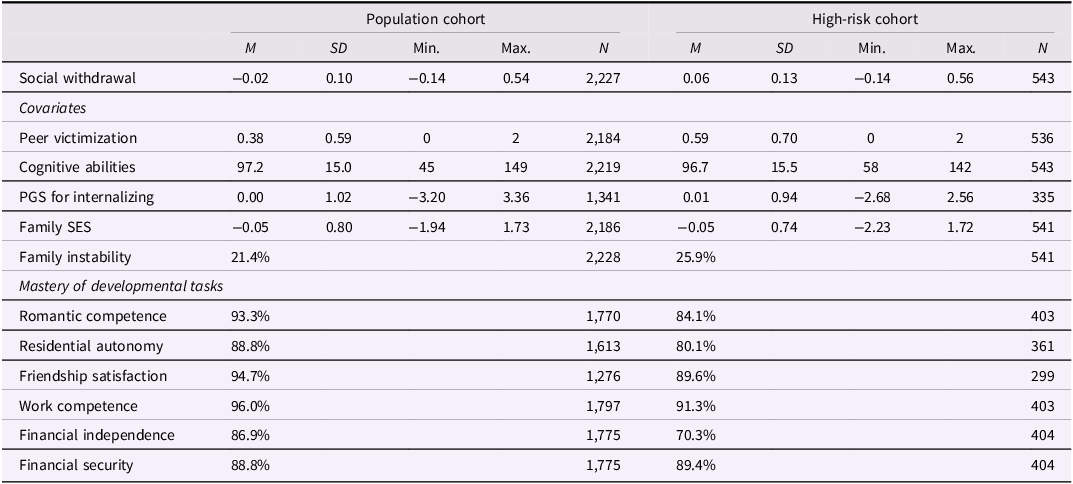
Table 2 presents descriptive statistics for mastery of developmental tasks, social withdrawal, and the covariates. Only a small percentage of young adults had never been in a stable romantic relationship (6.7% of the population cohort and 15.9% of the high-risk cohort). Similarly, only relatively few did not live independently (11.2% and 19.9%), were unsatisfied with friendships (5.3% and 10.4%), had little employment experience (4.0% and 8.7%), received social welfare (13.1% and 29.9%), and reported financial difficulties (11.2% and 10.6%). The high-risk cohort lagged behind on all developmental outcomes except financial security.
Descriptive statistics for social withdrawal, covariates, and mastery of developmental tasks
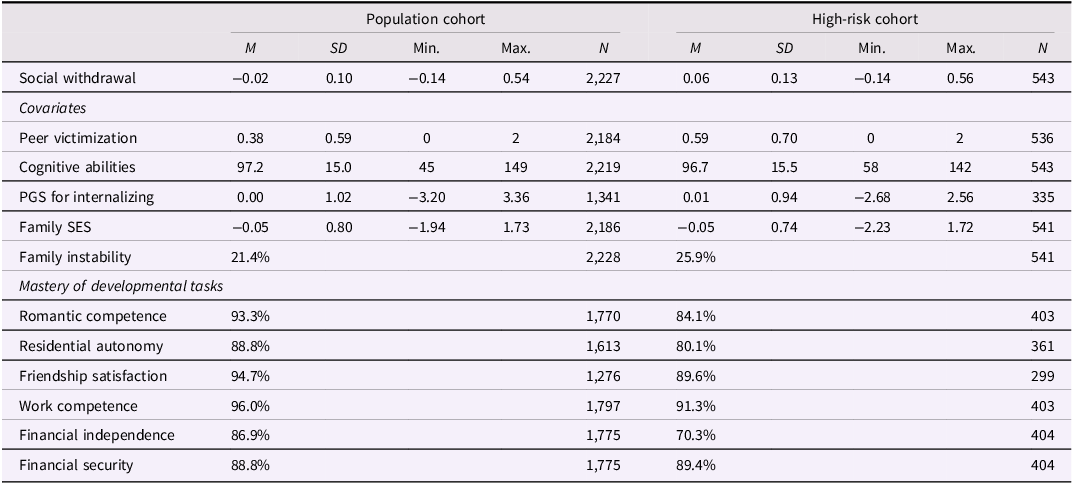
Table 2. Long description
The table compares social withdrawal, covariates, and mastery of developmental tasks between population and high-risk cohorts. It has 13 rows and 10 columns. The columns are labeled as follows: Social withdrawal, Peer victimization, Cognitive abilities, PGS for internalizing, Family SES, Family instability, Romantic competence, Residential autonomy, Friendship satisfaction, Work competence, Financial independence, and Financial security. Each row provides data for both cohorts, including mean, standard deviation, minimum, maximum, and sample size. The table shows that the high-risk cohort generally lags behind the population cohort in all developmental outcomes except financial security.
Participants in the high-risk cohort were more socially withdrawn (t (690.8) = 12.56, p < .001), and more often victimized (t (731.9) = −6.40, p < .001) than those in the population cohort. They also experienced higher levels of family instability (χ 2(1;2769) = 5.13, p = .024). However, no differences were found in cognitive abilities (t (2760) = −0.65, p = .52), socioeconomic status (t (2725) = −0.08, p = .93), or polygenic risk for internalizing problems (t (1674) = 0.17, p = .86).
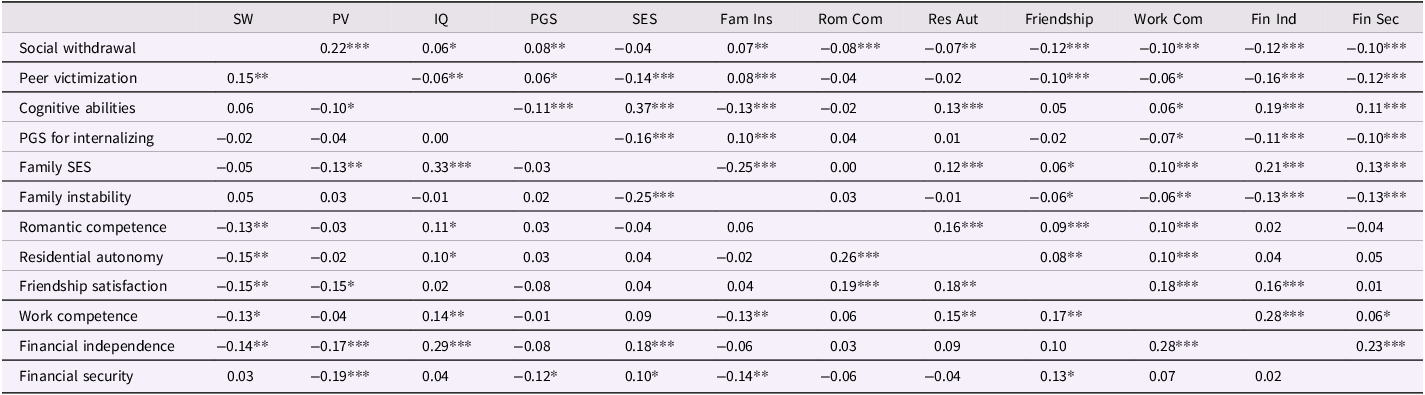
Table 3 shows the correlations between social withdrawal, covariates, and mastery of developmental tasks in both cohorts. Social withdrawal is negatively associated with all developmental tasks in the population cohort and five of the six tasks in the high-risk cohort. In the population cohort, but not the high-risk cohort, the polygenic score for internalizing problems correlates positively with social withdrawal, peer victimization, and family instability and negatively with cognitive abilities, family socioeconomic status, and mastery of four developmental tasks.
Correlations between social withdrawal, covariates, and mastery of developmental tasks in the population cohort (above the diagonal) and high-risk cohort (below the diagonal)
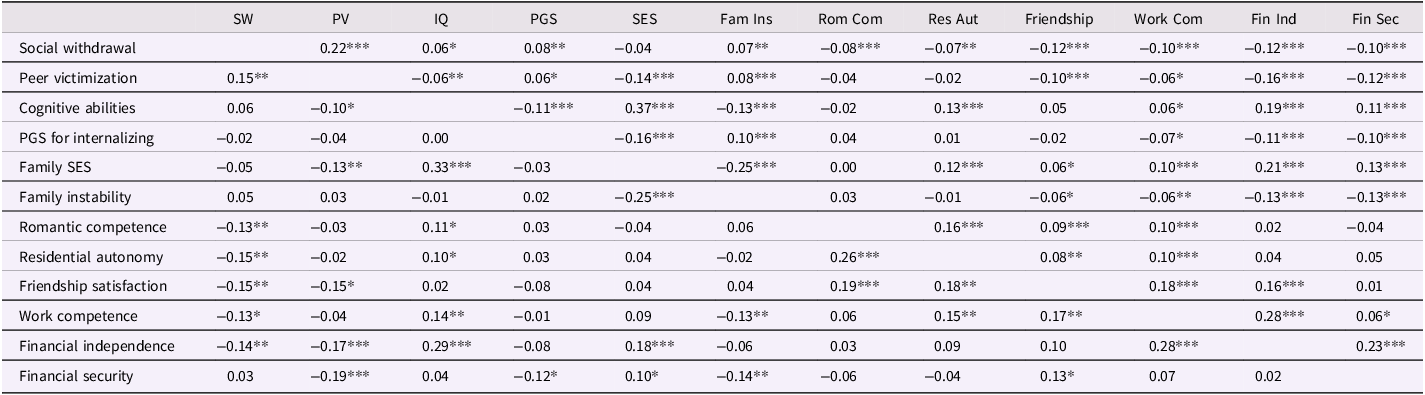
Table 3. Long description
A table with 12 rows and 13 columns showing correlations between social withdrawal, covariates, and mastery of developmental tasks in the population cohort and high-risk cohort. The columns are labeled SW, PV, IQ, PGS, SES, Fam Ins, Rom Com, Res Aut, Friendship, Work Com, Fin Ind, and Fin Sec. The rows are labeled with the same variables. Each cell contains a correlation value indicating the relationship between the variables in the population cohort (above the diagonal) and the high-risk cohort (below the diagonal). Notable trends include negative correlations between social withdrawal and all developmental tasks in the population cohort and five of the six tasks in the high-risk cohort. The polygenic score for internalizing problems correlates positively with social withdrawal, peer victimization, and family instability and negatively with cognitive abilities, family socioeconomic status, and mastery of four developmental tasks in the population cohort but not in the high-risk cohort.
Note. Pairwise correlations among the five continuous variables, along with point-biserial correlations involving the remaining variables.
*** p < .001; ** p < .01; * p < .05.
Logistic regressions on mastery of developmental tasks
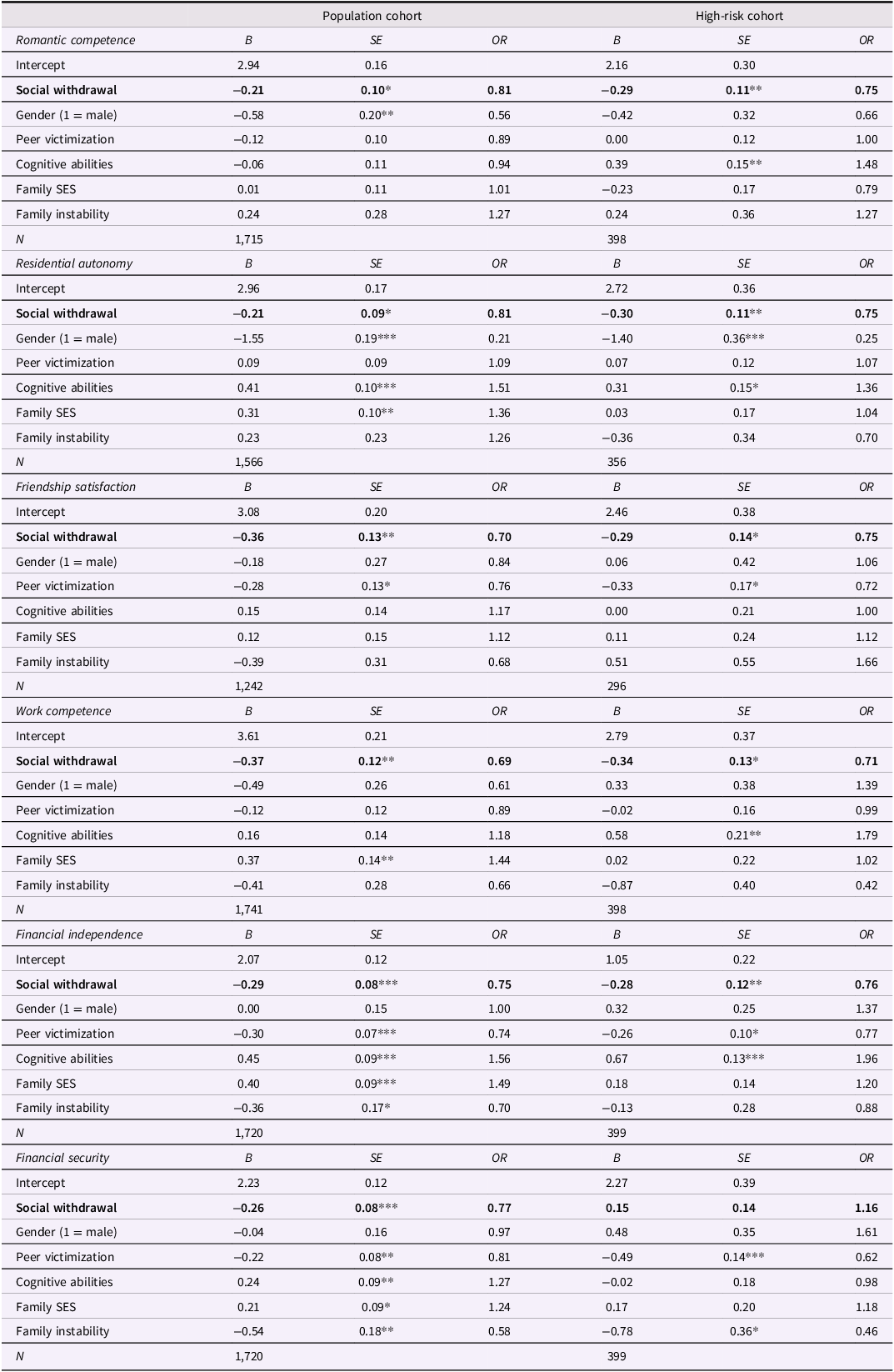
Table 4 shows that, as hypothesized, social withdrawal is consistently linked to lower mastery of developmental tasks across both cohorts, except for financial security in the high-risk cohort. Individuals who were more withdrawn were less likely to have a stable romantic relationship (OR = 0.81 in the population and 0.75 in the high-risk cohort) or to live independently by age 29 (OR = 0.81 and 0.75, respectively). They were also less likely to be satisfied with their friendships (OR = 0.70 and 0.75), reflecting lower friendship satisfaction. Similar patterns emerged in work outcomes: lower odds of stable employment (OR = 0.69 and 0.71) and a higher likelihood of receiving social welfare (OR = 0.75 and 0.76). In the population cohort, social withdrawal was also associated with lower financial security (OR = 0.77).
Logistic regressions on mastery of developmental tasks
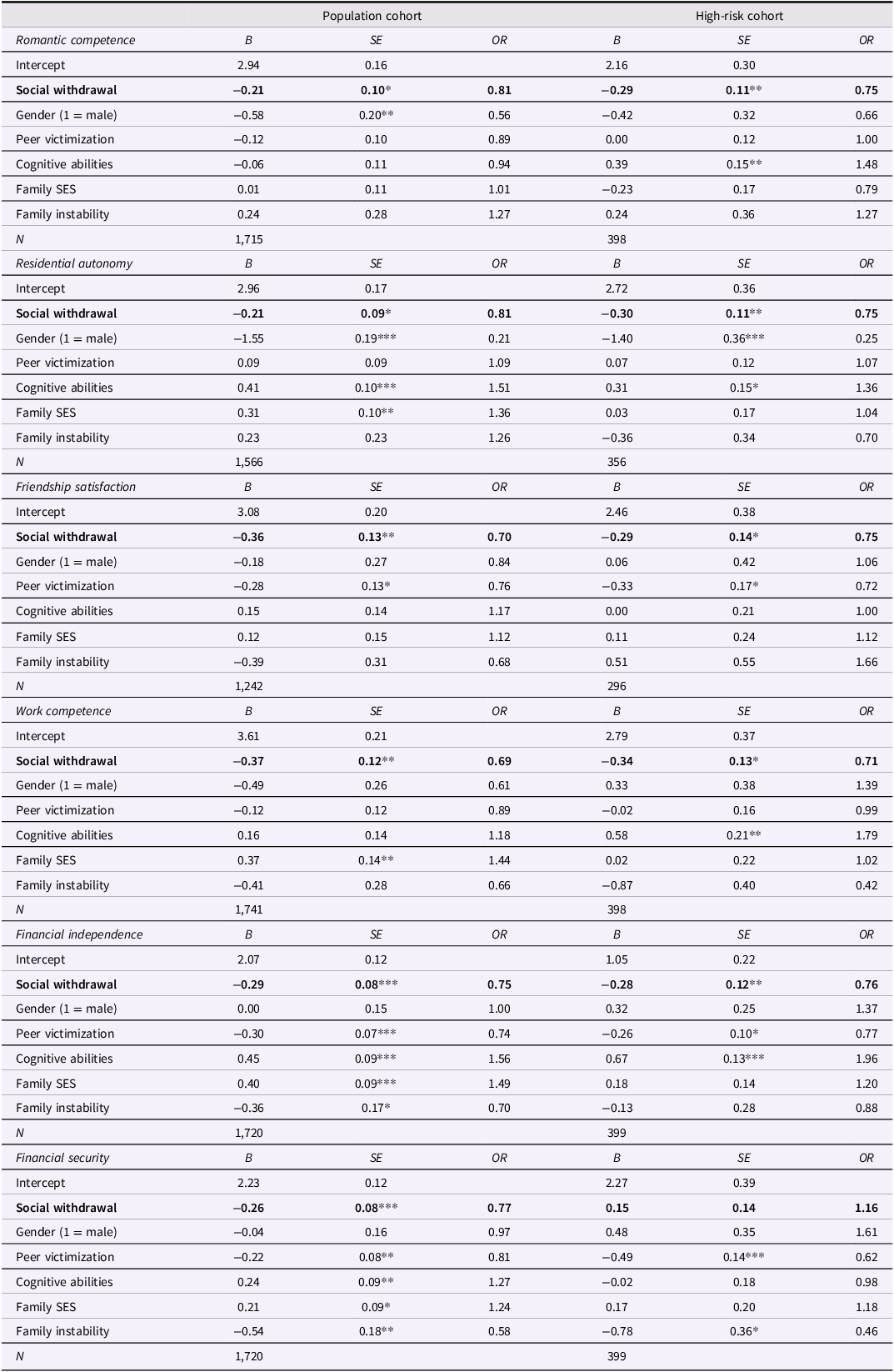
Table 4. Long description
The table presents logistic regression analyses on the mastery of developmental tasks, comparing a population cohort and a high-risk cohort. It includes data on romantic competence, residential autonomy, friendship satisfaction, work competence, financial independence, and financial security. The table has 6 rows and 18 columns. Column headers include Romantic competence, Residential autonomy, Friendship satisfaction, Work competence, Financial independence, and Financial security. Each section is divided into Population cohort and High-risk cohort, with sub-columns for B, SE, and OR. Row labels include Intercept, Social withdrawal, Gender, Peer victimization, Cognitive abilities, Family SES, and Family instability. Notable trends include consistent negative associations between social withdrawal and various developmental tasks across both cohorts, with some variations in specific outcomes.
Note. *** p < .001; ** p < .01; * p < .05.
As expected, higher cognitive abilities were associated with better developmental outcomes. In the high-risk cohort, these abilities increased the likelihood of having had a stable romantic relationship (OR = 1.48). These abilities were also associated with a greater likelihood of living independently in both cohorts (OR = 1.51 and 1.36), as well as higher work competence in the high-risk cohort (OR = 1.79). Higher cognitive abilities were also positively associated with the likelihood of financial independence (OR = 1.56 and 1.96) as well as financial security in the population cohort (OR = 1.27).
The relation between peer victimization and developmental task mastery was weaker than expected. It was only associated with a lower likelihood of achieving friendship satisfaction (OR = 0.76 and 0.72), financial independence (OR = 0.74 and 0.77) and financial security (OR = 0.81 and 0.62).
As hypothesized, higher family socioeconomic status was associated with more favorable outcomes, though only in the population cohort. It was associated with a higher likelihood of living independently (OR = 1.36), higher work competence (OR = 1.44), greater financial independence (OR = 1.49) and a higher likelihood of financial security (OR = 1.24). Family instability showed the opposite pattern. Family instability was negatively associated with financial independence in the population cohort (OR = 0.70) and with financial security in both cohorts (OR = 0.58 and 0.46).
Moderation analyses
First, we tested whether the effects reported in Table 4 were consistent across the population and high-risk cohorts. We found two moderation effects. The association between cognitive abilities and romantic competence differed significantly between the high-risk and population cohorts (difference = 0.45, SE = 0.18, p = .013). Likewise, the association between social withdrawal and financial security differed significantly between the high-risk and population cohorts (difference = −0.41, SE = 0.16, p = .010). However, after correcting for multiple testing using the Benjamini–Hochberg procedure (Benjamini & Hochberg, Reference Benjamini and Hochberg1995), neither moderation effect remained significant, as both p-values exceeded the critical adjusted p-value of .008.
Second, we examined whether the associations between social withdrawal and the completion of developmental tasks differed by gender. None of the associations differed significantly between girls and boys, either in the population cohort (the range of the p-values: from .12 to .98; median p-value: .28) or high-risk cohort (the range of the p-values: from .31 to .77; median p-value: .35).
Sensitivity analyses
Appendix 2 presents analyses that control for genetic confounding. Approximately 30% of participants were excluded because they did not provide genetic material. The polygenic score predicted only financial independence (OR = 0.81) and financial security (OR = 0.79). Apart from these associations, most results in Appendix 2 are similar to those in Table 4. After controlling for genetic confounding, social withdrawal was no longer associated with financial security in the population cohort and with friendship satisfaction in the high-risk cohort. Further analysis revealed that the decrease in significance was due to the smaller sample size rather than genetic control.
Appendix 3 presents analyses restricted to participants without a diagnosis of social anxiety disorder, major depressive disorder, or autism. Most odds ratios for the association between social withdrawal and mastery of developmental tasks remained significant and were stronger than those reported in Table 4. For instance, the association with work competence increased in magnitude, with the odds ratio changing from 0.69 in Table 4 to 0.53 in Appendix 3. Although the association with friendship satisfaction also became stronger, it was no longer statistically significant, likely due to reduced statistical power. Financial independence was the only outcome for which the association weakened, and it likewise lost statistical significance.
Overall, the additional analyses support the robustness of the findings. They suggest that social withdrawal during adolescence is associated with a reduced ability to complete developmental tasks by age 29, both in the general population and in high-risk cohorts. This holds true even when restricting the analyses to participants without relevant psychiatric diagnoses or when accounting for genetic confounding.
Discussion
This study provides robust evidence that socially withdrawn children and adolescents face enduring difficulties in mastering adult developmental tasks by revealing a substantial and consistent association between social withdrawal and the failure to master critical developmental tasks by age 29. These include forming stable romantic relationships, achieving residential autonomy, being satisfied with friendships, gaining work experience, and attaining financial independence and security. There were no differences in the associations by gender or childhood referral to specialized mental health services. The associations were stronger and more consistent than those observed in earlier TRAILS studies on bullying involvement and mastery of developmental tasks earlier in adulthood (Kretschmer et al., Reference Kretschmer, Veenstra, Branje, Reijneveld, Meeus, Deković, Koot, Vollebergh and Oldehinkel2018). This suggests that social withdrawal is more internalized and stable, whereas peer victimization seems to be more transient. In line, a recent study found that a friend’s acceptance can open social opportunities for excluded children, but it does not reduce social withdrawal (Commisso & Bukowski, Reference Commisso and Bukowski2026). These findings suggest that social withdrawal may indicate more than just current social difficulties. If it persists, it may limit opportunities to develop skills important for functioning as an adult. The broad associations across relational, residential, occupational, and financial domains imply that the consequences of social withdrawal extend beyond social relationships and affect the accumulation of experiences and competencies necessary for successful transitions into adulthood.
The associations remained robust after accounting for experiences of victimization, cognitive abilities, family socioeconomic status, family instability, and a polygenic score for internalizing problems. They also persisted in additional analyses restricted to population cohort participants without autism, major depressive disorder, or social anxiety disorder. Although genetic risk for internalizing problems was correlated with some of the outcomes of this study, it did not function as a confounder in the association between earlier social withdrawal and these outcomes. Our findings align with a meta-analysis (Gazelle et al., Reference Gazelle, Shafer Lundin, Lei, Cao and Litchfield2024) showing that social withdrawal is associated with delays in achieving adult developmental milestones related to societal participation, including education, work, and family life. This convergence of evidence underscores the pervasive impact of social withdrawal across various life domains.
One possible interpretation is that withdrawal initiates or contributes to a cumulative process of developmental opportunity loss. Children who engage less with peers have fewer opportunities to practice initiating interactions, negotiating conflicts, maintaining friendships, reading social cues, and adapting to unfamiliar social settings (Laursen & Veenstra, Reference Laursen and Veenstra2021, Reference Laursen and Veenstra2023). These missed opportunities may become increasingly consequential as developmental demands expand from childhood peer interactions to romantic relationships, independent living, employment, and financial management. Therefore, a small deficit in social engagement at one developmental stage may have consequences at later stages because each stage partly builds on competencies and experiences acquired earlier (Gazelle et al., Reference Gazelle, Shafer Lundin, Lei, Cao and Litchfield2024). In line with this interpretation, recent longitudinal evidence suggests that developmental assets, such as social competencies and supportive relationships, contribute to functioning in young adulthood (Morneau‐Vaillancourt et al., Reference Morneau-Vaillancourt, Thibault, Bilodeau- Houle, Comtois-Cabana, Boivin, Côté, Geoffroy, Landry and Ouellet- Morin2026). Furthermore, the timing of these assets across adolescence may be important. This perspective may also help explain why associations with adult functioning can persist even when the original social context has changed. It may not be that socially withdrawn adults are less comfortable with solitude; rather, earlier withdrawal may have altered the accumulation of social experiences and opportunities that support later transitions. Because our measure captures various forms and motivations of withdrawal, this interpretation may be more applicable to situations where withdrawal restricts social participation than to a voluntary preference for solitude.
We also examined other antecedents of the mastery of developmental tasks. Family instability was associated with poorer financial independence and security, whereas family socioeconomic status was associated with residential autonomy, work competence, and financial independence, though only within the population cohort. Family socioeconomic status may have limited influence once children have already received help by specialized mental health services. Higher childhood cognitive abilities were associated with greater mastery of several developmental tasks, including residential autonomy and financial independence. In the high-risk cohort, cognitive abilities were also positively linked to romantic and work competence. Peer victimization predicted financial insecurity and receiving welfare payments. These findings were in the predicted direction, and the strength of the associations between childhood predictors and mastery of developmental tasks nearly two decades later is striking. The pattern suggests that social withdrawal should be viewed as more than a risk factor for later interpersonal difficulties. Cognitive abilities, socioeconomic conditions, family stability, and peer experiences showed domain-specific associations with adult functioning. In contrast, social withdrawal was associated with multiple domains.
Strengths, limitations, and avenues for further research
Our study has several strengths. It draws on a cohort followed for more than two decades, with both self-reported and parent-reported measures of social withdrawal and later mastery of developmental tasks. We applied a stringent definition of mastery. Individuals who had not achieved these milestones by age 29 were considered to deviate from normative developmental trajectories (Twenge & Park, Reference Twenge and Park2019). In the population cohort, prevalence rates for such deviance ranged from 4 to 13 percent, consistent with prior research on social withdrawal that has focused on relatively rare outcomes such as psychiatric diagnoses. Despite the low prevalence of these outcomes, we still observed statistically significant differences in social withdrawal between those who had mastered these tasks and those who had not. Finally, we assessed the robustness of our findings by applying the same model to two cohorts: a population and a high-risk cohort.
However, several limitations should be noted as well. First, although the retention rate was high, the characteristics of participants lost to follow-up differed from those of retained participants. Consequently, our findings can only be generalized to somewhat advantaged participants. Although the excluded group did not differ in social withdrawal, it contained more participants with lower cognitive abilities, lower socioeconomic status, and less family stability. This probably weakened the associations detected in our analyses and limits the generalizability of our findings.
Second, prior theoretical frameworks and empirical studies conceptualize developmental tasks more broadly than the domains in the available data set, including, for instance, community service, political interest, electoral participation, and political voice (Wray-Lake et al., Reference Wray-Lake, Arruda and Schulenberg2020), civic responsibility as an aspect of work competence (Hutteman et al., Reference Hutteman, Hennecke, Orth, Reitz and Specht2014), emotional independence from parents, compliance with societal norms (Barry et al., Reference Barry, Madsen, Nelson, Carroll and Badger2009), and responsibility for one’s own health (Viner et al., Reference Viner, Ozer, Denny, Marmot, Resnick, Fatusi and Currie2012). Future research may examine whether socially withdrawn individuals are less likely to master these aspects of development.
Third, our measure of social withdrawal is relatively unspecific. That is, social withdrawal was assessed using a broad-band questionnaire completed by both adolescents and their parents. This assessment includes items that suggest various motivations for social withdrawal, such as unsociability and anxiety, as well as items that are not typically part of the definition of social withdrawal, such as being secretive.
Fourth, because peers are considered the most reliable sources of information for assessing social withdrawal (Spangler & Gazelle, Reference Spangler and Gazelle2009), relying solely on self-reports and parent reports is a limitation. Self-reports are subject to biases, and parents typically lack direct access to the contexts in which social withdrawal occurs (e.g., school). Therefore, future research should try to include peer reports of withdrawal.
Finally, the study was conducted in the Netherlands, and most of the participants were ethnically Dutch adolescents. Cross-cultural research is necessary to determine the broader applicability of these findings.
This study also suggests directions for future research. An important next step is to examine the psychological and social mechanisms by which social withdrawal impedes the mastery of developmental tasks. The meta-analysis (Gazelle et al., Reference Gazelle, Shafer Lundin, Lei, Cao and Litchfield2024) emphasizes the importance of investigating mediating pathways. Specifically, poor friendships, social isolation, and dissatisfaction may mediate the link between social withdrawal and subsequent adjustment (Barzeva et al., Reference Barzeva, Richards, Veenstra, Meeus and Oldehinkel2022). Over time, social withdrawal may reduce self-efficacy and social support, limit opportunities to practice social roles, and contribute to poorer relationships, peer difficulties, and stressful life events.
The meta-analysis (Gazelle et al., Reference Gazelle, Shafer Lundin, Lei, Cao and Litchfield2024) also suggests the existence of developmental cascades. Early social withdrawal can lead to delays in educational or occupational transitions, which can exacerbate psychosocial difficulties throughout one’s life. For example, lacking paid employment may increase the risk of financial hardship and welfare dependence, making independent living and stable romantic relationships more difficult (Case & Deaton, Reference Case and Deaton2020). Therefore, future research could examine the long-term consequences of delayed milestones associated with social withdrawal. An open question is whether individuals gradually catch up in adulthood or delays in domains such as romantic relationships, work experience, and financial independence persist into later adulthood. Researchers may also examine why some individuals overcome social withdrawal whereas others do not, and investigate whether mentorship or therapeutic support helps build confidence and social competence. Those who remain withdrawn may lack these opportunities or face disadvantages that reinforce isolation over time, such as persistent social exclusion or economic hardship.
Future research should examine whether interventions can improve peer interactions and relationship experiences of socially withdrawn adolescents. Existing intervention studies indicate that targeted support can substantially benefit these youth (Rubin et al., Reference Rubin, Coplan and Bowker2009). Social withdrawal may limit access to social capital and informal learning opportunities, which are necessary for taking on adult roles, such as living independently, finding a job, and being in a romantic relationship. Longitudinal trials are needed to evaluate the effectiveness of interventions such as seating arrangements (Van den Berg et al., Reference Van den Berg, Segers and Cillessen2012) and Sources of Strength (Wyman et al., Reference Wyman, Brown, LoMurray, Schmeelk-Cone, Petrova, Yu, Walsh, Tu and Wang2010) in targeting social withdrawal and improving peer relationships during adolescence (Veenstra, Reference Veenstra2026). Such interventions could have lasting positive effects on adult outcomes, such as friendship satisfaction and financial independence.
Conclusion
Social withdrawal during late childhood and adolescence is not merely a transient phase, but rather a risk factor with long-term developmental consequences. We found that higher levels of social withdrawal predicted lower mastery of several key developmental tasks by age 29, including forming stable romantic relationships, achieving residential autonomy, being satisfied with friendships, gaining work experience, and attaining financial independence and security. These associations were similar for both boys and girls, as well as for participants in the population and the high-risk cohort. A central strength of our findings is the long timespan between exposure and outcomes. Social withdrawal measured in youth predicted adult functioning 15 years later, even when controlling for cognitive abilities, family socioeconomic background, family instability, victimization, and genetic liability to internalizing problems. The findings highlight social withdrawal as an important risk factor and the potential value of early intervention to prevent long-term maladjustment.
Supplementary material
The supplementary material for this article can be found at https://doi.org/10.1017/S0954579426102004.
Data availability statement
The data set analyzed in this study is subject to the European Union’s General Data Protection Regulation and can be requested by means of a publication plan. More information can be found on the study website: https://www.trails.nl/en/hoofdmenu/data/data-use.
Funding statement
This research is part of the TRacking Adolescents’ Individual Lives Survey. TRAILS Participating centers include the University Medical Center and University of Groningen, the University of Utrecht, and the Parnassia Psychiatric Institute, all in the Netherlands. TRAILS has received financial support from various grants from the Netherlands Organization for Scientific Research NWO (Medical Research Council program grant GB-MW 940-38-011; ZonMW Brainpower grant 100-001-004; ZonMw Risk Behavior and Dependence grants 60-60600-97-118; ZonMw Culture and Health grant 261-98-710; Social Sciences Council medium-sized investment grants GB-MaGW 480-01-006 and GB-MaGW 480-07-001; Social Sciences Council project grants GB-MaGW 452-04-314 and GB-MaGW 452-06-004; ZonMw Longitudinal Cohort Research on Early Detection and Treatment in Mental Health Care grant 636340002; NWO large-sized investment grant 175.010.2003.005; NWO Longitudinal Survey and Panel Funding 481-08-013 and 481-11-001; NWO Vici 016.130.002, 453-16-007/2735; NWO Gravitation 024.001.003), the Dutch Ministry of Justice (WODC), the European Science Foundation (EuroSTRESS project FP-006), the European Research Council (ERC-2017-STG-757364 and ERC-CoG-2015-681466), Biobanking and Biomolecular Resources Research Infrastructure BBMRI-NL (CP 32), the Gratama Foundation, the Jan Dekker Foundation, the participating universities, and the Accare Center for Child and Adolescent Psychiatry. TK gratefully acknowledges the generous funding provided through a European Research Council Consolidator Grant, which was awarded under the Horizon Europe program (grant agreement no. 101087395). We are grateful to everyone who participated in this research or worked on this project. Open access funding provided by University of Groningen
Competing interests
None of the authors have conflicts of interest to report.
Ethical standards
This study was approved by the Dutch Central Committee on Research Involving Human Subjects (CCMO). Informed written consent was obtained from adolescents and their parents.
Pre-registration statement
This study involved a secondary data analysis of TRAILS data, and it was not pre-registered.
AI statement
Spelling and grammar checks were carried out using DeepL. Le Chat assisted with analyses in R.


 Open access

