



1 Introduction and main results
X. Jiang and H. Su [Reference Jiang and Su31] constructed a unital separable simple infinite dimensional nuclear C*-algebra
 $\mathcal {Z}$
with the same K-theoretic invariant as that of
 $\mathbb C$
. The Jiang-Su algebra, which is the stably finite analog of the Cuntz algebra
 ${\mathcal {O_{\infty }}}$
, has played a central role in the Elliott classification program for nuclear C*-algebras. A unital C*-algebra A is
 $\mathcal {Z}$
-absorbing if
 $A \cong A \otimes \mathcal {Z}$
. Certain
 $\mathcal {Z}$
-absorbing C*-algebras are classified by their ordered K-groups [Reference Lin and Niu39, Reference Winter54], and all classes of unital simple nuclear C*-algebras for which the Elliott conjecture is confirmed are already
 $\mathcal {Z}$
-absorbing. It was conjectured that the properties of strict comparison, finite nuclear dimension and
 $\mathcal {Z}$
-absorption are equivalent for unital separable simple infinite-dimensional nuclear C*-algebras (Toms-Winter conjecture) [Reference Toms and Winter52]. It is now known that the last two conditions are equivalent [Reference Castillejos and Evington11], [Reference Castillejos, Evington, Tikuisis, White and Winter12], [Reference Tikuisis51], [Reference Winter53] (building upon [Reference Matui and Sato40]). We also know that
 $\mathcal {Z}$
-absorption implies strict comparison for unital simple exact C*-algebras [Reference Rørdam50] and that for a unital separable simple infinite-dimensional nuclear C*-algebra with finitely many extremal traces, strict comparison is equivalent to
 $\mathcal {Z}$
-absorption [Reference Matui and Sato40]. Finally, we know that when there is at least one trace on a unital separable simple infinite-dimensional nuclear C*-algebra, then
 $\mathcal {Z}$
-absorption is equivalent to strict comparison plus the uniform
 $\Gamma $
-property [Reference Castillejos, Evington, Tikuisis, White and Uniform13].
Hirshberg and Orovitz introduced the notion of tracial
 $\mathcal {Z}$
-absorption for unital C*-algebras [Reference Hirshberg and Orovitz28]. (See Definition 3.1 below.) They show in [Reference Hirshberg and Orovitz28, Proposition 2.2 and Theorem 4.1] that for simple unital separable nuclear C*-algebras,
 $\mathcal {Z}$
-absorption is equivalent to tracial
 $\mathcal {Z}$
-absorption. The main result of [Reference Castillejos, Li and Szabó14] states this equivalence in the nonunital case. The main advantage of tracial
 $\mathcal {Z}$
-absorption is that it is easier to check in certain cases, particularly for crossed products. (See, for example, [Reference Kerr32].) This is due to the fact that tracial
 $\mathcal {Z}$
-absorption is defined via a local property.
The aim of this paper is twofold. First, there has recently been considerable interest in the classification and structure of nonunital simple C*-algebras [Reference Gong and Lin25, Reference Gong and Lin26, Reference Gong and Lin27]. Nonunital tracial
 $\mathcal {Z}$
-absorption may be useful in applying the results of the classification of nonunital C*-algebras (or, rather, stably projectionless C*-algebras) – in particular, the classification of crossed products of simple nonunital C*-algebras by actions with Rokhlin type properties. This requires, however, further progress in the recently started classification project for simple nonunital C*-algebras. (See, for example, [Reference Elliott, Gong, Lin and Niu18].) Second, tracial
 $\mathcal {Z}$
-absorption can substitute for
 $\mathcal {Z}$
-absorption when attempting to prove various regularity properties for simple C*-algebras, but holds more generally and is easier to verify. There are therefore motivations to study tracial
 $\mathcal {Z}$
-absorption in its own right.
In this paper, we extend the notion of tracial
 $\mathcal {Z}$
-absorption to the simple nonunital case and study it systematically.
Definition A. We say that a simple C*-algebra A is tracially
 $\mathcal {Z}$
-absorbing if
 $A \ncong \mathbb {C}$
, and for every
 $x, a \in A_{+}$
with
 $a \neq 0$
, every finite set
 $F \subseteq A$
, every
 $\varepsilon> 0$
and every
 $n \in \mathbb {N}$
, there is a c.p.c. order zero map
 $\varphi \colon M_{n} \to A$
such that
-
(1)
 $\big ( x^{2} - x \varphi (1) x - \varepsilon \big )_{+} \precsim a$
.
-
(2)
$\| [\varphi (z), b] \| < \varepsilon $
for any
$z \in M_{n}$
with
$\| z \| \leq 1$
and any
$b \in F$
.



Part (1) contains our main idea of ‘nonunital tracial smallness’. If A is unital, then we can take
 $x=1$
, and it turns out that this definition extends the definition of the unital case ([Reference Hirshberg and Orovitz28, Definition 2.1]); see Remark 3.7. This definition motivated the second named author and Forough to introduce a suitable notion of weak tracial Rokhlin property for finite group actions on simple nonunital C*-algebras. See Definition 1.1 of [Reference Forough and Golestani21] and the discussion after that. Also, see [Reference Forough and Golestani20, Definition 6.6], [Reference Jamali30] and [Reference Fu, Li and Lin22, Definition 4.4] in which Definition A is quoted from the unpublished version of the current paper, showing that this idea of nonunital tracial smallness has been motivating. This definition also appeared recently in [Reference Castillejos, Li and Szabó14] which has minor overlap in results with ours.
We prove in Section 7 that if A is finite, then one can add the following condition to Definition A:
-
(3)
$\| \varphi (1) a \varphi (1) \|> 1 - \varepsilon $
.

This is parallel to the definition of the weak tracial Rokhlin property for finite group actions [Reference Gardella and Hirshberg24, Reference Forough and Golestani21] and is needed for the proof of a result in [Reference Amini, Golestani, Jamali and Phillips1] that the permutation action on the minimal tensor product of finitely many copies of a tracially
 $\mathcal {Z}$
-absorbing C*-algebra has the weak tracial Rokhlin property, provided that the tensor product is finite.
Different characterizations of Definition A and its permanence properties are given in Sections 3 and 4. In particular, it is preserved under inductive limits and stable isomorphism, and passes to hereditary subalgebras.
The class of simple tracially
 $\mathcal {Z}$
-absorbing C*-algebras is large.
Theorem B. The following classes of C*-algebras are tracially
 $\mathcal {Z}$
-absorbing:
-
(1) simple nonelementary C*-algebras with tracial rank zero;
-
(2) simple purely infinite C*-algebras;
-
(3) simple
$\mathcal {Z}$
-absorbing C*-algebras.

Part (1) implies that many simple stably finite C*-algebras are tracially
 $\mathcal {Z}$
-absorbing. It is proved in Lemma 3.13 (unital case) and Proposition 4.10 (nonunital case). The special case of Part (1) where A is unital and separable follows from [Reference Fu, Li and Lin22, Proposition 6.9 and Theorem 4.11] and [Reference Fu and Lin23, Theorem 5.9] in which the authors use different methods from ours. A similar result by Matui and Sato is that every simple separable unital nuclear infinite-dimensional C*-algebra with tracial rank zero is
 $\mathcal {Z}$
-absorbing [Reference Matui and Sato40, Theorem 5.4]. (The nonunital version of this result follows from Part (1) and [Reference Castillejos, Li and Szabó14, Theorem A].) An example of a simple separable unital nonelementary C*-algebra with tracial rank zero (hence with stable rank one and real rank zero [Reference Lin37, Reference Lin38]) which is not
 $\mathcal {Z}$
-absorbing is constructed in [Reference Niu and Wang41]. It is nonnuclear and exact. As far as we know, this stably finite example and purely infinite examples of Theorem C (below) are the first known tracially
 $\mathcal {Z}$
-absorbing C*-algebras which are not
 $\mathcal {Z}$
-absorbing.
Part (2) follows directly form Definition A and characterizations of pure infiniteness [Reference Kirchberg and Rørdam33, Proposition 5.4] (see Example 3.11). We obtain purely infinite C*-algebras which are not
 $\mathcal {Z}$
-absorbing:
Theorem C. There are simple separable unital purely infinite (hence tracially
 $\mathcal {Z}$
-absorbing) C*-algebras which are not
 $\mathcal {Z}$
-absorbing.
The proof of this result is based on techniques from reduced free products of von Neumann algebras [Reference Dykema and Rørdam17, Reference Barnett10]. See Proposition 5.5 and Example 5.6. As a concrete example, the reduced C*-algebra free product
 $$\begin{align*}(M_2 \otimes M_2) \star_{\mathrm{r}} C ([0, 1]) \end{align*}$$
is simple separable unital purely infinite (hence tracially
 $\mathcal {Z}$
-absorbing) but not
 $\mathcal {Z}$
-absorbing (Example 5.7). By [Reference Hirshberg and Orovitz28, Theorem 4.1], this example is nonnuclear.
We remark that an interesting result of [Reference Fu, Li and Lin22] says that every simple separable tracially approximately divisible C*-algebra is purely infinite or has stable rank one [Reference Fu, Li and Lin22, Corollary 6.5]. Since tracial approximate divisibility is equivalent to tracial
 $\mathcal {Z}$
-absorption for simple separable C*-algebras [Reference Fu, Li and Lin22, Theorem 4.11], we see that every simple separable tracially
 $\mathcal {Z}$
-absorbing C*-algebra is purely infinite or has stable rank one.
Part (3) of Theorem B follows from tracial
 $\mathcal {Z}$
-stability of
 $\mathcal {Z}$
[Reference Hirshberg and Orovitz28, proposition 2.2] and that tracial
 $\mathcal {Z}$
-absorption passes to minimal tensor products (Theorem 5.1). In particular, the Razak-Jacelon algebra
 $\mathcal {W}$
is a stably projectionless C*-algebra which is tracially
 $\mathcal {Z}$
-absorbing.
It is shown in [Reference Hirshberg and Orovitz28, Theorem 3.3] that if A is a simple tracially
 $\mathcal {Z}$
-absorbing C*-algebra, then the Cuntz semigroup
 $W(A)$
is almost unperforated, and hence, A has strict comparison. We extend this to the nonunital case. We define a notion of strict comparison (called weak strict comparison) in a sense suitable for nonunital C*-algebras (Definition 6.8). Purely infinite simple C*-algebras have weak strict comparison, and for simple unital C*-algebras, we show that our definition reduces to strict comparison. The proof of different parts of the following result is given in Section 6. The notion of weak almost divisibility is defined and studied in [Reference Orovitz, Phillips and Wang43].
Theorem D. Let A be a simple tracially
 $\mathcal {Z}$
-absorbing C*-algebra. Then
-
(1)
$W (A)$
is almost unperforated; -
(2) A has weak strict comparison;
-
(3) A is weakly almost divisible.

The structure of this paper is as follows. In Section 2, we recall some facts and prove some results on Cuntz subequivalence. In Section 3, we define the notion of tracial
 $\mathcal {Z}$
-absorption for simple not necessarily unital C*-algebras (Definition 3.6) and investigate its primary properties. In Section 4, we show that tracial
 $\mathcal {Z}$
-absorption passes to hereditary subalgebras, matrix algebras and direct limits, and that it is Morita invariant. In Section 5, we compare tracial
 $\mathcal {Z}$
-absorption with
 $\mathcal {Z}$
-absorption. In Section 6, we study the Cuntz semigroup of tracially
 $\mathcal {Z}$
-absorbing C*-algebras. In Section 7, we verify finite tracially
 $\mathcal {Z}$
-absorbing C*-algebras.
We use the following (standard) notation. For a C*-algebra A,
 $A_{+}$
denotes the positive cone of A. Also,
 $A^{+}$
denotes the unitization of A (adding a new identity even if A is unital), while
 $A^{\sim } = A$
if A is unital and
 $A^{\sim } = A^{+}$
if A is nonunital. The notation
 $a \approx _{\varepsilon } b$
means
 $\|a - b\| < \varepsilon $
. We write
 $\mathcal {K} = K (\ell ^{2})$
and
 ${M}_{n} = M_{n} (\mathbb {C})$
. We take
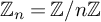 ${\mathbb {Z}}_n = {\mathbb {Z}} / n {\mathbb {Z}}$
. (The p-adic integers will never appear.) We take
 $\mathbb {N} = \{ 1, 2, \ldots \}$
. We abbreviate ‘completely positive contractive’ to ‘c.p.c.’. For any C*-algebra A, we denote its tracial state space by
 $T (A)$
.
2 Preliminaries on Cuntz subequivalence
In this section, we recall some results and provide some lemmas on Cuntz subequivalence needed in the subsequent sections. Some of these are already in the literature. See [Reference Ara, Perera, Toms, Ara, Lledó and Perera2] for an extensive discussion of Cuntz subequvalence.
Let A be a C*-algebra. For
 $a, b \in A_{+}$
, we write
 $a \precsim b$
if a is Cuntz subequivalent to b; that is, there is a sequence
 $(v_n)_{n \in \mathbb {N}}$
in A such that
 $\|a - v_{n} b v_{n}^{*} \| \to 0$
. We write
 $a \sim b$
if both
 $a \precsim b$
and
 $b \precsim a$
. The following lemma will be used in many places.
Lemma 2.1 ([Reference Kirchberg and Rørdam34], Lemma 2.2).
Let A be a C*-algebra, let
 $a, b \in A$
be positive, and let
 $\varepsilon> 0$
. If
 $\|a - b\| < \varepsilon $
, then there is a contraction
 $d \in A$
such that
 $(a - \varepsilon )_{+} = d b d^{*}$
. In particular,
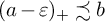 $(a - \varepsilon )_{+} \precsim b$
.
Observe that if
 $a \precsim b$
in A, then, by definition, there is a sequence
 $(v_{n})_{n \in \mathbb {N}}$
in A such that
 $\| a - v_{n} b v_{n}^{*} \| \to 0$
. But it is not the case that there always exists a bounded sequence with this property. However, we have the following lemma. It may be in the literature. We give a proof for the sake of completeness. (There is a similar result in [Reference Kirchberg and Rørdam34, Lemma 2.4(ii)], but we could not verify the proof. Nevertheless, essentially the same argument works here.)
Lemma 2.2. Let A be a C*-algebra, let
 $a, b \in A_{+}$
, and let
 $\delta> 0$
. If
 $a \precsim (b - \delta )_{+}$
, then there exists a sequence
 $(v_{n})_{n \in \mathbb {N}}$
in A such that
 $\|a - v_{n} b v_{n}^{*} \| \to 0$
and
 $\| v_{n} \| \leq \| a \|^{1/2} \delta ^{- 1/2}$
for every
 $n \in \mathbb {N}$
.
Proof. Let
 $n \in \mathbb {N}$
. Since
 $a \precsim (b - \delta )_{+}$
, there exists
 $w_{n} \in A$
such that
 $\big \| a - w_{n} (b - \delta )_{+}w_{n}^{*} \big \| < \frac {1}{n}$
. By Lemma 2.1, there exists
 $d_{n} \in A$
such that
 $$\begin{align*}\big( a - \tfrac{1}{n} \big)_{+} = d_{n} w_{n} (b - \delta)_{+} w_{n}^{*}d_{n}^{*}. \end{align*}$$
By [Reference Kirchberg and Rørdam34, Lemma 2.4(i)], there exists
 $v_{n} \in A$
such that
 $$\begin{align*}\big( a - \tfrac{1}{n} \big)_{+} = v_{n} b v_{n}^{*} \qquad {\mbox{and}} \qquad \| v_{n} \| \leq \| \big( a - \tfrac{1}{n} \big)_{+} \|^{1/2} \delta^{- 1/2}. \end{align*}$$
Now
 $v_{n} b v_{n}^{*} \to a$
and
 $\| v_{n} \| \leq \| a \|^{1/2} \delta ^{- 1/2}$
.
Lemma 2.3. Let A be a C*-algebra, let
 $x \in A$
be nonzero, and let
 $b \in A_{+}$
. Then for any
 $\varepsilon> 0$
,
 $$\begin{align*}( x b x^{*} - \varepsilon)_{+} \precsim x \big( b - \varepsilon / \| x \|^{2} \big)_{+} x^{*} \precsim \big( b - \varepsilon / \| x \|^{2} \big)_{+}. \end{align*}$$
If
 $\| x \| \leq 1$
, then
 $(x b x^{*} - \varepsilon )_{+} \precsim x (b - \varepsilon )_{+} x^{*} \precsim (b - \varepsilon )_{+}$
.
Proof. For the first statement, we have
 $$ \begin{align*} \big\| x b x^{*} - x \big( b - \varepsilon / \| x \|^{2} \big)_{+} x^{*} \big\| & \leq \| x \|^{2} \big\| b - \left( b - \varepsilon / \| x \|^{2} \right)_{+} \big\| \\ & \leq \| x \|^{2} \cdot \left( \frac{\varepsilon}{\| x \|^{2}} \right) = \varepsilon. \end{align*} $$
Let
 $\rho> 0$
. Using [Reference Kirchberg and Rørdam33, Lemma 2.5(i)] at the first step and Lemma 2.1 at the second step, we have
 $$\begin{align*}\big( (x b x^{*} - \varepsilon)_{+} - \rho \big)_{+} = (x b x^{*} - \varepsilon - \rho)_{+} \precsim x \big( b - \varepsilon / \| x \|^{2} \big)_{+} x^{*}. \end{align*}$$
Since
 $\rho> 0$
is arbitrary, it follows from [Reference Kirchberg and Rørdam33, Proposition 2.6] that
 $$\begin{align*}(x b x^{*} - \varepsilon)_{+} \precsim x \big( b - \varepsilon / \| x \|^{2} \big)_{+} x^{*}. \end{align*}$$
Clearly,
 $x \big ( b - \varepsilon / \| x \|^{2} \big )_{+} x^{*} \precsim \big ( b - \varepsilon / \| x \|^{2} \big )_{+}$
.
If
 $\| x \| \leq 1$
, then
 $\varepsilon / \| x \|^{2} \geq \varepsilon $
, and so
 $$\begin{align*}(x b x^{*} - \varepsilon)_{+} \precsim x \big( b - \varepsilon / \| x \|^{2} \big)_{+} x^{*} \leq x (b - \varepsilon)_{+} x^{*} \precsim (b - \varepsilon)_{+}. \end{align*}$$
This completes the proof.
In general, the reverse of the Cuntz subequivalence relation in Lemma 2.3 does not hold. However, a weaker version holds. See Lemma 2.5 below. We need the following proposition in its proof. It should be in the literature. We provide a proof for the sake of completeness.
Proposition 2.4. Let A be a C*-algebra, let
 $K \subseteq \mathbb {C}$
be a compact set, and let
 $f \colon K \to \mathbb {C}$
be a continuous function. Set
 $$\begin{align*}S = \big\{ x \in M (A) \colon {\text{x is normal and} \ {\operatorname{sp}} (x) \subseteq K} \big\}. \end{align*}$$
Then the functional calculus map
 $x \mapsto f (x)$
, from S to
 $M (A)$
, is strictly continuous. Furthermore, if
 $(x_{i})_{i \in I}$
is a norm bounded net in
 $M (A)_{+}$
which converges to
 $x \in M (A)$
strictly, then
 $x \in M (A)_{+}$
and
 $(x_{i} - \varepsilon )_{+} \to (x - \varepsilon )_{+}$
strictly.
Proof. First, note that S is norm bounded, by
 $\sup ( \{ |\lambda | \colon \lambda \in K \} )$
.
Let
 $(x_{i})_{i \in I}$
be a net in S which tends to
 $x \in S$
strictly. We have to show that
 $f (x_{i}) \to f (x)$
strictly. Since
 $(x_{i})_{i \in I}$
is bounded and the product is jointly continuous in the strict topology on bounded subsets of
 $M (A)$
, and since
 $a \mapsto a^*$
is strictly continuous, the statement holds when
 $f (\zeta )$
is a polynomial in
 $\zeta $
and
 ${\overline {\zeta }}$
. Now let
 $y \in A$
. We need to show that
 $f (x_{i}) y \to f (x) y$
and
 $y f (x_{i}) \to y f (x)$
in norm in A. We do only the first; the second is similar. Let
 $\varepsilon> 0$
. Choose
 $\delta> 0$
such that
 $\delta \| y \| < \frac {\varepsilon }{3}$
. There is a polynomial
 $g (\zeta )$
in
 $\zeta $
and
 ${\overline {\zeta }}$
such that
 $\sup _{\zeta \in K} | g (\zeta ) - f (\zeta ) | < \delta $
. Since
 $g (x_{i}) y \to g (x) y$
, there is
 $i_{0} \in I$
such that
 $\|g (x_{i}) y - g (x) y\| < \frac {\varepsilon }{3}$
for any
 $i \in I$
with
 $i \geq i_{0}$
. Thus, for
 $i \geq i_{0}$
, we have
 $$ \begin{align*} & \| f (x_{i}) y - f (x) y \| \\ & \hspace{3em} {\mbox{}} \leq \| f (x_{i}) y - g (x_{i}) y \| + \| g (x_{i}) y - g (x) y \| + \| g (x) y - f (x) y \| \\ & \hspace{3em} {\mbox{}} < \delta \| y \| + \tfrac{\varepsilon}{3} + \delta \| y \| < \varepsilon. \end{align*} $$
So
 $f (x_{i}) \to f (x)$
strictly.
Since
 $M (A)_{+}$
is strictly closed in
 $M (A)$
, the second part of the statement follows from the first.
We will use the following lemma in the proof of Proposition 3.19.
Lemma 2.5. Let A be a
 $\sigma $
-unital C*-algebra, let x be a strictly positive element, let
 $b \in M (A)$
, and let
 $\delta> 0$
. Then for every
 $\varepsilon> 0$
, there is
 $n_{0} \in \mathbb {N}$
such that for any
 $n \geq n_{0}$
, we have
 $$\begin{align*}\big( x (b - \delta)_{+} x - \varepsilon \big)_{+} \precsim x \big( x^{1/n} b x^{1/n} - \delta \big)_{+} x \precsim \big( x^{1/n} b x^{1/n} - \delta \big)_{+}. \end{align*}$$
Proof. Consider
 $A \subseteq M (A)$
and note that
 $x^{1/n} \to 1_{M (A)}$
strictly. So
 $x^{1/n} b x^{1/n} \to b$
strictly. Thus, by Proposition 2.4,
 $(x^{1/n} b x^{1/n} - \delta )_{+} \to (b - \delta )_{+}$
strictly. Hence,
 $x \big ( x^{1/n} b x^{1/n} - \delta \big )_{+} x \to x (b - \delta )_{+} x$
in A, and so there is
 $n_{0} \in \mathbb {N}$
such that for every
 $n \geq n_{0}$
,
 $$\begin{align*}\big\| x \big( x^{1/n} b x^{1/n} - \delta \big)_{+} x - x (b - \delta)_{+} x \big\| < \varepsilon. \end{align*}$$
Therefore, using Lemma 2.1 at the first step, we have
 $$\begin{align*}\big( x (b - \delta)_{+} x - \varepsilon \big)_{+} \precsim x \big( x^{1/n} b x^{1/n} - \delta \big)_{+} x \precsim \big( x^{1/n} b x^{1/n} - \delta \big)_{+}. \end{align*}$$
This completes the proof.
3 Tracial
$\mathcal {Z}$
-absorption

In this section, we define tracial
 $\mathcal {Z}$
-absorption for simple not necessarily unital C*-algebras (Definition 3.6). We show that this definition extends the unital version defined by Hirshberg and Orovitz (see Remark 3.7). As an example, every simple purely infinite C*-algebra is tracially
 $\mathcal {Z}$
-absorbing. In the separable case, we give an equivalent definition for tracial
 $\mathcal {Z}$
-absorption in terms of the central sequence algebra (Proposition 3.15). At the end of this section, we give another version of tracial
 $\mathcal {Z}$
-absorption (called strong tracial
 $\mathcal {Z}$
-absorption; see Definition 3.16), and we compare it with Definition 3.6.
We recall the definition of a unital tracially
 $\mathcal {Z}$
-absorbing C*-algebra.
Definition 3.1 ([Reference Hirshberg and Orovitz28], Definition 2.1).
A unital C*-algebra A is called tracially
 $\mathcal {Z}$
-absorbing if
 $A \ncong \mathbb {C}$
, and for every finite set
 $F \subseteq A$
, every
 $\varepsilon> 0$
, every
 $a \in A_{+} \setminus \{ 0 \}$
, and every
 $n \in \mathbb {N}$
, there is a c.p.c. order zero map
 $\varphi \colon {M}_{n} \to A$
such that the following hold:
-
(1)
$1 - \varphi (1) \precsim a$
. -
(2)
$\| [\varphi (z), b] \| < \varepsilon $
for any
$z \in M_{n}$
with
$\| z \| \leq 1$
and any
$b \in F$
.


Remark 3.2. Although Definition 3.1 makes sense for unital C*-algebras, it works well mainly for unital simple C*-algebras. For example, in [Reference Hirshberg and Orovitz28], the assumption of simplicity appears in almost all of the results. Because of this, in this paper, we define tracial
 $\mathcal {Z}$
-absorption only for (not necessarily unital) simple C*-algebras. However, we will not use the assumption of simplicity in some results (e.g., Theorems 4.1 and 4.7).
We need the following equivalent version of tracial
 $\mathcal {Z}$
-absorption in order to define this notion for nonunital C*-algebras.
Lemma 3.3. Let A be a unital C*-algebra with
 $A \not \cong \mathbb {C}$
. Then A is tracially
 $\mathcal {Z}$
-absorbing if and only if for every finite set
 $F \subseteq A$
, every
 $\varepsilon> 0$
, every
 $a \in A_{+} \setminus \{ 0 \}$
, and every
 $n \in \mathbb {N}$
, there is a c.p.c. order zero map
 $\varphi \colon M_{n} \to A$
such that
-
(1)
$( 1 - \varphi (1) -\varepsilon )_{+} \precsim a$
. -
(2)
$\| [\varphi (z), b]\| < \varepsilon $
for any
$z \in M_{n}$
with
$\| z \| \leq 1$
and any
$b \in F$
.


Proof. The forward implication is obvious because
 $( 1 - \varphi (1) - \varepsilon )_{+} \precsim 1 - \varphi (1)$
.
Now suppose that we are given F,
 $\varepsilon $
, a, and n as in the statement. We have to find a c.p.c. order zero map
 $\psi \colon M_{n} \to A$
such that
-
(3)
$1 - \psi (1) \precsim a$
. -
(4)
$\| [\psi (z), b] \| < \varepsilon $
for any
$z \in M_{n}$
with
$\| z \| \leq 1$
and any
$b \in F$
.


Choose
 $\delta> 0$
such that
 $$\begin{align*}\delta < \frac{\varepsilon}{ 1 + 2 \max \big( \{ \| x \| \colon x \in F \} \big)}. \end{align*}$$
By assumption, there is a c.p.c. order zero map
 $\varphi \colon M_{n} \to A$
such that
 $(1 - \varphi (1) - \delta )_{+} \precsim a$
and
 $\| [\varphi (z), b] \| < \delta $
for any
 $z \in M_{n}$
with
 $\| z \| = 1$
. Define a continuous function
 $f \colon [0, 1] \to [0, 1]$
by
 $$\begin{align*}f (\lambda) = \begin{cases} \frac{\lambda}{1 - \delta} & \hspace{1em} 0 \leq \lambda \leq 1 - \delta \\ 1 & \hspace{1em} 1 - \delta < \lambda \leq 1. \end{cases} \end{align*}$$
Using functional calculus for c.p.c. order zero maps ([Reference Winter and Zacharias55, Corollary 4.2]), set
 $\psi = f (\varphi )$
. Thus,
 $\psi \colon M_{n} \to A$
is a c.p.c. order zero map, and, similar to the proof of [Reference Archey, Buck and Phillips3, Lemma 2.8], we have
 $$ \begin{align} \| \varphi (z) - \psi (z) \| \leq \delta \| z \| \end{align} $$
for any
 $z \in M_{n}$
with
 $\| z \| \leq 1$
, and
 $$ \begin{align} 1 - \psi (1) = \tfrac{1}{1 - \delta} (1 - \varphi (1) - \delta)_{+} \sim (1 - \varphi (1) - \delta)_{+} \precsim a. \end{align} $$
By (3.2), we get (3). To prove (4), let
 $z \in M_{n}$
with
 $\| z \| \leq 1$
and let
 $x \in F$
. By (3.1), we get
 $$ \begin{align*} & \|\psi (z) x - x \psi (z) \| \\ & \hspace{3em} {\mbox{}} \leq \| \psi (z) x - \varphi (z) x \| + \|\varphi (z) x - x \varphi (z) \| + \| x \varphi (z)- x \psi (z) \| \\ & \hspace{3em} {\mbox{}} \leq \delta \| x \| + \delta + \delta \| x \| = \delta (1 + 2 \| x \|) < \varepsilon. \end{align*} $$
This completes the proof.
One may also work with
 $\varepsilon $
-order zero maps to check tracial
 $\mathcal {Z}$
-absorption. Recall that a c.p.c. map
 $\varphi \colon M_{n} \to A$
is
 $\varepsilon $
-order zero if whenever
 $y, z \in M_{n}$
are orthogonal positive elements of norm at most
 $1$
, then
 $\| \varphi (y) \varphi (z) \| < \varepsilon $
.
Proposition 3.4. Let A be a unital C*-algebra with
 $A \not \cong \mathbb {C}$
. Then A is tracially
 $\mathcal {Z}$
-absorbing if and only if for any finite set
 $F \subseteq A$
,
 $\varepsilon> 0$
,
 $a \in A_{+} \setminus \{ 0 \}$
, and
 $n \in \mathbb {N}$
, there is a c.p.c.
 $\varepsilon $
-order zero map
 $\varphi \colon M_{n} \to A$
such that
-
(1)
$(1- \varphi (1) -\varepsilon )_{+} \precsim a$
. -
(2)
$\| [\varphi (z), b] \| < \varepsilon $
for any
$z \in M_{n}$
with
$\| z \| \leq 1$
and any
$b \in F$
.


Proof. The forward implication is obvious. To prove the converse, we use Lemma 3.3. Let
 $ \varepsilon> 0$
, a finite set
 $ F $
,
 $ n \in \mathbb {N} $
, and
 $ a \in A_{+}\setminus \{0\}$
be given. We choose
 $ 0 < \varepsilon _{0} < \frac {\varepsilon }{2} $
such that
 $ \varepsilon _{0} < \frac {\varepsilon }{4(1 + \max \{ \| x \| : x \in F \})} $
. By [Reference Kirchberg and Winter35, Proposition 2.5], there is
 $ \delta < \frac {\varepsilon }{2}$
such that any c.p.c.
 $ \delta $
-order zero map is
 $ \varepsilon _{0} $
-close to a c.p.c. order zero map. By assumption, there is a c.p.c.
 $\delta $
-order zero map
 $\psi :\mathbb {M}_{n}\to A$
such that
-
(1)
$ (1- \psi (1) -\delta )_{+}\precsim a $
; -
(2)
$\| [\psi (z),b]\| < \delta $
for any normalized element
$z\in \mathbb {M}_{n}$
and any
$b\in F$
.


Thus, there exists a c.p.c. order zero
 $ \varphi : \mathbb {M}_{n} \rightarrow A $
such that
 $ \| \varphi (z) - \psi (z) \| < \varepsilon _{0} $
for any
 $ z \in \mathbb {M}_{n} $
with
 $ \| z \| = 1 $
. Hence,
 $$\begin{align*}\| x\varphi(z) - \varphi(z)x \| < \|x\|\varepsilon_{0} + \delta + \|x\|\varepsilon_{0} < \delta + \frac{\varepsilon}{2} < \varepsilon. \end{align*}$$
Also, we have
 $$\begin{align*} \| (1 - \varphi (1)) - (1 - \psi (1) - \delta )_{+} \| < \delta + \| \phi (1) - \psi (1) \| < \frac {\varepsilon }{2} + \varepsilon _{0}<\varepsilon. \end{align*}$$
Therefore, by Lemma 2.1,
 $ ( 1 - \varphi (1) - \varepsilon )_{+} \precsim (1 - \psi (1) - \delta )_{+} \precsim a. $
The following lemma will be used several times in the sequel.
Lemma 3.5. Let A be a C*-algebra and let
 $a \in A_{+} \setminus \{ 0 \}$
. Suppose that an element
 $x \in A_{+}$
has the following property. For any finite set
 $F \subseteq A$
, any
 $\varepsilon> 0$
, and any
 $n \in \mathbb {N}$
, there is a c.p.c. order zero map
 $\varphi \colon M_{n} \to A$
such that
-
(1)
$\big ( x^{2} - x \varphi (1) x - \varepsilon \big )_{+} \precsim a$
. -
(2)
$\| [\varphi (z), b] \| < \varepsilon $
for any
$z \in M_{n}$
with
$\| z \| \leq 1$
and any
$b \in F$
.




Then every positive element
 $y \in \overline {A x}$
also has the same property.
Proof. Let
 $F \subseteq A$
be a finite subset, let
 $\varepsilon> 0$
, and let
 $n \in \mathbb {N}$
. Let
 $\delta> 0$
satisfy
 $$\begin{align*}\delta < \min \left( 1, \, \frac{\varepsilon}{4 (2 \| y \| + 1)} \right). \end{align*}$$
Since
 $y \in \overline {A x}$
, there is
 $c \in A \setminus \{ 0 \}$
such that
 $\| y - c x \| < \delta $
. Set
 $$\begin{align*}\eta = \min \left( \varepsilon, \, \frac{\varepsilon}{2 \|c\|^{2}} \right). \end{align*}$$
By assumption, there is a c.p.c. order zero map
 $\varphi \colon M_{n} \to A$
such that
-
(3)
$\big ( x^{2} - x \varphi (1) x - \eta \big )_{+} \precsim a$
. -
(4)
$\| [\varphi (z), b] \| < \eta $
for any
$z \in M_{n}$
with
$\| z \| \leq 1$
and any
$b \in F$
.




By Lemma 2.3, we have
 $$ \begin{align*} \left( c x^{2} c^{*} - c x \varphi (1) x c^{*} - \frac{\varepsilon}{2} \right)_{+} & \precsim \left( x^{2} - x \varphi (1) x - \frac{\varepsilon}{2 \|c\|^{2}} \right)_{+} \\ & \precsim \left( x^{2} - x \varphi (1) x - \eta \right)_{+} \precsim a. \end{align*} $$
Also, we have
 $$ \begin{align*} & \big\| y^{2} - y \varphi (1) y - \left( c x^{2} c^{*} - c x \varphi (1) x c^{*} - \tfrac{\varepsilon}{2} \right)_{+} \big\| \\ & \hspace{3em} {\mbox{}} \leq \big\| y^{2} - y \varphi (1) y - c x^{2} c^{*} + c x \varphi (1) x c^{*} \big\| + \frac{\varepsilon}{2} \\ & \hspace{3em} {\mbox{}} \leq \| y^{2} - c x y \| + \| c x y - c x^{2} c^{*} \| + \big\| y \varphi (1) y - y \varphi (1) x c^{*} \big\| \\ & \hspace{3em} {\mbox{}} \hspace{3em} {\mbox{}} + \big\| y \varphi (1) x c^{*} - c x \varphi (1) x c^{*} \big\| + \frac{\varepsilon}{2} \\ & \hspace{3em} {\mbox{}} \leq \delta \| y \| + \delta \|c x\| + \delta \| y \| + \delta \|c x\| + \frac{\varepsilon}{2} & \hspace{3em} {\mbox{}} \\ & \hspace{3em} {\mbox{}} < 2 \delta (2 \| y \| + 1 ) + \frac{\varepsilon}{2} < \varepsilon. \end{align*} $$
Thus,
 $$\begin{align*}\big( y^{2} - y \varphi (1) y - \varepsilon \big)_{+} \precsim \big(c x^{2} c^{*} - c x \varphi (1) x c^{*} - \tfrac{\varepsilon}{2} \big)_{+} \precsim a. \end{align*}$$
Since
 $\eta < \varepsilon $
, for any
 $b \in F$
, we have
 $\| [\varphi (z), b] \| < \varepsilon $
.
Definition 3.6. We say that a simple C*-algebra A is tracially
 $\mathcal {Z}$
-absorbing if
 $A \ncong \mathbb {C}$
, and for every
 $x, a \in A_{+}$
with
 $a \neq 0$
, every finite set
 $F \subseteq A$
, every
 $\varepsilon> 0$
, and every
 $n \in \mathbb {N}$
, there is a c.p.c. order zero map
 $\varphi \colon M_{n} \to A$
such that
-
(1)
$\big ( x^{2} - x \varphi (1) x - \varepsilon \big )_{+} \precsim a$
. -
(2)
$\| [\varphi (z), b] \| < \varepsilon $
for any
$z \in M_{n}$
with
$\| z \| \leq 1$
and any
$b \in F$
.


Some definitions of this sort, such as for the weak tracial Rokhlin property (see [Reference Forough and Golestani21] for a definition in nonunital case), have an additional condition, which here would be to assume
 $\| a \| = 1$
and require
 $\| \varphi (1) a \varphi (1) \|> 1 - \varepsilon $
. We do not include such a condition here because it does not appear in Definition 3.1 ([Reference Hirshberg and Orovitz28, Definition 2.1]). When A is finite in a suitable sense, it is automatic that such a condition can be satisfied, as we show in Section 7.
Remark 3.7. Let A be a simple C*-algebra.
-
(1) If A is unital, Definition 3.6 is equivalent to Definition 3.1, even without assuming simplicity. In fact, by Lemma 3.3, Definition 3.6 implies Definition 3.1. The converse holds by Lemma 3.3 and taking
$x = 1$
in Lemma 3.5. -
(2) If A is
$\sigma $
-unital, it is enough that the properties in Definition 3.6 hold for some strictly positive element
$x \in A$
. This follows from Lemma 3.5. -
(3) In Definition 3.6, the ‘c.p.c. order zero’ condition on
$\varphi $
may be replaced by ‘c.p.c.
$\varepsilon $
-order zero’ (cf. Proposition 3.4). -
(4) Definition 3.6 holds for
$A = \mathbb {C}$
by taking
$\varphi = 0$
. To rule this out, the technical condition
$A \ncong \mathbb {C}$
is added. In fact, every nonzero simple tracially
$\mathcal {Z}$
-absorbing C*-algebra is infinite dimensional (Lemma 3.9 below) and not type I (Corollary 4.2 below). -
(5) In Definition 3.6, it is enough to have the map
$\varphi \colon M_{n} \to A$
for some
$l \in \mathbb N$
and each
$n> l$
. In fact, if Definition 3.6 holds for
$n = k m$
with
$k, m \in \mathbb {N}$
, then it also holds for
$n = m$
.


Remark 3.8. It is easy to see that in Definition 3.6, it is enough to take x in a norm dense subset of
 $A_{+}$
. Moreover, if
 $(e_{i})_{i \in I}$
is an approximate identity for A, it is enough to take x from the set
 $\{ e_{i} \colon i \in I \}$
. This follows from Lemma 3.5 because the set
 $$\begin{align*}\big\{ x \in A_{+} \colon {{x} \in \overline{A e_{i}} \ \text{for some } i \in I} \big\} \end{align*}$$
is dense in
 $A_{+}$
.
Lemma 3.9. Let A be a nonzero simple tracially
 $\mathcal {Z}$
-absorbing C*-algebra. Then A is infinite dimensional.
Proof. Suppose
 $\dim (A) < \infty $
. Choose
 $n \in \mathbb {N}$
such that
 $n^{2}> \dim (A)$
. We claim that there is no nonzero c.p.c. order zero map
 $\varphi \colon M_{n} \to A$
. Indeed, if we had such a map
 $\varphi $
, then [Reference Winter and Zacharias55, Theorem 3.3] would provide a homomorphism
 $\pi \colon M_{n} \to M(C)\cap \{\varphi (1)\}'$
such that
 $\varphi (z) = \pi (z) \varphi (1)$
for all
 $z \in M_{n}$
, where C denotes the C*-subalgebra of A generated by the range of
 $\varphi $
and
 $M(C)$
denotes the multiplier algebra of C. But
 $\dim (A) < n^{2}$
, so
 $\pi = 0$
. Thus,
 $\varphi = 0$
. This proves the claim.
Now it follows from Definition 3.6 that for every
 $x, a \in A_{+}$
with
 $a \neq 0$
and every
 $\varepsilon> 0$
, we have
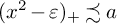 $(x^2 - \varepsilon )_{+} \precsim a$
. So
 $x \precsim a$
for every
 $x, a \in A_{+}$
with
 $a \neq 0$
. Since
 ${\mathrm {dim}} (A) < \infty $
, this can only happen if
 $A \cong \mathbb {C}$
, which is excluded in Definition 3.6, or
 $A = 0$
.
It may happen that
 $\varphi $
in Definition 3.6 is zero. See Example 3.11 below. First, we recall (see before Proposition 1.6 of [Reference Cuntz15]) that a simple C*-algebra A (not necessarily unital) is purely infinite if for every
 $a \in A_{+} \setminus \{ 0 \}$
, there is an infinite projection in
 ${\overline {a A a}}$
. For our purposes, the following characterization is often more useful. It is the simple case of [Reference Kirchberg and Rørdam33, Definition 4.1], according to which a not necessarily simple C*-algebra A is purely infinite if and only if there are no characters on A and for all
 $a, b \in A_{+}$
such that
 $a \in \overline {A b A}$
, we have
 $a \precsim b$
.
Definition 3.10 ([Reference Kirchberg and Rørdam33], Proposition 5.4).
A simple C*-algebra A is purely infinite if and only if
 $A \ncong \mathbb {C}$
and
 $a \sim b$
for any
 $a, b \in A_{+} \setminus \{ 0 \}$
.
Example 3.11. Let A be a simple purely infinite C*-algebra. Then A is tracially
 $\mathcal {Z}$
-absorbing. In fact, we can take
 $\varphi = 0$
in Definition 3.6.
Remark 3.12. In the proof of the following lemma, we use the fact that any simple unital (not necessarily separable) C*-algebra A with tracial rank zero has strict comparison of projections using traces; that is, if p and q are projections in A and
 $\tau (p) < \tau (q)$
for any
 $\tau \in T(A)$
, then
 $p \precsim q$
. The case that A is separable is contained in [Reference Lin38, Theorem 3.7.2]. The general case is handled as follows. By [Reference Lin36, Corollary 5.7],
 $\mathrm {TR}_{w}(A)=0$
(that is, the weak tracial topological rank of A is zero). Applying [Reference Lin36, Theorem 6.8] with
 $k=0$
, it follows that A has strict comparison of projections using traces. Note that, though it is not strictly stated in the proof of [Reference Lin36, Theorem 6.8] that A has at least one tracial state, this follows as in the separable case [Reference Lin38, Proposition 3.7.1]. For the sake of completeness, we give a proof for nonseparable tracial rank zero C*-algebras here. In fact, this is done by replacing sequences with nets: Let I be the directed set of all nonempty finite subsets of the closed unit ball of A and set
 $n(F)=\mathrm {card}(F)$
. Applying the definition of the tracial topological rank [Reference Lin38, Definition 3.6.2] to
 $F\in I$
,
 $\varepsilon =\frac {1}{n(F)}$
, and an arbitrary nonzero positive element
 $a\in A$
, there is a nonzero finite dimensional C*-subalgebra
 $B_F$
of A (depending on F and a) with unit
 $p_F$
such that
-
(1)
$\|p_{F}x-xp_{F}\|<\frac {1}{n(F)}$
for all
$x\in F$
, and -
(2) for any
$x\in F$
, there is
$b\in B_{F}$
such that
$\|p_{F}xp_{F}-b\|<\frac {1}{n(F)}$
.


Define a c.p.c. map
 $L_{F}:A\to B_{F}$
as follows. The map
 $\mathrm {id}:B_{F}\to B_{F}$
extends to a u.c.p. map
 $L^{\prime }_{F}:p_{F}Ap_{F}\to B_{F}$
, by Arveson’s extension theorem. Define
 $L_{F}(x):=L^{\prime }_{F}(p_{F}xp_{F})$
,
 $x\in A$
. Then
 $L_{F}$
is a c.p.c. map and
 $B_{F}$
is contained in the multiplicative domain of
 $L_{F}$
. It follows that
 $$ \begin{align*} \lim_{F\to \infty}\|L_{F}(xy)-L_{F}(x)L_{F}(y)\|=0,\ \ \text{for all}\ x,y\in A. \end{align*} $$
Given
 $F\in I$
, choose a tracial state
 $\tau _F : B_F \to \mathbb {C}$
and set
 $t_F= \tau _F \circ L_F$
, which is a state on A. As the state space of A is weak
 $^*$
compact, the net
 $(t_F )_{F\in I}$
has a cluster point
 $\tau $
. An argument similar to the proof of [Reference Lin38, Proposition 3.7.1] shows that
 $\tau $
is a tracial state on A, as desired.
Lemma 3.13. Let A be an infinite dimensional simple unital C*-algebra with tracial rank zero [Reference Lin38, Definition 3.6.2]. Then A is tracially
 $\mathcal {Z}$
-absorbing.
In Proposition 4.10 below, we remove the requirement that A be unital.
A variant of this lemma is stated in [Reference Matui and Sato40, Lemma 5.1] and is used to show that every simple separable unital nuclear infinite-dimensional C*-algebra with tracial rank zero is approximately divisible, and hence
 $\mathcal {Z}$
-absorbing [Reference Matui and Sato40, Theorem 5.4].
Proof of Lemma 3.13.
We prove the following statement, which clearly implies the conclusion. Let
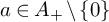 $a \in A_{+} \setminus \{ 0 \}$
, let
 $F \subseteq A$
be finite, let
 $\varepsilon> 0$
, and let
 $n \in \mathbb {N}$
. Then there is a homomorphism
 $\varphi \colon M_{n} \to A$
such that
-
(1)
$1 - \varphi (1) \precsim a$
. -
(2)
$\| [\varphi (z), x] \| < \varepsilon $
for any
$z \in M_{n}$
with
$\| z \| \leq 1$
and any
$x \in F$
.




Since A has real rank zero (by [Reference Lin38, Theorem 3.6.11]) and is unital, infinite dimensional, and simple, there are nonzero orthogonal projections
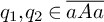 $q_1, q_2 \in {\overline {a A a}}$
. Apply the definition of tracial rank zero to find a projection
 $p \in A$
,
 $m, r (1), r (2), \ldots , r (m) \in \mathbb {N}$
, and a unital injective homomorphism
 $\psi $
from
 $B = \bigoplus _{l = 1}^m M_{r (l)}$
to
 $p A p$
such that
-
(3)
$\| [p, x] \| < \frac {\varepsilon }{6}$
for all
$x \in F$
. -
(4)
${\operatorname {dist}} (p x p, \, \psi (B)) < \frac {\varepsilon }{6}$
for all
$x \in F$
. -
(5)
$1 - p \precsim q_1$
.


Choose
 $n_0 \in \mathbb {N}$
such that
 $$\begin{align*}\frac{1}{n_0} < \inf_{\tau \in T (A)} \tau (q_2). \end{align*}$$
Choose
 $\nu \in \mathbb {N}$
so large that
 $\nu n> n_0$
.
For
 $l = 1, 2, \ldots , m$
, let
 $\big ( e_{j, k}^{(l)} \big )_{j, k = 1, 2, \ldots , r(l)}$
be the standard system of matrix units for
 $M_{r (l)}$
. Use [Reference Osaka and Phillips44, Lemma 2.3] to choose projections
 $f_0^{(l)}, f_1^{(l)}, f_2^{(l)}, \ldots , f_{\nu n}^{(l)} \in \psi \big ( e_{1, 1}^{(l)} \big ) A \psi \big ( e_{1, 1}^{(l)} \big )$
such that
 $$\begin{align*}f_1^{(l)} \sim f_2^{(l)} \sim \cdots \sim f_{\nu n}^{(l)}, \qquad f_0^{(l)} \precsim f_1^{(l)}, \qquad {\mbox{and}} \qquad \sum_{j = 0}^{\nu n} f_j^{(l)} = \psi \big( e_{1, 1}^{(l)} \big). \end{align*}$$
There is then a homomorphism
 $\beta _l \colon M_{\nu n} \to A$
such that the images of the diagonal matrix units in
 $M_{\nu n}$
are
 $f_1^{(l)}, f_2^{(l)}, \ldots , f_{\nu n}^{(l)}$
. Define a homomorphism
 $\beta \colon M_{\nu n} \to A$
by
 $$\begin{align*}\beta (z) = \sum_{l = 1}^m \sum_{k = 1}^{r (l)} \psi \big( e_{k, 1}^{(l)} \big) \beta_l (z) \psi \big( e_{1, k}^{(l)} \big) \end{align*}$$
for
 $z \in M_{\nu n}$
. Clearly,
 $\beta (z)$
commutes with
 $\psi (b)$
for all
 $z \in M_{\nu n}$
and
 $b \in B$
, and
 $\beta (1) \leq p$
.
Let
 $x \in F$
and let
 $z \in M_{n}$
satisfy
 $\| z \| \leq 1$
. Apply (4) to choose
 $b \in B$
such that
 $\| \psi (b) - p x p \| < \frac {\varepsilon }{6}$
. We have
 $[ \beta (z), \, (1 - p) x (1 - p) ] = 0$
, and so by (3) at the third step, we get
 $$ \begin{align*} \| [\beta (z), x] \| & \leq \| [\beta (z), \, p x p] \| + \| [\beta (z), \, p x (1 - p)] \| + \| [\beta (z), \, (1 - p) x p] \| \\ & \leq 2 \| \beta (z) \| \cdot \| p x p - \psi (b) \| \\ & \hspace{3em} {\mbox{}} + \| \beta (z) \| \cdot \| p x (1 - p) \| + \| \beta (z) \| \cdot \| (1 - p) x p \| \\ & < 2 \left( \frac{\varepsilon}{6} \right) + \left( \frac{\varepsilon}{6} \right) + \left( \frac{\varepsilon}{6} \right) < \varepsilon. \end{align*} $$
This is (2) with
 $\beta $
in place of
 $\varphi $
.
For every
 $\tau \in T (A)$
, for
 $l = 1, 2, \ldots , m$
, we have
 $$\begin{align*}\tau \big( f_1^{(l)} \big) = \tau \big( f_2^{(l)} \big) = \cdots = \tau \big( f_{\nu n}^{(l)} \big), \qquad \tau \big( f_0^{(l)} \big) \leq \tau \big( f_1^{(l)} \big), \end{align*}$$
and
 $$\begin{align*}\sum_{j = 0}^{\nu n} \tau \big( f_j^{(l)} \big) = \tau \big( \psi \big( e_{1, 1}^{(l)} \big) \big). \end{align*}$$
Therefore,
 $$\begin{align*}\tau \big( f_0^{(l)} \big) \leq \frac{1}{\nu n + 1} \tau (\big( \psi \big( e_{1, 1}^{(l)} \big) \big). \end{align*}$$
Since
 $$\begin{align*}p - \beta (1) = \sum_{l = 1}^m \sum_{k = 1}^{r (l)} \psi \big( e_{k, 1}^{(l)}\big) f_0^{(l)} \psi \big( e_{1, k}^{(l)}\big), \end{align*}$$
it follows that
 $$ \begin{align*} \tau (p - \beta (1)) & = \sum_{l = 1}^m r (l) \tau \big( f_0^{(l)} \big) \leq \frac{1}{\nu n + 1} \sum_{l = 1}^m r (l) \tau \big( \psi \big( e_{1, 1}^{(l)} \big) \big) \\ & = \frac{\tau (p)}{\nu n + 1} \leq \frac{1}{\nu n + 1} < \frac{1}{n_0} < \tau (q_2). \end{align*} $$
Since A has strict comparison of projections using traces (Remark 3.12), it follows that
 $p - \beta (1) \precsim q_2$
. We already have
 $1 - p \precsim q_1$
,
 $q_1 q_2 = 0$
, and
 $q_1 + q_2 \in {\overline {a A a}}$
, so
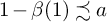 $1 - \beta (1) \precsim a$
. This is (1) with
 $\beta $
in place of
 $\varphi $
.
To complete the proof, we define
 $\varphi \colon M_n \to A$
by
 $\varphi (z) = \beta (1_{M_{\nu }} \otimes z)$
for
 $z \in M_n$
.
Now we give an equivalent definition for the tracial
 $\mathcal {Z}$
-absorption in terms of the central sequence algebra.
Notation 3.14. If
 $(A_{i})_{i \in I}$
is a family of C*-algebra, we let
 $\prod _{i \in I} A_i$
denote that set of all families
 $(a_{i})_{i \in I}$
in the set theoretic product of the
 $A_{i}$
such that
 $\sup _{i \in I} \| a_{i} \| < \infty $
. (This is the product in the category of C*-algebras.)
For a C*-algebra A, we write
 $$\begin{align*}A_{\infty} = \prod_{n \in \mathbb{N}} A \Big/ \bigoplus_{n \in \mathbb{N}} A. \end{align*}$$
We identify
 $a \in A$
with the equivalence class in
 $A_{\infty }$
of the corresponding constant sequence
 $(a)_{n \in \mathbb {N}}$
. We write
 $A_{\infty } \cap A^{\prime }$
for the relative commutant of A in
 $A_{\infty }$
.
The algebra
 $A_{\infty } \cap A^{\prime }$
is often written
 $A^{\infty }$
. We warn that some authors write
 $A^{\infty }$
for our
 $A_{\infty }$
.
Proposition 3.15. Let A be a simple separable C*-algebra. The following statements are equivalent:
-
(1) A is tracially
$\mathcal {Z}$
-absorbing. -
(2) For every
$a, x \in A_{+}$
with
$a \neq 0$
and every
$n \in \mathbb {N}$
, there exists a c.p.c. order zero map
$\psi \colon M_n \to A_{\infty } \cap A^{\prime }$
such that
$x^{2} - x \psi (1) x \precsim a$
in
$A_{\infty }$
.




If, moreover, A is unital, then these statements are equivalent to the following:
-
(3) For every nonzero
$a \in A_{+} $
and every
$n \in \mathbb {N}$
, there exists a c.p.c. order zero map
$\psi \colon M_n \to A_{\infty } \cap A^{\prime }$
such that
$1_{A_{\infty }} - \psi (1) \precsim a$
in
$A_{\infty }$
.




Proof. (1)
 $\Rightarrow $
(2): Let
 $\{a_{1}, a_{2}, \ldots \}$
be a dense subset of the closed unit ball of A. Put
 $F_{m} = \{a_{1}, a_{2}, \ldots , a_{m} \}$
for
 $m \in \mathbb {N}$
. Let
 $a, x \in A_{+}$
with
 $a \neq 0$
and let
 $n \in \mathbb {N}$
. We may assume that
 $\| a \| = 1$
. Tracial
 $\mathcal {Z}$
-absorption of A implies that for every
 $m \in \mathbb {N}$
, there exists a c.p.c. order zero map
 $\varphi _{m} \colon M_{n} \to A$
such that
 $$\begin{align*}\left( x^{2} - x \varphi_{m} (1) x - \tfrac{1}{m} \right)_{+} \precsim \left(a - \tfrac{1}{2} \right)_{+} \end{align*}$$
and
 $\| [\varphi _{m} (z), b] \| < \frac {1}{m}$
for every
 $z \in M_{n}$
with
 $\| z \| \leq 1$
and every
 $b \in F_{m}$
. Now let
 $\pi \colon \prod _{m \in \mathbb {N}} A \to A_{\infty }$
be the quotient map, and define
 $\psi \colon M_n \to A_{\infty }$
by
 $$\begin{align*}\psi (z) = \pi \big( ( \varphi_m (z) )_{m \in \mathbb{N}} \big) \end{align*}$$
for
 $z \in M_n$
. Then
 $\psi (M_n) \subseteq A_{\infty } \cap A^{\prime }$
. By Lemma 2.2, for every
 $m \in \mathbb {N}$
, there exists
 $v_{m} \in A$
such that
 $\|v_{m} \| \leq 2 \| x \|^{2}$
and
 $$\begin{align*}\big\| \left( x^{2} - x \varphi_{m} (1) x - \tfrac{1}{m} \right)_{+} - v_{m} a v_{m}^{*} \big\| < \tfrac{1}{m}. \end{align*}$$
Hence,
 $\big \| x^{2} - x \varphi _{m} (1) x - v_{m} a v_{m}^{*} \big \| < \frac {2}{m}$
. Put
 $v = \pi \big ( ( v_m )_{m \in \mathbb {N}} \big ) \in A_{\infty }$
. Then we have
 $x^{2} - x \psi (1) x = vav^{*} \precsim a$
in
 $A_{\infty }$
.
(2)
 $\Rightarrow $
(1): Suppose that (2) holds. To show that A is tracially
 $\mathcal {Z}$
-absorbing, we verify the condition in Remark 3.7(3) (Definition 3.6 with order zero replaced by
 $\varepsilon $
-order zero). So let a, x,
 $\varepsilon $
, F, and n be as in Definition 3.6. Choose a c.p.c. order zero map
 $\psi \colon M_{n} \to A_{\infty } \cap A^{\prime }$
such that
 $x^{2} - x \psi (1) x \precsim a$
in
 $A_{\infty }$
. Since
 $M_{n}$
is nuclear, there is a sequence
 $(\psi _{m})_{m \in \mathbb {N}}$
of c.p.c. maps from
 $M_{n}$
to A such that, if we define
 $$\begin{align*}\widetilde{\psi} = (\psi_m)_{m \in \mathbb{N}} \colon M_{n} \to \prod_{m \in \mathbb{N}} A, \end{align*}$$
then
 $\psi = \pi \circ \widetilde {\psi }$
. Since F is finite and
 $M_n$
is finite dimensional, it follows that there is
 $m \in \mathbb {N}$
such that
 $\| [\psi _{m} (z), y] \| < \varepsilon $
for every
 $z \in M_{n}$
with
 $\| z \| \leq 1$
and every
 $y \in F$
, such that
 $\| \psi _{m} (y) \psi _{m} (z) \| < \varepsilon $
for all
 $y, z \in M_{n}$
with
 $0 \leq y, z \leq 1$
and
 $y z = 0$
, and such that there is
 $w \in A$
with
 $\big \| x^{2} - x \psi _{m} (1) x - w a w^{*} \big \| < \varepsilon $
. Thus,
 $\big ( x^{2} - x \psi _{m} (1) x - \varepsilon \big )_{+} \precsim a$
. Hence,
 $\psi _{m}$
satisfies the conditions of Remark 3.7(3), and so A is tracially
 $\mathcal {Z}$
-absorbing. Thus, (1) holds.
Suppose that A is unital. The implication (3)
 $\Rightarrow $
(2) is obvious since
 $x^{2} - x \psi (1) x \precsim 1_{A_{\infty }} - \psi (1)$
. Also, (2)
 $\Rightarrow $
(3) follows by taking
 $x=1_A$
in (2).
To conclude this section, we give another version of tracial
 $\mathcal {Z}$
-absorption (called strong tracial
 $\mathcal {Z}$
-absorption, Definition 3.16 below), and we compare it with Definition 3.6. By Remark 3.7(1) and Remark 3.18, both definitions are equivalent to [Reference Hirshberg and Orovitz28, Definition 2.1] in the simple unital case. Definition 3.16 was our first proposal for the definition of tracial
 $\mathcal {Z}$
-absorption. At first glance, it seems to be a more natural definition extending the unital case. However, it turned out that Definition 3.6 is better, as it enables us to prove the permanence properties (Section 4), and it is enough to get
 $\mathcal {Z}$
-absorption in the separable nuclear case (Section 5). Though we do not have examples to show that these two definitions are actually different, it is worth having both.
Definition 3.16. We say that a simple C*-algebra A is strongly tracially
 $\mathcal {Z}$
-absorbing if
 $A \not \cong \mathbb {C}$
and for every
 $x, a \in A_{+}$
with
 $a \neq 0$
, every finite set
 $F \subseteq A$
, every
 $\varepsilon> 0$
, and every
 $n \in \mathbb {N}$
, there is a c.p.c. order zero map
 $\varphi \colon M_{n} \to A$
such that
-
(1)
$x^{2} - x \varphi (1) x \precsim a$
. -
(2)
$\| [\varphi (z), b] \| < \varepsilon $
for any
$z \in M_{n}$
with
$\| z \| \leq 1$
and any
$b \in F$
.


As an example, by taking
 $\varphi = 0$
, we see that every simple (not necessarily unital) purely infinite C*-algebra is strongly tracially
 $\mathcal {Z}$
-absorbing. (Compare with Example 3.11.) In particular, Examples 5.6 and 5.7 show that strong tracial
 $\mathcal {Z}$
-absorption does not imply
 $\mathcal {Z}$
-absorption.
Lemma 3.17. Let A be a C*-algebra and let
 $x, y \in A_{+}$
. If
 $y \in \overline {x A}$
, then for any
 $c \in (A^{\sim })_{+}$
, we have
 $y c y \precsim x cx$
.
Proof. Choose
 $(b_{n})_{n \in \mathbb {N}}$
in A such that
 $x b_{n} \to y$
. Then
 $b_{n}^{*} x c x b_{n} \to y c y$
and for any
 $n \in \mathbb {N}$
, we have
 $b_{n}^{*} x c x b_{n} \precsim x cx$
. Taking the limit in the latter gives the result.
Remark 3.18. By Lemma 3.17, if the condition stated in Definition 3.16 holds for some
 $x \in A_{+}$
, then it also holds for any positive element
 $y \in \overline {xA}$
. In particular, Definition 3.16 is equivalent to Definition 3.6 in the unital case. Moreover, it follows from Lemma 3.17 that if A is
 $\sigma $
-unital, then A is strongly tracially
 $\mathcal {Z}$
-absorbing if the properties in Definition 3.16 hold for some strictly positive element
 $x \in A$
.
The following result clarifies the relation between Definitions 3.6 and 3.16.
Proposition 3.19. Let A be a simple
 $\sigma $
-unital C*-algebra and let
 $x \in A$
be a strictly positive element. Then A is strongly tracially
 $\mathcal {Z}$
-absorbing if and only if for every
 $a \in A_{+}$
with
 $a \neq 0$
, every finite set
 $F \subseteq A$
, every
 $\varepsilon> 0$
, and every
 $n \in \mathbb {N}$
, there is a c.p.c. order zero map
 $\varphi \colon M_{n} \to A$
such that
-
(1)
$\left ( x^{2 / m} - x^{1 / m} \varphi (1) x^{1 / m} - \varepsilon \right )_+ \precsim a$
for every
$m \in \mathbb {N}$
. -
(2)
$\| [\varphi (z), b] \| < \varepsilon $
for any
$z \in M_{n}$
with
$\| z \| \leq 1$
and any
$b \in F$
.


Proof. Assume first that A is strongly tracially
 $\mathcal {Z}$
-absorbing. Let a, F,
 $\varepsilon $
, and n be as in the hypotheses, and apply Definition 3.16 with these elements and x as given, obtaining a c.p.c. order zero map
 $\varphi \colon M_{n} \to A$
. This map satisfies (2) by construction. For (1), let
 $m \in \mathbb {N}$
. Then
 $x^{1 / m} \in {\overline {x A}}$
, so, using Lemma 3.17 at the second step,
 $$\begin{align*}\big( x^{2 / m} - x^{1 / m} \varphi (1) x^{1 / m} - \varepsilon \big)_{+} \precsim x^{2 / m} - x^{1 / m} \varphi (1) x^{1 / m} \precsim x^{2} - x \varphi (1) x. \end{align*}$$
For the converse, let a, F,
 $\varepsilon $
, and n be as in Definition 3.16. Choose
 $\delta> 0$
with
 $$\begin{align*}\delta < \frac{\varepsilon}{1 + 2 \max \big( \{ \| y \| \colon y \in F \} \big)}. \end{align*}$$
By assumption, there is a c.p.c. order zero map
 $\varphi \colon M_{n} \to A$
such that (1) and (2) hold for
 $\delta $
instead of
 $\varepsilon $
. Define a map
 $f \colon [0, 1] \to [0, 1]$
by
 $$\begin{align*}f (\lambda) = \begin{cases} \tfrac{\lambda}{1 - \delta} & \hspace{1em} 0 \leq \lambda \leq 1 - \delta \\ 1 & \hspace{1em} 1 - \delta < \lambda \leq 1. \end{cases} \end{align*}$$
Using functional calculus for c.p.c. order zero maps ([Reference Winter and Zacharias55, Corollary 4.2]), set
 $\psi = f (\varphi )$
. As in the proof of Lemma 3.3, in
 ${A}^{\sim }$
, we have
 $$ \begin{align} 1 - \psi (1) = \frac{1}{1 - \delta} \big( 1 - \varphi (1) - \delta \big)_{+}. \end{align} $$
We show that (1) in Definition 3.16 holds (i.e.,
 $x^{2} - x \psi (1) x \precsim a$
). Let
 $\eta> 0$
. Then by (3.3), we have
 $$\begin{align*}\big((1 - \delta) (x^{2} - x \psi (1) x ) - \eta \big)_{+} = \big( x (1 - \varphi (1) - \delta)_{+} x - \eta \big)_{+}. \end{align*}$$
By Lemma 2.5, there is
 $m \geq 1$
such that
 $$ \begin{align} \big( x (1 - \varphi (1) - \delta)_{+} x - \eta \big)_{+} \precsim \big( x^{1 / m} (1 - \varphi (1)) x^{1 / m} - \delta \big)_{+}. \end{align} $$
The right-hand side of (3.4) is Cuntz subequivalent to a by (1). Since
 $\eta> 0$
is arbitrary, and using (3.3) at the first step, we get
 $$\begin{align*}x^{2} - x \psi (1) x \sim x (1 - \varphi (1)- \delta)_{+} x \precsim a. \end{align*}$$
The proof of (2) in Definition 3.16 is similar to the last part of the proof of Lemma 3.3. So A is strongly tracially
 $\mathcal {Z}$
-absorbing.
4 Permanence properties
In this section, we show that tracial
 $\mathcal {Z}$
-absorption passes to hereditary C*-subalgebras (Theorem 4.1). In particular, no simple tracially
 $\mathcal {Z}$
-absorbing C*-algebra is type I. Then we show that tracial
 $\mathcal {Z}$
-absorption passes to matrix algebras and direct limits. We also prove that it is preserved under Morita equivalence in the class of
 $\sigma $
-unital simple C*-algebras (Corollary 4.12). Moreover, we compare our nonunital definition of tracial
 $\mathcal {Z}$
-absorption with the unital definition when the algebra has an approximate identity (not necessarily increasing) consisting of projections (Proposition 4.9).
Theorem 4.1. Let A be a simple tracially
 $\mathcal {Z}$
-absorbing C*-algebra and let B be a hereditary C*-subalgebra of A. Then B is also tracially
 $\mathcal {Z}$
-absorbing.
Proof. Let
 $x \in B_{+}$
, let
 $a \in B_{+} \setminus \{ 0 \}$
, let
 $\varepsilon> 0$
, let
 $F \subseteq B$
be finite, and let
 $n \in \mathbb {N}$
. We must find a c.p.c. order zero map
 $\varphi \colon M_{n} \to B$
such that
-
(1)
$\big ( x^{2} - x \varphi (1) x - \varepsilon \big )_{+} \precsim a$
. -
(2)
$\| [\varphi (z), b] \| < \varepsilon $
for any
$z \in M_{n}$
with
$\| z \| \leq 1$
and any
$b \in F$
.


The case
 $x = 0$
is trivial, so by Lemma 3.5, we may assume that
 $\| x \| = 1$
. Also, we may assume that
 $\| b \| \leq 1$
for all
 $b \in F$
. Let
 $y_0$
be the sum of x with the positive and negative parts of the real and imaginary parts of all the elements of F, and set
 $y = \| y_0 \|^{-1} y_0$
. Then
 $y \in B_{+}$
,
 $\| y \| = 1$
, and
 $F \cup \{ x \} \subseteq {\overline {y B y}}$
. Since
 $\big ( y^{1 / m} \big )_{m \in \mathbb {N}}$
is an approximate identity for
 ${\overline {y B y}}$
, there is
 $m \in \mathbb {N}$
such that
 $$ \begin{align} \big\| [y^{1 / k}, b] \big\| < \tfrac{\varepsilon}{6} \qquad {\mbox{and}} \qquad \big\| y^{1 / k} b - b \big\| < \tfrac{\varepsilon}{6} \end{align} $$
for
 $k \in \{ m, 2 m, m / 2 \}$
and
 $b \in F \cup \{ x \}$
. Choose
 $\delta> 0$
for
 $\frac {\varepsilon }{6}$
according to [Reference Archey, Buck and Phillips3, Lemma 2.7]. We may assume that
 $\delta < \frac {\varepsilon }{4}$
. Since A is tracially
 $\mathcal {Z}$
-absorbing, there exists a c.p.c. order zero map
 $\psi \colon M_{n} \to A$
such that
-
(3)
$\big ( y^{2 / m} - y^{1 / m} \psi (1) y^{1 / m} - \delta \big )_{+} \precsim a$
. -
(4)
$\| [\psi (z) , b] \| < \delta $
for every
$z \in M_{n}$
with
$\| z \| \leq 1$
and every
$b \in F \cup \left \{ x, y^{2 / m}, y^{1 / m} \right \}$
.


Let us show that the conditions of [Reference Archey, Buck and Phillips3, Lemma 2.7] are satisfied for
 $y^{1 / m}$
,
 $\psi $
, and B in place of x,
 $\varphi _0$
, and B. Since
 $\| y \| \leq 1$
, we have
 $0 \leq y^{1 / m} \leq 1$
. Also by (4),
 $\big \| [\psi (z), \ , y^{1 / m}] \big \| < \delta $
for any
 $z \in M_{n}$
with
 $\| z \| \leq 1$
. Finally, we claim that
 ${\operatorname {dist}} \big ( \psi (z) y^{1 / m}, \, B \big ) < \delta $
for any
 $z \in M_{n}$
with
 $\| z \| \leq 1$
. In fact,
 $y^{1 / (2 m)} \psi (z) y^{1 / (2 m)} \in B$
(since B is hereditary), and by (4), we have
 $$\begin{align*}\big\| \psi (z) y^{1 / m} - y^{1 / (2 m)} \psi (z) y^{1 / (2 m)} \big\| \leq \big\| \psi (z) y^{1 / (2 m)} - y^{1 / (2 m)} \psi (z) \big\| < \delta, \end{align*}$$
proving the claim. Hence, by the choice of
 $\delta $
using [Reference Archey, Buck and Phillips3, Lemma 2.7], there is a c.p.c. order zero map
 $\varphi \colon M_{n} \to B$
such that for every
 $z \in M_{n}$
with
 $\| z \| \leq 1$
, we have
 $$ \begin{align} \big\| \psi (z) y^{1 / m} - \varphi (z) \big\| < \tfrac{\varepsilon}{6}. \end{align} $$
Now we show that
 $\varphi $
has properties (1) and (2) above. For (2), let
 $b \in F$
and let
 $z \in M_{n}$
satisfy
 $\| z \| \leq 1$
. Using (4.1), (4.2), and (4) at the second step, we have
 $$ \begin{align*} \| \varphi (z) b - b \varphi (z) \| & \leq \big\| \varphi (z) - \psi (z) y^{1 / m} \big\|\cdot \| b \| + \| \psi (z) \|\cdot \big\| y^{1 / m} b - b y^{1 / m} \big\| \\ & \hspace{3em} {\mbox{}} + \| \psi (z) b - b \psi (z) \|\cdot \big\| y^{1 / m} \big\| + \| b \|\cdot \big\| \psi (z) y^{1 / m} - \varphi (z) \big\| \\ & < \tfrac{\varepsilon}{6} + \tfrac{\varepsilon}{6} + \delta + \tfrac{\varepsilon}{6} < \tfrac{\varepsilon}{2} + \tfrac{\varepsilon}{4} < \varepsilon. \end{align*} $$
To prove (1), first we use (4.2) and (4) at the third step to get
 $$ \begin{align*} & \big\| \big( y^{2 / m} - y^{1 / m} \psi (1) y^{1 / m} - \delta \big)_{+} - \big( y^{2 / m} - y^{1 / (2 m)} \varphi (1) y^{1 / (2 m)} \big) \big\| \\ & \hspace{3em} {\mbox{}} \leq \delta + \big\| y^{1 / m} \psi (1) y^{1 / m} - y^{1 / (2 m)} \varphi (1) y^{1 / (2 m)} \big\| & \hspace{3em} {\mbox{}} & \hspace{3em} {\mbox{}} \hspace{3em} {\mbox{}} & \hspace{3em} {\mbox{}} \\ & \hspace{3em} {\mbox{}} \leq \delta + \big\| y^{1 / (2 m)} \big\| \cdot \big\| y^{1 / (2 m)} \psi (1) - \psi (1) y^{1 / (2 m)} \big\| \cdot \big\| y^{1 / m} \big\| \\ & \hspace{3em} {\mbox{}} \hspace{3em} {\mbox{}} + \big\| y^{1 / (2 m)} \big\| \cdot \big\| \psi (1) y^{1 / m} - \varphi (1) \big\|\cdot \big\| y^{1 / (2 m)} \big\| \\ & \hspace{3em} {\mbox{}} < \delta + \tfrac{\varepsilon}{6} < \tfrac{\varepsilon}{4} + \tfrac{\varepsilon}{6} < \tfrac{\varepsilon}{2}. \end{align*} $$
Thus, by (3), we have
 $$ \begin{align} \big( y^{2 / m} - y^{1 / (2 m)} \varphi (1) y^{1 / (2 m)} - \tfrac{\varepsilon}{2} \big)_{+} \precsim \big( y^{2 / m} - y^{1 / m} \psi (1) y^{1 / m} - \delta \big)_{+} \precsim a. \end{align} $$
At the second step using
 $\big \| x - x y^{1 / (2 m)} \big \| = \big \| x - y^{1 / (2 m)} x \big \|$
and (4.1) several times, we get
 $$ \begin{align*} & \big\| \big( x^{2} - x \varphi (1) x \big) - \big( x y^{2 / m} x - x y^{1 / (2 m)} \varphi (1) y^{1 / (2 m)} x - \tfrac{\varepsilon}{2} \big)_{+} \big\| \\ & \hspace{3em} {\mbox{}} \leq \tfrac{\varepsilon}{2} + \| x \| \cdot \big\| x - y^{2 / m} x \big\| + \big\| x - x y^{1 / (2 m)} \big\| \cdot \| \varphi (1) x \| \\ & \hspace{3em} {\mbox{}} \hspace{3em} {\mbox{}} + \big\| x y^{1 / (2 m)} \varphi (1) \big\| \cdot \big\| x - y^{1 / (2 m)} x \big\| \\ & \hspace{3em} {\mbox{}} < \tfrac{\varepsilon}{2} + \tfrac{\varepsilon}{2} = \varepsilon. \end{align*} $$
Using Lemma 2.3 at the second step and (4.3) at the third step, we now have
 $$ \begin{align*} \big( x^{2} - x \varphi (1) x - \varepsilon \big)_{+} & \precsim \big( x y^{2 / m} x - x y^{1 / (2 m)} \varphi (1) y^{1 / (2 m)} x - \tfrac{\varepsilon}{2} \big)_{+} \\ & \precsim \big( y^{2 / m} - y^{1 / (2 m)} \varphi (1) y^{1 / (2 m)} - \tfrac{\varepsilon}{2} \big)_{+} \precsim a. \end{align*} $$
It remains to prove that
 $B \not \cong \mathbb {C}$
. So suppose
 $B \cong \mathbb {C}$
. Since B is hereditary and A is simple, it follows that there is a Hilbert space H such that
 $A \cong K (H)$
. We have
 $A \not \cong \mathbb {C}$
and
 $A \neq 0$
, so A has a hereditary subalgebra D isomorphic to
 $M_2$
. Since
 $D \not \cong \mathbb {C}$
, by what we have already done, D is tracially
 $\mathcal {Z}$
-absorbing. This contradicts Lemma 3.9.
Corollary 4.2. Let A be a nonzero simple tracially
 $\mathcal {Z}$
-absorbing C*-algebra. Then A is not type I. In particular,
 $\mathcal {K}$
is not tracially
 $\mathcal {Z}$
-absorbing.
Proof. Suppose otherwise that A is type I. Since A is simple, it is elementary, by [Reference Blackadar7, Corollary IV.1.2.6]. Thus, there is a Hilbert space H such that
 $A\cong {K} (H)$
. In particular,
 $K(H)$
must be tracially
 $\mathcal {Z}$
-absorbing. By Lemma 3.9, H is infinite dimensional. Let p a projection in
 ${K} (H)$
with
 $\mathrm {rank} (p) = 2$
. Then
 $p{K} (H) p \cong M_{2}$
would be tracially
 $\mathcal {Z}$
-absorbing by Theorem 4.1, which is not possible by Lemma 3.9.
Theorem 4.3. Let A be a simple C*-algebra. The following are equivalent:
-
(1) A is tracially
$\mathcal {Z}$
-absorbing. -
(2) Every
$\sigma $
-unital hereditary C*-subalgebra of A is tracially
$\mathcal {Z}$
-absorbing. -
(3) For every positive element x in A,
$\overline {x A x}$
is tracially
$\mathcal {Z}$
-absorbing.


Proof. By Theorem 4.1, (1) implies (2). Clearly, (2) is equivalent to (3) since a hereditary C*-subalgebra
 $B \subseteq A$
is
 $\sigma $
-unital if and only if there is
 $x \in A_{+}$
such that
 $B = \overline {x A x}$
. It remains to show that (3) implies (1). Suppose that (3) holds. Thus, in particular,
 $A \ncong \mathbb {C}$
. Suppose that we are given
 $a, x \in A_{+} \setminus \{ 0 \}$
,
 $\varepsilon> 0$
, a finite set
 $F \subseteq A$
, and
 $n \in \mathbb {N}$
. Choose
 $y \in A_{+}$
such that
 $F \cup \{ x \} \subseteq \overline {y A y}$
(e.g., let y be the sum of x with the positive and negative parts of the real and imaginary parts of the elements of F). We get
 $\varphi $
as in Definition 3.6 by applying this definition to
 $\overline {y A y}$
.
Lemma 4.4 (cf. [Reference Hirshberg and Orovitz28], Lemma 2.3).
Let A be a simple C*-algebra which is not of type I and let
 $n \in \mathbb {N}$
. For every nonzero positive element
 $a \in {M}_{n} \otimes A = {M}_{n} (A)$
, there exists a nonzero positive element
 $b \in A$
such that
 $1 \otimes b \precsim a$
.
Proof. For
 $j, k = 1, 2, \ldots , n$
, let
 $e_{j, k} \in M_n$
be the standard matrix unit. Since a is a positive and nonzero element of
 ${M}_{n} (A)$
, there exists j such that
 $(e_{j, j} \otimes 1_{A^{\sim }}) a (e_{j, j} \otimes 1_{A^{\sim }}) \neq 0$
. By replacing a with
 $(e_{j, j} \otimes 1_{A^{\sim }}) a (e_{j, j} \otimes 1_{A^{\sim }})$
, we may assume that a is of the form
 $e_{j, j} \otimes c$
for some nonzero positive
 $c \in A$
. Use [Reference Phillips46, Lemma 2.1] to find
 $b_1, b_2, \ldots , b_n \in A_{+} \setminus \{ 0 \}$
such that
 $b_1 \sim b_2 \sim \cdots \sim b_n$
, such that
 $b_j b_k = 0$
for
 $j \neq k$
, and such that
 $b_1 + b_2 + \cdots + b_n \in {\overline {c A c}}$
. Then
 $$\begin{align*}1 \otimes b \sim e_{j, j} \otimes ( b_1 + b_2 + \cdots + b_n ) \precsim e_{j, j} \otimes c, \end{align*}$$
as desired.
The following is a nonunital analog of [Reference Hirshberg and Orovitz28, Lemma 2.4].
Proposition 4.5. Let A be a simple tracially
 $\mathcal {Z}$
-absorbing C*-algebra and let
 $n \in \mathbb {N}$
. Then
 ${M}_{n} (A)$
is also tracially
 $\mathcal {Z}$
-absorbing.
Proof. Let
 $x, a \in {M}_{n} (A)_{+}$
with
 $a \neq 0$
, let
 $\varepsilon> 0$
, let
 $m \in \mathbb {N}$
, and let
 $F \subseteq {M}_{n} (A)$
be finite.
By Lemma 4.4, it is enough to consider the case where
 $a = 1 \otimes b \in {M}_{n} \otimes A = {M}_{n} (A)$
for some nonzero element
 $b \in A_{+}$
. Also, there exists
 $y \in A_{+}$
such that
 $x \in {\overline {M_n (A) (1 \otimes y) }}$
. Thus, by Lemma 3.5, it is enough to take
 $x = 1 \otimes y$
with
 $y \in A_{+}$
. Let E be the set of all matrix entries of elements of F. Put
 $\delta = \varepsilon / n^{2}$
. Since A is tracially
 $\mathcal {Z}$
-absorbing, there exists a c.p.c. order zero map
 $\varphi \colon M_{m} \to A$
such that
-
(1)
$\big ( y^{2} - y \varphi (1) y - \delta \big )_{+} \precsim b$
. -
(2)
$\| [\varphi (z), d] \| < \delta $
for any
$z \in M_{n}$
with
$\| z \| \leq 1$
and any
$d \in E$
.


Define a c.p.c. order zero map
 $\psi \colon M_{m} \to {M}_{n} \otimes A$
by
 $\psi (z) = 1 \otimes \varphi (z)$
for
 $z \in {M}_{n}$
. Then
 $$ \begin{align*} \big( x^{2} - x \psi (1) x - \varepsilon \big)_{+} & = 1 \otimes \big( y^{2} - y \varphi (1) y - \varepsilon \big)_{+} \\ & \precsim 1 \otimes \big( y^{2} - y \varphi (1) y - \delta \big)_{+} \precsim 1 \otimes b = a. \end{align*} $$
Also, for any
 $z \in M_{n}$
with
 $\| z \| \leq 1$
and any
 $d = (d_{j, k})_{1 \leq j, k \leq n} \in F$
, we have
 $$ \begin{align*} \| [\psi (z), d] \| & = \| [1 \otimes \varphi (z), d] \| = \big\| ( [\varphi (z), \, d_{j, k}] )_{1 \leq j, k \leq n} \big\| \\ & \leq \sum_{j, k = 1}^{n} \|[\varphi (z), d_{j, k}] \| < n^{2} \delta = \varepsilon. \end{align*} $$
We have shown that
 $M_{n} (A)$
is tracially
 $\mathcal {Z}$
-absorbing.
Proposition 4.5 also follows from Theorem 5.1 below.
Definition 4.6. We say that a C*-algebra A is locally tracially
 $\mathcal {Z}$
-absorbing if for any
 $\varepsilon> 0$
and any finite subset
 $F \subseteq A$
, there exists a simple tracially
 $\mathcal {Z}$
-absorbing C*-subalgebra B of A such that
 $F \subseteq _{\varepsilon } B$
; that is, for any
 $a \in F$
, there exists
 $b \in B$
such that
 $\|a - b\| < \varepsilon $
.
Theorem 4.7. Let A be a simple locally tracially
 $\mathcal {Z}$
-absorbing C*-algebra. Then A is tracially
 $\mathcal {Z}$
-absorbing.
Proof. It follows from Definition 4.6 that
 $A \ncong \mathbb {C}$
. Let x, a, F,
 $\varepsilon $
and n be as in Definition 3.6. Write
 $F = \{f_{1}, f_{2}, \ldots , f_{m} \}$
. We may assume that
 $\| a \| = 1$
, that
 $\| x \| \leq \frac {1}{4}$
, and that
 $\varepsilon < 1$
. Set
 $E = F \cup \big \{ x^{1/2}, \, a^{1/2} \big \}$
. Choose
 $\delta> 0$
such that
 $$\begin{align*}\delta < \tfrac{\varepsilon}{4}, \qquad (2 + \delta) \delta < \tfrac{\varepsilon}{12}, \qquad {\mbox{and}} \qquad \big( 2 \|a^{1/2} \| + \delta \big) \delta < \tfrac{\varepsilon}{12}. \end{align*}$$
By assumption, there is a simple tracially
 $\mathcal {Z}$
-absorbing C*-subalgebra B of A such that
 $E \subseteq _{\delta } B$
.
In particular, there exists
 $b \in B$
such that
 $\| a^{1/2} - b \| < \delta $
. Then
 $$ \begin{align*} \| b^{*} b - a \| & \leq \| b^{*} b - b^{*} a^{1/2} \| + \|b^{*} a^{1/2} - a \| \\ & \leq \| b \|\delta + \|a^{1/2} \| \delta \leq \big( \|a^{1/2} \| + \delta + \|a^{1/2} \| \big) \delta < \tfrac{\varepsilon}{12}. \end{align*} $$
Set
 $d = (b^{*} b - \frac {\varepsilon }{12})_{+}$
. Then the estimate just done implies that
 $$ \begin{align} d \precsim a. \end{align} $$
Also,
 $d \neq 0$
since
 $\| b^{*} b \|> 1 - \frac {\varepsilon }{12}$
and
 $\varepsilon < 1$
.
Similarly, there exists
 $y \in B$
such that
 $\| x^{1/2} - y \| < \delta $
, and the element
 $w = y^{*} y$
satisfies
 $\| w - x \| < \tfrac {\varepsilon }{12}$
. Since
 $\| x \| \leq \frac {1}{4}$
and
 $\tfrac {\varepsilon }{12} < \tfrac {1}{12}$
, we have
 $\|w\| < 1$
. Therefore,
 $$ \begin{align} \| w^2 - x^2 \| < \tfrac{\varepsilon}{6}. \end{align} $$
Choose
 $e_{1}, e_{2}, \ldots , e_{m} \in B$
such that
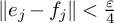 $\| e_{j} - f_{j} \| < \frac {\varepsilon }{4}$
for
 $j = 1, 2, \ldots , m $
. Since B is tracially
 $\mathcal {Z}$
-absorbing, there exists a c.p.c. order zero map
 $\varphi \colon {M}_{n} \to B$
such that
-
(1)
$\big ( w^{2} - w \varphi (1) w - \frac {\varepsilon }{4} \big )_{+} \precsim d$
. -
(2)
$\| [\varphi (z), e_{j}] \| < \frac {\varepsilon }{4}$
for
$j \in \{ 1, 2, \ldots , m \}$
and
$z \in {M}_{n}$
with
$\|z\| \leq 1$
.



Using (4.5),
 $\| w \| \leq 1$
, and
 $\| x \| \leq \frac {1}{4}$
at the third step, we then get
 $$ \begin{align*} & \big\| \big( w^{2} - w \varphi (1) w - \tfrac{\varepsilon}{4} \big)_{+} - \big( x^{2} - x \varphi (1) x \big) \big\| \\ & \hspace{3em} {\mbox{}} \leq \big\| \big( w^{2} - w \varphi (1) w - \tfrac{\varepsilon}{4} \big)_{+} - w^{2} - w \varphi (1) w \big\| \\ & \hspace{6em} {\mbox{}} + \big\| \big( w^{2} - w \varphi (1) w \big) - \big( x^{2} - x \varphi (1) x \big) \big\| \\ & \hspace{3em} {\mbox{}} \leq \tfrac{\varepsilon}{4} + \|w^{2} - x^{2} \| + \|w \varphi (1) w - w \varphi (1) x \| + \|w \varphi (1) x - x \varphi (1) x \| \\ & \hspace{3em} {\mbox{}} < \tfrac{\varepsilon}{4} + \tfrac{\varepsilon}{6} + \tfrac{\varepsilon}{12} + \tfrac{\varepsilon}{12} < \varepsilon. \end{align*} $$
Hence, using (1) at the second step and (4.4) at the third step, we get
 $$\begin{align*}\big( x^{2} - x \varphi (1) x - \varepsilon \big)_{+} \precsim \big( w^{2} - w \varphi (1) w - \tfrac{\varepsilon}{4} \big)_{+} \precsim d \precsim a. \end{align*}$$
Finally, for any
 $z \in {M}_{n}$
with
 $\| z \| \leq 1$
and for
 $j \in \{ 1, 2, \ldots , m \}$
, by (2), we have
 $$ \begin{align*} \| [\varphi (z), f_{j}] \| & \leq \|\varphi (z) f_{j} - \varphi (z) e_{j} \| + \|\varphi (z) e_{j} - e_{j} \varphi (z) \| + \| e_{j} \varphi (z) - f_{j} \varphi (z) \| \\ & < \tfrac{\varepsilon}{4} + \tfrac{\varepsilon}{4} + \tfrac{\varepsilon}{4} < \varepsilon. \end{align*} $$
So A is tracially
 $\mathcal {Z}$
-absorbing.
Corollary 4.8. Let A be a C*-algebra which is the direct limit of a system of simple tracially
 $\mathcal {Z}$
-absorbing C*-algebras. Then A is also simple and tracially
 $\mathcal {Z}$
-absorbing.
Proof. This follows immediately from Theorem 4.7.
For C*-algebras with an approximate identity (not necessarily increasing) consisting of projections we give a ‘unital’ equivalent statement for our ‘nonunital’ definition of tracial
 $\mathcal {Z}$
-absorption.
Proposition 4.9. Let A be a simple C*-algebra with an approximate identity
 $(p_{i})_{i \in I}$
(not necessarily increasing) consisting of projections. Then A is tracially
 $\mathcal {Z}$
-absorbing if and only if
 $p_{i} A p_{i}$
is tracially
 $\mathcal {Z}$
-absorbing in the unital sense for each
 $i \in I$
.
We can now generalize Lemma 3.13 to the nonunital case.
Proposition 4.10. Let A be an nonelementary simple C*-algebra with tracial rank zero (which is tracially AF; see [Reference Lin37, Definition 2.1]). Then A is tracially
 $\mathcal {Z}$
-absorbing.
Proof. Note that A is not assumed to be unital, and by definition, its minimal unitization is tracially AF. However, by [Reference Forough and Golestani21, Corollary A.22(1)], the algebra A has real rank zero. Therefore, A has an approximate identity
 $(p_{i})_{i \in I}$
(not necessarily increasing) consisting of projections. (This also follows from [Reference Lin37, Corollary 2.8].) The algebras
 $p_i A p_i$
have tracial rank zero by [Reference Forough and Golestani21, Corollary A.22(3)]. So they are tracially
 $\mathcal {Z}$
-absorbing by Lemma 3.13. Now Proposition 4.9 implies that A is tracially
 $\mathcal {Z}$
-absorbing.
Proposition 4.11. Let A be a simple C*-algebra. Then A is tracially
 $\mathcal {Z}$
-absorbing if and only if
 $A \otimes \mathcal {K}$
is tracially
 $\mathcal {Z}$
-absorbing.
Proof. The forward implication follows from Proposition 4.5 and Corollary 4.8. The converse follows from Theorem 4.1 because A is isomorphic to a hereditary subalgebra of
 $A \otimes \mathcal {K}$
. In fact, if p is a rank one projection in
 $ \mathcal {K}$
, then
 $p \mathcal {K} p =\mathbb {C}p$
, and hence, it follows that
 $A \otimes \mathbb {C}p$
is a hereditary subalgebra of
 $A \otimes \mathcal {K}$
isomorphic to A.
Corollary 4.12. Let A and B be simple C*-algebras.
-
(1) If A and B are stably isomorphic, and A is tracially
$\mathcal {Z}$
-absorbing, then so is B. -
(2) If A and B are
$\sigma $
-unital and Morita equivalent, and A is tracially
$\mathcal {Z}$
-absorbing, then so is B.


Proof. Part (1) follows from Proposition 4.11. For (2), let A and B be
 $\sigma $
-unital and Morita equivalent. By [Reference Raeburn and Williams47, Theorem 5.55],
 $A \otimes \mathcal {K} \cong B \otimes \mathcal {K}$
. Now the statement follows from (1).
It seems plausible that Corollary 4.12(2) holds even if A and B are not
 $\sigma $
-unital, but more work is needed.
5
$\mathcal {Z}$
-absorption and tracial
$\mathcal {Z}$
-absorption


In this section, we compare tracial
 $\mathcal {Z}$
-absorption with
 $\mathcal {Z}$
-absorption. We show that
 $\mathcal {Z}$
-absorption implies tracial
 $\mathcal {Z}$
-absorption, that the converse is false, but that the converse is true when the algebra is separable and nuclear [Reference Castillejos, Li and Szabó14] (see Remark 5.3).
First, we prove the following general result.
Theorem 5.1. Let A be a simple tracially
 $\mathcal {Z}$
-absorbing C*-algebra and let B be a simple C*-algebra. Then
 $A \otimes _{\mathrm {min}} B$
is tracially
 $\mathcal {Z}$
-absorbing.
Proof. Suppose we are given
 $\varepsilon> 0$
, a finite subset
 $F \subseteq A \otimes _{\mathrm {min}} B$
,
 $v, c \in ( A \otimes _{\mathrm {min}} B )_{+}$
with
 $c \neq 0$
, and
 $n \in {\mathbb {N}}$
. We have to find a c.p.c. order zero map
 $\varphi \colon {M}_{n} \to A \otimes _{\mathrm {min}} B$
such that the following hold:
-
(1)
$\left ( v^{2} - v \varphi (1) v - \varepsilon \right )_{+} \precsim c$
. -
(2)
$\| [\varphi (z), f] \| < \varepsilon $
for any
$z \in {M}_{n}$
with
$\| z \| \leq 1$
and any
$f \in F$
.


We may assume that there are
 $m \in {\mathbb {N}}$
and
 $$\begin{align*}r_1, r_2, \ldots, r_m \in A \qquad {\mbox{and}} \qquad s_1, s_2, \ldots, s_m \in B \end{align*}$$
such that
 $\| r_j \| \leq 1$
and
 $\| s_j \| \leq 1$
for
 $j = 1, 2, \ldots , m$
and such that
 $F = \big \{ r_{j} \otimes s_{j} \colon j = 1, 2, \ldots , m \big \}$
. By Kirchberg’s Slice Lemma ([Reference Rørdam, Rørdam and Størmer49, Lemma 4.1.9]), there are nonzero elements
 $a \in A_{+}$
and
 $b \in B_{+}$
such that
 $a \otimes b \precsim c$
in
 $A \otimes _{\mathrm {min}} B$
. Choose
 $\delta> 0$
such that
 $\delta < \varepsilon / 3$
. Since
 $A \otimes _{\mathrm {min}} B$
has an approximate identity consisting of elementary tensors
 $x \otimes y$
with x and y positive and of norm at most one, by Remark 3.8, we may assume that
 $v = x \otimes y$
with
 $x \in A_{+}$
,
 $y \in B_{+}$
, and
 $\| x \|, \, \| y \| \leq 1$
. By [Reference Kirchberg and Rørdam33, Proposition 2.7(v)], there is
 $k \in \mathbb {N}$
such that
-
(3)
$\left ( y^{2} - \delta \right )_{+} \precsim b \otimes 1_{k}$
in
${M}_{\infty } (B)$
.


Since A is simple and tracially
 $\mathcal {Z}$
-absorbing, Corollary 4.2 implies that A is not type I. Now Lemma 4.4 implies that there is
 $a_{0} \in A_{+} \setminus \{ 0 \}$
such that
-
(4)
$a_{0} \otimes 1_{k} \precsim a$
in
${M}_{\infty } (A)$
.


By assumption, A is tracially
 $\mathcal {Z}$
-absorbing. Applying Definition 3.6 with
 $\{ r_1, r_2, \ldots , r_m \}$
in place of F, with
 $\delta $
in place of
 $\varepsilon $
, with n as given and with
 $a_{0}$
in place of a, we obtain a c.p.c. order zero map
 $\varphi _{0} \colon {M}_{n} \to A$
such that the following hold:
-
(5)
$\left ( x^{2} - x \varphi _{0} (1) x - \delta \right )_{+} \precsim a_{0}$
. -
(6)
$\| [\varphi _{0} (z), r_j] \| < \delta $
for
$j = 1, 2, \ldots , m$
and any
$z \in {M}_{n}$
with
$\| z \| \leq 1$
.


Choose
 $e \in B_{+}$
such that
-
(7)
$\| e \| \leq 1$
,
$\| y e y - y^{2} \| < \delta $
, and
$\| e s_{j} - s_{j} \| < \delta $
and
$\| s_{j} e - s_{j} \| < \delta $
for
$j = 1, 2, \ldots , m$
.





Now define
 $\varphi \colon {M}_{n} \to A \otimes _{\mathrm {min}} B$
by
 $\varphi (z) = \varphi _{0} (z) \otimes e$
for
 $z \in {M}_{n}$
. Then
 $\varphi $
is a c.p.c. order zero map.
We show that (1) and (2) hold. To prove (1), first recall that
 $v = x \otimes y$
at the first step and use (7) at the last step to get
 $$ \begin{align*} & \big\| \big( v^{2} - v \varphi (1) v \big) - \big( x^{2} - x \varphi_{0} (1) x - \delta \big)_{+} \otimes \big( y^{2} - \delta \big)_{+} \big\| \\ & \hspace{3em} {\mbox{}} \leq \big\| x^{2} \otimes y^{2} - x \varphi_{0} (1) x \otimes y e y - \big( x^{2} - x \varphi_{0} (1) x \big) \otimes y^{2} \big\| + 2 \delta \\ & \hspace{3em} {\mbox{}} = \big\| x \varphi_{0} (1) x \otimes ( y^{2} - y e y ) \big\| + 2 \delta \\ & \hspace{3em} {\mbox{}} \leq \| y e y - y^{2} \| + 2 \delta < 3 \delta. \end{align*} $$
Then use Lemma 2.1 at the first step, use (3) and (5) at the second step, and use (4) at the fourth step to get
 $$ \begin{align*} \big( v^{2} - v \varphi (1) v - 3 \delta \big)_{+} & \precsim \big( x^{2} - x \varphi_{0} (1) x - \delta \big)_{+} \otimes \big( y^{2} - \delta \big)_{+} \\ & \precsim a_{0} \otimes ( b \otimes 1_{k} ) \sim ( a_{0} \otimes 1_{k} ) \otimes b \precsim a \otimes b \precsim c. \end{align*} $$
Thus,
 $$\begin{align*}\big( v^{2} - v \varphi (1) v - \varepsilon \big)_{+} \precsim \big( v^{2} - v \varphi (1) v - 3 \delta \big)_{+} \precsim c. \end{align*}$$
For (2), let
 $f \in F$
. Then there is
 $j \in \{ 1, 2, \ldots , m \}$
such that
 $f = r_{j} \otimes s_{j}$
. Let
 $z \in {M}_{n}$
satisfy
 $\| z \| \leq 1$
. Using (6) and (7) at the fourth step, we get
 $$ \begin{align*} & \| [\varphi (z), f] \| \\ & \hspace{1em} {\mbox{}} = \big\| [\varphi_{0} (z) \otimes e, \, r_{j} \otimes s_{j} ] \big\| \\ & \hspace{1em} {\mbox{}} = \big\| \varphi_{0} (z) r_{j} \otimes e s_{j} - r_{j} \varphi_{0} (z) \otimes s_{j} e \big\| \\ & \hspace{1em} {\mbox{}} \leq \big\| [ \varphi_{0} (z) , r_{j}] \otimes e s_{j} \big\| + \big\| r_{j} \varphi_{0} (z) \otimes (e s_{j} - s_{j}) \big\| + \big\| r_{j} \varphi_{0} (z) \otimes (s_{j} - s_{j} e) \big\| \\ & \hspace{1em} {\mbox{}} < \delta + \delta + \delta < \varepsilon. \end{align*} $$
This completes the proof.
Corollary 5.2. Let A be a simple
 $\mathcal {Z}$
-absorbing C*-algebra. Then A is tracially
 $\mathcal {Z}$
-absorbing.
Proof. By definition,
 $A \cong \mathcal {Z} \otimes A$
. By [Reference Hirshberg and Orovitz28, Proposition 2.2],
 $\mathcal {Z}$
is tracially
 $\mathcal {Z}$
-absorbing. Now Theorem 5.1 implies that A is tracially
 $\mathcal {Z}$
-absorbing.
For example, the Razak-Jacelon algebra
 $\mathcal {W}$
(see [Reference Jacelon29, Reference Nawata42]) is a stably projectionless tracially
 $\mathcal {Z}$
-absorbing C*-algebra.
Remark 5.3. In [Reference Castillejos, Li and Szabó14], it is proved that every simple separable nuclear tracially
 $\mathcal {Z}$
-absorbing C*-algebra A is
 $\mathcal {Z}$
-absorbing. The special case that A is not stably projectionless follows from the corresponding result for the unital case ([Reference Hirshberg and Orovitz28, Theorem 4.1]), the Morita invariance of
 $\mathcal {Z}$
-absorption in the class of separable C*-algebras ([Reference Toms and Winter52, Corollary 3.2]), and Theorems 4.1 and 5.1.
We obtain a different proof of a special case of [Reference Toms and Winter52, Corollary 3.4].
Corollary 5.4. Let A be a simple separable nuclear C*-algebra which is not stably projectionless and which is the direct limit of a system of simple
 $\mathcal {Z}$
-absorbing C*-algebras. Then A is
 $\mathcal {Z}$
-absorbing.
We now give examples of tracially
 $\mathcal {Z}$
-absorbing C*-algebras which are not
 $\mathcal {Z}$
-absorbing. Our examples are unital; no such examples were previously known, even in the unital case. We start with purely infinite examples. By Example 3.11, it is enough to find some separable purely infinite simple unital C*-algebra which is not
 $\mathcal {Z}$
-absorbing. The work for this is contained in Proposition 5.5. It is based on the ideas of [Reference Dykema and Rørdam17, Corollary 1.2], in which it is shown that an algebra A as in Proposition 5.5 is not approximately divisible. The execution here is much messier because we cannot use projections. A stably finite example is then obtained by applying Lemma 3.13 to an example in [Reference Niu and Wang41].
Proposition 5.5. For
 $j = 1, 2$
let
 $P_j$
be a von Neumann algebra, let
 $\omega _j \colon P_j \to {\mathbb {C}}$
be a faithful normal state, and let
 $G_j \subseteq P_j$
be a discrete subgroup of the unitary group
 $U (P_j)$
which is contained in the centralizer of
 $\omega _j$
and such that whenever
 $u, v \in G_j$
are distinct, then
 $\omega _j (v^* u) = 0$
. Suppose
 $G_1$
contains an element
 $a \neq 1$
, and
 $G_2$
contains distinct elements
 $b, c \neq 1$
. Let
 $(P, \omega )$
be the reduced free product von Neumann algebra
 $(P, \omega ) = (P_1, \omega _1) \star _{\mathrm {r}} (P_2, \omega _2)$
, equipped with its free product state
 $\omega $
. Let
 $A \subset P$
be any C*-subalgebra satisfying
 $a, b, c \in A$
. Then A is not
 ${\mathcal {Z}}$
-stable.
For a von Neumann algebra N and a state
 $\rho \colon N \to {\mathbb {C}}$
, a unitary
 $u \in N$
is in the centralizer of
 $\rho $
if and only if
 $\rho \circ {\mathrm {Ad}} (u) = \rho $
.
The algebras are called
 $(M_j, \varphi _j)$
in [Reference Barnett10], but this notation conflicts with notation for matrix algebras.
As discussed at the beginning of [Reference Barnett10, Section 2], the state
 $\omega $
is necessarily faithful and normal. By [Reference Barnett10, Theorem 2], P is a factor of type
 ${\mathrm {III}}$
.
Proof of Proposition 5.5.
Let D be the dimension drop interval algebra
 $$\begin{align*}D = \big\{ g \in C \big( [0, 1], \, M_2 \otimes M_3 \big) \colon {g\ (0) \in M_2 \otimes {\mathbb{C}} \cdot 1 \text{and} \ g (1) \in {\mathbb{C}} \cdot 1 \otimes M_3} \big\}. \end{align*}$$
It suffices to show that there is no approximately central sequence of unital homomorphisms from D to A. To do this, we set
 $$\begin{align*}N = 24 \qquad {\mbox{and}} \qquad \varepsilon = \frac{1}{70}. \end{align*}$$
We let
 $(e_{j, k})_{j, k = 1, 2}$
be the standard system of matrix units for
 $M_2$
, and we let
 $(f_{j, k})_{j, k = 1, 2, 3}$
be the standard system of matrix units for
 $M_3$
. For
 $n = 1, 2, \ldots , N$
, define
 $h_n \colon [0, 1] \to [0, 1]$
by
 $$\begin{align*}h_n (\lambda) = \begin{cases} 0 & \hspace{1em} 0 \leq \lambda \leq \frac{n - 1}{N} \\ N \lambda - n + 1 & \hspace{1em} \frac{n - 1}{N} < \lambda < \frac{n}{N} \\ 1 & \hspace{1em} \frac{n}{N} \leq \lambda \leq 1. \end{cases} \end{align*}$$
Then define functions
 $r_{j, n} \in D$
for
 $j = 1, 2$
and
 $s_{j, n} \in D$
for
 $j = 1, 2, 3$
by
 $$\begin{align*}r_{j, n} (\lambda) = (1 - h_n (\lambda)) (e_{j, j} \otimes 1) \qquad {\mbox{and}} \qquad s_{j, n} (\lambda) = h_n (\lambda) (1 \otimes f_{j, j}). \end{align*}$$
Next, define a compact set
 $S \subseteq D$
to consist of the functions defined for
 $\lambda \in [0, 1]$
by
 $$\begin{align*}\lambda \mapsto (u \otimes 1) r_{1, n} (\lambda) (u \otimes 1)^* \end{align*}$$
for
 $u \in U (M_2)$
and
 $n = 1, 2, \ldots , N$
, and
 $$\begin{align*}\lambda \mapsto (1 \otimes v) s_{1, n} (\lambda) (1 \otimes v)^* \end{align*}$$
for
 $v \in U (M_3)$
and
 $n = 1, 2, \ldots , N$
.
If there were an approximately central sequence of unital homomorphisms from D to A, then, in particular, there would be a unital homomorphism
 $\varphi \colon D \to A$
such that
 $$ \begin{align} \| [ \varphi (g), a ] \| < \varepsilon, \qquad \| [ \varphi (g), b ] \| < \varepsilon, \qquad {\mbox{and}} \qquad \| [ \varphi (g), c ] \| < \varepsilon \end{align} $$
for all
 $g \in S$
. We will show that this cannot happen.
Suppose therefore that
 $\varphi \colon D \to A$
is a unital homomorphism such that (5.1) holds for all
 $g \in S$
. Regard
 $C ([0, 1])$
as a unital subalgebra of D in the obvious way. Let
 $\mu $
be the Borel probability measure on
 $[0, 1]$
such that
 $(\omega \circ \varphi ) (g) = \int _{[0, 1]} g \, d \mu $
for all
 $g \in C ([0, 1])$
. We have
 $$\begin{align*}\sum_{n = 1}^N \mu \left( \left[ \frac{n - 1}{N}, \, \frac{n}{N} \right] \right) \leq 2 \mu ([0, 1]) = 2, \end{align*}$$
so there exists
 $n \in \{ 1, 2, \ldots , N \}$
such that if we set
 $I = \left [ \frac {n - 1}{N}, \, \frac {n}{N} \right ]$
, then
 $\mu (I) \leq \frac {2}{N}$
. Set
 $\alpha = (\omega \circ \varphi ) (h_n)$
.
We have
 $r_{1, n} + r_{2, n} = 1 - h_n$
, so
 $$\begin{align*}(\omega \circ \varphi) (r_{1, n}) + (\omega \circ \varphi) (r_{2, n}) = 1 - \alpha. \end{align*}$$
Therefore, there are
 $j, k \in {1, 2}$
such that
 $$\begin{align*}(\omega \circ \varphi) (r_{j, n}) \geq \frac{1 - \alpha}{2} \qquad {\mbox{and}} \qquad (\omega \circ \varphi) (r_{k, n}) \leq \frac{1 - \alpha}{2}. \end{align*}$$
The set of functions
 $$\begin{align*}\lambda \mapsto (u \otimes 1) r_{1, n} (\lambda) (u \otimes 1)^* \end{align*}$$
for
 $u \in U (M_2)$
, is connected and contains both
 $r_{j, n}$
and
 $r_{k, n}$
. Therefore, there is
 $u \in U (M_2)$
such that the function
 $$\begin{align*}r (\lambda) = (u \otimes 1) r_{1, n} (\lambda) (u \otimes 1)^* \end{align*}$$
satisfies
 $(\omega \circ \varphi ) (r) = \frac {1}{2} (1 - \alpha )$
. A similar argument, starting with
 $$\begin{align*}(\omega \circ \varphi) (s_{1, n}) + (\omega \circ \varphi) (s_{2, n}) + (\omega \circ \varphi) (s_{3, n}) = \alpha, \end{align*}$$
produces
 $v \in U (M_3)$
such that the function
 $$\begin{align*}s (\lambda) = (1 \otimes v) s_{1, n} (\lambda) (1 \otimes v)^* \end{align*}$$
satisfies
 $(\omega \circ \varphi ) (s) = \frac {\alpha }{3}$
. Then
 $(\omega \circ \varphi ) (r + s) \in \big [ \frac {1}{3}, \frac {1}{2} \big ]$
. It follows that
 $$ \begin{align} (\omega \circ \varphi) (r + s) - \big[ (\omega \circ \varphi) (r + s) \big]^2 \geq \frac{1}{6}. \end{align} $$
Define
 $l \in C ([0, 1])$
by
 $$\begin{align*}l (\lambda) = \big\| r (\lambda) + s (\lambda) - (r (\lambda) + s (\lambda))^2 \big\| \end{align*}$$
for
 $\lambda \in [0, 1]$
. We have
 $0 \leq r + s \leq 1$
, so
 $0 \leq (r + s)^2 \leq r + s$
, and
 $$\begin{align*}0 \leq r + s - (r + s)^2 \leq l \leq 1. \end{align*}$$
Also,
 $l (\lambda ) = 0$
for
 $\lambda \not \in I$
. Therefore,
 $$ \begin{align*} 0 & \leq (\omega \circ \varphi) (r + s) - (\omega \circ \varphi) \big( (r + s)^2 \big) \\ & \leq (\omega \circ \varphi) (l) = \int_{[0, 1]} l \, d \mu \leq \mu (I) \leq \frac{2}{N} = \frac{1}{12}. \end{align*} $$
Combining this inequality with (5.2) gives
 $$ \begin{align} (\omega \circ \varphi) \big( (r + s)^2 \big) - \big[ (\omega \circ \varphi) (r + s) \big]^2 \geq \frac{1}{12}. \end{align} $$
Recall that for
 $x \in P$
, we have
 $\| x \|_{\omega } = \omega (x^* x)^{1/2}$
. In particular,
 $\| x \|_{\omega } \leq \| x \|$
. The proof of [Reference Barnett10, Theorem 11] shows that for every
 $x \in P$
, we have
 $$\begin{align*}\| x - \omega (x) \cdot 1 \|_{\omega} \leq 14 \max \big( \| [x, a] \|_{\omega}, \, \| [x, b] \|_{\omega}, \, \| [x, c] \|_{\omega} \big). \end{align*}$$
If
 $0 \leq x \leq 1$
, a calculation shows that
 $$\begin{align*}\| x - \omega (x) \cdot 1 \|_{\omega}^2 = \omega (x^2) - \omega (x)^2. \end{align*}$$
Put
 $x = r + s$
and use (5.3) at the first step and (5.1) at the third step to get
 $$ \begin{align*} \frac{1}{12} & \leq 14^2 \max \big( \| [x, a] \|_{\omega}^2, \, \| [x, b] \|_{\omega}^2, \, \| [x, c] \|_{\omega}^2 \big) \\ & \leq 14^2 \max \big( \| [x, a] \|^2, \, \| [x, b] \|^2, \, \| [x, c] \|^2 \big) < 14^2 \varepsilon^2 = \frac{1}{25}, \end{align*} $$
a contradiction.
Example 5.6. There is a simple separable unital purely infinite C*-algebra which is not
 ${\mathcal {Z}}$
-stable.
We start with the example at the end of [Reference Barnett10], which gives
 $(P_1, \omega _1)$
and
 $(P_2, \omega _2)$
, satisfying the hypotheses of Proposition 5.5. Let
 $(P, \omega )$
and
 $a, b, c \in P$
be as there.
Since, by [Reference Barnett10, Theorem 2], P is a factor of type
 ${\mathrm {III}}$
, we can apply [Reference Dykema and Rørdam17, Proposition 1.3(i)] (whose method goes at least back to [Reference Blackadar6, Proposition 2.2]) to find a purely infinite simple separable C*-algebra
 $A \subseteq P$
such that
 $a, b, c \in A$
. Then A is not
 ${\mathcal {Z}}$
-stable by Proposition 5.5.
In fact, one can explicitly write down a purely infinite simple separable reduced free product algebra which is not
 ${\mathcal {Z}}$
-stable.
Example 5.7. Let A be the reduced free product
 $A = (M_2 \otimes M_2) \star _{\mathrm {r}} C ([0, 1])$
, taken with respect to the Lebesgue measure state on
 $C ([0, 1])$
and the state on
 $M_2 \otimes M_2$
given by tensor product of the usual tracial state
 ${\mathrm {tr}}$
with the state
 $\rho (x) = {\operatorname {tr}} \big ( {\mathrm {diag}} \big ( \frac {1}{3}, \frac {2}{3} \big ) x \big )$
on
 $M_2$
. We claim that A is purely infinite and simple but not
 ${\mathcal {Z}}$
-stable.
To prove pure infiniteness, in [Reference Dykema16, Example 3.9(iii)], take
 $A_1 = M_2$
with the state
 ${\mathrm {tr}}$
, take
 $F = M_2$
with the state
 $\rho $
, and take
 $B = C ([0, 1])$
with the state given by Lebesgue measure. These choices satisfy the hypotheses there. So A is purely infinite and simple.
To prove failure of
 ${\mathcal {Z}}$
-stability, in Proposition 5.5, take
 $P_1 = M_2 \otimes M_2$
with the state
 ${\operatorname {tr}} \otimes \rho $
, and take
 $P_2 = L^{\infty } ([0, 1])$
with the state given by Lebesgue measure. Take
 $G_1 = \left \{ 1, \, \left ( \begin {smallmatrix} 1 & 0 \\ 0 & -1 \end {smallmatrix} \right ) \otimes 1 \right \}$
, and take
 $G_2$
to be the set of functions
 $\lambda \mapsto e^{2 \pi i n \lambda }$
for
 $n \in \mathbb {Z}$
. These choices satisfy the hypotheses there. Moreover,
 $G_2 \subseteq C ([0, 1])$
. Therefore, the reduced free product
 $A = (M_2 \otimes M_2) \star _{\mathrm {r}} C ([0, 1])$
is a subalgebra of the algebra P of Proposition 5.5 which contains a, b and c, so is not
 ${\mathcal {Z}}$
-stable by Proposition 5.5.
One might hope that if A is a purely infinite simple separable C*-algebra, then the conditions of
 ${\mathcal {O}}_{\infty }$
-stability,
 ${\mathcal {Z}}$
-stability and approximate divisibility are all equivalent. This seems too good to be true.
Example 5.8. There is a simple separable stably finite unital C*-algebra which is tracially
 $\mathcal {Z}$
-absorbing but not
 $\mathcal {Z}$
-absorbing. Start with the example in [Reference Niu and Wang41] of a simple separable stably finite unital C*-algebra which has tracial rank zero [Reference Lin38, Definition 3.6.2] but is not
 $\mathcal {Z}$
-absorbing. This algebra is tracially
 $\mathcal {Z}$
-absorbing by Lemma 3.13.
6 The Cuntz semigroup
In this section, we generalize Theorem 3.3 of [Reference Hirshberg and Orovitz28] to the nonunital case. More precisely, we show that if A is a simple tracially
 $\mathcal {Z}$
-absorbing C*-algebra, then
 $W (A)$
is almost unperforated. This implies that A has strict comparison in a sense suitable for nonunital C*-algebras. (See Definition 6.8 below.) The proof is a modification of the argument given in [Reference Hirshberg and Orovitz28]. Moreover, we show that A is weakly almost divisible, as in Definition 6.11.
Definition 6.1. Let A be a C*-algebra and let
 $a \in {M_{\infty } (A)}_{+}$
. We say that a is weakly purely positive if 0 is an accumulation point of
 $\mathrm {sp} (a)$
.
Remark 6.2. Recall (see before [Reference Ara, Perera, Toms, Ara, Lledó and Perera2, Corollary 2.24]) that
 $a \in {M_{\infty } (A)}_{+}$
is called purely positive if there is no projection
 $p \in {M_{\infty } (A)}_{+}$
such that
 $\langle p \rangle = \langle a \rangle $
in
 $W (A)$
. By [Reference Ara, Perera, Toms, Ara, Lledó and Perera2, Proposition 2.23], if A is a unital C*-algebra with
 $\mathrm {tsr} (A) = 1$
, then
 $a \in {M_{\infty } (A)}_{+}$
is weakly purely positive if and only if a is purely positive. In general, pure positivity implies weak pure positivity. We do not know whether the converse holds.
The following lemma is a nonunital analog of [Reference Hirshberg and Orovitz28, Lemma 3.2].
Lemma 6.3. Let A be a simple tracially
 $\mathcal {Z}$
-absorbing C*-algebra. Let
 $a, b \in A_{+}$
. Suppose b is weakly purely positive and there is a positive integer n such that
 $n \langle a \rangle \leq n \langle b \rangle $
in
 $W (A)$
. Then
 $a \precsim b$
.
Some parts of the proof are similar to the proof of [Reference Hirshberg and Orovitz28, Lemma 3.2]. (See [Reference Hirshberg and Orovitz28, Notation 2.13] for some of the notation used in that proof.) We provide a complete proof because of some differences due to the absence of the identity.
Proof of Lemma 6.3.
We may assume that
 $\| a \| = \| b \| = 1$
. Let
 $\varepsilon> 0$
; we prove that
 $(a - \varepsilon )_{+} \precsim b$
.
The assumption says
 $a \otimes 1_{n} \precsim b \otimes 1_{n}$
. By [Reference Kirchberg and Rørdam33, Proposition 2.6], there is
 $\delta> 0$
such that
 $$\begin{align*}\big( a \otimes 1_{n} - \tfrac{\varepsilon}{2} \big)_{+} \precsim ( b \otimes 1_{n} - \delta )_{+}. \end{align*}$$
Choose
 $c_0 \in M_n (A)$
such that
 $$\begin{align*}\big\| c_0 \big[ (b \otimes 1_{n} - \delta)_{+} \big] c_0^* - \big( a \otimes 1_{n} - \tfrac{\varepsilon}{2} \big)_{+} \big\| < \tfrac{\varepsilon}{2}. \end{align*}$$
It follows from Lemma 2.1 that there is
 $c_1 \in M_n (A)$
such that
 $$\begin{align*}c_1 c_0 \big[ (b \otimes 1_{n} - \delta)_{+} \big] c_0^* c_1^* = \big( \big( a \otimes 1_{n} - \tfrac{\varepsilon}{2} \big)_{+} - \tfrac{\varepsilon}{2} \big)_{+}. \end{align*}$$
Thus,
 $$\begin{align*}c_1 c_0 \big[ (b - \delta)_{+} \otimes 1_{n} \big] (c_1 c_0)^{*} = (a - \varepsilon)_{+} \otimes 1_{n}. \end{align*}$$
Let
 $f_{1}, f_{2} \in C_{0} ((0 , 1])$
be nonnegative functions such that
 $f_{1} = 0$
on
 $\big [ \frac {\delta }{2}, 1 \big ]$
,
 $f_{1}> 0$
on
 $\big ( 0, \frac {\delta }{2} \big )$
, and
 $\| f_{1} \| = 1$
, and such that
 $f_{2} = 0$
on
 $\big [ 0, \frac {\delta }{2} \big ]$
and
 $f_{2} = 1$
on
 $[\delta , 1]$
. Put
 $d =f_{1} (b)$
. Since b is weakly purely positive,
 $d \neq 0$
. Put
 $c = c_1 c_0 [f_{2} (b) \otimes 1_{n}]$
. Since
 $f_{2} (\lambda ) (\lambda - \delta )_{+} = (\lambda - \delta )_{+}$
for
 $\lambda \in [0, 1]$
and
 $ f_{1} f_{2} = 0$
, we get
 $$\begin{align*}c \big[ (b - \delta)_{+} \otimes 1_{n} \big] c^{*} = (a - \varepsilon)_{+} \otimes 1_{n} \qquad {\mbox{and}} \qquad c (d \otimes 1_{n}) = 0. \end{align*}$$
Write
 $c = (c_{j, k})_{1 \leq j, k \leq n}$
with
 $c_{j, k} \in A$
for
 $j, k = 1, 2, \ldots , n$
. Then
 $$ \begin{align} c_{j, k} d = 0. \end{align} $$
For any
 $\mu> 0$
, we will find
 $z \in A$
such that
 $$ \begin{align} \big\| z \big[ (b - \delta)_{+} + d \big] z^{*} - (a - \varepsilon)_{+} \big\| < \mu. \end{align} $$
This will prove the first step in the calculation
 $$\begin{align*}(a - \varepsilon)_{+} \precsim (b - \delta)_{+} + d \precsim b; \end{align*}$$
since the second step is clear, and
 $\varepsilon> 0$
is arbitrary, we will have finished the proof.
So fix
 $\mu> 0$
. We have
 $$ \begin{align} \sum_{l = 1}^{n} c_{j, l} (b - \delta)_{+} c_{k, l}^{*} = \begin{cases} (a - \varepsilon)_{+} & \hspace{1em} j = k \\ 0 & \hspace{1em} j \neq k. \end{cases} \end{align} $$
As in the proof of [Reference Hirshberg and Orovitz28, Lemma 3.1], define
 $g, h \in C_{0} ((0, 1])$
by
 $$\begin{align*}g (\lambda) = \begin{cases} \sqrt{ 13 \lambda / \mu} & \hspace{1em} \lambda < \mu / 13 \\ 1 & \hspace{1em} \lambda \geq \mu / 13 \end{cases} \qquad {\mbox{and}} \qquad h (\lambda) = 1 - \sqrt{1 - \lambda} \end{align*}$$
for
 $\lambda \in [0, 1]$
. Then
 $$ \begin{align} | g (\lambda)^{2} \lambda - \lambda | < \tfrac{\mu}{12} \qquad {\mbox{and}} \qquad 1 - h (\lambda) = \sqrt{1 - \lambda} \end{align} $$
for all
 $\lambda \in [0, 1]$
.
Put
 $$\begin{align*}F = \big\{ (a - \varepsilon)_{+} \big\} \cup \big\{ c_{j, k} (b - \delta)_{+} c^{*}_{l, m} \colon j, k, l, m = 1, 2, \ldots, n \big\}. \end{align*}$$
At this point, we need functional calculus for c.p.c. order zero maps for a function
 $k \in C_0 ((0, 1])$
([Reference Winter and Zacharias55, Corollary 4.2]). We follow the notation there, writing
 $k (\varphi )$
(and then
 $\varphi ^{1/2}$
), rather than
 $k [\varphi ]$
(and
 $\sqrt {[\varphi ]}$
) as in [Reference Hirshberg and Orovitz28, Notation 2.13]. We briefly recall its construction, slightly simplified since the domain is unital. By [Reference Winter and Zacharias55, Theorem 3.3]), there is a unital homomorphism
 $\pi $
from
 $M_n$
to the multiplier algebra of the C*-algebra generated by the range of
 $\varphi $
such that
 $\varphi (w) = \varphi (1) \pi (w) = \pi (w) \varphi (1)$
for all
 $w \in M_n$
. Then
 $k (\varphi ) (w) = k (\varphi (1)) \pi (w)$
for all
 $w \in M_n$
. We need two consequences:
 $$ \begin{align} k (\varphi) (w) \cdot \varphi (1) = \varphi (1) \cdot k (\varphi) (w) \end{align} $$
for any
 $k \in C_0 ((0, 1])$
and
 $w \in M_n$
, and
 $$ \begin{align} k (\varphi) (w_1) \cdot k (\varphi) (w_2) = k (\varphi (1)) \cdot k (\varphi) (w_1 w_2) \end{align} $$
for any
 $f \in C_0 ((0, 1])$
and
 $w_1, w_2 \in M_n$
.
For any C*-algebras B and A, any map
 $\varphi \colon B \to A$
and any subset
 $F \subseteq A$
, we define
 $$\begin{align*}C (\varphi, F) = \sup \big( \big\{ \| [\varphi (w), y] \| \colon {{w \in B \text{satisfies} \| w \| \leq 1 \text{and} y \in F}} \big\} \big). \end{align*}$$
It follows from [Reference Hirshberg and Orovitz28, Lemma 2.8] that there is
 $\eta _{0}> 0$
such that if
 $\varphi \colon M_{n} \to A$
is a c.p.c. order zero map with
 $C (\varphi , F) < \eta _{0}$
, then
 $$ \begin{align} C ( g (\varphi), F ) < \frac{\mu}{24n^{4}}, \qquad C ( \varphi^{1/2}, F ) < \frac{\mu}{24n^{4}}, \qquad {\mbox{and}} \qquad C ( h (\varphi), F ) < \frac{\mu}{6}. \end{align} $$
Use [Reference Archey and Phillips4, Lemma 2.5] to choose
 $\eta> 0$
such that
 $\eta < \min \big ( \eta _{0}, \tfrac {\mu }{30} \big )$
and such that whenever
 $e, s \in A_{+}$
satisfy
 $$\begin{align*}\| e \| \leq 1, \qquad \| s \| \leq 1, \qquad {\mbox{and}} \qquad \| e s - s e \| < 9 \eta, \end{align*}$$
then
 $\big \| e^{1/2} s - s e^{1/2} \big \| < \mu / 6$
. Choose
 $x \in A_{+}$
such that
 $$ \begin{align} \| x \| \leq 1 \qquad {\mbox{and}} \qquad \big\| x (a - \varepsilon)_{+} - (a - \varepsilon)_{+} \big\| < \eta. \end{align} $$
Applying Definition 3.6, with
 $\eta $
in place of
 $\varepsilon $
, and with n, F and x as given, we obtain a c.p.c. order zero map
 $\varphi \colon M_{n} \to A$
such that
 $$ \begin{align} C ( \varphi, F) < \eta \qquad {\mbox{and}} \qquad \big( x^{2} - x \varphi (1) x - \eta \big)_{+} \precsim d. \end{align} $$
Put
 $$ \begin{align} r_0 = 1 - \varphi (1) \qquad {\mbox{and}} \qquad r = \big( x^{2} - x \varphi (1) x - \eta \big)_{+} = (x r_0 x - \eta)_{+}. \end{align} $$
Then
 $r_0 \in A^{\sim }$
and
 $r \in A$
. Set
 $$\begin{align*}a_{1} = \varphi (1) (a - \varepsilon)_{+}, \ \ \ a_{2} = r_0^{1/2} (a - \varepsilon)_{+} r_0^{1/2}, \ \ \ {\mbox{and}} \ \ \ a_{3} = r^{1/2} (a - \varepsilon)_{+} r^{1/2}. \end{align*}$$
Since
 $$ \begin{align} \big\| \big[ r_0, \, (a - \varepsilon)_{+} \big] \big\| = \big\| \big[ 1 - \varphi (1), \, (a - \varepsilon)_{+} \big] \big\| = \big\| \big[ \varphi (1), \, (a - \varepsilon)_{+} \big] \big\| < \eta, \end{align} $$
the choice of
 $\eta $
implies
 $$ \begin{align} \big\| (a - \varepsilon)_{+} - (a_{1} + a_{2}) \big\| < \frac{\mu}{6}. \end{align} $$
For
 $j, k = 1, 2, \ldots , n$
, let
 $e_{j, k} \in M_n$
be the standard matrix unit, and set
 $$ \begin{align} g_{j, k} = g (\varphi) (e_{j, k}) \qquad {\mbox{and}} \qquad \widehat{c}_{j, k} = \varphi^{1/2} (1) g_{j, k} c_{j, k}. \end{align} $$
Then set
 $\widehat {c} = \sum _{j, k = 1}^{n} \widehat {c}_{j, k}$
.
We claim that
 $$ \begin{align} \big\| \widehat{c} (b - \delta)_{+} \widehat{c}^{*} - a_{1} \big\| < \frac{\mu}{6}. \end{align} $$
We follow the proof of [Reference Hirshberg and Orovitz28, Lemma 3.1]. One checks, following the steps there and using (6.6) and (6.3), that
 $$ \begin{align} \sum_{j, k, l, m = 1}^{n} g_{j, k} g_{l, m} c_{j, k} (b - \delta)_{+} c_{m, l}^{*} = g (\varphi) (1)^2 \cdot (a - \varepsilon)_{+}. \end{align} $$
Now, using (6.13) at the second step, using (6.7) at the third step, using (6.7) and (6.5) at the fourth step, using (6.15) at the fifth step, and using (6.4) at the sixth step, we have
 $$ \begin{align*} \widehat{c} (b - \delta)_{+} \widehat{c}^{*} & = \sum_{j, k, l, m = 1}^{n} \widehat{c}_{j, k} (b - \delta)_{+} \widehat{c}^{*}_{m, l} \\ & = \varphi^{1/2} (1) \left( \sum_{j, k, l, m = 1}^{n} g_{j, k} c_{j, k} (b - \delta)_{+} c_{m, l}^{*} g_{l, m} \right) \varphi^{1/2} (1) \\ & \approx_{\mu / 24} \varphi^{1/2} (1) \left( \sum_{j, k, l, m = 1}^{n} g_{j, k} g_{l, m} c_{j, k} (b - \delta)_{+} c_{m, l}^{*} \right) \varphi^{1/2} (1) \\ & \approx_{\mu / 24} \varphi (1) \left(\sum_{j, k, l, m = 1}^{n} g_{j, k} g_{l, m} c_{j, k} (b - \delta)_{+} c_{m, l}^{*} \right) \\ & = \varphi (1) \cdot g (\varphi) (1)^2 \cdot (a - \varepsilon)_{+} \\ & \approx_{\mu / 12} \varphi (1) (a - \varepsilon)_{+} \\ & = a_{1}. \end{align*} $$
This proves (6.14).
We claim that
 $$ \begin{align} \| a_{2} - a_{3} \| < \frac{\mu}{2}. \end{align} $$
First, using (6.10) at the first step, using (6.8) at the second and fourth steps, and using (6.11) and (6.10) at the third and fifth steps, we have
 $$ \begin{align*} r (a -\varepsilon)_{+} & \approx_{\eta} x r_0 x (a - \varepsilon)_{+} \approx_{\eta} x r_0 (a - \varepsilon)_{+} \\ & \approx_{\eta} x (a - \varepsilon)_{+} r_0 \approx_{\eta} (a - \varepsilon)_{+} r_0 \approx_{\eta} r_0 (a - \varepsilon)_{+}. \end{align*} $$
Thus,
 $$\begin{align*}\big\| r (a - \varepsilon)_{+} - r_0 (a - \varepsilon)_{+} \big\| < 5 \eta \qquad {\mbox{and}} \qquad \big\| r (a - \varepsilon)_{+} - (a - \varepsilon)_{+} r_0 \big\| < 4 \eta. \end{align*}$$
Taking adjoints in the second inequality and combining gives
 $$\begin{align*}\big\| r (a - \varepsilon)_{+} - (a - \varepsilon)_{+} r \big\| < 9 \eta. \end{align*}$$
By the choice of
 $\eta $
, and using (6.11) for the first inequality,
 $$\begin{align*}\big\| r_0^{1/2} (a - \varepsilon)_{+} - (a - \varepsilon)_{+} r_0^{1/2} \big\| < \frac{\mu}{6} \quad {\mbox{and}} \quad \big\| r^{1/2} (a - \varepsilon)_{+} - (a - \varepsilon)_{+} r^{1/2} \big\| < \frac{\mu}{6}. \end{align*}$$
Now
 $$ \begin{align*} \| a_{2} - a_{3} \| & = \big\| r_0^{1/2} (a - \varepsilon)_{+}r_0^{1/2} - r^{1/2} (a - \varepsilon)_{+} r^{1/2} \big\| \\ & \leq \frac{\mu}{6} + \frac{\mu}{6} + \big\| r_0 (a - \varepsilon)_{+} - r (a - \varepsilon)_{+} \big\| \\ & < \frac{\mu}{3} + 5 \eta < \frac{\mu}{3} + \frac{\mu}{6} = \frac{\mu}{2}. \end{align*} $$
This proves (6.16).
Using (6.9) and (6.10) for the second step, we get
 $a_{3} \precsim r \precsim d$
. Choose
 $s \in A$
such that
 $\| s d s^{*} - a_{3} \| < \frac {\mu }{6}$
. Since
 $d = f (b)$
, as in the proof of [Reference Hirshberg and Orovitz28, Lemma 3.1], replacing s with
 $s k (b)$
for a function
 $k \in C ([0, 1])$
which is
 $1$
on
 $\big [ 0, \frac {\delta }{2} \big ]$
and vanishes on
 $[\delta , 1]$
, we may assume that
 $s (b - \delta )_{+} = 0$
. Set
 $z = \widehat {c} + s$
. Using (6.1) and (6.13) at the first step, and using (6.14), (6.16), and (6.12) at the third step, we get
 $$ \begin{align*} & \big\| z[(b - \delta)_{+} + d]z^{*} - (a - \varepsilon)_{+} \big\| \\ & \hspace{1em} {\mbox{}} = \big\| \widehat{c} (b - \delta)_{+} \widehat{c}^{*} + s d s^{*} - (a - \varepsilon)_{+} \big\| \\ & \hspace{1em} {\mbox{}} \leq \big\| \widehat{c} (b - \delta)_{+} \widehat{c}^{*} - a_{1} \big\| + \| s d s^{*} - a_{3} \| + \| a_{3} - a_{2} \| + \| a_{1} + a_{2} - (a - \varepsilon)_{+} \| \\ & \hspace{1em} {\mbox{}} < \frac{\mu}{6} + \frac{\mu}{6} + \frac{\mu}{2} + \frac{\mu}{6} = \mu. \end{align*} $$
This proves (6.2) and completes the proof.
The following theorem is the nonunital generalization of [Reference Hirshberg and Orovitz28, Theorem 3.1]. The proof is essentially the same.
Theorem 6.4. Let A be a simple tracially
 $\mathcal {Z}$
-absorbing C*-algebra. Then
 $W (A)$
is almost unperforated.
Proof. Let
 $a, b \in M_{\infty } (A)_{+}$
. Suppose there is
 $k \geq 2$
such that
 $k \langle a \rangle \leq (k - 1) \langle b \rangle $
. We have to show that
 $a \precsim b$
. Choose
 $n \in \mathbb {N}$
such that
 $a, b \in M_{n} (A)_{+}$
. Since
 $M_{n} (A)$
is tracially
 $\mathcal {Z}$
-absorbing (by Proposition 4.5), we may assume that
 $a, b \in A$
. If b is weakly purely positive, then Lemma 6.3 implies that
 $a \precsim b$
. If b is not weakly purely positive, then b is not purely positive. So there exists a projection
 $p \in A$
such that
 $\langle p \rangle = \langle b \rangle $
. We may assume that
 $p \neq 0$
. Since A is not type I (by Corollary 4.2), we can apply [Reference Hirshberg and Orovitz28, Lemma 3.1] to obtain a weakly purely positive element
 $c \in A$
such that
 $(k - 1) \langle p \rangle \leq k \langle c \rangle $
and
 $c \leq p$
. Thus,
 $k \langle a \rangle \leq (k - 1) \langle p \rangle \leq k \langle c \rangle $
. Therefore, by Lemma 6.3,
 $a \precsim c \leq p \sim b$
.
For strict comparison, we need dimension functions. We give careful statements since there is conflicting terminology in the literature.
Definition 6.5. Let A be a C*-algebra. A dimension function d on A is an additive order preserving function
 $d \colon W (A) \to [0, \infty ]$
. It is equivalent to give a function
 $d \colon M_{\infty } (A)_{+} \to [0, \infty ]$
such that
 $d (a \oplus b) = d (a) + d (b)$
and
 $a \precsim b$
implies
 $d (a) \leq d (b)$
, and we use the same letter for both versions of a dimension function. The set of all dimension functions on A is denoted by
 $\mathrm {DF} (A)$
.
This definition is given after [Reference Rørdam50, Theorem 4.5]. We warn that at the beginning of [Reference Rørdam48, Section 4], the algebra A is assumed unital and it is required that
 $d ( \langle 1_A \rangle ) = 1$
, a state where there is an additive order preserving function from
 $W (A)$
to
 $[0, \infty )$
. In [Reference Blackadar and Handelman8, Definition I.1.2], the algebra A is not assumed unital, but it is required that
 $\sup _{a \in A_{+}} d (a) = 1$
. (In [Reference Blackadar and Handelman8, Definition I.1.2], a dimension function d is actually taken to be defined on
 $M_{\infty } (A)$
, but to satisfy
 $d (a) = d (a^* a)$
for all
 $a \in M_{\infty } (A)$
.)
The following is also from after [Reference Rørdam50, Theorem 4.5], except that the definition of lower semicontunity is from the beginning of [Reference Rørdam50, Section 4].
Definition 6.6. Let A be a C*-algebra, and let
 $d \colon M_{\infty } (A)_{+} \to [0, \infty ]$
be a dimension function. We say that d is lower semicontinuous if whenever
 $(a_n)_{n \in {\mathbb {N}}}$
is a sequence in
 $M_{\infty } (A)_{+}$
and
 $\| a_n - a \| \to 0$
, then
 $d (a) \leq \liminf _{n \to \infty } d (a_n)$
.
Lemma 6.7 (Proposition 4.1 of [Reference Rørdam48]).
Let A be a C*-algebra, and let
 $d \colon M_{\infty } (A)_{+} \to [0, \infty ]$
be a dimension function. Define
 ${\overline {d}} \colon M_{\infty } (A)_{+} \to [0, \infty ]$
by
 $$\begin{align*}{\overline{d}} (a) = \lim_{\varepsilon \to 0^{+}} d \big( (a - \varepsilon)_{+} \big) \end{align*}$$
for
 $a \in M_{\infty } (A)_{+}$
. Then
 ${\overline {d}}$
is lower semicontinuous, and
 ${\overline {d}} = d$
if and only if d is lower semicontinuous.
Proof. The proof of [Reference Rørdam48, Proposition 4.1] works just as well in the present situation, without normalization and with values allowed to be in
 $[0, \infty ]$
.
We have not found the following definition in the literature in the nonunital case. (For example, it is not in [Reference Blackadar, Robert, Tikuisis, Toms and Winter9].)
Definition 6.8. Let A be a C*-algebra. We say that A has weak strict comparison if whenever
 $a, b \in M_{\infty } (A)_{+}$
satisfy
 $a \in {\overline {M_n (A) b M_n (A)}}$
(where n is such that
 $a,b \in M_n (A)$
) and
 $d (a) < d (b)$
for every dimension function d on A with
 $d (b) = 1$
, then
 $a \precsim b$
.
Purely infinite simple C*-algebras have weak strict comparison, since then
 $a \in {\overline {M_n (A) b M_n (A)}}$
implies
 $a \precsim b$
.
For simple unital C*-algebras, we show that our definition reduces to strict comparison.
Proposition 6.9. Let A be a simple unital C*-algebra which has a quasitrace. Then A has strict comparison (defined using quasitraces) if and only if A has weak strict comparison.
As usual, we take quasitraces to be normalized
 $2$
-quasitraces, and we denote the set of quasitraces on A by
 ${\mathrm {QT}} (A)$
. Recall that a unital C*-algebra A is said to have strict comparison (defined using quasitraces) if whenever
 $a, b \in M_{\infty } (A)_{+}$
satisfy
 $d_{\tau } (a) < d_{\tau } (b)$
for all
 $\tau \in {\mathrm {QT}} (A)$
, then
 $a \precsim b$
.
Proof of Proposition 6.9.
Observe that if
 $b \in M_{\infty } (A)_{+} \setminus \{ 0 \}$
, then
 $d (b)> 0$
for every nonzero dimension function d on A. Indeed, suppose
 $d (b) = 0$
and
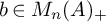 $b \in M_n (A)_{+}$
. Then
 $\big \{ a \in M_n (A) \colon d (a^* a) = 0 \big \}$
is a proper ideal in
 $M_n (A)$
(a priori not necessarily closed). But
 $M_n (A)$
has no nontrivial ideals, closed or not, so
 $b = 0$
. It follows that
 $d_{\tau } (b)> 0$
for all
 $\tau \in {\mathrm {QT}} (A)$
.
Suppose A has strict comparison. Let
 $a, b \in M_{\infty } (A)_{+}$
satisfy
 $a \in {\overline {M_n (A) b M_n (A)}}$
and
 $d (a) < d (b)$
for every dimension function d on A with
 $d (b) = 1$
. If
 $b = 0$
, then
 $a = 0$
, so
 $a \precsim b$
. Otherwise, let
 $\tau \in {\mathrm {QT}} (A)$
. Then
 $d = d_{\tau } (b)^{-1} d_{\tau }$
is a dimension function on A with
 $d (b) = 1$
. So
 $d (a) < d (b)$
by hypothesis, and it follows that
 $d_{\tau } (a) < d_{\tau } (b)$
. Since
 $\tau $
is arbitrary, strict comparison implies
 $a \precsim b$
.
Conversely, assume that A has weak strict comparison. We first claim that
 $W (A)$
is almost unperforated. Let
 $a, b \in M_{\infty } (A)_{+}$
, and suppose there are
 $m, n \in {\mathbb {N}}$
such that
 $n \langle a \rangle \leq m \langle b \rangle $
and
 $n> m$
. We want to show that
 $a \precsim b$
. (This version of almost unperforation is clearly equivalent to the usual, and is [Reference Rørdam50, Definition 3.1].) If
 $b = 0$
, then
 $a = 0$
, so
 $a \precsim b$
. Otherwise, for any dimension function d on A with
 $d (b) = 1$
, we have
 $n d (a) \leq m d (b) < n d (b)$
, so
 $d (a) < d (b)$
. Then
 $a \precsim b$
by weak strict comparison.
The rest is essentially contained in the proof of [Reference Rørdam48, Theorem 5.2(a)]. Let
 $a, b \in M_{\infty } (A)_{+}$
satisfy
 $d_{\tau } (a) < d_{\tau } (b)$
for all
 $\tau \in {\mathrm {QT}} (A)$
. Clearly,
 $b \neq 0$
. Fix
 $\varepsilon> 0$
; we claim that for all dimension functions d on A such that
 $d (b) = 1$
, we have
 $d \big ( (a - \varepsilon )_{+} \big ) < d (b)$
.
We prove the claim. Since A is simple and unital, for every
 $c \in M_{\infty } (A)_{+}$
, there is n such that
 $\langle c \rangle \leq n \langle b \rangle $
. This shows that the values of d are in
 $[0, \infty )$
; that is, d is a state on
 $W (A)$
in the sense described at the beginning of [Reference Rørdam48, Section 3]. So the dimension function
 ${\overline {d}}$
of Lemma 6.7 also has values in
 $[0, \infty )$
. It is nonzero because
 ${\overline {d}} (1) = d (1)$
. Theorem II.2.2 of [Reference Blackadar and Handelman8] provides
 $\tau \in {\mathrm {QT}} (A)$
such that
 $d (1)^{-1} {\overline {d}} = d_{\tau }$
. Now, using the assumption
 $d_{\tau } (a) < d_{\tau } (b)$
at the third step,
 $$\begin{align*}d \big( (a - \varepsilon)_{+} \big) \leq {\overline{d}} (a) = d (1) d_{\tau} (a) < d (1) d_{\tau} (b) = {\overline{d}} (b) \leq d (b). \end{align*}$$
The claim is proved.
Combining the claim and [Reference Rørdam48, Proposition 3.1], we get
 $(a - \varepsilon )_{+} \precsim b$
. Since this is true for all
 $\varepsilon> 0$
, we have
 $a \precsim b$
, as desired.
Definition 6.8 was chosen because it is the conclusion of [Reference Rørdam50, Corollary 4.7], and gives the same answer as the usual definition in the simple unital case.
More direct analogs of strict comparison seem to be unsuitable. As a heuristic example, consider
 $A = C (S^2 \times S^2) \otimes {\mathcal {K}}$
. The algebra
 $A_0 = C (S^2 \times S^2)$
does not have strict comparison because there is a rank
 $2$
projection
 $q_1 \in M_{\infty } (A_0)$
which is not Murray-von Neumann subequivalent to the trivial rank
 $3$
projection
 $q_2 = 1_{M_{3}} \otimes 1$
. So A should not have strict comparison either. It presumably would if one restricted to dimension functions with finite values. Indeed, define
 $$\begin{align*}x = {\mathrm{diag}} \big( 1, \tfrac{1}{2}, \tfrac{1}{3}, \ldots \big) \in \mathcal{K} \qquad {\mbox{and}} \qquad e = {\mathrm{diag}} \big( 1, 0, 0, \ldots \big) \in \mathcal{K}. \end{align*}$$
Any dimension function d on A has
 $d (1 \otimes x) \geq n d (1 \otimes e)$
for every
 $n \in {\mathbb {N}}$
. So if
 $d (1 \otimes x)$
is finite, then
 $d (1 \otimes e) = 0$
. Similar reasoning shows that in fact if
 $d (1 \otimes x)$
is finite, then
 $d (p) = 0$
for every projection
 $p \in A$
. So
 $d (q_1) = d (q_2) = 0$
for every dimension function with finite values, and the standard example to show lack of strict comparison fails.
It does not help to restrict to lower semicontinuous dimension functions with finite values.
Therefore, in the definition of a dimension function, infinite values are allowed [Reference Blackadar and Handelman8]. However, the dimension function given by
 $d (0) = 0$
and
 $d (a) = \infty $
for all nonzero
 $a \in M_{\infty } (A)_{+}$
gives
 $d (q_1) = d (q_2) = \infty $
, so again the standard example to show lack of strict comparison fails. This dimension function is lower semicontinuous, so again it does not help to restrict to lower semicontinuous dimension functions.
This discussion leaves several other possibilities, which we do not address.
-
(1) In Definition 6.8, use only lower semicontinuous dimension functions.
-
(2) Use all dimension functions which are finite on the Pedersen ideal of
$A \otimes {\mathcal {K}}$
. -
(3) In (2), use only lower semicontinuous dimension functions.

Returning to the main development, from Theorem 6.4, we get the following consequence.
Proposition 6.10. Let A be a simple (not necessarily unital) tracially
 $\mathcal {Z}$
-absorbing C*-algebra. Then A has weak strict comparison.
Proof. Let
 $a, b \in M_{\infty } (A)_{+}$
satisfy
 $a \in {\overline {M_n (A) b M_n (A)}}$
and
 $d (a) < d (b)$
for every dimension function d on A with
 $d (b) = 1$
. Note that n is such that
 $a, b \in M_n (A)$
. Then
 $M_n (A)$
is tracially
 $\mathcal {Z}$
-absorbing by Proposition 4.5. By Theorem 6.4,
 $W (M_n (A))$
is almost unperforated. Now apply [Reference Rørdam50, Corollary 4.7], noting that this result (unlike some other results in [Reference Rørdam50]) does not require the algebra to be unital.
Definition 6.11 ([Reference Orovitz, Phillips and Wang43], Definition 3.1).
Let A be a C*-algebra. We say that A is weakly almost divisible if for any
 $a \in M_{\infty } (A)_{+}$
, any
 $n \in \mathbb {N}$
and any
 $\varepsilon> 0$
, there is
 $\eta \in W (A)$
such that
 $n \eta \le \langle a \rangle $
and
 $\langle (a - \varepsilon )_{+} \rangle \le (n + 1) \eta $
.
Weak almost divisibility is a weak version of divisibility. This property can be used to prove that the crossed product by an action with the tracial Rokhlin property preserves strict comparison in the absence of tracial
 $\mathcal {Z}$
-stability. See [Reference Orovitz, Phillips and Wang43].
Proposition 6.12. Let A be a simple C*-algebra. If A is tracially
 $\mathcal {Z}$
-absorbing, then A is weakly almost divisible.
Proof. Let
 $a \in M_{\infty } (A)_{+}$
,
 $n \in \mathbb {N}$
, and
 $\varepsilon> 0$
be as in Definition 6.11. We have to find
 $b \in M_{\infty } (A)_{+}$
such that
 $$\begin{align*}n \langle b \rangle \leq \langle a \rangle \qquad {\mbox{and}} \qquad \big\langle (a - \varepsilon)_{+} \big\rangle \leq (n + 1) \langle b \rangle. \end{align*}$$
We may assume that
 $(a - \varepsilon )_{+} \neq 0$
. Since
 $M_m (A)$
is also tracially
 $\mathcal {Z}$
-absorbing for any
 $m \in \mathbb {N}$
(Proposition 4.5), we may assume that
 $a \in A$
. Use [Reference Phillips46, Lemma 2.4] to find
 $z \in A_{+} \setminus \{ 0 \}$
such that
 $$ \begin{align} (n + 2) \langle z \rangle \leq \big\langle (a - \varepsilon)_{+} \big\rangle. \end{align} $$
Choose
 $z_0 \in B_{+} \setminus \{ 0 \}$
such that
 $z_0 \precsim z$
in A. By Theorem 4.3, the subalgebra
 $B = \overline {aAa}$
of A is tracially
 $\mathcal {Z}$
-absorbing. Thus, there exists a c.p.c. order zero map
 $\psi \colon M_{n} \to B$
such that
 $$ \begin{align} \big( a - a^{1/2} \psi (1) a^{1/2} - \tfrac{\varepsilon}{2} \big)_{+} \precsim z_0. \end{align} $$
Let
 $t \in C_0 ((0, 1])$
denote the identity function, and use [Reference Winter and Zacharias55, Corollary 4.1] to find a homomorphism
 $\rho \colon C_0 ((0, 1]) \otimes M_{n} \to B$
satisfying
 $\rho (t \otimes x) = \psi (x)$
for all
 $x \in M_n$
. For
 $j, k = 1, 2, \ldots , n$
, let
 $e_{j, k} \in M_n$
be the standard matrix unit. Set
 $b = \psi (e_{1, 1})$
. We have
 $$ \begin{align} \psi (1) = \sum_{j = 1}^n \psi (e_{j, j}) \sim 1_{n} \otimes \psi (e_{1, 1}) = 1_{n} \otimes b. \end{align} $$
So
 $n \langle b \rangle = \langle \psi (1) \rangle $
. Since
 $\psi (1) \in B = {\overline {a A a}}$
, it follows that
 $n \langle b \rangle \leq \langle a \rangle $
.
Now we show that
 $\langle (a - \varepsilon )_{+} \rangle \le (n + 1) \langle b \rangle $
. Using [Reference Phillips46, Lemma 1.5] in the first step, (6.18) in the second step, and (6.19) in the third step, we get
 $$ \begin{align*} (a - \varepsilon)_{+} & \precsim \big( a^{1/2} \psi (1) a^{1/2} - \tfrac{\varepsilon}{2} \big)_{+} \oplus \big(a - a^{1/2} \psi (1) a^{1/2} - \tfrac{\varepsilon}{2} \big)_{+} \\ & \precsim \psi (1) \oplus z_0 \precsim (1_{n} \otimes b) \oplus z. \end{align*} $$
Hence,
 $$ \begin{align} \langle (a - \varepsilon)_{+} \rangle \leq n \langle b \rangle + \langle z \rangle. \end{align} $$
It remains to show that
 $\langle z \rangle \leq \langle b \rangle $
. Since A is simple and
 $b \neq 0$
, we certainly have
 $z \in {\overline {A b A}}$
. Since A has weak strict comparison (by Proposition 6.10), it now suffices to show that
 $d (z) < d (b)$
for all
 $d \in \mathrm {DF} (A)$
with
 $d (b) = 1$
. If
 $d (z) = 0$
, we are done. Otherwise, by (4.1) at the beginning of [Reference Rørdam48, Section 4], there is
 $m \in {\mathbb {N}}$
such that
 $\big \langle (a - \varepsilon )_{+} \big \rangle \leq m \langle b \rangle $
. Then
 $$\begin{align*}d (z) \leq d \big( (a - \varepsilon)_{+} \big) \leq m d (b) = m. \end{align*}$$
That is,
 $d (z)$
is finite. By (6.17) and (6.20), we have
 $$\begin{align*}n d (z) < (n + 2) d (z) - d (z) \leq d \big( (a - \varepsilon)_{+} \big) - d (z) \leq n d (b). \end{align*}$$
We have shown that
 $d (z) < d (b)$
for all
 $d \in \mathrm {DF} (A)$
with
 $d (b) = 1$
, as desired.
7 Tracial
$\mathcal {Z}$
-absorption for finite C*-algebras

The objective of this section is to prove Proposition 7.12, which states that if A is a finite simple tracially
 $\mathcal {Z}$
-absorbing C*-algebra, then in Definition 3.6, we can assume
 $\| a \| = 1$
and require
 $\| \varphi (1) a \varphi (1) \|> 1 - \varepsilon $
. This is parallel to the definition of the weak tracial Rokhlin property for finite group actions.
We do not actually use Proposition 7.12. However, almost all the work which goes into it is needed for the proof of a result in [Reference Amini, Golestani, Jamali and Phillips1] that the permutation action on the minimal tensor product of finitely many copies of a tracially
 $\mathcal {Z}$
-absorbing C*-algebra has the weak tracial Rokhlin property, provided that the tensor product is finite.
It is not entirely clear what the ‘right’ definition of finiteness is for nonunital C*-algebras, even simple ones. We will use the following definition, which seems to be the most common.
Definition 7.1 (V.2.2.1 in [Reference Blackadar7]).
A nonunital C*-algebra A is finite if its unitization
 $A^{+}$
is finite in the usual sense; that is,
 $1$
is a finite projection in
 $A^{+}$
. Otherwise, A is infinite.
Equivalently, all one-sided invertible elements in
 $A^{+}$
are two-sided invertible.
There is further discussion of finiteness in [Reference Blackadar7, Sections V.2.2 and V.2.3]. For our further discussion, we need the following definition and notation.
Definition 7.2 (Definition 3.2 in [Reference Kirchberg and Rørdam33]).
Let A be a C*-algebra and let
 $ a\in A_{+}$
. Then a is infinite if there exists
 $b \in A_{+} \setminus \{ 0 \}$
such that
 $a \oplus b \precsim a$
. Otherwise, a is finite.
Notation 7.3. For any C*-algebra A, we let
 ${\operatorname {Ped}} (A)$
denote the Pedersen ideal (smallest dense ideal) in A; see [Reference Pedersen45, Section 5.6].
The following elementary fact will be used often enough that we record it here.
Lemma 7.4. Let A be a C*-algebra, let
 $a \in A_{+}$
, and let
 $\varepsilon> 0$
. Then
 $(a - \varepsilon )_{+} \in {\operatorname {Ped}} (A)$
.
Proof. This is immediate from the proof of [Reference Pedersen45, Theorem 5.6.1].
For a simple nonunital C*-algebra A, we can consider at least four further conditions, none of which appears in [Reference Blackadar7]:
-
(1) Every positive element in
${\operatorname {Ped}} (A)$
(see Notation 7.3) is finite. -
(2) The finite elements of
$A_{+}$
are dense in
$A_{+}$
. -
(3) For every
$a \in A_{+}$
and
$\varepsilon> 0$
, the element
$(a - \varepsilon )_{+}$
is finite. -
(4) There are a dimension function (see Definition 6.5) d on A and a positive element a in
${\operatorname {Ped}} (A)$
such that
$0 < d (a) < \infty $
.


It is not reasonable to require that all positive elements of A be finite, since it follows from [Reference Kirchberg and Rørdam33, Proposition 3.7] that every nonzero separable stable C*-algebra contains infinite elements.
Condition (3) is the condition we actually use.
Conditions (1), (2), and (3) are very similar. Apart from the obvious implications, from (1) to (3) (because
 $(a - \varepsilon )_{+} \in {\operatorname {Ped}} (A)$
by Lemma 7.4) and from (3) to (2), we have not investigated the relations between these three conditions. Proposition 7.8 below shows that finiteness as in Definition 7.1 implies (3). Corollary 7.7 below shows that Condition (4) implies Condition (3). Definition 7.1 has the advantage that important permanence properties are immediate.
Remark 7.5. Finiteness as in Definition 7.1 has the following properties.
-
(1) All subhomogeneous C*-algebras are finite.
-
(2) Direct limits of direct systems of finite C*-algebras with injective maps are finite.
-
(3) Arbitrary direct limits of subhomogeneous C*-algebras are finite.
-
(4) Subalgebras of finite C*-algebras are finite.
Lemma 7.6. Let A be a simple C*-algebra, and let d be a dimension function on A (Definition 6.5).
-
(1) If there is
$a \in {\operatorname {Ped}} (A)_{+} \setminus \{ 0 \}$
such that
$d (a) = 0$
, then
$d (b) = 0$
for all
$b \in {\operatorname {Ped}} (A)_{+}$
. -
(2) If there is
$a \in {\operatorname {Ped}} (A)_{+} \setminus \{ 0 \}$
such that
$d (a)$
is finite, then
$d (b)$
is finite for all
$b \in {\operatorname {Ped}} (A)_{+}$
.


Proof. Both the sets
 $$\begin{align*}\big\{ a \in A \colon d (a^* a) = 0 \big\} \qquad {\mbox{and}} \qquad \big\{ a \in A \colon d (a^* a) < \infty \big\} \end{align*}$$
are easily seen to be (not necessarily closed) ideals in A. Therefore, each is either equal to
 $\{ 0 \}$
or contains
 ${\operatorname {Ped}} (A)$
.
Corollary 7.7. Let A be a simple C*-algebra. Assume that there are a dimension function (see Definition 6.5) d on A and
 $a \in {\operatorname {Ped}} (A)_{+}$
such that
 $0 < d (a) < \infty $
. Then all positive elements of
 ${\operatorname {Ped}} (A)$
are finite.
Proof. Suppose there is an infinite element
 $a \in {\operatorname {Ped}} (A)_{+}$
. By definition, there is
 $b \in A_{+} \setminus \{ 0 \}$
such that
 $a \oplus b \precsim a$
.
Let d be a dimension function on A as in the statement. Then
 $d (a) + d (b) \leq d (a)$
. So
 $d (b) = 0$
or
 $d (a) = \infty $
. If
 $d (a) = \infty $
, then
 $d (x) = \infty $
for all
 $x \in {\operatorname {Ped}} (A)_{+} \setminus \{ 0 \}$
by Lemma 7.6(2), contradicting the hypothesis of the statement. So
 $d(a)<\infty $
and
 $d (b) = 0$
. Choose
 $\varepsilon> 0$
such that
 $\varepsilon < \| b \|$
. Then
 $(b - \varepsilon )_{+} \neq 0$
, and is in
 ${\operatorname {Ped}} (A)$
by Lemma 7.4. Therefore,
 $d\left ( (b - \varepsilon )_{+} \right )\leq d(b)=0$
, which implies that
 $d (x) = 0$
for all
 $x \in {\operatorname {Ped}} (A)_{+}$
by Lemma 7.6(1), contradicting the hypothesis of the statement.
Proposition 7.8. Let A be a simple C*-algebra. Suppose that there are
 $a \in A_{+}$
and
 $\varepsilon> 0$
such that
 $(a - \varepsilon )_{+}$
is infinite. Then A is infinite in the sense of Definition 7.1.
Although it was not convenient to write the proof this way, having chosen
 $b \in A_{+} \setminus \{ 0 \}$
which is orthogonal to
 $(a - \varepsilon )_{+}$
, heuristically the key point is that
 $(a - \frac {\varepsilon }{3})_{+}$
is in the algebraic ideal generated by b.
This proposition should also be true in the unital case, but we do not need it there.
Proof of Proposition 7.8.
Replacing a by
 $\| a \|^{-1} a$
and
 $\varepsilon $
by
 $\| a \|^{-1} \varepsilon $
, we can assume that
 $\| a \| = 1$
. Then clearly,
 $\varepsilon < 1$
.
Define continuous functions
 $f_1, f_2 \colon [0, 1] \to [0, 1]$
by
 $$\begin{align*}f_1 (\lambda) = \begin{cases} 0 & \hspace{0.5em} 0 \leq \lambda \leq \frac{2 \varepsilon}{3} \\ 3 \varepsilon^{-1} \lambda - 2 & \hspace{0.5em} \frac{2 \varepsilon}{3} < \lambda < \varepsilon \\ 1 & \hspace{0.5em} \varepsilon \leq \lambda \leq 1 \end{cases} \quad {\mbox{and}} \quad f_2 (\lambda) = \begin{cases} 0 & \hspace{0.5em} 0 \leq \lambda \leq \frac{\varepsilon}{3} \\ 3 \varepsilon^{-1} \lambda - 1 & \hspace{0.5em} \frac{\varepsilon}{3} < \lambda < \frac{2 \varepsilon}{3} \\ 1 & \hspace{0.5em} \frac{2 \varepsilon}{3} \leq \lambda \leq 1 \end{cases} \end{align*}$$
Define
 $$\begin{align*}a_0 = (a - \varepsilon)_{+}, \qquad e_1 = f_1 (a), \qquad {\mbox{and}} \qquad e_2 = f_2 (a). \end{align*}$$
Then
 $e_1 a_0 = a_0$
. By assumption, there is
 $c \in A_{+} \setminus \{ 0 \}$
such that
 $a_0 \oplus c \precsim a_0$
. Since A is not unital,
 ${\overline {(1 - e_2) A (1 - e_2)}}$
is a nonzero hereditary subalgebra of A. By [Reference Phillips46, Lemma 2.4], there exists a positive element
 $c_0 \in {\overline {(1 - e_2) A (1 - e_2)}}$
such that
 $\| c_0 \| = 1$
and
 $c_0 \precsim c$
. Then set
 $b = f_2 (c_0)$
and
 $b_0 = f_1 (c_0)$
. So
 $b_0 \neq 0$
and
 $b b_0 = b_0$
. Also
 $b \precsim c_0$
, so
 $a_0 + b \precsim a_0$
. Note that
 $a_0 c_0=0$
, and so
 $a_0 b=0$
.
Since A is simple, [Reference Phillips46, Lemma 1.13] provides
 $n \in \mathbb {N}$
and
 $y_1, y_2, \ldots , y_n \in A$
such that
 $\left \| e_2 - \sum _{j = 1}^n y_j b y_j^* \right \| < \frac {1}{2}$
. In
 $W (A)$
, we then have
 $$\begin{align*}\langle e_1 \rangle \leq \big\langle \big( e_2 - \tfrac{1}{2} \big)_{+} \big\rangle \leq \left\langle \sum_{j = 1}^n y_j b y_j^* \right\rangle \leq \sum_{j = 1}^n \langle y_j b y_j^* \rangle \leq n \langle b \rangle \leq \langle a_0 \rangle + n \langle b \rangle. \end{align*}$$
It follows from an induction argument that
 $\langle a_0 \rangle + (n + 1) \langle b \rangle \leq \langle a_0 \rangle $
, so
 $e_1 + b \precsim a_0$
. Therefore, there is
 $v \in A$
such that
 $$ \begin{align} \| v a_0 v^* - (e_1 + b) \| < \frac{1}{2}. \end{align} $$
Define
 $$\begin{align*}s = v a_0^{1/2} + (1 - e_1 - b)^{1/2}. \end{align*}$$
Note that if A is unital, then
 $s\in A$
, and if A is nonunital, then
 $s\in A^{+}$
.
Since
 $e_1 a_0 = a_0$
and
 $b a_0 = 0$
, we have
 $$\begin{align*}(1 - e_1 - b) a_0 = a_0 (1 - e_1 - b) = 0, \end{align*}$$
and it follows (for example, by polynomial approximation) that
 $$ \begin{align} (1 - e_1 - b)^{1/2} a_0^{1/2} = a_0^{1/2} (1 - e_1 - b)^{1/2} = 0. \end{align} $$
We claim that s is right invertible. To prove this, we show that
 $\| 1 - s s^* \| < \frac {1}{2}$
. Now
 $$\begin{align*}s s^* = v a_0^{1/2} a_0^{1/2} v^* + (1 - e_1 - b) + v a_0^{1/2} (1 - e_1 - b)^{1/2} + (1 - e_1 - b)^{1/2} a_0^{1/2} v^*. \end{align*}$$
The last two terms are zero by (7.2). The first is equal to
 $v a_0 v^*$
. So the relation
 $\| 1 - s s^* \| < \frac {1}{2}$
follows from (7.1). The claim is proved.
Now we claim that
 $s b_0 = 0$
. Since
 $e_1 b_0 = 0$
and
 $b b_0 = b_0$
, we have
 $(1 - e_1 - b) b_0 = 0$
, so
 $(1 - e_1 - b)^{1/2} b_0 = 0$
. Using
 $a_0 b_0 = 0$
, so
 $a_0^{1/2} b_0 = 0$
, we now get
 $s b_0 = 0$
, as desired.
It follows from the last claim that s is not two-sided invertible, completing the proof.
Lemma 7.9. For every
 $\varepsilon> 0$
, there is
 $\delta> 0$
such that whenever A is a C*-algebra, and
 $x, h \in A_{+}$
satisfy
 $\| x \| \leq 1$
,
 $\| h \| \leq 1$
and
 $\| x h x \|> 1 - \delta $
, then
 $\| h x h \|> 1 - \varepsilon $
.
Proof. The statement is trivial if
 $\varepsilon> 1$
, so assume
 $\varepsilon \leq 1$
. Set
 $\delta = 1 - (1 - \varepsilon )^{1/2}> 0$
. Now let A, x and h be as in the hypotheses. Using selfadjointness of
 $x h x$
at the second step and
 $x^2 \leq x$
at the last step, we have
 $$\begin{align*}1 - \varepsilon = (1 - \delta)^2 < \| (x h x)^2 \| = \| x h x^2 h x \| \leq \| h x^2 h \| \leq \| h x h \|. \end{align*}$$
This completes the proof.
The following lemma generalizes [Reference Phillips46, Lemma 1.8].
Lemma 7.10. For every
 $\varepsilon> 0$
, there is
 $\delta> 0$
such that whenever A is a C*-algebra,
 $\alpha , \beta \in [0, \infty )$
, and
 $r, x, h \in A_{+}$
satisfy
 $$\begin{align*}\| r \| \leq 1, \qquad \| x \| \leq 1, \qquad \| h \| \leq 1, \qquad {\mbox{and}} \qquad \| r x - x \| < \delta, \end{align*}$$
then
 $$\begin{align*}\big( r x r - [ \alpha + \beta + \varepsilon ] \big)_{+} \precsim \big( h^{1/2} x h^{1/2} - \alpha \big)_{+} \oplus (r^2 - r h r - \beta)_{+}. \end{align*}$$
Proof. Use [Reference Lin38, Lemma 2.5.11] to choose
 $\delta> 0$
such that whenever A is a C*-algebra and
 $r, x \in A_{+}$
satisfy
 $\| r \| \leq 1$
,
 $\| x \| \leq 1$
, and
 $\| r x - x \| < \delta $
, then
 $\big \| r x^{1/2} - x^{1/2} \big \| < \frac {\varepsilon }{2}$
. (Note that the statement of [Reference Lin38, Lemma 2.5.11] requires that A is unital, however, it holds in the nonunital case whenever the continuous function f satisfies
 $f(0)=0$
using the same proof for
 $A^{\sim }$
.)
Now let A,
 $\alpha $
,
 $\beta $
, r, x and h be as in the hypotheses. We have
 $$\begin{align*}\big\| x^{1/2} r h r x^{1/2} - x^{1/2} h x^{1/2} \big\| \leq 2 \big\| r x^{1/2} - x^{1/2} \big\| < \varepsilon, \end{align*}$$
so, by [Reference Phillips46, Lemma 1.6],
 $$ \begin{align} \big( x^{1/2} r h r x^{1/2} - [\alpha + \varepsilon] \big)_{+} \precsim \big( x^{1/2} h x^{1/2} - \alpha \big)_{+}. \end{align} $$
Now, using [Reference Elliott, Robert and Santiago19, Proposition 2.3(ii)] at the first and fourth steps, [Reference Phillips46, Lemma 1.5] at the second step, and (7.3) and Lemma 2.3 at the third step, we have
 $$ \begin{align*} \big( r x r - [ \alpha + \beta + \varepsilon ] \big)_{+} & \sim \big( x^{1/2} r^2 x^{1/2} - [ \alpha + \beta + \varepsilon ] \big)_{+} \\ & \precsim \big( x^{1/2} r h r x^{1/2} - [\alpha + \varepsilon] \big)_{+} \oplus \big( x^{1/2} (r^2 - r h r) x^{1/2} - \beta \big)_{+} \\ & \precsim \big( x^{1/2} h x^{1/2} - \alpha \big)_{+} \oplus ( r^2 - r h r - \beta)_{+} \\ & \sim \big( h^{1/2} x h^{1/2} - \alpha \big)_{+} \oplus ( r^2 - r h r - \beta)_{+}. \end{align*} $$
This completes the proof.
The following lemma is a nonunital version of [Reference Phillips46, Lemma 2.9].
Lemma 7.11. Let A be a simple C*-algebra which is not of type I, let
 $r \in A_{+}$
be a finite element, and let
 $x \in \big ( {\overline {r A r}} \big )_{+}$
satisfy
 $\| x \| = 1$
. Then for every
 $\varepsilon> 0$
, there are
 $\delta> 0$
and
 $y \in \big ( {\overline {x A x}} \big )_{+} \setminus \{ 0 \}$
such that whenever
 $h \in A_{+}$
satisfies
 $\| h \| \leq 1$
and
 $( r^2 - r h r - \delta )_{+} \precsim y$
, then
 $\| h x h \|> 1 - \varepsilon $
.
Proof. By Lemma 7.9, and changing the value of
 $\varepsilon $
, it suffices to prove this with the conclusion
 $\| x h x \|> 1 - \varepsilon $
instead of
 $\| h x h \|> 1 - \varepsilon $
.
If
 $\varepsilon> 1$
, there is nothing to prove. So assume
 $\varepsilon \leq 1$
.
Set
 $\varepsilon _0 = \frac {\varepsilon }{15}$
. Apply Lemma 7.10 with
 $\varepsilon _0$
in place of
 $\varepsilon $
, getting
 $\rho> 0$
(called
 $\delta $
there).
For
 $\alpha , \beta \in [0, \infty )$
with
 $\alpha < \beta $
, define a continuous function
 $f_{\alpha , \beta } \colon [0, \infty ) \to [0, 1]$
by
 $$\begin{align*}f_{\alpha, \beta} (\lambda) = \begin{cases} 0 & \hspace{1em} 0 \leq \lambda \leq \alpha \\ (\beta - \alpha)^{-1} (\lambda - \alpha) & \hspace{1em} \alpha < \lambda < \beta \\ 1 & \hspace{1em} \beta \leq \lambda. \end{cases} \end{align*}$$
The elements
 $f_{1/n, 2 / n} (r)$
, for
 $n \in \mathbb {N}$
, form an approximate identity for
 ${\overline {r A r}}$
. Choose
 $n \in \mathbb {N}$
so large that
 $\frac {2}{n} < \varepsilon _0$
and the element
 $r_0 = f_{1/n, 2 / n} (r)$
satisfies
 $\| r_0 x - x \| < \min \big ( \frac {\rho }{3}, \varepsilon _0 \big )$
. Define a continuous function
 $g \colon [0, \infty ) \to [0, \infty )$
by
 $$\begin{align*}g (\lambda) = \begin{cases} \frac{n^2 \lambda}{4} & \hspace{1em} 0 \leq \lambda \leq \frac{2}{n} \\ \frac{1}{\lambda} & \hspace{1em} \frac{2}{n} < \lambda. \end{cases} \end{align*}$$
Set
 $s = g (r)$
. Then
 $\| s \| \leq \frac {n}{2}$
. We have
 $$\begin{align*}\| s r - r_0 \| \leq \frac{2}{n} < \varepsilon_0 \qquad {\mbox{and}} \qquad \| s r \| \leq 1. \end{align*}$$
So
 $$ \begin{align} \big\| s (r^2 - r h r ) s - (r_0^2 - r_0 h r_0 ) \big\| < 4 \varepsilon_0. \end{align} $$
By [Reference Phillips46, Lemma 2.8], there are
 $a, b \in \big ( {\overline {x A x}} \big )_{+}$
such that
 $\| a \| = \| b \| = 1$
,
 $a b = b$
, and whenever
 $d \in {\overline {b A b}}$
satisfies
 $\| d \| \leq 1$
, then
 $\| x d - d \| < \min \big ( \frac {\rho }{3}, \varepsilon _0 \big )$
. Use [Reference Phillips46, Lemma 2.4] to choose nonzero orthogonal positive elements
 $z_1, z_2 \in {\overline {b A b}}$
such that
 $\| z_1 \| = \| z_2 \| = 1$
. For
 $j = 1, 2$
, set
 $b_j = f_{\varepsilon _0, 2 \varepsilon _0} (z_j)$
. Use [Reference Phillips46, Lemma 2.6] to choose nonzero positive elements
 $c_j \in {\overline {f_{2 \varepsilon _0, 3 \varepsilon _0} (z_j)Af_{2 \varepsilon _0, 3 \varepsilon _0} (z_j)}}$
for
 $j = 1, 2$
such that
 $c_1 \sim c_2$
. We may clearly assume
 $\| c_1 \| = \| c_2 \| = 1$
. Then
 $$\begin{align*}b_1 b_2 = 0, \qquad 0 \leq c_j \leq b_j \leq 1, \qquad a b_j = b_j, \qquad {\mbox{and}} \qquad b_j c_j = c_j. \end{align*}$$
Define
 $y = c_1$
and
 $\delta = 4 \varepsilon _0 / n^2$
.
Now let
 $h \in A_{+}$
satisfy
 $\| h \| \leq 1$
and
 $( r^2 - r h r - \delta )_{+} \precsim y$
. Suppose
 $\| x h x \| \leq 1 - \varepsilon $
. The choices of a and b imply that
 $$\begin{align*}\big\| x (b_1 + b_2) - (b_1 + b_2) \big\| < \min( \varepsilon_0, \frac{\rho}{3}) \qquad {\mbox{and}} \qquad \big\| x (b_1 + b_2)^{1/2} - (b_1 + b_2)^{1/2} \big\| < \varepsilon_0. \end{align*}$$
Therefore,
 $$ \begin{align} \big\| h^{1/2} (b_1 + b_2) h^{1/2} \big\| & = \big\| (b_1 + b_2)^{1/2} h (b_1 + b_2)^{1/2} \big\| \\ & < \big\| (b_1 + b_2)^{1/2} x h x (b_1 + b_2)^{1/2} \big\| + 2 \varepsilon_0 \notag \\ & \leq \| x h x \| + 2 \varepsilon_0 \leq 1 - \varepsilon + 2 \varepsilon_0 = 1 - 13 \varepsilon_0. \notag \end{align} $$
We have
 $$ \begin{align} \big\| r_0 (b_1 + b_2) - (b_1 + b_2) \big\| & \leq \| r_0 x - x \|\cdot \| b_1 + b_2 \| + 2 \big\| x (b_1 + b_2) - (b_1 + b_2) \big\| \\ & < \min \left( \frac{\rho}{3}, \varepsilon_0 \right) + 2 \min \left( \frac{\rho}{3}, \, \varepsilon_0 \right) = \min ( \rho, \, 3 \varepsilon_0 ), \notag \end{align} $$
so
 $$ \begin{align} \big\| r_0 (b_1 + b_2) r_0 - (b_1 + b_2) \big\| < 6 \varepsilon_0. \end{align} $$
Now, using
 $1 - \varepsilon _0 < 1$
and [Reference Phillips46, Lemma 1.10] at the first step, using (7.7) and [Reference Phillips46, Corollary 1.6] at the second step, and at the third step using (7.6) and the choice of
 $\rho $
using Lemma 7.10, with
 $\alpha = 1 - 13 \varepsilon _0$
, with
 $\beta = 5 \varepsilon _0$
, and with
 $\varepsilon _0$
in place of
 $\varepsilon $
,
 $$ \begin{align*} c_1 + c_2 & \precsim \big( b_1 + b_2 - (1 - \varepsilon_0) \big)_{+} \\ & \precsim \big( r_0 (b_1 + b_2) r_0 - (1 - 7 \varepsilon_0) \big)_{+} \\ & \precsim \big( h^{1/2} (b_1 + b_2) h^{1/2} - (1 - 13 \varepsilon_0) \big)_{+} \oplus ( r_0^2 - r_0 h r_0 - 5 \varepsilon_0 )_{+}. \end{align*} $$
It follows from (7.5) that
 $\big ( h^{1/2} (b_1 + b_2) h^{1/2} - (1 - 13 \varepsilon _0) \big )_{+} = 0$
. So, using (7.4) and [Reference Phillips46, Corollary 1.6] at the second step, using Lemma 2.3 at the third step, and using the choice of
 $\delta $
and
 $\| s \| \leq \frac {n}{2}$
at the fourth step,
 $$ \begin{align*} c_1 + c_2 & \precsim ( r_0^2 - r_0 h r_0 - 5 \varepsilon_0 )_{+} \\ & \precsim \big( s (r^2 - r h r ) s - \varepsilon_0 \big)_{+} \\ & \precsim \left( r^2 - r h r - \frac{\varepsilon_0}{\| s \|^2} \right)_{+} \precsim ( r^2 - r h r - \delta )_{+} \precsim y = c_1. \end{align*} $$
Since A is simple,
 $c_1 c_2 = 0$
,
 $c_1 \sim c_2$
, and r is finite, this contradicts [Reference Kirchberg and Rørdam33, Lemma 3.8]. The proof is complete.
Proposition 7.12. Let A be a finite simple tracially
 $\mathcal {Z}$
-absorbing C*-algebra. Then for every
 $x, a \in A_{+}$
with
 $\| a \| = 1$
, every finite set
 $F \subseteq A$
, every
 $\varepsilon> 0$
and every
 $n \in \mathbb {N}$
, there is a c.p.c. order zero map
 $\varphi \colon M_{n} \to A$
such that
-
(1)
$\big ( x^{2} - x \varphi (1) x - \varepsilon \big )_{+} \precsim a$
. -
(2)
$\| [\varphi (z), b] \| < \varepsilon $
for any
$z \in M_{n}$
with
$\| z \| \leq 1$
and any
$b \in F$
. -
(3)
$\| \varphi (1) a \varphi (1) \|> 1 - \varepsilon $
.


By Lemma 7.9, we could equally well use the condition
 $\| a \varphi (1) a \|> 1 - \varepsilon $
.
Proof of Proposition 7.12.
Let
 $x, a \in A_{+}$
with
 $\| a \| = 1$
, let
 $F \subseteq A$
be finite, let
 $\varepsilon> 0$
, and let
 $n \in \mathbb {N}$
.
We may assume that
 $x \neq 0$
. Define
 $$\begin{align*}\eta = \min \left( \frac{1}{8}, \, \frac{\varepsilon}{24}, \, \frac{\varepsilon}{8 \| x \| ( \| x \| + 1 )} \right). \end{align*}$$
Choose
 $x_0 \in A_{+}$
such that
 $$\begin{align*}\| x_0 \| = 1, \qquad \| x_0 x - x \| < \eta, \qquad {\mbox{and}} \qquad \| x_0 a - a \| < \eta. \end{align*}$$
Define
 $x_1 = (x_0 - \eta )_{+}$
. Then
 $x_1$
is finite by Proposition 7.8. Since
 $\| a \| = 1$
, we have
 $$ \begin{align} \| x_1 a x_1 - a \| \leq 2 \| x_1 - x_0 \| + \| x_0 a - a \| + \| a x_0 - a \| < 4 \eta. \end{align} $$
So
 $\| x_1 a x_1 \|> 1 - 4 \eta $
. Thus,
 $x_1 a x_1 \neq 0$
, and we can set
 $a_0 = \| x_1 a x_1 \|^{-1} x_1 a x_1$
.
We claim that
 $$ \begin{align} \| a_0 - a \| < \frac{\varepsilon}{2}. \end{align} $$
To prove the claim, using
 $1 \geq \| x_1 a x_1 \|> 1 - 4 \eta $
at the first step, using (7.8) at the second step, using
 $\eta \leq \frac {1}{8}$
at the third step, and using
 $\eta \leq \frac {\varepsilon }{20}$
at the fourth step,
 $$\begin{align*}\| a_0 - a \| \leq \left( 1 - \frac{1}{1 - 4 \eta} \right) + \| x_1 a x_1 - a \| < \frac{4 \eta}{1 - 4 \eta} + 4 \eta \leq 8 \eta + 4 \eta \leq \frac{\varepsilon}{2}. \end{align*}$$
The claim is proved.
Apply Lemma 7.11 with
 $x_1$
in place of r, with
 $\eta $
in place of
 $\varepsilon $
, and with
 $a_0$
in place of x, getting
 $\delta> 0$
and
 $y \in \big ( {\overline {a_0 A a_0}} \big )_{+} \setminus \{ 0 \}$
as there. By [Reference Phillips46, Lemma 2.4], there is
 $c \in A_{+} \setminus \{ 0 \}$
such that
 $c \precsim y$
and
 $c \precsim a$
. Set
 $$\begin{align*}\rho = \min \left( \delta, \, \frac{\varepsilon}{2}, \, \frac{\varepsilon}{2 \| x \|^2} \right). \end{align*}$$
Apply the definition of tracial
 $\mathcal {Z}$
-absorption with
 $x_1$
in place of x, with
 $\rho $
in place of
 $\varepsilon $
, with c in place of a, and with F and n as given, getting a c.p.c. order zero map
 $\varphi \colon M_{n} \to A$
such that
-
(4)
$\big ( x_1^{2} - x_1 \varphi (1) x_1 - \rho \big )_{+} \precsim c$
. -
(4)
$\| [\varphi (z), b] \| < \rho $
for any
$z \in M_{n}$
with
$\| z \| \leq 1$
and any
$b \in F$
.


Since
 $\rho \leq \varepsilon $
, Condition (2) in the conclusion follows from (5).
We prove Condition (1) in the conclusion. We have
 $\| x_0 x - x \| < \eta $
and
 $\| x_1 - x_0 \| \leq \eta $
, so
 $\| x_1 x - x \| < (1 + \| x \|) \eta $
. Therefore, using the choice of
 $\eta $
at the third step,
 $$ \begin{align*} \big\| \big( x x_1^2 x - x x_1 \varphi (1) x_1 x \big) - \big( x^2 - x \varphi (1) x \big) \big\| & \leq 4 \| x \|\cdot \| x_1 x - x \| \\ & < 4 \| x \| ( \| x \| + 1 ) \eta \leq \frac{\varepsilon}{2}. \end{align*} $$
Using this and [Reference Phillips46, Corollary 1.6] at the first step, using
 $\| x \|^2 \rho \leq \tfrac {\varepsilon }{2}$
at the second step, using Lemma 2.3 at the third step, using (4) at the fourth step, and using
 $c \precsim a$
at the fifth step, we now get
 $$ \begin{align*} \big( x^2 - x \varphi (1) x - \varepsilon \big)_{+} & \precsim \big( x x_1^2 x - x x_1 \varphi (1) x_1 x - \tfrac{\varepsilon}{2} \big)_{+} \\ & \precsim \big( x x_1^2 x - x x_1 \varphi (1) x_1 x - \| x \|^2 \rho \big)_{+} \\ & \precsim \big( x_1^2 - x_1 \varphi (1) x_1 - \rho \big)_{+} \precsim c \precsim a. \end{align*} $$
This is (1).
Finally, since
 $c \precsim y$
,
 $\rho \leq \delta $
, and
 $\eta \leq \frac {\varepsilon }{2}$
, (4) and the choices of
 $\delta $
and y using Lemma 7.11 imply that
 $\| \varphi (1) a_0 \varphi (1) \|> 1 - \frac {\varepsilon }{2}$
. Combining this estimate with (7.9) gives Condition (3) in the conclusion.
Acknowledgements
This work is based upon research funded by Iran National Science Foundation (INSF) under project no. 4035229. The principal investigator of the latter project is N. Golestani, who is the corresponding author of the current paper. M. Amini was partially supported by grants from IPM (no. 98460121). S. Jamali would like to acknowledge the support of Tarbiat Modares University where he was a graduate student while this work was in its preliminary stages. The work of N. C. Phillips was partially supported by the US National Science Foundation under Grant DMS-1501144.
Competing interest
The authors declare that they have no competing interests.
Data availability statement
This is a theoretical study and no empirical data were used.



