Introduction
Capillary refill time (CRT) is a measure of peripheral circulation and is recommended in the 2021 guidelines for treating and managing sepsis. Reference Evans, Rhodes and Alhazzani1 Past study examined the optimal strength and time of nail bed pressing to realize objective CRT measurement. Reference Kawaguchi, Nakada and Oshima2 In addition, it experimentally demonstrated that the feedback function of the optimal measurement conditions is essential to meet the optimal measurement conditions with manual compression. Reference Shinozaki, Nakada and Kawaguchi3 The study in the past developed a portable CRT measurement device with a feedback function and demonstrated that the measured values were more stable than conventional visual CRT measurements. Reference Shinozaki, Shimizu and Saito4 To evaluate the effect of vascular occlusion on the CRT and the cut-off value for peripheral circulatory failure, this study induced peripheral circulatory failure by performing vascular occlusion tests, because the artery occlusion test (AOT) and venous occlusion test (VOT) result in the occlusion of peripheral blood flow and prolongation of CRT.
This study hypothesized that the cut-off value for peripheral circulatory failure can be obtained using CRT values measured with AOT and VOT as positive and with no occlusion test (No OT) as negative and tested this hypothesis.
Methods
Study Design
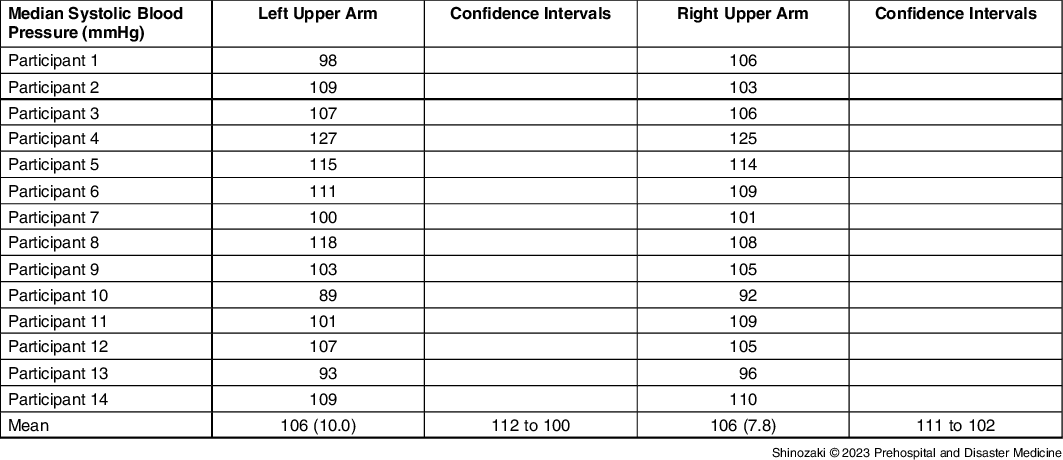
The Institutional Review Board of Chiba University Graduate School of Medicine (Chiba, Japan) approved this experimental study (approval number: 4154). Written informed consent was obtained from all the participants. Fourteen (14) healthy adults (eight males and six females; age: 20–26 years) participated in this study. Excluded were individuals with underlying medical conditions or those taking medication. Blood pressure was measured thrice from both arms of the participants by using a sphygmomanometer (ES-W1200ZZ, Terumo Corp.; Tokyo, Japan), and the median systolic blood pressure of both arms was confirmed to be 10mmHg or less (Table 1). Reference Bruins, Geboers and Bauer5 Systolic blood pressure was employed as the reference value for the vascular occlusion test and was the median of the blood pressure measured thrice from the left arm.
Median Systolic Blood Pressure of the Study Participants

Hampel Filter
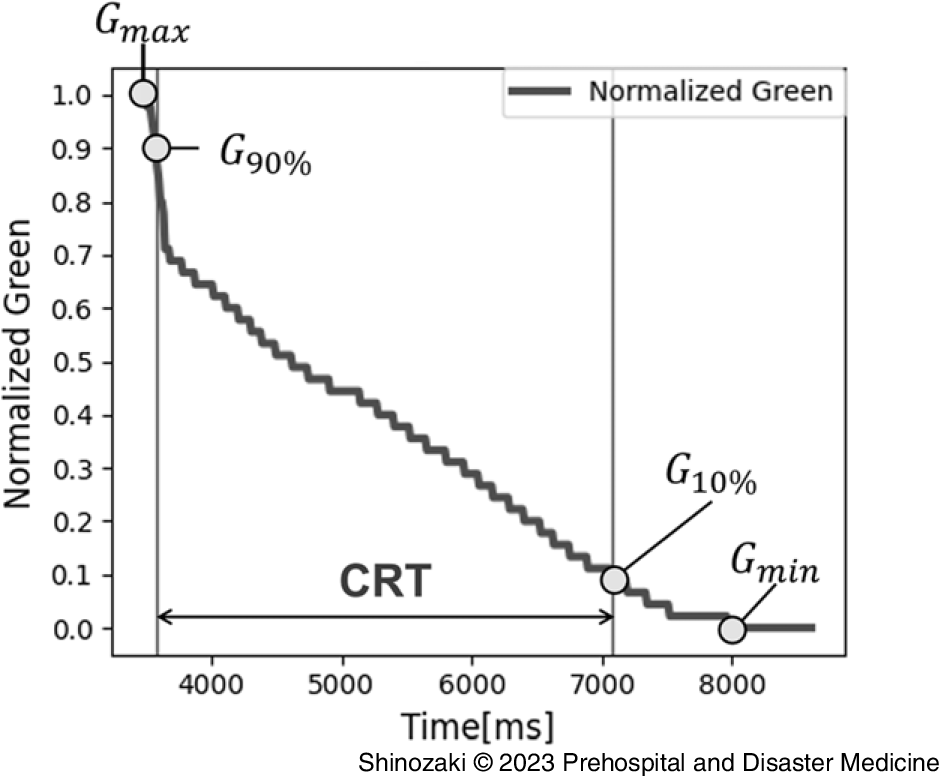
The CRT in this study is calculated according to the definition from the time series data of nail bed color measured by the color sensor (Figure 1). Reference Kawaguchi, Nakada and Oshima2,Reference Shinozaki, Shimizu and Saito4 The developed device is manually operated to release, which may introduce spike noise into the time series data of the nail bed color. A Hampel filter was used to compensate for spike noise. Reference Davies and Gather6 The Hampel filter is a moving-window implementation of the Hampel identifier proposed by Davies and Gather. It is a digital filter that corrects spike noise in the time series data by replacing it with the median value in the local window. The Hampel filter response can be expressed using Eq. (1):
 $${y_k} = \left\{ {\matrix{ {{x_k}\;\left| {{x_k} - {m_k}} \right|\; \le t{S_{k,}}} \hfill \cr {{m_{k\;}}\left| {{x_k} - {m_k}} \right|\;t{S_k}} \hfill \cr } } \right.,$$
 $${m_k} = {\rm{median}}\left\{ {{x_{k - K}},\; \cdots ,\;{x_k},\; \cdots ,\;{x_{k + K}}} \right\},$$
 $${S_k} = 1.4826 \times {\rm{media}}{{\rm{n}}_{j \in \left[ { - K,\;K} \right]}}\left\{ {\left| {{x_{k - j}} - {m_k}} \right|} \right\},$$
Definition of CRT in This Study.
Note: CRT was calculated by normalizing the green channel values of the color sensor after release by the maximum and minimum values and from the time difference between G10% and G90%.
Abbreviation: CRT, capillary refill time.

where k is the reference identifier of the input data,
 ${y_k}$
is the output value of the Hampel filter,
 ${x_k}$
is the input data being referenced,
 ${m_k}$
is the median of the moving window data and can be obtained using Eq. (2), K is the half-width parameter of the local window, t is the threshold of tolerance limits, and
 ${S_k}$
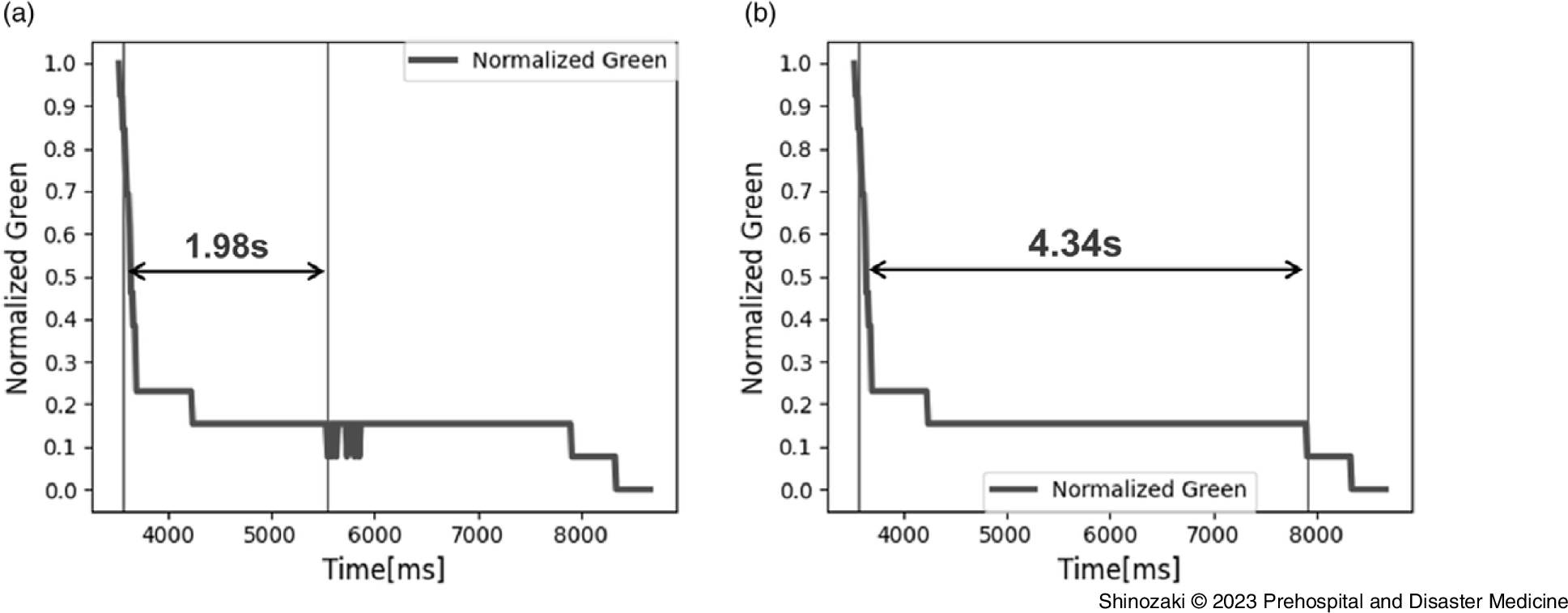
is the median absolute deviation (MAD) scale estimate obtained using Eq. (3). With a coefficient of 1.4826, the MAD scale estimate is an unbiased estimate of the standard deviation for Gaussian distributed data. In this study, the half-width parameter K was empirically set as four, and the tolerance limit threshold value t was set as three. When the recovery curve contained noise, the calculated CRT was shorter (Figure 2(a)); the correct CRT was calculated when the noise was corrected using the Hampel filter (Figure 2(b)).
Effect of Hampel Filter on Measurement Error Correction.
Note: (a) Before Correction; (b) After Correction.

Detection of Abnormal Waveforms by Recovery Rate of Nail Bed Color
In this study, the abnormal waveform of the nail bed color recovery curve was determined from the recovery rate of nail bed color after pressure release. The recovery rate of nail bed color R can be expressed using Eq. (4):
 $$R = {{{G_{max}} - {G_{min}}} \over {{G_{max}} - {G_{base}}}} \times 100,$$
where
 ${G_{base}}$
is the minimum value of the green channel of the color sensor during compression, and
 ${G_{max}}$
and
 ${G_{min}}$
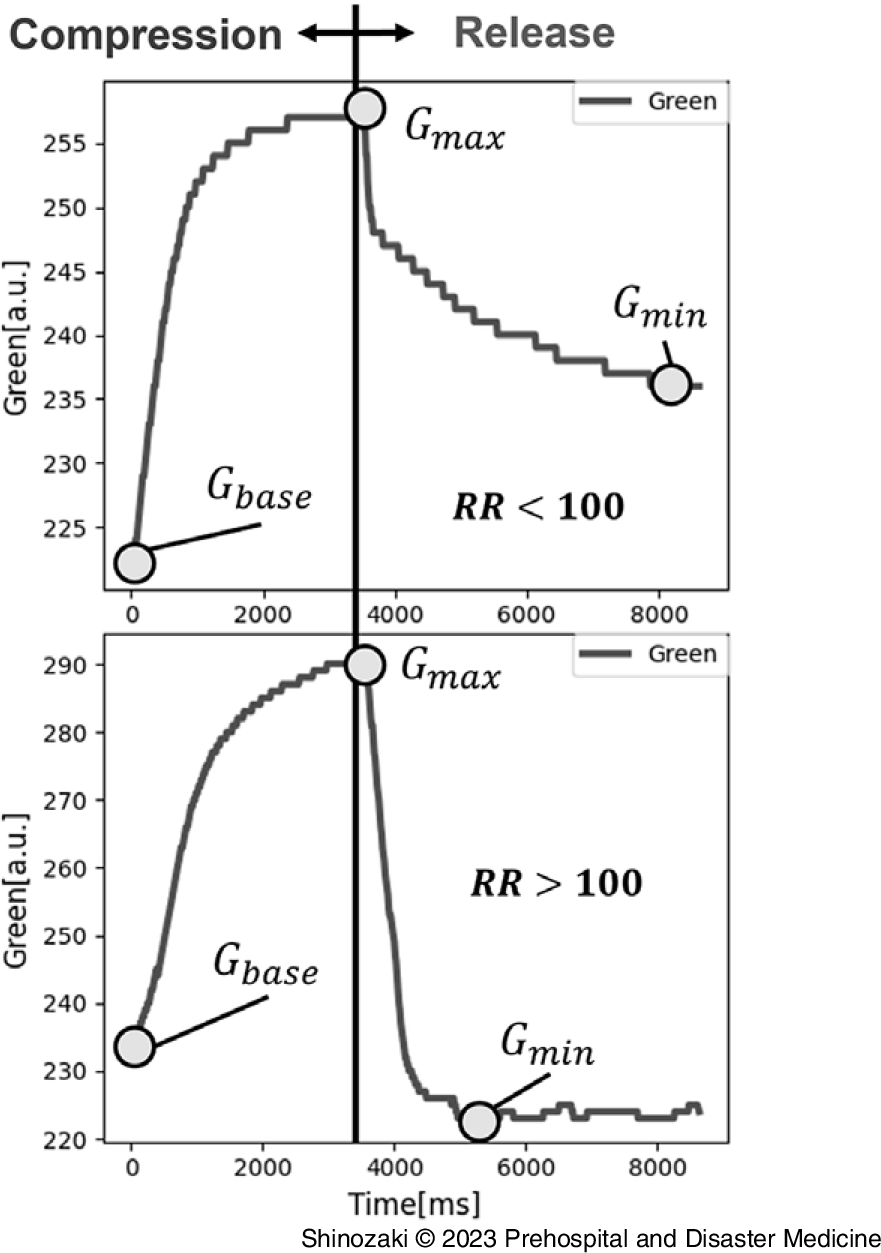
are the maximum and minimum values of the green channel of the color sensor after compression release. If the nail bed color does not recover to
 ${G_{base}}$
after pressure release, the recovery rate R is R100; if it recovers above
 ${G_{base}}$
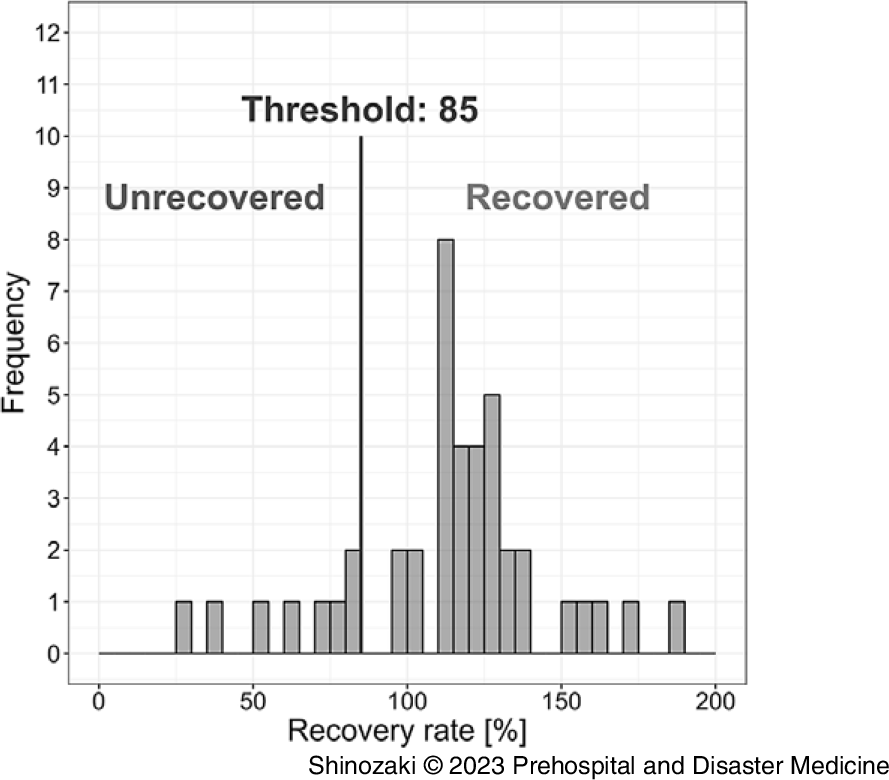
, R ≥ 100 (Figure 3). A histogram of the recovery rate R calculated from the nail bed color recovery curves of 42 cases measured in this study was created, and the threshold of abnormal waveforms was automatically obtained using Otsu’s method
Reference Otsu7
(Figure 4). Otsu’s method is mainly used for binarization in image processing and automatically determines the threshold that maximizes the degree of separation, which is the ratio of the between-class variance to the within-class variance of two classes. The threshold of abnormal waveforms was calculated as 85 by using Otsu’s method. From the results of abnormal waveform determination by recovery rate R, eight cases of recovery curves were eliminated as abnormal waveforms in AOT. No abnormal waveforms were found in the recovery curves measured by No OT and VOT.
Definition of Recovery Rate of Nail Bed Color.

Histogram of Recovery Rate of Nail Bed Color as Measured using the Total Occlusion Test.
Note: The bin width of the histogram is set at 5%.

Correction of CRT by Fingertip Temperature
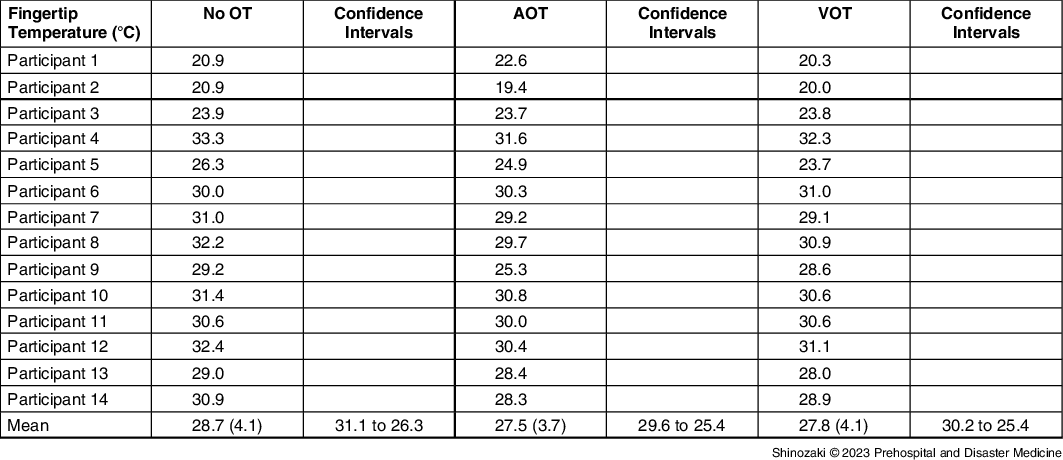
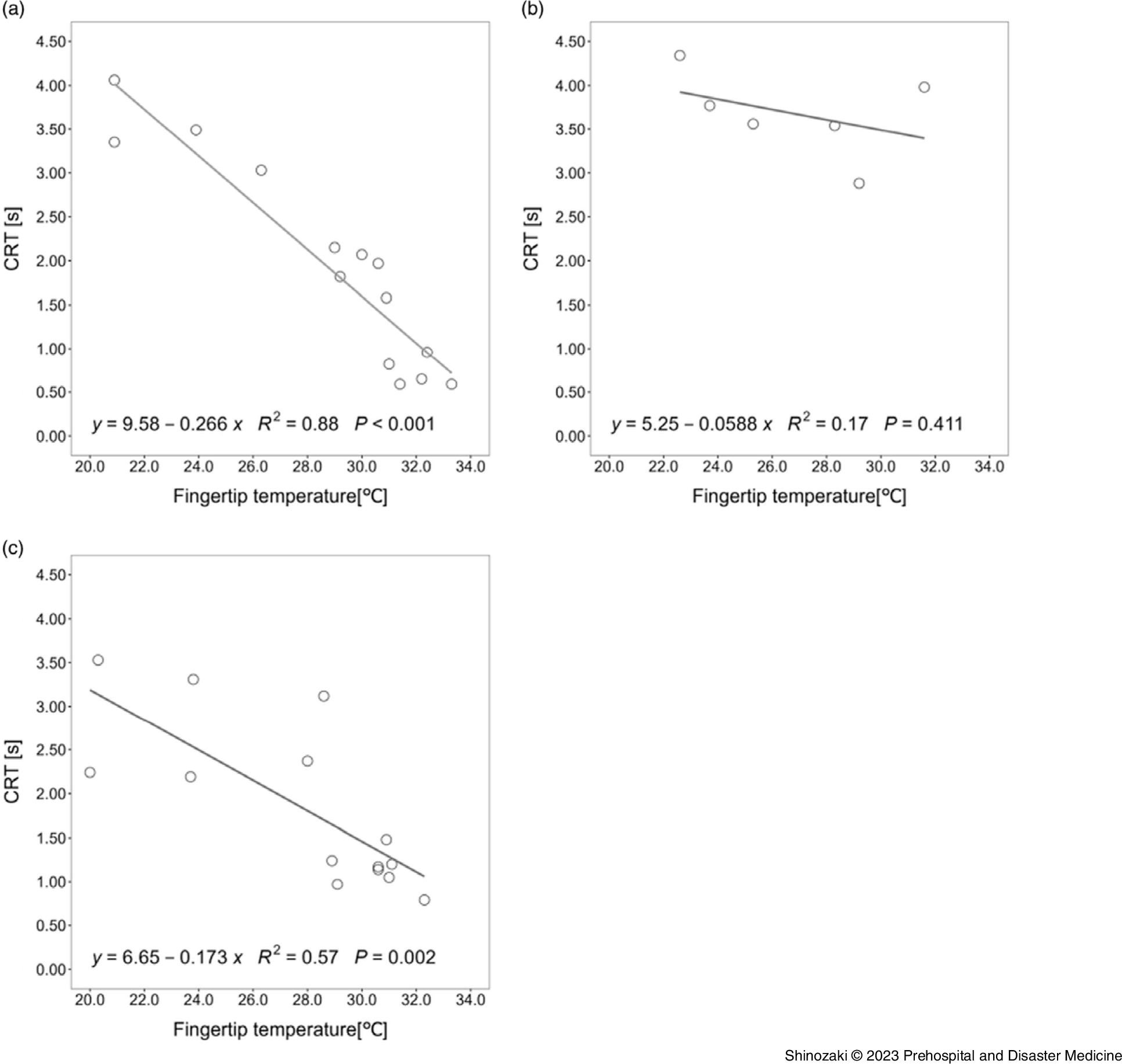
A scatter plot of fingertip temperatures (Table 2) and CRTs measured in each occlusion test is shown in Figure 5. Single regression analysis revealed that No OT and VOT CRT were associated with fingertip temperature (No OT: P < .001, regression coefficient: 0.27; AOT: P = .411, regression coefficient: 0.06; VOT: P = .002, regression coefficient: 0.17). The correction equation for CRT due to fingertip temperature obtained by single regression analysis is given by Eq. (5):
 $$C' = C + \alpha \times \left( {T - T'} \right),$$
Fingertip Temperature of the Study Participants

Abbreviations: No OT, no occlusion test; AOT, artery occlusion test; VOT, venous occlusion test.
Relationship between CRT Measured in Each Occlusion Test and Fingertip Temperature.
Note: (a) No OT; (b) AOT; (c) VOT.
Abbreviations: CRT, capillary refill time; No OT, no occlusion test; AOT, artery occlusion test; VOT, venous occlusion test.

where C is the CRT before temperature correction,
 $C'$
is the CRT after temperature correction, T is the fingertip temperature,
 $T'$
is the average fingertip temperature in each occlusion test (No OT: 28.7°C; VOT: 27.8°C), and
 $\alpha $
is the regression coefficient (No OT: 0.27; VOT: 0.17). The correction by fingertip temperature was applied only to the CRTs measured at No OT and VOT and not to CRTs measured at AOT.
CRT Measurement Experiment
Participants rested in the supine position for ten minutes in a quiet, air-conditioned environment at a room temperature of 23°C–24°C before the start of the experiment. A pulse oximeter (OX-101, DRETEC Co. LTD; Saitama, Japan) was attached to the ring finger of the participant’s left hand. Three types of vascular occlusion tests (AOT, VOT, and No OT) were performed by placing a sphygmomanometer (Aneroid sphygmomanometer II, SANKEI Co. LTD; Chiba, Japan) on the left upper arm of the participant. For the AOT, a pressure of 30mmHg higher than the systolic pressure was applied. Reference Bruins, Geboers and Bauer5 The device operator confirmed that the participants’ oxygen saturation could not be measured using a pulse oximeter due to arterial occlusion caused by the AOT. For the VOT, a pressure of 60mmHg was applied. Reference Casavola, Paunescu and Fantini8 The operator confirmed that the pulse oximeter could measure the participants’ oxygen saturation during the VOT. For the No OT, no pressure was applied. The AOT and VOT were performed for 120 seconds according to the maximum duration (119 seconds) required for the local oxygen saturation (rSO2) of the skin over the thumb carpometacarpal joint on the dorsal side of the hand to decrease to 40%. Reference Bruins, Geboers and Bauer5 After 120 seconds, the CRT was measured once from the participant’s left index finger by using the developed CRT measuring device with the cuff inflated. Because the CRT was measured with the vessels occluded, the measurement was not repeated to account for changes in the fingertip’s condition. After performing CRT measurements, fingertip temperature was measured using a non-contact thermometer (DVM105, Velleman Group; Gavere, Belgium) from the skin above the distal interphalangeal joint on the nail side of the index finger of the participant’s left hand. The interval between occlusion tests was ten minutes, and the order of trials was changed in six ways for each volunteer. The CRTs calculated from the recovery curves of 14 No OT, six AOT, and 14 VOT cases not detected by abnormal waveform detection and corrected for fingertip temperature were used for statistical analysis.
Statistical Analysis
The measured data were analyzed using R 4.2.2 version (The R Project for Statistical Computing; Vienna, Austria) 9 and visualized using Tidyverse 1.3.2 version (Posit; Boston, Massachusetts USA). 10 Python 3.8.10 version (Python Software Foundation; Wilmington, Delaware USA), 11 Pandas 1.5.2 version (NumFOCUS; Austin, Texas USA), 12 and Matplotlib 3.6.2 version (NumFOCUS; Austin, Texas USA) 12 were used to visualize the recovery curves shown in Figure 1, Figure 2, and Figure 3. The CRTs calculated from the recovery curves of 14 No OT, six AOT, and 14 VOT cases not detected by abnormal waveform detection and corrected for fingertip temperature were used for statistical analysis. Median CRTs between No OT and AOT and No OT and VOT were compared using the Wilcoxon signed-rank test. The cut-off value of CRT was determined using Youden’s index by drawing the receiver operating characteristic (ROC) curve Reference Youden13 (sklearn 0.0.post1 version, NumFOCUS; Austin, Texas USA). 12 P < .05 was considered significant.
Results
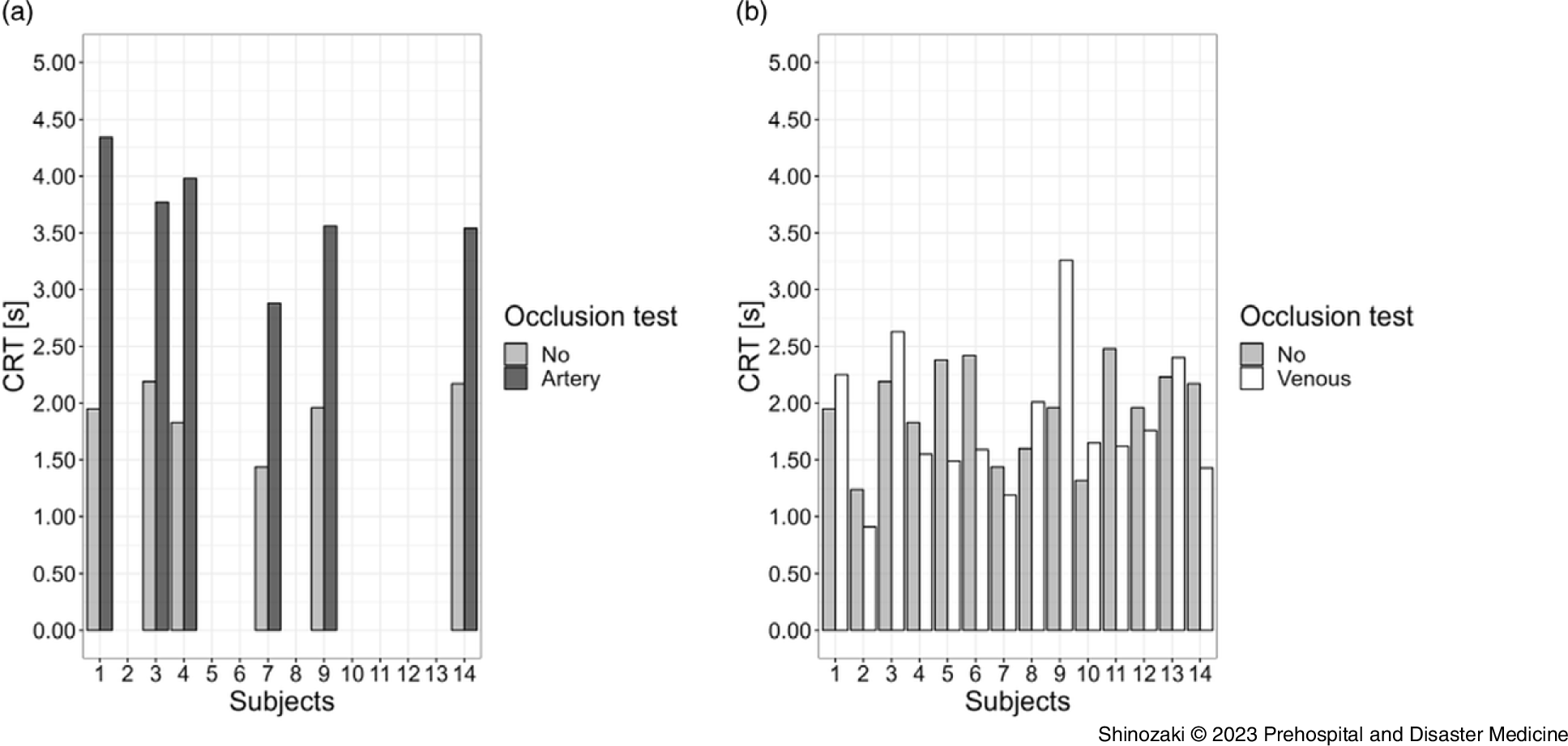
In each vascular occlusion test, the CRTs of the AOT and VOT were compared based on the CRT of No OT in the same participant (Figure 6). The CRT of AOT was longer than that of No OT in all cases where it was not detected as an abnormal waveform. The CRT of VOT was higher in six cases compared to that of No OT. Wilcoxon signed-rank test results revealed significantly higher median CRT for No OT and AOT and no significant difference in median CRT for No OT and VOT (No OT and AOT: P = .036; No OT and VOT: P = .59).
Comparison of CRT Measured in Each Occlusion Test in the Same Participant.
Note: (a) AOT and No OT; (b) VOT and No OT
Abbreviations: CRT, capillary refill time; No OT, no occlusion test; AOT, artery occlusion test; VOT, venous occlusion test.

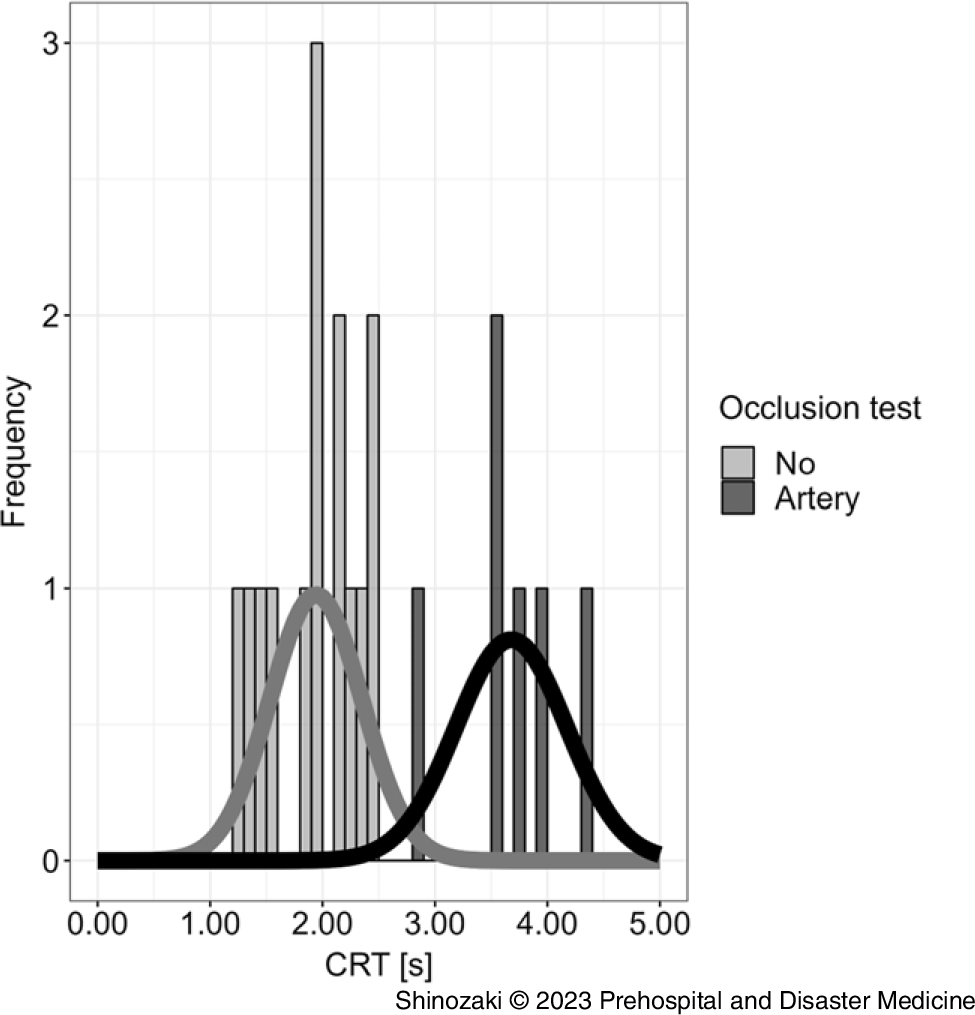
A histogram of the CRTs measured at No OT and AOT was created to evaluate the cut-off value for peripheral circulatory failure (Figure 7). The CRT distribution for No OT and AOT was bimodal. The ROC curve was drawn with the CRT of AOT as positive for peripheral circulatory failure and the CRT of No OT as negative, and the cut-off value of CRT was obtained using Youden’s index. Reference Youden13 The resulting CRT cut-off value was 2.88 seconds. The classification performance was 1.00 for area under the curve, accuracy, sensitivity, and specificity.
Histogram of CRTs Measured by No OT and AOT.
Note: The solid line is the normal distribution curve of CRT for each measured vascular occlusion test.
Abbreviations: CRT, capillary refill time; No OT, no occlusion test; AOT, artery occlusion test.

Discussion
Despite its limitations in terms of interobserver variability, Reference Espinoza, Welsh and Dubin14,Reference Sheridan, Baker, Kayser, Jones and Hansen15 CRT provides excellent discrimination for shock outcomes when used alone or in combination with other laboratory findings. When patients in shock are evaluated, a CRT of more than three seconds often indicates worse clinical outcomes. Reference Lara, Enberg and Ortega16,Reference Sebat, Vandegrift, Oldroyd, Kramer and Sebat17 In addition, increased CRT after resuscitation with initial infusion is strongly associated with increased organ damage and mortality. Reference Lara, Enberg and Ortega16,Reference Ait-Oufella, Bige and Boelle18 As such, CRT is recommended in the 2021 guidelines for treating and managing sepsis. Reference Evans, Rhodes and Alhazzani1 This study developed a portable CRT measurement device Reference Shinozaki, Nakada and Kawaguchi3,Reference Shinozaki, Shimizu and Saito4 and evaluated the effect of vascular occlusion on CRT and the cut-off value of peripheral circulatory failure in the measurement device. The study hypothesized that CRT would be longer in AOT and VOT; however, CRT in AOT was significantly longer compared to CRT in No OT, and CRT in VOT was not significantly different from CRT in No OT. Thus, AOT blocks blood flow into the periphery, whereas VOT blocks blood outflow from the periphery, allowing the blood to flow into the periphery. Thus, it suggests that the impairment of inflow blood flow may significantly impact CRT in particular. While this study did not examine the effects of medical history such as aging-related changes or diabetes, which can affect blood vessels and blood flow, these factors may influence CRT and caution is necessary when applying the results in clinical practice. In the detection of abnormal waveforms by using the recovery rate of nail bed color, eight AOT data samples were excluded as abnormal waveforms, whereas No OT and VOT data samples were detected as abnormal waveforms (Figure 3 and Figure 4). Therefore, because abnormal waveforms are detected only at AOT, peripheral circulatory status can be evaluated from the recovery curve of the nail bed color.
The CRT cut-off value obtained using Youden’s index was 2.88 seconds. Because the case in which AOT obstructed blood flow to the periphery for two minutes can be considered an experimental model of an abnormal state in which peripheral rSO2 dropped to approximately 40%, Reference Bruins, Geboers and Bauer5 the cut-off value of peripheral circulatory failure of 2.88 seconds obtained in this study can be considered the threshold of an abnormal state. In the ANDROMEDA-SHOCK study of septic shock, Reference Hernández, Ospina-Tascón and Damiani19 significant results were obtained when CRT exceeding three seconds measured by manual compression and visual observation was considered abnormal. Results in this study may be able to measure CRT in a peripheral circulation state similar to clinically significant shock state, as supported by the clinically significant outcomes shown in the ANDROMEDA-SHOCK study Reference Hernández, Ospina-Tascón and Damiani19 that used a similar threshold to this study. However, it should be noted that the microcirculation of shock patients encountered in clinical practice may differ in pathophysiology from arterial occlusion, which raises the possibility of a threshold value different from that used in this study.
Limitations
The study has several limitations. First, a small number of participants were included in this study. In addition, because only one individual operated the device, there is a possibility of bias in the measurement results. Moreover, since this study only measured CRT in healthy adults in their 20s, there is a possibility of age-related effects. Reference Pickard, Karlen and Ansermino20 Future studies will expand the age range of the study participants and the number of people operating the device to further validate the results.
Conclusions
This study aimed to study the effect of vessel occlusion on CRT and the cut-off value for peripheral circulatory failure. The results of the experiment showed that arterial occlusion had a significant impact on CRT. Additionally, the cut-off value for the peripheral circulatory failure model created by arterial occlusion was 2.88 seconds. The study results apply only to healthy young adults because the study results were based on a subset of young adults. The wide-spread use of precise CRT measurement by using portable CRT measurement devices will contribute to simple and quantitative microcirculation monitoring in clinical settings.
Conflicts of interest
Taka-aki Nakada received executive compensation from Smart119 and held stock. Inc. Taka-aki Nakada has a patent related to CRT measurements. Yukihiro Nomura belongs to an endowment department sponsored by HIMEDIC Inc. and Siemens Healthcare K.K.; however, the status is irrelevant to the contents of the paper. The remaining authors have no other conflicts of interest related to this submission.