1. Introduction
Pure mathematics can play an indispensable role explaining empirical phenomena if recent accounts of insect evolution are correct. Apart from challenging the nominalist view that mathematics can only “index” or “map” physical facts in scientific explanation, these cases would seem to demand an expansion of our understanding of how mathematics applies to the natural world. Such robust mathematical explanations also seem to challenge strictly causal accounts of explanation within the natural sciences.
At the heart of these issues are broader debates about so-called indispensability arguments. Indispensability arguments for scientific realism uphold the indispensability of entities to our best scientific theories as a sufficient and necessary basis for ontological commitment. Indispensability can be gauged in a variety of ways against a variety of objectives (see Field Reference Field1989). If scientific explanation is the objective, an indispensability argument takes the specific form of an inference to the best explanation (IBE). The scientific examples in question are taken to support this kind of inference, what Baker calls the “enhanced indispensability argument”:
1. We ought to be ontologically committed to any entity that is explanatorily indispensable in our best scientific theories.
2. Mathematical entities play an indispensable explanatory role in science.
3. Hence, we ought to be ontologically committed to mathematical entities.
Apart from thorny issues concerning indispensability and scientific explanation (see van Fraassen Reference van Fraassen1989; Maddy Reference Maddy1992; Sober Reference Sober1993), proponents of the enhanced indispensability argument must provide examples supporting premise 2.Footnote 1 Two recent examples are the hexagonal structure of honeycombs and the prime life cycles of periodical cicadas: “Start with the question of why hive-bee honeycomb has a hexagonal structure. What needs explaining here is why the honeycomb is always divided up into hexagons and not some other polygon” (Lyon and Colyvan Reference Lyon and Colyvan2008, 228). “The example featured the life cycle of the periodical cicada, an insect whose two North American subspecies spend 13 years and 17 years, respectively, underground in larval form before emerging briefly as adults. One question raised by biologists is: why are these life cycles prime?” (Baker Reference Baker2009, 614).
Baker and Colyvan claim that the answers to these questions have an indispensable mathematical component. They also argue that the mathematical component provides explanatory power that a mathematics-free explanation, assuming one could be given (which they doubt), would lack. Neither example supports these views. Both examples as presented commit what we call the optimality fallacy: assuming a trait exists because it was selected for as a solution to a biological optimization problem. Sections 2 and 3 describe Baker and Colyvan’s arguments and specify where the fallacy occurs. Section 4 explains how the problem can be avoided. Section 5 modifies the original examples to show how an indispensable explanatory role for mathematics might be established. Section 6 concludes by examining the implications of this analysis, particularly for how mathematical explanation should be characterized.
2. Periodically Prime Cicadas
In the genus Magicicada, four cicada species have a 13-year life cycle and three exhibit a 17-year life cycle. The majority of this time is spent underground in a juvenile form extracting nutrients from a plant source (through a proboscis piercing a root; Williams and Simon Reference Williams and Simon1995). Once mature, the nymphs simultaneously emerge within a specific 2–4 week window, their exoskeletons harden, they mate, and they then die. The obviously puzzling property of these cicadas is their prime life cycle, and unsurprisingly “biologists take it that there is something to be explained—at least potentially—concerning the primeness” (Baker and Colyvan Reference Baker and Colyvan2011, 329). Taking the philosophical significance of this explanatory request seriously, Baker (Reference Baker2005, 233) offers the following argument (italics added):
1. Having a life-cycle period that minimizes intersection with other (nearby/lower) periods is evolutionarily advantageous. (biological law)
2. Prime periods minimize intersection (compared to non-prime periods). (number theoretic theorem)
3. Hence organisms with periodic life cycles are likely to evolve periods that are prime. (mixed biological/mathematical law)
4. Cicadas in ecosystem-type E are limited by biological constraints to periods from 14 to 18 years. (ecological constraint)
C. Hence cicadas in ecosystem-type E are likely to evolve 17-year periods.
Inferring 3 from 1 and 2 requires the assumption that if a trait is evolutionarily advantageous then selection will act to favor it and that selective history accounts for the existence of prime life cycles.Footnote 2 However, it is an indisputable fact that a trait’s presence in a population is not necessarily because of its being evolutionarily advantageous. Moreover, a trait being evolutionarily advantageous does not entail there has been or will be selection for that trait. Premise 3 simply does not follow from premises 1 and 2. The claim being asserted in premise 3 may nevertheless be true, of course, but many biologists offer strong evidence for alternative explanations for why the life cycle periods are prime that make no essential use of number theory.
One prominent hypothesis is that there was a 4-year jump from a prior (nonprime) 9-year life cycle to the current 13-year cycle in the distant evolutionary past (Grant Reference Grant2005). According to the 4-year jump hypothesis, primeness played no role in the origin of the trait. Prime life cycles are merely by-products of 4-year developmental changes catalyzed by ecological pressures, such as competition over food resources. Several considerations support the jump hypothesis. The first is that recent phylogenetic analyses suggest the whole Magicicada genus diverged from a common ancestor at least 3 million years ago and that this is when long periodic life cycles evolved. Thus, the long periodic life cycles that would later become prime evolved long before diversification into the extant species. Alternative hypotheses in which primeness does explanatory work place the diversification in the much more recent evolutionary past (see Grant Reference Grant2005).
Another consideration favoring the 4-year jump hypothesis is that there is evidence of many other 4-year developmental changes in the 13- and 17-year cicadas (Marshall, Cooley, and Hill Reference Marshall, Cooley and Hill2011). For example, the 17-year cicadas M. septendecim and M. cassini sometimes exhibit 4-year developmental accelerations, emerging at year 13. Developmental delays also occur. All four 13-year cicada species sometimes exhibit 4-year developmental delays to emerge at year 17, or even delay their emergence by another 4 years to emerge at (nonprime) year 21. Similarly, 17-year cicadas sometimes delay emergence (in “large numbers”; Grant Reference Grant2005, 172; Marshall et al. Reference Marshall, Cooley and Hill2011, 446) by 4 years, resulting in a (nonprime) 21-year life cycle. Furthermore, a different cicada species, Okanagana rimosa, has a 9-year life cycle, and there is strong evidence that the ancestral species of Magicicada had a similar life cycle (Grant Reference Grant2005). In 4-year increments, most logical possibilities between 9 and 21 years are instantiated by extant cicada species, prime and nonprime numbers included. It should be emphasized that the magnitude of these deviations strongly supports developmental plasticity in life cycle length, rather than random fluctuations from selectively favored prime periods (Marshall et al. Reference Marshall, Cooley and Hill2011). If the 4-year jump hypothesis is correct, primeness does little or no work in the origin of prime number cicada life cycles. (The need to explain the absence of life cycles of other prime numbers like 11 also obviously fades.) As a consequence, long prime periodical life cycles should be quite rare among cicada species. And in fact that expectation is reflected in their actual frequency. The current best estimate is that 3,044 cicada species exist but only 7/3,044 have atypically long and prime life cycles. Rather than constituting a unique biological phenomenon requiring special (selective) explanation, the rarity of these life cycles might indicate they are nothing more than improbable by-products of (selectively neutral) stochastic evolutionary processes (Moran Reference Moran1962).
But why a 4-year jump? One hypothesis is that nymphal crowding created competition for underground resources, which caused slower maturation or dormancy, thereby delaying the emergence of the 9-year cicada (Williams and Simon Reference Williams and Simon1995). Other studies support this type of nonmathematical hypothesis. For example, a study examining avian predation pressure during cicada emergences found lower predation pressure in years 13 and 17 was due to ecological effects initiated by previous emergence events, not as a consequence of being prime numbered (Koenig and Liebhold Reference Koenig and Liebhold2013). Cicada emergences cause substantial enrichment of forest soils that produce direct effects below ground and indirect effects above ground. Put simply, the idea is that these effects “engineer” predator species such as bird populations (via impacts to nutrients, plant growth, etc.) to keep them from tracking cicada emergences. In effect, the ecological effects of a prior cicada emergence set bird populations on a trajectory such that the subsequent emergence encounters reduced predation pressure.Footnote 3
These studies illustrate the error in inferring that organisms with periodic life cycles are likely to evolve prime periods because minimization with predators is advantageous. Moreover, it should be noted that while the focus here is the problematic inference in Baker’s argument, the presumed obvious adaptiveness of prime life cycles is an empirical claim that is, surprisingly, controversial. Prime life cycles could only potentially avoid intersection with predators that are also periodical. But, there is zero evidence of any current or past predator species that has a periodical life cycle. More significantly, recent models suggest that even if such predators exist, prime numbered life cycles are in fact not optimal (Lehmann-Ziebarth et al. Reference Lehmann-Ziebarth, Heideman, Shapiro, Stoddart, Hsiao, Stephenson, Milewski and Ives2005). Prime life cycles did not evolve because prime life cycles are selectively advantageous if the 4-year jump hypothesis is correct.
Two potential objections to this conclusion should be addressed before turning to the honeycomb structure case in the next section. First, one might think the research summarized here fails to undermine Baker’s argument because it does not require his adaptationist story be correct. What matters is that there could have been selection for prime life cycles because they are prime. But to draw a realist conclusion, the enhanced indispensability argument as an IBE requires actual examples of mathematics being explanatorily indispensable, not possible examples. Possible examples are inadequate because IBE is not an inference about possibilia. It is possible a fire-like element phlogiston is released during combustion, but our best chemical theories do not posit phlogiston to explain combustion. We therefore are not ontologically committed to phlogiston according to IBE. Analogously, although it is possible natural selection could have favored prime life cycles, our best scientific accounts of their evolutionary origin do not posit prime numbers in the relevant explanation. As such, not only does the example fail to establish the explanatory indispensability of mathematics, IBE dictates that we not be ontologically committed to prime numbers.
A second objection focuses on a more basic invocation of mathematics. Although primeness is not explanatorily salient, the 4-year jump hypothesis still invokes numbers. After all, the hypothesis entails the proposition that the life cycle periodicity in years changed by 4. Therefore, one ought to be ontologically committed to numbers. This objection overlooks that the use of numbers here is not explanatory. Of course, numbers “index” or “map” periods of time, but it is the biological events occurring during these periods that explain why cicadas have prime life cycles. Four years simply represents the amount of time the 9-year cicada delayed emergence because of nymphal crowding.Footnote 4 Nymphal crowding has explanatory power here: not the numbers 4, 9, 13, or 17.
3. Hexagonal Honeycombs
The Honeycomb Conjecture (HC), now a theorem (Hales Reference Hales2001), states that “a hexagonal grid represents the best way to divide a surface into regions of equal area with the least total perimeter” (Lyon and Colyvan Reference Lyon and Colyvan2008, 229).Footnote 5 According to Colyvan (Reference Colyvan2012, 104), “the hexagonal structure is a solution to a biological optimization problem,” and as such HC explains the hexagonal structure of honeybee honeycombs. This hypothesis has been favored by many biologists (see Hepburn, Pirk, and Duangphakdee Reference Hepburn, Pirk and Duangphakdee2014).
There is, however, a long history of biological thought tracing all the way back to Darwin that runs counter to this contention. Darwin studied honeybees extensively. Studying other varieties of bee nests he hypothesized that honeybee nests were once similar to bumblebee nests, which have spherical cells, and then they came to resemble Mexican stingless bees whose cells have a hexagonal base but more rounded walls. Darwin also observed that bees tend to build new hives on existing hives. On the basis of these considerations, he theorized that over many generations the construction of spherical cells closer and closer together eventually pushed them together and ultimately led to the hexagonal bases forming. Construction of spherical cells in close proximity leads to the intersection and breaking of cell walls. Bees repair the breakages creating flat walls at the points of intersection, which result in cells taking on a hexagonal shape. Darwin conducted several experiments testing this hypothesis, and the results supported his proposed mechanism of honeycomb construction. These findings are detailed in On the Origin of Species, chapter 7.
Since then alternative mechanisms for hexagonal cell formation have been proposed that support Darwin’s hypothesis that hexagonal openings are not a result of (unwittingly) mathematically cunning bees but rather a by-product of hive construction. For example, Karihaloo, Zhang, and Wang (Reference Karihaloo, Zhang and Wang2013, 1) claim: “The cells in a natural honeybee comb have a circular shape at ‘birth’ but quickly transform into the familiar rounded hexagonal shape, while the comb is being built. The mechanism for this transformation is the flow of molten visco-elastic wax near the triple junction between the neighboring circular cells” (see fig. 1). According to the wax-flow hypothesis, individual worker bees construct circular cells side by side, and the heat generated during the building process causes the malleable wax walls to gradually elongate and straighten. Eventually, the adjoining circular cell walls fuse together, creating the hexagonal shape. This account, which enjoys widespread support, squares poorly with the enhanced indispensability account. And if the basic outline of the view shared by most evolutionary biologists is correct, mathematically optimal patterns and the maximally efficient use of wax contributed little if anything to what explains why hexagonal honeycombs evolved. As a recent comprehensive review puts it: “The shape of the honeybee cell does not have its celebrated regularity; its economy is a teleological myth. The entire history of the honeybee cell in natural history, geometry and philosophy is the story of centuries-old misconceptions” (Hepburn et al. Reference Hepburn, Pirk and Duangphakdee2014, 237).Footnote 6 In particular, Colyvan and Lyon’s example provides little support for the second premise of the enhanced indispensability argument. The example is subject to the same criticism as Baker’s: assuming evolution is an optimizer in this case is incorrect. Actual answers to the questions Baker and Colyvan posed do not have an indispensable explanatory mathematical component.
a, Fresh honeycomb opening; b, 2 days later. From Karihaloo et al. (Reference Karihaloo, Zhang and Wang2013).

4. Mathematical Optimality versus Actuality
At the root of the error is a failure to distinguish two types of why-questions:
Why is X adaptive?
Why is it the case that X?
Call the former question type A, for adaptive, and the latter type E, for existence.Footnote 7 This distinction makes the nature of the mistake quite clear: it is assuming the answer to an A-question must be part of the answer to an E-question. Sections 2 and 3 show that satisfactory answers to some E-questions—Why do cicadas have prime life cycles? Why are honeybee honeycombs hexagonal?—do not seem to have explanatory mathematical components. It is uncontroversial, however, that mathematics has some explanatory relevance for many A-questions: Why would prime life cycles be adaptive? Why would hexagonal openings be adaptive?
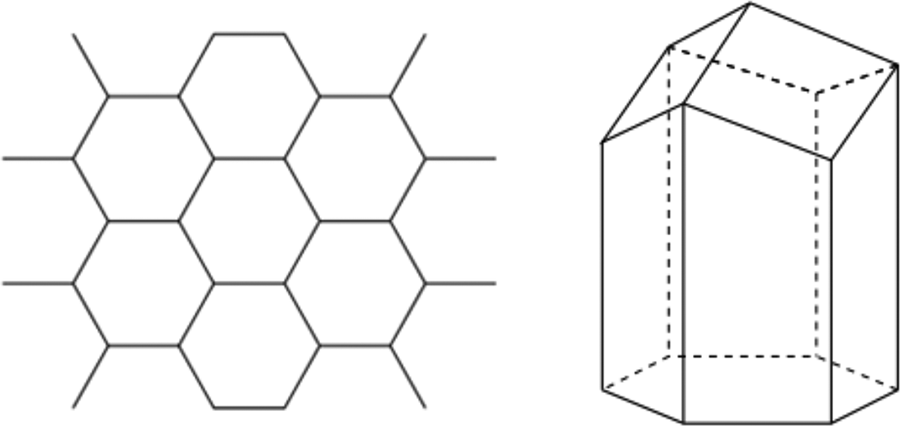
Consider the honeycomb case again. Räz (Reference Räz2013) describes an important property of honeycomb cells thus far neglected in the philosophical literature: only the opening is hexagonal (see fig. 2).
Left, Two-dimensional grid of hexagonal openings; right, what Räz claims is the three-dimensional structure of a whole honeycomb cell. The closed end is composed of three rhombi. From Räz (Reference Räz2013).

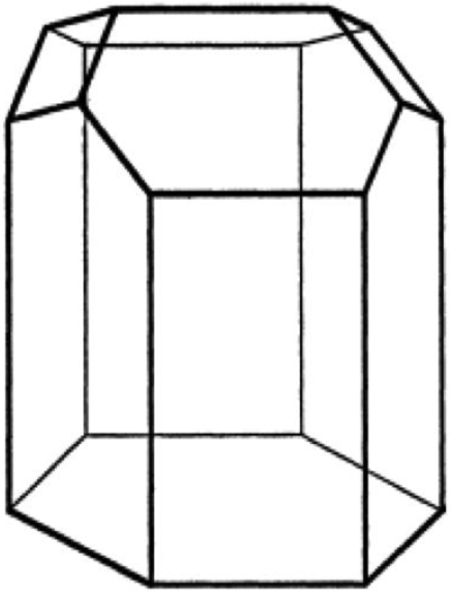
The optimality at issue in HC is also two-dimensional. The theorem therefore supplies only part of what is needed to establish that the honeycomb structure is mathematically optimal. A complete account of the optimal structure must be three-dimensional, given in terms of surface area relative to volume, rather than perimeter relative to area. The key question is whether hexagonal openings are mathematically optimal for the three-dimensional structure. Tóth (Reference Tóth1964) proved the answer is yes: honeycomb cells with the shape in figure 3—not the shape in figure 2—are three-dimensionally optimal in the relevant sense.
Mathematically optimal three-dimensional honeycomb cells have a closed end made of two hexagons and two rhombi. From Tóth (Reference Tóth1964).

Notice how the closed end differs from the proposed actual structure portrayed in the right image of figure 2. This distinction, however, makes little difference to optimality. The optimal honeycomb shape only minimizes the surface area–volume ratio by an additional 0.34%. Although very small fitness differences can drive evolution, the optimal shape is much more complicated to construct. It is therefore implausible that the miniscule efficiency gain exceeds the probable fitness drag of the greater geometric complexity.
Despite these worries, the opening is still a hexagon. That this two-dimensional shape persists across different three-dimensional structures seems to cry out for mathematical explanation. Mathematics explains why the cell structure in figure 3 optimizes the surface area–volume ratio. And given its structural similarity with the claimed actual three-dimensional configuration (see fig. 2)—especially their effectively identical surface area to volume efficiency—surely the mathematics in large part also explains the approximately optimal actual honeycomb structure. It seems utterly implausible that mathematics accounts for the optimality in figure 3 (with deductive certainty) but would say nothing about the nearly isomorphic structure in figure 2.
There are, however, serious difficulties with this story, particularly its bearing on the enhanced indispensability argument. Contrary to what Tóth (Reference Tóth1964), Räz (Reference Räz2013), and many others have assumed, the three-dimensional structure of honeycombs depicted in figure 2 is not entirely accurate and fails to deliver what the enhanced indispensability argument requires. Initially, the closed end of the cell is a rhombic dodecahedron. But that structure is just a by-product of the wax-flow hypothesis, which is at odds with Baker and Colyvan’s idea that the bees are themselves constructing the optimal structure because it is selectively advantageous.Footnote 8 As frequently occurs throughout the biological world, what appears to be a fitness maximizing product of natural selection is actually not an adaptation but rather a “spandrel” about which selection was silent (Gould and Lewontin Reference Gould and Lewontin1979). Moreover, the three-dimensional rhombic-dodecahedron structure does not last (Hepburn et al. Reference Hepburn, Pirk and Duangphakdee2014). As a bee colony uses a honeycomb, individual cell bases are transformed into simple hemispheres by the bees’ activity. Not only do optimality considerations such as HC not “explain … why bees use hexagonal cells in their honeycombs” (Baker Reference Baker2009, 624) given the wax-flow hypothesis, the entire three-dimensional structure is transitory. One would think an optimal structure built to realize a significant selective advantage would have more staying power.
5. The Cicadas Revisited
Despite the problems with Baker and Colyvan’s arguments described above, we believe a different kind of explanatory argument avoids these criticisms. Recall the relevant (advantageous) A-question concerning the cicadas: Why are prime periods advantageous? Given the properties primes possess, a plausible answer is that prime life cycles minimize encounters with predators. Problems only arise when this A-question answer is taken to supply strong grounds for the relevant (existential) E-question: Why do the prime life cycles exist? So, the fix is simple. Reject the assumption that a trait being adaptive entails there was selection for it, and focus explanatory efforts on the relevant A-questions.
Furthermore, this simple fix does not preclude the possibility that mathematics can do indispensable explanatory work for biological A-questions. Take the cicadas. The evolutionarily salient property is that different life cycle periods (putatively) face different degrees of predation pressure. If the ecologically and physiologically feasible life cycle range for periodical cicada species is 2–24 years (Borror, De Long, and Triplehorn Reference Borror, Long and Triplehorn1981), there are number-theoretic facts that bear directly on this evolutionarily salient property. Table 1 captures those facts.
Number-Theoretic Facts

| Number of Divisors | Life Cycle Number |
|---|---|
| 2 | 2, 3, 5, 7, 11, 13, 17, 19, 23 |
| 3 | 4, 9, 22 |
| 4 | 6, 8, 10, 14, 15, 21 |
| 5 | 12, 16 |
| 6 | 18, 20 |
| 7 | … |
| 8 | 24 |
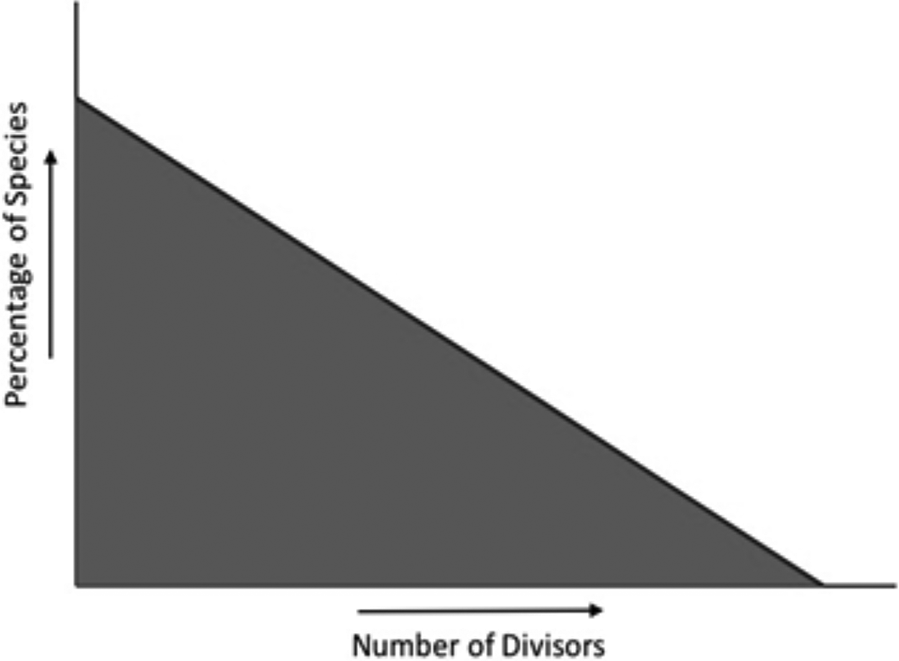
To illustrate how the mathematics bears on (probable) predation pressure, which in turn bears on possible species distributions patterns (see fig. 4), consider the following empirical inference. The number-theoretic facts represented in table 1 suggest a prediction about the distribution of species across life cycle periods. Since minimizing predation pressure is advantageous, if there is selection for this property, a qualitative trend should be expected.
Life cycle distribution. A negative correlation is expected between a possible life cycle’s number of divisors and the proportion of extant periodical species with that life cycle period.

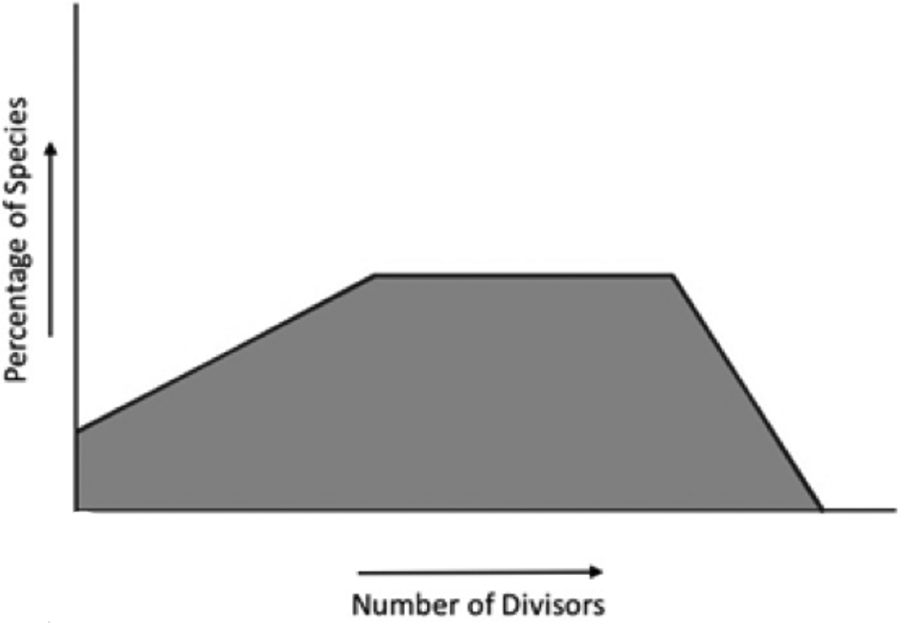
This trend is based on a hypothesized negative correlation between a possible life cycle’s number of divisors and the proportion of extant periodical species with that life cycle period. Assuming predation is sufficiently strong, unlucky species with life cycle periods replete with divisors are likely to be selected out of existence. The primary (and seemingly indispensable) basis for this prediction, and for the explanation of the qualitative trend if it were found, is clearly the relevant number-theoretic facts about primes. But, it should be emphasized that those facts do not necessitate a specific pattern in the physical world. If all periodical insect species were surveyed, obtaining the kind of result in figure 5, which contravenes what the mathematics suggests, is nevertheless possible. Finding this unexpected pattern would suggest one of two things. Either, quite surprisingly, there is not selection for the minimization of predation pressure, or there is, but stronger selection pressures swamp its effects on most insect populations.
Life cycle distribution. An unexpected relationship between the number of life cycle divisors and the proportion of extant species.

The way in which mathematical facts about how many divisors a number has bears on empirical phenomena in this case motivates a modified argument:
1. A positive correlation exists between the number of divisors of a life cycle period and the predation pressure the respective species experiences.Footnote 9
2. Prime numbers have the fewest divisors possible.
∴ Species life cycles cannot minimize predation pressure more than prime life cycles.
This kind of argument seems to show that properties of primes are an indispensable part of what explains some empirical phenomena about periodical organisms, specifically the pattern described above. But the argument is not committed to the problematic claim that what is evolutionary adaptive must be selected for.
6. Conclusion
This analysis uncovers a potential difficulty for some explanatory indispensability arguments. Recall that if an indispensability argument is intended as an IBE, the goal is establishing that mathematical entities are explanatorily indispensable just as (empirical) theoretical entities are claimed to be. But the distinction between A- and E-questions reveals a disanalogy between mathematical and theoretical entities and consequently that not all IBEs are created equal. The IBE basis for scientific realism about theoretical entities such as electrons and black holes does not necessarily extend to mathematical entities such as numbers and functions. Only when the entities in question are doing existential explanatory work (i.e., answering E-questions) can ontological inferences be made. Thus, unless mathematical entities are indispensable for answering E-questions, the enhanced indispensability argument fails. Whether mathematical entities can serve this function remains an open question. Our analysis shows that explanations of what is adaptive—such as the fitness edge of prime life cycles—are answers to A-questions, not E-questions, and therefore not applicable to the enhanced indispensability argument.
Apart from Baker and Colyvan’s arguments, the positive case described in section 5 has implications for other accounts of the nature of mathematical explanation. Lange (Reference Lange2013) argues that mathematical explanations in science work by “revealing that the explanandum is more necessary than ordinary causal laws are” (491). For example, a mother attempting to evenly distribute 23 strawberries among three children will inevitably fail because the fact that 3 does not evenly divide 23 perfectly constrains what is causally possible. The argument presented at the end of section 5 satisfies this strong criterion. The conclusion—species life cycles cannot minimize predation pressure more than prime life cycles—is maximally causally restrictive. Notice that Lange’s criterion entails that anything less than such a maximal restriction cannot be a distinctively mathematical scientific explanation. But the indispensable role mathematics plays in predicting a species distribution pattern across life cycles, and explaining that pattern assuming it were found, suggests Lange’s criterion is much too strong. In this case, the mathematics does not necessitate that the pattern must be realized in the physical world, so its distinctively explanatory status on Lange’s account is void. That conclusion seems to disregard the essential explanatory contribution the mathematics makes.
Finally, it is worth stressing that our analysis does not assume or necessarily favor nominalism. Baker (Reference Baker2016) recently responded to nominalist objections to the enhanced indispensability argument by strengthening the mathematical optimization results in the original cicada example to bolster the Platonist position.Footnote 10 Baker claims the mathematically more robust explanation requires less concrete ontological commitments than existing nominalist explanations, thereby making the Platonistic explanation more parsimonious. Whether this poses a genuine problem for nominalism has no bearing on the criticisms presented here. But the criticisms presented here do seem to directly bear on the optimality inference at the heart of Baker’s new argument.